
 Published on and written by Cyril Jarnias
Settling or working abroad is already a challenge in itself. In Tuvalu, a tiny archipelago lost in the heart of the Pacific, the issue of access to healthcare becomes central as soon as you start preparing your expatriation project. The country covers only 26 km², its medical system is entirely public, technical resources are limited, and any serious health problem almost automatically requires a medical evacuation to Fiji, New Zealand, or Australia. For an expatriate, fully understanding this context is the number one condition for living there without exposing yourself to unreasonable risks.
The Tuvaluan healthcare system includes Princess Margaret Hospital as its key facility, limited care on the outer islands, mental health and dental services, as well as vaccinations. For any foreigner residing in Tuvalu, international health insurance and medical evacuation coverage are absolutely essential.
A public, universal… but very limited healthcare system
Tuvalu stands out for a completely state-run healthcare system. There is no private sector: no private clinics, no individual practices, no for-profit hospitals. All facilities – hospital, health centers, dispensaries – belong to the state, and nearly 99% of health funding comes directly from the government.
For Tuvaluan citizens, the country offers universal coverage: primary care, prevention, hospitalizations, and most medications are free at the point of use. There is no “European-style” general practitioner system: anyone can go directly to the hospital or a health center for a consultation.
The cost of an air evacuation for an expatriate can easily exceed 100,000 USD.
Adequate capacity for basic care
Considering its size (about 11,000 inhabitants), Tuvalu has a relatively dense primary care network. The capital Funafuti concentrates the national hospital and several health centers, while each of the eight outer islands has at least one basic medical facility. These units handle common illnesses, some simple emergencies, maternal and child health, vaccination, and a significant part of health education.
Diagnostic equipment is rudimentary, the national pharmacy has a limited range of medications, no CT scan or MRI is available, and medical and surgical specialties are almost nonexistent, relying on general practitioners trained abroad or temporary international missions.
For an expatriate with a complex chronic condition, cancer, advanced heart disease, or needing sophisticated tests, Tuvalu can at best offer minimal follow-up while awaiting transfer to a neighboring country.
Princess Margaret Hospital: the heart of the healthcare system
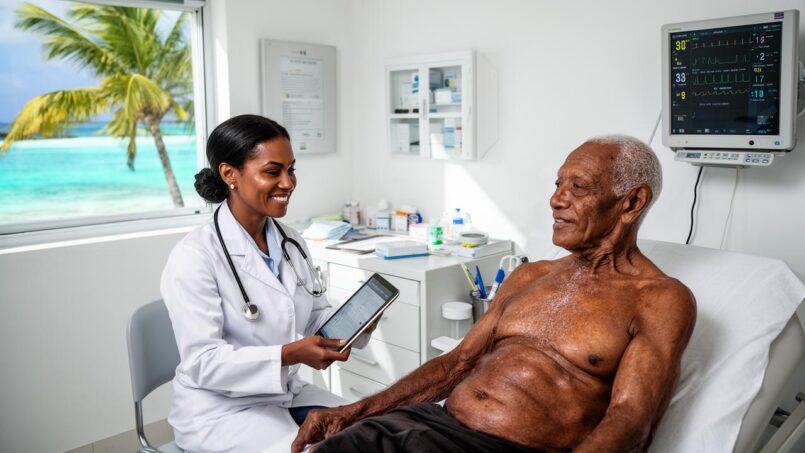
At the center of this system is Princess Margaret Hospital (PMH), located on Funafuti atoll. It is the only hospital in the country, the only facility with inpatient beds, surgical capacity, and proper emergency services. It is also the referral hospital for all outer islands.
Capacity and available services
PMH has between 36 and 50 beds depending on the source and period, divided into separate wards for men, women, and infants. The hospital offers:
– Outpatient general medicine consultations;
– An emergency department for trauma and acute conditions;
– A small surgical unit capable of performing so-called “minor” procedures (simple appendicitis, hernias, superficial wounds, etc.);
– An obstetrics and gynecology unit for deliveries and some simple gynecological procedures;
– A basic laboratory for some common tests;
– A rudimentary radiology department (standard X-rays);
– A modest intensive care unit;
– A hospital pharmacy providing essential medications.
The hospital coordinates campaigns against non-communicable diseases (diabetes, hypertension) and in connection with the health impacts of climate change (diarrheal diseases, respiratory infections, vector-borne diseases). It also houses mental health, ophthalmology, dentistry, and maternity units.
What PMH cannot do
However, PMH lacks the means to manage serious or specialized conditions that, in a larger country, would be considered “routine” at a regional hospital. No cardiac surgery, no neurosurgery, no advanced resuscitation, no modern oncology, no transplantation, no advanced imaging, no complex endoscopy.
In practice, this means that most severe cases – major trauma, complicated heart attacks, advanced cancers, serious neurological conditions, end-stage renal failure, etc. – require an evacuation to Fiji, New Zealand, Australia, or even Guam or Hawaii depending on needs and existing agreements.
For an expatriate, the rule is simple: PMH can stabilize, provide basic diagnosis, and sometimes treat an acute episode, but any condition beyond enhanced general medicine will need to be followed up abroad.
International support and a shortage of staff
The hospital operates with a limited local workforce, especially in nursing. There are about 40 nursing staff members for the entire country, with only a few qualified nurses assigned to PMH. On the outer islands, a typical health center may have one registered nurse, one or two nursing assistants, and sometimes a community health worker.
During crisis periods – COVID-19 outbreaks, typhoid or flu flare-ups – Tuvalu had to call on international reinforcements, notably through the Pacific Community and funding from the Australian Department of Foreign Affairs. Fijian nurses were thus brought in to strengthen teams, illustrating the structural fragility of human resources.
Tuvalu
On the medical side, PMH long benefited from the support of expatriate doctors (Philippines, China, Germany, Russia, Myanmar), often funded by United Nations programs. Even today, many Tuvaluan doctors have been trained abroad (Fiji, New Zealand, Australia, Cuba) and rely on telemedicine to discuss complex cases with regional specialists.
For an expatriate, this means the possibility of interacting with English-speaking doctors trained in more developed hospital systems, but working with very limited resources.
Health centers and clinics on the outer islands
Beyond Funafuti, each of the other inhabited islands has a health center. These facilities, sometimes called “Community Health Centers,” play an essential role for local populations but can only offer a basic level of care.
The health centers on the islands of Nanumea, Niutao, Nui, Nukufetau, Nukulaelae, Nanumaga, or Vaitupu generally have a few beds (3 to 10 at most), a nurse in charge, one or two assistants, and very modest supplies of medications and equipment. They provide:
Presentation of the five main areas covered by primary care medicine
Comprehensive and continuous patient management for any common health problem.
Monitoring of communicable diseases and administration of vaccines according to the schedule.
Treatment of injuries or conditions that do not require immediate hospitalization.
Medical monitoring of pregnant women and young children up to school age.
Management of minor injuries such as sprains, simple fractures, or superficial wounds.
In case of a serious emergency (severe accident, suspected stroke, serious obstetric complication, sepsis, etc.), the center primarily plays a stabilization role while awaiting transfer to Funafuti. Depending on weather conditions and available means, this transfer may be by boat, and then eventually by plane for international evacuation.
For an expatriate assigned to an outer island – for example, in a development project, humanitarian mission, or administrative post – it is crucial to factor in this delay and logistical fragility when assessing risks. An accident on a remote island does not allow for the same “golden hour” of care as in Europe or North America.
Emergencies, important numbers, and the reality of rescue services
On paper, Tuvalu has an emergency alert system. Several numbers exist:
| Type of service | Number to dial |
|---|---|
| Police | 911 |
| Ambulance | 999 |
| Fire | 000 |
| Hospital (Funafuti – PMH) | (+688) 20749 / 20765 |
In practice, especially on Funafuti, it is often quicker to get to the hospital by your own means (car, motorcycle, pickup truck) than to wait for an ambulance that is rarely well-equipped and not always available. Rescue vehicles lack the advanced equipment you would expect in an industrialized country: little to no monitoring, no sophisticated defibrillators, no heavy paramedical equipment.
On the outer islands, there is generally no ambulance in the Western sense. Transfers are done by utility vehicle when possible, or directly by boat to reach Funafuti or an air evacuation point.
For an expatriate, the classic concept of a “SAMU” or “911 with advanced medical care” therefore bears little resemblance to the Tuvaluan reality. Here again, anticipation and prevention – for example, avoiding risky activities without nearby rescue resources – become essential levers of personal safety.
Main health risks for expatriates in Tuvalu
Tuvalu’s health profile reflects both its geographic isolation, its climate vulnerability, and the epidemiological transition occurring in many small island states.
Among the most common threats, we find:
– Diarrheal diseases linked to contaminated water and food (acute diarrhea, typhoid, hepatitis A and E);
– Respiratory infections (flu, viral infections, lung diseases related to overcrowding and housing conditions);
– Vector-borne diseases (dengue, lymphatic filariasis), favored by heat and stagnant water;
– Non-communicable diseases (diabetes, hypertension, obesity, cardiovascular diseases);
– Skin conditions (abscesses, wound infections, fungal infections) often worsened by the hot, humid climate, seawater, and hygiene challenges;
– Heat-related issues (heat stroke, dehydration, exhaustion), with the frequency of heat waves expected to increase due to climate change.
For an expatriate, most of these risks can be reduced by common-sense measures: scrupulous hygiene, consumption of treated or bottled water, mosquito protection, appropriate vaccination, pre-departure medical consultation, a robust personal first-aid kit, etc. But some risks – especially those linked to extreme weather events (cyclones, flooding, water shortages) – are largely beyond individual control and require familiarizing yourself with local emergency plans and safety instructions.
Dental care: a major weak point
Dental care is one of the weakest links in Tuvalu’s healthcare system, both for locals and expatriates. Services are mainly provided at Princess Margaret Hospital, in a very basic dental unit. They mainly perform:
– Screening consultations;
– Extractions;
– Some simple restorative care (fillings);
– Minor oral surgery procedures.
The availability of prosthetics, orthodontics, implantology, or cosmetic dentistry is virtually nonexistent. Material resources are limited, consumables can run out, and there is no network of private practices to diversify the offer.
Public health data reveal a high prevalence of periodontal disease in the local population, leading to significant tooth loss as early as the forties and treatment needs starting in childhood. To address this, WHO recommends teledentistry to overcome geographic isolation and the training of professionals specialized in periodontics adapted to limited resources.
For an expatriate, the implication is clear: anything involving non-urgent dental care should be planned outside of Tuvalu, before departure or during regular stays in better-equipped countries (Australia, New Zealand, Fiji). A check-up and complete dental exam before settling in Tuvalu are strongly recommended, as is an international insurance policy that includes a dental component to cover care received abroad.
Basic comparison: local vs. overseas dental care
| Aspect | In Tuvalu (PMH) | Abroad (Fiji / Australia / NZ) |
|---|---|---|
| Types of procedures | Extractions, simple treatments | Full range (implants, prosthetics, orthodontics…) |
| Quality of equipment | Very basic | Modern, international standards |
| Availability | Limited, no choice of practitioner | Broad, with possible selection of practitioner |
| Language | English, Tuvaluan | English, sometimes other languages |
| Cost | Low but limited offering | Higher, but more choice and quality |
| Need for insurance | Strong for care outside Tuvalu | Essential to reduce out-of-pocket costs |
Mental health: a still-taboo but evolving topic
Tuvalu has a specific legal framework for mental health, the “Mental Treatment Act”, which defines the concept of a “person of unsound mind”, admission procedures to psychiatric units, and the roles of magistrates, the minister, and a visiting committee. The mental health unit is integrated into Princess Margaret Hospital, with a small inpatient capacity and a strong focus on outpatient and community care.
Access to specialized care (psychiatrists, psychologists, nurses) remains limited. Stigma and taboo around suicide persist, driving many Tuvaluans toward traditional or religious remedies. To address this, health authorities, WHO, UNICEF, the Red Cross, and local churches are implementing community-based approaches: psychosocial support, suicide prevention training, and strengthening resilience to climate shocks.
For an expatriate living in such an isolated environment, facing the realities of climate change and sometimes monotonous island life, mental health is not a theoretical issue. Loneliness, distance from family, work pressure, and climate anxiety can weigh heavily. Yet the availability of specialized psychotherapy on site is virtually nonexistent.
In practice, expatriates mainly rely on: local networks, online resources, and advice from other expats.
– Telemedicine and telepsychology through their international insurance (24/7 access to psychologists or psychiatrists, mental coaching programs, etc.);
– Informal support networks: colleagues, other expats, religious communities;
– Regular trips abroad to see specialists in person if needed.
Before a long-term departure, it is prudent to check that your insurance contract covers mental health (consultations, possibly psychiatric hospitalizations, online support programs).
Vaccination and prevention: a pillar of preparation
No vaccinations are required to enter Tuvalu: no yellow fever certificate, no formally mandatory schedule. But this observation is misleading: from a medical standpoint, traveling or expatriating to Tuvalu requires a very up-to-date vaccination status.
The main reference organizations (CDC, WHO, British and Swiss authorities, etc.) notably recommend:
Update of routine vaccines: DTaP, polio, MMR, varicella. Recommended vaccinations: hepatitis A, hepatitis B, typhoid (for extended stays or rustic conditions), seasonal flu (for at-risk individuals), and COVID-19. Specialized vaccines (pneumococcal, meningococcal, BCG) depending on age, risks, and duration.
For an expatriate, a pre-travel consultation with a travel medicine specialist is essential. The goal is not just to “check boxes” on vaccines, but to review:
Plan for regular treatments and supplies, anticipate specific risks (diving, water sports, construction work, medical post), and put together a self-contained emergency kit with antibiotics, anti-diarrheals, pain relievers, bandages, antiseptics, wound care materials, and oral rehydration salts.
International health insurance: the vital tool for expatriates in Tuvalu
Given the structural limitations of Tuvalu’s healthcare system, international health insurance is not a luxury or a vague recommendation. It is absolutely vital. Without it, an expatriate – even in good health – faces considerable financial and health risks.
Why a simple travel insurance policy is not enough
Standard travel insurance often covers emergency care abroad for a limited period, sometimes a few months, with relatively low reimbursement caps. In Tuvalu, several factors change the equation:
– The near certainty that any serious problem will require an evacuation by medical aircraft to Fiji, New Zealand, or Australia, for amounts that can exceed 100,000 USD;
– The infrequency of flights (usually twice a week), which can delay an evacuation and prolong the duration of local care;
– The fact that some foreign hospitals may require a large financial deposit before accepting an evacuated patient;
– The absence of a local private sector, making some insurance models unsuitable (no “network” in Tuvalu).
A robust international insurance policy is necessary for expatriates living in areas with weak medical infrastructure, with priority coverage for evacuation and care abroad.
Essential coverages
For an expatriate in Tuvalu, a good contract must include: a competitive salary, comprehensive health coverage, housing allowances, family-related benefits, and coverage of travel expenses.
– Solid hospitalization coverage, with annual limits of at least several hundred thousand euros or dollars, or even unlimited;
– Full coverage of medical evacuation, including repatriation to the home country if necessary;
– The ability to be evacuated to Fiji, New Zealand, or Australia, with explicit mention of such destinations;
– A 24/7 assistance service capable of organizing evacuation logistics, booking medical flights, and coordinating with destination hospitals;
– A “direct billing” system, allowing facilities to bill the insurer directly (crucial in case of costly hospitalization);
– Useful options for extended stays: outpatient consultations, medications, imaging, maternity, dental care, vision care, etc., usable especially during stays in Australia, New Zealand, or the home country.
Several major international insurers are regularly cited as suitable for expatriates in Tuvalu. The annual limit data illustrates the scope of available coverage:
| Insurer / Plan | Approximate annual limit |
|---|---|
| April – Emergency Plan | 250,000 € |
| April – Basic Formula | 500,000 € |
| April – Essential | 1,000,000 € |
| April – Comfort | Unlimited |
| April – Premium | Unlimited |
| AXA – Foundation | 160,000 $ |
| AXA – Standard | 1,600,000 $ |
| AXA – Comprehensive | 2,400,000 $ |
| AXA – Prestige | 3,200,000 $ |
| AXA – Prestige Plus | 8,000,000 $ |
| Cigna – Silver | 1,000,000 USD |
| Cigna – Gold | 2,000,000 USD |
| Cigna – Platinum | Unlimited |
| GeoBlue – Xplorer (US expats) | Unlimited worldwide benefits |
The common recommendation for such an isolated destination is to aim for at least 100,000 USD in emergency coverage, and rather 250,000 USD or more for medical evacuation. In practice, most serious expatriate plans far exceed these thresholds.
Medical evacuation: the true lifeline
Most official recommendations stress one point: in Tuvalu, any serious illness or major injury requires transport to a more advanced facility, usually in Suva (Fiji), sometimes in Auckland or Sydney. Insurance providers therefore systematically include a “medical evacuation” guarantee in their expat plans.
This guarantee typically covers:
– The cost of the medical flight (air ambulance or charter);
– The possible presence of a doctor or nurse accompanying the patient;
– The return of the patient once stabilized;
– In some cases, transportation of a family member.
For expatriates, it is important to check the details: Does the coverage include incidents on the outer islands? Evacuations in case of cyclone? Transfers to a country of your choice or only to hospitals designated by the insurer? Are deductibles reasonable? Are pre-existing conditions covered, fully, with a surcharge, or excluded?
Telemedicine and tele-expertise: valuable support in a remote archipelago
Tuvalu’s geographic isolation makes it an ideal environment for telemedicine. The country has established a digital link between Funafuti hospital and dispensaries on the outer islands, using satellite connections and common applications (WhatsApp, Viber, Zoom). Island nurses can send images, discuss cases via video with PMH doctors, and receive assistance with diagnosis or transfer decisions.
Access to telemedicine services through international insurance
Access to general practitioners and specialists via video conference, often included in international insurance contracts.
Mobile apps or medical monitoring platforms offered by insurance companies for personalized support.
– 24/7 online medical consultations with general practitioners or specialists;
– Wellbeing and mental health coaching programs;
– Second medical opinions on complex cases;
– Teleconsultation management for common issues (minor infections, renewable prescriptions, interpretation of results, etc.);
Using these services obviously does not replace a physical exam when necessary, but helps triage situations, avoid unnecessary trips, and obtain expert advice when local skills are exceeded.
Preparing for your expatriation: health checklist
Living in Tuvalu is neither impossible nor unreasonable, but requires meticulous preparation. Before departure, a future expatriate should at a minimum:
Get a full health check-up including a dental exam and resolve any planned issues. Update your vaccinations according to a travel medicine center. Build a several-month supply of medications, anticipating supply difficulties, and keep prescriptions. Take out international health insurance covering hospitalization, routine care, and medical evacuation, ensuring it includes Tuvalu and neighboring countries. Check your employer’s evacuation plans and coverage for family members. Prepare a comprehensive first-aid kit for injuries, infections, and tropical trauma. Finally, note down emergency numbers and contact details for Princess Margaret Hospital and local health centers.
Once on site, a few habits make a difference: drink only safe water (bottled or boiled), systematically protect yourself from mosquitoes, be wary of raw or undercooked food, respect the sun and heat, regularly check your skin and any wounds, avoid risky behaviors (alcohol, night driving, careless swimming).
Conclusion: living in Tuvalu with lucidity and anticipation
Healthcare for expatriates in Tuvalu is both accessible and extremely precarious. Accessible, because the archipelago has a central hospital and a network of health centers capable of handling most minor ailments and some common emergencies. Precarious, because the slightest condition beyond that requires a long, costly evacuation, dependent on weather, aircraft availability, and the strength of your insurance coverage.
Living in Tuvalu exposes you to a high-risk health environment. Rigorous preparation is essential: take out suitable international insurance, put together a comprehensive medical kit, have regular check-ups in better-equipped neighboring countries, and exercise daily vigilance to minimize serious surprises.
For an expatriate, health in Tuvalu is not a secondary issue to be dealt with at the last minute, but the cornerstone of any life project on these fragile atolls. Anticipate, inform yourself, and get properly insured: this trio makes the difference between a controlled experience and a potentially perilous adventure.
A wealth planning project or a question? Contact us now to speak with a wealth management expert.
Disclaimer: The information provided on this website is for informational purposes only and does not constitute financial, legal, or professional advice. We encourage you to consult qualified experts before making any investment, real estate, or expatriation decisions. Although we strive to maintain up-to-date and accurate information, we do not guarantee the completeness, accuracy, or timeliness of the proposed content. As investment and expatriation involve risks, we disclaim any liability for potential losses or damages arising from the use of this site. Your use of this site confirms your acceptance of these terms and your understanding of the associated risks.

Cyril Jarnias is an independent expert in international wealth management with over 20 years of experience. As an expatriate himself, he is dedicated to helping individuals and business leaders build, protect, and pass on their wealth with complete peace of mind.
On his website, cyriljarnias.com, he shares his expertise on international real estate, offshore company formation, and expatriation.
Thanks to his expertise, he offers sound advice to optimize his clients' wealth management. Cyril Jarnias is also recognized for his appearances in many prestigious media outlets such as BFM Business, les Français de l’étranger, Le Figaro, Les Echos, and Mieux vivre votre argent, where he shares his knowledge and know-how in wealth management.





