
 Published on and written by Cyril Jarnias
Moving to Tuvalu has nothing to do with a typical relocation to London, Dubai, or Singapore. No skyline, no crowded subway, no business districts lined with glass towers. Tuvalu, a tiny Pacific island nation, has barely 10,000 residents, a capital built on a ribbon of land, and an expat community that is microscopic yet surprisingly cosmopolitan.
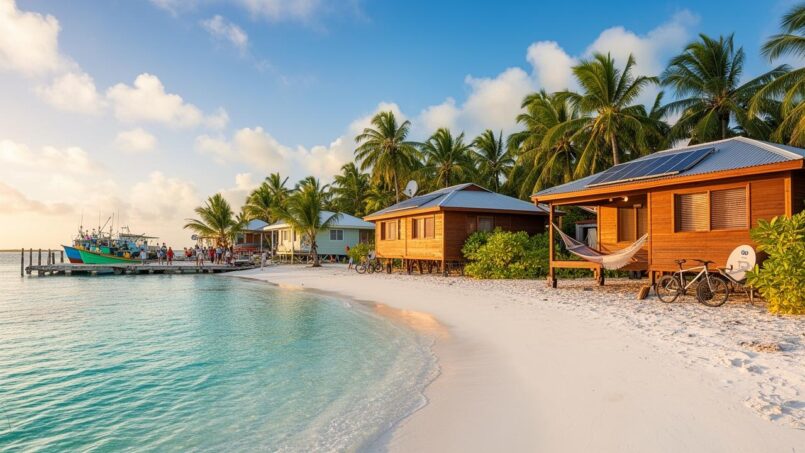
In Tuvalu, expat life is mainly concentrated on the atoll of Funafuti, specifically in the village of Vaiaku, where you’ll find government offices, shops, accommodations, and social hubs. Homes are lined up along the airstrip, with a handful of stores and direct access to the turquoise lagoon and the Pacific Ocean.
Funafuti and Vaiaku: The Heart of Expat Life
Funafuti is both the capital and the main entry point to the country. The atoll forms a narrow oval surrounding a massive lagoon, Te Namo. Funafuti’s population hovers around 6,000, roughly 60% of Tuvalu’s total population. For an expat, almost everything happens here.
Within this already tiny area, one neighborhood clearly stands out: Vaiaku. Located on the main islet of Fongafale, it is the administrative center and nerve center for the foreign community. Available data explicitly cites it as “the best neighborhood for expats to stay in,” and it’s where you’ll find most of the infrastructure that non-Tuvaluans rely on: hotels, banks, a few restaurants, workspaces, and public services.
In Vaiaku, Tuvalu’s only real town, you’ll find the country’s sole hotel (the Funafuti Lagoon Hotel, also called Vaiaku Lagi Hotel), government offices, the main church, cafes, and shops. Located near the airport, the airstrip cuts through town and doubles as a sports field, promenade, and public square between flights, perfectly capturing local neighborhood life.
Why Vaiaku Attracts Expats
If Vaiaku is considered the go-to neighborhood for expats, it’s primarily because it offers what the rest of the country cannot: a rare combination of connectivity, basic services, and social network.
The key strengths behind this appeal are fairly clear:
The local population is very welcoming and tight-knit, making it easy for expats to integrate. Essential services (banks, shops, cafes with Wi-Fi, accommodations, government offices, airport) are concentrated and accessible on foot or by bike around Vaiaku. The cost of living is moderate: an expat spends about $2,000–$2,100 per month, but a simpler lifestyle can drop to $600–$900 excluding rent. Finally, the natural setting is spectacular with the lagoon, white sand beaches, tropical vegetation, corals, turtles, and tropical fish right nearby.
A specialized index, Worksplorer, gives Tuvalu an overall score of 53%, with notably high marks for connectivity (85%) and weather (86%), two crucial aspects for digital nomads or international aid workers. This contrast between the country’s small size and relatively reliable internet attracts a very specific type of expat: those seeking a quiet environment far from big cities, but without being completely cut off from the web.
Around the Airstrip: Funafuti’s “Expat Belt”
When you dig into Funafuti’s very unique geography, you see that the “expat map” literally unfolds along the airstrip. That’s where you’ll find most of the accommodations frequented by foreigners.
Filamona Lodge: The Small Foreign Community’s Living Room
Just to the left of the airport terminal, airstrip side, is Filamona Lodge. On paper, it’s an unassuming guesthouse. In practice, it’s a landmark for most expats passing through or on assignment.
The available data is clear: Filamona Lodge is described as the preferred gathering spot for Tuvalu’s small expat community. You’ll find NGO employees, aid workers, humanitarian staff, and expats from Australia, New Zealand, or other Pacific states, as well as Westerners on technical missions. The list of nationalities on the dedicated expat platform is striking: Afghans, French, Canadians, Moroccans, Spaniards, Americans, Bangladeshis, Cameroonians, Kuwaitis, and more – a mosaic of over 150 different origins, though in practice very few live permanently on the island.
The atmosphere at Filamona Lodge is said to be “livelier than anywhere else in town”—provided there are expats in Tuvalu at the same time. This guesthouse serves as a neighborhood bar, restaurant, and common room for a community that would otherwise be extremely scattered.
Filamona Lodge
You’ll find there: information, resources, and tools needed for getting by.
– A restaurant, often cited as offering “the best food in the country” despite a limited menu focused on grilled tuna with onions and rice.
– A terrace where people drink Philippine San Miguel beer (Light, Pale Pilsen, or Red Horse, very popular with sailors)—sometimes a bit too warm for some tastes.
– An “informal club” atmosphere: foreigners share housing tips, contacts for organizing lagoon trips, and practical information about life in Tuvalu.
For many transient expats, staying or at least hanging out at Filamona means entering the “little global village” in the middle of the atoll.
Esfam, L’s, Vailutai, Militano: The Discreet Addresses That Matter
Still within this strip along the airstrip, other addresses keep popping up in the experiences of expats and long-term travelers.
A selection of lodges on the atoll, with their highlights and practical tips
To the right of the airport. A homestay with no bar or restaurant, but a small shop. Owners are very helpful for arranging tours to the Funafuti Conservation Area or renting motorbikes. Closed on Sundays (rest and worship).
Quiet, at the eastern end of the airstrip. Rooms with shared or private bathroom at reasonable prices. Direct contact by email recommended (more so than booking platforms). Ideal for those seeking peace and quiet.
The cheapest options in Funafuti, more basic. Mostly of interest to tight budgets: young expats, interns, or travelers staying several weeks.
To visualize this micro-expat geography around the airport and Vaiaku, here’s a summary:
| Establishment | Approximate Location | Type of Accommodation | Role for Expats |
|---|---|---|---|
| Funafuti Lagoon Hotel (Vaiaku Lagi) | Lagoon side, ~50 m from airport | Hotel, ~16–20 rooms | Official reference, houses sailors and officials |
| Filamona Lodge | Left of terminal, airstrip side | Lodge with restaurant | Expat community gathering point |
| Esfam Lodge | Right of airport | Homestay, small shop | Practical base for tours and scooter rental |
| L’s | Eastern end of airstrip, quiet area | Simple rooms, shared/private bathroom | Good value option, quiet |
| Vailutai / Militano | Funafuti, budget area | Basic lodges | Budget long-stay solutions |
This “string” of addresses effectively functions as a single extended neighborhood for foreigners, with the airstrip as its main boulevard.
Vaiaku: Services, Promenade, and Daily Life
Let’s zoom back in on Vaiaku, the “number one neighborhood” for expats according to the data. What makes this place so strategic for a foreigner living or working in Tuvalu?
Housing and Cost of Living Around Vaiaku
Housing available in the Vaiaku area and its immediate surroundings falls within a fairly narrow range. For a one-bedroom apartment in Funafuti, the data shows:
– In the center: about $300 to $600 USD per month.
– Outside the center (still on the same islet, but farther from services): $200 to $350 USD.
More detailed estimates mention rents around $275 USD for a small 40 m² in the center, with “cheap” versions just under $200 USD. A three-bedroom house falls more between $500 and $900 USD.
The table below summarizes these ballpark figures:
| Type of Accommodation | Location | Estimated Monthly Rent (USD) |
|---|---|---|
| Studio / 1-bedroom (~40 m²) | Center (Vaiaku) | 275–600 |
| Studio / 1-bedroom “economy” | Center / nearby | 193–300 |
| 1-bedroom | Outside center | 200–350 |
| House / 3-bedroom apartment | Funafuti | 500–900 |
The challenge is not so much the price as the scarcity of listings. Funafuti has very few rental properties actually available, and a significant portion is occupied first by transient sailors, government officials on assignment, or ship crews. Result:
Local hotels and lodges are often full, and bookings via international platforms frequently fail. It’s therefore best to contact accommodations directly by email. Additionally, since most land is community-owned, property purchase by foreigners is very rare, and expats mainly live in long-term rentals or guesthouses.
For a single expat, the cost of living in Funafuti including rent is around $700–$750 USD per month according to some local estimates, but data aggregators for nomads instead cite budgets around $2,000–$2,500 USD per month for Western comfort levels (especially due to the cost of imports and Airbnb-type accommodations). This discrepancy is explained by:
– The gap between a local lifestyle (local produce, simple housing, few outings) and an “expat/nomad” lifestyle (imported goods, air conditioning, tourist accommodation, etc.).
– The very low competition in tourist accommodations: the median price for an Airbnb on Funafuti far exceeds $4,000 USD per month, while a small hotel might cost around $640 USD monthly.
Practical Life: Shops, Bank, Internet
Settled in Vaiaku, an expat also enjoys relatively easy access to essential services.
The National Bank of Tuvalu is reliable and operates in English, simplifying transfers. Grocery shopping is done at JY Ocean PTY Ltd and other small stores, but prices are high. Internet is limited (10 Mbps fixed, 5–7 Mbps mobile), sufficient for emails but not for HD streaming. Coworking is emerging ($99–$150/month); cafes like Lagoon Cafe offer free Wi-Fi.
Transport and Mobility in the Neighborhood
Getting around Funafuti is human-scale. The main “street” of Vaiaku, the airport airstrip, and Fongafale’s second paved road are all traversable on foot or by bicycle.
The fare of about $1 USD per trip on minibuses is the most economical public transport option in the area.
Monthly transport costs for a resident remain very modest: estimated around $30 USD for a single person, and just over $80 USD for a family of four.
Where Expats Really Meet Up: Cafes, Bars, Churches, Maneapa
In a country with neither a shopping mall nor a big nightlife scene, the “neighborhood hangouts” for expats in Funafuti are not necessarily what you’d expect.
Hotel Terraces and Beer Bars: Informal Socializing
The terraces at Filamona Lodge and the Funafuti Lagoon Hotel serve as the real expat village squares. That’s where you’ll find:
– The few foreigners who live in Tuvalu long-term (NGO staff, teachers, technical consultants).
– Sailors on shore leave who heavily frequent the Funafuti Lagoon Hotel.
– Transient officials on missions for governments or international organizations.
The price in USD for a 0.5 L beer at a cafe in Cuba, where imported San Miguel is the only brand available.
Further north along the airstrip, livelier bars like Matagigali Bar or Lucky Set heat up Thursday through Saturday nights, mainly for local youth. Expats go there more occasionally, depending on their tolerance for very loud disco atmospheres.
Next to the town council, Tefota Express serves as a liquor store and features an unusual beer garden, set up between shipping containers. Some expats adopt it as an end-of-day spot.
Local regulations prohibit alcohol sales between 3 PM and 6 PM, which directly impacts drinking habits, including among foreigners.
Church, Maneapa, and Local Culture: Living in a Deeply Community-Oriented Neighborhood
Vaiaku is not just an administrative base. It is also the cultural and spiritual center of Funafuti, dominated by the large church of Tuvalu and the maneapa, the big community hall.
Expats who settle in for more than a few weeks often end up being invited to:
– Church services, at the heart of social life.
– Traditional dance evenings in the maneapa.
– “Tuvaluan feast nights”: communal meals mixing fish, taro, breadfruit, and coconut milk preparations.
These places give the neighborhood a profoundly communal character, which many foreigners cite as a major reason for their attachment to Funafuti despite the difficulties (isolation, slow internet, very humid climate).
Funafala and the Nearby Islets: The Other Side of Expat Life
While Vaiaku remains the most practical base, some expats—especially those committed long-term or seeking a lifestyle very close to local communities—turn to more remote islets like Funafala.
Funafala is about fifteen kilometers from Funafuti, accessible only by boat. The islet:
– Has a handful of households (about ten families recorded at one point).
– Has neither school, nor store, nor public ferry service.
– Experiences, like the rest of the atoll, coastal erosion, extreme heat, and sea level rise.
Despite a perfect awareness of climate risks, the residents of Funafala refuse to leave their island. The number of households there is even increasing, driven by cultural preservation, the search for a healthier environment, and a voluntary re-rooting.
For an expat, living on Funafala is an extremely committed project:
– Complex logistics (you need to coordinate with the Funafuti town council for boats, obtain land permissions, organize supplies).
– Limited access to health services and education.
– Requires very deep integration into the community fabric.
This type of settlement remains marginal, but it exists. A few foreigners, often heavily involved in community or environmental projects, choose to live on these islets to fully share the daily life of local families.
Who Are the Expats of Tuvalu… and Where Do They Live?
The platform that gathers expats interested in Tuvalu offers a fascinating glimpse into the diversity of profiles, even if many never go beyond the planning stage:
– A Canadian student in tourism and hospitality looking for information about the country.
– A Cameroonian physics teacher employed by his ministry, curious about Tuvalu.
– Experienced professionals, like a Filipino civil engineer with 36 years of career or an American inventor and music teacher.
– People looking to leave Europe, Latin America, Africa, South Asia, and the Middle East, drawn by the idea of living in a place described as a refuge from global conflicts.
Among the users already on the ground:
– American, New Zealander, Kuwaiti, Bangladeshi, Spanish, English expats, etc.
– Some Tuvaluans themselves living on Funafuti, like milikini.teagai, who mentions being married with ten children there.
– Tuvaluans living abroad (New Caledonia, Madagascar, etc.), interested in a possible return.
In practice, most expats actually living in Tuvalu concentrate on Funafuti, often between Vaiaku and the area near the airstrip. The country’s other islands are much more rural, with few or no services, and only rarely host long-term foreigners, except for very specific projects (education, health, climate programs).
Tuvalu: A Quiet Paradise… But Not for Everyone
The rankings that assess Tuvalu as a place for foreigners paint a contrasting picture.
Frequent positives:
– Safety: the country is rated “very safe”, with very little crime and roads considered safe.
– Environment: excellent air quality, sparsely populated islands, no heavy industry, stunning landscapes.
– Cost of living: more affordable than many big cities, especially compared to Chicago, where Tuvalu would be about 40% cheaper.
– Community: strong social cohesion, a sense of mutual help, especially in a neighborhood like Vaiaku where everyone knows each other.
But there are also decidedly darker points:
Internet deemed unusable for demanding work, healthcare system with only one major hospital and few specialists, hot and humid climate with constant 29°C and high humidity, safety and inclusion rated as hostile for women, families, and LGBTQ+ individuals, and very limited leisure options with no museums or cinemas.
These factors explain why, despite its beauty and tranquility, Tuvalu attracts only a handful of digital nomads, and almost exclusively expats on structured assignments (NGOs, cooperation, infrastructure projects, climate programs, etc.).
How Much Does Life Really Cost in the Popular Neighborhoods?
To better understand what daily life in Vaiaku and its immediate surroundings costs an expat, we can add up the main expense categories:
| Expense Category | Single Person (USD/month, Funafuti) | Family of 4 (USD/month, Funafuti) |
|---|---|---|
| Rent + utilities | ~351 | ~547 |
| Food | ~264 | ~689 |
| Transport | ~30 | ~82 |
| Miscellaneous (health, leisure, etc.) | 100–300 (variable estimates) | 200–500 |
From aggregated data, some sources give:
– $718/month for a person in Funafuti (including rent), in a more “local” approach.
– $1,669/month for a family of four (including rent), still in Funafuti.
Other databases geared toward digital nomads show significantly higher budgets:
– About $2,094/month for an expat.
– Nearly $2,978/month for a family.
– Up to $2,473/month for a “nomad” including Airbnb-type lodging, coworking, and a more consumer-oriented lifestyle.
In Vaiaku and on the atoll, the cost of living depends enormously on the lifestyle adopted, as the wide gap observed shows.
– An aid worker or volunteer willing to accept simple guesthouse accommodation, eat local dishes, and get around by bike can live relatively comfortably on a budget close to the lower estimates.
– A remote worker wanting an independent, air-conditioned unit, consuming many imported products, and relying on “European-style” internet access should plan for the upper end of the range, especially since Airbnb-type properties are extremely expensive given the space offered.
Vaiaku for Digital Nomads: Asset or Trap?
Funafuti, and particularly Vaiaku, is sometimes presented as an “emerging spot for digital nomads,” at the crossroads of tropical charm and modern connectivity. The reality is more nuanced.
The advantages, for someone working remotely:
– An extremely calm environment, conducive to concentration.
– A small but close-knit community, with limited but real networking opportunities.
– The availability of mobile internet and a few Wi-Fi cafes, as well as a small but growing number of coworking spaces.
– A relaxed atmosphere, a slow pace of life, few distractions.
The downsides:
Internet speeds are low (0.5 to 10 Mbps) with expensive data caps. Dining options are limited, mainly Chinese food or grilled fish, except for a few spots like 3 T’s red snapper or Filamona’s tuna. There is little nightlife and significant geographic isolation: infrequent flights via Fiji Airways and maritime links with no fixed schedules.
For a short period (a few weeks or months), Vaiaku can offer a digital nomad a radically different experience, centered on minimalism, nature, and engaging with a micro-insular community. Over the long term, however, most remote workers are likely to hit the technical and logistical limits of the place.
An Expat Neighborhood Under Climate Pressure
It’s impossible to talk about the neighborhoods most popular with expats in Tuvalu without mentioning the constant pressure from climate change.
Scientific projections are alarming:
– NASA estimates that half of Funafuti atoll could be underwater at high tide by 2050.
– Two of the country’s nine islands are already nearly submerged.
– Cyclone Pam in 2015 displaced about 45% of the national population.
The Vaiaku neighborhood, barely above sea level, resists mass exodus. Thanks to international funding, the Tuvalu Coastal Adaptation Project is carrying out massive landfill and coastal protection works to keep the capital habitable.
For expats, this means that settling in Vaiaku also involves:
– Taking part, directly or indirectly, in an unprecedented experiment of adapting a capital city to climate impacts.
– Living in a place where people openly discuss rising sea levels, potential migration, international treaties like the Falepili Union with Australia, which provides 280 permanent residence visas annually to Tuvaluans in response to the climate threat.
– Observing daily the tension between the desire to stay and the need to consider exit routes.
Conclusion: An “Expat Neighborhood” on an Islet Scale
To the question “what are the most popular neighborhoods for expats in Tuvalu?”, the answer ultimately comes down to very few names:
Vaiaku, the administrative and human center of Funafuti, concentrates accommodations, banks, cafes, the lagoon, government offices, and social life. Around the airport airstrip, a mini hotel zone with Filamona Lodge, Esfam, L’s, Vailutai, or Militano serves as a base camp for transient foreigners. On satellite islets like Funafala, a few highly integrated outsiders share the life of rural communities in villages at the end of the world.
Tuvalu offers neither neighborhood diversity nor major urban contrasts. However, for those who accept its constraints—isolation, stifling heat, finicky internet, minimal service offerings—life along the sandy streets of Vaiaku, under the shade of coconut trees and to the rhythm of the tides, offers something no other capital can: the experience of living at the heart of a micro-insular society, where every expat is immediately noticed, integrated, and invited to find their place in a world on the front line of climate change.
In this setting, the “expat neighborhood” of Tuvalu is not just a location on a map: it’s a tiny community, scattered among a few lodges around an airstrip, a hotel facing the lagoon, and a maneapa where traditional songs still echo. A place as fragile as it is fascinating, whose very existence attracts, each year, a handful of curious souls ready to live anywhere but everywhere else.
A heritage project or a question? Contact us now to speak with a wealth management expert.
Disclaimer: The information provided on this website is for informational purposes only and does not constitute financial, legal, or professional advice. We encourage you to consult qualified experts before making any investment, real estate, or expatriation decisions. Although we strive to maintain up-to-date and accurate information, we do not guarantee the completeness, accuracy, or timeliness of the proposed content. As investment and expatriation involve risks, we disclaim any liability for potential losses or damages arising from the use of this site. Your use of this site confirms your acceptance of these terms and your understanding of the associated risks.

Cyril Jarnias is an independent expert in international wealth management with over 20 years of experience. As an expatriate himself, he is dedicated to helping individuals and business leaders build, protect, and pass on their wealth with complete peace of mind.
On his website, cyriljarnias.com, he shares his expertise on international real estate, offshore company formation, and expatriation.
Thanks to his expertise, he offers sound advice to optimize his clients' wealth management. Cyril Jarnias is also recognized for his appearances in many prestigious media outlets such as BFM Business, les Français de l’étranger, Le Figaro, Les Echos, and Mieux vivre votre argent, where he shares his knowledge and know-how in wealth management.





