
 Published on and written by Cyril Jarnias
Settling in Tuvalu is unlike any other expatriation experience. A micro-island state in the heart of the Pacific, a territory barely above sea level, Tuvalu combines a unique living environment, a tiny but highly codified administration, and an entirely unique climate and geopolitical context. To turn a tourist stay into a real life project, you need to understand a mosaic of rules: visas, residence and work permits, taxation, social protection, healthcare, land ownership, regional mobility…
This article gathers and organizes all the factual information available to provide as comprehensive a guide as possible for those considering living in Tuvalu.
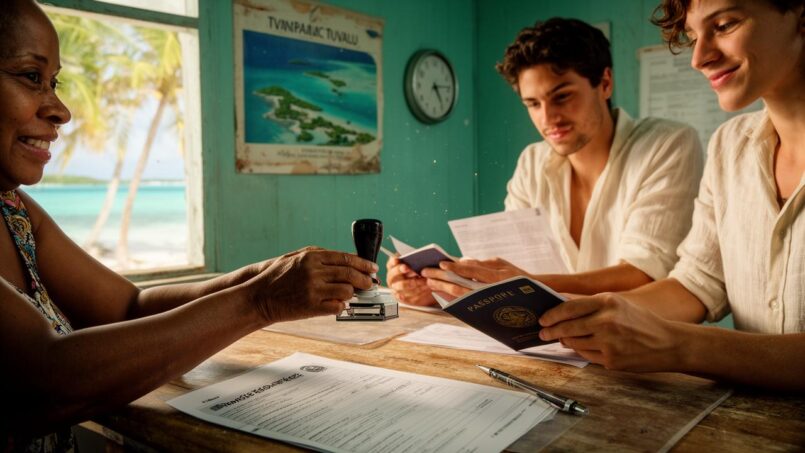
Entering the Territory: Visa, Passport, and Initial Checks
Before discussing residence or employment, you must first be able to cross the border. Tuvalu’s entry system is based on a simple principle: almost everything is done on arrival, but with a valid passport, solid supporting documents, and, for certain statuses, official forms.
For all travelers, a passport valid for at least six months after the date of arrival is mandatory. Without this document, or if the passport is listed as lost or stolen in databases, entry is refused.
Most visitors receive a 30-day visitor permit upon arrival, costing 100 AUD unless exempt. Citizens of the EU (excluding Ireland), Iceland, Liechtenstein, Norway, Switzerland, and Taiwan can stay 90 days out of 180 without formalities.
Regardless of exemptions, the basic logic remains: to receive the entry stamp, you must demonstrate you are a temporary visitor. Authorities systematically require:
– a return or onward ticket,
– proof of sufficient means of subsistence for the duration of the stay,
– proof of accommodation (hotel reservation or attestation),
– a compliant passport.
At the airport or port, each traveler fills out an arrival card (Form 5) and then a departure card (Form 6) upon leaving. These forms feed the migration statistics of a country with barely 10,000 to 11,000 inhabitants.
Visitors can request a 30-day extension from the immigration office in Funafuti, for a fee of 10 to 100 dollars depending on the permit. Up to three months of tourist presence are possible, without working or studying.
Conditions and Limitations of the Visitor Permit
The visitor permit is not a disguised mini-work permit. The regulation is explicit: under this status, it is strictly prohibited to engage in employment, to start or manage a business, to study, or to carry out proselytizing activities. The visitor card may include a clear note such as “Prohibited to Work or Proselytize.”
However, a special case exists: the Principal Immigration Officer may affix a special endorsement authorizing very limited business activity, for a maximum stay of 30 days. This exemption comes with an additional fee of 100 dollars, on top of other charges. It is more aimed at exploratory missions, business meetings, or market studies than at long-term settlement.
Upon expiration of the visitor permit, if no other authorization has been granted, the rule is unambiguous: the national must leave Tuvalu. Immigration closely monitors overstays, which result in fines, temporary re-entry bans, or even prosecution.
Becoming a Resident: The “Permit to Enter and Reside”
To live in Tuvalu for more than just a quarter, you must clear an administrative hurdle: obtain a permit to enter and reside. This document is the core of the long-term residence system. It allows settlement for reasons of work, business, studies, research, religious mission, or other purposes approved by the minister responsible for Immigration.
This permit is initially issued for a maximum duration of one year. It can then be extended, but not indefinitely: the law limits extensions to three renewals within a five-year period, unless a special exemption deemed of “national interest” by the minister is granted.
Obtaining this permit requires a formal application:
– the applicant fills out an official form (Form 3 of the regulatory schedule),
– the form is completed in English or Tuvaluan,
– the signatory is the applicant themselves, or the parent/guardian if under 18,
– the file is submitted to an immigration officer along with all supporting documents.
Here is a summary of documents generally required for this type of permit:
| Required Item | Details |
|---|---|
| Identity document | Valid passport or identity certificate |
| Photos | 2 passport-type photos (head and shoulders) |
| Financial proof | Bank statements, attestations, or resident sponsor form (Form 6) |
| Proof of purpose | Employment contract, offer letter, business plan, invitation letter, etc. |
| Processing fee | Non-refundable fee of 20 dollars for processing |
| Permit fee | 200 dollars for an adult, 100 dollars for a child under 16 |
| Health and police record | Medical certificate, X-ray report, and police reports if residence > 1 year |
The distinction between processing fee and permit fee is important: the 20 dollars for processing the application is due in all cases and is never refunded, even if refused.
Health, Police Clearance, and Personal Conditions
For a stay of less than twelve months, Tuvalu generally does not require a heavy medical examination. Beyond one year, requirements tighten: medical form (Form 7), X-ray (Form 8), and police report for each country where the applicant has lived for more than one year in the last five years.
Authorities only grant a residence permit to persons who prove they meet the required conditions.
– in good health (without serious conditions not locally manageable),
– of good moral character (no adverse criminal record or threat to public order),
– capable of ensuring their financial self-sufficiency or properly sponsored.
The check requires police certificates less than six months old, even for countries of past residence beyond ten years. The aim is to detect security risks in a micro-state with limited police resources.
Cost of the Permit to Enter and Reside
The texts also detail pricing according to the applicant’s geographic and family situation:
| Situation | Permit fee (excluding processing fee) |
|---|---|
| Applicant already residing in Tuvalu | 1,200 AUD |
| Each dependent (residing in Tuvalu) | 300 AUD |
| Applicant from abroad | 600 AUD |
| Each dependent (abroad) | 150 AUD |
| Annual permit renewal | 20 AUD per extension |
| Application processing fee | 20 AUD, non-refundable |
These amounts may be added to the 100 AUD for an initial visitor permit if the person entered as a tourist before filing a residence application. Authorities may also combine these fees with possible additional medical exams or document certifications.
Accepted Reasons for Residency
The system explicitly distinguishes several categories of projects:
– employment within a public entity, an NGO, or the small private sector,
– conducting business (starting or managing a local commercial activity),
– studies (schooling, higher education, or research),
– religious activity (accompanying communities, pastoral missions),
– any other purpose approved by the minister (development projects, technical assistance, etc.).
For entrepreneurial projects, the administration requires a precise description of the nature of the activity, proof of financial capacity, and, if needed, specific authorizations under foreign investment legislation.
In the case of employment, the application is backed by an employment sponsorship form (Form 5), duly completed by the Tuvaluan employer.
Working in Tuvalu: Work Permits and the Employer’s Role
Tuvalu has one of the smallest labor markets on the planet. The civil service, a few public companies (electricity, telecommunications), a handful of hotel structures, and international organizations make up most potential recruiters. Opportunities for foreigners are therefore rare and heavily regulated.
Legally, any paid activity carried out by a non-citizen requires a work permit linked to a permit to enter and reside. The 1999 regime on work permits and professional visas governs recruitment procedures, family arrivals, repatriation obligations, and administrative conditions.
The Central Role of the Employer
The Tuvaluan employer is at the heart of the process:
1. They must first demonstrate that no capable local worker is available for the position. 2. They issue a formal job offer detailing duties, duration, salary, and benefits. 3. They fill out the required sponsorship forms for the work permit application. 4. They submit the application, often on behalf of the future employee, to immigration services.
The employer must fully comply with local labor law, including fair compensation, safety conditions, contract duration requirements, and repatriation commitments at the end.
Types of Employment-Related Visas and Permits
In practice, the system distinguishes several profiles:
– Temporary Work Visa: short-term authorization, generally less than 12 months, for a specific project with a local sponsor and demonstration of local labor scarcity.
– Skilled Worker Visa: for professionals with rare technical or specialized skills in Tuvalu, with verification of diplomas and experience.
– Business Visa: for foreigners wishing to establish or manage a local business; the application must be accompanied by a business plan and financial guarantees.
– Research/Academic Visa: for researchers or teachers involved in programs in cooperation with local institutions.
The procedure requires a formal job offer, a signed contract, proof of qualifications (diplomas, professional licenses, detailed CV), as well as medical and police certificates in most cases.
Application processing takes an average of 4 to 6 weeks, provided the file is complete. Authorities may require certified translations into English and reserve the right to request additional information.
Renewal, Change of Employer, and Penalties
Work permits are tied to the contract and the employer who sponsored the arrival. Any substantial change (role, salary, employer) must be notified and may require a renewal or a new application.
Tuvalu has a strict policy against undeclared work:
– a foreigner working without a valid permit faces deportation and a re-entry ban,
– an employer who hires people without permits or in violation faces heavy fines and temporary administrative closure,
– the State conducts inspections and audits in companies to verify compliance with issued permits.
Renewals must be initiated at least one month before the expiration date to avoid any status gap; an overstay could render the employee’s presence illegal.
Health, Insurance, and Medical Constraints
Living in Tuvalu involves dealing with a healthcare system that is both universal and extremely limited in resources. For the local population, basic care is free and provided mainly by the Princess Margaret Hospital (PMH), the country’s only hospital, located on Fogafale islet in Funafuti. The outer islands are served by dispensaries run by nurses and paramedical staff.
Local infrastructure covers general medicine, minor surgery, maternity care, and some infectious diseases. However, the absence of CT scanners and MRIs means medical evacuation to Fiji or New Zealand is required for heavy imaging, specialized care, or prolonged intensive care.
Health authorities emphasize several points before any long-term residence project:
Before leaving, verify that Tuvalu can provide the basic care needed for your condition. Take out international health insurance covering emergency evacuation and overseas care. Have mobilizable financial reserves for care outside Tuvalu and possible repatriation. Plan a sufficient supply of personal medications, given the country’s dependence on imports.
In practice, expatriates frequently use international insurers that offer:
– worldwide coverage,
– free choice of providers,
– direct billing,
– 24/7 medical assistance,
– specific coverage for air ambulance or stretcher on commercial flights.
The texts emphasize that for long-term stay, such a contract is almost essential: the national infrastructure, even when strengthened by projects funded by the World Bank and the UN system, remains very vulnerable to climatic hazards and has limited margins in the event of a major crisis.
Resident Taxation: Income Tax, Social Security, and the Tuvalu National Provident Fund
Settling in Tuvalu also means entering a very specific fiscal landscape. The country applies a territorial taxation system: only income generated within the territory is taxable; foreign income, as a general rule, escapes Tuvaluan tax.
A person becomes a tax resident when they spend at least 183 days per year in the territory. Beyond this threshold, they fall under the Income Tax Act, in effect since the 1980s and regularly updated.
Personal Income Tax
Income tax brackets vary by source, a sign of successive adjustments. However, some constants are found:
– a 0% bracket for low incomes (up to 10,000 AUD according to several versions),
– progressive rates peaking around 30 to 35% for higher incomes,
– a flat rate of 40% for non-residents on Tuvalu-source income.
Certain categories of income or actors benefit from relief:
– dividends are often exempt,
– income from the sale of copra, fish, or handicrafts by residents may be exempt,
– entities with educational, charitable, religious, cultural, or community purposes are largely outside the scope of tax.
Taxpayers can claim deductions for donations to registered charities or family allowances for dependents. However, capital gains from the sale of assets such as financial assets or real estate are generally included in the taxable base and taxed according to the income tax scale.
Business and Consumption Taxation
The corporate tax rate is around 30% for resident entities, with a rate of 40% for non-resident companies on their Tuvalu-source income.
The tax structure is supplemented by:
– a consumption tax of about 7% levied on domestic sales of large companies,
– a sales tax of 2.5% on most goods, with exemptions for certain basic products like kerosene, flour, rice, or soap,
– the absence of a national VAT in the classic sense, but analogous mechanisms on consumption.
These levies are in addition to customs duties on imports, fishing licenses (a major source of public revenue), and various stamp duties.
The Tuvalu National Provident Fund (TNPF): Pillar of Social Protection
Any person employed in Tuvalu quickly encounters the Tuvalu National Provident Fund (TNPF), the country’s mandatory retirement savings scheme.
Membership is mandatory for Tuvaluan citizens aged 15 to 55 who receive a local salary. For non-citizens, membership is optional but accessible, including for self-employed workers or domestic employees.
The contribution structure is as follows:
| Contributor | Contribution rate | Allocation of funds |
|---|---|---|
| Employee | 13% of salary | Retirement account + MEDU account (health/education savings) |
| Employer | 10% of salary | Same allocation in the employee’s name |
| Monthly total | 23% | 73.91% to Retirement & General account, 26.09% to MEDU account |
Contributions must be paid by the 15th of the following month. At year-end, the TNPF board calculates profits from investments and distributes a crediting interest rate to members’ accounts.
Administrative procedures related to the TNPF follow a simple pattern:
– the employer, once their business is registered with the government, submits an Employer Registration Form to the TNPF and receives a unique employer number,
– each employee fills out a Member’s Registration Form (contact details, date of birth, nationality),
– the employee completes a Nomination Form, designating beneficiaries in case of death.
At retirement (from age 45 upon cessation of activity, or automatically at 65), the member can choose a lump sum benefit or a monthly pension (provided they convert all or part of their savings). Specific benefits also exist:
– emigration benefit for those permanently leaving the country,
– woman’s home benefit for women leaving their job to devote themselves to their household,
– death benefit for the dependents of a deceased member,
– housing benefit to finance the construction or renovation of a home (under strict conditions: having at least $20,000 in the account, being over 45 years old, withdrawing a maximum of 50%, and having funds paid directly to suppliers or contractors).
This system is the main retirement plan for formal employees. Any foreign resident legally employed in Tuvalu must comply with it.
Tax Procedures and Penalties
The tax calendar is based on the calendar year (January–December). Depending on the source, income tax returns must be filed either before the end of April of the following year, or before December 31 for certain regimes; in all cases, limited extensions (often three months) may be granted by the Tuvalu Revenue Authority upon reasoned request.
Tuvalu applies escalating penalties for non-compliance:
– if the tax due is not paid by the due date (generally the 15th of the following month for installments), an immediate fine of 500 AUD may be imposed,
– interest of 1% per month applies on outstanding amounts,
– every three months of delay, an additional 5% of the tax due is added,
– tax authorities may order the temporary closure of a business and ban from leaving the territory any taxpayer with a tax debt exceeding 500 dollars.
Finally, provisional payment obligations exist in September and February, in the form of income tax installments. Any taxpayer wishing to live and invest in Tuvalu must therefore anticipate this proximity-based tax system, unsophisticated but rigorously applied.
Land Ownership, Rental, and Investment: A Customary System
For those settling in Tuvalu with the idea of buying a house by the lagoon, a major surprise awaits: private ownership in the Western sense is extremely limited, and foreigners cannot in practice become full owners.
Most land is governed by a customary system: plots belong to families, clans, or communities. Even the state does not hold land in full ownership and relies heavily on leases concluded with traditional owners.
The key points of the land tenure system are as follows:
Pure individual ownership is rare and regulated in Vanuatu. Foreigners cannot permanently own the land but can enter into long-term leases (often up to 99 years) with customary owners or the state. These leases must be approved by authorities and registered with the Land Registry. Many plots are fragmented among multiple rights holders, making negotiations complex, and community members’ rights may extend across several islets depending on marriage alliances and inheritances.
For a foreign resident, the steps therefore focus on long-term rental rather than purchase. Typical steps include:
The four key steps to lease customary land: 1) Verify customary title by consulting the community, chiefs, and the Land Registry. 2) Negotiate the lease with all rights holders, including the extended family, on duration, initial rent, and periodic payments. 3) Draft the contract with a local lawyer expert in customary practices. 4) Register the lease with the Lands and Survey Department, paying stamp duties or transfer fees.
The stakes of such a process are considerable. The lack of a complete cadastre, the multiple possible claims on the same land, and the physical fragility of the atolls (erosion, submersion) make real estate investment in Tuvalu a delicate and exposed operation.
Cost of Living and Setup Budget
Living in Tuvalu is neither exorbitant nor cheap: it all depends on lifestyle. Compiled statistics suggest:
– for a single person, a total monthly budget between about 600 and 900 US dollars,
– for a family of four, between 1,800 and 3,000 US dollars.
Housing dominates costs, especially in Funafuti. Approximate figures are:
| Type of accommodation | Approximate monthly rent |
|---|---|
| Studio/1-bedroom in central Funafuti | 250–600 USD |
| Studio/1-bedroom outside center | 180–350 USD |
| 3-bedroom house | 500–900 USD |
The rest of the budget is distributed across: communication, logistics, and human resources.
The monthly food cost for one person in Gabon, mainly including imported products.
International comparisons indicate that the total cost of living in Tuvalu is below the global average, but the average local salary (around 350 to 700 dollars per month depending on sources) poorly covers monthly expenses. For an expatriate with income from outside the country, purchasing power can be comfortable; for a resident paid at the local level, the margin is slim.
Alternative Paths: Mobility to Australia and New Zealand
For those who acquire Tuvaluan citizenship after years of residence, or who are spouses/family of a Tuvaluan, there are extremely original regional mobility pathways, directly linked to Tuvalu’s status as a state threatened by climate change.
The Falepili Union Treaty with Australia
In 2023, Australia and Tuvalu signed the Falepili Union treaty, which entered into force in 2024. This text creates the first mobility channel specifically designed as a response to climate risks. It provides:
– an annual quota of 280 Tuvaluans who can obtain a special visa of the Pacific Engagement Visa – Treaty Stream (subclass 192),
– access to permanent residence in Australia, with the ability to work, study, and benefit from major social programs (Medicare, family allowances, education),
– no requirement to have a prior job offer,
– freedom to travel freely between Tuvalu and Australia,
– retention of Tuvaluan citizenship even in the event of Australian naturalization.
More than 5,000 people have expressed interest in this visa through an online lottery in this micro-state.
For a foreign resident who becomes a Tuvaluan citizen, this channel represents a mobility opportunity to Australia without a prior employment condition, but also a subject of ethical reflection: the multiplication of such departures weighs on demography, the workforce, and the country’s ability to function as a state.
The “General” Pacific Engagement Visa and New Zealand
Meanwhile, Australia has launched a Pacific Engagement Visa open to nationals of ten Pacific countries and Timor-Leste, with 3,000 places per year. In this program:
Around one hundred visas for permanent residence in Australia were reserved for Tuvaluans in the first year of this program’s implementation.
New Zealand, for its part, offers Tuvalu citizens the Pacific Access Category Resident Visa, also allocated by ballot (75 places annually for Tuvalu). Conditions are more standard:
– age between 18 and 45,
– acceptable job offer or spouse with such a job, with a minimum income,
– sufficient English proficiency,
– requirement to provide recent medical and police certificates,
– possibility to include a spouse and dependent children (up to 24 years old) in the application.
For a person living in Tuvalu and integrated into the community, these regional mechanisms represent as many exit doors – or dual anchors – that redefine the notion of “living in Tuvalu” in the era of climate change: inhabiting the archipelago, but with a possible foothold in Australia or New Zealand.
Citizenship, Naturalization, and “Investor Passports”
A truly sustainable life project in Tuvalu sooner or later raises the question of citizenship. However, the country, wary of past controversial experiences, follows a cautious line.
Standard Naturalization
The main framework is set by the Constitution and the Citizenship Act. A foreigner wishing to become Tuvaluan must, as a general rule:
– reside at least seven consecutive years in Tuvalu,
– prove their good character,
– demonstrate their ability to support themselves,
– show a sincere intention to remain attached to the country,
– take an oath of allegiance at naturalization.
Tuvalu has allowed dual nationality since 2009, so you do not have to renounce your original nationality. Additionally, certain categories (former citizens, persons who have served the state abroad, etc.) may benefit from a reduced period of five years to obtain nationality.
There is currently no direct citizenship by investment pathway: no financial amount, however high, allows buying nationality under 2025 conditions.
“Investor Passports”: A Travel Document, Not Nationality
Passport legislation however provides for the possibility of issuing, for investor immigrants, Tuvaluan passports valid for five years. An Investment Passport Committee – comprising the Secretary to Government, the Commissioner of Police, the Attorney-General, and other senior officials – may grant this status to foreigners who meet certain investment conditions.
It is crucial to note that
– an investor passport does not entail automatic access to nationality,
– it does not transform its holder into a Tuvaluan citizen,
– it can be revoked by the committee,
– in the past (late 1990s) it was used for massive passport sales that tarnished the country’s international image, leading to the abandonment of these practices.
Today, this legal possibility remains in the texts, but there is no operational CBI program recognized. For a real citizenship by investment to emerge, the Citizenship Act would need substantial amendment, or a specific law would need to be passed, which is not the case.
Additional Procedures: Police Record, Civil Status Documents, Police Procedures
A long-term residence or naturalization project involves various formalities with local authorities.
Birth, death, and marriage certificates are issued by the Registrar General in Funafuti. Police certificates are obtained from the Commissioner of Police (Funafuti), with applications by mail for residents abroad. Tuvaluan passports (48 pages) are provided by the Chief Immigration Officer; alternative documents exist (Identity Certificate, Seamen’s Certificate).
In the context of visa procedures for New Zealand or Australia, these local certificates often help complete applications (proof of age, birth, criminal record, etc.).
Conclusion: Living in Tuvalu, an Administrative and Existential Project
Living in Tuvalu is not just about getting a stamp on a passport. It means accepting to navigate an administrative environment that is both simple in size and sophisticated in its challenges: selecting the right type of permit (visitor permit, permit to enter and reside, work permit), dealing with a territorial tax system and a mandatory provident fund, settling on land you will never own in the Western sense, and organizing your life around a single hospital and possible medical evacuations to other countries.
Living in Tuvalu means integrating into a state that struggles to preserve its sovereignty and the habitability of its territory against rising sea levels, while negotiating dignified mobility agreements with Australia and New Zealand. Administrative procedures are not limited to forms and fees; they involve a life choice in one of the most vulnerable and closely watched places on the planet.
For those who accept these constraints, seriously prepare for health, tax, and legal stay obligations, and build a relationship of trust with local authorities and communities, Tuvalu can offer a rare form of island life: slow, communal, sober, but inseparable from the great questions of the 21st century.
A wealth planning project or a question? Contact us now to speak with a wealth management expert.
Disclaimer: The information provided on this website is for informational purposes only and does not constitute financial, legal, or professional advice. We encourage you to consult qualified experts before making any investment, real estate, or expatriation decisions. Although we strive to maintain up-to-date and accurate information, we do not guarantee the completeness, accuracy, or timeliness of the proposed content. As investment and expatriation involve risks, we disclaim any liability for potential losses or damages arising from the use of this site. Your use of this site confirms your acceptance of these terms and your understanding of the associated risks.

Cyril Jarnias is an independent expert in international wealth management with over 20 years of experience. As an expatriate himself, he is dedicated to helping individuals and business leaders build, protect, and pass on their wealth with complete peace of mind.
On his website, cyriljarnias.com, he shares his expertise on international real estate, offshore company formation, and expatriation.
Thanks to his expertise, he offers sound advice to optimize his clients' wealth management. Cyril Jarnias is also recognized for his appearances in many prestigious media outlets such as BFM Business, les Français de l’étranger, Le Figaro, Les Echos, and Mieux vivre votre argent, where he shares his knowledge and know-how in wealth management.





