
 Published on and written by Cyril Jarnias
In the middle of the Pacific, halfway between Australia and Hawaii, a tiny archipelago of nine coral atolls is increasingly attracting the curiosity of expatriates seeking a radical break: Tuvalu. With barely 26 km² of land, a population of about 11,000, and an average elevation of less than 2 meters above sea level, this country is one of the smallest and most vulnerable on the planet.
Settling in these islands, even temporarily, offers an idyllic setting (lagoons, beaches, community life) but involves major constraints: isolation, environmental fragility, modest economy, limited job market, selective immigration system, limited infrastructure, and the threat of rising sea levels on long-term habitability.
This article provides a detailed overview of the strengths and limitations of expatriating to Tuvalu, based exclusively on the data and analyses from the provided research report: living environment, cost and standard of living, healthcare system, climate and risks, mobility, safety, legal framework, and professional prospects. The goal is neither to idealize a “lost paradise” nor to paint it darkly, but to give potential expatriates the most factual elements possible to make an informed decision.
A Micro-Island State with an Extreme Geography
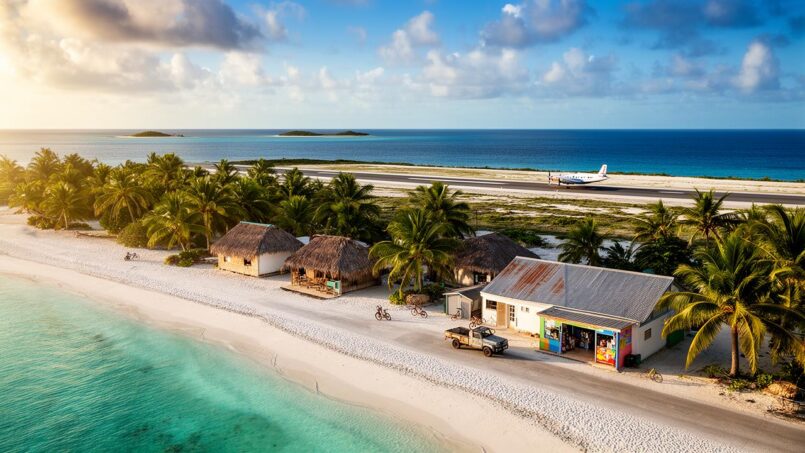
Expatriating to Tuvalu means accepting to live in a physical environment that is both fascinating and extremely constrained. The archipelago consists of nine coral atolls or islands arranged in a chain over about 420 kilometers, with almost no relief: the highest point, on Niulakita, tops out at around 4.5–4.6 meters. Nearly the entire population lives within one kilometer of the shore, on narrow, low-lying land surrounded by the Pacific.
No surface water, exclusive reliance on rainwater stored in tanks; constant exposure to spring tides, cyclone swells, and flooding that regularly inundates low-lying areas, including the runway at Funafuti Airport.
Living here means dealing with a spectacular yet unstable nature, where the ocean is never far away, both literally and figuratively.
A Slow, Community-Oriented Quality of Life… and Radically Isolated
One of the major attractions of Tuvalu for some expatriates is its pace of life. The country is described as peaceful, far from major tourist flows, with a simple economy, strong community ties, and a village atmosphere on a national scale. For those fleeing urban frenzy, traffic jams, and consumerist pressure, the archipelago offers an environment where “time slows down.”
Daily life in Tuvalu revolves around the extended family and island communities, with places like the maneapa for meetings. The value of fale pili encourages mutual aid and solidarity, which provides security and support for integrated expatriates, reducing loneliness.
But this same framework can be destabilizing. The archipelago has very few permanent foreigners; there is no large organized expat community nor infrastructure designed for them (no international schools, very few “international” stores, limited leisure options). Geographic isolation is radical: air links go almost exclusively through Fiji, are irregular, costly, and the country remains one of the most isolated in the world.
For many, Tuvalu is not a practical “base” for reaching the region, but rather a niche destination, suited for those who accept living on the fringes of global circuits.
Cost of Living: A Simple Daily Life but Expensive Imports
The report shows a nuanced picture of the cost of living in Tuvalu. On one hand, some sources indicate relatively modest budgets to live “comfortably”: a single person would need about 600 to 900 USD per month, a family of four between 1,800 and 3,000 USD, while a budget of 2,500 USD per month is described as allowing a pleasant standard of living. Other data sets, however, show much higher spending levels.
To summarize, we can distinguish two aspects: the cost relative to the global level, and the internal structure of expenses.
Tuvalu, a Rather Cheap Country… but with Low Local Purchasing Power
International comparisons place Tuvalu among the relatively affordable countries: it is about 1.6 times cheaper than the global average and ranks 148th out of 197 for cost of living. Compared to a benchmark like New York (index 100), the archipelago would have an index close to 47. In other words, life costs on average half as much as in a major Western metropolis.
The average net monthly income in Senegal, estimated between 352 and 695 USD, sometimes covers only half of a single person’s monthly expenses.
Expenditure Structure: Moderate Housing, Costly Imports
Available data reveal a typical structure of small importing islands: relatively affordable housing, still reasonable basic services, but high cost of many imported goods – processed food, branded products, technology.
The table below illustrates some monthly estimates for a single person, based on different data sets (amounts in USD, indicative):
| Expense Category | “Budget” Range (month) | “Comfort” Range (month) |
|---|---|---|
| Rent + Utilities (studio/1 bed) | 200 – 600 | 300 – 600+ |
| Food | 200 – 400 | 260 – 700 |
| Local Transport | 20 – 40 | 30 – 80 |
| Routine Health (excl. insurance) | 10 – 30 | 50 – 100 (with dental, etc.) |
| Internet / Telecom | 20 – 100+ | 90 – 150 |
| Estimated Total (excl. extras) | ~600 – 900 | 1,500 – 2,500+ |
Housing is, by all accounts, less expensive than in many large cities. A one-bedroom apartment in Funafuti ranges between 300 and 600 USD in the city center, a bit less on the outskirts; a three-bedroom home ranges from 500 to 900 USD. For those considering a purchase, some figures suggest prices per square meter significantly lower than Western markets, but data is very heterogeneous and, above all, the land issue is extremely complex (see below).
A basic internet connection can cost from 25 USD per month, while high-speed subscriptions go up to 90–150 USD.
Regarding food, local staple products remain affordable: fish (about 3 to 6 USD/kg), rice (1.2 to 3 USD/kg), bread (less than 1 USD per half loaf), eggs (3 to 5 USD per dozen). In contrast, imported products (fruit, meat, beverages, branded items) are expensive: 4 to 8 USD/kg for some fruits, imported soft drinks, cigarettes at nearly 7 USD per pack, etc.
For everyday needs, simple restaurants are accessible (5–10 USD per meal), a dinner for two at a mid-range establishment runs between 15 and 35 USD. Paid leisure activities remain rare and inexpensive: a movie around 5 USD, a gym membership around 25 USD per month.
Key Advantage for Expats: A Good Foreign Salary Opens High Purchasing Power
For an expatriate paid according to Western scales – NGO, international donor, foreign company contract – the combination of “generally low cost of living + low local wages” translates into high purchasing power and potentially very significant savings capacity. Some simulations suggest savings possibilities exceeding 70% of income for well-paid profiles.
On the other hand, a freelancer or remote worker paid at the same level as in Europe but having to finance frequent travel, international health insurance with medical evacuation, and quality internet access will see their margins shrink. It is therefore crucial to calculate one’s budget precisely, especially including “hidden” costs (insurance, plane tickets, parcel shipping, reliable internet connection).
Job Market: Narrow Opportunities but Niches for Highly Skilled Workers
Tuvalu has a very small economy, heavily dependent on external revenues (fishing license fees, aid, remittances from its seafarers working abroad, sale of the .tv domain name). The local labor market is narrow, dominated by the civil service, fishing, subsistence agriculture, a few services, and the development and climate project sector.
For an expatriate, this means two things: few open positions, but a high concentration of opportunities in skilled positions related to international aid or major projects (climate, energy, water, governance, health).
An Immigration System Tailored to the Country’s Needs
Tuvalu does not have an open long-term residence policy for retirees or investors. The framework is clear:
– there is no formal retirement visa;
– there is no path to permanent residence for foreigners, nor naturalization by length of stay;
– citizenship is based solely on descent;
– any long-term stay is practically tied to a specific employment contract, for a position that cannot be filled locally.
For foreign workers, a renewable one-year work permit is required, tied to an employer. The company or organization must demonstrate that the required skills are not available on the local market, after publishing vacancies through national channels. Obtaining the permit requires approval from the Commissioner of Labour and Immigration.
Expatriation purely by “lifestyle choice”, without a structured professional project in the country, is therefore very difficult: no residence by investment, no long-term resident status for independent income. One comes to Tuvalu because they are assigned, recruited for a project, or seconded by an organization, not to “retire in the sun.”
Targeted Skill Needs
The landscape of job offers confirmed by the report shows a strong presence of organizations like the UN (UNDP, FAO, WHO, IOM, UNOPS, UNCDF), the Asian Development Bank, cooperation agencies (Australia, New Zealand), NGOs or international consulting firms. Positions notably include:
Recruitments cover priority sectors: climate and coastal adaptation, water and sanitation, economic governance, fisheries and agriculture, early warning systems, as well as public sector reforms, education, health, and social protection.
Coastal engineers, climate experts, climate finance specialists, adaptation project coordinators, climate mobility experts.
Project managers for water scarcity management, hydrologists, engineers.
Public finance advisors, state-owned enterprise specialists, auditors.
Program coordinators for land degradation neutrality, marine resource specialists.
Maintenance technicians, climate experts, oceanographers, multi-country program coordinators.
Professionals dedicated to public reforms, education, health, and social protection.
These are generally fixed-term positions (from a few months to several years), highly specialized, often project-funded. They target experienced profiles (often more than 7–10 years of experience) and require accepting a constrained logistical context.
In summary, the advantage of Tuvalu for a highly skilled expatriate in these fields is the opportunity to work at the heart of global climate and development issues in a real-life laboratory. The major drawback remains the narrowness of the market: once the assignment ends, there are almost no local alternatives.
Healthcare: A Basic System, Evacuation Nearly Mandatory for Serious Cases
Another crucial point for anyone considering moving to Tuvalu: healthcare. The country has a fully public system, free for citizens, but limited in its capacities, both human and material. There is no private healthcare sector or authorized private pharmacy.
Services Concentrated in Funafuti and Very Incomplete
The core of the system is Princess Margaret Hospital in Funafuti: about 50 beds, general medicine, basic surgery, maternity, dental care, some anesthesia and surgical capacity, a small pediatric unit. This facility is the only referral center for the entire archipelago. Two health centers complement the offering on the capital atoll, while each island has a clinic primarily staffed by nurses or medical assistants.
For expatriates, the picture is clear: routine care (minor infections, basic treatment, simple maternity) is possible locally, but any complex issue – specialized procedures, serious conditions, advanced imaging (CT, MRI), cancers – almost always requires evacuation to Fiji or Australia. U.S. authorities, for example, explicitly recommend considering medical evacuation as nearly mandatory for serious cases.
Recommendation from U.S. authorities
Several elements reinforce this observation:
– shortage of specialists (no qualified pediatricians or psychiatrists, regular reliance on ad hoc foreign missions for some specialties);
– limited technical platform, absence of many sophisticated examinations and treatments;
– logistical fragility (medicine supply, equipment, electricity).
The government, with support from the World Bank and other partners, is investing in modernizing the system (hospital and clinic renovation, strengthening climate resilience of infrastructure, recruiting doctors trained abroad). But in the short and medium term, an expat cannot rely on a level of care comparable to that of a developed country.
International Health Insurance and Evacuation: A Cost Not to Overlook
For a foreigner residing in Tuvalu, consultations are paid, and above all, medical evacuation by commercial or charter flight to Fiji or Australia is both frequent and costly. It is therefore imperative to take out international insurance explicitly including evacuation coverage to a third country, with sufficiently high limits.
Insurance can cost up to 300 USD per month, with additional costs for medications (55 USD/month) and specialist consultations (25-30 USD). These expenses add to the local cost of living and must be factored in from the start of expatriation planning, especially for families and people with medical histories.
A Health Environment Under Climate Pressure
Climate change already has a measurable impact on health in Tuvalu. The severe drought of 2011 triggered water and sanitation problems, leading to an increase in respiratory infections, diarrheal diseases (cholera, typhoid, diarrhea), skin conditions, and other illnesses related to contaminated water. Rising temperatures, heatwaves, salinization of aquifers, and increased cyclone frequency raise health risks (soil evaporation, water quality degradation, food insecurity).
For an expatriate, this translates into: adaptation to a new lifestyle, cultural challenges, and potentially career development.
– the need to manage one’s own health security (water treatment, hygiene, increased vigilance during shortage episodes);
– possible exposure to water rationing episodes like in 2011, when domestic consumption was limited to 20 liters per person per day;
– an environment where health infrastructure is regularly stressed by natural crises.
The advantage, in return, is living at the heart of a transforming health system, supported by many international projects, which can offer unique experiences to health professionals… but requires a high tolerance for uncertainty.
Climate and Natural Hazards: Living on the Front Line
The climate aspect is arguably the most decisive in assessing the advantages and disadvantages of expatriating to Tuvalu. The country is regularly cited as one of the states most threatened by sea-level rise: in three decades, sea levels around the archipelago have already risen about 15 cm, and a significant portion of land and infrastructure is projected to fall below the high tide line by 2050 under high-emission scenarios.
Several phenomena combine:
Major risks include sea-level rise worsening tides and flooding, more frequent and intense tropical cyclones (Pam in 2015, Tino in 2020), drought threatening water and food supplies, salinization of aquifers and soils (especially for pulaka) reducing agriculture and drinking water, and coastal erosion; despite net land gain from sediments, these new lands are not habitable, as the Tuvaluan Prime Minister notes.
In the long term, scientific assessments suggest the country could become uninhabitable between 2060 and the end of the century under a high-emission scenario. The government, however, adopts a firm stance: the official strategy (“Plan A”) is to strengthen resilience in place – with projects like the Tuvalu Coastal Adaptation Project and a long-term adaptation plan to create raised and protected land. A “Plan B” is mentioned, consisting of preserving the community and culture digitally, even via a sort of virtual duplicate of the country, in the event of forced relocation.
For an expatriate, these elements have several implications:
– accept an increased risk of natural disasters and extreme weather events;
– potentially experience episodes of internal displacement, such as after Cyclone Pam, which displaced 45% of the population;
– contend with growing long-term land and infrastructure insecurity.
The advantage, for those working in climate, resilience, or humanitarian fields, is being on one of the most iconic front lines of the climate crisis, with a role to play in designing responses. The downside, obvious, is making one’s own daily life a laboratory of these risks.
Agriculture, Food, and Food Security
On such a tiny and salinized territory, local agriculture is limited. Traditional crops like pulaka suffer from saltwater intrusion into cultivation pits, forcing inhabitants to raise their plantations. Reefs and coastal fisheries are affected by warming and ocean acidification, while oceanic fish stocks are sensitive to phenomena like El Niño.
For an expatriate, this translates in several ways:
Food supply relies heavily on imports, leading to irregular availability of certain products like fruit, meat, dairy, and processed foods. Additionally, a Western-style diet rich in imported products costs more.
Food insecurity mainly affects vulnerable local households, but all residents feel the weight of global price fluctuations, freight costs, and climate effects. Conversely, settling in Tuvalu may encourage adopting a simpler, more local diet (fish, tubers, rice), which some may see as an advantage, others as a frustration.
Mobility, Migration, and Sense of Belonging
A singular aspect of the Tuvaluan context is the relationship with mobility. Over the period 2005–2015, 97% of surveyed households reported having been affected by a natural hazard, and over 70% believe that sea-level rise, flooding, salinization, and drought would be factors in future emigration. Yet, the majority of Tuvaluans remain deeply attached to their ancestral land and consider leaving as a last resort.
For Tuvaluans: New Migration Corridors
Agreements like the Falepili treaty with Australia have recently opened specific mobility channels for Tuvaluan citizens: up to 280 people per year – potentially nearly 4% of the population – can obtain a right to reside, work, and study in Australia with access to health and education systems. This measure is explicitly presented as a response to the climate crisis, not merely a labor migration program.
Mobility offers Tuvalu income diversification through remittances, skills acquisition, and a safety route for the most exposed, but it also carries risks: brain drain, labor loss, depopulation weakening the state, and strains on community networks.
For the Foreign Expatriate: Integration to Be Built on the Margins
For an expat from outside, this migration dynamic has two effects. First, it reinforces the presence of international agencies, NGOs, and experts involved in planning these mobility corridors, multiplying projects and thus opportunities for skilled assignments. Second, it highlights the centrality of culture and identity in Tuvaluan life: any sustainable expatriation must take into account this very ancient relationship with the land and kinship ties.
Integration in Tuvalu requires acceptance of the falekaupule (island assembly) and respect for chiefs and elders. Expatriates are seen as transient partners tied to a project, not as permanent members, which limits opportunities to put down roots.
Legal Framework, Immigration, and Absence of a Permanent Residence Path
Legally, Tuvalu has a very specific framework that heavily weighs on the possibility of long-term expatriation. Immigration is strictly regulated, and the country has not designed its system to accommodate large numbers of foreigners.
Entry and Stay: A Short-Term Focused System
Nationals of many countries, especially Europeans (Schengen states, some associated states like Iceland, Norway, or Switzerland) and Taiwan, can enter without a visa for short stays, generally up to 30 days, sometimes up to 90 for Europeans. Others must obtain a visa on arrival (fee-based, around 100 AUD) or before departure, upon presentation of supporting documents (return ticket, sufficient funds, passport valid for at least six months). Extensions beyond one month are requested locally, on a case-by-case basis.
For a stay other than tourism (work, study, religious or cultural mission, research), a specific entry and residence permit is required, issued upon arrival upon presentation of an employment contract or sponsorship document. These permits are generally valid for one year and renewable, with requirements such as a medical exam and, for long contracts, a criminal record extract.
No Naturalization or Residence by Investment or Retirement
One of the most discouraging elements for a lifetime settlement project is the total absence of a path to citizenship or permanent residence for foreigners: nationality law is based solely on descent, and naturalization by length of residence does not exist. In other words, even after many years of presence, a foreigner remains a non-citizen, dependent on the renewal of permits.
Tuvalu does not offer any residence by investment program or retirement visa. Unlike Fiji, Samoa, or the Cook Islands, it is not a suitable destination for a second life as a retiree.
For an expatriate, the advantage is operating in a country where demographic and land balance is protected, with little speculation and strict control of foreign presence. The downside, obviously, is the impossibility of turning a temporary stay into lasting legal roots.
Public Safety, Crime, and Daily Life
In terms of safety, Tuvalu stands out positively. The country is regularly presented as one of the safest in the world, with a very low crime rate, little or no serious violence, and almost no organized crime.
The crime index is below 20, indicating an environment where offenses are limited to a few thefts of unattended items.
For an expatriate, this concretely means: adaptation to a new culture, managing administrative and legal aspects, and discovering new living environments.
– great freedom of movement, including on foot, day and night;
– a very low risk of assault, kidnapping, terrorism, or organized crime;
– a daily life where one quickly feels at ease, especially in small communities where everyone knows each other.
However, there are a few points of caution:
The Seychelles impose severe laws on drug possession, drunk driving, and male homosexual relations, with penalties up to several years in prison, while police and judicial infrastructure is limited by a lack of material resources, especially on outer islands.
Moreover, even though delinquency risks are low, environmental hazards (strong ocean currents on outer coasts, pollution of Funafuti lagoon, sudden weather conditions) require a minimum of caution.
Overall, for an expat, safety is a strongly positive point of life in Tuvalu, especially compared to many other destinations.
Infrastructure, Digital Connectivity, and Practical Life
Another key dimension of contemporary expatriation: internet access, electricity, transportation, and basic services. In these areas, Tuvalu is a country in transition, with recent progress but also structural weaknesses.
Internet: From an Under-Connected Country to a Satellite Lab
For a long time, Tuvalu operated with a minuscule internet capacity for the entire country (barely a few megabits per second in the 2010s), relying mainly on slow and expensive satellite links. Since then, several major steps have been taken:
– successive agreements with high-throughput satellite operators, increasing capacity to several hundred megabits;
– deployment of community Wi-Fi hotspots and VSAT terminals in the islands;
– installation of the first submarine cable link (Tuvalu Vaka), connected to a major regional network, with potential capacity of several gigabits;
– arrival of low-orbit satellite services like Starlink, offering some users speeds of 50 to 150 Mbps.
<!– wp:group {"className":"custom-block-attention background-attention","layout":{"type":"constrained"}}The incumbent operator Tuvalu Telecom Corporation, the only national provider, is simultaneously developing 4G and gradually replacing Funafuti’s copper network with fiber optics. However, the country starts from a very low base, and disparities remain.
– Funafuti concentrates most of the coverage (3G/4G, public Wi-Fi, access points);
– outer islands often have to make do with a few hotspots or shared satellite links, sometimes with only one technician on the island;
– weather conditions (rain, storms, cyclones) can still disrupt the link;
– costs remain high for the local population, even though prepaid plans exist.
For an expatriate dependent on remote work, the situation is mixed. In Funafuti, it is becoming possible to work remotely for standard uses (regular video calls, file transfers), at the cost of an expensive subscription and some hiccups. On other atolls, however, reliability is more uncertain, making full-time telework riskier.
Electricity, Transportation, and Daily Life
Electricity supply is mainly from diesel generators, with solar extensions underway. On some islands, availability may not be continuous (historically 12 to 18 hours per day), although efforts to improve reliability continue. It is prudent to inquire specifically about the power regime of the target island.
Transportation relies on a few roads, with Funafuti’s airstrip serving as a multifunctional esplanade (playground, promenade, two-wheeler track). Outside the capital atoll, roads are unpaved. Taxis and minibuses are inexpensive, but there is no sophisticated public transport or fast ferries.
Regarding services, the range is limited: a few convenience stores, little shopping choice, virtually no large retail outlets. Leisure activities mainly consist of outdoor activities (snorkeling, fishing, walks, participation in community life) rather than sophisticated facilities.
For an expatriate who values simplicity, proximity to nature, and community life, this frugality can be an asset. For those needing a wide range of goods and services or frequent mobility, it will be a major deterrent.
Culture, Education, and Family Life
Tuvalu has a very strong Polynesian culture, whose pillars – language, music, dance, religion, community customs – permeate daily life. Choral singing at services, collective dances like the faatele, frequent festivities in the maneapa structure social time far more than commercial calendars.
For an expatriate, this offers an opportunity for deep cultural immersion, but also raises the question of education and family life.
Education: A Public System Inspired by the British Model, No International School
The education system, compulsory and free between roughly ages 6 and 16, is inspired by the British model. Each island has a primary school; Funafuti and Vaitupu host the country’s only two secondary schools, one public (Motufoua Secondary School, boarding), the other private (Fetuvalu High School, run by the Church of Tuvalu and following the Cambridge curriculum).
Over 600 students are sometimes enrolled in a primary school in the capital, with fewer than 20 teachers, illustrating significant overcrowding.
For expatriates with children, the key point is the absence of an international school in the strict sense. Existing institutions are not “international schools” but national or faith-based schools that, for some, use foreign curricula. It is possible, in some cases, to follow distance learning programs or resort to homeschooling, but this requires strong parental involvement.
Most international families come for limited assignments and plan for continued schooling in neighboring countries. Immersion can be enriching for young children but more complicated for teenagers aiming for competitive academic paths.
Social Life and the Expatriate’s Place
Socially, Tuvalu’s advantage lies in its friendliness: warm population, low crime, very active community structures, numerous cultural and religious events. Foreigners are generally well received, especially when they respect local codes (modest dress, respect for customary and religious authorities, participation in collective activities).
But the small number of expats, the absence of structured networks, and the predominance of the Tuvaluan language in many contexts can create a sense of isolation for some, especially non-working spouses who struggle to enter a nearly non-existent job market.
Assessment: For Which Profile Does Expatriation to Tuvalu Make Sense?
Weighing the advantages and disadvantages of expatriating to Tuvalu means confronting two realities: that of a community haven of peace, on the front line of the fight against climate change, and that of a minuscule, structurally fragile, poorly connected state with no prospect of permanent residence for foreigners.
On the strengths side, we can cite: strengths
– exceptional public safety, with very low crime;
– a warm and supportive community society, where social isolation is rare for those who get involved;
– a slow pace of life, far from urban and consumerist pressures;
– a cost of living generally below the global average, offering strong purchasing power for well-paid expatriates;
– niche but exciting professional opportunities in climate, adaptation, governance, water, public health;
– the unique experience of living at the heart of one of the world’s symbols of the climate crisis.
On the limitations side, the following points are determining:
– an extremely restrictive immigration system, with no path to permanent residence, naturalization, or retirement for foreigners;
– a tiny labor market, centered on a few international projects, with very little room for “standard” private employment or entrepreneurship targeting foreigners;
– a limited healthcare system, making medical evacuations necessary for complex cases and requiring robust international insurance;
– fragile infrastructure (water, electricity, transport, internet) despite rapid progress;
– extreme environmental vulnerability, with cyclone risks, droughts, flooding, salinization, and long-term uncertainty about habitability;
– an educational offering without an international school, complicating sustainable settlement for families aiming at certain standards.
In practice, expatriation to Tuvalu is mainly suited to three types of profiles:
Development, climate, health, or governance professionals assigned by international or governmental organizations on fixed-term contracts; researchers, journalists, documentarians, or artists who see Tuvalu as an exceptional working ground for a delimited project; and people seeking a radically different life experience, accepting legal precariousness, logistical constraints, and climate risks within the framework of a specific professional mandate.
For all, the key is preparation: understanding the legal framework (work permit, impossibility of naturalization), anticipating costs (health insurance with evacuation, plane tickets, communication), accepting the isolation and simplicity of the goods and services offering, and integrating the ethical dimension of one’s presence in a country whose social fabric and institutional capacities are extremely limited.
Tuvalu is neither a postcard tax haven where one would settle to escape worries, nor an already uninhabitable climate hell. It is a tiny, living, resilient island state that seeks to remain on its land despite the threats. Expatriating there means accepting to experience this struggle on a daily basis.
A wealth planning project or a question? Contact us now to speak with a wealth management expert.
Disclaimer: The information provided on this website is for informational purposes only and does not constitute financial, legal, or professional advice. We encourage you to consult qualified experts before making any investment, real estate, or expatriation decisions. Although we strive to maintain up-to-date and accurate information, we do not guarantee the completeness, accuracy, or timeliness of the proposed content. As investment and expatriation involve risks, we disclaim any liability for potential losses or damages arising from the use of this site. Your use of this site confirms your acceptance of these terms and your understanding of the associated risks.

Cyril Jarnias is an independent expert in international wealth management with over 20 years of experience. As an expatriate himself, he is dedicated to helping individuals and business leaders build, protect, and pass on their wealth with complete peace of mind.
On his website, cyriljarnias.com, he shares his expertise on international real estate, offshore company formation, and expatriation.
Thanks to his expertise, he offers sound advice to optimize his clients' wealth management. Cyril Jarnias is also recognized for his appearances in many prestigious media outlets such as BFM Business, les Français de l’étranger, Le Figaro, Les Echos, and Mieux vivre votre argent, where he shares his knowledge and know-how in wealth management.





