
 Published on and written by Cyril Jarnias
At first glance, “tiny lost atoll in the middle of the Pacific” rhymes with simple living and modest expenses. Tuvalu partly confirms this cliché, but the reality is more nuanced, especially for a foreigner who depends on imported goods, the Internet, and international health insurance. The country falls well below the global average in terms of cost of living, but local wages are very low and some line items can blow the budget wide open.
This article provides a detailed analysis of monthly expenses in Tuvalu, including rent, food, transport, healthcare, telecoms, and visas, with numerical comparisons against Australia, the United States, and neighboring Pacific countries.
General picture: cheap country, very low incomes
Tuvalu is among the cheapest countries in the world in terms of cost of living. The average basket for one person, including housing, is estimated at about 717 USD per month, roughly 1.62 times lower than the global average. According to other sources, the “realistic” budget for a single expatriate ranges from 600 to 900 USD per month, while a family of four needs between 1,800 and 3,000 USD to live comfortably.
The average income after taxes is 353 USD per month, covering only about half of basic monthly expenses.
In other words, for an expatriate paid by an international organization or a foreign employer, Tuvalu can seem cheap; for a local employee, life is, on the contrary, tight and the budget hard to balance.
Cost of living: at a glance
Overall estimates hover around the following amounts:
| Profile | Monthly “average” cost (including rent) | “Comfortable” range | Note |
|---|---|---|---|
| Single person | 717 USD (local source) / 600–900 USD (range) | Up to ~1,500 USD (depending on lifestyle) | Simple but decent local level |
| Couple | ≈3,293 USD (aggregate average all cities, not very representative of Tuvalu reality) | 1,600–3,000 USD (realistic adjusted budget) | “All cities” averages are skewed upward |
| Family of 4 | 1,668 USD (local source) / 1,800–3,000 USD (range) | 2,300–8,300 USD (depending on standard of living) | Wide gap between “budget” and “luxury” |
The wide discrepancies between certain estimates (e.g., 717 USD vs. over 2,000 USD for a single person) mainly reflect the difference between a very local lifestyle and one (“Western expatriate” consuming imported goods, fast Internet, paid leisure, and private healthcare outside the country).
Housing: moderate rents, but very limited supply
For a country so tiny, the rental market is restricted and extremely concentrated in Funafuti, the capital. That’s where most housing accessible to foreigners is located.
Various sources converge on a range of 200 to 600 USD per month for standard accommodation, which is very low compared to major Western cities.
Rent levels in Funafuti
The most consistent figures show the following:
| Type of housing | Location | Typical monthly rent |
|---|---|---|
| Studio / 1 bedroom | Funafuti center | 300–600 USD (450–900 TVD) |
| Studio / 1 bedroom | Outside center | 200–350 USD (300–525 TVD) |
| House / 3-bedroom apt | Funafuti | 500–900 USD (750–1,350 TVD) |
Other data mention even lower average rents for some leases: a small apartment in the center at about 209 USD (range 112–307 USD), and a large apartment on the outskirts around 205 USD. These levels would be up to 88–92% cheaper than equivalents in the United States.
In practice, an expatriate willing to accept simple housing without “hotel” comfort or an idyllic view can find a place for 200 to 400 USD per month. A larger or more “Western” apartment (recent furniture, air conditioning, better Internet connection) climbs to around 500–600 USD and up.
Aggregated data indicate a “rent + utilities” line item around 351 USD monthly for a single person and 546 USD for a family of four. This confirms that a reasonable rent in Tuvalu remains significantly lower than what you would find in Australia, Europe, or North America.
Utilities and Internet: cheap electricity, very expensive data
While rents stay contained, the bill can spike on telecoms, especially Internet. Basic utilities (electricity, water, gas) are relatively modest.
For a single person, basic monthly bills run about 40 to 100 USD depending on consumption and type of housing. Detailed figures for Tuvalu show approximately 55 USD for electricity, 15 USD for water, 14 USD for gas or heating. In aggregate, some databases mention 47–48 USD in utilities for one person and 72–73 USD for a family, which remains consistent with the ranges.
The price of a high-speed Internet connection in Australia is about 90 US dollars per month.
On the mobile side, a plan with data and calls costs around 80 USD per month, compared to about 35 USD in Australia. For an expatriate who works remotely or stays highly connected, the telecom line item becomes one of the heaviest in the budget.
Typical utilities for an expatriate
| Item | Tuvalu (monthly average) | Comment |
|---|---|---|
| Electricity | ~55 USD | Little air conditioning, moderate use |
| Water | ~15 USD | Usually simple billing |
| Gas / cooking | ~14 USD | Limited use |
| Broadband Internet | 90–150 USD | Very expensive per Mbps |
| Mobile plan | 10–80 USD | From basic prepaid to substantial data plan |
For a “connected expatriate” profile, Internet and phone can therefore represent more than 150–200 USD per month, i.e., one-third to half of a local budget.
Food: living local is economical, imported goods cost a lot
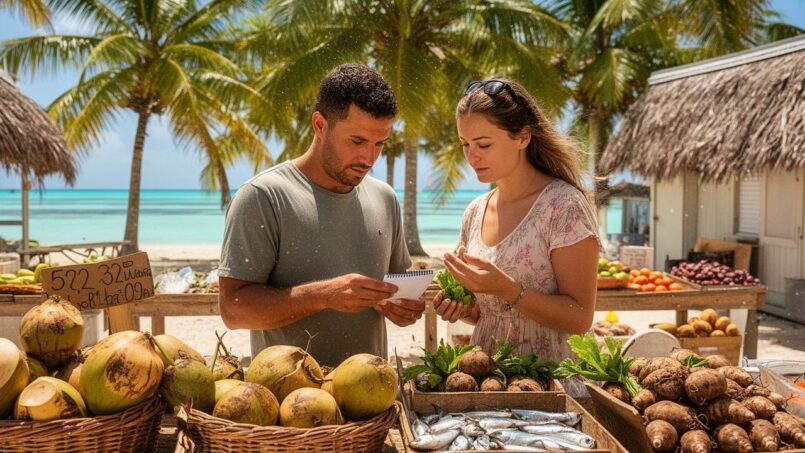
Tuvalu is heavily dependent on imports for food, which drives up the cost of anything that cannot be produced locally. On the other hand, eating local fish, rice, basic staples, and local fruits remains very affordable.
Overall estimates put the food budget at 200 to 400 USD per month for a single person. One specific source even figures food spending at 264 USD for one person and 689 USD for a family of four.
For an expatriate who cooks at home and adopts a diet close to local habits, a budget of around 250–300 USD per month is credible. If you add many imported products (cheese, imported alcohol, branded snacks, Western cooking), the bill easily approaches the top of the range.
A few emblematic prices
Available data, in Australian and US dollars, give an idea of the basic basket in Tuvalu:
| Product | Price in Tuvalu | Note |
|---|---|---|
| 500 g chicken breast | ~10 AUD (~7 USD) | Imported, fairly expensive |
| Dozen eggs | 6 AUD (~3.9 USD) | General range 3–5 USD |
| Bread for 2 people / 1 day | 2 AUD (~1.3 USD) | Very affordable bread |
| 2 L Coca-Cola | 2 AUD (~1.3 USD) | Surprisingly cheap sweet drink |
| 3 L laundry detergent | 7 AUD (~4.6 USD) | Standard household product |
| 4 rolls of toilet paper | 18 AUD (~12 USD) | Very expensive, import + isolation |
| 1 kg local fish | 3–6 USD | Excellent value for money |
| 1 kg rice | 1.5–3 USD | Inexpensive staple |
| 1 kg chicken (with bone) | 4–7 USD | Cheaper than boneless breast |
| 1 kg imported fruit | 4–8 USD | Strong import premium |
A classic pattern for small island states emerges: local fishing and some subsistence crops keep prices low, while processed products, toilet paper, detergent, imported sodas, or certain fruits from far away can be significantly more expensive than in industrialized countries.
Tuvalu’s food budget is about 10% higher than that of Micronesia and nearly 28% more expensive than in Australia due to heavy reliance on imports, while other categories like housing and transport are much cheaper.
Eating out: cheap if you keep it simple
Available figures in euros and dollars show that basic dining remains inexpensive, provided you target small local establishments.
For example, a cheap meal, including a drink, runs around 3.4 € (about 3.6 USD). A dinner for two in a “mid-range” restaurant with three courses is about 18.9 € (roughly twenty dollars).
A full meal for two people in a Tuvalu restaurant can cost up to 35 USD.
For an expatriate who regularly eats out at small restaurants or snack bars, a monthly “eating out” budget of 100 to 150 USD is therefore sufficient. The only caveat: the offering is limited. Do not expect the gastronomic variety of a major capital city.
Transport: short distances, few options, little spending
Tuvalu is extremely small. Most daily trips are done on foot or by bike, especially on Funafuti. The country has neither a developed bus network nor trains, and no ride-hailing app like Uber operates there.
The available means of transport are local minibuses, a few taxis, bicycles, some rental cars, and boats for getting from one island to another. For an expatriate, the daily transport budget is therefore surprisingly modest.
Monthly transport spending for a single person in Tuvalu is 29.9 USD.
Typical travel costs
Detailed data for expatriates and visitors give the following order of magnitude:
| Type of transport | Average cost | Details |
|---|---|---|
| Local minibus ticket | 1–2 AUD (~0.7–1.3 USD) | Pay cash to driver |
| Short taxi ride | 5–8 AUD (~3–5 USD) | Very few taxis, negotiable fares |
| 8 km taxi trip | ~9 USD | Average data |
| Monthly pass (local buses) | ~20 USD | Limited network |
| Scooter rental / day | 20–30 AUD (~15–20 USD) | Ideal for exploring Funafuti |
| Bicycle rental / day | 10–15 AUD (~7–10 USD) | Popular means of transport |
| Gasoline / liter | 1.4–2 USD | Varies widely by source |
For inter-island connections, public ferries typically cost 10 to 20 AUD per trip depending on distance. It is also sometimes possible to get free boat rides offered by fishermen or as part of government events, but this is unpredictable.
In reality, an expatriate living in Funafuti can easily get by with a monthly bicycle rental, a few taxi rides, and one or two boat trips per month. Transport expenses then remain marginal, especially compared to housing, food, or telecom budgets.
Healthcare: cheap local care, essential international insurance
On paper, Tuvalu has a public health system offering free basic care to nationals. The country does not allow private healthcare facilities and has only one hospital, the Princess Margaret Hospital in Funafuti, supplemented by a few clinics in the capital and eight health centers in the outer islands.
For an expatriate, the conclusion is clear: the quality of basic care is considered adequate but very limited. As soon as a serious problem arises (complex surgery, heart disease, cancer, severe accident, etc.), evacuation to a better-equipped neighboring country—usually Fiji, Australia, or New Zealand—becomes almost mandatory.
Average monthly spending on doctor visits and dental care at local clinics
However, expatriates are strongly advised to take out international health insurance with medical evacuation coverage. Budget tables specific to expatriates estimate this line item at about 300 USD per month for a policy with decent coverage, which is more than double the cost in neighboring countries like Micronesia, where equivalent insurance would run around 200 USD per month.
Healthcare costs for an expatriate
| Item | Tuvalu (monthly) | Comment |
|---|---|---|
| Consultations and dentist | ~50 USD | Basic care, inexpensive |
| Medications / pharmacy | ~55 USD | Limited selection, many shortages |
| International health insurance | ~300 USD | With evacuation to Fiji/Australia |
| Gym / sports | ~25–45 USD | Few facilities, often through hotels |
The “health” cost for an expatriate is therefore largely driven by international insurance and the risk of evacuation, not by routine on-site care.
Telecoms and digital: a real weak spot for the budget
For a digital nomad, a remote worker, or an expatriate executive, Tuvalu presents a paradox. The overall cost of living is low, but digital access is expensive and limited. The average reported connection speed is around 2 Mbps, far below Western standards, and fast subscriptions quickly become costly.
Tuvalu Telecom Corporation offers prepaid plans starting at about 10 USD for 1 GB of data. For heavy usage (video conferencing, large uploads, streaming), postpaid plans or broadband offers at 50–60 Mbps cost between 50 and 90 USD per month, and can reach 150 USD with TV and larger data volumes.
A digital nomad using a coworking space must add about 150 USD per month for a spot in the rare such facilities. An expatriate can therefore easily spend 100 to 250 USD per month solely from the need for a fast and stable connection, which represents a significant portion of a 700 to 900 USD budget.
Visas, permits, and paperwork: an often overlooked cost
Settling in Tuvalu is not just about renting a place and unpacking. Visas, work permits, and extensions of stay also have a cost, especially for expatriates coming to work for a company, an NGO, or to start a business.
The visa on arrival for a one-month tourist stay generally costs 100 AUD (about 65 USD). Some nationalities (Schengen countries, Taiwan) have exemptions for stays up to 90 days, but most visitors must pay these fees in cash, in AUD or USD.
The fine for unauthorized overstay can be up to 200 AUD per day.
Work permits are significantly more expensive, especially when applied for from within Tuvalu rather than before departure. An employment or business permit can cost 600 USD for the main holder and 150 USD per dependent when filed from outside the country, but climbs to 1,200 USD and 300 USD respectively if done on the ground. A study permit costs about 300 USD, while other specific permits (research, religious or cultural activities, family reunification) range from 100 to 600 USD.
For an expatriate employee sent by an organization, these costs are often covered by the employer. For a freelancer or entrepreneur, they weigh directly on the setup budget and must be anticipated.
International comparisons: Tuvalu vs. Australia and the United States
The comparison data are particularly revealing for an expatriate used to life in Sydney, Brisbane, or the United States.
Based on comparable baskets:
Analysis of the main expense categories: housing, food, transport, and healthcare
The overall cost of living (including rent) is 32% lower than in Australia. Rents are 64% cheaper and transport is 66.7% cheaper, thanks to the small territory and low mobility.
Food costs 28% more, a consequence of reliance on imports. Healthcare expenses (insurance, consultations, evacuations) are 28.6% higher than in Australia.
Compared to the United States, the cost of living in Tuvalu would be on average 71% lower. An American household spending over 5,300 USD per month for a family of four would only need about 1,550 USD in Tuvalu to maintain a comparable standard of living on basic items. A single person, who would need 2,615 USD per month in the United States, could get by on 740–750 USD in Tuvalu.
Living in Tuvalu may seem cheaper for housing, food, and not owning a car, but it involves major trade-offs in comfort, leisure, healthcare, and connectivity compared to a large wealthy country.
Salaries and purchasing power: why a foreign salary changes everything
One of the most striking aspects of the Tuvaluan landscape is the overall weakness of local wages. The very limited economy is based on fishing, subsistence agriculture, administration, and a few international missions. There is no national minimum wage. In the public sector, a minimum annual salary is cited at 3,000 to 4,000 TVD, roughly 3,120 to 4,160 USD, and the average salary scale gives about 10,000 AUD per year (833 AUD per month, equivalent to 550–600 USD).
The real average salary of about 353 USD per month covers only two weeks of basic needs for a single person, and only a third to a quarter of a family of four’s expenses. The figures of 5,000 USD per month are disconnected from local reality, likely pulled up by high incomes of diplomats, NGO staff, or maritime officers.
In contrast, Tuvaluans employed as seafarers abroad earn very high sums by local standards: a new recruit already makes 400–500 USD per month, an experienced Able Seaman reaches 1,000–1,200 USD, while his Australian counterparts can earn up to 6,000 USD. These salaries feed significant remittance flows from abroad to Tuvalu, supporting many households.
With a monthly income of 2,000 to 3,000 USD or more, the cost of living of 600 to 900 USD per person is very advantageous for an expatriate paid by a company, NGO, or UN agency, allowing comfortable living and saving despite higher expenses for Internet or health insurance.
Sample budget for a single expatriate
By cross-referencing different sources, we can sketch a realistic monthly budget for a single expatriate with an “intermediate” standard of living: neither ultra-frugal nor luxurious.
Take the case of a person living in Funafuti, with a salary from abroad. They live in a one-bedroom apartment, cook frequently at home, and occasionally eat at local restaurants. For transportation, they mainly use a bicycle and occasionally a taxi. They also have good international health insurance.
A plausible budget could look like this:
| Item | Estimated amount (USD / month) | Comment |
|---|---|---|
| Rent + utilities (1 bed) | 350–450 | Simple apartment, electricity, water |
| Internet + mobile | 100–180 | Fixed connection + mobile data |
| Food (groceries) | 250–320 | Mix local / imported, home cooking |
| Restaurants and cafés | 80–150 | 2–3 meals out / week |
| Local transport | 20–40 | Bicycle, few taxis, minibus |
| International health insurance | 200–350 | Policy with evacuation |
| Health out-of-pocket (meds, consults) | 20–50 | Basic care |
| Leisure, sports, miscellaneous | 50–100 | Gym, outings, small purchases |
| Visas / renewals (monthly average) | 20–50 | Depending on status and frequency |
This gives a total between 1,090 and 1,640 USD per month. By tightening certain items (more modest housing, more limited Internet, fewer restaurant meals, employer-subsidized insurance), it is realistic to get down to around 800–1,000 USD monthly for a single person, which matches the 600–900 USD ranges cited for a “comfortable” but rather local lifestyle.
Sample budget for a family of four
For a family, costs increase, but the absence of school fees (in local public schools), the moderation of rent, and the limited daily travel keep the budget from ballooning.
Using the previous line items for two adults and two children:
Overview of typical monthly expenses for a family (housing, food, transport, healthcare, etc.)
Rent + utilities for a 2–3 bedroom home: 500–800 USD
Food budget: 600–800 USD (official sources mention 689 USD)
Multi‑user plans: 150–250 USD
Transport expenses: 50–100 USD (mostly for adults)
Family international insurance: 400–600 USD; routine care: 50–80 USD
Leisure, sports, clothing, miscellaneous: 150–250 USD; visas and permits: 50–100 USD
This yields a range of 1,950 to 2,960 USD per month, consistent with the 1,800–3,000 USD needed for a comfortable family life indicated by sources.
For an expatriate family supported by an organization, this budget is entirely manageable and even leaves room for significant savings in some cases. For a local family living on national income, it is a standard of living well above average.
Tuvalu, “cheap” or “expensive” for an expatriate?
The picture that emerges from all the data is paradoxical but consistent:
On the numerical side, Tuvalu is significantly cheaper than most developed countries, especially for housing, transport, and some everyday services. On the other hand, imported food, telecommunications, and expatriate healthcare (insurance and evacuations) are noticeably higher. The gap between the cost of living and local wages is large: Tuvaluans live on a subsistence economy, while an expatriate paid internationally enjoys very comfortable purchasing power.
For a foreigner coming to work in Tuvalu with an external income, life is objectively inexpensive provided they accept:
– a very limited supply of goods and services,
– a modest and costly Internet connection,
– the need to take out excellent international health insurance,
– a fragile logistical environment, where access to certain products depends on cargo ships and stock.
Tuvalu can be affordable for small budgets in the low season (guesthouses at 50–60 USD/night, meals at 5–10 USD), but the isolation and high cost of the Internet make it a more demanding destination than other better‑served Asian or Pacific options.
In summary, the cost of living in Tuvalu for expatriates is not just a matter of numbers; it is above all a question of trade-offs between simplicity of life, isolation, digital needs, healthcare expectations and appetite for a community‑oriented, slow lifestyle, decidedly off the beaten path of mass consumption.
A wealth project or a question? Contact us now to speak with a wealth management expert.
Disclaimer: The information provided on this website is for informational purposes only and does not constitute financial, legal, or professional advice. We encourage you to consult qualified experts before making any investment, real estate, or expatriation decisions. Although we strive to maintain up-to-date and accurate information, we do not guarantee the completeness, accuracy, or timeliness of the proposed content. As investment and expatriation involve risks, we disclaim any liability for potential losses or damages arising from the use of this site. Your use of this site confirms your acceptance of these terms and your understanding of the associated risks.

Cyril Jarnias is an independent expert in international wealth management with over 20 years of experience. As an expatriate himself, he is dedicated to helping individuals and business leaders build, protect, and pass on their wealth with complete peace of mind.
On his website, cyriljarnias.com, he shares his expertise on international real estate, offshore company formation, and expatriation.
Thanks to his expertise, he offers sound advice to optimize his clients' wealth management. Cyril Jarnias is also recognized for his appearances in many prestigious media outlets such as BFM Business, les Français de l’étranger, Le Figaro, Les Echos, and Mieux vivre votre argent, where he shares his knowledge and know-how in wealth management.





