
 Published on and written by Cyril Jarnias
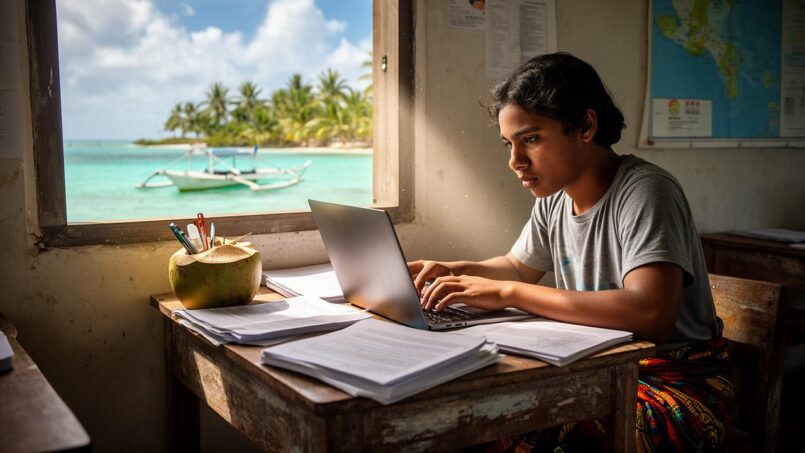
Choosing to study abroad in Tuvalu is anything but ordinary. This tiny Pacific island state, a global showcase for climate change and an extremely close-knit Polynesian society, offers an academic and human experience found nowhere else. People come to study here less for the size of the campus than for the relevance of the subjects, the closeness with instructors, the cultural immersion, and the opportunity to observe global issues like sea-level rise, marine resource management, or education in an island context firsthand.
The University of the South Pacific (USP) campus in Funafuti is the country’s only higher education institution. It serves as the main academic gateway for studying in Tuvalu in fields such as environmental science, marine science, renewable energy engineering, or education sciences.
A country-laboratory for the environment, the sea, and education
Tuvalu is one of the smallest states in the world, with about 26 km² of land, most of it less than two meters above sea level. This extreme geography places it on the front line of climate disruption: sea-level rise, more intense cyclones, saltwater intrusion damaging traditional crops, freshwater stress, and coastal erosion.
In Tuvalu, engineering, environmental science, and marine science programs incorporate themes like climate change adaptation, sustainable coastal zone management, renewable energy, and marine ecosystem conservation, making the country a concrete case study on the resilience of small island states.
The country has also made education a strategic lever. The Ministry of Education, Youth and Sports (MEYS), sometimes referred to as the Ministry of Education & Human Resources Development, oversees a school system that is free from primary through secondary school, and paves the way for higher education through the local USP campus. The small population size (about 11,000 inhabitants, a large proportion in Funafuti) means limited school enrollments and, in higher education, much smaller student groups than elsewhere. The result: highly personalized instruction, direct access to instructors, and an academic community where “everyone knows everyone.”
For international students, this setting offers a dual opportunity: to contribute to the research and development efforts of a country under climate pressure, and to immerse themselves in a Polynesian culture where solidarity, faith, and a sense of community structure daily life.
The heart of the system: The University of the South Pacific – Tuvalu Campus
The higher education landscape in Tuvalu is extremely concentrated. The University of the South Pacific (USP) campus in Funafuti is the main, and in practice the only, tertiary institution in the country. It is a regional center of a large intergovernmental university owned by twelve Pacific island states (including Tuvalu), headquartered in Suva (Fiji) but with campuses throughout the Pacific Ocean.
A small campus for immense challenges
Often described as one of the smallest university campuses in the world, the USP site in Funafuti nonetheless fulfills essential functions. It hosts about 330 students per semester, coming from all nine islands of Tuvalu, and offers a range of programs:
– certificates, diplomas, and bachelor’s degrees in science, engineering, and education;
– master’s and doctoral programs, particularly in environmental, marine, engineering technology, and education fields;
– short training and continuing education for government officials, teachers, and staff from local ministries or NGOs.
Instruction is primarily distance or hybrid, with in-person classes for foundation levels and some bachelor’s degrees if a local tutor is available. The campus uses the USPNet satellite network to connect Funafuti students to courses and tutorials from the main Laucala campus in Suva.
Programs sharply focused on Pacific needs
The range of programs relevant to a study project in Tuvalu centers around a few major families of disciplines, closely aligned with the country’s priorities:
| Field | Example Degree | Level | Indicative Duration | Indicative Tuition* |
|---|---|---|---|---|
| Environment | Bachelor of Science in Environmental Science (spec. Climate Change & Coastal Management) | Bachelor’s | 3–4 years | ~ $12,000 USD |
| Marine Science | Bachelor of Science in Marine Science (spec. Marine Biology & Ecology) | Bachelor’s | 3–4 years | ~ $12,000 USD |
| Engineering | Bachelor of Engineering Technology (spec. Renewable Energy & Sustainability) | Bachelor’s | 3–4 years | ~ $12,000 USD |
| Education | Bachelor of Education (Primary / Secondary) | Bachelor’s | 3–4 years | $5,000–$6,000 USD |
| Environment | Master of Science in Environmental Science (spec. Climate Change Adaptation & Mitigation) | Master’s | 1–2 years | ~ $14,000 USD |
| Marine Science | Master of Marine Science (spec. Marine Conservation & Resource Management) | Master’s | 1–2 years | ~ $14,000 USD |
| Engineering | Master of Engineering Technology (spec. Sustainable Energy Systems) | Master’s | 1–2 years | ~ $14,000 USD |
| Education | Master of Education | Master’s | 1–2 years | $7,000–$8,000 USD |
| Environment | PhD in Environmental Science (spec. Climate Change Impact & Adaptation) | Doctorate | 3–5 years | ~ $16,000 USD |
| Marine Science | PhD in Marine Science (spec. Marine Ecosystem Conservation) | Doctorate | 3–5 years | ~ $16,000 USD |
| Engineering | PhD in Engineering Technology (spec. Renewable Energy Innovation) | Doctorate | 3–5 years | ~ $16,000 USD |
– Indicative amounts based on collected data, excluding scholarships and funding.
Education sciences also play a significant role, with a full range of degrees and certificates for teacher training (early childhood, primary, secondary, educational leadership, pedagogy, etc.). These programs serve to professionalize the national teaching force but are also open to international students interested in education in an island and community context.
Admission procedures and intake schedule
For most bachelor’s programs (sciences, engineering, education) and diplomas or certificates, USP operates with two main intakes: February and July. Doctoral programs allow more flexible entry, generally around these two periods.
General admission requirements follow a standard pattern:
– for bachelor’s degrees: high school diploma or equivalent, plus proof of English proficiency (TOEFL/IELTS);
– for master’s degrees: a bachelor’s degree in a related field, validated English proficiency, and a project or research proposal for research-oriented tracks;
– for doctorates: a master’s in the discipline or a related field, academic English, and a detailed research proposal;
– for diplomas and certificates: completion of secondary school (or equivalent) and sufficient English, including for 6-month certificates in environment, marine science, or renewable energy technology.
Education programs sometimes have specific requirements (teaching experience for entry into the Master of Education or Postgraduate Diploma in Education), making them primarily professional development programs for practicing teachers from Tuvalu or other Pacific countries.
A country turned outward: studying in Tuvalu… and beyond
Even though the USP campus in Funafuti is central, the reality of Tuvaluan higher education pathways is largely regional or international. The majority of high school graduates pursue part of their studies abroad, whether at USP but on the main Suva campus, at Fiji National University, or at Australian or New Zealand universities.
For an international student, this logic of mobility translates into two possibilities:
– coming to Tuvalu to complete a full program (e.g., a bachelor’s or master’s);
– or integrating Tuvalu into a broader pathway, via an exchange or a field semester, especially for research on climate, oceans, or education in small islands.
In both cases, an ecosystem of scholarships and programs exists to significantly reduce the cost.
Overview of accessible scholarships and funding
Students interested in studies related to Tuvalu can tap into several funding mechanisms, whether managed by USP, partner governments, or multilateral organizations.
| Scholarship Program | Primary Target Audience | Key Benefits |
|---|---|---|
| USP Graduate Scholarship | Master’s & doctoral students at USP | Covers tuition, living allowance, research grant (merit-based) |
| USP Bursary Scheme | All USP students (based on need) | Partial tuition support, financial aid based on demonstrated need |
| Australia Awards Scholarships (AAS) | Citizens of Tuvalu and other developing countries for study in Australia | Full tuition, airfare, living allowance, health coverage, orientation program, academic support |
| Australia Awards Pacific Scholarships (AAPS) | Pacific citizens, including Tuvalu, for study in the region (USP, FNU…) | Full tuition, travel, allowance, orientation program, basic medical coverage |
| New Zealand Pacific Scholarships & other NZ scholarships | Citizens of Pacific countries for study in New Zealand or regionally | Tuition, travel, monthly allowance, health coverage |
| Commonwealth Scholarships | Citizens of Commonwealth states | Full tuition, travel costs, living allowance |
| Japan-Pacific ICT Scholarship | Pacific island citizens in ICT | Tuition, travel, living allowance (via Japanese government) |
| Tuvalu Government Scholarships | Tuvaluan citizens | Partial or full funding for studies, including at the main USP campus or regionally |
For a non-Pacific student coming to Tuvalu, some of these scholarships (Commonwealth, for example, or certain USP programs) may apply depending on nationality. Others, like Australia Awards or New Zealand Pacific Scholarships, primarily target island state nationals but shape the regional academic environment in which Tuvalu operates.
Applications for these scholarships generally require:
– a strong academic record (grades, degrees, references);
– a study plan aligned with development priorities (climate, governance, education, etc.);
– a commitment to contribute to the home country’s development upon return.
Cost of living, tuition fees, and budget to plan
The financial question is crucial when considering studying in a country as remote as Tuvalu. Available data shows that the cost of living remains below the global average, but with peculiarities linked to insularity and dependence on imports.
Cost of living: a relatively affordable island, but constrained
Cost of living indices place Tuvalu around 47 (New York = 100), making it about 1.6 times cheaper than the global average and ranking low in terms of everyday expenses. Concretely, for a single student, several monthly budget scenarios appear in the data:
| Profile | Estimated Monthly Budget (USD, including rent) |
|---|---|
| Student/tight budget | $400–$600 USD |
| “Reasonable” level | ~ $600–$900 USD |
| “Comfortable” budget | above $1,050 USD |
For a family of four, monthly expense ranges, including housing, are typically between $1,800 and $3,000 USD for a comfortable standard of living, with tighter scenarios around $1,500–$1,700 USD.
Rents for housing remain moderate compared to other island countries
| Type of Accommodation in Funafuti | Average Monthly Rent (USD) |
|---|---|
| Studio / 1 bedroom in city center | $300–$600 USD (average ~ $346 USD) |
| 1 bedroom outside center | $200–$350 USD |
| 3-bedroom housing | $500–$900 USD |
To this, add utilities (water, electricity, garbage), estimated on average between $40 and $100 USD per month for a single person, $60 to $70 for a family. High-speed internet is more expensive: plans can exceed $90 USD per month for speeds around 50 Mbps.
Food expenses reflect dependence on imports: the food budget for a single person is estimated at $200–$400 USD per month, with relatively low prices for local products (fish, some fruits) but higher for imported goods (milk, cheese, fruits from far away, canned goods).
Tuition fees: amounts vary by level
University fees for an international student at USP Tuvalu vary significantly according to level:
The announced cost for a PhD in environmental, marine, or engineering technology sciences is about $16,000 USD for the program duration.
Public universities in Tuvalu generally show annual fees between $1,000 and $3,000 AUD for nationals, but these amounts do not directly apply to international students outside regional scholarship systems.
For a study project, you must therefore combine:
– tuition fees (to negotiate or reduce via scholarships);
– monthly cost of living;
– airfare (almost invariably via Fiji, with infrequent and expensive flights);
– private health insurance, required for obtaining a study permit.
Finding accommodation in Tuvalu as a student
Tuvalu is not a country of large resorts or hotel chains: no international group is established, and accommodation relies almost entirely on small family-run structures or public facilities. For a student, this reality has important practical implications.
General types of housing
On Funafuti, most options fall into three main categories:
– houses or apartments for rent, often shared;
– pensions and family guesthouses;
– homestays.
Typical configurations for students include:
– renting a room in a 2, 3, or 4-bedroom house, with shared kitchen, living room, and bathroom;
– renting a small apartment (1 to 3 rooms), sometimes with private kitchen and bathroom;
– homestay accommodation, very common for those improving their English or immersing themselves in local culture.
The basic monthly budget for student housing, often including utilities, is around $300 USD.
Hotels, lodges, and pensions: useful references upon arrival
Even if a student will likely not spend their entire schooling in a hotel, it is often wise to book a few nights in tourist accommodation while finding a long-term solution. In Funafuti, several establishments serve this “entry point” role:
| Establishment | Type | Features | Indicative range (USD / night) |
|---|---|---|---|
| Funafuti Lagoon Hotel (formerly Vaiaku Lagi Hotel) | Government hotel | Right in the center, lagoon view, 17 air-conditioned rooms with private bathroom, balcony overlooking the lagoon, all-inclusive packages | ~ $150–$200 USD |
| Vaiaku Lagi Hotel (name often used) | Hotel | 17 rooms, lagoon view, near the philatelic bureau, air conditioning, Wi-Fi in common areas | ~ $65–$80 USD for cheapest options |
| Esfam Lodge | Family lodge | 3 minutes from the airport, 16 rooms, close to bank, telecom, and government buildings | ~ $85–$105 USD |
| Filamona Lodge | Family pension | Next to the international airport runway, in operation since 1998 | ~ $80–$100 USD |
| Island Breeze Motel | Motel | Simple motel-style accommodation | Mid-range budget |
| L’s Lodge, AMS Lodge, Afelita Island Resort, Niueti Lodge, Lilah’s Lodge, Nene’s Accommodations, Militano Lodge, Fale Tolu Motel, Solomai Guesthouse, Wamasiri Lodge | Lodges and guesthouses | Varied offerings, often fewer than 10 rooms, family-run | $40–$100 USD depending on comfort |
Basic pensions and homestays on the outer islands generally range between $40 and $60 USD per night, with very simple amenities: fan, local meals, shared or basic bathroom. More comfortable establishments in Funafuti sometimes add air conditioning, Wi-Fi in common areas, and meal service.
Booking strategy: anticipate scarcity
The number of available rooms on the archipelago is limited. Data recommends booking in advance:
For the dry season (May to October) and major events, book 3 to 4 months in advance. For transition months (April, November), allow 2 to 3 months. In the wet season (November to April), 1 to 2 months is enough, despite unchanged capacity.
Also note:
– credit card payments are still rarely accepted; plan enough cash, usually in Australian dollars;
– hot water is uncommon in hotels; best to check this point when booking;
– water or power outages are not unusual: bring a flashlight, toiletries, mosquito repellent, and basic medications.
Universities and exchange programs can help find accommodation before arrival, especially homestays or shared housing. If searching on the ground, it is best to book at least a few nights in a lodge (some are listed via Dorms.com or RocApply) to have time to find good opportunities.
Administrative procedures: study permits and immigration
Coming to study in Tuvalu involves a process for an entry and residence permit for studies, distinct from a simple visitor visa.
Study permit: conditions and duration
An international student must obtain a “permit to enter and reside” for study purposes, often called a study permit or entry and residence permit. Several conditions are required:
– a letter of acceptance from a recognized institution, confirming full-time enrollment;
– proof of full payment of tuition fees for the period in question;
– demonstration of sufficient financial means to cover stay and studies;
– valid private health insurance.
Documents to provide include:
List of documents needed for travel. Ensure you provide all of the following.
Passport valid for at least six months.
Two recent passport photos.
Official birth certificate.
High school certificate or other diplomas.
Recent medical report (less than 3 months old), free of infectious diseases, signed by a certified professional.
For those under 18, travel authorization from parents or legal guardian.
The study permit is generally valid for up to one year and can be renewed up to three times within a five-year period. Fees indicated for a study permit are $300 USD for the main student, $150 USD per dependent. Processing takes on average between 2 and 4 weeks.
Formalities can be completed before departure at an embassy or by mail to the Ministry of Foreign Affairs. Some entry and residence permits for study can also be issued upon arrival, subject to presenting the appropriate documents to the immigration officer.
Do not confuse visitor visa with study permit
Many travelers benefit from a visa on arrival for one month (sometimes free depending on nationality) or visa exemptions up to 90 days. However, this visitor status prohibits study, work, or proselytizing activities. It does not replace a study permit: beginning an academic program on a simple tourist visa would be contrary to regulations.
For a study stay, it is therefore essential:
– to prepare the entry and residence permit application before traveling, or;
– to ensure it will be issued upon arrival by presenting all supporting documents (university acceptance, finances, health, etc.).
Daily student life between campus, lagoon, and community
Studying in Tuvalu also means a radical change in living environment. The country combines the characteristics of a micro‑island state, a tightly-knit Polynesian society, and a territory on the front line of climate change.
Climate, seasons, and environment
The climate is tropical, with temperatures generally between 25 and 31 °C year-round. There are:
– a roughly dry season from April/May to October;
– a wetter season from October/November to April, with heavier rainfall and cyclone risks.
Weather hazards are not theoretical. Cyclones like Pam (2015) or Tino (2020) caused significant damage, sometimes equivalent to more than a third of national GDP. Sea levels continue to rise, increasing the frequency of flooding in low-lying areas of Funafuti during king tides and storm surges. For a student, this translates concretely into:
Occasional flooding of roads and the airport during extreme rain events, freshwater restrictions during drought with reliance on rainwater collection, and the need for safety and cyclone preparedness (evacuation plans, water and food stocks).
For a program in environment, coastal engineering, or marine sciences, these conditions are an integral part of the academic experience: many research projects focus precisely on infrastructure vulnerability, coastal management, or water resilience.
Culturally, Tuvalu is deeply Polynesian, with the indigenous language (Tuvaluan) omnipresent in daily life, and English as the official language for work and education. Schooling generally uses Tuvaluan in early primary school, then English as the medium of instruction from level 3 onward, though teachers often revert to the local language to explain difficult concepts.
English is the main language for courses and institutional communication, but learning a few words and phrases in Tuvaluan greatly eases integration, especially in host communities and at local events.
Tuvaluan society is characterized by: strong social cohesion, a rich Polynesian culture, and a fragile economy based mainly on agriculture, fishing, and international aid. Traditions and community values play a central role in daily life, influencing social interactions and family structures.
– a strong emphasis on the extended family (aiga) and community networks;
– a lifestyle centered around the community meeting house (maneapa or falekaupule), where meetings, celebrations, and deliberations take place;
– a culture of sharing and mutual aid (fale pili, the idea of looking after one’s neighbor like a family member);
– widespread Christian faith, which structures many social events, festivals, songs, dances (faatele, fakaseasea).
Foreigners are generally welcomed with warmth, curiosity, and respect if they show humility, respect codes of modesty (dress and demeanor), and participate in community life (shared meals, celebrations, youth activities). A homestay is particularly enriching for discovering local cuisine, daily practices like outdoor meals and the hierarchy of respect for elders, as well as the nuances of non-verbal communication.
Available infrastructure and services
Tuvalu remains a low-resource country with limited infrastructure:
– a single airport runway in Funafuti, regularly affected by weather;
– limited healthcare, especially for complex cases;
– variable internet connectivity, though steadily improving;
– a labor market dominated by the public sector, education, fishing, some development projects, and NGOs.
For a student, this means a certain material simplicity but also a daily life focused on human relationships rather than consumption. Leisure activities revolve largely around the lagoon (fishing, swimming, boat trips), sports, and cultural and religious events, rather than shopping malls or large entertainment venues.
Career prospects and job opportunities after studying in Tuvalu
Even though Tuvalu is a micro‑labor market, the courses taken there (or related to the country) target job opportunities far beyond the archipelago, particularly in the following fields:
Explore career opportunities in key sectors of environment, engineering, education, and public policy.
Become an environmental consultant, climate analyst, conservation project manager, or sustainability officer.
Work as a marine biologist, fisheries manager, marine policy advisor, or coastal ecosystem specialist.
Access careers as a solar or wind engineer, energy efficiency consultant, or resilient infrastructure project manager.
Work as a teacher, teacher trainer, curriculum designer, or specialist in inclusive or community education.
Become a climate policy advisor, development project coordinator, or community resilience specialist.
Gross annual salary ranges for these profiles, as reported in international data (not limited to Tuvalu itself), often fall between $40,000 and $80,000 USD depending on field and experience level. Expertise related to sustainability, renewable energy, and climate change adaptation is particularly sought after globally.
Tuvalu, despite its size, concentrates an impressive density of climate projects, coastal resilience programs, and multilateral initiatives. Jobs found there include:
Here are examples of jobs in climate adaptation: management and financing of adaptation projects; climate and ocean experts within the meteorological service; coordinators of programs for water management, land degradation, or climate-resilient health; consultants for UN agencies (UNDP, FAO, IOM, WHO, etc.) and networks like the Climate Finance Access Network.
For an international student, a stint in Tuvalu – whether through a thesis, a doctorate, or a research assignment – helps build a very credible profile for organizations working on small island states, climate justice, or integrated ocean management.
Strengths and limitations of a study project in Tuvalu
Coming to study in Tuvalu is obviously nothing like a typical exchange in a major university city. The choice offers very marked advantages, but also constraints that must be faced honestly.
What Tuvalu offers that is truly unique
Academically, USP Tuvalu offers:
– small class sizes, real proximity to instructors, easy exchanges with program coordinators;
– direct integration of climate, marine, and sustainable development issues into curricula, based on concrete situations;
– a powerful regional network via USP and its partnerships (Pacific universities, UNESCO, open and distance learning networks, etc.).
On a personal and cultural level:
Deep immersion in a community-based society where one is quickly known and included if one respects the codes; the chance to live in a country embodying the dilemmas of climate globalization, between attachment to territory and debates on future migrations; a spectacular natural environment despite the threats it faces.
Logistical and material constraints not to be underestimated
In return, several limitations must be considered:
Isolation with few expensive flights via Fiji, limited infrastructure imposing a simple lifestyle, weather events disrupting classes and communications, and a labor market too narrow for a foreign graduate, even qualified.
For these reasons, Tuvalu is particularly well-suited for:
– research stays, at master’s or doctoral level, on topics related to environment, sea, education, culture, or community resilience;
– exchange or semester programs with a field focus, through the USP network;
– continuing education for professionals (teachers, civil servants, NGOs) linked to the Pacific.
A full bachelor’s program is possible, but more suitable for students already on a regional trajectory (e.g., from the Pacific, scholarship holders of an Australian or New Zealand program) than for a European or North American student starting from scratch.
How to concretely prepare a study project in Tuvalu?
For anyone who wants to take the plunge, a few major steps are necessary.
First, refine your academic project:
– identify the most coherent field (environment, marine sciences, engineering, education);
– check prerequisites (degrees, English level, possible professional experience);
– determine the intake session (February or July for most programs).
Next, examine funding options:
– study available scholarships (USP Graduate Scholarship, bursaries, Commonwealth scholarships, your own country’s programs);
– ensure the project aligns with donor priorities (climate, governance, education, sustainable development).
Then, anticipate practical aspects:
To prepare for your integration, start by contacting the USP Tuvalu campus directly for first-hand information on courses, housing, and the calendar. Then book temporary accommodation for your arrival, such as a lodge or guesthouse in Funafuti, and simultaneously begin searching for a long-term solution (shared housing, homestay, or rental). Finally, prepare your study permit application including acceptance, financial proof, insurance, and medical certificates, while strictly respecting deadlines.
Finally, work on cultural integration:
– read up on Tuvalu’s Polynesian culture, social norms (respect for elders, modesty, importance of churches and community festivals);
– learn a few words of Tuvaluan;
– think about how your study project can make a real contribution to the local community, beyond simple data collection or a line on your CV.
Choosing Tuvalu for a research or study project requires a partnership-based and respectful approach. The country combines extreme climate vulnerability with a strong capacity for action, rooted in solidarity, resilience, and intense climate activism. Training there means accepting being transformed by this reality while contributing with your expertise.
—
Studying abroad in Tuvalu is not a mass choice, and that is precisely what gives it its value. For students interested in small island states, climate change, oceans, or education in a community context, the archipelago offers a rare combination: a living laboratory of the major challenges of our century, a well-connected regional university, and a society where one learns as much about human relationships as about climate models or covariance matrices.
Provided one carefully prepares their project—academically, financially, administratively, and culturally—Tuvalu can become far more than a tiny dot on the map: a turning point in an academic and life journey.
An estate planning project or a question? Contact us now to speak with a wealth management expert.
Disclaimer: The information provided on this website is for informational purposes only and does not constitute financial, legal, or professional advice. We encourage you to consult qualified experts before making any investment, real estate, or expatriation decisions. Although we strive to maintain up-to-date and accurate information, we do not guarantee the completeness, accuracy, or timeliness of the proposed content. As investment and expatriation involve risks, we disclaim any liability for potential losses or damages arising from the use of this site. Your use of this site confirms your acceptance of these terms and your understanding of the associated risks.

Cyril Jarnias is an independent expert in international wealth management with over 20 years of experience. As an expatriate himself, he is dedicated to helping individuals and business leaders build, protect, and pass on their wealth with complete peace of mind.
On his website, cyriljarnias.com, he shares his expertise on international real estate, offshore company formation, and expatriation.
Thanks to his expertise, he offers sound advice to optimize his clients' wealth management. Cyril Jarnias is also recognized for his appearances in many prestigious media outlets such as BFM Business, les Français de l’étranger, Le Figaro, Les Echos, and Mieux vivre votre argent, where he shares his knowledge and know-how in wealth management.





