
 Published on and written by Cyril Jarnias
Thousands of miles from neon-saturated megacities, nightlife in Tuvalu is anything but a marathon of trendy clubs. Here, evenings play out on the scale of a small country with fewer than 12,000 residents, with no real city, just a few miles of coral ribbon. Yet for those willing to trade strobe lights for stars and queues for kava circles on the sand, Tuvaluan nights offer a rare experience: intimate, communal, and deeply rooted in local culture.
A Night Like Dinner at a Friend’s House
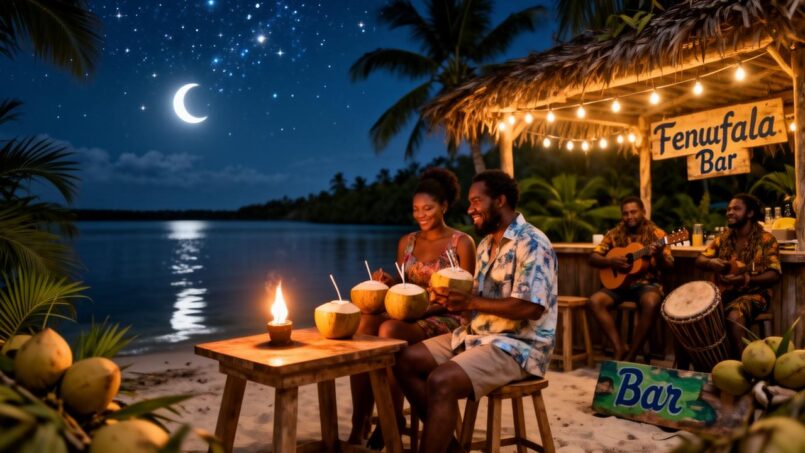
When the sun sets over Funafuti Lagoon, it’s not a bar district that lights up, but a few open terraces, impromptu barbecues, and the tarmac of an airstrip turned into a public park. Most evenings feel more like a village party than a night out: you recognize faces, sit on mats, share marinated raw fish, and chat about the weather or the latest rugby matches.
Good to know:
With fewer than 12,000 inhabitants, half of whom live on the islet of Fongafale, Tuvalu offers a unique social closeness. The atmosphere is very safe: it’s common to leave your flip-flops at a bar entrance without fear of theft. Evenings are often described as a large family gathering.
Night falls quickly, but not the shutters: in practice, most places close around 10 p.m. You don’t come to Tuvalu to down shots until dawn, but to chat, listen to a guitar passed from hand to hand, or watch the sky from the old U.S. military airstrip.
The Rules of the Game: Alcohol, Religion, and Hours
To understand the night in Tuvalu, you also need to know its legal and religious framework. The country is predominantly Protestant, and Christian practice structures the weekly rhythm. Sunday is a near-sacred day: shops closed, bars shut down, kava circles dormant. Even the consumption of alcohol is officially banned on that day across the entire territory, under a specific regulation that came into effect in late 2020. A first offense results in a warning or an on-the-spot fine; repeat offenses can lead to community service or, in extreme cases, a short prison term.
Attention:
According to the Alcoholic Drink Act, alcohol is sold only in licensed establishments (hotel bar, tavern, club, restaurant, or off-license store), with restricted hours: midday (11 a.m.–3 p.m.) and evening (6:30 p.m.–10 p.m.), except on Sundays when sale and consumption are prohibited.
On paper, the country therefore has only a handful of places authorized to sell alcohol. In practice, this further concentrates social life: the three main hotel establishments in Funafuti—including the Vaiaku Lagi Hotel and the Funafuti Lagoon Hotel—serve as accommodation, restaurant, bar, and neighborhood meeting point all in one. There are almost no independent bars; hotel terraces act as “local cafes.”
Drinking, Yes, But Discreetly
Beyond the law, social norms encourage restraint. Overt drunkenness is frowned upon, and alcohol consumption must remain discreet and respectful. The legal drinking age is 18 for both locals and visitors, and licensed establishments are supposed to check age. Driving after drinking is illegal, and even though traffic is light and motorbikes are slow, police can intervene.
Example:
Legal constraints and religious norms, such as Sunday being devoted to religious activities, explain why Tuvaluan nights are short and calm; the social buzz is concentrated on Friday and especially Saturday, considered the big night of the week.
Key Spots for a Night Out in Funafuti
Funafuti holds nearly all of the country’s nightlife. The atoll, flat as a pancake and highly vulnerable to sea-level rise, houses on Fongafale the only airstrip, government buildings, most shops, and nearly all accommodations. It’s here, over a few hundred meters, that the nocturnal “scene” takes shape.
The “Vaiaku Strip”: Village Heart of the Night
The area of Vaiaku, in the center of Fongafale, could be described as the sketch of a nocturnal “downtown.” It brings together the main hotels, a few restaurants and shops, and the famous international airport runway, which—outside the rare flight hours—turns into a promenade, rugby field, and gathering place.
On Saturday evenings, the terrace of the Vaiaku Lagi Hotel—the only “true” state-owned national hotel—fills with families. They share plates of ika mata (raw fish marinated in coconut milk and lime), and Bluetooth speakers circulate playlists blending reggae, Pacific pop, and reworked hymns. The atmosphere is far from the resort bar cliché: the clientele is mixed, family-oriented, kids move between tables, and conversation dominates.
A few steps away, other establishments like Filamona Lodge or simple restaurants also serve as meeting points. Foreigners—NGO staff, passing sailors, rare tourists—mingle with locals over a late dinner or a cold beer.
A Few Typical Spots and Their Reviews
The few places listed online give an idea of Funafuti’s nightscape. The table below gathers some frequently mentioned establishments, with the tone of user reviews:
| Place | Type | Location (Fongafale / Vaiaku) | Reported Overall Rating |
|---|---|---|---|
| Funafuti Lagoon Hotel | Hotel, restaurant, bar | Vaiaku | Rated “Excellent” by many reviews |
| Filamona Lodge | Guesthouse, restaurant | Next to the airport | Considered “Very Good” |
| Blue Ocean Restaurant | Restaurant | Vaiaku | Overall “Very Good” reviews |
| Matagigali Bar | Bar / local club | Near the north end of the airstrip | Reputation as a lively spot on weekend evenings |
| Dillian Restaurant & Bar | Restaurant & bar | Vaiaku | Very positive reviews but few in number |
| Fripay BBQ | Informal beach barbecue | North of Vaiaku | Recommended for its sunset grills |
These places are not clubs in the Western sense: they are simple terraces, plastic tables, string lights, a fridge with imported beer (Fosters, VB, Red Horse, San Miguel…). The essence lies in the exchanges, improvised music, and on good nights, a bit of dancing.
Matagigali, Tefota, and the “Nightclub” Tuvaluan-Style
Local sources don’t always agree: some describe Tuvalu as a country “without a disco,” others mention two actual nightclubs. On the ground, the reality is intermediate: a few more nocturnal bars adopt nightclub codes while remaining deeply rooted in the local context.
Matagigali Bar
Weekend hotspot in Vaiaku, near the north end of the airstrip. Rugged yet endearing atmosphere, no air conditioning, with pool table, dance floor, and outdoor space.
Atmosphere and Setting
Worn-down interior, outdoor area for smoking and chatting. Mix of international hits and Polynesian rhythms, sometimes with ukuleles or local guitars.
Activities On-Site
Pool table, dance floor. Varied music programming supported by local instruments.
Another spot, often identified as Tefota, operates somewhere between a drink shop, neighborhood bar, and mini-club. It features an improvised “beer garden” among shipping containers, amplified music, and a mostly young crowd attracted by its “cool island” vibe and the chance to meet people.
A recent video testimonial mentions entry fees around 10 dollars for general access and 20 dollars for a “VIP” area during special year-end parties. Hours are governed by law and religious customs: closing must occur by around 11:30 p.m. on Saturday, at the risk of customers caught drinking after that being reminded by police of the respect owed to the sanctity of Sunday.
Matagigali: Fluctuating Hours but a Friday Staple
Local sources indicate that Matagigali usually opens around 7 p.m., with particularly lively parties on Friday (sometimes running very late), and a more subdued atmosphere on Saturday with an early closing. This reality illustrates the constant tension between the desire to party and respect for religious norms.
The Airport Runway: Stadium, Promenade, and “Mini Times Square”
One of the most striking quirks of nightlife in Funafuti is the role of the international airport runway. Used only a few hours a week for the rare Fiji Airways flights, it transforms the rest of the time into a multifunctional space: rugby field, soccer pitch, athletics track, family walkway, picnic area.
Tip:
In the late afternoon and evening, when the heat drops, impromptu teams play rugby or soccer on the tarmac, while quieter groups settle on the grass or edges to chat, share a meal, or watch the kids. After the bars close, some extend the night by walking to the ends of the runway to stargaze, made spectacular by the near-total absence of light pollution and the open sea horizon.
This repurposing of a historic infrastructure—a World War II legacy—underscores how scarce public space is on a narrow atoll, where the entire population lives within a kilometer of the shore. It also illustrates how Tuvaluans turn constraints (lack of parks, land pressure) into opportunities for togetherness.
Fest-Noz Tuvaluan Style: Festivals, Night Markets, and “Twists”
Far from chain nightclubs, the big highlights of Tuvaluan night are often tied to community events: trade fairs, cultural festivals, religious gatherings, sports competitions, or family celebrations. These occasional gatherings structure the nightly calendar.
Trade Fair: Grills, Music, and Giant Speakers
Funafuti periodically hosts a two-week Trade Fair. To a visitor, the event feels like a tropical fair: two rows of stalls along a narrow alley, barbecues that only really come alive after 7 p.m., large families seated on mats watching performances on stage. Food portions—grilled fish, chicken, rice-vegetable-meat combos—are generous and affordable, so much so that a small group can easily dine for just a few bills.
Good to know:
Music blares from large speakers from 7 a.m. to about 10 p.m. No need to bring your own sound system on the boat or to the guesthouse.
Night Markets: Between Bazaar and Mini-Festival
Some evenings, especially around paydays (every two weeks), a night market sets up under large tents. You’ll find stalls with traditional clothing, flower crowns, handmade necklaces, and in another area, smoking barbecues offering grilled meat and fish. A small stage hosts local singers or bands, under the watchful eye of police ensuring safety.
2
Night markets are held two days a week, on Thursdays and Fridays.
“Twists” and Dance Nights at the Vaiaku Lagi Hotel
About every two weeks, the Vaiaku Lagi Hotel hosts dance evenings nicknamed “twists.” These are local-style “discos,” where dance groups perform traditional shows for a small fee before opening the floor to guests for freer dancing.
These evenings confirm the hotel’s central role as the pivot of island social life: national hotel, restaurant, bar, conference room, occasional disco, and cultural showcase, all in one.
The Night as a Showcase of Tuvaluan Culture
You can’t talk about nightlife in Tuvalu without mentioning the role of traditional music and dance. While bars play pop or reggae, the country’s true soundtrack—the one that emerges on big occasions—consists of polyphonic singing, percussion on wooden crates, and group dances telling the islands’ stories.
Fatele, the Beating Heart of Evenings
The fatele is often described as Tuvalu’s “national dance.” It’s a collective song-dance, central to many celebrations: weddings, birthdays, church festivals, political events, visits from dignitaries. When an important ceremony ends, it’s common for the program to be “closed” with a fatele, sometimes improvised, sometimes carefully prepared.
Example:
In a maneapa, elderly men sit and intone a short, poetic chant, repeated at an accelerating tempo, while other voices join in. Around them, men and women clap hands on the floor or on makeshift percussion (metal biscuit tins or wooden boxes) to mark the rhythm.
In front of the chorus, lines of young women (and sometimes men, especially in modern variations) rise and dance in synchronization. The steps are limited, but the gestures of arms, hands, and torso tell a story: a ancestor’s feat, a local legend, a notable event, a praise for a guest. The music builds in intensity until a sudden stop, like a guillotine. Then a new chant may begin, and so on, sometimes for hours.
Good to know:
Fatele can happen during the day, but their atmosphere is unique at night, with voices resonating under the lights of community houses. Unlike bars, these gatherings are intergenerational, bringing together grandparents, parents, and children.
Modern Music, Reggae, and Hotel Guitars
Alongside traditional forms (fatele, fakaseasea, ancient fakanau now extinct), a modest contemporary music scene exists. Influenced by radio, missionaries, and regional exchanges, it blends ukuleles, guitars, local percussion, and genres like reggae, pop, or afropop.
Tuvaluan artists and groups—sometimes banded under banners like Tuvalu Live Music Zone—share their tracks online, leveraging regional Pacific festivals to gain exposure. Locally, the most accessible scene for a visitor remains the hotel terraces, where a guitar circulates, and hymns or romantic songs in Tuvaluan are sung, often with spontaneous harmonies.
This omnipresence of music in evenings, whether sacred or secular, reinforces the “conversation over spectacle” character of the Tuvaluan night: the audience is not a mere spectator but a participant.
Practical Tips for Going Out at Night in Tuvalu
To fully enjoy these minimalist and warm nights, a few precautions and local habits are worth knowing.
Getting Around in the Dark
Funafuti’s roads are little or unpaved, rarely lit. Sidewalks are nonexistent, and paths can be cut off by high-tide pools or holes in the coral. After dark, a simple walk can become treacherous if you can’t see where you’re stepping.
Locals recommend always carrying a small flashlight in your pocket or on your phone, and wearing closed-toe shoes or sturdy sandals if using the road or causeway. Walking along the shore also requires watching the tides, which are fast on a flat atoll.
Attention:
Motorbikes are the main mode of transport, but helmets are nearly nonexistent, and night driving on these rough roads increases risks. It’s best to avoid riding late after drinking, even if distances are short.
Dress, Attitudes, and Respect for Norms
Tuvaluan society is conservative, especially under the influence of churches. Women, in particular, are encouraged to cover their shoulders and knees outside of beaches, especially on Sundays. For travelers, adopting a simple dress code—t-shirt, shorts or long wrap, sandals—is usually enough to avoid missteps.
Public displays of affection are frowned upon, and there is no visible LGBTQ+ scene. The law still criminalizes same-sex sexual relations between men, with theoretical penalties of up to 14 years in prison, though these provisions are rarely discussed in daily life. This nonetheless contributes to the invisibility of sexual minorities in the nightlife space.
Tip:
Photographing kava circles, religious festivities, or dance ceremonies should be done tactfully: always ask permission, as some elders appreciate discretion. Conversely, participating in shared meals, prayers, or songs when invited is seen as a sign of respect.
Safety: Relative but Not Absolute Tranquility
Crime statistics remain very low. Serious incidents are rare and often linked to family conflicts exacerbated by alcohol rather than random assaults. Snatch theft is almost unheard of, though an unattended item might sometimes disappear.
The main nighttime risk is more mundane: sprained ankle in the dark, motorbike fall, dehydration in the hot, humid atmosphere. Drinking boiled or bottled water between beers is recommended. In case of a serious medical issue, facilities are limited in Funafuti, and evacuation abroad may sometimes be necessary.
A Nightlife Shaped… by Rising Seas
Beyond the festive aspects, talking about the night in Tuvalu requires considering the backdrop: a country of 26 km², with an average elevation of no more than 2 meters, constantly threatened by sea-level rise, saltwater intrusion into aquifers and soil, storm surges, and coastal erosion.
Good to know:
King tides and La Niña episodes cause flooding of low-lying areas, affecting the airport runway (used as an informal night center), homes, and surrounding areas. Seawater appears at every high tide in the coral substrate. According to locals, these phenomena are more frequent than before, making every patch of dry land precious for leisure and socializing.
In this context, the night is not just time for relaxation, but also a moment to gauge the country’s fragility. Sandbags lining some coasts, landfill work (like at Queen Elizabeth Park in Funafuti), or protective walls built as part of coastal adaptation projects are visible as a backdrop to twilight walks.
Authorities are heavily investing in renewable energy and coastal reinforcement projects. A recurring refrain: “If we save Tuvalu, we save the world.”
Tuvalu Authorities
Niche Tourism… and Nights to Be Invented
Tuvalu remains one of the least visited countries on the planet. Before the pandemic, annual arrivals numbered at most a few thousand, mainly visitors from Fiji, Australia, and New Zealand, supplemented by development project workers. Average revenue per tourist is among the lowest in the Pacific, a sign of still-nascent tourism, with no resorts or mass cruises, only about fifteen small guesthouses and roughly 150 to 200 rooms in total.
In this landscape, nightlife has not yet been stylized to appeal to an international market. It primarily reflects the needs and habits of locals: modest social venues, community fairs, traditional dances in maneapa, night games on the airstrip, picnics under coconut trees. The few more “club-like” bars such as Matagigali or Tefota remain the exception, not the rule.
In the medium term, large-scale national cultural festivals—like the one planned in Funafuti with a strong musical and choreographic component—could give a more structured face to evenings, attracting the diaspora and offering a calendar of events. But accommodation capacity will remain limited by habitable land area and the pressure from climate change.
How to Enjoy Evenings in Tuvalu Without Altering Them
For a traveler coming here seeking “something else” than yet another lineup of clubs, a few simple principles allow experiencing the Tuvaluan night fully while respecting its fragility.
One is to accept the local tempo: focus on Friday and Saturday nights, don’t be offended if by 10 p.m. chairs are already being stacked, consider Sunday as an opportunity to experience polyphonic hymns at church and long shared lunches. Another is to prioritize community experiences: night markets, fatele in a maneapa, beach barbecues, rather than seeking a miniature version of a big city’s nightlife.
Tip:
Finally, it’s hard to ignore the link between the idyllic night—clear sky, calm lagoon, gentle pace—and the threats to this tranquility. By choosing responsible behaviors (limiting plastic waste, respecting freshwater, supporting local initiatives, being mindful of coral reefs when swimming before or after sunset), every visitor can contribute, modestly, to prolonging the existence of these timeless evenings.
Nightlife in Tuvalu is not just about a bar or a club: it is the translation, after sunset, of a tight-knit island society, a dense musical culture, and a territory fighting to remain habitable. Sitting on a mat by the lagoon, listening to a fatele in the glow of bulbs, or walking on the airstrip while scanning the stars—that is also, in some way, taking part in this quiet resistance.
A heritage project or a question? Contact us now to speak with a wealth management expert.

Cyril Jarnias is an independent expert in international wealth management with over 20 years of experience. As an expatriate himself, he is dedicated to helping individuals and business leaders build, protect, and pass on their wealth with complete peace of mind.
On his website, cyriljarnias.com, he shares his expertise on international real estate, offshore company formation, and expatriation.
Thanks to his expertise, he offers sound advice to optimize his clients' wealth management. Cyril Jarnias is also recognized for his appearances in many prestigious media outlets such as BFM Business, les Français de l’étranger, Le Figaro, Les Echos, and Mieux vivre votre argent, where he shares his knowledge and know-how in wealth management.





