
 Published on and written by Cyril Jarnias
wp:paragraph Settling in Tuvalu means accepting that the sea, the wind, and the land set the rhythm of your days. The same goes for **the plate**. Here, cooking is neither a marketing product nor a packaged tourist attraction: it is lived primarily in **homes**, churches, maneapa (meeting houses), and during major celebrations. For an expatriate, discovering this cuisine means entering the country’s intimacy, understanding its ties to the ocean, its concerns about climate change, and its pride in preserving ancestral recipes. This guide offers a **concrete immersion** into the cuisine of Tuvalu, with a perspective that is both **food-loving**, **cultural**, and **practical**, tailored for those settling in or staying long-term on the islands.
Understanding the Tuvaluan Plate: Three Pillars and a Context
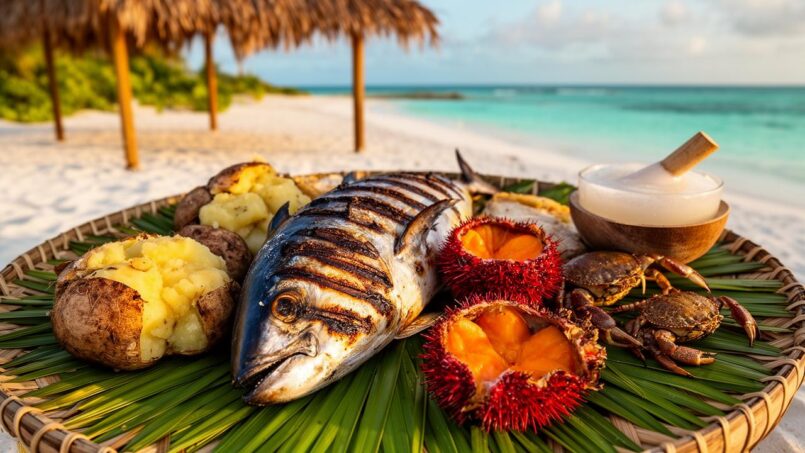
The cuisine of Tuvalu rests on a clear foundation: **the ocean**, **the coconut tree**, and **pulaka**. Around these three pillars revolve other roots (taro, sweet potato, cassava), breadfruit, bananas, pandanus, and a few garden vegetables.About 90% of the food consumed in Tuvalu is imported, mainly from New Zealand, Australia, and Fiji.
The Three Foundations of Local Cuisine
The foundation of **Tuvaluan** gastronomy can be summarized as follows:| Pillar | Culinary Role | Examples of Uses |
|---|---|---|
| Ocean | Main source of protein | Tuna, reef fish, octopus, coconut crabs, flying fish |
| Coconut tree (ni) | Fat, liquid, sweetness, cooking medium | Coconut milk and cream, oil, toddy, coconut sprouts, leaves for wrapping dishes |
| Pulaka (swamp taro) | Staple starch, cultural symbol | Boiled with lolo (coconut cream), fekei, tulolo, stews, accompaniment to fish |
Pulaka: More Than a Starch, an Identity Marker
You cannot understand Tuvalu’s gastronomy without talking about **pulaka**, this **giant swamp taro** cultivated in pits dug down to the freshwater lens. Each pit is a true cultural micro-landscape: dug by hand, filled with composted leaves, maintained over several years. Pulaka takes three to five years to reach maturity. Its texture is dense, very rich in starch and calcium, and its taste vaguely resembles taro or yam with an earthy note.A Plant at the Heart of Social Life
The cultivation of **pulaka** remains deeply collective. **Planting, weeding, harvesting** bring together families and neighbors. Some villages even pass down entire pits as an inheritance, with their stories and techniques. Sharing pulaka with a guest is a gesture of great hospitality: its presence on a festive table is a sign of **abundance** and respect.During weddings, community celebrations, or religious holidays, pulaka is honored in the “te aitu” (great feast). Must-try recipes include fekei, tulolo, and boiled pulaka drizzled with coconut cream.
Iconic Recipes Using Pulaka
Tuvaluans use this tuber in **multiple ways**, playing mainly on **cut**, **cooking method**, and **amount of lolo** (coconut cream). A few key preparations:| Dish | Preparation | When it’s eaten |
|---|---|---|
| Boiled pulaka with lolo | Corms boiled until tender, served with fresh coconut cream | Daily meals, side dish with fish |
| Fekei | Grated pulaka mixed with coconut cream, sometimes toddy, shaped and steamed in pulaka leaves | Celebrations, snacks, light dessert |
| Tulolo | Mashed pulaka, beaten, then covered with warm coconut cream | Family meals, side dish with canned meat or fish |
| Pulaka “pie” | Pulaka puree, flour, and coconut cream, baked in an oven | Modern variations, sometimes with imported meat |
A Threatened… and Defended Food
**Sea level rise**, saltwater intrusion into the water table, and **extreme weather events** make pulaka pits harder to maintain. Some islands are experimenting with more salt-tolerant varieties or moving cultivation to raised concrete beds. At the same time, the massive arrival of imported foods, quick to prepare, is drawing some youth away from these tasks, seen as tedious or “old-fashioned.”In response, workshops and training sessions are multiplying to explain to young people the importance of pulaka, not only nutritionally but as an identity foundation. As an expatriate, taking part in a planting day or a cooking workshop focused on pulaka is an excellent way to enter this societal debate… through practice.
The Central Role of Festivals and Community Meals
In Tuvalu, major religious or national holidays are inseparable from **food**. Dances, music, and singing competitions follow one another, but everything converges on one moment: the **collective feast**. If you are invited, you will have access to dishes you will never see on a restaurant menu.Festive Calendar and Typical Dishes
**Several major dates structure the year.** Each has its own tone, **its preferred dances**, but also **an associated culinary palette**. Here is a summary of the main events and what is often found on the **tables**:| Holiday / Event | Cultural Dimension | Dances / Music | Signature Dishes and Products |
|---|---|---|---|
| Te Aso Fa’alupega (Cultural Day) | Celebration of identity and traditions | Fakanau and fakaseasea dances, pate (drum) and ukulele music | Pulaka, feke (octopus), coconut dishes, kainga (great feast) |
| Tuvalu Day (National Day) | Assertion of sovereignty, national unity | Traditional songs, fatele | Pulaka cooked in umu, fekei, banana and coconut desserts |
| Independence Day / Constitution Day | Strong political commemorations | Songs, parades, prayers | Palusami, ika mata, se’i (smoked fish), luau (taro + coconut) |
| Te Aso Faka-Tau (Gospel Day) | Honoring Christianity | Religious celebrations, church hymns | Fai’ai (coconut bread with fish or meat), banana and coconut desserts |
| Christmas | Family and religious holiday | Carols in the Tuvaluan language | Palusami, assorted fish, coconut desserts, large te aitu |
| Local festivals (Funafuti, village feasts) | Community strengthening, transmission | Fatele, dance and music competitions | Te aitu with pulaka, octopus, tuna, crabs, pork, coconut dishes |
Te Aitu, Kainga, and Meals Under Health Scrutiny
**The words vary from island to island**, but the principle remains the same: **a large community meal where an abundance of food is seen as an indicator of success**. You will find fatty meats, dishes in coconut cream, sometimes turtle or luxury items like coconut crab. Speeches by men often emphasize the generosity of the hosts and the quality of the dishes.The profusion of food at feasts leads to caloric overload, digestive issues, and risks of food poisoning, with frequent cases of stomach aches and diarrhea, despite the use of banana leaves to keep insects away.
Classic Dishes of the Tuvaluan Table
To help you navigate dish names and know what to try first, here is an overview of the **must-try recipes**, with their cultural context.Palusami: Generosity in Taro Leaves
**Palusami** is considered one of the most iconic dishes. It contains the **DNA of local cuisine**: fresh taro leaves, coconut cream, sometimes onions, fish, or corned beef. The principle: young, tender taro leaves are filled with a **thick mixture of coconut cream**, finely chopped onion, and, depending on the family, pieces of **fish or canned meat**. The whole thing is folded into tight little packets, then steamed or cooked in the umu. The result is creamy, fragrant, and quite rich. The dish is inseparable from religious holidays, weddings, and large family gatherings. In the Tuvaluan imagination, **palusami** is associated with **abundance** and **fertility**. Serving it to a guest is a sign of particular **generosity**. Preparing it is often a **collective** activity, with each person having a role (washing leaves, preparing coconut cream, folding).Ota Ika / Ika Mata: The Sea in a Bowl
**Another pillar**: raw fish marinated in lime juice and coconut cream. Called **ota ika** or **ika mata** depending on the variation, this dish encapsulates the islanders’ relationship with the sea. Tuna, reef fish, or mahi-mahi, diced and “cooked” by the acidity of the lime, is then mixed with tomatoes, cucumbers, onions, and sometimes chili. A touch of coconut cream rounds out the whole.Ota ika is a fish dish served cold, as an appetizer or light meal, very present at celebrations and on family tables. It illustrates the promotion of sustainable fishing, serving as an educational tool to remind that fish is an economic resource and a cultural heritage to protect.
Fekei and Coconut Sweets: The Art of Island Desserts
**Traditional desserts** almost always revolve around three elements: **banana**, **breadfruit**, **coconut** (in the form of cream, palm sugar – toddy – or coconut sprouts). Fekei, very common, comes in **two main types**:Two emblematic recipes from the Pacific Ocean: one made from grated pulaka cooked in leaves, the other made from ripe bananas cooked into a pudding.
Grated pulaka mixed with coconut cream and sometimes reduced toddy, shaped into balls or cylinders, steamed in pulaka leaves, then topped with coconut cream.
Ripe bananas mashed with coconut cream and sugar or honey, cooked gently until a pudding-like texture is achieved.
| Dessert / Sweet | Base | Special Feature |
|---|---|---|
| Papa | Dense cake with coconut and sugar, steamed or baked | Very popular in Funafuti bakeries |
| Kakai / kakea | Mashed banana and coconut cream, sweetened | Present during religious holidays |
| Fausi | Local bread made from flour, toddy, and coconut, wrapped in pandanus leaves | Keeps for several days, useful when access to shops is limited |
| Kulima | Creamy dessert made from breadfruit and coconut cream | Often served on special occasions |
Curries and Reworked Outside Influences
Trade routes have brought to Tuvalu **spices, vegetable oils, soy sauce, basmati rice**. Little by little, the women – often in charge of cooking – have integrated these elements into their recipes, creating **highly popular hybrid dishes**. **Tuvalu Tuna** (or coconut tuna) is the best-known example: tuna steaks quickly seared in a mix of **onion–garlic–ginger–chili–curry**, then simmered in coconut milk and soy sauce, sometimes with crunchy vegetables (snow peas, cucumber, green onion). Served over rice (often cooked in a water–coconut milk mix), this dish perfectly illustrates the meeting of local ingredients and imported techniques. Other **curries** have **become established**: – **coconut crab curry**, an adaptation of a recipe from South India, with onions, curry, and spices; – **octopus curry**, very fragrant, marrying marine flavors with mild spices. For an expatriate, these dishes often serve as a **good entry point**: the flavors are familiar (**curry, rice, coconut**) while remaining rooted in the local terroir.Where and How to Eat Local in Funafuti
Unlike other tourist destinations in the Pacific, **Tuvalu does not abound with “typical restaurants” advertising “traditional cuisine” in their windows**. Authentic Tuvaluan food is mainly enjoyed in people’s homes, at church meals, or **community celebrations**. Nevertheless, some places in Funafuti allow you to get close to its flavors.Overview of Dining Places
| Place | Profile | What You’ll Find |
|---|---|---|
| Vaiaku Lagi Hotel (restaurant) | The only hotel’s restaurant, frequented by officials, expats, and some locals | Grilled fish, coconut dishes, curries (including tuna), mix of local/international cuisine, lagoon view |
| Te Namo Restaurant | Well-known spot for local flavors, busier in the evenings | Fish and pork cooked in umu, taro, pulaka as a side, seafood soups |
| Kapi’s Beach Bar & Grill | Casual spot near the beach, mixed crowd of travelers and locals | Fish skewers, grilled seafood, light snacks, sometimes pulaka or coconut bread as sides |
| Filamona’s Seafood Shack | Small no-frills eatery with picnic tables | Grilled mahi-mahi and octopus, served with pulaka or rice, cooked to order |
| Funafuti Market | Central market | Local fruits and vegetables, fresh fish, snacks: banana chips, fried breadfruit, fish skewers, papa, kafalu (sweet bread) |
| Fish Market | Place to buy the freshest fish | Tuna, snapper, mahi-mahi, reef fish; to cook at home or at your guesthouse |
| Roadside Stalls | Small informal stands | Feke (grilled or boiled octopus), banana chips, fried breadfruit, sweet breads, small coconut cakes |
What You Won’t Find… and What You Must Accept
In Tuvalu, you won’t see a sign saying **”100% traditional Tuvaluan cuisine”** on every corner. The most authentic cuisine is familial and religious. Being invited to eat at someone’s home is **an honor**, not a commercial service. It often takes time, connections, and real social integration before experiencing a true kainga or a typical Sunday meal.At the same time, you have to contend with a very present offering of imported products, sometimes ultra-processed. Supermarkets line their shelves with white rice, noodles, sugary drinks, canned meat. For an expatriate, the temptation is great to rely only on these familiar products. Yet, the Tuvalu experience also passes through the market, small gardens, direct negotiation for fish or pulaka with a neighbor.
Resident or expatriate in Tuvalu
Eating Local… and Staying Healthy: What the Recommendations Say
Tuvalu’s health authorities, supported by the **Pacific Community (SPC)**, have published **guidelines for healthy eating**. They are also useful for expatriates, who sometimes share the same pitfalls (too much white rice, refined cereals, salty canned goods).The Three Food Groups and Energy Share
The recommendations structure the diet around **three groups**: – **energy foods**: roots, tubers, cereals (**pulaka, taro, cassava, breadfruit, cooked green bananas, whole wheat bread, brown rice**); – **protective foods**: fruits and vegetables (**papaya, ripe banana, local green leaves, tomatoes, cucumbers, capsicum**); – **building foods**: proteins (fish, lean poultry, lean cuts of pork or beef, eggs, legumes, low-fat dairy products).The guidelines recommend that energy foods make up about 35% of daily intake, favoring whole versions like pulaka, breadfruit, or brown rice over refined flours or fried foods.
Replace rice with pulaka, taro, breadfruit, or sweet potato. Buy papayas, bananas, cucumbers, tomatoes, and local greens at the market. For proteins, choose fresh fish, eggs, dried beans, or lentils instead of deli meats and corned beef.
Foods to Limit: A Message That Also Concerns Newcomers
The recommendations emphasize **reducing**: – **refined cereals** (white rice, pasta, vermicelli, white breads); – **products high in sugars and fats** (cookies, cakes, snacks, chips); – fatty meats and very salty canned goods; – abundant fried foods. They primarily target the **local population**, but an expatriate settling in may quickly fall into these **habits**, out of convenience. The best strategy is to combine your nutritional knowledge with local products: a fresh tuna curry with coconut milk and plenty of vegetables, served over breadfruit rather than a mountain of white rice, is much more in line with the spirit of the national recommendations.Water, Hygiene, and Food Safety: Precautions for Expatriates
Tap water is not always **drinkable** in Tuvalu. Access to water depends largely on rainwater tanks, and **quality** can vary after heavy rains or drought periods. Health authorities and international organizations remind us of a few simple principles: – **drink bottled or boiled water**; – be wary of ice cubes (often made with untreated water); – avoid **unpasteurized dairy products**; – choose well-cooked dishes served very hot, and fruits you can peel yourself; – avoid raw vegetables in places where hygiene seems questionable.Travelers should follow the principle ‘boil it, cook it, peel it, or forget it’ in Tuvalu, where traveler’s diarrhea is common due to a fragile cold chain and high temperatures. Rigorous hand hygiene with soap or alcohol-based sanitizer before meals greatly reduces risks.
Integrating Through the Table: Attitudes and Codes to Know
Beyond the **”what to eat”** aspect, the essential for an expatriate is to understand **how one eats**, and what meals **mean socially**.Invitations and Sharing
Getting an **invitation to eat** at a Tuvaluan family’s home is a sign of **trust**. Bluntly refusing is not customary. If you have **dietary restrictions**, it is useful to learn a few basic phrases. For example, to indicate you do not eat meat, a formula in the local language allows you to say it with gratitude rather than abrupt rejection.During traditional meals in Tuvalu, people often eat sitting on mats, sometimes with their hands. In Funafuti restaurants, which are mostly Westernized with tables and cutlery, it is more respectful to follow the local code when in a village or at celebrations, and to serve yourself as others do.
Meal Rhythm and Relationship to Time
Life in Tuvalu is slow, and meals fit into this tempo. You don’t hurry a cook to be served, you don’t rush a lunch on the go. The recommendation made to locals – **take time to eat**, don’t gulp down a meal while doing something else – aligns with a certain **island life philosophy**. For an expatriate, accepting to adjust your expectations to this rhythm (especially in small restaurants and stalls) avoids frustration and misunderstandings.In the outer islands, the structure of the day often resembles a specific organization, paced by local activities and natural constraints, including key moments like early rising, daily chores, and rest times according to tides or weather.
Vegetarian, Vegan, or Special Diet Expatriates: How to Adapt
The concept of **vegetarianism** is not widespread in Tuvalu. Traditional cuisine gives a central place to **fish** and, during celebrations, to **pork**. For an expatriate who does not consume animal products, you will need to be proactive. **Naturally vegetarian options exist**: – **boiled or roasted pulaka**, with coconut cream; – **grilled or fried breadfruit**; – **boiled green bananas in coconut sauce**; – **banana fekei**; – **local breads** (fausi, kafalu); – **banana chips**, fried breadfruit, papa (coconut cake)… However, many **coconut-based dishes** may contain **fish** or corned beef without being visually obvious. The simplest advice: ask whether the “lolo” preparations contain fish or not, and if in doubt, avoid them. On the outer islands, choices are more limited; bringing some basic plant-based products (lentils, chickpeas, nuts, powdered plant milk) can be invaluable to round things out.Cuisine, Climate, and Food Security: What Your Plate Says About the Country
Eating in Tuvalu is not limited to **choosing between raw fish and tuna curry**. The way Tuvaluans grow, fish, buy, or import their food is directly linked to the **country’s major challenges**. – **dependence on imports** – many of which are cheap, high in salt, sugar, and fats – undermines **public health** and food sovereignty; – climate change, by affecting reefs, coastal fish stocks, and pulaka pits, threatens traditional resources; – pressure on lagoon fisheries around Funafuti, exacerbated by population growth, makes stocks vulnerable.In response, the government, NGOs, and communities are developing raised bed gardens, testing new plant varieties (like a more salt-tolerant pulaka), organizing culinary festivals where women from different islands come to show how to prepare fausi, solomei, fekapulu, fekei utanu, or ikamasima (salted fish). These gatherings reconnect youth with their grandmothers’ recipes and demonstrate that these dishes are often healthier than imported industrial foods.
Practical Tips for Fully Experiencing Local Gastronomy
In summary, a few **concrete pointers** to turn your stay in **Tuvalu** into a **thoughtful gastronomic experience**:Make the Funafuti market a regular stop by buying fresh fish, breadfruit, papayas, bananas, and local greens. Gradually try the classics: palusami at a celebration, ota ika with guaranteed freshness, fekei as a dessert. Taste at least once a dish cooked in an umu, even if occasions are rare and ceremonial. Follow nutritional recommendations: favor fruits, vegetables, and local products (pulaka, taro, breadfruit) over refined imported foods. Respect social codes: accept invitations, share, offer your help, and do not judge local habits. Finally, stay vigilant about hygiene: drink bottled water, wash your hands often, and avoid raw foods in questionable conditions.
A heritage project or a question? Contact us now to speak with a wealth management expert.
Disclaimer: The information provided on this website is for informational purposes only and does not constitute financial, legal, or professional advice. We encourage you to consult qualified experts before making any investment, real estate, or expatriation decisions. Although we strive to maintain up-to-date and accurate information, we do not guarantee the completeness, accuracy, or timeliness of the proposed content. As investment and expatriation involve risks, we disclaim any liability for potential losses or damages arising from the use of this site. Your use of this site confirms your acceptance of these terms and your understanding of the associated risks.

Cyril Jarnias is an independent expert in international wealth management with over 20 years of experience. As an expatriate himself, he is dedicated to helping individuals and business leaders build, protect, and pass on their wealth with complete peace of mind.
On his website, cyriljarnias.com, he shares his expertise on international real estate, offshore company formation, and expatriation.
Thanks to his expertise, he offers sound advice to optimize his clients' wealth management. Cyril Jarnias is also recognized for his appearances in many prestigious media outlets such as BFM Business, les Français de l’étranger, Le Figaro, Les Echos, and Mieux vivre votre argent, where he shares his knowledge and know-how in wealth management.





