
 Published on and written by Cyril Jarnias
Tuvalu is one of the most isolated countries in the world, set in the middle of the Pacific on a handful of atolls barely a few kilometers long. This extraordinary geography has a direct impact on transportation: very few roads, no railways, no subway or structured bus network, but a mosaic of local solutions – planes, government ships, inter‑island boats, taxis, scooters, bicycles, and walking.
This guide covers public transportation in Tuvalu, including international travel, getting around Funafuti atoll, connections to the outer islands, maritime services, and zero-carbon mobility projects.
Getting to Tuvalu: more an “expedition” than a simple trip
Before even talking about public transportation on the ground, you have to reach the archipelago. And that’s no small feat.
No direct flights from Europe or North America; all routes go through regional hubs (Fiji, Australia, New Zealand, or Kiribati) to the country’s only airport, Funafuti International Airport.
The heart of the problem is the last leg between Nadi (Fiji) and Funafuti: a tiny regional route, operated in quasi‑monopoly, on a minuscule airport subject to tides, storms, and weather vagaries. From there, the whole logic of transportation in Tuvalu becomes clear: low capacity, infrequent services, high risk of delays or cancellations.
Air travel: Funafuti, a runway that also serves as a road
Funafuti International Airport (code FUN) handles all air traffic in the country. The runway is built on the islet of Fongafale – a strip of land sometimes only about twenty meters wide – and serves as a landing strip, a road, and a public space when no flights are scheduled. In the evening, locals walk, play football or volleyball on it, before it becomes an international airport again a few times a week.
Extremely limited international service
Air service to Tuvalu relies mainly on a single player: Fiji Airways. The airline is the only one providing regular international flights to Funafuti from Fiji. In practice, for anyone coming from Europe, North America, or Asia, the sequence is almost always the same: long‑haul to Nadi (NAN) or Suva (SUV), then a turboprop to Funafuti.
Fiji Airways typically operates the ATR 72‑600, a propeller aircraft suited to small runways. Flights often go through Suva with a stop in Nadi, and run on a three‑times‑weekly schedule.
Typical flight schedule Fiji – Tuvalu
The most dependable rotations follow a regular pattern between Suva and Funafuti, with morning departures and early afternoon returns.
| Day | Route | Departure | Arrival |
|---|---|---|---|
| Tuesday | Suva → Funafuti | 9:20 AM | 11:40 AM / 11:50 AM |
| Tuesday | Funafuti → Suva | 12:20 PM | 2:50 PM |
| Thursday | Suva → Funafuti | 9:20 AM | 11:40 AM |
| Thursday | Funafuti → Suva | 12:20 PM | 2:50 PM |
| Saturday | Suva → Funafuti | 9:20 AM | 11:40 AM / 11:50 AM |
| Saturday | Funafuti → Suva | 12:20 PM | 2:50 PM |
Exact times may vary slightly, but one thing remains constant: these flights are strictly daytime. Funafuti’s runway has no lighting, and the airport operates only under visual flight rules (VFR). As a result, no landings after mid‑afternoon; if a departure is too delayed at Nadi or Suva, the flight is simply canceled rather than moved to the evening.
A fragile, flood‑prone runway subject to tides
Funafuti’s runway was recently resurfaced as part of a World Bank‑funded project, but engineers quickly noticed “blisters” and cracks due to a local peculiarity: the highly porous coral subsoil allows seawater to rise under the effect of tides and heavy rains. During king tides, water seeps up, floods sections of the runway, and forces temporary airport closures.
This phenomenon illustrates a broader problem: the vulnerability of Tuvalu’s transportation infrastructure to sea‑level rise and climate change. In the long term, the government is even discussing a new airport on raised, reclaimed land, given the real risk of submersion.
A monopoly that comes at a high price
The Nadi/Suva – Funafuti segment is a textbook case of airline monopoly. Fiji Airways has virtually no competition. As a result, fares are high: a round trip between Fiji and Tuvalu can reach €500 to €700, sometimes more, a disproportionate share of the total travel cost. Airlines factor in cancellation risks, weight constraints on a short runway, and low capacity (about 50 seats per flight).
A complete round trip to Funafuti often exceeds €2,000 for Europeans buying a single ticket.
Flight strategy: split the journey and build in a buffer
In this context, several practical approaches are essential:
Buy your long‑haul Europe–Nadi flight and the Nadi–Funafuti segment separately to take advantage of competition between airlines. Always schedule a 24‑hour overnight stop in Fiji as a buffer in case of cancellation or delay. Avoid any tight connection to Funafuti, or you risk being stuck in Nadi for two or three days.
Most travelers heading to Tuvalu combine their stay with a few days in Fiji, which offers far greater flexibility in transportation and accommodation.
Regional air links and the role of other airlines
Beyond Fiji, a few regional connections existed or exist marginally, in particular via Air Kiribati, which operates a weekly Tarawa – Funafuti flight on a 35‑seat Dash 8, with a return immediately after. However, this type of service remains anecdotal in terms of overall traffic and does not replace the central role of Fiji Airways.
For trips to and from Europe, many airlines handle the long‑haul portion to Nadi or other hubs (Doha, Singapore, Seoul, etc.), but none serve Tuvalu directly. The country thus depends entirely on its single runway and a few weekly rotations.
Maritime transportation: the backbone of inter‑island travel
In Tuvalu, the sea is the equivalent of a national highway. To connect the nine inhabited islands, transport food, fuel, medicine, teachers, or health workers, the country relies primarily on a small fleet of government ships and a more informal network of fishing boats and local ferries.
Government ships: Nivaga II, Manu Folau, Nivaga III
The state operates several mixed cargo‑passenger vessels. The most emblematic are the Nivaga II and the Manu Folau, long the only ones serving the “outer islands,” before newer ships like the Nivaga III arrived.
These vessels run three main domestic routes:
– northern route (Nanumea, Niutao, Nanumanga),
– central route (Nui, Vaitupu, Nukufetau),
– southern route (Nukulaelae, Niulakita).
Frequency ranges between one call every two to four weeks depending on the island, though the stated policy goal is to avoid gaps longer than two months without a ship visit. In practice, weather, breakdowns, and budget constraints can stretch the intervals.
Typical frequencies and travel times
The distance between Funafuti and Nanumea, the northernmost island, is about 450 km, which the ships cover in roughly twenty hours. The southern routes are shorter, but the sea can remain rough. Voyages are often measured in days rather than hours: three to four days to the southern islands, up to a week for a complete northern loop.
Inter‑island boat fares
Fares on these government vessels remain relatively affordable for such long distances, thanks to heavy public subsidies.
| Route | Class | Round trip (approx.) | Meals |
|---|---|---|---|
| Funafuti → northern islands | 1st class | A$250 | without meals |
| Funafuti → southern islands | 1st class | A$190 | without meals |
| Funafuti → northern islands | Deck | A$107 | without meals |
| Funafuti → southern islands | Deck | A$87 | without meals |
On these trips, most passengers bring their own provisions; meals served aboard are often repetitive, and drinking water can run short. For a foreign traveler, it is strongly recommended to bring plenty of food, water, and possibly a mattress or hammock if traveling deck class.
International maritime connections
Government vessels serve not only domestic islands. They also maintain occasional service to Suva, the capital of Fiji. A Funafuti–Suva voyage takes about four days and operates roughly once a quarter. Fares vary by class:
– about A$73 deck class (one way, meals included),
– about A$316 for a double cabin (one way, meals included).
The cargo ship Nei Matagare runs irregularly between Tuvalu and Fiji. To book a berth, you need to go through local agencies in Suva.
A heavily subsidized service
Operating these ships is expensive. Between 2015 and 2020, running the inter‑island fleet cost an estimated 1.2 million Australian dollars per year, largely covered by the state. Passenger ticket revenue covers only a small fraction of that amount, but it is essential to ensuring minimal territorial continuity in a country with virtually no domestic air service.
The port of Funafuti: maritime gateway
Funafuti, the capital and largest atoll, concentrates most maritime infrastructure:
Port facilities and maritime traffic of Tuvalu’s capital
Located north of Vaiaku, this wharf can accommodate cargo ships up to 180 meters long and with a draft of 8 meters.
The port has infrastructure for bulk, containers, and petroleum products.
A modest traffic of about twenty ships per year, illustrating the country’s extreme isolation.
Nukufetau also has a deep‑water port that can accommodate inter‑island ships and some cargo vessels.
Ferries, shuttles, and local boats: everyday mobility between atolls
Beyond the large government vessels, Tuvalu also operates on the rhythm of a more informal fleet: small barges, communal ferries, fishing boats, private speedboats, even passing yachts. This very flexible fabric handles most short trips, especially around Funafuti.
Government‑promoted inter‑island ferries
On certain routes, the state supports lighter ferries for short‑distance travel. These inter‑island services complement the big ships and can connect:
– Funafuti to several nearby islands,
– secondary villages to atoll capitals.
The fare is modest, generally between A$10 and A$20 per person depending on distance. Schedules vary, as they often depend on tides, weather, and cargo needs.
Private boats, fishermen, impromptu shuttles
In many cases, especially for reaching uninhabited islets or remote villages, the most effective solution is to ask locals. Fishermen, owners of small speedboats, families with a boat often agree to take passengers:
– sometimes for free, especially during community events;
– sometimes in exchange for sharing fuel costs, negotiated case by case.
This very flexible and largely informal economy is the real “public transportation” of maritime Tuvalu. However, it requires accepting a degree of unpredictability: bad seas or a finicky engine can cancel a departure without notice.
Chartered vessels and charter solutions
For specific projects – scientific missions, film shoots, groups of travelers – chartering is an option. The RV Manaui II, for example, can be rented for inter‑island missions:
The maximum capacity of this service is 10 passengers, each with a berth.
A three‑day round trip Funafuti–Vaitupu for a local organization is estimated at around A$5,100, including fuel, rations, and maintenance. If the number of passengers is less than ten, the Ministry of Fisheries may sometimes sell the remaining berths to other travelers at a fare of about A$50 one way, without altering the route.
Getting around Funafuti: taxi, scooter, bike… or on foot
Once you arrive on the main atoll, the scene changes radically. Funafuti – and more specifically the islet of Fongafale, where most accommodation is concentrated – is only about twelve kilometers long and very narrow, with a single road running along the coral ridge.
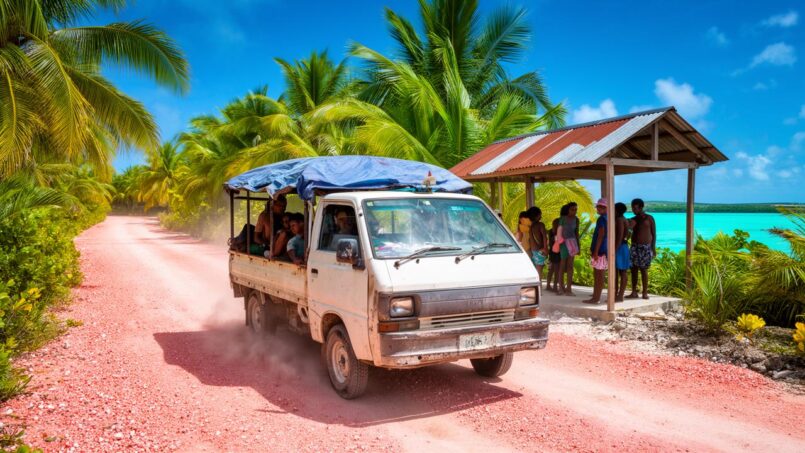
In this compact space, a formal bus or tram network would make little sense. “Public transportation” takes much lighter forms: informal taxis, private minibuses, two‑wheel rentals, walking.
A geography that discourages large networks
On Fongafale, everything revolves around a single main road that runs through villages, government offices, the airport, and residential areas. Distances between points of interest – airport, wharf, hotels, market, government buildings – are measured in minutes rather than tens of kilometers.
This ultra‑compact nature explains the absence of public buses, urban lines, or ticketing systems. Mobility relies on flexibility: everyone manages with walking, biking, scooters, hitchhiking, and taxis.
Taxis: few but available
There is a small number of taxis in Funafuti. The fleet is limited – a few vehicles in service each day – and you shouldn’t expect standards of major capitals: older cars, mostly no air conditioning, rudimentary suspension. But they do the job: shuttling travelers between the airport, accommodations, the port, and villages.
Taxis are generally found:
– near the airport when a flight arrives;
– near main hotels and guesthouses;
– at the wharf.
You can also book by phone or through some local booking platforms that offer fixed‑price transfers, 24/7 pickup, and different vehicle types (standard sedans, SUVs, minivans, even “VIP” vehicles in some catalogs). In practice, the on‑the‑ground reality remains modest, but this structured offering is beginning to appear.
Fares, often negotiable, remain reasonable given the very short distances: a simple trip within Funafuti runs about A$5 to A$8. It is advisable to ask the price before getting in.
Private minibuses: an embryonic form of collective transport
In the village of Vaiaku and surrounding areas, a private 26‑seat minibus runs daily from 7:00 AM to 9:00 PM, mainly for residents’ commutes. There are no bus stops or official schedules: you just flag the driver to get on, and call out to get off.
The fare is modest (a few local dollars), making it one of the few conventional ground public transport options. However, it remains marginal for a traveler: on such a narrow atoll, scooters or walking are far more common.
Scooter and bicycle rentals: the top option
For a visitor, the most practical way to get around Funafuti is renting scooters or small motorcycles. This is the mode of transport massively used by Tuvaluans and it fits perfectly with the short distances and low speed limit (about 25 mph, or 40 km/h maximum).
Several rental points exist:
– at hotels and guesthouses, which often have their own fleet of scooters;
– in small garages or shops along the main road;
– through private individuals who rent out two‑wheelers informally.
Typical rates are around A$20 to A$30 per day, sometimes A$10 to A$15 at the most affordable accommodations. Payment is usually in cash, as Tuvalu’s tourism economy is very much cash‑based.
Renting a bicycle costs about A$10 to A$15 per day, sometimes free at the hotel. The island is flat and without hills, making it a comfortable option despite the sun and humidity.
Indicative daily transport costs on Funafuti
The table below summarizes some ballpark figures, useful for planning a local transport budget.
| Mode of transport | Typical cost | Notes |
|---|---|---|
| Taxi (short trip) | A$5–8 | Negotiable fare, cash payment |
| Private minibus | ~A$2–3 | No fixed schedules or stops |
| Scooter rental | A$20–30/day (sometimes A$10–15) | Via hotels, garages, or individuals |
| Bicycle rental | A$10–15/day | Sometimes free at some guesthouses |
| Walking | Free | Fongafale is ~12 km long, flat terrain |
Walking: a “public transport” in its own right
In Tuvalu, walking is not just a leisure activity; it is often the most logical way to get around. Fongafale is perfectly walkable: the main road is flat, distances between villages are modest, and cars are few. You can cover a good part of the island in about an hour, enjoying views of the ocean on one side and the lagoon on the other.
The airport runway, outside flight hours, even becomes a huge public promenade. Locals gather there at sunset to play sports, chat, or just hang out. For a visitor, it’s a unique experience: sharing a space that serves as a road, an airport, a village square, and a playground all at once.
Absence of trains, urban buses, and heavy transport
At no point is it necessary – or even possible – to take a train or subway in Tuvalu. The archipelago has no rail infrastructure whatsoever, and the narrowness of the islets makes such transport unthinkable.
There is no organized bus network with routes, schedules, and ticketing. Ground transport is limited to the Vaiaku minibus and a few private vehicles, with no stations or transfer hubs, relying on individual initiative.
This simplicity has a downside: no guarantee of service. In case of tropical rain, mechanical breakdown, or a village celebration, informal transport often temporarily stops working. Hence the importance of keeping a good margin of flexibility in your plans.
Between outer islands: logistics that are both essential and unpredictable
For residents of the outer atolls, government ships represent far more than just a transport service. They bring food, medicine, spare parts, fuel, and ensure the rotation of boarding students, civil servants, and medical teams. When the ship is late, the whole local life suffers.
Foreign travelers can embark on these lines, but must accept rustic conditions: basic cabins, crowded decks, rudimentary hygiene, sometimes rough seas. In exchange, they experience a rare, off‑the‑beaten‑path encounter with locals.
More occasional transfers – fishing boats, communal shuttles, motorized canoes – serve trips of a few kilometers: reaching an uninhabited islet for diving, visiting a neighboring village, attending a church service or a festival. Again, everything is often decided by chatting with Tuvaluans on the spot.
Transport and climate change: an explosive equation
Transport in Tuvalu cannot be understood without considering climate pressure. The country, where elevation rarely exceeds two to three meters above sea level, faces rapid sea‑level rise, increasing storm surges, and drought episodes. These phenomena directly affect transport infrastructure:
– regular flooding of the Funafuti runway during high tides;
– accelerated deterioration of roads and wharves from waves and salt intrusion;
– the need to protect or raise strategic arteries (access roads to schools, hospitals, port, airport).
Tuvalu aims for a carbon‑neutral development trajectory by the year 2050.
Yet the bulk of these emissions come precisely from the energy sector, especially transport (diesel for electricity generation and fossil fuels for ships and vehicles). Transitioning to more energy‑efficient modes of transport is therefore not a luxury, but a strategic necessity.
Toward cleaner transport: bikes, e‑bikes, and electric vehicles
To reduce its carbon footprint without compromising mobility, Tuvalu has launched a series of reflections on modernizing its transport sector. A national technology assessment prioritized several options, some of which directly touch on “public transportation” in the broad sense.
Two main axes stand out for land travel on Funafuti:
– massive development of soft mobility: bikes, e‑bikes, walking;
– gradual introduction of light electric vehicles.
Target: 50% of short trips by non‑motorized mobility
Authorities have set an ambitious goal: by 2030, half of all short‑distance trips should be made on foot, by bike, or by e‑bike, which would reduce road transport emissions by about 30%.
To achieve this, several levers are being considered:
– subsidies for purchasing bikes and e‑bikes;
– tax exemptions for soft mobility equipment;
– development of safe paths and lanes for pedestrians and cyclists;
– awareness campaigns promoting walking and biking as “normal” daily modes of travel, not just leisure.
This movement fits with Funafuti’s natural configuration: flat terrain, short distances, low density. All factors that make cycling particularly relevant, including for tourist use.
Rise of light electric vehicles
In parallel, Tuvalu is examining the possibility of gradually converting part of its car and scooter fleet to electric. The stated goal is to have 20% of light electric vehicles on the road by 2030. The country has already experimented with solar‑powered solutions, with mixed results, highlighting the need:
To develop electric mobility, it is necessary to expand charging infrastructure with public stations powered by photovoltaics, develop a viable economic model for battery maintenance and replacement, and reinforce public information on the costs and benefits of electric vehicles.
For a visitor, these projects are not yet visible everywhere. But in the coming years, a growing share of scooters, taxis, and service vehicles will likely become electric, with a direct impact on the soundscape and air quality on the atoll.
Practical tips for using transport in Tuvalu
In the absence of large organized networks, getting around Tuvalu relies heavily on anticipation and flexibility. A few pointers can help avoid unpleasant surprises.
Plan air connections in advance
– Schedule at least one overnight stopover in Fiji before continuing to Funafuti, to absorb a possible flight cancellation.
– Keep in mind daylight constraints: a late takeoff from Nadi can mean outright cancellation if the plane cannot land before sunset.
– Travel with reasonable luggage if possible: flights to Funafuti have strict weight limits, increasing the risk of bag rejection or excess fees.
Book boats in advance… but stay flexible
– Contact the Marine Services Office in Funafuti upon arrival to check the government ship schedule (Nivaga, Manu Folau, etc.).
– Accept that this schedule is indicative; dates are often “subject to change without notice.”
– Set aside extra “buffer” days if you absolutely want to visit an outer island, as the ship may be delayed by several days.
On the ground: adopt the local rhythm
– Walk or rent a bike for short trips: often the simplest and most pleasant solution.
– Rent a scooter to explore all of Fongafale: in one day you can easily cover the atoll from north to south.
– Negotiate the taxi fare before getting in, keeping in mind that trips are short and amounts remain modest.
Rely on accommodations and the community
– Inform your hotel or guesthouse of your arrival time: hosts often arrange transfers from the airport or port.
– Ask locals for advice on specific trips (access to an islet, attending an event on another island, etc.): the solution will almost always involve a local boat or a relative’s boat.
A human‑scale “public transportation”
Talking about “public transportation” in Tuvalu means accepting a much more flexible definition than what residents of large metropolises are used to. Here, there is no crowded subway, no numbered lines, no monthly transport passes. The “public” manifests differently:
– on a government ship where villagers, goods, and civil servants share decks and cabins for days;
– on a single minibus that picks up workers and students every morning along the road;
– on a scooter lent between neighbors to go to the shop or post office;
– on a fishing boat that, out of solidarity, takes an extra passenger for free to the neighboring island.
This handmade mobility, sometimes disorienting, is also one of the charms of Tuvalu. It forces the visitor to slow down, to leave room for the unexpected, to accept that the weather or the tide ultimately has more power over your schedule than a printed timetable.
A charm of Tuvalu
At the same time, it poses immense challenges for a tiny state that, with limited resources, must maintain its roads, wharves, airstrip, and rethink its transport system in the context of climate emergency. Between government ships, bush aviation, scooters, bicycles, and electrification projects, transport in Tuvalu remains in perpetual adaptation – both to the sea gnawing at its shores, and to a world slowly awakening to the fragility of these territories.
For the traveler willing to work with this reality, the archipelago offers a radically different mobility experience: a world where you move first and foremost to the rhythm of the community, the sea, and the sun.
A heritage project or a question? Contact us now to speak with a wealth management expert.
Disclaimer: The information provided on this website is for informational purposes only and does not constitute financial, legal, or professional advice. We encourage you to consult qualified experts before making any investment, real estate, or expatriation decisions. Although we strive to maintain up-to-date and accurate information, we do not guarantee the completeness, accuracy, or timeliness of the proposed content. As investment and expatriation involve risks, we disclaim any liability for potential losses or damages arising from the use of this site. Your use of this site confirms your acceptance of these terms and your understanding of the associated risks.

Cyril Jarnias is an independent expert in international wealth management with over 20 years of experience. As an expatriate himself, he is dedicated to helping individuals and business leaders build, protect, and pass on their wealth with complete peace of mind.
On his website, cyriljarnias.com, he shares his expertise on international real estate, offshore company formation, and expatriation.
Thanks to his expertise, he offers sound advice to optimize his clients' wealth management. Cyril Jarnias is also recognized for his appearances in many prestigious media outlets such as BFM Business, les Français de l’étranger, Le Figaro, Les Echos, and Mieux vivre votre argent, where he shares his knowledge and know-how in wealth management.





