
 Published on and written by Cyril Jarnias
Settling in Madeira often means fulfilling a dream of nature, a gentle way of life, and endless ocean. But from the very first days, the same question arises for travelers, expats, and even seniors spending several months there: how to keep talking, seeing, and hearing loved ones as if you’d never left the mainland?
Madeira benefits from excellent communication infrastructure: high-performance mobile networks, widely available fiber optics, popular messaging apps, and efficient postal services. The main challenge is choosing a practical and cost-effective solution to stay in touch, especially for those less comfortable with technology.
This guide offers a very practical overview of the options available to you from Madeira to stay connected with your loved ones, whether they live in Lisbon, Paris, Brussels, or Buenos Aires. With an important thread running through it: how to help seniors, often less at ease with digital tools, also benefit from this connectivity.
1. Madeira, a surprisingly well-connected island
Madeira has invested heavily in its digital infrastructure. The island is described as “exceptionally well-connected,” with robust and reliable internet and mobile data quality, comparable to mainland Portugal. Fiber optics cover inhabited areas extensively, and 4G/5G is available over much of the territory.
In practice, this means that in Funchal, Machico, Santa Cruz, Câmara de Lobos, or Calheta, you can make high-definition video calls, telework, or stream a movie without difficulty. Even in many coastal villages like Porto Moniz or Santana, you generally get a good 4G signal.
The island’s volcanic terrain, with its central mountains, deep valleys, hiking trails (like between Pico do Arieiro and Pico Ruivo), and road tunnels, creates areas where mobile phone signal can disappear, especially along levada paths and in the Laurissilva forest.
For Porto Santo, the situation is similar: good 4G in the town of Vila Baleira and along the long beach, with a more patchy signal inland and on the northern tip.
In short, staying reachable from Madeira is not a question of “can we?” but rather a choice of operator, plan, and digital tools suited to your needs and those of your loved ones.
2. Choosing a mobile operator in Madeira to stay reachable
Three major national operators cover Madeira, as they do the rest of Portugal: MEO, Vodafone, and NOS. They coexist with a few virtual or newer operators, but for a stay or a move to the island, these three remain the benchmarks.
MEO, the coverage champion
Formerly Portugal Telecom, MEO is the historic operator. It stands out for its network footprint and its specific investments in the Madeira archipelago.
An audit conducted in 2024 in Funchal gave it the highest overall score (956/1000), with particularly high marks for voice and data, as well as excellent quality measured via “crowdsourced” data. MEO boasts nearly 100% 4G coverage of the population and 85% 5G coverage.
Technically, MEO relies on a broad “mid-band” layer (around 3.5 GHz) supported by a solid “low-band” layer (700 MHz), allowing it to combine high speed and coverage in more difficult areas. On Madeira, this strategy translates to better reliability in valleys and rural zones compared to its competitors.
For hikers or those frequently traveling between villages and the interior of the island, operator MEO is often considered the most reliable choice in terms of network coverage.
Vodafone, the safe bet in urban areas
Vodafone, very present in Europe, has an excellent reputation in Portugal for network quality and customer service, especially in urban areas. It is co-leader in reliability with MEO at the national level and stands out for advanced frequency aggregation and good peering paths to the global internet.
Concretely, in and around Funchal, as well as in tourist areas, Vodafone offers high speeds and a very stable experience for video, calls, and browsing. However, in more remote or very mountainous areas, coverage can be slightly less consistent than MEO.
NOS, the budget-friendly option in cities
NOS is often seen as the operator with “good value-for-money” offers. Its 4G/5G coverage is robust in cities and larger towns, and its prepaid plans can be significantly more aggressive in pricing for large data volumes.
NOS signal is known to be less reliable in remote corners of Madeira. It remains generally satisfactory if you are mainly staying in Funchal, Caniço, or along the south coast. However, hikers frequenting the interior or remote areas should consider an alternative solution to stay connected.
Where to buy your SIM in Madeira?
Prepaid SIMs (pré-pago) are very easy to find: at Cristiano Ronaldo Airport (arrivals hall), in shopping centers (La Vie, Forum Madeira, Madeira Shopping), at retailers like Worten, or in official operator stores.
Some examples of plans (approximate figures):
| Operator | Example prepaid offer | Indicative duration | Approximate price |
|---|---|---|---|
| MEO | 10 GB data | 30 days | €15 |
| MEO | “Tourist” plan | 8–30 days, generous data | €14.99–€34.90 |
| Vodafone | 10 GB + national calls/SMS | 30 days | approx. €20 |
| Vodafone | Go Total “unlimited” | 15–30 days | €20–€35 |
| NOS | 5 GB | 30 days | €10 |
| NOS | 40 GB | 1 month | €10–€20 |
Many Portuguese plans also include specific data allowances for social media and messaging (WhatsApp, Instagram…), which is particularly useful for staying in touch without watching every MB used.
For travelers from outside the EU, these local offers are almost always much more economical than standard international roaming, which can charge between €10 and €15 per MB in some home countries.
3. eSIM, local SIM, WiFi: which strategy to stay connected?
To keep in touch with your loved ones, you first need… a connection. In Madeira, three main strategies exist: roaming from your home country, a local SIM (physical or eSIM), and fixed or public WiFi.
Roaming from your home country
If you come from another EU country, the “Roam like at home” regulation allows you to use your plan as at home in Madeira, without major surcharges. However, it remains essential to check your operator’s “fair use” policy, which may impose limits on data used abroad.
The cost of traditional roaming for non-European travelers can reach up to €150 for about ten days.
Local SIM or eSIM: the smart move
This is the go-to solution for anyone wanting to call, send messages, video conference, and use GPS without worrying about their wallet.
A local SIM often costs between €3 and €8 per GB, whereas roaming can go up to €10–€50 per GB. Setup takes about thirty minutes in a store (including identity registration), and most offers are straightforward: you pay upfront, use data, and top up if needed.
For compatible smartphones, eSIM adds the convenience of not having to handle a physical card. Several international providers (Holafly, Airalo, Yesim, Gigago, etc.) sell eSIMs for Portugal: you order online, receive a QR code, scan it, and the connection is ready upon landing.
Some approximate figures:
| eSIM Provider | Example Portugal/Madeira plan | Volume/duration | Indicative price |
|---|---|---|---|
| Holafly | Unlimited data | 5–30 days | ~€18.90–€68.90 |
| Airalo | 1–30 GB | 7–30 days | ~$4.50–$19 |
| Yesim | 10–30 GB or unlimited | 1–30 days | ~$8–$51 |
| Gigago | ~1 GB/day | 7–30 days | ~$21.90–$54.90 |
However, note: many “tourist” eSIMs do not provide a local number for regular calls. They are designed for data use, so perfect for WhatsApp, FaceTime, Zoom… but not for receiving a standard Portuguese phone call.
Fixed and public WiFi
For a long-term stay (expatriation, retirement, remote work), installing a fiber box is often the best solution. In Funchal and most towns, MEO, NOS, and Vodafone offer fixed subscriptions with speeds ranging from 100 Mb/s to 1 Gb/s.
Many establishments like hotels, cafés, libraries, and shopping malls offer free WiFi access. Madeira Island has also deployed a public “Madeira Free WiFi” network in various outdoor spaces such as gardens, squares, and promenades.
This is handy for sending updates or making an occasional video call. But for daily, stable, and secure connectivity, it’s better to avoid relying solely on public WiFi, which is often slower and less secure.
4. The top apps for staying in touch from Madeira
Once connected to the internet, the key lies in the apps you and your loved ones use. And here, one player dominates: WhatsApp.
WhatsApp, the simplest global bridge from Madeira
Globally, WhatsApp has about 3 billion monthly users. In Portugal, over 90% of internet users use it regularly. In 14 countries (including Portugal, Spain, Brazil, Mexico, and Turkey), more than 90% of internet users aged 16+ connect to WhatsApp at least once a month.
In practice, this means that in Europe, Latin America, North Africa, or South Asia, your loved ones are very likely reachable through this channel.
WhatsApp allows, via internet:
– exchanging messages,
– sending photos, videos, documents,
– making audio calls,
– and individual or group video calls.
Calls are end-to-end encrypted, enhancing privacy, and the interface is familiar to users of all ages. Many Portuguese plans even include large data volumes dedicated specifically to WhatsApp.
For someone living in Madeira, mastering this means of communication is fundamental to keeping ties with family and friends.
Other messaging apps and networks widely used in Portugal
In Portugal, the hierarchy of communication apps leans very heavily towards WhatsApp, but other services play a complementary role.
In August 2025, the ranking of communication apps on Android in Portugal placed:
– WhatsApp Messenger at the top,
– Telegram in second place,
– Snapchat, Messenger (Facebook), Discord, and WhatsApp Business also well positioned.
Instagram and Facebook, very popular (used by over 80% and over 60% of the population respectively), are also used for private messages and video calls via Messenger or Instagram calls.
Telegram, meanwhile, claims over one billion active users worldwide and ranks in the top 5 most downloaded apps. It can be a good alternative for loved ones very concerned about privacy, or who participate in large group chats.
When to use Zoom, Skype, FaceTime, Google Duo, or WhatsApp for video?
For more structured video calls (family gatherings, remote birthdays, holiday celebrations), several studies on seniors show that a few platforms stand out:
FaceTime is an ideal video calling solution if all participants use Apple devices (iPhone, iPad, Mac). It offers a simple interface, high image quality (valuable for visually impaired users), encrypted calls, and good group call management. Its major limitation is incompatibility with Android or Windows devices.
– Zoom Designed for video conferencing, it handles large meetings, shared screens, and live captions very well—useful for seniors with hearing difficulties. Multi-platform, it works on smartphones, tablets, PCs, and Macs. However, it requires a good stable connection, and its history of security issues calls for maintaining good practices (passwords, waiting rooms, etc.).
Skype is a historic reference for video calls, accessible on Android, iOS, and Windows. It allows video calls, messaging, file sharing, group creation, and even calls to landlines. Calls between Skype users are free, which can be handy for keeping in touch with loved ones less familiar with newer apps. However, its interface is now considered less modern compared to the competition from newer services.
– Google Duo (now integrated into the consumer version of Google Meet) Designed for simplicity, with end-to-end encryption, a very clean interface, and a call preview feature (“Knock Knock”). Available on Android and iOS, it’s a good option for seniors, though it remains less universal than WhatsApp.
– WhatsApp For seniors, several comparisons explicitly recommend it, along with Google Duo, for its simple interface. For call quality, Zoom and Skype are still slightly ahead, but ease of use and the fact that “everyone already has it” make it the ultimate tool for quick, informal video calls.
To choose what to use from Madeira, a simple rule: start with what’s most common among your loved ones. In many European and Latin American families, that will be WhatsApp; in very “Apple” families, FaceTime; for large “clan gatherings” with cousins around the world, Zoom is often the most practical.
5. Seniors, loneliness, and video: Madeira doesn’t escape the challenge
Madeira attracts many retirees, both Portuguese and foreign. Yet, across Europe, isolation among the elderly is identified as a major public health issue. Portugal is no exception: until recently, only a minority of seniors had computer skills, and many almost never used the internet.
On-the-ground initiatives carried out on mainland Portugal provide valuable insight into what can be set up in Madeira (within families, residences, or associations) to ensure seniors also remain connected to the rest of the world.
When video helps maintain autonomy and reassures the whole family
Studies on video use among the elderly converge: video calls help maintain strong social bonds despite physical distance. They give seniors autonomy, allowing them to manage their own contacts, and reassure their children and grandchildren, who can “see” them regularly, detect changes in appearance or mood, and react if needed.
Specifically designed for the elderly, this digital frame also serves as a video calling terminal. It rings and displays the caller directly without requiring any manipulation on a smartphone. Outside of calls, it continuously displays photos.
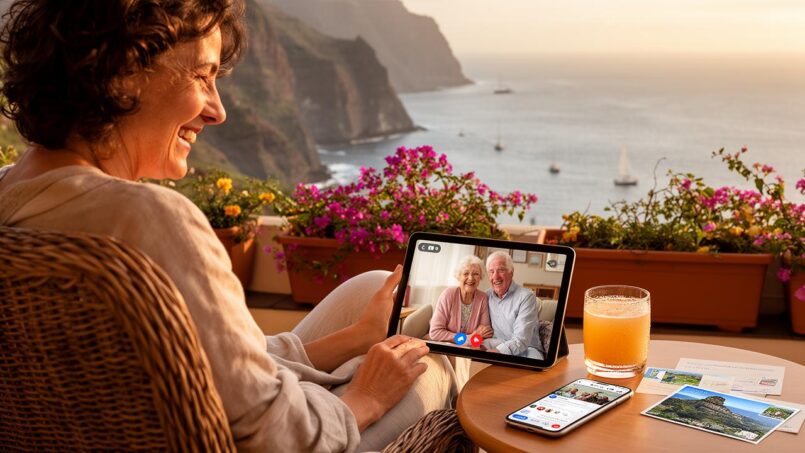
Even without a dedicated device, a simple smartphone or tablet connected to WiFi in an apartment in Funchal can become a window into the grandchildren’s living room in Paris or Brussels.
The barrier of the “digital divide” among those over 65
In Portugal, a study notes that barely over a quarter of 65–74 year-olds had basic computer skills. The government and many organizations have therefore launched massive inclusive digital training programs:
– the national program “Eu Sou Digital” aims to introduce one million adults to basic internet uses;
– projects like OITO or ICTskills4All have shown that a cycle of workshops on smartphones and tablets significantly improves mastery of digital tools for those over 55, with satisfaction rates above 90%;
– centers like CYBER_SÉNIOR or initiatives led by the Aga Khan Foundation equip seniors with tablets and train them to send messages, make calls, or use WhatsApp and Facebook to talk to their families.
This is the number of OITO workshops after which participants notice a clear improvement in their ‘mobile proficiency’.
For a senior living in Madeira, this means that the obstacle is not so much the infrastructure (the island is well connected), but the support: finding someone—child, grandchild, neighbor, volunteer—willing to spend time showing, repeating, and reassuring.
How, practically, to help an aging loved one remotely from Madeira?
If you are on the island and your parents or grandparents stayed behind in your home country, the setup is reversed: you are the one far away. The best practices from Portuguese projects can nevertheless inspire you.
A few simple principles:
– start from concrete uses that matter to the person (seeing grandchildren, receiving photos, following a mass or a show online);
– break down goals: first answer a video call, then initiate one, then open a photo message, etc.;
– prioritize simple interfaces (WhatsApp, Duo, possibly a dedicated device like a connected frame);
– accept repeating often, and using analogies (“it’s like a phone with a picture”).
From Madeira, you can also take advantage of your good connection to organize structured “family meetings” virtually, which we’ll discuss later.
6. Organizing family reunions online from Madeira
Distance, travel costs, and health constraints have popularized a new form of family gathering: the “virtual reunion” or the “family party via video conference”. From a living room in Funchal, you can bring together cousins in Canada, aunts in France, and grandparents still on the Portuguese mainland in just a few clicks.
Research on these virtual gatherings offers several insights.
Why these meetings work so well
A virtual family reunion has several advantages:
– it removes financial barriers (no plane tickets, no hotels);
– it is inclusive for the elderly or those with reduced mobility;
– it makes it easy to record exchanges and memories;
– it requires less logistics (no need to prepare a meal for 30 people).
For a family spread across several countries, it is sometimes the only way to bring everyone together in the same year.
The ingredients for a good online family reunion
Experts recommend organization quite similar to a physical event, adapted to the digital realm:
Clearly defining the reason for the event (birthday, Christmas, quarterly catch-up, introducing a newborn, etc.) is essential. This clear objective serves as a foundation to build and organize the meeting program effectively.
– 2. Choose the right platform
– Zoom for large families and flexibility (breakout rooms, recording);
– WhatsApp or FaceTime for more intimate exchanges, in small groups.
3. Consider time zones From Madeira (same time zone as mainland Portugal), you have to juggle times for the Americas, Africa, Asia. Tools like World Time Buddy or Google Calendar help visualize overlapping hours. It is often advisable to alternate meeting times from one gathering to the next to share the burden across continents.
4. Send clear invitations The invitation should include the date, time with time zone, connection link, planned agenda, and a contact for technical support.
Doing a test connection a few days before the event, especially with elderly participants, helps avoid frustrations. It is advisable to designate a tech-savvy family member to troubleshoot common issues (microphone, camera, etc.).
6. Plan activities Family stories, quizzes, “guess this baby,” karaoke, recipe sharing, presenting a shared photo album… These activities break the ice and give rhythm to the meeting.
7. Limit the duration Beyond 90 minutes, fatigue sets in, especially for seniors. Rather than exhausting everyone, it is often better to plan several shorter sessions throughout the year.
From Madeira, the quality of the connection allows you to act as the “central hub” for this type of gathering: you can share your screen, show a slideshow of photos taken on the island, give a virtual tour of your neighborhood in Funchal via your phone camera… So many ways to bring a little bit of Madeira into the family living room.
7. International phone calls from Madeira: watch out for rates
While the internet is the go-to solution for staying in touch, sometimes a regular phone call is necessary: administrative landline, elderly relative without a smartphone, emergency, etc. In such cases, international rates can quickly add up.
The price grids of a major mobile operator illustrate the scale of the differences: without a specific plan, an international call can cost several dollars per minute; with an international option, some countries become free or very cheap, while others remain expensive (Central Africa, Pacific islands, satellite calls).
The cost per minute of a phone call to certain countries like Burkina Faso or Mauritania can exceed 60 cents.
The lesson for someone based in Madeira:
– to talk to loved ones with internet access, always favor WhatsApp, Skype, or Zoom: the call is then included in your data plan;
– for contacts without a connection, look into low-cost VoIP services (some offer bundles of dozens or hundreds of international minutes for $10);
– if you must use the regular network, consider an international option from your Portuguese operator and carefully check the countries and number types covered (landline vs. mobile).
8. Mail, packages, documents: staying in touch beyond the digital
Staying in touch isn’t just about sending messages or videos. Many also want to send gifts, postcards, administrative paperwork. Here again, Madeira is far from isolated.
Regular mail with CTT
The Portuguese postal service, CTT, serves Madeira just like the rest of the country. Post offices are present in most towns and villages, and many retail points (kiosks, bookstores) sell stamps and envelopes.
Correct addressing is essential to avoid loss and delays. The standard Portuguese postal code applies: four digits, a hyphen, three digits (e.g., 9060-406). A complete address for an apartment typically includes the building name, floor, position (left/right), street, postal code, and city.
Delivery times, under normal conditions, are a few days for domestic mail within Portugal, and 7 to 20 days internationally depending on the destination. For important documents, it is recommended to use tracked or registered services, or, even better, a private courier.
Packages and express: DHL, UPS, FedEx, TNT, and specialized networks
Several major international carriers operate in Madeira, offering deliveries to over 200 countries within 24, 48, or 72 hours depending on the destination. Specific “island” surcharges may apply (for example, an island supplement of about €30 on some services to Madeira/Azores).
To send a package from Funchal, you can use a comparison platform or a specialized store (e.g., Mail Boxes Etc.) to generate a label, schedule a home pickup, and choose the delivery method (home, pickup point, or airport). Delivery times for shipments within Portugal (between the mainland and Madeira) are generally 1 to 3 days.
For an expat in Madeira, these options are particularly useful for:
– receiving personal effects sent from the home country;
– shipping birthday or Christmas gifts to family abroad;
– sending signed documents quickly.
Madeira is therefore not a postal “end of the world”: as long as addresses are correctly filled in, formatting rules are followed, and, for non-EU destinations, customs forms are attached, letters and packages circulate without major difficulty.
9. Managing time differences to communicate without disturbing
If you are in Madeira and your loved ones are in France or Belgium, the problem is simple: the same time zone or nearly so. Complications arise when the family is more spread out: a brother in Canada, parents in Europe, a child in Asia.
Specialists in remote collaboration recommend a few habits to avoid accidentally calling at 3 AM.
Get into the habit of always mentioning the time zone
When proposing a call or video slot, it is recommended to always specify the reference zone and, ideally, indicate the corresponding time in the main time zone of the person you’re contacting.
Example from Madeira: > “Let’s talk on Sunday at 8 PM (Madeira/Lisbon time), which is 9 PM in Paris and 3 PM in Montreal.”
To facilitate organizing international meetings, use tools like Google Calendar, which automatically converts times and sends invitations in each participant’s time zone. Specialized converters, such as World Time Buddy, also allow you to quickly visualize acceptable overlapping time slots between different countries.
Respect everyone’s “normal” hours
General recommendations in international work also apply to family relationships:
– avoid non-urgent calls and messages during the recipient’s nighttime;
– use the scheduling features of emails or messages (some tools like Slack or certain email clients allow you to write at one time and send later in the other person’s day);
– establish, when necessary, a shared time window (for example, 5–7 PM in Madeira, corresponding to morning across the Atlantic).
In a very geographically dispersed family, it is advisable to vary the time slots for large online meetings. This helps balance the effort and not systematically impose difficult hours on the same members, such as those living in Asia who would have to go to bed at midnight to connect with relatives in Europe.
Use asynchronous communication when live isn’t possible
With time differences, expecting instant responses all the time is unrealistic. Asynchronous tools—WhatsApp messages, emails, recorded explanatory videos (via Loom or simply the smartphone camera)—allow you to stay in touch without requiring simultaneous presence.
The important thing then is to clarify expectations: specify, for example, that you don’t expect a reply until the next day, or that the message is “for later,” which avoids putting unnecessary pressure on loved ones who are sleeping… or working.
10. Leveraging the Portuguese digital ecosystem when living in Madeira
Living in Madeira also means integrating into a country where digital technology plays an important role in daily life. This can facilitate many aspects of communication with your loved ones… and with institutions.
In 2025, about 89% of Portuguese were internet users, and nearly three-quarters of the population had at least one social media account. Young adults (18–30) are almost all equipped with smartphones and check social networks daily, often for more than two hours a day.
WhatsApp, Instagram, Facebook, and Messenger dominate usage, while Telegram, Snapchat, or Discord are growing, especially among younger people. For an expat in Madeira, this means that:
The majority of local contacts (neighbors, colleagues, shopkeepers) are reachable via instant messaging. These tools are easy to use for both work and private life. You can create groups (family, neighborhood, expat, etc.) to structure your social life effectively.
Useful services and apps, between Madeira and the rest of the country
Several apps have been designed at the Portugal level and prove very practical in Madeira for informing and reassuring your loved ones.
– JM Madeira: news app about the island (news, sports, events), useful for understanding the local context and sharing it with those back home (“Look, there’s such and such a festival in Funchal”).
ProCiv is the official Portuguese app for emergency situations. It allows you to quickly alert emergency services by automatically transmitting your profile and geolocation. It’s a reassuring tool because your family knows you have it available in case of a problem.
– Translation apps: several services with hundreds of thousands of positive reviews allow you to translate spoken or written phrases between English and Portuguese, including from photos. Some paid versions work offline. Invaluable for senior expats in Madeira who don’t speak the language, and for reassuring their family about their ability to get by.
These building blocks complement the core arsenal—smartphone, messaging, video—and help make Madeira a base where you can live “far away” while remaining intensely connected.
Conclusion: Madeira, out of sight… but not out of heart
Madeira is not just a refuge for nature lovers and those seeking a mild climate. The island has equipped itself with a digital infrastructure that brings it closer, on a daily basis, to Lisbon, Paris, São Paulo, or Montreal. Fiber, 4G/5G, affordable local SIMs, eSIMs activated in minutes, ultra-popular messaging apps like WhatsApp, video conferencing platforms, and efficient postal and courier services: everything works to make distance a mere logistical detail, not an insurmountable wall.
Staying in touch with loved ones from Madeira is therefore above all a matter of strategy:
To maintain good communication with family abroad, it is advisable to: choose an operator and connection type suited to your usage; favor tools already familiar like WhatsApp, supplemented by Zoom, FaceTime, or Skype; simplify interfaces for seniors by drawing on digital literacy programs; not neglect mail and packages for their emotional value; and learn to manage time zones without disrupting sleep or work.
On this basis, the kilometers between Madeira and “home” largely fade away. A parent’s voice, a grandchild’s laugh, news from a friend are just a click away, whether you’re on a balcony in Funchal or by a levada. The essential, deep down, remains what it has always been: taking the time to call, write, show that you are thinking of others—technology merely opens wider the channels through which these attentions flow.
A wealth management project or a question? Contact us now to speak with a wealth management expert.
Disclaimer: The information provided on this website is for informational purposes only and does not constitute financial, legal, or professional advice. We encourage you to consult qualified experts before making any investment, real estate, or expatriation decisions. Although we strive to maintain up-to-date and accurate information, we do not guarantee the completeness, accuracy, or timeliness of the proposed content. As investment and expatriation involve risks, we disclaim any liability for potential losses or damages arising from the use of this site. Your use of this site confirms your acceptance of these terms and your understanding of the associated risks.

Cyril Jarnias is an independent expert in international wealth management with over 20 years of experience. As an expatriate himself, he is dedicated to helping individuals and business leaders build, protect, and pass on their wealth with complete peace of mind.
On his website, cyriljarnias.com, he shares his expertise on international real estate, offshore company formation, and expatriation.
Thanks to his expertise, he offers sound advice to optimize his clients' wealth management. Cyril Jarnias is also recognized for his appearances in many prestigious media outlets such as BFM Business, les Français de l’étranger, Le Figaro, Les Echos, and Mieux vivre votre argent, where he shares his knowledge and know-how in wealth management.





