
 Published on and written by Cyril Jarnias
Lost in the heart of the Pacific, Tuvalu is one of the least-visited countries in the world. The archipelago has no large resorts, no mass cruises, and no flashy tourist infrastructure. Yet for those who embrace the isolation, the slow pace of maritime connections, and the scarcity of flights, Tuvalu offers a rare combination: spectacular lagoons, nearly pristine reefs, untouched Polynesian villages, and a culture deeply tied to the land and sea.
Good to know:
The sites and experiences in Tuvalu are first and foremost a gateway to issues of preservation, climate change, and community life, based on recent studies in tourism, biodiversity, and sustainable development.
Funafuti: Gateway and Tourist Heart of the Country
Most visitors only ever land on one island: Funafuti, the capital atoll and the country’s only aerial gateway. It is also, quite simply, the only place where tourist accommodations are available.
Funafuti is a long ribbon of coral set between ocean and lagoon. Fongafale, the main islet, concentrates the airport, services, the majority of the population, and the few places to stay and eat. The landscape is surprising: the airstrip literally cuts across the island, and when no planes are scheduled, it transforms into a huge playground where people come to run, play soccer, volleyball, or simply stroll at sunset.
The overall atmosphere is one of total simplicity. Getting around is done on foot or by bike, with a few motorbikes and taxis rounding out the options, but the tiny scale of Fongafale makes walking very practical. The main beaches and small shops are within walking distance of most guesthouses.
Life Around the Airstrip and the Village of Vaiaku
The center of public life is located between the airstrip, the lagoon front of Vaiaku, and the administrative buildings. This is where the archipelago’s main hotel is found, the Funafuti Lagoon Hotel (formerly Vaiaku Lagi Hotel), with about twenty rooms, a restaurant, and a terrace overlooking the lagoon, although part of the view is now obscured by landfill work.
Example:
Around the airport, a few family lodges like Filamona Lodge (popular with expats), Esfam Lodge and L’s Lodge (typical of Tuvaluan hospitality), Niueti Lodge (sea view and quiet), or the guesthouses Nene’s Accommodations and Lilah’s Lodge offer few rooms, family management, and direct contact with locals.
Capacity remains very limited and is often taken up by seamen, government workers on assignment, or technical teams working on large projects (coastal adaptation, submarine cable, aviation). Booking well in advance, preferably by contacting establishments directly via email, is almost essential.
The Tuvalu Women’s Handicraft Centre: A Showcase of Craftsmanship
In the heart of Vaiaku, a stone’s throw from the airport, the Tuvalu Women’s Handicraft Centre is one of the cultural must-sees. This community center, established in the 1990s, functions both as a small ethnographic museum and a craft market. Here you’ll find what defines the material soul of Tuvalu: woven pandanus mats, baskets, fans, shell necklaces, decorative objects sometimes made from recycled materials.
Tip:
More than a sales space, it is a place of transmission. Women work there, weaving or crocheting (kolose) while explaining techniques, patterns, and their family history. Buying here directly supports artisans and helps preserve traditional skills that are fully integrated into the country’s tourism offering.
The table below summarizes the types of items you can discover there:
| Type of Item | Main Materials | Cultural or Everyday Use |
|---|---|---|
| Mats (ta’ele) | Dried and woven pandanus leaves | Ceremonies, gifts, home decoration |
| Baskets and hats | Pandanus, coconut fiber | Transport, traditional clothing |
| Necklaces (tui misa/pule) | Shells from the Cypraeidae family, fibers | Adornment, ceremonial gifts |
| Crocheted fabrics (kolose) | Cotton or synthetic fibers | Clothing, doilies, decorative items |
The Cultural Centre and National Library
Still in Funafuti, a visit to the Tuvalu National Library and Archives helps you understand how the country documents its memory and heritage. The library holds archives on colonial history, oral traditions, songs and dances like the fatele, as well as recent impacts of climate change or diplomatic relations surrounding the country’s survival challenges.
The small adjacent cultural center occasionally hosts exhibitions of contemporary Tuvaluan art, often focused on the sea, storms, taro pits (pulaka), and village life. These modest but dense spaces are among the essential “sites” for anyone wanting to grasp the cultural depth of the islands.
Funafuti Conservation Area: An Ecological Gem and Ecotourism Laboratory
About fifteen kilometers from Fongafale, on the western side of the atoll, lies Tuvalu’s iconic natural site: the Funafuti Conservation Area, also called Kogatapu or Funafuti Marine Conservation Area. Established in the late 1990s after scientific surveys and extensive consultation with customary landowners and the council of elders, this protected area covers approximately 33 km² of reefs, lagoon, passes, ocean, and six small islets (motu).
Among these islets are Tepuka Vili Vili (or Tepuka Savilivili), Fualopa, Fuafatu, Vasafua, Fuagea (or Fuakea), and Tefala. Their total land area is small—barely 8 hectares—but their ecological importance is disproportionate: they harbor nearly 40% of the remaining native forest on the atoll and significant fragments of tropical coastal woodland. No one lives there today, and all forms of fishing, hunting, or collecting are prohibited.
Remarkable Biodiversity in a Tiny Space
Biological surveys conducted before and after the creation of the protected area showed exceptional richness for such a small country. Before 1999, 76 “indicator” fish species, 141 edible fish species, and 149 species of mobile invertebrates (crabs, sea cucumbers, etc.) were recorded. A 2010 survey brought the total known fish species in Tuvalu to 607, including 66 new records for the country.
Attention:
The reefs, although affected by El Niño-related bleaching, host corals, algae, and invertebrates. You can observe moray eels, reef sharks (gray, blacktip, whitetip, lemon), manta rays, and spotted eagle rays (near-threatened IUCN). Offshore, pelagic predators like tiger sharks, oceanic whitetip sharks, and makos (rokea).
The protected area also plays a critical role for sea turtles. Nesting sites are found for the green turtle (fonu in Tuvaluan), a species globally endangered or critically endangered depending on the list, as well as the hawksbill and leatherback turtles, both highly threatened. On Fualopa islet, a colony of black noddies (taketake) nests, among the nine seabird species and several migratory shorebirds, including the rare bristle-thighed curlew.
A Dream Playground for Diving and Snorkeling
For the visitor, the Funafuti Conservation Area is first and foremost a vast marine park accessible by boat from Fongafale. Day trips can be negotiated with owners of local boats or through the lodges; you cross the lagoon—about 15 km—to picnic on a coconut-palm-dotted motu, snorkel over coral heads, or explore the outer slope when sea conditions allow.
Good to know:
Tuvalu has no structured dive centers like those in Fiji or French Polynesia. Diving here is of the exploration type, with areas along the outer slopes, in the passes between ocean and lagoon, and around coral bommies. Currents are stronger, but the chances of seeing reef sharks, rays, and large jacks are higher.
Inside the lagoon, dives are calmer and shallower, suitable for snorkeling. Visibility varies with tides and weather, but the absence of mass tourism means the reefs experience far less human pressure than elsewhere in the Pacific. A 2007 monitoring study actually showed an increase in biomass of commercially valuable fish and the presence of large individuals, indicating low fishing pressure in the zone.
A Symbol of Tuvaluan Ecotourism
The Funafuti Conservation Area is at the heart of the national tourism strategy. The Tuvalu Sustainable Tourism Policy 2022‑2032 cites it as an example of an ecotourism product that can combine discovery, education, and conservation. The country explicitly encourages visitors to come, provided they follow strict rules: no fishing, avoid touching corals, do not collect shells, minimize waste, and, if possible, participate in beach clean-ups or coral restoration actions.
In this model, the protected area is not just a “spot” to check off, but a laboratory: it demonstrates that for a micro-state extremely vulnerable to climate change, it is possible to use tourism as a lever to strengthen the protection of its natural heritage rather than deplete it.
Protected Area Model
Beaches and Islets of Funafuti Lagoon: A String of Escapes
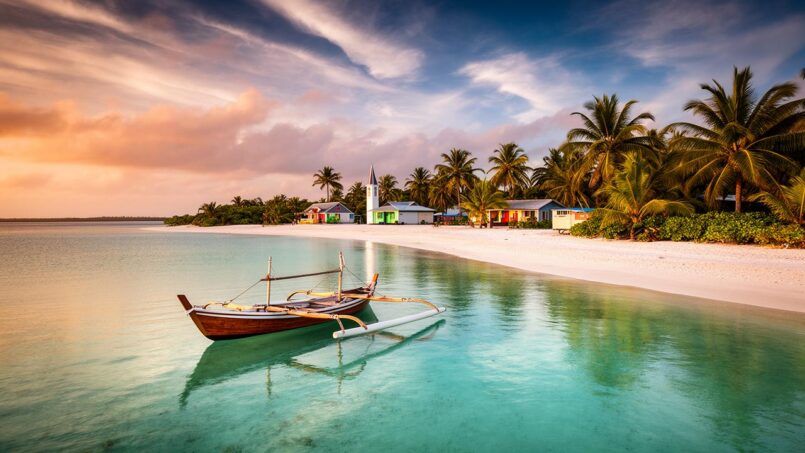
Around the main landing, the vast Funafuti lagoon (called Te Namo) opens like a turquoise amphitheater dotted with islets and sandbars. Several beaches and motu have become destinations in their own right for locals and the rare traveler alike.
Among the most well-known are Fatato Beach, Tuvellice Beach, Falauniufatu Beach, Tepuka, Tepuka Vili Vili, Funafala, and Tefonufala. Each offers a slightly different face of the same picture: white coral sand, rows of coconut palms, crystal-clear water over sandy bottoms or scattered coral heads.
Good to know:
These anecdotal sites are part of a larger project for a UNESCO Global Geopark in Funafuti, led by the Pacific Ecotourism Recovery Initiative. The goal is to use the atoll, lagoon, reefs, and villages as a coherent whole to tell the story of atoll geology, reef dynamics, Polynesian cultural adaptation, and contemporary climate challenges.
The following table illustrates some iconic islets and beaches of Funafuti lagoon:
| Lagoon Site | Tourist Highlights | Main Access from Fongafale |
|---|---|---|
| Fatato Beach | Postcard beach, easy snorkeling | Short boat trip or local canoe |
| Tepuka | Forested motu, white sand, near protected area | Organized day excursion |
| Tepuka Vili Vili | Islet vulnerable to cyclones, surrounding corals | Same (depending on sea conditions) |
| Funafala | Intermittently inhabited islet, village atmosphere | Local boat, sometimes informal connections |
| Falauniufatu / Tefonufala | Sandbanks, swimming, marine life observation | Chartered boat, favorable tide |
Day trips often combine several of these stops with time for swimming, traditional fishing (outside the protected area), or simply lounging. The lack of built structures and the need to bring your own drinking water remind you, however, that these “tourist sites” remain first and foremost fragile natural spaces.
Nanumea, Nanumaga, Nukulaelae, and Other Outer Atolls
Most visitors stick to Funafuti due to lack of time, budget, or regular connections. Yet the outer atolls are arguably the most fascinating sites in Tuvalu for anyone seeking deep immersion in island life.
You will find no hotels, no tourist restaurants, and no organized tours. Travel is exclusively by government ships, which serve each island every two or three weeks, sometimes less frequently. The lack of a wharf on most islands means passengers and cargo have to be transferred to small boats, often in conditions that can be difficult or even dangerous when the sea is rough.
Despite these constraints, certain atolls stand out as niche destinations, especially for diving, exploring nearly self-sufficient communities, and observing the impacts of climate change.
Nanumea: Quiet Lagoon and Exposed Reefs
Located at the extreme north of the archipelago, Nanumea is one of the five atolls with a closed lagoon. Its entrance channel, well-marked but shallow and narrow, deters many large sailboats, especially when tidal currents are strong. Once inside, however, the anchorage is remarkably calm, protected by the island and surrounding reef.
2010
In 2010, surveys confirmed a great variety of reefs including outer slope, reef flat, and patch reefs, with fauna similar to Funafuti but in an even more discreet human context.
For a visitor with their own boat—the only realistic way to explore these reaches—Nanumea offers very uncrowded outer reef dives, walks around the island, and direct contact with a population that lives primarily from fishing, pulaka cultivation, and some subsistence crops supplemented by supply ship arrivals.
Nukufetau: The Accessible Lagoon and Crossroads Atoll
About 85 nautical miles north-northwest of Funafuti, Nukufetau Atoll is one of the few, along with Funafuti, to have a natural pass deep enough to allow ships into the lagoon. For sailboats, access via Teafua Pass is considered relatively straightforward and then offers several well-sheltered anchorages, although a westerly wind at high tide can make mooring uncomfortable.
Attention:
Nukufetau is an active community, not a tourist site, connected to Funafuti by government ships. It has a small bank with no ATM, basic food stores, and internet access at the government station. Shelves empty before the cargo ship arrives, illustrating its extreme logistical dependence.
For a traveler, the interest lies in observing this coral rural life, fishing trips within the lagoon and on the outer slope, and directly studying what it means to live “on the front line” of climate change: poor soils, scarce fresh water, increasing pressure from storms and sea-level rise.
Nukulaelae and the New Lagoon Ports
Further south, Nukulaelae is one of the pilot islands for the maritime and tourism strategy. Thanks to a large project funded notably by the Asian Development Bank, a new channel and a small inner harbor have been developed in the lagoon to reduce risks during passenger and cargo transfers. A safer wharf, boat shelters, and a dredged and marked channel now facilitate arrivals.
Good to know:
This type of investment, prioritized on the islands of Nanumaga, Niutao, and Nui, aims to secure transfers and reduce the dangers of stopovers. In the long term, it will allow for modest but better-distributed tourism, via family stays or community lodges.
Niulakita, Vaitupu, Nui: Preserved Landscapes and Cultures
Other islands, even more isolated, currently welcome almost no leisure travelers. Niulakita, tiny, has only about a dozen houses; you can walk around it in just an hour, skirting the coast, between rocks, fallen trunks, erosion, and heavy swell coming from the open ocean. Vaitupu, the largest atoll by area, houses the only national high school and a subsistence agriculture structured around pulaka taro pits.
Everywhere, the same reality: no hotels, no specific tourist infrastructure, but immense cultural wealth. Songs, dances, navigation stories, religious or community festivals punctuate village life and constitute, for the future, potential “tourist sites” once respectful visitation frameworks are in place.
Nanumanga and the Underwater “Fire Caves”
Among the most intriguing curiosities of Tuvalu is a site still very inaccessible: the famous “fire caves” of Nanumanga. Discovered during dives in the 1980s, these underwater cavities near this northern atoll revealed traces of combustion, suggesting they were frequented or used by humans at a time when sea levels were lower.
The Submerged Archaeological Potential
A site of international scientific importance, but a tourist visit fraught with challenges.
Scientific Importance
An ancient submerged habitation or ritual site, of global interest for archaeology.
Tourist Difficulties
No dive club, unreliable boat logistics, depth and demanding marine conditions.
Nanumanga nonetheless illustrates the nature of Tuvalu’s “must-see sites”: they are less about over-equipped places than about focal points where human history, atoll geology, sea-level rise, and possible underwater archaeology intersect. For diving researchers, documentary filmmakers, or enthusiasts of island prehistory, this type of location is one of the very reasons to come to Tuvalu.
Funafala and Traditional Villages: Back to the Rhythm of the Atolls
On the scale of Funafuti, the islet of Funafala represents a sort of anti-capital: a more peaceful island village, away from the noise of Fongafale’s engines, accessible by boat, and still deeply oriented toward fishing, cultivation, and community life. For some Tuvaluans, it is a refuge, even an alternative to the growing density of the capital and its waste management problems.
Example:
Small eco-lodges have developed on nearby motu, such as Afelita Island Resort on an islet north of Fongafale. Run by a Tuvaluan couple, these island accommodations offer an experience far from the standards of large chains: a few bungalows, a near-silent environment, meals prepared with local produce, and above all total immersion in the daily life of a family.
For the visitor, the “visit” to these traditional villages is as much a tourist site as a social experience. You learn:
Good to know:
In this island country, survival depends on rigorous management of freshwater reserves (wells, rainwater tanks) and agriculture adapted to coral soils (pulaka, taro, bananas, cassava, pandanus), sometimes cultivated in pits reaching the water table. Local power structures, notably the *Falekaupule*, chiefs, and pastors, govern the use of land, reefs, and lagoons.
Looking ahead to the future UNESCO candidacy of the Tuvalu atoll cultural landscape, these villages and their taro pits are set to become internationally recognized sites, both as witnesses to pre-colonial sustainable management practices and as experimental grounds for adapting to climate change.
Lakena, Pulaka, and Coral Agricultural Landscapes
The islet of Lakena, at the northern tip of one of the atolls (sources describe it notably for Vaitupu), perfectly illustrates what an “agri-tourism site” in Tuvalu could be. Barely 2.3 km long, this strip of land is home to a small population of about 580 inhabitants, a freshwater lake used for washing, and a belt of pulaka taro pits dug into the coral substrate.
These deep pits, maintained and fertilized for generations, testify to the ingenuity deployed by the inhabitants to feed themselves in an environment almost devoid of soil. Between the taro pits, fruit trees—coconuts, breadfruit, pandanus, bananas, mangoes—form a patchwork of community gardens and family plots.
Currently, Lakena receives almost no tourists, but in the vision of the Tuvalu Sustainable Tourism Policy, this type of landscape is central: it tells the story of the “importance of the land” (taaua o manafa), a fundamental value for Tuvaluans, and could, through guided visits, address the burning issue of salinization of water tables and taro pits due to sea-level rise.
Lakena Beach and Waves for Surfing
At the opposite end from the calm lagoons, some coastal areas like Lakena Beach are known for offering regular waves, suitable for surfing or stand-up paddleboarding. Available information remains fragmentary, but it is known that the bathymetry of the reef flats and the configuration of the reef produce interesting sets for experienced surfers willing to accept the lack of supervised services and rescue equipment.
Tip:
Tuvalu has no surf school or structured equipment rental. Currently, the waves are only accessible to surfers who already have their own gear, often during sailboat crossings. To develop tourism, small local structures would need to be created to supervise this activity, while remaining very vigilant about impacts on the coastline.
Diving at Funafuti, Nanumanga, and in the Reef Passes
Even though Tuvalu does not have an internationally certified dive center, the country’s waters offer a considerable playground for enthusiasts of scuba diving or snorkeling. The almost entirely coral nature of the territory—nine atolls and islands on a reef table, with no continental shelf—results in:
Example:
Dive sites in Tuvalu are characterized by steep outer reef slopes where deep blue appears quickly after the reef break, spectacular natural passes like those of Funafuti or Nukufetau where currents, nutrients, pelagic fish, and reef sharks concentrate, as well as numerous coral “bommies” in the lagoons that serve as refuges for a highly diverse fauna.
Tuvalu’s appeal for diving lies less in listed “star” sites than in the feeling of being almost alone in the world underwater. The low tourist traffic and restricted fishing in the Funafuti Conservation Area result in the presence of large individuals among targeted species (groupers, snappers), a rare phenomenon on heavily exploited reefs.
70
Over 70% of Funafuti’s reefs were bleached during the El Niño events of 1998-2000 and 2000-2001.
For divers, these reefs thus become beautiful and poignant sites, where you can concretely observe the marks of climate change and the local efforts to cope with it.
Living Cultural Sites: Fatele, Festivals, and Meeting Houses
To talk about “must-see sites” in Tuvalu without mentioning culture would be to miss the point. Here, most heritage places are not frozen monuments but living social spaces: the village church, the Falekaupule (council house), the grassy area that serves as a central square. This is where fatele performances take place, a collective dance-song form where men and women, in pandanus costumes, strike powerful rhythms and tell the story of the clan, the island, or recent events.
Good to know:
The fatele is experienced during religious festivals, weddings, or national celebrations like Te Aso Fa’ahinga (Independence Day). It is not a tourist spectacle but a community event combining aesthetics, friendly competition, and solidarity.
Thematic festivals, such as Te Lapa dedicated to fishing practices, or days devoted to weaving, carving, or music, also punctuate the year. Although they do not yet have a formalized tourist calendar, these events could eventually become strong pillars of the cultural offering, provided they are guided by the communities’ own priorities rather than external expectations.
Museums, Memories, and World War II Relics
Besides the women’s handicraft center and the national library, Funafuti also retains tangible traces of World War II. Military remnants—old airstrips, concrete structures, wrecks or remains of installations—survive on some islets or near the capital.
Good to know:
Tourism development studies identify relics as an asset for travelers interested in Pacific military history. Combined with guided tours of ancient cultural sites (taro pits, drought shelters, old wells), they can create a heritage trail across the atolls.
Again, nothing is standardized today: no military museum, few interpretive panels. But these elements are already part of the places to explore for anyone wanting to understand the layers of history superimposed on a few square kilometers of coral.
Tuvalu: A “Last-Chance” Destination and Sustainable Tourism Laboratory
If you look at all these sites—marine protected areas, traditional villages, agricultural landscapes, isolated reefs, festivals, craft centers—a common thread emerges: Tuvalu positions itself as a niche, even “last-chance” destination for those who want to see with their own eyes the concrete impacts of sea-level rise and storms, but also the responses implemented by an island society.
Good to know:
Tuvalu’s 2022‑2032 tourism policy targets study travelers, volunteers, and students in coastal management or marine biology, among others. Visitors are invited to contribute to concrete actions: mangrove reforestation, reef restoration, beach clean-ups, and to minimize their footprint by avoiding single-use plastics, conserving water, and prioritizing walking or biking.
In this perspective, each “must-see site”—whether it is the Funafuti Conservation Area, Lakena with its taro pits, Nanumea and its lagoon, or the Tuvalu Women’s Handicraft Centre—also becomes a place of education and mobilization. The country is working on innovative tools, ranging from a possible “environmental pledge” stamped in the passport to future labels for responsible accommodations or a potential ecological levy dedicated to funding adaptation.
Synthesis: How to Look at Tuvalu’s Sites Differently
For a country whose total land area barely reaches 26 km², scattered over nearly 1.3 million km² of ocean, the notion of “must-see tourist sites” takes on a special meaning. It is not about stacking must-sees, but understanding that every motu, every lagoon, every meeting house plays multiple roles at once: a living place, a fragile barrier against the sea, a biodiversity reservoir, a memory holder, an adaptation laboratory.
The following table summarizes some major site types and their cross-cutting functions:
| Site Type | Primary Example | Tourist Function | Essential Local Function |
|---|---|---|---|
| Marine protected area | Funafuti Conservation Area | Diving, snorkeling, excursions | Conservation, fishery reproduction, education |
| Traditional village / motu | Funafala, villages of Vaitupu | Cultural immersion, homestay | Habitat, customary governance, agriculture |
| Coral agricultural landscape | Lakena taro pits | Agri-cultural visit | Food security, water management |
| Beach / lagoon islet | Tepuka, Fatato, Tuvellice Beach | Swimming, picnic, observation | Coastal protection, limited resource collection |
| Cultural / craft center | Tuvalu Women’s Handicraft Centre | Museum, shopping, workshops | Income for women, transmission of knowledge |
| Historic site / war relic | World War II remnants | Heritage tourism | Historical marker, collective identity |
Coming to Tuvalu means accepting that the “must-see” is less a monument than a conversation, a reef, a shared meal under a pandanus roof, or an overnight trip on a government cargo ship. It also means understanding that these sites are not just fragile backdrops threatened by rising seas, but places of social and environmental innovation where, on a small scale, possible responses to planetary crises are being sketched out.
For those who choose to make the journey, the Funafuti Conservation Area, the lagoon motu, the villages of the outer atolls, the taro pits of Lakena, the waves of Lakena Beach, the “fire caves” of Nanumanga, the fatele festivals, and the woven halls of the Falekaupule will form a unique itinerary, a world away from classic tourist circuits. A network of discreet but unforgettable sites, in a country that has decided to make tourism an ally, not an enemy, of its survival.
A heritage project or a question? Contact us now to speak with a heritage management expert.

Cyril Jarnias is an independent expert in international wealth management with over 20 years of experience. As an expatriate himself, he is dedicated to helping individuals and business leaders build, protect, and pass on their wealth with complete peace of mind.
On his website, cyriljarnias.com, he shares his expertise on international real estate, offshore company formation, and expatriation.
Thanks to his expertise, he offers sound advice to optimize his clients' wealth management. Cyril Jarnias is also recognized for his appearances in many prestigious media outlets such as BFM Business, les Français de l’étranger, Le Figaro, Les Echos, and Mieux vivre votre argent, where he shares his knowledge and know-how in wealth management.





