
 Published on and written by Cyril Jarnias
Moving to Tuvalu, whether for a few weeks or several years, raises a very concrete question: how can you keep in touch with your family, friends, and colleagues when you live in one of the most isolated countries in the Pacific? The good news is that the archipelago is gradually emerging from the digital shadows. Submarine cables, next-generation satellites, and the rise of 4G are changing the game. The not-so-good news is that constraints remain strong, especially as soon as you move away from Funafuti.
To stay reachable and support loved ones from a distance while in Tuvalu, you need a concrete strategy based on local infrastructure and tools, avoiding marketing promises.
Understanding Tuvalu’s digital landscape
Before choosing an app or a SIM card, it is essential to understand the playing field: who provides internet and mobile service, how the islands are connected to the rest of the world, and what the main bottlenecks are.
Tuvalu consists of nine islands, scattered across a vast maritime area, with barely ten thousand inhabitants. For a long time, the country ranked among the least connected states on the planet. In 2012, the entire country had only 1.5 Mbit/s download and 512 kbit/s upload. In other words, the bandwidth of a single “average” European household for the entire country.
The historic provider, entirely state-owned, is the Tuvalu Telecommunications Corporation (TTC). For years, this company was simultaneously the telecom operator, internet service provider, and manager of international links, with no real competition. Its mobile network is based on GSM, with widespread 2G/3G and limited 4G, concentrated on Funafuti and a few islands.
Nearly 74% of residents use the Internet, a rate higher than the global average.
Submarine cable and satellites: a gradual revolution
This historical lag stems from the fact that Tuvalu was only connected to the world via satellite. Geostationary contracts (Intelsat, ABS, then Kacific) provided at best a few hundred Mbit/s for the entire country, at high costs and with significant latency. In 2019, the government still had to make do with 73 Mbit/s for the main government building.
Several breakthroughs have occurred nonetheless.
In 2020, TTC signed an agreement with Kacific using a dedicated beam on the Kacific-1 satellite, increasing national capacity from 340 Mbit/s to about 640 Mbit/s. The contract included 60 VSAT terminals for schools, clinics, and government offices, 40 outdoor Wi-Fi hotspots, and 4.5 m and 2.4 m antennas for mobile backhaul. Thanks to this agreement, TTC reduced retail internet prices by about 50%, connected over 50 business customers, and equipped eight primary schools, two secondary schools, and one specialized facility for people with disabilities.
Then, the arrival of Starlink is radically changing the game. The service was introduced in 2024, followed by a “Starlink Community Gateway” station installed on Funafuti, capable of delivering up to about 10 Gbit/s. By 2025, Starlink captured nearly 90% of the local internet market, with consumer plans offering speeds of 50 to 150 Mbit/s and latency around 50 ms. TTC even migrated its international traffic to Starlink and cut its Kacific links in the summer of 2025.
The country’s first submarine cable, the Tuvalu Vaka Cable, connected in December 2024 and activated in October 2025, is part of Google’s Central Pacific Connect initiative. Funded at $56 million by Australia, the United States, Japan, Taiwan, and New Zealand, it offers four fiber pairs and scalable capacity beyond 10 Gbit/s, ensuring faster, more stable, and cheaper internet access.
Coverage and internal divide
Despite these advances, the reality remains mixed between the capital and the outer islands. On Funafuti and Vaitupu, about 68% of the population has 4G; on other islands, mobile coverage drops or disappears. Some localities have virtually no modern communications: no internet, no mobile, and sometimes not even a working HF radio or landline phone.
The network core is located on Funafuti, and the outer islands remain connected via VSAT. On these islands, access is mainly through community Wi‑Fi hotspots powered by satellite terminals. Typically, there are three to five hotspots per island, which residents connect to using their own phones. Where no site is installed, you may have to walk several kilometers to get a usable signal.
In this context, staying in touch with your loved ones requires juggling different means: mobile, Wi‑Fi, personal satellite, or even HF radio for emergency situations.
Choosing your connection: roaming, local SIM, eSIM, satellite
With the scene set, you need to decide the key question for any resident or traveler: what will your daily connection rely on? Four families of options emerge: roaming from your home operator, a local TTC SIM, international eSIMs, and personal satellite solutions.
International roaming: reserve for real emergencies
Foreign operators apply rates for Tuvalu that sometimes border on the absurd. Examples from other Pacific islands give an idea: up to $5 per minute for calls without a plan, or more than $10 to $20 per megabyte of data. Even with a so-called “international” add-on, the per-minute price can remain above $1.
Using roaming for long video calls with family or sending large amounts of video quickly leads to bills of several hundred dollars. This tool should therefore be considered a safety net, for short, truly critical calls (lost passport, medical emergency, banking issue) when all other solutions have failed.
Local TTC SIM: the foundation for long-term presence
For anyone staying more than a few days on Funafuti, the local SIM card issued by TTC is the most reasonable choice. It provides a Tuvaluan number, essential for interacting with local services (hotels, taxis, government offices) and often required for registration with certain services.
Purchase is mainly at the TTC headquarters on Funafuti, sometimes at the airport or through a few partner shops. A passport is required for registration, and the phone must be unlocked. Activation is usually straightforward but can take time due to limited technical staff.
Plans are prepaid, with top-ups in small denominations. The main drawback is the cost: 1 to 2 GB of data can cost 20 to 30 Australian dollars, a significant portion of the average local income. For a short stay, we recommend budgeting 30 to 50 AUD to cover a week of messaging, a few VoIP calls, and moderate browsing.
On the outer islands, the SIM card is not very useful in areas without coverage, but it remains handy as soon as you reach a village equipped with a relay or TTC hotspot.
Regional eSIMs: a supplement, rarely a primary solution
On paper, international eSIMs are ideal for travelers: online purchase, activation via QR code, no queues or language barriers. In practice, Tuvalu is so remote that most major providers do not offer a specific plan for the country. Some offer “Pacific” plans meant to cover the region, but Tuvalu is often absent or only theoretical.
Even if a plan includes Tuvalu, performance is not guaranteed because the eSIM uses the local network (TTC or other) and international links with the same bandwidth constraints. The price per gigabyte is generally higher than that of a local SIM card, for equivalent or inferior service.
The eSIM is therefore interesting as a transitional solution, for example, to have a few hundred megabytes available right after landing, before you can buy a TTC SIM, or as a backup in case of loss or blocking of the local card. For a resident or extended stay, it does not replace integration with local networks.
Residential Starlink: high-speed connection for homes and communities
Since 2025, many homes, businesses, and even entire villages have installed their own Starlink terminal. The equipment costs around $600, with a monthly subscription in the range of $90 to $110, for speeds that can exceed 100 Mbit/s. Considering that a single terminal can power a Wi‑Fi router for an entire family or even several households, the investment becomes rational for a resident who heavily depends on the connection (remote work, studies, business management, coordination with the diaspora).
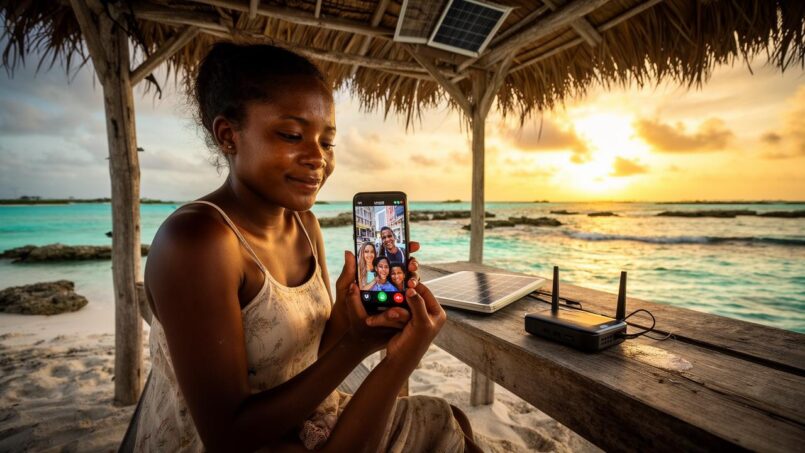
Starlink transforms exchanges between loved ones: reliable HD video conferencing, possibility to transfer large files, and fewer interruptions compared to a traditional geostationary link. It also allows a community to create a digital “hub”: sharing the bill, installing the router in a communal hall, and scheduling video calls at agreed times.
High-definition video calls become smooth and reliable, without the annoying latency of traditional links.
Sending large files is now feasible, making it easier to share documents or media between loved ones.
The community shares the bill and installs the router in a communal hall, allowing everyone to make their video calls at agreed times.
This community approach aligns with Tuvaluan culture of fale pili — “watching over your neighbor like a family member.” Pooling internet access so that everyone can call their children who have moved to New Zealand or Australia is not just an economic calculation; it is also a concrete way to maintain social bonds.
Comparison of main connectivity options
To get a clearer picture, it is useful to compare the main options available when living or staying in Tuvalu.
| Option | Estimated cost | Reliability / speed | Recommended use |
|---|---|---|---|
| Operator roaming | Very high ($/MB, $/min) | Depends on local network | Emergency backup only |
| Local TTC SIM | Medium to high (20–30 AUD/1–2 GB) | Low to fair speed, network sometimes congested | Several days/weeks stays, daily life |
| Regional eSIM | High | Often limited, uncertain coverage | Backup solution, first connection upon arrival |
| Residential Starlink | Investment ($600 + $90–110/month) | Good to very good (50–150 Mbit/s) | Residential homes, shared living, heavy usage |
In practice, the most solid combination for staying in touch daily often involves pairing a TTC SIM for local calls and small data usage on the go, plus a high-speed Wi‑Fi connection, ideally via Starlink, at home or in a community space.
Choosing the right tools for calls and messages
Once the connection issue is settled, the next step is finding the best way to talk to your loved ones, depending on their devices, location, and habits. Between free messaging apps, applications for calling landlines and mobiles, or prepaid cards, the range is wide. Some services are not well suited to Tuvalu, while others work particularly well.
Internet messaging: WhatsApp, Viber, Telegram, FaceTime
For all contacts with a smartphone and a decent connection, messaging apps remain the most economical solution.
WhatsApp now dominates a good part of the planet. The app allows audio and video calls, group chats, and file sharing. It is rated around 4.7 on the App Store and 4.3 on Google Play. Its weak point, in a context like Tuvalu, is its data consumption and the fact that it can accumulate many files on the phone, which will be problematic on devices with low power or limited storage.
Viber, widely used in some Asian and Eastern European countries, also offers encrypted voice/video calls and a strong community dimension, with groups of up to 100 people. The app is fairly well rated (around 4.6 on the App Store and 4.5 on Google Play). However, it contains ads, which can be annoying on an already slow network, and syncing your address book involves sending your contacts to their servers.
Telegram offers cloud storage, heavy file sending, built-in translation and editing. Its ratings are 4.2 on the App Store and 4.4 on Google Play. Channels and groups are useful for following a family scattered between Tuvalu, New Zealand, and Australia. Media is hosted in the cloud to save device space, but consumes more bandwidth.
FaceTime, built into Apple devices, offers very good video call quality when bandwidth permits. It is rated 4.3 on the App Store. Its obvious limit: it only works between Apple devices. In a family where some members are on Android, it is better to bet on a cross-platform solution like WhatsApp, Viber, or Telegram.
All these apps require sufficiently stable internet. In an environment where bandwidth fluctuates, it may be necessary to prioritize simple audio calls and turn off video to avoid constant disconnections.
Calling landlines and mobiles: Yolla, BOSS Revolution, Rebtel, Talk360…
Free messaging apps have one constraint: your contact must be online and also have the app. However, some of the loved ones of Tuvaluans – especially elderly people remaining on an island or in remote villages – do not always have a smartphone or data connection. In that case, you need to be able to call a regular number, landline or mobile, from an app running over the internet.
Several services specialize in this type of discounted international calling.
Yolla lets you call landlines and mobiles in Tuvalu while keeping your number. Yolla‑to‑Yolla calls are free; otherwise, prepaid credit is needed. Rates are shown per minute with the local time before dialing. No subscription or hidden fees, but connection fees may apply on some routes. Also offers mobile top-ups to 160+ countries and a referral program with bonus credits.
BOSS Revolution works on a similar model: an app linked to a prepaid account, with per‑country retail rates. For Tuvalu, the rate is around 39.5 cents per minute; $10 therefore buys about twenty minutes of calls. The app is well-rated (around 4.6 on the App Store and 4.5 on Google Play) and is particularly aimed at diasporas who want to call their families regularly.
Rebtel relies on two levers: unlimited offers to certain countries, and especially an “offline” mode where the international call is routed via a local number, which helps bypass data issues. This option can be useful if your internet connection is too unstable for standard VoIP. However, subscriptions auto‑renew, your local minute usage still applies, and canceling certain plans can be complicated.
Talk360 positions itself as an international call service particularly performant for Africa, with optimized routing to countries like Nigeria, Kenya, or South Africa. If your loved ones live in these areas, the tool can usefully complement other apps. The company behind the service is registered as Talk360 Group B.V.
Other services exist – Localphone, Roamless, Nobel App, HelloAirDial, Vonage, Google Voice, etc. – but not all are relevant from Tuvalu. Google Voice, for example, requires a US number and activation from the United States; it is therefore difficult to use for a Tuvaluan resident. Vonage is more designed as a fixed‑line phone solution for a home or small business abroad. Some services apply connection fees or unfavorable rounding (Nobel App, for instance, rounds up to 4 minutes on its cheapest plan), which increases the bill.
The key to choosing the right app is to cross-reference three factors: the location of your loved ones, the stability of your local connection, and your budget. Where data is scarce, a service like Rebtel in offline mode may be preferable. Where a stable Wi‑Fi is available, pure VoIP apps like Yolla or BOSS Revolution often offer the best value for money.
Summary of key useful international calling services
| Service | Main use case | Strengths | Notable limitations |
|---|---|---|---|
| Yolla | Calls to mobiles/landlines, top-ups | Number preservation, transparent rates, referral bonuses | No app‑to‑app SMS, some fees on certain routes |
| BOSS Revolution | Calls to mobiles/landlines | Large user base, stable apps | Variable rates, need to monitor balance |
| Rebtel | Unlimited calls, offline mode | Works even with little data | Auto‑renewing subscriptions, local minutes used |
| Talk360 | Calls to Africa especially | Good routing to some African countries | Less relevant if your loved ones are not in Africa |
| Viber Out | Calls from Viber to regular numbers | Integration with Viber | Coverage limited to about 60 countries, rates not always competitive |
In any case, it is advisable to check user reviews (on the App Store, Google Play, or Trustpilot) and test with a small credit before committing significant amounts, especially since a wrong move can be costly: some users report accidental $20 calls on expensive routes.
Managing constraints: slow speeds, outages, cost
Tuvalu still faces several structural challenges: slow speeds in some areas, instability due to weather conditions, and the disproportionate cost of data compared to average income. To maintain contact with loved ones without blowing your budget or losing patience, some best practices are essential.
First, it helps to plan call times. On Funafuti, the network tends to be less congested early in the morning or late in the evening, when fewer users are online. Scheduling family calls during these windows, especially video calls, significantly improves quality.
To stay in touch even on a slow 3G connection, turn off video and reduce call quality on WhatsApp or Viber. Prioritize short voice messages over long videos. SMS remains useful if your loved ones have affordable international plans or if you are temporarily out of data.
For sending photos and videos, it is better to compress files and transfer them during off-peak hours, or even wait until you are connected to a more generous Wi‑Fi, such as at a hotel or government building on Funafuti. Telegram, with its built-in editing and compression options, is particularly well-suited for this.
It is recommended to use a TTC SIM for permanent reachability, a shared Starlink subscription for a shared household or extended family, and a backup eSIM to avoid a total cutoff while traveling in case of issues with the local card.
The cultural dimension: maintaining fa’a‑Tuvalu from a distance
Staying in touch from Tuvalu is not just about technical or cost issues. Tuvaluan culture places a central emphasis on extended family, reciprocal obligations, and ties to the home island. The concept of fale pili, the idea of caring for your neighbor like a family member, now extends to transnational networks: you look after your loved ones in Auckland, Sydney, or Suva just as you do for those who stayed in the village.
Social media, regular calls, and cultural events such as Tuvalu Language Week in New Zealand, Independence Day, or gatherings around fatele and siva are essential for strengthening trust, mutual support, and belonging between generations and countries in the diaspora.
From a distance, messaging apps and video calls also serve to transmit language, songs, dances, and stories (fakafonua). For example, during the Tuvalu Arts Festival in 2019 in Auckland, young female entrepreneurs presented creations blending Western fashion with Tuvaluan symbols, while elders led weaving or singing workshops. These exchanges can now be continued online: a grandmother on Funafuti can guide her granddaughter born in Australia in learning fatele via a FaceTime video call; an uncle in Wellington can send weekly audio recordings of prayers or traditional songs via Telegram.
The Falepili visa between Tuvalu and Australia allows circular mobility without mandatory permanent residence, without age or disability discrimination. This flexibility encourages life paths shared between the two countries, but requires smooth communication channels.
Emergency communication: radio, HF, and alert systems
The question of contact with loved ones in Tuvalu concerns not only daily life but also times of crisis. The archipelago, with no point higher than three meters above sea level, is extremely vulnerable to cyclones, storm surges, and prolonged droughts. The government has therefore developed a multi‑layer emergency communication system.
A network of HF radios has been deployed on the islands, installed at meteorological offices, police stations, maritime services, and telecommunications facilities. It runs entirely on solar power with antennas adapted to the lack of space. Using systems like the Barrett 2020, it enables voice and email transmission, ensuring a minimum flow of information even during a general blackout.
National radio, Radio Tuvalu, also plays a central role. During a cyclone, it broadcasts weather bulletins at least every hour and can remain on air 24/7. Traditional community alert systems remain in force, such as the code of flags hoisted at the police station or the Island Council: a red flag for storm winds, a red flag with a black square for an imminent hurricane. Loudspeakers and spotlights are also used to alert the population.
300 wind‑up radios were delivered in 2022 by the Department of Climate Change with support from the UN.
For a resident, being prepared means at least knowing the frequencies used (for example, VHF channels 18 and 19 for the coordination center, certain national HF frequencies), verifying access to a community radio, and keeping a way to recharge your phone (power bank, small solar panel) to send a message as soon as the network returns. For a loved one living abroad, it is useful to know that in the event of a disaster, the absence of news does not necessarily mean the worst, but often reflects the temporary destruction of networks.
Toward a “digital nation”: a future where connection also runs through the cloud
Tuvalu has been working for several years on a unique project: becoming a “digital nation.” The idea is to digitize civil registries, cultural archives, and certain public services, in order to preserve the identity and continuity of the state even if rising seas make some areas uninhabitable. This program, supported notably by the World Bank, the Pacific Community (SPC), and private actors such as Accenture or Amazon Web Services, relies on the availability of fast and reliable internet.
By 2027, provide 4G or better mobile service to the entire population, with a 5G upgrade planned by 2030. Deployment of fixed high‑speed broadband networks (GPON/XGS‑PON) for institutions and businesses, installation of public Wi‑Fi hotspots on every island by 2028, and promotion of a “wireless‑first” approach for new deployments.
For family and community relationships, this means that digital tools will become even more structuring. One can imagine virtual maneapa — those large traditional meeting houses — recreated as video conference rooms, where members of the same clan connected from Funafuti, Sydney, Auckland, or Vancouver follow a fatele, a wedding ceremony, or a religious service together. Shows and broadcasts like PMN Tuvalu in New Zealand already play this bridging role; tomorrow, they will be able to rely on more robust infrastructure, reducing interruptions and enabling more interactivity.
The digital transformation for Tuvaluans carries risks of cybercrime, scams, and harassment, requiring stronger efforts in cybersecurity and media literacy to protect themselves, verify information, and control their data.
In conclusion: weaving a safety net of solutions rather than chasing a miracle tool
Staying in touch with loved ones from Tuvalu means giving up the idea of a single, perfect solution. The local context pushes you to build a “safety net” of complementary means: a TTC SIM for everyday use and local communication, a shared connection like Starlink for video calls and large data exchanges, one or two well-chosen international calling apps for reaching regular numbers, and one or two messaging services for day‑to‑day life.
The important thing is to accept a degree of unpredictability: a tropical downpour can drop the bandwidth just as a birthday video call begins; a ship accidentally cutting a local cable can disrupt traffic for several hours; an island without a mobile relay forces you to fall back on an HF radio or satellite phone.
Traveler or resident of a remote island
But as the Tuvalu Vaka Cable, Starlink gateways, and 4G/5G networks solidify, these hiccups become less frequent. The possibility for a grandmother remaining on a remote island to watch her grandson’s parade at Polyfest in Auckland live, or for a young Tuvaluan to instantly send fatele videos to cousins in Australia, is no longer a distant utopia. Provided you choose your tools wisely and accept working around constraints, Tuvalu can remain deeply connected to its diaspora — and beyond, to the rest of the world.
A heritage project or a question? Contact us now to speak with a wealth management expert.
Disclaimer: The information provided on this website is for informational purposes only and does not constitute financial, legal, or professional advice. We encourage you to consult qualified experts before making any investment, real estate, or expatriation decisions. Although we strive to maintain up-to-date and accurate information, we do not guarantee the completeness, accuracy, or timeliness of the proposed content. As investment and expatriation involve risks, we disclaim any liability for potential losses or damages arising from the use of this site. Your use of this site confirms your acceptance of these terms and your understanding of the associated risks.

Cyril Jarnias is an independent expert in international wealth management with over 20 years of experience. As an expatriate himself, he is dedicated to helping individuals and business leaders build, protect, and pass on their wealth with complete peace of mind.
On his website, cyriljarnias.com, he shares his expertise on international real estate, offshore company formation, and expatriation.
Thanks to his expertise, he offers sound advice to optimize his clients' wealth management. Cyril Jarnias is also recognized for his appearances in many prestigious media outlets such as BFM Business, les Français de l’étranger, Le Figaro, Les Echos, and Mieux vivre votre argent, where he shares his knowledge and know-how in wealth management.





