
 Published on and written by Cyril Jarnias
In this archipelago of nine islands lost in the middle of the Pacific, sport is not just entertainment: it is a social cement, an identity marker, and increasingly, a lever for public health and national pride. In Tuvalu, where land is scarce and the sea gnaws a little more at the coasts each year, every available plot becomes a playground, every evening an opportunity to gather around a ball, a rope, or an ano braided from pandanus leaves.
The country practices sports on unusual fields like an airport runway, land reclaimed from the ocean, or a sandy malae. Yet it sends athletes to the Olympics, excels in regional weightlifting, develops a national football team, and makes beach volleyball an international reference.
A sporting landscape shaped by lack of space
Tuvalu has barely 26 km² of land spread across six atolls and three reef islets. With only one true multifunctional playing field – the Tuvalu Sports Ground in Funafuti – and no athletics track, no gymnasium, not even a rugby or football field meeting international standards, organizing sport is a constant matter of improvisation.
The country’s only international airport becomes a vast urban park every afternoon after the last plane departs. The asphalt runway is divided into recreational zones: football goals are set up, imaginary lines drawn for touch rugby, and a volleyball net erected, creating a collective play space for young people.
Families settle on the grassy strips beside it, bring out large picnic baskets, and watch the matches while eating their evening meal. In a country where internet connection is slow, expensive, and unreliable, young people overwhelmingly gather outdoors at every opportunity. The airport thus becomes, on a daily basis, the archipelago’s main “village square.”
An artificial strip of land about 780 meters long was created in Tuvalu to combat erosion and rising sea levels.
Football, the number one passion despite only one field
Among modern sports, none rivals football. It is by far the most deeply rooted sport in daily life, whether played on the airport runway or on the country’s only official grass pitch, the Tuvalu Sports Ground.
The national championship is based on eight clubs, each affiliated with one of the main islands of the archipelago. They all share the same field in Funafuti, requiring tight organization: matches of the two men’s divisions, A-League and B-League, often follow one another on the same day. Women’s teams are aligned with this same structure, with a Women’s A-Division and several annual cups.
Available data shows a true abundance of competitions:
| Football competition in Tuvalu | Categories involved | Particularities |
|---|---|---|
| A-Division | Men | Elite division, 8 amateur clubs |
| B-Division | Men | Reserves of A-Division clubs |
| Women’s A-Division | Women | National women’s championship |
| Independence Cup | Men & women | Tournament linked to national day |
| NBT Cup | Men & women | Sponsored competition |
| Christmas Cup | Men & women | End-of-year tournament |
| Tuvalu Games (football section) | Men & women | Multidisciplinary inter-island competition |
Despite often difficult playing conditions – a field sometimes waterlogged, extreme heat, lack of proper changing rooms – football retains a central place. The Tuvalu National Football Association, founded in 1979, was long only an associate member of the Oceania Football Confederation (OFC). This position limited access to funding. Its upgrade to full membership opened the door to an annual aid of about 30,000 New Zealand dollars to improve football development.
Even without FIFA affiliation, Tuvalu fields players from the A-Division in regional competitions like the Pacific Games. Its results are modest with a goal deficit against better-resourced nations, but emphasis is placed on participation and international visibility rather than on the record.
Men’s clubs are not alone in fueling this dynamism. All major teams now have a women’s squad. Women’s participation in football is growing, and the federation is working with the OFC on a genuine strategy to promote women’s football. In a country where gender norms remain traditionally marked, this evolution is far from trivial.
Te ano: the national game that makes villages vibrate
Alongside soccer, another type of ball rules the Tuvaluan imagination: the ano, spherical or cubic, braided from dried pandanus or coconut leaves, filled with dead leaves, coconut shell fragments, and small pebbles. Heavy, hard, sometimes decorated with colorful patterns, this ball is used for te ano, the national game of Tuvalu.
This traditional sport, often compared to volleyball but with two balls in play and its own rules, is played on a malae, a large open space at the heart of the village. The two teams, mixed or not, can include players of all ages. The arrangement of positions is codified: in the center, the captain (alovaka) and the receiver (tino pukepuke); behind them, in rows, the rest of the team, the vaka.
On a signal, each receiver throws his/her ‘ano’ to the captain who strikes the ball toward the opponent’s court. Field players prevent the ball from touching the ground without catching it fully with their hands, and must send it back to the receiver, who alone is allowed to catch it. The team can target less skilled players, adding a tactical dimension and pressure on those targets.
A distinctive feature of te ano is the simultaneous use of two balls, which creates a very fast dynamic and demands constant vigilance. Each ball falling inside a court gives a point to the other team. Ten points make a set, and players shout “Taia” when that threshold is reached. The match is usually played as best of five sets.
Beyond the score, the essence of the game lies in the ritual that follows: the winners stand up to sing a fatele, a traditional song and dance, while the losers must sit and watch, sometimes performing a humorous chant themselves to “bring the winners back down to earth.” In some communities, like on the island of Niutao, tradition had it that the winning team also won a meal: the losers then went fishing and prepared a feast.
Once used to resolve tensions, celebrate events, and measure the strength of families, te ano is still honored during Te Aso Fiafia, the big annual festival in Funafuti blending traditional sports and artistic performances.
The ano, a sporting and cultural object
The making of the ano itself is a cultural act. Men and women patiently braid the core from three strips of pandanus or coconut leaves, fill it with natural materials to achieve the desired density, then wrap it in a second layer. The shape can be perfectly round or cubic; cubic balls, sometimes dyed in bright colors, are highly prized in certain variants, especially among women’s teams.
New Zealand’s national museum Te Papa holds several ano in its collection dedicated to Pacific cultures, proof that these sporting objects are also works of art and material witnesses to a skill that goes beyond mere play.
Kilikiti, faga, ula, fakana: a heritage of physical games
Te ano is not the only traditional sport still alive in Tuvalu. Other disciplines testify to the former importance of martial activities and physical preparation in island society.
These include:
| Traditional sport | Brief description | Nature of practice |
|---|---|---|
| Kilikiti | Local variant of cricket, with bat, ball, and large expanded teams | Team game, adapted Polynesian heritage |
| Faga | Traditional wrestling where two opponents try to pin each other to the ground | Combat sport, strength and technique |
| Ula | Spear throwing, maximum distance to decide competitors | Accuracy, strength, link to war and hunting |
| Fakana | Canoe race involving several rowers per boat | Water sport, team spirit |
| Fuu Fuu Penu | Circle game with an object hidden behind a participant, who must run and catch the placer | Chase game, very convivial |
At the end of the 19th century, regular practice of running, spear throwing, stick fencing, and wrestling was widespread. The arrival of Christian missionaries profoundly changed this landscape, many judging these games too violent or too tied to old beliefs. Some then declined, but several, like kilikiti or te ano, resisted and are now being rehabilitated as major cultural markers.
Recent diaspora initiatives to revitalize cultural games during language weeks and festivals, combining tradition, physical activity, and social connection.
Reviving games during cultural events to preserve a threatened tradition.
Offering a festive and accessible physical activity for all, strengthening family ties and overall health.
Volleyball, beach volleyball, and beach sports: when sand becomes a stadium
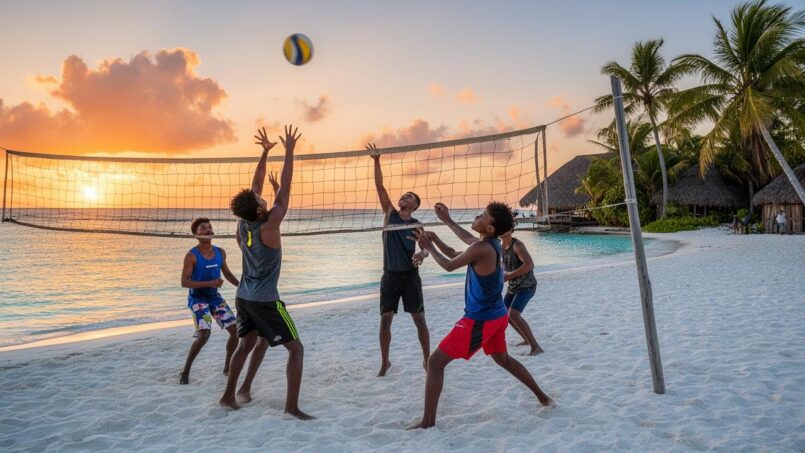
Volleyball is one of the most visible sports in daily life, whether on the airstrip or on the atoll beaches. Its high-level version – beach volleyball – has become in recent years a tremendous vehicle of recognition for Tuvalu.
Two players, Saaga Malosa and Ampex Isaac, have emerged as the faces of this sport in the country. After accumulating few international competitions – six tournaments in six years – they nonetheless gained valuable experience by participating in the Commonwealth Games. Despite losses without winning a set against better-structured nations like England, New Zealand, or Cyprus, this exposure prepared them for a feat: winning silver at the Pacific Games in Honiara.
The Tuvaluan duo won five consecutive matches, dominating the Solomons in the semifinal, before losing in the final to Australia. This success was due to technical support from the Volleyball Empowerment program, with coach Federica Tonon, equipment, and financial aid.
In a sense, beach volleyball sums up the strengths and constraints of Tuvalu: this sport requires little heavy infrastructure, just sand and poles, but opens the door to highly publicized international competitions. For a micro-state seeking positive symbols abroad, seeing its flag fly on beach volleyball podiums is deeply meaningful.
Rugby on the runway, rugby for all
Rugby union remains a developing sport in Tuvalu, but the seven-a-side variant – rugby sevens – has gained more traction since its introduction in 2007. The national team participates in the Pacific Games rugby sevens tournaments and the Oceania Championship, often against regional giants like Fiji or Samoa.
Lacking a grass field, young Tuvaluan rugby players trained on the airstrip, learning to tackle and sprint on tarmac. A first turning point came when they participated in a rugby festival in Nadi, Fiji, experiencing a real rugby field for the first time.
Coaches’ testimonials are clear: this immersion was a formative shock. Used to playing “among themselves” on the tarmac, the young players discovered a level of intensity, technicality, and tactical variety beyond anything they had known. Educators emphasize the “click” effect that this kind of experience triggers, both in terms of motivation and game vision.
The Tuvalu Rugby Union launched the ‘Get Into Rugby’ program with the Ministry of Education. Volunteers traveled by boat to the seven outer islands to run sessions in schools, including tag rugby initiation, teacher training, and mini-tournaments. For many children, it was the first time they touched an oval ball.
This effort led to rugby becoming an official sport at a major school event, the Vaitupu Island Youth Sport Day at Motufoua Secondary School. In the longer term, the federation aims to organize a regular inter-school festival and launch a women’s rugby sevens championship, to build a first national women’s team.
Weightlifting and powerlifting: medals for a micro-state
On the regional stage, Tuvalu owes much to its strength athletes. While team sports struggle to get past the early rounds of Oceania competitions, weightlifting and powerlifting have brought the country its first international gold medals.
In 2013, weightlifter Tuau Lapua Lapua won gold in the snatch (62 kg), a bronze in the clean and jerk, and silver in the total. In 2015, powerlifter Telupe Iosefa earned Tuvalu’s first ever gold medal at the Pacific Games (120 kg). These feats show that a small country can excel in sports requiring little infrastructure.
The results of a few major athletes illustrate this success:
| Athlete | Discipline | Competition / year | Notable result |
|---|---|---|---|
| Tuau Lapua Lapua | Weightlifting (62 kg) | Pacific Mini Games 2013 | Gold in snatch, silver in total, bronze in clean & jerk |
| Telupe Iosefa | Powerlifting (120 kg) | Pacific Games 2015 | 1st Tuvaluan gold medal at Pacific Games |
| Asenate Manoa | Sprint / powerlifting | Olympics 2008 & 2012, Pacific Games 2015 | 1st female Olympian, bronze in powerlifting (72 kg) |
| Tuau Lapua Lapua | Weightlifting | Olympics 2012 | 12th place in -62 kg |
These disciplines have also enabled the emergence of iconic figures like Asenate Manoa, the first woman to represent Tuvalu at the Olympic Games, a sprinter who later switched to powerlifting and won medals at the regional level. Their journeys help spread the idea in the country that women’s sports can mean performance and visibility, not just leisure.
Pacific Games, Commonwealth, Olympics: opening up to the world
While daily sports life takes place on improvised surfaces, Tuvalu is nonetheless very present in major regional and international gatherings. Since 1979, the country regularly participates in the Pacific Games and Pacific Mini Games. It joined the Commonwealth Games in 1998, and the Olympic Games in 2008.
Tuvaluan delegations are necessarily small, often limited to a few track athletes and one or two weightlifters or powerlifters. But the regularity of this participation testifies to the commitment of the Tuvalu Association of Sports and National Olympic Committee (TASNOC), recognized as a National Olympic Committee in 2007.
Tuvalu’s athletes compete in various disciplines such as athletics (100 meters), javelin, weightlifting, powerlifting, boxing, table tennis, and beach volleyball. Although no Olympic medal has been won, they have set several national records in athletics and obtained regional medals in strength sports.
Beyond the numbers, these major events have a symbolic role: they offer young Tuvaluans models of commitment, perseverance, and openness to the world. They also strengthen the country’s political weight in regional sports bodies and facilitate access to support programs (scholarships, training camps, technical coaching).
The Tuvalu Games and festivals: sport as national celebration
On the domestic level, the most significant sporting event is undoubtedly the Tuvalu Games, held annually since 2008. For several days in April, delegations from the different islands embark on the inter-island ship to reach Funafuti. The program includes athletics events, badminton tournaments, table tennis matches, various team competitions, sometimes supplemented by traditional games.
The Independence Day Sports Festival, held every October 1st, combines official ceremonies and sports matches, playing a similar role to this national mini-Pacific Games by fostering healthy rivalry between islands, stimulating talent scouting, and strengthening the sense of national belonging beyond the sea distances.
Cultural festivals, such as Te Aso Fiafia, systematically combine traditional physical events (spear throwing, tug-of-war, coconut husking, te ano, kilikiti) with dance and song performances. In this context, sport is never isolated: it is always embedded in a set of cultural, religious, and community practices.
Playing a sport in Tuvalu: concrete, collective, and open
For a resident of Tuvalu – or a visitor able to adapt to local realities – the concrete sporting offer is structured around a few main families of practices.
Football and futsal dominate organized leisure by far, with almost daily matches on the airport runway and a dense competitive calendar on the Tuvalu Sports Ground. Volleyball and basketball fit into any space large enough for a net or an improvised hoop. Rugby, especially sevens or tag version, is gaining ground in schools and at festivals.
In indoor or cramped spaces, badminton, table tennis, weightlifting, and powerlifting are practiced. Small-scale competitions are organized, often linked to the Tuvalu Games or local festivals. Netball and teqball are being introduced through dedicated federations.
Finally, traditional games hold a special place: te ano remains the most typically Tuvaluan sport, accessible to all and perfectly suited to the climate and local resources. Kilikiti, faga, ula, or Fuu Fuu Penu complete this landscape by offering forms of movement where the playful and social dimension takes precedence over raw performance.
A sport in flux: equality, protection, and health
Behind this abundance, TASNOC and the national federations are working to evolve sports practice toward greater safety, inclusion, and public health benefits. A national plan on non-communicable diseases (diabetes, cardiovascular diseases, cancers, mental disorders) has identified physical inactivity as a major risk factor, alongside tobacco, alcohol, and unbalanced diet.
This article does not provide a specific figure to highlight.
At the same time, the issue of safety and violence in sport is taken seriously. With support from the Australian Team Up program and the Oceania Impact Network, TASNOC organized in-depth training on participant protection and gender awareness. Coaches, federation leaders, and high school students learned to identify different forms of abuse, understand the concept of consent, distinguish sex from gender, challenge stereotypes, and design child protection policies in a sports context.
A safeguarding policy was drafted and adopted, with the perspective of rolling it out within federations, through codes of conduct, consent forms for activities involving minors, and clear reporting procedures. The ambition is to make the sports field as safe a space as possible, including for girls and people with disabilities.
Climate, heat, and sea level rise: new challenges for practice
Like all Pacific nations, Tuvalu is on the front line of climate change. Coastal erosion and recurrent flooding directly threaten the meager spaces available for sport. Areas reclaimed from the sea, such as The Reclaimed Land, must be carefully protected with giant sandbags to prevent them from disappearing.
Extreme weather events, such as felt temperatures near 50°C or flooding, have already delayed or canceled matches in Oceania, with similar risks for Tuvalu.
In the medium term, studies project increasingly high temperatures during traditional competition seasons in the southern hemisphere. They estimate that without adaptation measures – shortening matches, cooling breaks, moving to indoor spaces – it may sometimes become dangerous to play outdoor football.
In this context, the way Tuvalu conceives its hundreds of daily sporting moments – on the airport, in the lagoon, on reclaimed land – will have to continue evolving. Sport, which helps strengthen the physical and psychological resilience of the population, is itself forced to adapt to increasingly extreme environmental conditions.
A micro-state, a great sports culture
In the end, talking about popular sports to practice in Tuvalu is telling a story of constraints turned into drivers of inventiveness. The scarcity of infrastructure has pushed residents to repurpose the airport into a stadium, transform a simple anti-submersion dyke into a playing field, and reinvent the rules of imported sports to adapt them to the local context.
It is also a story of continuity, where ancestral games like *te ano* or *kilikiti* coexist with football, volleyball, or rugby, and feed the same thirst for movement, friendly competition, and collective celebration. Every match on the runway, every game of *te ano* on a village *malae*, every powerlifting tournament in a cramped venue helps make sport a pillar of Tuvaluan identity.
Cultural analyst
For anyone interested in sports practice in small island states, Tuvalu offers an open-air laboratory: a country where you can play football under a taking-off plane, contest a beach volleyball final with the sea as your only backdrop, or measure yourself against neighbors in a spirited te ano. A country that, despite its small size and the threats it faces, loudly affirms its right to run, throw, jump, dance… and score points, on every possible field.
A heritage project or a question? Contact us now to speak with a wealth management expert.
Disclaimer: The information provided on this website is for informational purposes only and does not constitute financial, legal, or professional advice. We encourage you to consult qualified experts before making any investment, real estate, or expatriation decisions. Although we strive to maintain up-to-date and accurate information, we do not guarantee the completeness, accuracy, or timeliness of the proposed content. As investment and expatriation involve risks, we disclaim any liability for potential losses or damages arising from the use of this site. Your use of this site confirms your acceptance of these terms and your understanding of the associated risks.

Cyril Jarnias is an independent expert in international wealth management with over 20 years of experience. As an expatriate himself, he is dedicated to helping individuals and business leaders build, protect, and pass on their wealth with complete peace of mind.
On his website, cyriljarnias.com, he shares his expertise on international real estate, offshore company formation, and expatriation.
Thanks to his expertise, he offers sound advice to optimize his clients' wealth management. Cyril Jarnias is also recognized for his appearances in many prestigious media outlets such as BFM Business, les Français de l’étranger, Le Figaro, Les Echos, and Mieux vivre votre argent, where he shares his knowledge and know-how in wealth management.





