Adapting to Djibouti’s Local Climate: A Practical Guide for Expats
Published on and written by Cyril Jarnias
wp:paragraph
Moving to Djibouti means accepting two inseparable realities: extreme heat almost year-round and a cost of living significantly higher than in much of Africa. For an expatriate, adapting to the climate isn’t just about enduring 40 °C in the shade—it involves rethinking your daily rhythm, budget, housing, transportation, work habits, and even healthcare.
Good to know:
This guide summarizes key information about Djibouti and its capital to help you plan a realistic move, avoiding costly mistakes in terms of both comfort and budget.
Understanding Djibouti’s climate to better prepare
Djibouti’s climate is officially desert. In practice, it is often described as “extreme.” Temperatures remain high all year long, rainfall is rare and torrential, and the combination of heat, dryness, and sun demands a true survival strategy on a daily basis.
A hot country… all the time, with a real “heat wall” in summer
Records show the average temperature hovers around 30 °C over the year, with relatively small seasonal differences that still make a big difference to your comfort.
Typical conditions can be summarized as follows:
Time of year
Average actual temperature
Average feels-like temperature
Climate features
December – February
26–29 °C daytime
25–27 °C
Mildest season, cooler nights
March – May
30–35 °C
32–37 °C
Gradual rise in heat
June – September
37–44 °C (peak in July)
40–48 °C and above
“Oppressive” heat, risk of heatstroke
October – November
32–36 °C
34–38 °C
Heat returns but more bearable
In Djibouti City, the period from June to September is described as particularly grueling. Frequent 40 °C+ days occur, with a much hotter feel. Episodes of hot, dusty wind (the khamsin) can reduce visibility and irritate the airways.
1
The average temperature has already risen by about 1 °C compared to the 1961–1990 period.
Relentless sun, rare but violent rain
Djibouti is one of the sunniest countries in the world: over 3,200 hours of sunshine per year, or 8–10 hours per day on average. UV radiation is high year-round, meaning you need protection even during the local winter.
Caution:
Rainfall in Djibouti is low (130–165 mm/year) and very irregular, concentrated in a few short but violent episodes in spring and fall. These rains can cause flash floods, urban flooding, and sometimes landslides in steep areas.
Summer (June–August) is almost completely dry. In the mountains (Goda, Day), rain is slightly more frequent, which explains the presence of the country’s only real forest.
Humidity, wind, and dust: the underestimated factors
Records show generally low humidity on a yearly scale (often between 12 and 27%), which intensifies the feeling of dryness, but this varies by area: coastal regions can experience periods where heat combines with higher humidity, creating a heavy feel, especially at the end of the hot season.
The desert wind laden with dust (khamsin) poses two challenges: respiratory comfort (irritated eyes, throat, sinuses) and cleanliness (dust everywhere in homes and offices). For an expatriate with asthma or allergies, this factor must be taken seriously.
Choosing your arrival period: a real success factor
Settling in a hot country is easier if you give your body time to acclimatize. In a climate like Djibouti’s, your arrival period has a very concrete impact on your adaptation.
Tip:
Climate data and on-the-ground feedback indicate that the most favorable time for moving in is between November and April. The optimum is December to February. During these months, daytime temperatures hover around 25–30 °C, nights are cooler, and in some years a hint of greenery may reappear after the rains.
Arriving in the peak heat (June–August) means facing a brutal thermal shock while you’re already dealing with administrative procedures, house hunting, and getting your bearings in the city. It’s possible, but much more exhausting, with a higher risk of dehydration and heatstroke.
In practice, if you have control over your contract start date, aiming for a start between December and February clearly eases physical and psychological adjustment.
Protecting yourself from the heat on a daily basis
Adapting to the local climate means accepting that heat becomes a structuring parameter of your days. You don’t live in Djibouti City like you do in Paris or Montreal; if you try, you’ll exhaust yourself.
Adjusting your daily rhythm: the split day
The local work rhythm accounts for the heat: the week typically runs from Sunday to Thursday, with hours like 8 am–1 pm then 2 pm–5 pm. The core afternoon, when the sun is strongest, is avoided as much as possible.
As an expatriate, adopting this rhythm is a first step in adaptation:
– Schedule outdoor meetings and errands for the morning or late afternoon;
– Reserve tasks requiring the most concentration for cooler hours;
– Limit intense physical activity to early morning or evening.
In summer, this split becomes even more important. A simple 20-minute walk in the midday sun can be enough to put you in difficulty, especially during the first few weeks.
Hydration and diet: the foundation for lasting the distance
The lack of drinkable tap water means you must adopt a strict routine:
Good to know:
It is recommended to drink only bottled or filtered water. You should always keep a supply at home to cover possible local stock shortages or delivery issues. Finally, always carry water with you on every trip, no matter how short.
Health guidelines also emphasize the classic rule: “boil it, cook it, peel it, or forget it.” Drinking an icy soda (Coca or Pepsi at around 337 Djiboutian francs for a small bottle) is tempting, but it doesn’t hydrate like water and adds excess sugar. Meanwhile, digestive infections like traveler’s diarrhea remain common: always wash your hands or use hand sanitizer before eating.
The extreme climate tires the body; very heavy meals at midday can worsen drowsiness. Local habits (spiced tea or coffee, shared meals, high consumption of grains and stews) can be adjusted to your tolerance. For an expatriate, the key is to eat enough salt and get a variety of foods to compensate for mineral loss through sweat, without overdoing fried foods or sugar.
Clothing and cultural codes: covering up without suffocating
The local dress code is based on modesty, but it is also partly a pragmatic response to heat and sun. In Djibouti City, outfits are a bit more casual than in rural areas, but the general expectation remains the same: cover shoulders and knees, avoid tight or very short clothing.
Climate-adapted housing options for expatriates
Discover the types of accommodation best suited to climate conditions to ensure comfort and durability during an expatriation.
Well-insulated house
Choose a building with effective thermal insulation to retain heat in winter and keep cool in summer, reducing energy consumption.
Air-conditioned apartment
Go for a home equipped with an efficient air conditioning system in hot and humid regions to maintain a pleasant indoor environment.
Naturally ventilated home
Choose a dwelling designed to promote natural airflow in temperate climates, reducing the need for artificial cooling systems.
Residence with central heating
Select a property with reliable and economical central heating for areas with harsh winters.
– For men: light shirts or short-sleeved tees, cotton or linen pants. Sleeveless shirts are frowned upon in the city;
– For women: long dresses or skirts, flowy pants, tops covering shoulders and chest. A scarf is useful to cover up if needed (mosque visits, more conservative neighborhoods, Ramadan).
Thermally, breathable fabrics (cotton, linen), light colors, and loose cuts are your best allies. Add sun protection: wide-brimmed hat or cap, quality sunglasses, high-SPF sunscreen applied generously.
Keep in mind that clothing is not just about comfort: in a predominantly Muslim country, overly “beachy Western” attire may be seen as disrespectful, especially during Ramadan or near places of worship.
Air conditioning, ventilation, and the electricity bill
In a country where temperatures regularly exceed 40 °C, air conditioning is not a luxury but a vital component of domestic comfort. However, it comes at a cost, especially since electricity tariffs in Djibouti are among the highest in the region.
Data show that, for an expatriate renter, utility costs (electricity, water, etc.) can skyrocket quickly:
78,000
Estimated monthly amount in Djiboutian francs for utility bills for a family apartment in areas with intensive air conditioning.
The differences come from the level of comfort you seek: an expatriate who runs AC day and night in every room will obviously pay much more than a local who uses only a fan and occasional AC.
To balance comfort and budget, some good practices are essential:
– choose a well-insulated home for the region, with walls and windows that limit heat gain;
– favor rooms oriented to catch as little direct afternoon sun as possible;
– use air conditioning mainly at night and during peak heat hours, supplementing with fans;
– close shutters and curtains during the day to limit indoor heating.
Given the fragility of the grid (reliance on electricity imports from Ethiopia, occasional outages), having a home with a generator or at least backup solutions (batteries, rechargeable lamps) can also make a difference during a blackout.
Climate and cost of living: a couple you can’t ignore
The heat weighs not only on your body but also on your wallet. In Djibouti City, the cost of living for an expatriate is high, and the climate is one reason: need for air conditioning, bottled water, housing in better-equipped neighborhoods, etc.
Local cost of living: huge contrast between expatriates and Djiboutian salaries
The numbers are telling. For Djibouti City:
Profile
Monthly cost of living (approx.)
Average local
$1,388
Expatriate
$2,441
Digital nomad
$5,840
Expatriate family (overall estimates)
$4,858
At the other extreme, the median net salary after taxes in Djibouti City is around $233 per month. Nationally, an average of 232–504,000 DJF is reported, still far from the costs borne by expatriates. The result: living comfortably in Djibouti City costs about 2.5 times the local average salary.
For an expatriate, this often translates into a “package” covered by the employer: salary in foreign currency, housing allowance, international health insurance, annual plane tickets, and sometimes school fees. Without such a package, a family would struggle to absorb the combined cost of climate (air-conditioned housing, water, health), international education, imports, and leisure.
Housing: when protecting yourself from the climate costs a fortune
Rent is the first expense line affected by the climate. Almost all housing suited to foreigners (air conditioning, recent construction, good overall condition) is concentrated in Djibouti City, in neighborhoods like Haramous, Gabode, Versailles, Héron Marabout, or some parts of the city center.
Example:
Real estate market data reveals very wide price ranges. This gap is mainly explained by the distinction between so-called “local” housing, which corresponds to the standard market, and high-end products specifically designed and marketed to an expatriate clientele. For example, a standard apartment in a local residential neighborhood and a luxury service apartment in a secure expatriate compound in the same city can show radically different prices per square meter.
In dollars, in Djibouti City:
Type of housing
Monthly rent range
Notes
Studio/1 bedroom – city center (“local” version)
~$243–245
Basic offering, sometimes lacking standards expatriates seek
1 bedroom “cheap”
~$166–167
Limited comfort
3 bedrooms – city center (“local” version)
~$447–515
Decent apartments for local families
3 bedrooms “cheap”
~$294–343
Plainer housing, often on the outskirts
1 bedroom – city center, high-end expatriate level
~$1,340–2,180 (average ~$1,758)
Apartments in modern compounds, AC, sometimes services
Furnished studio 45 m² in expensive area (in DJF)
~187,000 DJF
Mid-range furnished segment for well-off clientele
This duality explains why, to an observer, “life in Djibouti” can seem either surprisingly cheap or extremely expensive: it all depends on whether you’re looking from the perspective of a local employee or an expatriate demanding comfort comparable to a major Western city.
For a couple or a single person, qualitative data indicate that a “good” city apartment, suitable for an expatriate, runs around $500 to $1,200 per month. As soon as you move into premium products (serviced apartments, secure compounds, sea views), you quickly hit the range above $1,500.
Food, outings, and climate: the trade-off between AC, cooking, and restaurants
Food in Djibouti isn’t uniformly expensive, but the climate influences how you consume. Eating out often means escaping the heat of your home by enjoying the air conditioning of a restaurant or café.
A few reference points in the city (in dollars):
Expense item
Average price
Simple lunch menu
~$4.12
Dinner for two in a mid-range restaurant
~$23.10
Fast food like McDonald’s
~$5.23
Cappuccino
~$1.92
Beer 0.5 L in a pub
~$1.88
In Djiboutian francs, the same scale applies: a meal at a cheap restaurant is often around 1,500–1,750 DJF, dinner for two in a mid-range restaurant around 14,500 DJF, a draft beer around 1,000 DJF.
For an expatriate who wants to regularly enjoy the air conditioning of cafés, hotels, and restaurants, the bill quickly adds up. Conversely, eating at local markets or neighborhood eateries, where ventilation is more basic, reduces costs but exposes you more to the heat and health risks.
Transport: reliance on taxis and cars under the scorching sun
In a city where walking for long in the full sun is unpleasant and sometimes dangerous, motorized transport becomes an almost mandatory expense.
In the city, indicative fares are as follows:
Type of transport
Average cost
Local bus ticket
~50 DJF (about $0.48)
Monthly public transport pass
~3,777 DJF to $42.20 depending on source
Taxi start (flagfall)
500 DJF
Taxi fare per mile
~1,609 DJF
3 km taxi ride (in practice)
~$10
8 km ride
~$7.46 (aggregated figures)
Gasoline – liter
~310 DJF or $1.06
Public transport is generally poorly regulated and not always safe. Many expatriates turn to company cars, rental with driver, or a “trusted” taxi, even if it means paying more. The extreme heat makes it unrealistic to walk long distances, especially in summer.
Climate, health, and access to care: an adaptation you shouldn’t underestimate
Living under 40 °C for several months a year, with a health system that still needs improvement, is no small matter. For an expatriate, adapting to the climate also means very proactively managing your health.
Health risks amplified by heat and drought
Several cumulative factors need to be considered:
– non-potable tap water: systematic use of bottled or filtered water, and increased risk of waterborne diseases (cholera, typhoid) if control is poor;
– intense heat: dehydration, heatstroke, worsening of chronic conditions (cardiac, respiratory);
– vector-borne diseases: malaria, dengue, other mosquito-borne infections, all the more concerning when heat favors their proliferation;
– dust and sand winds: irritations, asthma attacks, conjunctivitis.
Good to know:
The public health system is developing, with limited coverage outside the capital and often overcrowded facilities. The major hospitals in Djibouti City, such as Peltier General Hospital or Balbala Hospital, serve as referral centers but lack resources. Private clinics, more modern, are mainly intended for expatriates and local elites.
Under these conditions, recommendations converge:
Tip:
Before traveling abroad, it is crucial to take out international health insurance covering, among other things, medical evacuation to a better-equipped country (like Nairobi, Addis Ababa, Europe, or the Gulf). You should also put together a basic pharmacy adapted to the local climate, including oral rehydration salts, antiseptics, antidiarrheals, antimalarial treatment if needed, and creams for burns and sunburn. Finally, it is imperative to check and update your vaccinations, particularly against hepatitis A and B, typhoid, yellow fever if required, and routine vaccines such as tetanus, polio, and measles.
Organizing daily life: thinking “climate health”
To stay functional over the long haul, an expatriate must turn a few health recommendations into reflexes:
– drink before you’re thirsty, several liters per day depending on activity;
– avoid physical exertion in full sun, especially during the acclimatization phase;
– schedule rest periods in the shade or in air-conditioned indoors;
– watch for warning signs (headaches, nausea, dizziness, unusual fatigue) and don’t hesitate to stop an activity and cool down.
Families with children must be extra vigilant: youngsters feel the effects of heat faster, tolerate temperature swings between air-conditioned interiors and scorching exteriors poorly, and are more vulnerable to diarrhea and infections.
Water, electricity, internet: living in a fragile environment
The extreme climate doesn’t just test individuals; it also puts constant pressure on the country’s resources, especially water and energy. For an expatriate, adapting means incorporating these constraints into your consumption habits.
A country in permanent water stress
Djibouti has no permanent rivers and depends largely on groundwater and water import projects (e.g., via pipeline from Ethiopia). Chronic drought and rainfall variability increase pressure on the resource.
What this means in practice:
– accept that water is a precious resource, to be conserved daily (quick showers, reducing domestic waste, watching for leaks);
– expect occasional outages or drops in pressure, especially in some neighborhoods or periods;
– keep emergency stocks at home, especially if traveling to more remote areas.
Good to know:
Managing water is both an ecological gesture and a precaution to ensure your comfort in case of problems with the distribution network.
Expensive and sometimes unreliable electricity, imperfect internet
Electricity in Djibouti is mainly supplied by the state-owned company Électricité de Djibouti (EDD). A significant portion of energy comes from Ethiopia via interconnections. If hydropower production drops on the Ethiopian side (e.g., low dam levels), exports may be reduced, directly affecting Djibouti’s energy supply.
Production costs are high: reliance on imported fossil fuels, maintenance of aging generators, lack of subsidies. According to analyses, the unit cost can approach $0.35/kWh, with high tariffs for households, especially beyond the first consumption tiers.
For an expatriate heavily dependent on air conditioning and digital connectivity, this context translates into:
Caution:
Electricity bills can be very high due to intensive use of air conditioners and electric appliances. It is crucial to check the quality of the electrical installation, insulation, and the presence of backup generators in the building before renting. Additionally, expect sometimes unstable internet connections and expensive bandwidth, despite national investments in digital infrastructure.
Dominant internet plans (50–60 Mbps) typically cost around $25–50 per month, which remains significant relative to local living standards. For a teleworker or a demanding digital nomad (HD video calls, large uploads), Djibouti is not yet a tech paradise: better to have multiple access solutions (fixed connection + mobile data, coworking, etc.).
Settling in Djibouti City: neighborhoods, housing, and urban climate
Almost all of the expatriate community lives in Djibouti City, which concentrates services, jobs, infrastructure, and suitable housing. The urban climate is influenced by the heat island effect: concrete surfaces, lack of vegetation, dense traffic – all factors that keep heat in during the evening.
The main residential neighborhoods popular with expatriates are:
Example:
The Djiboutian capital is structured into several areas with distinct characteristics. Haramous is an affluent area, home to embassies, international schools, and recent villas and apartment buildings that are often air-conditioned and secured. Gabode is a large residential neighborhood near the airport, subdivided into several sub-areas (Gabode 3, 5, etc.) with many expatriate homes. Zones like Versailles, Héron Marabout, and Ambouli are rapidly developing, with a mix of apartment buildings, apart-hotels, and furnished residences. Finally, the City Center / Place Rimbaud is the historic and commercial heart, characterized by its proximity to the port, markets, and hotels.
The outskirts like Balbala offer significantly lower rents but standards less aligned with expatriate expectations (less air conditioning, poorer road maintenance, more difficult access to services).
To limit the climate’s impact on your daily life, a few search criteria are essential:
Good to know:
When choosing a home suited to extreme heat, prioritize orientation and exposure that limits direct sunlight (avoid unprotected west-facing facades). Check for shaded areas, vegetation, or an inner courtyard, as well as good airflow (opposite windows, natural ventilation). Make sure the home is equipped with air conditioning and effective ventilation. Finally, proximity to main transport routes reduces the time you’re exposed to the heat during commutes.
Apart-hotels or furnished residences (with cleaning services, sometimes a pool, centralized air conditioning) can be a good compromise for the first few months, while you figure out your real needs and the level of heat you can handle.
The social and cultural climate: adapting without getting burned
Beyond the temperature, “adapting to the local climate” also means understanding the social atmosphere, codes, and relationship with time, all of which are largely shaped by the heat, religion, and the country’s history.
Ramadan, schedules, and public life
During Ramadan, daily life is reorganized: it is frowned upon to eat, drink, smoke, or chew gum in public during daylight hours. The climate plays a central role here: with the heat, the fatigue of fasting is greater, and administrations may adjust their hours.
Good to know:
For an expatriate, it is essential to respect local codes, especially in an already physically demanding environment. Expect some services to run at a slower pace and a general atmosphere that is quieter during the day and more lively in the evening after the fast-breaking meal (iftar).
Hospitality, cafés, and “social AC” spots
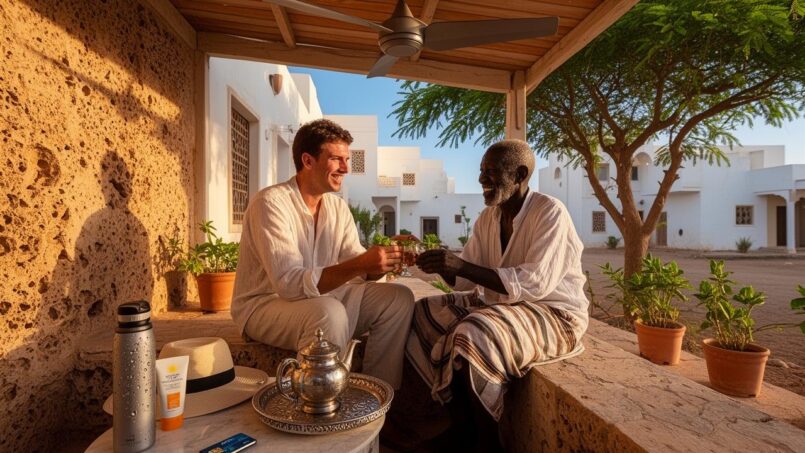
Djiboutians are known for their hospitality. Many social moments revolve around tea or coffee, in air-conditioned cafés or at home. For an expatriate, these places become climate refuges as much as spaces for social integration.
A few typical spots for the expat community: cafés with Wi-Fi, hotels with pools and bars, beaches near the city (Plage du Héron, Doraleh Beach, farther beaches like Siesta Beach). The sea, warm all year round, offers a relative cool alternative, even though the sun remains strong.
Safety, travel, and heat
Advice from foreign embassies emphasizes the importance of limiting nighttime travel outside urban areas, especially toward the borders (Eritrea, Somalia, isolated areas). Roads can be in poor condition, poorly lit, sometimes mined in certain regions, and the risk of accidents increases with fatigue and heat.
Tip:
In the city, heat influences petty crime: pickpocketing and minor theft are concentrated in crowded areas like markets or downtown. While basic precautions (not flashing valuables, avoiding walking alone at night) remain essential, the heat can also lower your vigilance. Adjusting your hours and mode of transport is therefore an effective strategy, both for your safety and your comfort.
How much to budget for living in Djibouti, taking the climate into account
Combining all this data, we can outline typical monthly budgets for an expatriate looking to live decently in Djibouti City while respecting climate constraints (air-conditioned housing, bottled water, some leisure).
Order of magnitude for a monthly expatriate budget
These amounts aim to give a sense of scale, in dollars, for a “comfortable but not luxurious” standard of living:
Expense item
Single
Couple
Family of 4*
Housing (decent, air-conditioned apartment)
$700–1,200
$900–1,500
$1,200–2,000
Utilities (electricity, water, internet)
$150–300
$200–350
$250–400
Food (mix home cooking and local restaurants)
~$250–350
~$400–600
~$600–800
Transport (taxis, possibly car rental)
$60–150
$100–200
$150–250
Health, insurance (outside employer package)
$80–200
$150–300
$200–500
Leisure, outings, miscellaneous
$150–300
$250–400
$300–600
Estimated total
$1,400–2,500
$1,800–3,300
$2,700–4,500
*For a family with young children not yet in international school. Once you include an international school, costs skyrocket (annual fees can exceed $4,000 per child, and much more for some English-speaking institutions).
4,858
The estimated monthly cost for an expatriate family according to compiled data.
For a single person, you can theoretically get down to around $1,270 per month by tightening the budget significantly (more modest housing, fewer air-conditioned outings, local purchases rather than imports). At the other extreme, a very affluent lifestyle with high-end housing, frequent outings, travel, and heavy consumption of imported goods can easily reach $5,000 per month or more.
Preparing before departure: the moves that make a difference
Adapting to the local climate begins even before you land in Djibouti.
A few concrete preparation areas:
Tip:
A successful expatriation requires careful preparation in several key areas. Medically, it is crucial to have a complete health checkup, adjust chronic treatments (e.g., for hypertension or asthma) to the local climate, update vaccinations according to recommendations, and put together a personal medical kit. For housing, it is advisable to negotiate rent and utility coverage in your expatriation contract and consider a temporary first stay, such as an air-conditioned apart-hotel, while finding permanent housing. For insurance, you must verify that it covers medical evacuation, private clinic hospitalizations, and heat-related illnesses. Gear should include light, appropriate clothing, a hat, sunglasses, sunscreen, a quality water bottle, water filtration equipment if necessary, and electrical appliances compatible with 230 V / 50 Hz current (type C and E plugs). Finally, integration involves acquiring at least basic French or Arabic, and familiarizing yourself with Islamic customs such as Ramadan, prayer times, modest dress codes, and halal food.
Arriving informed about the reality of the climate and cost of living helps avoid disillusionment: Djibouti is neither a “cheap exotic post” nor an unlivable hell, but a demanding environment that requires a certain level of resources, anticipation, and humility.
In conclusion: Making the heat a parameter, not an obstacle
Living in Djibouti, and particularly in Djibouti City, forces you to relearn simple things: when to go out, how to dress, how much to drink, where to live, how to ventilate your apartment, how much the next electricity bill will be.
Good to know:
The extreme climate is a central, not secondary, element of expatriation. To make it a manageable constraint, you must anticipate it from the planning stage, budget realistically, and adapt your daily habits. The goal is not to mechanically replicate your original lifestyle, but to build a new framework that can become acceptable, even enjoyable.
In return, the country offers a unique light, a warm sea with spectacular seabeds, a culture blending African, Arab, and French influences, and a close-knit expatriate community that learns, day by day, to live with the sun rather than against it. Adapting to the local climate is the first step to enjoying it fully.
Disclaimer: The information provided on this website is for informational purposes only and does not constitute financial, legal, or professional advice. We encourage you to consult qualified experts before making any investment, real estate, or expatriation decisions. Although we strive to maintain up-to-date and accurate information, we do not guarantee the completeness, accuracy, or timeliness of the proposed content. As investment and expatriation involve risks, we disclaim any liability for potential losses or damages arising from the use of this site. Your use of this site confirms your acceptance of these terms and your understanding of the associated risks.
Cyril Jarnias
Cyril Jarnias is an independent expert in international wealth management with over 20 years of experience. As an expatriate himself, he is dedicated to helping individuals and business leaders build, protect, and pass on their wealth with complete peace of mind.
On his website, cyriljarnias.com, he shares his expertise on international real estate, offshore company formation, and expatriation.
Thanks to his expertise, he offers sound advice to optimize his clients' wealth management. Cyril Jarnias is also recognized for his appearances in many prestigious media outlets such as BFM Business, les Français de l’étranger, Le Figaro, Les Echos, and Mieux vivre votre argent, where he shares his knowledge and know-how in wealth management.
To provide the best experiences, we use technologies like cookies to store and/or access device information. Consenting to these technologies will allow us to process data such as browsing behavior or unique IDs on this site. Not consenting or withdrawing consent, may adversely affect certain features and functions.
Functional
Always active
The technical storage or access is strictly necessary for the legitimate purpose of enabling the use of a specific service explicitly requested by the subscriber or user, or for the sole purpose of carrying out the transmission of a communication over an electronic communications network.
Preferences
The technical storage or access is necessary for the legitimate purpose of storing preferences that are not requested by the subscriber or user.
Statistics
The technical storage or access that is used exclusively for statistical purposes.The technical storage or access that is used exclusively for anonymous statistical purposes. Without a subpoena, voluntary compliance on the part of your Internet Service Provider, or additional records from a third party, information stored or retrieved for this purpose alone cannot usually be used to identify you.
Marketing
The technical storage or access is required to create user profiles to send advertising, or to track the user on a website or across several websites for similar marketing purposes.

 Published on and written by Cyril Jarnias






