
 Published on and written by Cyril Jarnias
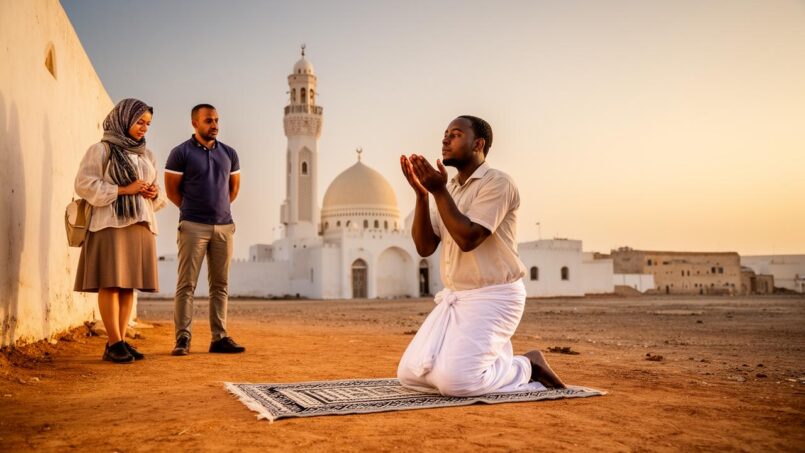
Settling in Djibouti means entering a country where religion structures time, public space, and a large part of social relations. For an expatriate, understanding this religious framework is essential to avoid missteps, integrate more easily, and simply better appreciate the society that welcomes you. This guide provides a concrete overview, based on available data, of local religious practices and what they imply in daily life.
An Officially Muslim Country, But Generally Tolerant
Djibouti is a small state in the Horn of Africa, deeply marked by Islam and African traditions. The Constitution proclaims Islam as the state religion, while guaranteeing freedom of thought, conscience, and worship. Legally, all faiths are supposed to be treated equally, although in practice, Islam retains a central place, both in law and social norms.
Percentage of Djibouti’s population that is Muslim.
The share of non-Muslims is small, around 6% according to estimates, mostly Christians (Catholic, Protestant, Orthodox) and, in tiny proportions, adherents of other religions (Hindus, Baha’is, Jews) or people claiming no religion. These minorities are overwhelmingly concentrated in Djibouti City, where nearly three-quarters of the total population already lives.
For an expatriate, the key takeaway is twofold: society is both very religious and generally tolerant. Islamic practice permeates public life, but authorities affirm respect for freedom of worship, provided it remains discreet and avoids any proselytism toward Muslims.
A Legal Framework That Protects Religious Freedom…and Strictly Controls Proselytism
On an institutional level, religious freedom is enshrined in the Constitution. In practice, however, everything related to worship is closely controlled.
Religious groups, including Muslim communities, must register with the state. Islam is supervised by the Ministry of Islamic Affairs and Waqfs, which controls mosques, private religious schools, the content of sermons, and the appointment of imams (who have become civil servants). Sermons are reviewed by a High Islamic Council, authorized to sanction any imam deemed too politicized or extremist.
Non-Muslim communities must obtain authorization from the Ministry of Foreign Affairs (and, depending on the case, the Ministry of the Interior). Registration involves security checks that can sometimes be lengthy. Once authorized, these communities sign an annual or multi-year agreement defining the framework of their activities and must submit regular reports to the authorities. Foreign religious leaders must apply for a work permit and purchase a paid residence card.
In Djibouti, law and custom forbid or strongly discourage any public attempt to convert Muslims. The country has issued an official reservation to the International Covenant on Civil and Political Rights to enshrine this prohibition. Non-Muslim groups may practice their faith in private and import religious texts, but must avoid any public preaching.
For an expatriate, this implies particular vigilance in how religious topics are approached. Discussing one’s faith is not forbidden, but actively seeking to convince a Muslim can be perceived as an aggression, and may even lead to police intervention if it takes the form of visible proselytism.
A Very Largely Muslim Religious Landscape
Even if Djibouti is characterized by a certain denominational diversity, society remains extremely homogeneous from a religious standpoint. The available figures help provide orientation.
Here is a summary of the major religious families present in the country.
| Religion / Main Current | Estimated Share of Population | Key Observations |
|---|---|---|
| Islam (Sunni, Shafi’i rite) | ~94% | State religion and dominant faith of Somalis and Afars |
| Other Muslims (e.g., Shi’a minority) | Marginal | Small communities, notably Ismaili |
| Christianity (all denominations) | ~1.1% to 2.4% | Mostly expatriates and people of Ethiopian or European origin |
| Other religions / No religion | A fraction of the 6% overall | Hindus, Baha’is, a few Jews, atheists, etc., very small number |
Behind these broad categories lies a more detailed religious fabric for Christians, even though they represent only a small minority.
| Christian Denomination | Estimated Numbers / Share | Dominant Profile |
|---|---|---|
| Catholics | ≈ 5,000 faithful | Diocese of Djibouti, one bishop, five priests, about twenty nuns |
| Orthodox (mostly Ethiopian) | ≈ 3.2% of the population according to one source, but concentrated among migrants | Strong link with the Ethiopian diaspora |
| Protestants (Reformed, Lutheran, Baptist, Evangelical, Adventist, Mennonite…) | ≈ 0.1% to 1% (about 4,700 people) | Fairly dispersed communities, often linked to foreign missions |
| LDS (The Church of Jesus Christ of Latter-day Saints) | < 25 members | Mainly foreign military or civilian personnel, no known Djiboutian members |
For a Christian expatriate, the consequence is clear: most Christian churches and communities are located in Djibouti City, and one mostly meets other foreigners (military, diplomats, humanitarian workers, staff of international companies) there. The few Djiboutians born into Christianity or converted remain very discreet, often to avoid family tensions.
The Place of Islam in Daily Life
To understand the social rhythm of the country, one must delve into the details of local Islamic practice. The five daily prayers (salat) structure the day. The call to prayer (adhan) echoes from the mosques from dawn until nightfall. Each prayer is linked to a position of the sun, which explains why the times vary slightly each day.
As an indication, a table of prayer times helps visualize this temporal framework, using a typical example.
| Prayer / Reference Point | Example Time (Djibouti City) | Significance in the Day |
|---|---|---|
| Fajr (dawn) | Around 5:00 AM | Prayer before sunrise |
| Sunrise / Shuruq (sunrise) | Around 6:20 AM | Start of a period when prayer is discouraged |
| Dhuhr (noon) | Around 12:10–12:15 PM | Midday prayer, often followed by a break |
| Asr (afternoon) | Around 3:30 PM | Afternoon prayer |
| Maghrib (sunset) | Around 5:50–6:00 PM | Prayer immediately after sunset |
| Isha (night) | Around 7:00–7:10 PM | Evening prayer, sometimes in congregation at the mosque |
Certain time slots are considered inappropriate for prayer, for example just after sunrise or just before sunset. This level of precision is less critical for an expatriate than being aware that these times structure activity. It is not uncommon for a small shop to close for a few minutes, for civil servants to take a brief absence, or for traffic to slow down around major mosques, especially on Fridays.
Friday is the most important religious day of the week. The midday prayer (Jumu’a) gathers men at the mosque, often leading to reduced hours or business closures. For a foreign professional, it is crucial to avoid scheduling a strategic meeting at this time. Instead, favor late morning or early afternoon, allowing sufficient margin for participants to pray.
Ramadan: The Month That Changes the Country’s Rhythm
The month of Ramadan is undoubtedly the period when the religious dimension of Djibouti is most visible. For about thirty days, Muslims fast from dawn until sunset: no food, no drink, no cigarettes or chewing gum during the daytime.
In Djibouti, although the law does not penalize not fasting, social pressure is strong. Eating or drinking openly on the street during Ramadan is perceived as an affront to religious modesty. Reports of short prison sentences for publicly breaking the fast have surfaced, highlighting the importance of visibly respecting this collective practice, even if these cases remain rare.
For a non-Muslim expatriate, the rules of courtesy to follow are fairly clear: avoid eating, drinking, or smoking in public during the day, including in a car with windows down. Many restaurants close or only open near sunset. Some large hotels or establishments catering to foreigners may arrange discreet spaces to serve meals at noon, but caution remains advisable.
The month of Ramadan changes the rhythm of work and social life. Workdays are often shortened, and a dip in energy may be noticeable in the late afternoon among those fasting. Evenings, on the other hand, are very lively around iftar, the meal breaking the fast. It traditionally begins with dates and water or milk, followed by more substantial dishes, and can last late into the night. This period is marked by family conviviality, generosity, and more intense religious practice.
Greetings also evolve: saying “Ramadan Kareem” or “Ramadan Mubarak” is appreciated and shows an effort to adapt. The month ends with the great feast of Eid al-Fitr, which involves massive morning prayers, family visits, charitable donations (Zakat al-Fitr), and public holidays.
Major Muslim Holidays and Their Impact on Public Life
Apart from Ramadan and Eid al-Fitr, the Djiboutian year is punctuated by several important religious holidays, which may be days off or alter schedules.
>The main holidays are as follows:
| Holiday / Event | Main Religious Meaning | Practical Effects for an Expatriate |
|---|---|---|
| Eid al-Fitr (end of Ramadan) | Celebration of the end of fasting, forgiveness and gratitude | Many offices and shops closed, festive atmosphere |
| Eid al-Adha (Feast of Sacrifice) | Commemoration of Ibrahim/Abraham’s sacrifice | Livestock sacrifice, meat sharing, public holidays |
| Hijri (Islamic New Year) | Beginning of the Hijri calendar year | More solemn day, sometimes a holiday, limited activities |
| Mawlid (Birth of the Prophet) | Tribute to the life of Prophet Muhammad, prayers, stories and songs | Religious gatherings, sometimes festivities and distribution of sweets |
During Eid al-Adha, the practice of sacrificing a sheep, goat, or cow, followed by distributing part of the meat to poor families, strengthens community bonds. For foreigners, this holiday is often an occasion to receive invitations to share a meal, but also to witness sometimes striking slaughter scenes, especially for those unfamiliar with the practice.
Religious holidays like Eid often lead to closures or reduced hours in the civil service and private sector. It is advisable to confirm your appointments as these periods approach and to anticipate a general slowdown in activities over several days.
Christian Minorities: A Modest but Active Presence
In a largely Muslim country, Christian communities remain small but well-structured. The oldest and most visible is the Catholic Church, present since the late 19th century with the arrival of French Capuchin missionaries. These religious figures founded schools, hospitals, and training centers that have left a mark on the country’s educational and healthcare landscape.
Today, the Catholic diocese has a single parish in Djibouti City, divided into several chapels, with about 5,000 faithful. Its bishop, a Franciscan, resides on site, and about twenty nuns and a few priests provide pastoral care and, above all, extensive social activities. Caritas Djibouti, the Church’s charitable arm, plays a central role among the most vulnerable.
Maximum number of street children welcomed each morning by Caritas for essential services like food and healthcare.
Protestant and Evangelical churches, while numerically smaller, are also heavily involved with refugees and at-risk youth. A well-known Evangelical church in Djibouti City holds regular services, including one in English, making it particularly attractive to English-speaking expatriates. Other denominations, such as Lutherans, Baptists, or Mennonites, are often part of mission or humanitarian cooperation projects.
Finally, micro-communities like The Church of Jesus Christ of Latter-day Saints meet mostly on military bases or in private circles, in a very discreet form, without any real local roots.
The common thread among these different churches is that they cater mainly to foreigners, migrant workers, staff of international organizations, and, to a lesser extent, a few Djiboutians who are socially or family-wise able to assume a Christian affiliation. For a believer expatriate, these parishes are valuable places for sociability, mutual support, and moral encouragement in an environment where the majority faith is different.
Traditional Practices and Ancestral Beliefs
Islam has not erased all older beliefs. In some Afar or Somali circles, elements of traditional spirituality combine with Islam. This might involve special respect for ancestors, specific rites of passage, or veneration of trees and sites considered sacred.
Traditional healers (qalad or wadaad) still practice, often in the private sphere, combining herbal medicine, religious recitations, and rituals to treat physical or spiritual ailments. These practices, barely visible to expatriates, influence the worldview of a part of the population.
The prudent approach is to neither caricature nor exoticize these beliefs, while keeping in mind that there are also practices now prohibited by law, such as certain forms of mutilation or rites deemed contrary to human rights. Local and international NGOs are conducting increasing awareness work, particularly on the issue of female genital mutilation, still present but illegal.
Dress Code, Appearance, and Implicit Rules
In Djibouti’s public space, modest dress is the rule. This does not necessarily mean austerity: women gladly wear colorful fabrics, jewelry, and elaborate headdresses during festivals or weddings. But shoulders and knees are generally covered, and tight-fitting clothes are rare outside certain very cosmopolitan urban circles.
Traditional attire remains common. Many men wear the “macawiis”, a kind of wrap or sarong, or the “tobe”, a white cotton tunic, especially in rural areas. Women readily wear the “dirac”, a long, light dress, accompanied by a large shawl (“garbasaar”). The headscarf, in various forms (including the “shash” for married women), is extremely common, without being legally mandatory.
For expatriates, adopt a sober and covered outfit in the city, particularly outside the capital or in places with strong religious significance. Women are not required to cover their hair, except in explicitly religious spaces or to better integrate into a very conservative context. Men should avoid tank tops and shorts downtown; shorts are rather tolerated on private beaches or in hotel resorts.
The beach and pool are special cases. Standard swimwear is accepted in hotels and on some private beaches, but a pareo or a cover-up is recommended as soon as you leave the swimming area to walk in public space.
Daily Gestures, Greetings, and “Little Rules” That Matter
Beyond clothing, it is often in the details of daily life that cultural adaptation plays out. The most common greeting remains the handshake, sometimes accompanied by a slight nod. Nevertheless, for religious reasons, some Muslim women prefer not to shake hands with men, and vice versa. The rule of courtesy for an expatriate is to let the opposite sex person decide: if they extend a hand, you shake it; otherwise, a verbal greeting with a smile is enough.
In many contexts, the right hand is associated with cleanliness and honor; it is used for eating, offering or receiving an object, and shaking hands. The left hand, traditionally linked to intimate gestures, should be avoided for these uses, particularly in conservative circles.
Displays of affection in public are also tightly coded. Two friends of the same sex may hold hands or kiss on the cheeks without this having any romantic connotation. On the other hand, a heterosexual couple will refrain from kissing or embracing in the street. Even a simple touch of the hand can be frowned upon in very religious neighborhoods. For expatriate couples, it is therefore wiser to keep any displays of affection for the private sphere.
Avoid sensitive topics like politics, clans, colonial heritage, or religious criticism. Instead, favor positive and respectful exchange themes such as holidays, cuisine, language, or family life, without being intrusive.
Mosques and Holy Sites: Respect and Distance
Mosques line every neighborhood. For a non-Muslim, access to these places of worship is in principle forbidden or heavily restricted, except in special circumstances with explicit permission. It happens that on the occasion of cultural events or official visits, some mosques accept a small group of foreign visitors, provided they respect a strict dress code and do not interfere with prayers.
Outside, keep your voice down, avoid noisy idling, and do not photograph the interior or worshippers without permission, especially during Friday prayer or Ramadan. If invited inside, remove your shoes, remain silent, avoid walking in front of someone praying, and for women, cover your hair and entire body.
Certain sites, such as the Goda Mountains housing the tomb of a venerated Sufi saint (Sheikh Abu Yazid), hold particular spiritual value for locals. Here again, the best attitude for an expatriate is discretion: ask a local guide what is appropriate, follow directions, and avoid any tourist behavior seeking exotic sensations in a space that Djiboutians primarily consider sacred.
Alcohol, Khat, and Religious Perceptions
>Djibouti is not a dry country: alcohol is legal, but its sale is strictly regulated. It is mainly found in international hotels, certain restaurants, and a few bars frequented by expatriates. Public consumption of alcohol outside these spaces is very frowned upon, and can even lead to penalties in case of evident drunkenness in public.
For Muslim colleagues, refusing a drink of alcohol is often an act of religious conviction. Insisting or joking about it is considered disrespectful, even if some individuals discreetly disregard this prohibition.
Khat, a plant with stimulant effects, is widely tolerated and consumed, imported daily from Ethiopia. Men, sometimes also women, gather in the late afternoon to chew its leaves, in an atmosphere halfway between a social break and an informal ritual. Views on this practice vary enormously: some see it as simple recreation, others as a social scourge. For an expatriate, being exposed to it or invited to share a khat chewing session can be a moment of social observation, but caution is advised given the psychostimulant effects and the ethical debate this plant stirs.
Professional Life in the Shadow of the Minarets
From a professional standpoint, the influence of religion mainly translates into the organization of working time and certain implicit rules of decorum. Companies, administrations, and international organizations generally align with the Islamic week where Friday is the holy day, even if in some sectors a more “international” rhythm persists.
Managers must incorporate prayer times, religious holidays, and adjustments to working hours during Ramadan into their schedules. It is advisable to avoid planning training sessions, important events, or project deadlines during sensitive periods, such as the last ten days of Ramadan or the days preceding Eid holidays.
In meetings, it is common to start with extended greetings, exchange a few words about family or health, sometimes concluding with a religious phrase like “Insha’Allah” (God willing) when referring to a future project. These expressions, even if for some they are more a habit than active piety, testify to a framework of reference where the religious remains omnipresent.
Interfaith: Peaceful Coexistence and Very Real Limits
On paper and in daily life, Djibouti appears as a country of relatively peaceful coexistence between the Muslim majority and religious minorities. The government emphasizes tolerance and supports civic education initiatives promoting respect for all faiths. Muslim and Christian leaders occasionally meet for exchanges on peace, fighting extremism, or poverty.
Humanitarian or educational projects involve actors from different religions, for instance in aid to refugees or schooling for vulnerable children. Additionally, during Ramadan, Christians sometimes participate in iftars of their Muslim neighbors or colleagues, and conversely, Muslims may attend Christian celebrations upon invitation, without this implying a change of religion.
However, this coexistence comes with very clear red lines. The conversion of a Muslim to Christianity, for example, remains socially explosive. Many converts hide their new faith from their families and entourage, for fear of being rejected, even attacked or disinherited. Community pressure to remain faithful to Islam remains strong, and it is practically impossible in reality for a non-Muslim to reach certain high positions in the administration.
For an expatriate, this double face of tolerance – openness in everyday practice, firmness as soon as conversion is involved – must be taken seriously. Rejoicing in religious freedom for one’s own community does not preclude being cautious and very respectful of the individual spiritual journeys of Djiboutians.
Practical Tips for a Believer or Non-Believer Expatriate
At the end of this overview, a few simple principles emerge for navigating Djibouti’s religious landscape smoothly.
First, observe before acting. Take time to see how colleagues, neighbors, or shopkeepers behave during prayer, at the neighborhood mosque, during Ramadan or approaching Eid, to understand what is expected of a discreet and respectful foreigner.
Next, ask when in doubt. Asking a polite question to a trusted partner (“Can I do this?”, “How should I behave?”) is often perceived positively, as a sign of consideration for the local culture.
In Djibouti, it is permissible to mention one’s faith or lack thereof in the context of an exchange, but any attempt at demonstration or persuasion can be perceived as an attack, religion being intimately tied to identity.
For practicing expatriates, finding a religious community of one’s tradition can be invaluable support. Christian churches in particular often play the role of a social space for foreigners, offering services in several languages, discussion groups, children’s activities, or charitable actions to participate in.
For non-believers, adaptation is mainly based on respecting social and cultural codes rather than active participation in religious practices. This includes: greeting during religious holidays, refraining from eating or drinking in public during fasting periods, adopting modest dress, avoiding any joke or irreverent remark about religion, and refraining from systematically photographing elements perceived as “picturesque” inside places of worship.
By integrating these reference points, an expatriate in Djibouti can not only avoid missteps, but also discover, behind the religious norms, a warm society attached to hospitality, where faith constitutes both a collective bond and an intimate reference point. Understanding local religious practices then becomes not a constraint, but a key to forging deeper relationships and building a richer and more peaceful experience of living abroad.
Disclaimer: The information provided on this website is for informational purposes only and does not constitute financial, legal, or professional advice. We encourage you to consult qualified experts before making any investment, real estate, or expatriation decisions. Although we strive to maintain up-to-date and accurate information, we do not guarantee the completeness, accuracy, or timeliness of the proposed content. As investment and expatriation involve risks, we disclaim any liability for potential losses or damages arising from the use of this site. Your use of this site confirms your acceptance of these terms and your understanding of the associated risks.

Cyril Jarnias is an independent expert in international wealth management with over 20 years of experience. As an expatriate himself, he is dedicated to helping individuals and business leaders build, protect, and pass on their wealth with complete peace of mind.
On his website, cyriljarnias.com, he shares his expertise on international real estate, offshore company formation, and expatriation.
Thanks to his expertise, he offers sound advice to optimize his clients' wealth management. Cyril Jarnias is also recognized for his appearances in many prestigious media outlets such as BFM Business, les Français de l’étranger, Le Figaro, Les Echos, and Mieux vivre votre argent, where he shares his knowledge and know-how in wealth management.





