
 Published on and written by Cyril Jarnias
Settling in Djibouti as an expat often means plunging headfirst into a tiny, strategic, expensive, yet fascinating country. The vast majority of foreigners concentrate in the capital, where you’ll find embassies, international organizations, schools and… apartments that accept rent in dollars. But behind this obvious fact lies a real geography of expatriation, with a few neighborhoods that consistently come up in conversations: Haramous, Gabode, Héron, Versailles, Ambouli, the city center around Place Rimbaud, and of course Balbala for those on a budget.
To successfully settle in, it’s essential to understand the different neighborhoods, their advantages, their limitations, and their prices. The cost of living, already high in the region, becomes particularly steep for so-called “expat standard” housing.
Haramous: The Diplomatic and School Heart of Expat Life
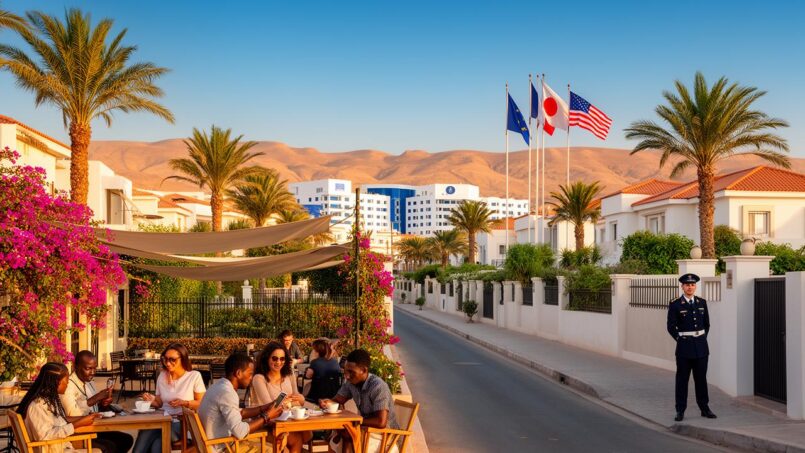
If you had to pick a symbol of expat life in Djibouti, Haramous would be the clear winner. The neighborhood concentrates what many foreign families look for: proximity to embassies, access to international schools, secure villas, and an environment perceived as more “upscale” than average.
A High-End Residential Area
Haramous is clearly described as a high-end residential area. Here you’ll find spacious villas, often with views of the Gulf of Tadjourah or islets like Île aux Tortues, and an unusual density of embassies and international representations. The U.S. Embassy, for example, is located in the Haramous subdivision (Lot #350‑B), which immediately gives you an idea of the level of security and control in the area.
This diplomatic concentration creates a particular social microclimate: monitored streets, the presence of private guards, a flow of 4x4s bearing NGO logos, and an environment where expats constantly cross paths with embassy staff, military mission personnel, UN agency workers, or employees of major logistics companies.
The International School Hub
For families, this is the other major selling point: Haramous is home to several key institutions in the international school landscape. These include Turkish and Saudi schools, as well as the QSI International School of Djibouti, which offers an English-language curriculum from kindergarten through secondary school, emphasizing 21st-century skills (critical thinking, collaboration, leadership, digital literacy).
The Haramous neighborhood in Djibouti is home to or in close proximity to several international or French-language schools, such as the International School of Djibouti, the International School of Africa, and the Lycée d’État de Djibouti. This concentration makes it a highly sought-after area for expat executives with school-age children.
Housing Designed for a Foreign Clientele
In and around Haramous, the real estate market clearly targets an international clientele. Listings talk about 4-, 5-, or 6-room villas in secure compounds, with generator, air conditioning, indoor parking, equipped kitchen, and sometimes a swimming pool. Rents reflect this.
A few benchmarks help you gauge the price level:
| Type of property (Djibouti City) | Average monthly rent (USD) | Notes |
|---|---|---|
| Studio / 1-bedroom “expat” in center | 1,000 – 2,000 | Typical range for Haramous and comparable neighborhoods |
| 1-bedroom in center (national statistical average) | ~245 | “Local” level, more modest standard |
| 3-bedroom in center (national statistical average) | ~447 | Rarely the standard for expat villas |
| 3-bedroom villa in Lota – Harmous (listing) | 265,000 Fdj (~1,490 USD) | Indicative rent from data |
| Furnished 5-room villa in Haramous (listing) | 450,000 Fdj (~2,530 USD) | High-end furnished villa |
The gap between national averages and what an expat actually pays in search of comfort, security, and proximity to schools is striking. Where statistics mention a 3-room apartment in the center at $447, listings targeting foreigners easily exceed $1,500 or even $2,500 for a well-located villa or apartment in Haramous.
Concrete Example: The Villa Haramous
One of the emblematic accommodations associated with the neighborhood is “The Villa Haramous”, a guesthouse located about 3.85 km from the city center, within a complex of apartments (Lootah apartments). The establishment doesn’t just offer a roof; it provides the full range of amenities that expats on assignment or newcomers looking for a “soft landing” seek.
Discover all the amenities and services available on-site for a pleasant and secure stay.
Enjoy a restaurant, bar, snack bar, and coffee shop. A shared lounge, garden, and games room with billiards are also available.
Unwind in the outdoor swimming pool (open year-round), sauna, and hammam.
24-hour front desk, laundry and ironing service. Free public parking nearby.
The property is equipped with video surveillance, smoke detectors, fire extinguishers, and alarms for your safety.
All air-conditioned rooms come with a balcony, flat-screen TV, refrigerator, dishes, kettle, bed linen, and towels. Some offer views of the city or a lake. The marketing pitch highlights access to “wellness packages,” a variety of breakfast options (buffet, continental, à la carte, in-room), and acceptance of international credit cards. In short, a product calibrated for a mobile, multilingual (French, English, Arabic), and relatively affluent audience.
Neighborhood Pros and Cons
For a newcomer, Haramous piles on the advantages: sense of security, presence of institutions, proximity to schools, quick access to the airport and main roads, and a concentration of housing designed for a Western lifestyle. Expats who settle there often find a reassuring environment, away from the road or service problems that affect other parts of the city.
Rental prices are very high, and the social life, centered on the international community, limits interaction with the local population outside of professional or domestic contexts.
Gabode: The Other Residential Bastion for Foreigners
Less frequently mentioned in brochures but very present in expat discussions, Gabode forms a vast residential area, divided into several sub-sectors like Gabode 3 or Gabode 5. Close to the airport, it offers an alternative to Haramous for those seeking a primarily residential environment with a wide choice of villas and apartments.
A Neighborhood Designed for the Upper Middle Class
Gabode has many housing developments built to accommodate civil servants, executives, and government employees. You’ll find many single-family homes, sometimes subdivided, often surrounded by walls, with shady inner courtyards. For expats, the main interest lies in the compromise between proximity to services, accessibility, and the availability of medium-to-large housing.
In some areas like Héron Marabout or near Gabode, studios and small furnished apartments of 20 to 45 m², often equipped with air conditioning and internet access, are now being offered to a foreign, single, or couple clientele.
Price Ranges and Typology
Looking at the overall rental data, you can see what makes Gabode an interesting option: average prices for housing outside the hypercenter remain more affordable than in the most sought-after areas, while being close by road.
In Djiboutian francs, the monthly rental ranges are as follows:
| Type of housing | City center (Fdj) | Outside center (Fdj) |
|---|---|---|
| 1 bedroom (average) | 255,000 (120,000 – 390,000) | 85,000 (40,000 – 130,000) |
| 3 bedrooms (average) | 176,666 (150,000 – 200,000) | 264,378 (180,000 – 400,000) |
For an expat, these raw numbers aren’t enough: a “good” house in Gabode, with effective air conditioning, a generator, decent furniture, minimal finishing, and a responsive manager, will come closer to the higher end of the range, or even exceed it. But you’re often still below Haramous rents for an equivalent surface area.
A Practical but Uneven Neighborhood
Gabode has the advantage of being connected to major roads, close to the airport and major public facilities. Many expats rent villas there through local agencies or embassy networks. However, the quality of the houses varies greatly. Testimonies mention sometimes very spacious homes but with recurring plumbing, electrical, air conditioning, and generator problems.
The classic configuration of these villas includes three bedrooms and two or three bathrooms, a large living room, an inner courtyard often paved (suited to the climate), and sometimes a rooftop terrace for evenings. The trade-off is clear: you gain space and proximity to services, but at the cost of sometimes heavy maintenance and finishes that fall short of European standards.
Héron, Versailles, and Ambouli: The Rising Neighborhoods
Around the Haramous–Gabode core gravitate several rapidly changing areas, regularly mentioned as “developing” and increasingly geared toward a foreign clientele: Héron, Versailles, Ambouli.
Héron: From Historic Plateau to Chic District
Historically, the Héron islet is one of the four elevations that structured Djibouti’s original site (along with Plateau de Djibouti, Plateau du Serpent, and Plateau du Marabout). It’s here that a rather suburban-style urbanization gradually developed, with large villas surrounded by shady courtyards, highly sought after as you approach the waterfront.
Number of rooms in the luxurious Djibouti Palace Kempinski, a waterfront hotel with a private beach, which boosts the attractiveness of the Héron neighborhood.
A project called “Djiboutiana” is also explicitly presented as a response to urbanization challenges in the Héron neighborhood, intended to become one of the city’s most beautiful living spaces. It promises modern residences, shared rooftop terraces, underground parking, reinforced electrical systems, fiber optics, and even hybrid solutions with solar panels. In other words, urban planning tailored for the upper-middle classes and foreigners.
Versailles and Ambouli: The New Real Estate Playgrounds
Versailles and Ambouli appear as transition zones, still marked by sometimes informal urbanization, but where new residences, aparthotels, and furnished studios are multiplying. For owners, these areas offer cheaper land than Haramous or Héron, while remaining close enough to activity centers to attract expats.
Discover the features of modern apartments available for rent, often offered with integrated services for a comfortable stay.
Small 2- or 3-story buildings offering 70 to 110 m² apartments with 2 or 3 bedrooms. Located sometimes near the sea or landmarks like the Oumousalama mosque.
Housing often rented with included services: cleaning, internet, and sometimes a shared pool, in the form of aparthotels.
Such as the Waafi Corniche Hotel Apartments or JANO HOUSE APARTHOTEL, illustrating this serviced accommodation offering.
For a solo expat or a childless couple, these neighborhoods offer a financial advantage: you stay in an environment perceived as relatively safe, with new housing and rents still slightly below those in the most sought-after sectors.
Place Rimbaud and the Historic Center: Living in the Heart of the City
At the opposite end of the closed residential enclaves, the city center around Place Rimbaud attracts another category of expats: those who prioritize activity, proximity to the port, markets, cafés, and administrative offices.
The Commercial and Historic Center
The city center, with Plateau de Djibouti and Place Rimbaud, is the commercial and administrative heart of the capital. Here you’ll find the port, the historic train station, numerous offices, lively markets, hotels of all categories, and a dense offering of restaurants, cafés, and shops.
Living in the city center allows you to reach many workplaces on foot, reducing commute times and fostering immersion in local life. Additionally, rents are on average more affordable than in the so-called “premium” neighborhoods often favored by the international community.
A Highly Contrasted Housing Offer
The center’s building stock mainly consists of 1- to 3-story apartment blocks, with shops on the ground floor and housing above. Available apartments can be very decent or, conversely, in poor condition, with precarious materials (corrugated iron, wood) in some pockets previously prone to flooding.
In terms of price, the averages cited give an idea of the order of magnitude:
| City center housing indicator | Average value |
|---|---|
| 1-bedroom in center (national statistic) | ~245 USD / month |
| 3-bedroom in center | ~447 USD / month |
| Purchase price per m² in center | ~1,488 USD / m² |
In practice, these amounts apply more to a “local” market. Expats who choose to live in the city center often opt for aparthotels, small renovated residences, or short-stay rentals through platforms, with higher rates but a higher standard.
Minimum price in euros for a hotel night in Djibouti, in short-stay establishments.
Urban Life, Bars, and Nightlife
The center remains the epicenter of Djiboutian nightlife. This is where expat-favored restaurants are concentrated—from the Indian “Kurry – Flavour of India” to French addresses like Café de la Gare or La Mer Rouge, along with the Japanese Melting Pot. This density of nightlife spots, combined with the presence of the port and markets, makes the center a lively, sometimes noisy neighborhood with heavy foot traffic during the day and evening.
For some expats, it’s precisely this mix that makes living there interesting. For others, the preference is for a quieter retreat back to Haramous or Gabode after work.
Balbala and PK12: The Budget Option, Far from the Usual Circuits
At the other end of the scale, Balbala and, further out, PK12 represent another reality of Djibouti City. Balbala is a vast peri-urban area on the heights, long developed informally, now partially subdivided by the state.
A Vast Working-Class Neighborhood
Balbala is home to a large part of the Djiboutian population. Urbanization is dense, often precarious in some areas, with houses made of temporary or self-built materials. Nevertheless, the site has the advantage of being on the heights overlooking the Gulf of Tadjourah, therefore better ventilated and less exposed to the flooding of the Oued Ambouli than lower neighborhoods.
You’ll find some more stabilized sectors, such as Cité Barwaqo, Cité Hodan, or parts of Quartier 11 near the Arta road, where permanent housing has been laid out by the state to accommodate civil servants. But overall, housing standards remain well below those sought by most expats.
Lower Rents, But Few Expats
Balbala is consistently described as a “more affordable” option, with rents significantly lower than in the center or privileged residential areas. This is what makes it a refuge for low- or middle-income families, whether they come from inland or neighboring countries.
The area is not very attractive for expats, especially families, due to the lack of international schools, distance from embassies, limited infrastructure, and an environment perceived as less secure.
PK12, located on the outskirts, is experiencing a real estate boom with secure “compounds” and modern villas, sometimes intended for expats working on industrial or logistics projects outside the center. You’ll find, for example, listings for villas in secure compounds at Al Gamil / PK12. But this type of product remains a minority in the overall geography of expatriation.
Haramous by the Sea: Leisure, Beaches, and Getaways
Coming back to Haramous also means mentioning the coastal front, which plays an important role in the daily lives of foreigners. The area acts as a gateway to the Djiboutian coastline and the Red Sea, with its reefs, beaches, and islands.
A Prized Coastline for Leisure
Expats based in Djibouti spend a good part of their weekends at the sea: diving, snorkeling, boat trips, beach days at spots like Plage de Soleil, Siesta Beach, Moucha Island, Maskali, or White Sands Beach. Dive clubs like Dolphin Excursions or Djibouti Divers organize regular outings to explore the marine life of the Red Sea.
Haramous is a preferred logistical starting point, offering quick access to the corniche, proximity to marinas and nautical tourism operators, and easy access to roads leading to more distant beaches.
A Connected Neighborhood, but Designed for Cars
Although part of Djibouti City remains walkable, the country has a strong car culture. For Haramous, “walkability” data indicates a score of 41/100, meaning you can walk for some errands but using a car remains almost essential.
The price of a liter of fuel can reach around 310 Djiboutian francs in some areas.
For short distances, taxis remain affordable: an 8 km ride is estimated at about $7.50, and a local bus ticket is around $0.48. From Djibouti City, buses connect to peri-urban and coastal areas, with tickets around 200 Fdj, for journeys of 30 to 45 minutes.
Cost of Living and Housing Budget for an Expat
Living in Djibouti’s most sought-after neighborhoods comes at a price. To understand what this entails, you need to cross-reference rental data with overall cost of living figures.
A Country Cheaper than the Global Average… Except for Foreigners
Global indices rank Djibouti among countries roughly twice as cheap as the world average. The capital is in the bottom 15% of the least expensive cities globally, based on a standard consumption basket.
Estimated monthly cost of living for a single person in Djibouti City, including housing, which is more than double the local average net salary.
For expats, estimates climb much higher. Specialized sources provide the following figures for Djibouti City:
| Profile | Estimated monthly cost (USD) |
|---|---|
| “Classic” expat | ~2,441 |
| Expat family | ~4,858 |
| Digital nomad | ~5,840 |
| Local resident | ~1,388 |
These amounts reflect a lifestyle that includes housing in a sought-after neighborhood, imported goods, international school fees, leisure, and transportation.
Breakdown of Expense Categories
To better understand the financial burden of housing in a neighborhood like Haramous or Héron, you need to add associated service costs to the rent:
Average annual cost of primary school tuition at an international school in Djibouti, ranging from $3,500 to $4,170.
To this base, add transportation costs (less than $50 per month for a person if mainly using taxis and local buses), groceries (about $227 per month for a single adult, $595 for a family), and leisure (gym membership around $25 monthly, dining out, cinema at $4.75 per screening, etc.).
How Do Expats Find Their Housing?
Beyond the numbers, a question immediately arises for those arriving: how do you find an apartment or villa in Haramous, Gabode, Héron, or elsewhere without getting lost or ripped off?
Local Agencies, Aparthotels, and Informal Networks
The most common practices rely on several simultaneous channels. Many expats arrive with housing already negotiated by their employer, especially those working for embassies, NGOs, or large international organizations. Embassies often have their own networks of agencies and landlords.
For newcomers, the first few months are often spent in an aparthotel or via Airbnb, while scouting neighborhoods. Platforms like Booking, Airbnb, and Expedia offer options in sought-after areas such as Haramous, Héron, Gabode, Plateau du Serpent, and the city center.
Local agencies like African Land, platforms dedicated to nomads and expats like Flatio or ExpatEasily, or even “Djibouti Expats” groups on social networks serve as intermediaries for finding furnished housing, often without a large deposit, with included services (cleaning, Wi-Fi, sometimes a rental car, help with administrative procedures).
Importance of Social Networks and Communities
The expat community in Djibouti is relatively small but highly interconnected. Networks like InterNations have a local chapter that organizes monthly events. Friendship-oriented apps like Wooh also exist to facilitate in-person connections. In practice, many good real estate deals circulate first by word of mouth: colleagues leaving at the end of a contract, embassy neighbors, school families passing along contacts of reliable landlords.
Forums like Expat.com or ExpatWoman are valuable resources for future expats. They allow you to exchange advice on neighborhoods to prioritize or avoid, compare rent levels, and gather concrete feedback on the quality of life in certain buildings or gated communities (compounds).
Living in Expat Neighborhoods: Lifestyle, Safety, and Constraints
Beyond the housing itself, choosing a neighborhood in Djibouti implies a certain lifestyle. The sectors popular with foreigners share several common characteristics.
A Social Life Centered on a Few Places
Expats living in Haramous, Gabode, or Héron often structure their daily lives around a handful of hubs: schools, hotels with swimming pools, Wi-Fi-equipped cafés, and beaches. Establishments like the Sheraton, the Djibouti Palace Kempinski, or other major hotels serve as informal social clubs: you go there for brunch, the pool, happy hour, “wine and cheese” evenings.
Nature outings happen on weekends: Lake Assal, Lake Abbé, Forêt du Day, Grand Bara desert. These excursions require a 4×4, sometimes a guide, and a minimum of preparation, especially for families.
An Environment Perceived as Safe but with Constraints
Overall, Djibouti is considered one of the most stable countries in the region, with a moderate political risk level. Street crime exists (pickpocketing, opportunistic theft, break-ins of cars or poorly secured houses) but remains marginal compared to other regional capitals. Expat neighborhoods, heavily monitored, are rarely the scene of major incidents, aside from a few attempted burglaries in poorly secured homes.
The terrorist threat, particularly from the Al-Shabaab group, targets Djibouti due to its role in Somalia. Increased vigilance is required in places frequented by foreigners (hotels, restaurants, shopping centers, stadiums, places of worship) and in neighborhoods with a strong diplomatic presence like Haramous, symbolically more exposed.
Cultural Constraints and Legal Framework
Djibouti is a conservative Muslim republic. In expat neighborhoods, daily life can seem quite free—hotel pools, private parties, and some bars have a very international feel. But respecting certain codes remains necessary: modest dress as soon as you leave these micro-bubbles, discretion in public displays of affection, caution on political or religious topics.
Homosexuality, though not explicitly criminalized, is heavily stigmatized, requiring great discretion for same-sex couples everywhere, including in expat neighborhoods. Additionally, legislation severely punishes drug use and strictly prohibits photographing sensitive infrastructure such as ports, military bases, airports, bridges, and mosques.
Is It Absolutely Necessary to Live in an Expat Neighborhood in Djibouti?
The question often arises for those hesitating between a somewhat expensive apartment in Haramous or Héron and a more “local” option in the city center or a neighborhood like Quartier 7 or Village Lotah.
The Safety and Logistics Argument
For families with children enrolled at QSI, the International School of Djibouti, or a French lycée, the answer is often yes: living in Haramous, Gabode, or Héron reduces commute times, facilitates invitations between children, limits exposure to certain urban problems, and provides an environment perceived as more controlled.
Expat neighborhoods also concentrate the most useful services: private doctors, clinics, pharmacies, supermarkets better stocked with imported goods, sports clubs, travel agency offices, etc.
The Immersion and Budget Argument
Conversely, single expats, NGO volunteers, or certain independent profiles may choose to live more centrally or in intermediate neighborhoods to reduce their housing costs and live in direct contact with the city.
Price in dollars per night, with a minimum commitment of 30 nights, for some short-term rental accommodations outside the Haramous-Gabode-Héron triangle.
The compromise then becomes a very personal trade-off between immersion, comfort, perceived safety, and budget. But for a first posting in Djibouti, especially with a family, Haramous and its immediate neighbors remain the most reassuring option.
In Summary: The Mental Map of Expat Neighborhoods in Djibouti
Without claiming to cover all the nuances of a changing city, we can draw a mental map of the most sought-after areas by expats, with their dominant functions:
| Neighborhood / Area | Primary Profile | Key Strengths |
|---|---|---|
| Haramous | Diplomats, executives, expat families | Embassies, international schools, high-end villas, quick airport access |
| Gabode (3, 5…) | Expats, civil servants, upper middle class | Airport proximity, many housing developments, large homes |
| Héron | Affluent expats, business clientele | Waterfront villas, luxury hotels, modern real estate projects |
| Versailles / Ambouli | Young professionals, couples, short-term missions | New residences, aparthotels, still moderate rents |
| City Center / Rimbaud | Urban expats, short stays, digital nomads | Proximity to port, markets, restaurants, nightlife |
| Balbala / PK12 | Locals, modest families, some compounds | Low rents, growing supply but few expats |
For anyone considering settling in Djibouti, these names quickly become essential landmarks. Haramous dominates the scene, especially for families and diplomatic personnel. Gabode and Héron round out this top three, while Versailles, Ambouli, or certain sectors of the center offer more affordable or more urban alternatives.
In Djibouti, rents corresponding to expat living standards can far exceed the local average income. Although the country is ranked as relatively cheap globally, real estate in sought-after expat neighborhoods forms a very costly bubble, creating a significant economic contrast.
Disclaimer: The information provided on this website is for informational purposes only and does not constitute financial, legal, or professional advice. We encourage you to consult qualified experts before making any investment, real estate, or expatriation decisions. Although we strive to maintain up-to-date and accurate information, we do not guarantee the completeness, accuracy, or timeliness of the proposed content. As investment and expatriation involve risks, we disclaim any liability for potential losses or damages arising from the use of this site. Your use of this site confirms your acceptance of these terms and your understanding of the associated risks.

Cyril Jarnias is an independent expert in international wealth management with over 20 years of experience. As an expatriate himself, he is dedicated to helping individuals and business leaders build, protect, and pass on their wealth with complete peace of mind.
On his website, cyriljarnias.com, he shares his expertise on international real estate, offshore company formation, and expatriation.
Thanks to his expertise, he offers sound advice to optimize his clients' wealth management. Cyril Jarnias is also recognized for his appearances in many prestigious media outlets such as BFM Business, les Français de l’étranger, Le Figaro, Les Echos, and Mieux vivre votre argent, where he shares his knowledge and know-how in wealth management.





