
 Published on and written by Cyril Jarnias
Expatriating in Djibouti is not just about changing countries, climates, or positions. It means entering a very specific economic ecosystem, at once African, Arab, and Francophone, where professional exchanges rely as much on trust and personal relationships as on contracts and Excel spreadsheets. For an expatriate, the network is not a “plus”—it is the invisible infrastructure that conditions access to opportunities, the flow of procedures, and ultimately, the chances of success on the ground.
In Djibouti, nicknamed the ‘Hong Kong of the Red Sea,’ business is primarily built on personal relationships, not anonymous exchanges. It is crucial to understand, develop, and maintain your local network—whether through in-person meetings, business forums, expat groups, or informal exchanges.
A Strategic Crossroads Where It All Comes Down to Relationships
Djibouti holds an extraordinary geopolitical position: at the junction of Africa, the Middle East, and Asia, facing the Bab el-Mandeb Strait, through which a large portion of global maritime trade passes. This makes it a major logistics hub for neighboring Ethiopia, as well as a regional platform for telecommunications, commerce, energy, and tourism.
The economy relies heavily on services, which account for over 80% of GDP, driven largely by port and logistics activities. The secondary sector (industry) remains modest, around 17% of GDP, while agriculture is marginal. The country has no major oil or mineral resources and has therefore positioned itself as a transit, connectivity, and services platform.
This considerable weight of services—where players are numerous, sometimes competing, always interacting—largely explains the importance of relational capital. In an environment where the state, major operators (ports, telecoms, free zones), international donors, and a still-embryonic private sector coexist, access to the right person at the right hierarchical level often outweighs the best PowerPoint presentation.
Analysis of the economic context of services
Employment and private sector figures confirm this: there are only about 3,000 companies with a business license, of which barely 2,000 declare at least one employee to the National Social Security Fund. Almost all are concentrated in services, commerce, and transit. In such a context, every key player is quickly interconnected, and intermediaries who “know everyone” become structural pivots of the network.
Cultural Codes: Hormo, Qaraabo, and the Art of Consensus
To understand networking in Djibouti, you must start with the values that permeate society and the business world. Two Somali concepts come up frequently: hormo, respect, and qaraabo, kinship or extended family. Transposed to work, they mean that hierarchy is strong, age and social status matter, and bonds of trust are built over time, often well beyond the office.
The tradition of *waxtaan* or *shir* illustrates the importance of dialogue and consensus-building in decision-making processes, even within hierarchical environments. For an expatriate, this translates practically into longer-than-expected negotiations, where multiple meetings with different circles of stakeholders are needed before a formal agreement is reached.
The relationship with time is another key point. Punctuality is appreciated, especially from a foreigner, but the actual flow of meetings can be flexible: they often start with talk about family, health, and local news before getting down to business. Trying to get straight to the point too quickly is seen as abrupt, even disrespectful.
In this culture where orality, proximity, and conviviality prevail, communication is both polite and often indirect. A “maybe” can mean “no,” a silence can express disagreement. Gestures, tone, and glances matter as much as words. This is the art of reading between the lines, essential for anyone wanting to build a solid network.
Languages and Codes: Mastering the Right Registers to Connect Better
Djibouti is officially bilingual in French and Arabic, with two major national languages, Somali and Afar, and a multitude of other languages present (English, Amharic, Oromo, Italian, Chinese, etc.). In practice, linguistic registers vary by context.
The situation can be summarized as follows:
| Context / Situation | Dominant Languages | Impact on Networking for an Expatriate |
|---|---|---|
| Administration, law, politics | French (primary), Arabic (translations) | Essential for understanding rules, decrees, procedures |
| Large companies, ports, telecoms | French, growing English | French remains the cornerstone of formal exchanges |
| SMEs, shops, local services | Arabic, Somali, Afar, some French | Arabic helps build rapport; Somali/Afar gives goodwill capital |
| NGO sector, diplomacy, defense | French, English, Arabic | Frequent trilingualism, openness to English-speaking expats |
| Daily life, markets, neighborhoods | Somali (majority), Afar | A few words are enough to break the ice |
For building a network, French remains the pivot language, especially if you frequent economic bodies, large companies, banks, or ministries. Arabic is very useful for contacts with the administration, local SMEs, and more traditional players. A few greeting phrases in Somali or Afar (“Iska waran?”, some expressions of thanks) often make a difference in relationships.
Work documents (contracts, reports, memos) should ideally be available in French, sometimes Arabic. Since the law is primarily written in French, that is the language in which the regulatory framework is understood. To network with public decision-makers or local management, ignoring French means depriving yourself of a major channel.
Key Institutions: Where the Network Hubs Are in Djibouti
One of the most effective reflexes for an expatriate is to quickly align with the major institutions that structure Djibouti’s economic life. They concentrate events, useful contacts, and economic information, and effectively act as “network multipliers.”
The Djibouti Chamber of Commerce and Industry: A Must
Founded in 1907 and reformed in 2002, the Djibouti Chamber of Commerce and Industry (often simply called the Djibouti Chamber of Commerce) is the pivot of the national private sector. It represents businesses before public authorities, collects market data, organizes studies and training, and most importantly, runs business clubs and sector networks.
Its governance, ensured by a General Assembly of 44 elected members and a board of 8 volunteer members, reflects the symbolic weight given to employer commitment. The Chamber:
To boost a territory, a structure can bring together businesses by sector, create clubs and networks to foster exchanges, publish a directory of companies (including new ones) to reference them, and organize or co-organize events such as forums, seminars, or business missions, often in partnership with other institutions.
For an expatriate, approaching the Chamber, participating in its events, asking to be connected with a sector club, or getting support with administrative procedures is a powerful shortcut into the local ecosystem.
A simple table helps visualize the main advantages of this institution for a newcomer:
| Chamber of Commerce Function | Concrete Benefit for an Expatriate |
|---|---|
| Representation of the private sector | Understand power dynamics, identify market “heavyweights” |
| Company directory | Target potential partners or employers |
| Business clubs and networks | Access targeted networking events |
| Training and technical assistance | Align with local standards, gain credibility |
| Co-organization of forums and seminars | Multiply high-level meetings in a short time |
Global Chamber® Djibouti: A Gateway to the International
Another strategic player for an expatriate, Global Chamber® Djibouti, presents itself as an international network designed to facilitate export, import, and investment. Its particularity is that it relies on hundreds of chapters worldwide, claiming a base of over 100 million trusted contacts.
For a manager or foreign entrepreneur, this dual anchoring—local and global—is interesting for several reasons:
Discover the main services offered to develop your international projects
Allows you to connect your projects to third markets to expand your commercial reach.
Provides a framework for organizing trade missions and structured B2B meetings.
Connects you with mentors, partners, or investors familiar with the target region.
Here again, registration, participation in events, and contacting the local management (under the leadership of its Executive Director) are networking levers to exploit from the start.
FSD, DPFZA, ANPI: Other Nodes of Economic Power
Around these horizontal networks revolve institutional players that effectively concentrate a large part of investment decisions:
– The Djibouti Sovereign Fund (FSD), organizer of the Djibouti Forum, acts as an investment catalyst, notably in the port, logistics, energy, and digital sectors.
– The Djibouti Ports and Free Zones Authority (DPFZA) manages the country’s major port complexes and free zones, the heart of logistics activities.
– The National Agency for Investment Promotion (ANPI) supports investors, provides information on the legal framework and incentives, and directs them to administrative partners.
Building ties with these institutions, participating in their events, familiarizing yourself with their strategic priorities—this means positioning yourself close to the Djiboutian “decision-making core.”
Forums, Trade Fairs, and Major Events: Accelerators of Encounters
Djibouti has multiplied major international events that combine economic promotion, strategic reflection, and intensive networking. For an expatriate, these forums are real concentrated opportunities.
The Djibouti Forum, “Gateway of Opportunities”
Under the patronage of the President of the Republic, this exchange platform bringing together sovereign funds, institutional investors, public and private actors, is designed to highlight Djibouti’s potential in logistics, new trade corridors, energy, telecoms, and tourism.
The program typically includes:
– expert sessions and sector panels,
– thematic workshops,
– dedicated networking events,
– pre-arranged one-on-one meetings,
– site visits (ports, Moucha Islands, etc.).
For a recently arrived expatriate, attending this event is a unique opportunity to map out the major players, capture investment trends, and identify potential sponsors.
Intermodal Africa and Logistics Trade Fairs
Another major event: Intermodal Africa, a large trade fair for ports, logistics, and maritime transport, usually held at a reference hotel in the capital. You’ll meet CEOs of port companies, logistics professionals, representatives of regional professional associations, investors, and bank account managers.
The event mixes:
– international conference,
– exhibition of companies and institutions,
– technical visits to terminals and platforms,
– networking cocktails and dinners at partner hotels.
In a country where the Ethio-Djibouti corridor and ports represent the economic heart, being physically present at this type of trade fair—even as a simple visitor—allows you to make contacts with almost the entire logistics value chain.
Other Sectoral Meetings
The Chamber of Commerce relays or co-organizes other events focused on Francophone entrepreneurs, agriculture, investment in neighboring Ethiopia, or forums with partners from the Gulf or Asia. This constant flow of events illustrates Djibouti’s role as a crossroads, but above all gives expatriates multiple opportunities to position themselves.
A practical point: at these high-level events, it is common to be asked for identification (passport, resident card) and sometimes advance data to access port areas or high-security zones. Preparing this in advance avoids unpleasant surprises at the entrance.
Expatriate Networks: A Springboard, Not a Bubble
Beyond institutions, a successful expatriation in Djibouti requires understanding the foreign communities already established. The city concentrates a significant expatriate population relative to the country’s size, consisting of military, humanitarian, diplomatic personnel, employees of large companies, and consultants.
Online Platforms and Communities
Several structures offer an entry point:
Discover the main platforms and groups for meeting other expatriates, exchanging practical tips, and facilitating your settlement in Djibouti.
A community of hundreds of members from dozens of nationalities, organizing monthly events such as afterworks, dinners, and outings.
Platforms like Expat.com or ExpatWoman.com with dedicated sections for life in Djibouti to exchange tips on neighborhoods, schools, safety, and leisure.
Apps like Wooh App that connect people with shared values and interests for in-person meetups.
Groups such as ‘Djibouti Expats’ or ‘Expats in Djibouti’ to find housing, a vehicle, a business partner, or a sports partner.
These spaces do not replace Djiboutian networks, but they provide a useful foundation for the first few months: recruiter recommendations, information on NGOs seeking foreign skills, informal contacts with people who have already “decoded” local customs.
National and Francophone Associations
The historic French presence translates into a very active associative fabric, including the Union of French Abroad, Français du Monde – ADFE, and other charitable organizations or spouses of diplomats. Even if these associations are primarily aimed at French nationals, they are often open and serve as a meeting point with decision-makers, teachers, entrepreneurs, or NGO leaders.
For a Francophone expatriate, these associations act as a bridge to:
– international schools and their communities,
– certain major employers (French companies, educational institutions, NGOs),
– cultural or charitable events shared with Djiboutian partners.
The challenge, however, is not to remain confined to an exclusively expatriate circle. The real power of networking in Djibouti comes from the ability to combine these international communities with local institutions, businesses, and associations.
Social Life as an Extension of the Professional Network
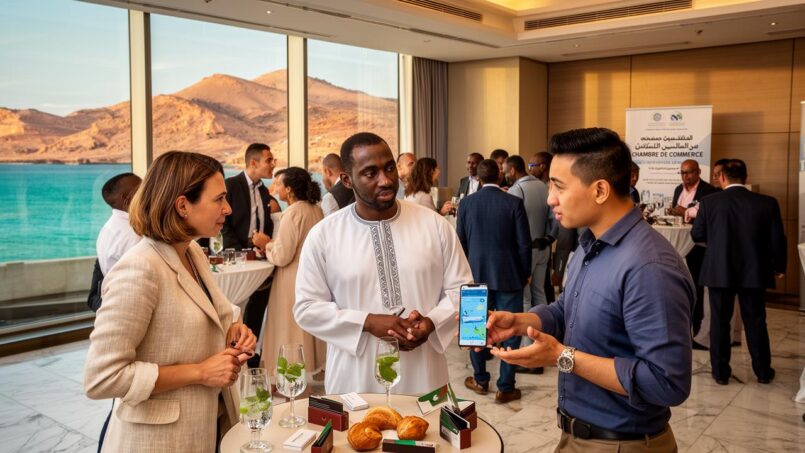
In Djibouti, the boundary between professional network and social life is porous. Invitations for tea (shaah), sharing strong coffee with dates, lunch at a city restaurant, or a day at sea around the Moucha and Maskali Islands often have a semi-professional dimension.
Expatriates readily talk about:
Social life in Djibouti includes various activities like organizing barbecues by the pool, diving or snorkeling trips with clubs (e.g., Djibouti Divers Club) or operators (e.g., Dolphin Excursions), weekend excursions to Lake Assal or Lake Abbé, “wine and cheese” evenings at major hotels, and dinners in private residences where diplomats, executives, elected officials, and business leaders meet.
These gatherings are natural places for information to circulate: that infrastructure project, that regulatory reform, that upcoming mission of an international organization, that job opportunity at an NGO or a port company. Word of mouth works at full throttle here.
Accepting invitations, observing the codes (being modest in attire, avoiding sensitive topics like politics or religion, showing respect for elders) and, above all, reciprocating—by inviting in turn—are essential gestures for consolidating a network.
Building a Network in Promising Sectors
Djibouti’s economy concentrates its growth prospects in a few major sectors where the demand for skills is high and the need for partnerships is numerous. Targeting these development areas mechanically increases the density and quality of the network an expatriate can build there.
The main sectors can be summarized as follows:
| Key Sector | Weight / Main Advantages | Networking Opportunities for Expatriates |
|---|---|---|
| Transport, ports, logistics | Regional hub, Ethio-Djibouti corridor, modern port equipment | Trade fairs like Intermodal Africa, terminal visits, CCD/DPFZA meetings |
| Telecoms & digital | 12 submarine cables, data centers, ambition to become a digital hub | Tech forums, “smart nation” initiatives, meetings with operators and startups |
| Fintech & financial services | Growth of digital banking services, blockchain projects | Exchanges with banks, regulators, incubators |
| Tourism & leisure | Rapid growth, natural sites (Lake Assal, islands) | Contacts with tourism offices, hotels, leisure operators |
| Energy & renewables | Geothermal, solar, green hydrogen projects | Energy forums, meetings with donors and developers |
| Fishing & agri-food | Large exclusive economic zone, under-exploited sector | Technical cooperation, export projects to EU, training |
For an expatriate, the choice of sector is not neutral: it directs you toward certain relational circles. A digital professional will naturally find themselves in spheres led by the Ministry of Digital Economy, telecom operators, data centers, and donors (World Bank, regional investment banks). A logistics manager, on the other hand, will live more in the orbit of the ports, the Free Zones Authority, major shipping companies, and freight forwarders.
Using LinkedIn Strategically from Djibouti
While Djiboutian culture values face-to-face meetings, LinkedIn nevertheless plays a growing role in building a network, especially for international profiles. The trick is to adapt your use of the platform to the local context.
On one hand, LinkedIn is:
– a digital “business card”,
– a tool for identifying decision-makers (CEOs, free zone directors, NGO HR managers, telecom executives),
– a space to make your expertise visible.
On the other hand, it does not replace direct contact, but it prepares and maintains it.
Expert in professional relations
A few principles apply:
To develop your professional network in Djibouti, polish your profile (bilingual, professional photo, compelling headline). Target strategic connections (Chamber of Commerce, port companies, NGOs). Start conversations with personalized messages, and after an event, send a LinkedIn invitation mentioning the context.
The pace, meanwhile, must respect the Djiboutian logic of long-term time: you don’t “close” a partnership through a simple exchange on LinkedIn. You initiate a link that must be nurtured on the ground, over coffee or at an event.
Mentoring and Support: Shortening the Learning Curve
One of the best ways to accelerate building a network in a country with complex codes is to surround yourself with mentors. In Djibouti itself, certain organizations—the Chamber of Commerce, diaspora communities, sector groups—encourage mentorship programs where experienced entrepreneurs advise younger ones.
Specialized international platforms allow you to find a mentor in your field. These online solutions often use intelligent matching systems and are suitable for identifying mentors based in the region or with specific expertise in emerging markets, which is particularly useful for an expatriate.
– discuss your career or business goals,
– understand the risks and opportunities of an environment like Djibouti,
– develop a coherent networking strategy,
– benefit from regular feedback.
Ideally, however, combine both approaches: a “global” mentor, accustomed to international careers, and a “local” mentor, grounded in Djiboutian networks. The first provides strategic vision, the second the finesse of the codes.
Managing Hierarchies and Protocols in Network Building
One recurring pitfall for expatriates is underestimating the weight of hierarchy. In Djibouti, organizations—public and private—operate on very vertical patterns. You avoid contradicting a superior in public, respect formal titles (Mr. Director, Madam Minister, Doctor, Engineer), and generally let the most senior decision-maker initiate or conclude exchanges.
In this context, developing a network requires:
For effective internal communication, it is essential to know who to contact for each matter, to scrupulously follow established formal communication channels, and to avoid bypassing a middle manager by going directly to management without going through the appropriate levels.
The most effective network is often two-tiered:
– trusting relationships with operational managers who know the files and ground realities,
– more institutional relationships with leaders, activated at key moments (contract signing, project launch, resolving blockages).
All this fits within a logic of respect, where ego must take a back seat. Presenting yourself as a partner eager to “grow together” rather than a savior here to “bring the solution” opens far more doors.
Building Bridges with Civil Society and the Associative World
While the traditional networking hubs are chambers of commerce, business forums, and expat communities, Djiboutian civil society also contains many useful relays. Local development associations, NGOs, unions, and charitable organizations form a relational universe of their own.
Participating in training, sponsorship, solidarity, or educational projects within local structures allows you to:
Meeting respected community leaders helps you finely understand the country’s social realities (such as youth unemployment or housing issues), gain local legitimacy, which has a positive impact on business relationships afterward.
In a society where the notion of qaraabo (extended kinship) permeates daily life, being perceived as someone who “gives“—time, expertise, support—rather than someone who only “takes” economic opportunities, profoundly changes the nature of the network built.
Paying Attention to the Details That Make a Difference
Over the course of encounters, certain “small” details have a disproportionate effect on the perception you give of yourself and, consequently, on the quality of the network you build.
Among them:
For social and professional interactions, several points are essential: greet warmly with a firm, respectful handshake using the right hand, adapting physical contact according to preferences. Speak with a moderate tone and avoid staring intensely at a person of higher rank out of deference. Present and receive business cards with both hands or the right hand, and examine them before putting them away. When invited, it is appreciated to bring a small gift and respect customs like removing shoes. Finally, use humor cautiously, avoiding sarcasm or sensitive topics like religion or politics.
These gestures, far from being trivial, are signals sent to your interlocutors. In a universe where trust is built over time but also on the consistency between words and attitudes, they directly contribute to opening—or closing—doors.
Maintaining the Network Over Time
Making an initial contact is one thing. Turning it into a lasting relationship is another. In Djibouti, as elsewhere but even more so, loyalty plays a central role. It involves:
To maintain an effective professional network, it is crucial to stay present without being intrusive—for example, by sending a message on a major holiday, an email with useful information, or an invitation to an event. Always keep your commitments, even minor ones, like sending a promised document or making an introduction. Celebrate others’ successes, such as a promotion or project launch, by offering sincere congratulations—this strengthens bonds. Finally, accept the local pace: don’t take offense at slow responses, meeting postponements, or prolonged decisions, as aggressive insistence is often counterproductive.
Here again, the combined use of digital tools (emails, LinkedIn messages, professional WhatsApp groups) and in-person meetings (courtesy visits, coffees, lunches, repeated attendance at the same events) allows you to weave a network that gradually becomes a true community of trust.
As a Guiding Thread
Developing your professional network abroad, and especially in Djibouti, means orchestrating several dimensions simultaneously: understanding a specific economic environment, respecting strong cultural codes, anchoring yourself in key institutions, attending major events, and integrating into both expat communities and local society.
This crossroads country offers opportunities in several sectors (ports, digital, energy, tourism, services to international organizations, consulting). However, to realize them, it is essential to establish yourself locally—to stop being simply ‘passing through’ and become an identified, recognized, and respected interlocutor.
This shift rarely happens in air-conditioned meeting rooms. It is born on a café terrace, at a business forum, on a port quay, during a dinner at a local’s home, at an InterNations gathering, at a Chamber of Commerce meeting, or in an NGO office. It rests on a simple alchemy: listening, patience, respect, curiosity. In Djibouti, these qualities are the true currency of the professional network.
Disclaimer: The information provided on this website is for informational purposes only and does not constitute financial, legal, or professional advice. We encourage you to consult qualified experts before making any investment, real estate, or expatriation decisions. Although we strive to maintain up-to-date and accurate information, we do not guarantee the completeness, accuracy, or timeliness of the proposed content. As investment and expatriation involve risks, we disclaim any liability for potential losses or damages arising from the use of this site. Your use of this site confirms your acceptance of these terms and your understanding of the associated risks.

Cyril Jarnias is an independent expert in international wealth management with over 20 years of experience. As an expatriate himself, he is dedicated to helping individuals and business leaders build, protect, and pass on their wealth with complete peace of mind.
On his website, cyriljarnias.com, he shares his expertise on international real estate, offshore company formation, and expatriation.
Thanks to his expertise, he offers sound advice to optimize his clients' wealth management. Cyril Jarnias is also recognized for his appearances in many prestigious media outlets such as BFM Business, les Français de l’étranger, Le Figaro, Les Echos, and Mieux vivre votre argent, where he shares his knowledge and know-how in wealth management.





