
 Published on and written by Cyril Jarnias
Settling in Djibouti is not just about changing continents or climates. You enter a society where social codes, family relationships, the perception of time, work, religion, and even table manners are profoundly shaped by a blend of African, Arab, and French influences. For an expatriate, these cultural differences can be a source of misunderstandings… or, on the contrary, a path to successful integration, provided you know and respect them.
Understanding the cultural foundation of Djibouti
Djibouti is a small country in the Horn of Africa, at the crossroads of the Red Sea and the Gulf of Aden. Its position as a crossroads between Africa, the Middle East, and Asia is reflected in its population, language, cuisine, and social practices. The culture results from a complex weave of Somali and Afar traditions, Arab heritage, and French influence.
Society is predominantly Sunni Muslim, with religious practice structuring daily life, schedules, the rhythm of days, and the legal framework in several areas, particularly family and personal status. It is often described as a conservative society, in the sense that everyone’s roles, the place of the family, hierarchical respect, and public modesty remain strong references, even if cities are undergoing rapid modernization.
Two main ethnic groups dominate: the Somalis (notably the Issa, but also the Gadabuursi and Isaaq) and the Afar. Each has its own traditions, forms of lineage organization, and customary systems. Around this core, Arab (especially Yemeni), Ethiopian, and European communities have been added. The result is a mosaic where everyone’s identity is simultaneously familial, clan-based, religious, and national.
“Unity, Equality, Peace” – it is not just a slogan: the coexistence of different groups has historically relied on traditional mediation mechanisms, carried out by leaders, elders, and families, which favor appeasement and compromise rather than a “winner-loser” logic.
National motto of Chad
Family as the heart of social life
In Djibouti, one does not first define oneself by one’s job or individual status, but by one’s family and kinship network. The extended family is the true basic unit: it includes parents, grandparents, uncles, aunts, close and distant cousins, sometimes all living in the same neighborhood, or even under the same roof.
Elders hold a central place. Their word guides major decisions: marriage, moving, alliance choices, conflict resolution. Younger people must show them respect, first in how they greet, listen, and address them, but also in their life choices, which are expected to uphold the group’s honor.
Good to know:
The sense of family extends beyond the domestic sphere and constitutes a crucial safety net, including financial help, housing, childcare, and support in case of illness or unemployment. For an expatriate, this means that your local contact rarely acts as an isolated individual, but as a member of a network of relationships. This network can influence their availability, priorities, and approach to negotiations.
Gender roles and changes
The family model remains largely patriarchal: the man is traditionally seen as the head of the family, the breadwinner and primary decision-maker, while the woman bears most domestic and educational responsibilities. These roles are reinforced both by local customs and by a conservative interpretation of religious texts.
In practice, the situation is more complex. In urban areas, more women are gaining access to education, vocational training, and salaried jobs, sometimes in technical or managerial sectors. Public policies promote gender equality and women’s participation in economic and political life, even though figures show that gaps remain very wide, especially in labor force participation or access to leadership positions.
For an expatriate, especially in a professional setting, it is important to understand this tension between traditional norms and new aspirations. A Djiboutian female colleague or boss may, for example, face prejudice in her own environment, which makes respectful, non-paternalistic behavior all the more crucial, being careful not to reinforce stereotypes.
Languages and communication codes
Djibouti is officially French and Arabic speaking, but the linguistic reality is richer. French is very present in administration, education, and part of the business world; Arabic holds a key place in institutions and the religious sphere; while Somali and Afar permeate daily life, especially in working-class and rural areas. English is growing in international business, logistics, port activities, and among younger urban generations.
Tip:
A French-speaking expatriate can often get by in French, especially in Djibouti City and in institutional or international circles. However, making the effort to learn a few words in Arabic, Somali, or Afar – even just greetings – is highly appreciated and seen as a concrete sign of respect.
Here is a simplified overview of languages in key contexts.
| Context | Dominant language(s) | Practical notes for an expatriate |
|---|---|---|
| Administration & government | French, Arabic | Official documents mostly in French or Arabic |
| Local business / SMEs | French, Arabic, Somali, Afar | Frequent code-switching depending on interlocutors |
| Large groups / multinationals | French, English | English is growing, especially with foreign partners |
| Markets, construction sites, port | Somali, Afar, Arabic, some French | Gestures, tone, and respect matter as much as language |
| Daily life in the city | French, Somali, Arabic | Frequent multilingual greetings |
| Rural areas | Somali, Afar | A local guide is often essential |
Beyond language, the way of communicating is itself culturally marked. The direct, upfront tone common in some Western countries can be perceived as brutal or disrespectful. In Djibouti, a more diplomatic style is valued, where one spares sensitivities, especially when addressing a superior, an elder, or a partner with whom the relationship matters.
Attention:
A polite “maybe” can mask a refusal, and a prolonged silence may indicate hesitation or disagreement rather than tacit approval. In a professional setting, the absence of an explicit “no” therefore does not automatically mean agreement.
Non-verbal cues play a key role: posture, physical distance, voice modulation, eye contact. A calm tone, a composed attitude, avoiding loud voices in public are all markers of good upbringing. Open humiliation, harsh criticism, sarcasm, or visible anger in front of others are very poorly perceived and can break a relationship of trust.
Greetings, politeness, and the place of elders
The moment of greetings is an important ritual, whether in a social or professional context. You do not “get straight to the point” without taking time to ask about health, family, and work. An expatriate in a hurry who skips these preliminaries easily comes across as cold, even condescending.
The most common form of greeting is a handshake, always with the right hand, often accompanied by a slight bow of the head as a sign of deference. Among close friends of the same sex, displays of affection can be more demonstrative: hugs, cheek kisses between men, series of symbolic kisses or cheek touches between women.
Example:
In a conservative environment, with a person of the opposite sex, it is best not to initiate physical contact like a handshake. If the other person does not extend their hand, a polite and neutral alternative is a slight nod, possibly accompanied by a hand placed over the heart.
Greeting formulas reflect linguistic plurality: you often hear “As-Salaam-Alaikum” (and its response “Wa-Alaikum-Salaam”), but also “Bonjour,” “Bonsoir,” or “Nabad” in Somali. In a more traditional context, you might address an elder as “Oday” (elder, chief), a sign of great respect.
Age hierarchy is observed as soon as you enter a room: you greet the oldest or most important people first, before turning to others. Omitting an elder from greetings can be perceived as a more serious affront than being slightly late for an appointment.
Religion, daily life, and sensitive periods
The weight of Islam in Djiboutian life permeates many aspects that the expatriate will quickly feel. The call to prayer rings out five times a day, reminding of the rhythm of obligatory prayers. Friday has a special status, with the main midday prayer that can shift office, shop, or administration hours.
Attention:
Muslim dietary rules (halal) are strict, with ritual slaughter, a prohibition on pork, and regulations on alcohol. In public spaces, it is essential to respect the religion, its symbols, and practices, and to avoid sensitive discussions about theology, politics, or tribes, unless the local interlocutor initiates the exchange with discretion.
The month of Ramadan is undoubtedly when these norms are most visible. Muslims fast from dawn to sunset, abstaining from eating, drinking, smoking, or chewing gum. Out of respect, it is strongly discouraged for a non-Muslim to consume anything visible in public during the day. Working hours shorten, life slows down during the day and picks up after breaking the fast, around evening meals (iftar) and family gatherings.
Good to know:
For an expatriate, Ramadan means anticipating earlier meetings and less productive afternoons. You need to be patient with interlocutors tired from fasting. Restaurants may be closed during the day or only offer discreet service. Conversely, sharing an iftar with colleagues or neighbors is a privileged moment for building bonds.
Clothing and modesty codes
Djibouti’s heat naturally encourages light clothing, but social norms value modest dress, especially outside very touristy areas. Showing too much skin in public is quickly interpreted as a lack of respect for local values.
Good to know:
For women expatriates in Djibouti, it is advisable to wear loose, light, and covering clothing (shoulders and knees), such as long dresses, midi or maxi skirts, flowy pants and tunics. Wearing a veil is not mandatory for foreign women, but it is common among married Djiboutian women. However, in mosques or certain religious contexts, it is essential to cover your head and wear clothing that covers your arms and legs.
Men benefit from wearing pants and a shirt or polo with sleeves, even if in very touristy or private beach areas, more casual attire might be tolerated. Shorts in the city remain associated with tourists and are not well regarded in administrative or professional settings. Men’s tank tops should be avoided in public spaces.
Traditional outfits remain frequent: macawiis (a type of sarong) or tobe (white cotton robe) for men, colorful dirac for women, sometimes complemented by a shawl (garbasaar) and a headscarf. During festivities, jewelry and adornments can be spectacular, inspired notably by Berber patterns.
Swimming is a special case: classic swimwear is reserved for private beaches and pools, mainly those of hotels. On public beaches, many women swim clothed or opt for very covering attire. Wearing a one-piece swimsuit, a shorty, or more modest swimwear helps avoid staring or comments.
Hospitality, invitations, and shared meals
The reputation of Djiboutian hospitality is not unwarranted. Being invited to someone’s home is a real honor, especially for a foreigner first perceived with curiosity, then, if all goes well, as a guest to be pampered.
Table manners and etiquette
Tips on how to behave appropriately when invited to dinner at a French home.
Arrival and entry
Upon arrival, it is customary to remove your shoes at the entrance and wait to be invited to sit down.
Table behavior
Wait to be invited to start eating. Tasting a little of everything shows respect for the host’s effort.
Handling offers
Systematically refusing drinks and food is poorly perceived. Tactfully explain any dietary restrictions if necessary.
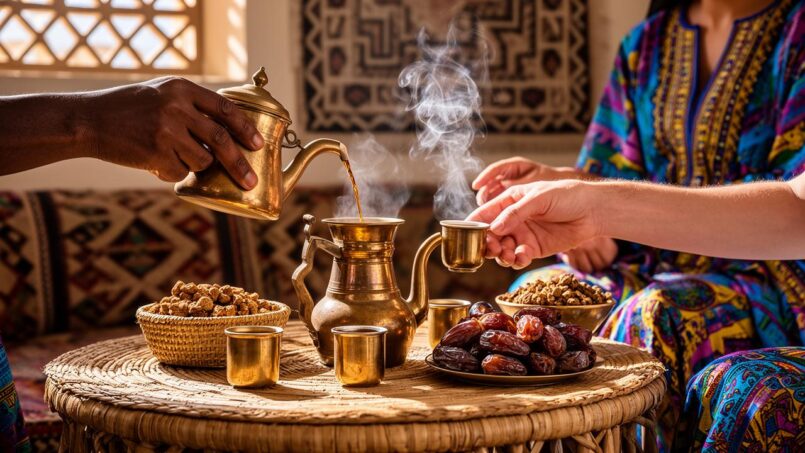
Offering a small gift – dates, fruit, pastries, sweets – is not mandatory but always appreciated. At the end of the meal, politeness dictates that you do not leave immediately after finishing your plate: you stay for a while to chat, have tea or coffee, and thank warmly. These extended exchanges are the heart of the relationship, even more than the meal itself.
Good to know:
Dishes are usually served in a large communal platter around which guests gather. It is best to serve yourself from the area in front of you, using your right hand if eating with your fingers, after washing your hands. It is important to avoid waste by only taking what you can reasonably finish.
Tea and coffee hold a strong symbolic place. Coffee, inherited from Ethiopian tradition, can involve a true ceremony with roasting of the beans, grinding, and brewing in a specific pot (jebena). Tea (shaah), often very sweet and flavored with ginger or cardamom, punctuates the day. Cups are refilled almost automatically: as long as a guest does not refuse insistently, it is considered normal to keep serving.
Local cuisine and eating habits
Djiboutian gastronomy reflects the country’s geography and history: a blend of Somali, Afar, Yemeni, Ethiopian, French, and sometimes Indian flavors. Many dishes are spicy, without being systematically fiery, and feature grains (rice, wheat, corn), legumes, and meats (goat, lamb, beef, camel, fish).
Example:
Among culinary specialties, a spiced rice dish accompanied by meat is considered an emblematic meal. The cuisine also features lamb or goat stews, spicy beef soups, Yemeni-style grilled fish, as well as diced meat stir-fried with spices. Side dishes include flatbreads like lahoh (a fermented pancake) or sabayaad (a flaky flatbread). Finally, stuffed fritters similar to samosas are very popular, especially for breaking the fast during Ramadan.
Breakfast (“quraac“) is an important meal, often consisting of lahoh accompanied by tea or coffee, sometimes with liver, goat meat, or dried meats. Lunch (“qado”) is traditionally the most substantial meal of the day. Schools and some workplaces close for a few hours in the mid-afternoon, allowing time for a family meal and a nap.
Desserts and snacks include dense sweets made from sugar, spices, and nuts, vegetable fritters, tropical fruits (mango, guava, banana), and porridges flavored with cumin.
For an expatriate, the diversity of options in the city is an asset: local restaurants, Yemeni, Ethiopian, Chinese, Vietnamese, Lebanese eateries, not to mention international hotels. Western cuisine remains concentrated in upscale establishments. At home, many families combine traditional dishes with global influences, especially among younger people.
Khat, alcohol, and public behavior
Two products hold a special place in social practices: khat and alcohol, each with very different meanings and statuses.
Good to know:
Khat is a plant with stimulant effects, often chewed during male social gatherings for discussion. A foreign visitor may be invited; you can politely refuse without causing offense, as long as you do not come across as condescending.
Alcohol, on the other hand, is legal but strictly regulated. It is found mainly in certain hotels, restaurants, and bars targeting a foreign clientele, primarily in Djibouti City. Its consumption in public remains frowned upon, especially outside these venues. Public intoxication is severely punished and can lead to heavy penalties, including prison. For an expatriate, alcohol consumption must therefore remain discreet and confined to appropriate settings.
Good to know:
Physical displays of intimacy, such as kissing or holding hands in a heterosexual couple, are generally to be avoided in public, especially in rural and conservative areas. On the other hand, it is common and socially accepted for men to hold hands or walk arm in arm, which is seen as a sign of friendship, not romantic attraction.
LGBTQ+ individuals should keep in mind that even if penal codes do not explicitly criminalize same-sex relations, social pressure and the invocation of public morality laws make any visibility risky. Discretion is essential.
Professional life: hierarchies, time, and trust
In the workplace, Djiboutian culture combines French administrative influences, relational logics from Arab and African contexts, and local values centered on respect (hormo) and kinship (qaraabo). The economy, heavily oriented toward services, logistics, port activities, and international organizations, further creates heterogeneous professional environments where international codes and local norms coexist.
Companies and administrations generally operate with a clear hierarchical structure, with a decision-making flow that comes from the top. Directly contradicting a superior, bypassing the chain of command, or imposing a too horizontal management style can be perceived as challenging the established order. The continued use of titles (“Mr. Director,” “Madam Minister,” “Doctor,” “Engineer”) remains common, even in informal exchanges.
Good to know:
Punctuality is officially valued, but some flexibility is tolerated. A delay of 5 to 15 minutes for a meeting is generally not dramatic, while arriving too early can embarrass your hosts. The emphasis is more on availability for in-depth exchanges and strengthening bonds than on strictly adhering to the start time.
Negotiations often take place over several meetings. You first discuss anything but the main subject: family, weather, current events, country news. Shortening or skipping these preliminary conversations is perceived as a lack of respect. In this context, wanting to “get straight to the point,” close a contract in a single session, or force a decision through pressure or urgency has little chance of success.
Here are some characteristic traits of the professional culture to keep in mind.
| Aspect | Dominant practice in Djibouti | Implicit expectations towards an expatriate |
|---|---|---|
| Hierarchy | Vertical structure, strict respect for levels | Do not bypass superiors, use titles |
| Decision-making | Top-down, multiple consultations, influence networks | Accept delays, avoid demanding an immediate response |
| Punctuality | Desired but flexibly interpreted | Arrive on time, remain patient if the meeting starts late |
| Negotiation | Slow process, centered on the relationship | Prioritize the long term over quick wins |
| Communication | Indirect, diplomatic, heavy non-verbal load | Read between the lines, avoid direct public criticism |
| Networking | Key: family, clan, friends, former schoolmates | Invest in informal meetings (tea, lunch, dinner) |
Recruitment illustrates this logic well. A human resources manager may give more weight to a candidate’s ability to integrate into local rhythms, respect elders, and value the team, than to a brilliant technical CV. The interview begins upon arriving at the premises: greeting the reception staff, how you wait without being glued to your phone, how you respond to small talk questions – all are clues to the candidate’s cultural compatibility.
Dress and attitude at work
The professional dress code tends toward formal or business casual depending on the sector, but always with a focus on decency. Men frequently wear dress pants and a shirt, sometimes a light suit. Ties are not systematic, especially due to the heat. Women wear outfits covering knees and shoulders: pantsuits, long dresses or skirts paired with long-sleeved tops. Too flashy, tight, or revealing attire can be offensive in some circles.
Tip:
Gestures, especially foot positioning, carry significant meaning in traditional settings. Crossing your legs in a way that exposes the sole of your shoe toward someone can be seen as a lack of respect. It is therefore advisable to avoid showing the soles of your feet, particularly in the presence of a superior or an older person, to prevent any negative interpretation.
In written exchanges, the use of formal French predominates, with elaborate polite formulas, titles, and a respectful tone. On the phone, you always start with cordial greetings before stating the purpose of the call. An email that is too direct, without an introductory phrase or thanks, may be seen as brusque to the point of being offensive.
Free time, safety, and daily life
Outside work, Djiboutian life revolves around families, cafes, markets, private beaches, and sports or outdoor activities for those who can. Expatriates are mainly concentrated in the capital, where the main services, international schools, well-equipped hospitals, and leisure spaces are located.
Attention:
Risks such as theft, assault, or road hazards (unlit vehicles, animals on the roads) exist. Avoid traveling alone at night in isolated areas. Prefer taxis, private drivers, or hotel shuttles over public transportation, which is often poorly regulated and run-down, and not recommended for expatriates.
Authorities take very seriously anything related to terrorism, military, port, and airport installations. Taking a photo of a port, bridge, airport, official building, military personnel, or police officer can get you into serious trouble, including detention and expulsion. This sensitivity sometimes extends to less obvious places: when in doubt, it is better to refrain from photographing.
Tip:
To photograph people in Djibouti, it is essential to ask their permission beforehand, especially in the case of women and children. Many Djiboutians do not appreciate being photographed by strangers. A direct, courteous approach accompanied by a smile is far preferable to any attempt at discreet or long-distance photography.
Expatriates should also be aware of the logic of tipping. While not mandatory, it is appreciated: around 10% in restaurants (unless service is included), rounding up the fare for taxis, a small amount for porters or hotel staff. That said, politeness and verbal appreciation remain the most important things.
Cultivating your “cultural intelligence”
Expatriating to Djibouti is not about memorizing an endless list of prohibitions and prescriptions; it is above all about learning to read a different social environment and gradually adapting your behaviors. Several key attitudes facilitate this adaptation.
One is patient observation of others. Watching how colleagues greet each other, how families behave in restaurants, how people dress for this or that occasion, allows you to adjust your own behavior without necessarily having it explained to you.
Tip:
Genuine respect for religious beliefs and practices is shown through simple, concrete gestures. This includes being quiet during the call to prayer, letting a colleague finish their prayer before discussing a professional matter, not joking about fasting during Ramadan, and dressing appropriately when visiting a place of worship. These actions send strong signals of consideration and respect for others.
The ability to slow down is also crucial. Time in Djibouti serves a purpose other than optimizing productivity; it serves to hold together people, families, and networks. An expatriate who systematically refuses tea or a meal “to go faster” may gain a few minutes but lose significant opportunities for trust.
Good to know:
In intercultural interactions, it is crucial to show humility. This means accepting that you won’t understand everything immediately, listening actively, asking for clarifications without aggression, and acknowledging your own mistakes. This approach, centered on human relationships, is often better received than a rigid attitude aimed solely at following rules.
Djibouti is not a closed or hostile country toward foreigners, quite the contrary. The strong tradition of hospitality, the importance given to welcoming others, and the country’s historical role as a crossroads of peoples and goods have forged a culture of openness, provided that you yourself show respect for what Djiboutians consider essential: family, faith, honor, and the time devoted to others.
For an expatriate ready to play the game, cultural differences are then no longer obstacles, but the very substance of a rich, demanding, and deeply formative life experience.

Cyril Jarnias is an independent expert in international wealth management with over 20 years of experience. As an expatriate himself, he is dedicated to helping individuals and business leaders build, protect, and pass on their wealth with complete peace of mind.
On his website, cyriljarnias.com, he shares his expertise on international real estate, offshore company formation, and expatriation.
Thanks to his expertise, he offers sound advice to optimize his clients' wealth management. Cyril Jarnias is also recognized for his appearances in many prestigious media outlets such as BFM Business, les Français de l’étranger, Le Figaro, Les Echos, and Mieux vivre votre argent, where he shares his knowledge and know-how in wealth management.





