
 Published on and written by Cyril Jarnias
Moving to Djibouti means arriving at the crossroads of East Africa, the Arabian Peninsula, and French heritage. This strategic position, long connected to the ancient spice routes, is directly reflected on the plate. Between Somali stews, Ethiopian breads, Yemeni-style fish, and touches of French bistros, the Djiboutian table is a faithful mirror of the country: diverse, blended, and warm.
Discovering the local cuisine helps you understand the culture and social codes. This guide helps you navigate between small popular restaurants (bouibouis) and expat-friendly establishments, taking into account budget, religious habits, hygiene concerns, and the best addresses in the city to avoid missteps.
Understanding the DNA of Djiboutian Cuisine
The local cuisine is the result of a deliberate blend of Somali, Afar, Yemeni, Ethiopian, Arab, Indian, and French influences. Historically, the region served as a passage point on the spice route; Arab merchants, French colonists, and neighbors from the Horn of Africa each left their recipes and spices.
The cuisine of the Horn of Africa (Eritrea, Ethiopia, Somalia, Djibouti) is based on simple but flavorful foundations. It includes many grains such as rice, sorghum, millet, and sometimes teff, accompanied by legumes (lentils, chickpeas, beans). Proteins come from goat, mutton, beef, and sometimes camel meat, along with a strong presence of fish and seafood thanks to the proximity of the Red Sea and the Gulf of Aden. The uniqueness and richness of flavors come from seasonings: cardamom, cumin, cinnamon, cloves, saffron, chilies, and spice blends like *berbere* or fragrant clarified butters (*niter kibbeh*).
Practically all food served is halal, in line with the Muslim majority. Pork is virtually absent, alcohol is confined to authorized hotels and bars, and some dishes are reserved for major religious festivals like Eid.
A Daily Rhythm of Stews, Rice, and Breads
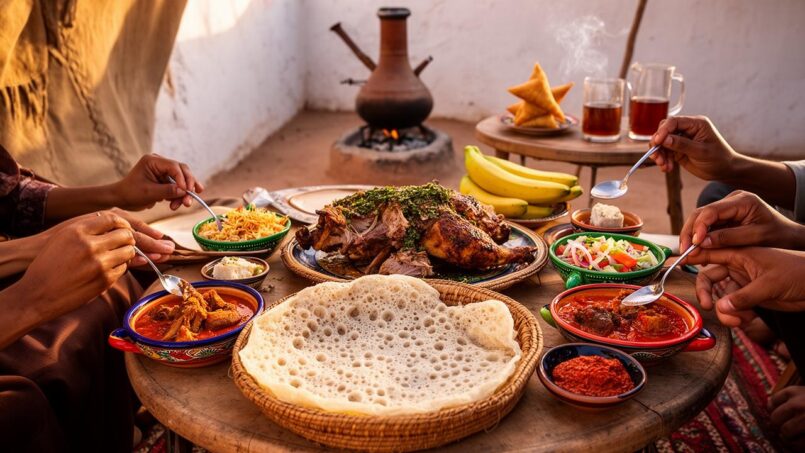
Meals revolve largely around three elements: a starch (rice, bread, sometimes pasta), a stew (called maraq or soup), and spices. Lunch (qado) is often the biggest meal of the day, while dinner (casho) is simpler but always convivial. A large communal dish placed in the center is often shared, and eating with the right hand is common, especially when using spongy breads to scoop up bites.
Typical breads – lahoh (or laxoox), canjeero, injera – strongly recall Ethiopia and Somalia, while spiced fragrant rice evokes Yemeni and Indian influences. In the capital, there are also very visible traces of French presence: cafés, pastry shops, croissants, steak-frites, or mussels and fries do exist, often popular among expats craving European references.
Must-Try Dishes in Djibouti to Understand the Country
To truly grasp the local gastronomy, some dishes should be at the top of your list. They tell the country’s history, its climate, its neighboring influences, and its religious codes.
Skoudehkaris, the Comforting National Dish
Considered the emblematic dish, Skoudehkaris (or Skudahkharis) is a meat and rice stew. It usually contains lamb or mutton, sometimes beef, slow-cooked with onions, tomatoes, and a typical spice blend: cardamom, cumin, cinnamon, cloves, and sometimes a bit of chili.
The result is a complete, aromatic but not fiery dish, served in a large sharing platter. It is very common in families, but you can enjoy it at local restaurants like Restaurant la Fontaine or Restaurant La Viragre, known for their authentic Djiboutian cuisine.
| Dish | Main Ingredients | Culinary Characteristics |
|---|---|---|
| Skoudehkaris | Rice, meat (lamb/beef), tomatoes, onions | National dish, warm spices (cardamom, cloves…) |
| Fah-fah | Meat (goat/beef), vegetables | Very spicy soup/stew, served with bread |
| Lahoh / Laxoox | Fermented batter from flour | Spongy bread, similar to Ethiopian injera |
| Sambusa | Meat/lentil filling in thin pastry | Fried triangular snack, very popular |
| Mukbaza / Yemeni fish | Whole grilled fish, spicy sauce | Yemeni specialty, often cooked over charcoal |
Fah‑fah, the Spicy Soup for Cool Evenings
Fah‑fah (sometimes called “Djiboutian soup”) is a meat stew – most often goat or beef – long boiled with vegetables (potatoes, onions, carrots, sometimes cabbage or bell pepper) and generous amounts of chili. It is served piping hot, with a spongy bread like canjeero or injera used as a spoon for dipping.
This dish is perfect for cool evenings and is a simple way to gauge the local spice level. In small neighborhood restaurants (bouibouis), it is among the cheapest and most filling options.
Lahoh, the Essential Spongy Pancake
If you have a traditional breakfast (quraac), you will inevitably come across lahoh (or laxoox). This spongy pancake, cooked on one side only, is a cousin of Ethiopian injera, but often smaller, thinner, and sometimes slightly sweet.
In the morning, it is eaten with honey, clarified butter, or a milk sauce. For lunch and dinner, it serves as a base for scooping up stews (meat or vegetables) without utensils. Places like Le Palmier are known for serving fresh Lahoh, while Ethiopian restaurants such as Mesob or Kokeb offer very similar versions, accompanied by stews (wet) and spiced vegetables.
Sambusa and Bajiyos, the Street Food Stars
On the sidewalk, around markets like the Central Market, sambusas are everywhere. These fried triangles, similar to Indian samosas, are filled with minced meat (often goat or beef), lentils, or vegetables seasoned with cumin and chili. They are dipped in spicy red sauces or milder chutneys.
This is the maximum budget in dollars to fill up on a plate of bajiyos, popular fritters during Ramadan.
Mukbaza and Yemeni Fish: The Sea on Your Plate
The proximity to Yemen has left a strong mark on the seafood cuisine. The “Yemeni fish” (mashwi) is a must-try experience: a whole fish, marinated in spices and then cooked in a tandoor-style oven or directly over embers. It is typically served with lemon and a spicy condiment, zahawiq, similar to a salsa, and accompanied by a slightly sweet bread called mukbaza that can be mixed with banana and honey.
For this type of dish, several addresses are must-visits:
For an authentic Yemeni culinary experience, Mukbassa Central Chez Youssouf (also called Moukbasa National) is an institution renowned for its charcoal-cooked fish. Saba and Janateyn Yemeni restaurant are also highly appreciated for their fresh fish and generous cuisine. For seafood, Restaurant La Mer Rouge is a flagship address where you can choose lobster, crab, tuna, or kingfish from the Red Sea directly from the tank.
Camel, Spicy Stews, and Sweet Treats
Trying camel meat at least once is a “100% local” experience. It is often prepared as a stew, sometimes as a burger. It is leaner than beef, with a slightly sweet note. In parallel, there is a multitude of spicy stews – zigni, shigni, maraq, fotie – based on beef or lamb, served over rice or with bread.
On the sweet side, the star of special occasions is xalwo (halva): a dense confection made from sugar, cornstarch, ghee, cardamom, sometimes peanuts or nutmeg, served during religious festivals or weddings. Banana fritters and honey-fried pastries are common desserts in cafés and pastry shops.
Where to Eat in Djibouti: Overview of Main Types of Places
Djibouti City offers a surprisingly wide range of restaurants, from street stalls to gourmet tables. The challenge for an expat is not so much finding food as knowing where to go to discover local flavors without blowing the budget.
Bouibouis, Buvettes, and Markets: The Authentic Heart
Small popular restaurants – often called bouibouis or buvettes – are the ideal place to experience everyday cuisine: Skoudehkaris, Fah‑fah, vegetable stews, grilled meats, spongy breads, sambusas… You can eat there for $2 to $5 per plate, in a very simple setting.
Markets play a central role:
– Central Market: a bustling large hall in the heart of the city. You’ll find spices, fruits, vegetables, fish, and street food stalls. It’s a good starting point to try sambusas, grilled fish, or bagiya while stocking up on fresh fruit and condiments at low prices.
– Boulaos Market: a smaller market with a very good selection of fresh produce and snacks.
– Les Caisses / Boulevard de Bender: a place to stroll for souvenirs, clothing… and a few food stalls.
For an expat, local markets are the ideal place to do grocery shopping, as the cost of vegetables, bread, dried beans, and spices is significantly lower than in supermarkets.
Djiboutian and East African Restaurants
Several restaurants explicitly specialize in Djiboutian or East African cuisine. They offer an excellent compromise between authenticity and comfort.
| Restaurant | Main Cuisine Type | Specialty for an Expat |
|---|---|---|
| Restaurant la Fontaine | Djiboutian, African, Ethiopian | Skoudehkaris, local dishes, affordable prices |
| Restaurant La Viragre | Djiboutian | Reference for typical local cuisine |
| Katkout | Djiboutian | Address to discover the country’s cuisine |
| Restaurant Nil Bleu | Djiboutian | Traditional dishes in a simple setting |
| Le Kintz | Djiboutian | Good introduction to local gastronomy |
| Wadago (Cité Wadajir) | Djiboutian | Flavors of the popular neighborhood, away from tourist areas |
| SAWOR Restaurant (Cabri) | Djiboutian | Family atmosphere, goat dishes (cabri) |
| Restaurant Bonne Famille (Cabri) | Djiboutian, family-style | Ideal for trying grilled goat with a group |
| Mesob, Kokeb, Le Bafena, Bafena | Ethiopian / African | Injera, spicy stews, sometimes traditional dance |
| Saba, Janateyn, Moukbazza Al Youssouf | Yemeni / Yemeni-style fish | Oven or charcoal-cooked fish, very local experience |
Most of these restaurants serve hearty dishes at moderate prices, well below those of places catering to international tourists.
Seafood Cuisine and Restaurants with a View
With its coastline, Djibouti City is full of spots to eat fresh fish and seafood, often grilled local-style with cumin, lemon, and garlic.
Must-visit addresses:
Discover a selection of restaurants and must-visit spots to savor local specialties, from fresh seafood to traditional dishes, in settings ranging from sandy beaches to spectacular panoramas.
Very famous for its seafood. Choose your own lobsters, crabs, or fish from the tanks. Kingfish, Red Sea tuna, and jumbo shrimp are often on the menu.
Barbecue/grill and seafood restaurant offering a sea view. People come as much for the panorama as for the plate.
French cuisine and seafood, with a beachfront location. Very popular for combining “beach” and fine dining.
Iconic restaurant near the lowest point in Africa. Offers local cuisine with spectacular views, often visited during excursions.
Ideal for enjoying simply grilled fish on the sand, served with lemon and chili.
Historic Addresses, Bistros, and European Atmosphere
For expats seeking a bit of familiarity, Djibouti has plenty of European or fusion inspired tables.
A selection of renowned establishments combining international cuisine, unique atmosphere, and historic setting.
Housed in a former train station from 1898, one of the oldest in Djibouti. Serves French and international cuisine, with a good selection of seafood, in a historically rich setting.
European restaurant praised for the quality and consistency of its flavorful cuisine. Some sources also mention an Asian offering.
International and European cuisine in a relaxed atmosphere around a pool. A popular refuge to unwind.
Italian-French fusion, highly appreciated for the quality of the food and stunning views of the bay.
Includes Le Longchamp, Le Santal, Tentazioni, and Magic Restaurant. Restaurants with Italian, French, sometimes Spanish or Indian influences, often popular for evenings with a Western vibe.
There are also international brasseries like Melting Pot (Japanese/Asian cuisine), or pubs/restos like QG Pub & Resto, Timeout Restaurant and Sport Bar, Sixteen Eleven Kitch’n, combining sports screens with burgers or barbecue.
Pizzas, Fast Food, and Indian Cuisine
For those who want to alternate between local and comfort food, the city is very well stocked:
– Pizzerias: Pizzaiolo Haramous, Pizzaiolo Central, Le Pizzaiollo, Magic Restaurant (pizzas using local ingredients), all recognized for their hefty pizzas.
– Fast food: Point Burger, Urban Kitchen, Chicking Djibouti, Caffe-in… often popular for a quick burger or fried chicken.
– Indian cuisine: very present and often excellent. Kurry – Flavour of India, Signatures Restaurant Djibouti, Singh’s Restaurant, V.P Singh restaurant, Le Santal (which also mixes pizza and Chinese), Longchamp (for its excellent Indian cuisine). Curry, biryani, kebab, tandoori chicken, and naan are easy to find.
For vegetarians, Ethiopian and Indian restaurants are generally the ones offering the most meat-free choices (lentils, chickpeas, vegetables in sauce). However, this remains more limited than in major Western cities.
Budget, Prices, and Strategies for Eating Well Without Breaking the Bank
The budget question is central for expats, especially since Djibouti imports nearly 90% of its food: anything Western or very “expat-oriented” can add up quickly.
Price Ranges
The available price indications show a highly contrasting landscape.
| Type of Meal / Place | Indicative Range | Practical Comment |
|---|---|---|
| Street food (sambusas, grilled items) | $1 to $3 | Fried snacks, sambusas, skewers, fritters… great value for quantity/price |
| Bouibouis / local buvettes | $2 to $5 | Plates of stew + rice/bread, very filling |
| Yemeni fish for two | $10 to $20 | Whole fish, bread, sauces, and water included |
| Coffee / tea | About $1 | Often served with small treats |
| “Expat” restaurants / hotels | Much higher | Bill close to European prices, especially for wine and desserts |
In supermarkets, some prices reflect the cost of living: imported vegetables, meat, condiments, and hot sauces can be significantly more expensive than in neighboring countries.
Tips for Managing Your Budget
For an expat, the most effective strategy is to combine several approaches:
To eat your fill at low cost (a few dollars) and discover authentic cuisine, choose street foods like sambusas, grilled fish, or simple stews.
2. Stock up at the market Fruits (bananas, mangoes, papayas), vegetables, spices, dried beans, and bread are available at the Central Market or Boulaos for very little. Shopping there and then cooking at home is the best way to keep expenses down in the long run.
Dining at places like La Mer Rouge, Café de la Gare, Kuriftu Lounge, or Beach House is a pleasure, but often costly. To keep the experience enjoyable without making it a daily habit, it is best to reserve these for weekends or special occasions.
4. Use local delivery services Platforms like Glovo, Jumia Food, or FoodChow, as well as services like Waaka Djibouti, allow you to order local or international dishes. A great plan during periods of extreme heat, provided you check restaurant ratings.
5. Cook for yourself when possible If your accommodation has a kitchen, buying fish at the port or market, fresh vegetables, and rice makes it easy to reproduce a Skoudehkaris, spicy grilled fish, or a lentil stew.
Cultural Codes and Table Etiquette: Avoiding Faux Pas
Eating in Djibouti is not just about consuming a meal. The table is a place of sociability, respect for elders, and religious practice.
Hospitality, Sharing, and the Right Hand
Djiboutian culture – both Afar and Issa – places hospitality first and foremost. Being invited to eat is an honor. Refusing without a valid reason can be perceived as an offense. You are expected to taste at least a little of each dish offered.
Meals are often served on a large communal platter. Unless otherwise indicated, people eat mostly with the right hand, as the left is considered impure in tradition. Before and after the meal, a hand washing ritual may be offered.
A few simple rules:
It is polite to wait for the eldest or the host to start eating before you serve yourself. Avoid wasting food, as leaving a lot on your plate is frowned upon. After the meal, it is customary to take time to chat, at least over a tea (shaah) or coffee (buna).
Ramadan and Religious Festivals
During the month of Ramadan, the day is structured by fasting: from dawn to sunset, Muslims do not eat or drink. Even though expats are not required to fast, it is strongly recommended not to eat, drink, or smoke in public during these hours, including in the car.
In the evening, iftar (or afur) is a very convivial moment. It features an abundance of sambusas, bajiyos, harira, dates, and sweets. Some tables may invite you to share this fast-breaking meal: a privileged opportunity to experience an intimate moment of local culture.
Alcohol and Drinks
Tea and coffee, often flavored with cardamom, ginger, or cinnamon, hold a central place in socializing. Fresh fruit juices (mango, papaya, guava) are also ubiquitous.
Alcohol is available but discreet, mainly served in hotels and some foreigner-friendly restaurants. Drinking on the street, being drunk in public, or consuming alcohol during Ramadan is very frowned upon. If you drink, do so in designated places without ostentation.
Tipping and Service Pace
Service in restaurants may seem slower than in Europe or North America: this is social time, not a race. Being patient is part of the game.
Regarding tipping:
– It is not mandatory, but appreciated.
– In the absence of service charges, leaving about 10% of the bill is well-regarded.
– Rounding up a bill or leaving a small amount for a waiter or taxi driver is also common.
Food Safety, Health, and Water: Eating Local Without Upsetting Your Stomach
As in many hot countries, exploring street food requires a few precautions, especially at first.
Hydration and Drinking Water
Tap water is not considered safe to drink. It is recommended:
– Only drink bottled water that is well-sealed and opened in front of you.
– Avoid ice cubes in drinks unless you are certain of the water source.
– Use safe water (bottled or filtered) even for brushing your teeth.
A good ecological and sanitary habit is to use a water bottle with a built-in filter. This practice significantly reduces plastic waste from single-use bottles. Moreover, it secures your water consumption by purifying it, whether at home, at work, or on the go.
Hygiene and Choosing Stalls
For street food:
– Favor busy stalls, a sign of high food turnover.
– Choose dishes cooked to order and served piping hot.
– Avoid pre-prepared raw salads and pre-cut fruit.
– Peel fruits yourself (bananas, oranges, mangoes) when buying them at the market.
If in doubt about vegetables, a solution is to rinse them at home in treated water (sometimes with a few drops of a chlorinated solution designed for this purpose).
Vaccinations and Common Illnesses
Before a long-term stay, a travel clinic consultation is advisable. Standard recommendations include updating routine vaccines, and vaccinations such as hepatitis A and B, typhoid, and tetanus. Malaria is not present in the capital but exists in rural areas; other diseases like dengue or chikungunya, transmitted by mosquitoes, are also present. The use of repellent, long clothing in the evening, and mosquito nets is strongly advised.
From a dietary standpoint, “traveler’s diarrhea” is the main risk. Following basic food hygiene rules significantly reduces the risk of contracting it.
Eating Like a Local Every Day: Concrete Examples
To help you envision the daily life of an expat in Djibouti, here are some very realistic scenarios.
A Typical Day for an Expat Who Wants to Eat Local
– Breakfast Quraac at a small café near you or at home: lahoh bread with honey and shaah tea with cardamom. If you are curious, add some fried liver or suqaar (small cubes of beef in sauce) offered at some bouibouis.
– Lunch Head to a local restaurant like Restaurant la Fontaine or Le Kintz for a Skoudehkaris with a tomato-onion salad. A fresh mango juice to complete the meal. Budget: moderate, filling.
– Afternoon snack / tea break Buy sambusas and bajiyos at the Central Market, with steaming tea at a popular café or at your desk.
To end the day while discovering local flavors, two restaurants are recommended for a dinner by the water: La Mer Rouge or Bankouale. You can enjoy grilled fish, shrimp, or a seafood platter.
A Balanced Week Between Local and International
Over a week, many expats alternate:
– 3 to 4 meals at bouibouis (often weekday lunches);
– 2 “expat” evenings at European/Asian restaurants (Melting Pot, La Pergola, Tentazioni…);
– 1 more festive evening by the sea or at a bar-restaurant (QG Pub & Resto, Timeout, Beach House…);
– 2 to 3 home-cooked meals using market produce (fish from the port, vegetables, rice, legumes).
This rhythm allows you to explore local cuisine while keeping budget and digestion in check.
Learning and Cooking Yourself: Extending the Experience at Home
Cooking Djiboutian cuisine at home is an excellent way to embrace the country. The markets provide everything you need for a Skoudehkaris, a simplified Fah‑fah, or a plate of spicy grilled fish.
References for Market Shopping
At the Central Market or Place Rimbaud, you can buy:
– basic vegetables (onions, tomatoes, potatoes, bell peppers);
– legumes (lentils, chickpeas, beans);
– fruits (bananas, dates, mangoes, guavas, papayas);
– day-caught fish;
– spices (cumin, cardamom, cinnamon, cloves, spicy blends);
– local breads or flour for making lahoh.
Some supermarkets, like Casino or Hayat, offer a selection of imported products useful for expats, such as dairy, pasta, and Western condiments.
Get Inspired by Traditional Recipes
Recommended recipes to start with:
– Simplified Skoudehkaris: lamb stew, rice, tomatoes, onions, cumin, cardamom, cinnamon.
– Homemade Fah‑fah: beef or goat soup with root vegetables and chili.
– Sambusas: filling of minced beef, leeks, onions, cumin, chili, in homemade dough or ready-made wrappers.
– Yemeni-style grilled fish: whole fish, garlic-lemon-spice marinade, oven or barbecue cooking.
Participating in cooking classes (for example at La Maison de la Culture when they offer workshops) can also help you master these techniques.
Living in Djibouti means both having access to a deeply blended local cuisine and being able, within a few miles, to go from spicy camel meat to Italian risotto, an American burger, or a sushi platter.
To grasp the social importance of food in Djibouti, it is recommended to step off the international circuits. Immersion comes from exploring the alleys around the Central Market, the lively dining rooms of Moukbassa Central Chez Youssouf, the women selling sambusas and bajiyos on the sidewalks, or popular Ethiopian restaurants like Kokeb.
By following a few simple rules – drinking bottled water, choosing busy stalls, eating with the right hand, staying discreet about alcohol, and observing Ramadan with tact – it is entirely possible to enjoy delicious food daily without getting sick or offending local sensibilities.
For expats, sharing local dishes like Skoudehkaris or Yemeni fish turns cuisine from mere scenery into a real tool for understanding the country and accelerating integration into local life.
In short, the best way to discover local gastronomy in Djibouti is to experience it at every level: on the sidewalk with a piping hot sambusa, in a historic restaurant like Café de la Gare, at the central market with a bag of spices in hand, and at home, trying to replicate these flavors using products from the Gulf of Tadjourah and the spices of the Horn of Africa.
Disclaimer: The information provided on this website is for informational purposes only and does not constitute financial, legal, or professional advice. We encourage you to consult qualified experts before making any investment, real estate, or expatriation decisions. Although we strive to maintain up-to-date and accurate information, we do not guarantee the completeness, accuracy, or timeliness of the proposed content. As investment and expatriation involve risks, we disclaim any liability for potential losses or damages arising from the use of this site. Your use of this site confirms your acceptance of these terms and your understanding of the associated risks.

Cyril Jarnias is an independent expert in international wealth management with over 20 years of experience. As an expatriate himself, he is dedicated to helping individuals and business leaders build, protect, and pass on their wealth with complete peace of mind.
On his website, cyriljarnias.com, he shares his expertise on international real estate, offshore company formation, and expatriation.
Thanks to his expertise, he offers sound advice to optimize his clients' wealth management. Cyril Jarnias is also recognized for his appearances in many prestigious media outlets such as BFM Business, les Français de l’étranger, Le Figaro, Les Echos, and Mieux vivre votre argent, where he shares his knowledge and know-how in wealth management.





