
 Published on and written by Cyril Jarnias
Capital city perched at the junction of the Red Sea and the Gulf of Aden, Djibouti combines French, Arabic, and African influences. This cultural diversity is fully reflected in its nightlife. Here, there are no flashy megaclubs with garish neon lights like in Dubai or Ibiza, but rather a more intimate scene, mixing neighborhood bars, five-star hotel lounges, humid clubs, waterfront terraces, and musical evenings that keep Somali and Afar traditions alive.
The capital, the country’s economic and social heart, concentrates most places of interest. It attracts a mixed population: local residents, a large expatriate community (military, humanitarian workers, port workers, diplomats), and travelers. Evenings are cosmopolitan, with conversations mixing French, Arabic, English, and Afar, against an eclectic soundtrack ranging from Nigerian afrobeat to French hits, along with Caribbean and traditional music.
Understanding nightlife in Djibouti also means accepting its contradictions: a predominantly Muslim and conservative society where alcohol is nonetheless served in many licensed hotels and bars, lively clubs but strict regulations against public drunkenness, parties with international DJs in luxury hotels, and a few kilometers away, nearly deserted beaches where you can light a campfire under the stars.
In this guide, we explore the neighborhoods, bars, clubs, waterfront spots, the cultural scene, as well as costs, rules to know, and safety tips to adopt.
Understanding Djibouti’s Nightlife Scene
In the African landscape, Djibouti does not go overboard with partying. The night scene is described as modest, sometimes quiet, but it has a particular charm: it’s more about closeness than excess. The main appeal is not to “club-hop” all night, but to discover how locals spend their evenings, between shisha cafes, hotel bars, concerts, and terraces facing the sea.
Night establishments generally open around 7 PM and close around 2 AM from Saturday to Wednesday. On Thursdays and Fridays (considered the local weekend), some places extend closing until 3 AM. This schedule allows you to organize the evening in several stages: start with an aperitif on a terrace or at a seafood restaurant, then head to a bar or lounge, and possibly finish at a club to dance.
On the musical front, Djiboutian nightlife blends afrobeat, dancehall, modern African music, Arabic sounds, French pop, and of course local influences. Resident DJs at major clubs or five-star hotels often slip in Somali or Afar tracks between international hits.
Main Nightlife Districts
In Djibouti City, several areas shape the geography of the evenings. Each has its style, crowd, and price level.
Plateau du Serpent: The Heart of the Night
The Plateau du Serpent is the true nightlife epicenter. This is where a large portion of the city’s recognized bars, restaurants, and clubs are concentrated. You’ll find both establishments frequented by Djiboutians and spots popular with expats.
You can move from a quiet dinner at a restaurant to a lively bar, then finish at a nightclub without really changing neighborhoods. It’s also an area where French (colonial heritage), Arab, and African influences mix—this is felt as much in the food as in the playlists and the clientele.
Among the addresses associated with the area or its vibe, you’ll find restaurants like La Mer Rouge, Le Longchamp, or L’Historil, bars like Scotch djibouti, Cantina, or 11 Degrees North, as well as early-evening spots such as QG Pub & Resto or Timeout Restaurant and Sport Bar.
Haramous: Chic Lounges and Beach Clubs
Further east, toward the sea, the Haramous district has established itself as the area for upscale lounges and beach clubs. High-end hotels have set up there, bringing in their wake a more sophisticated range of bars, restaurants, and cafes.
In Djibouti, you’ll find establishments like Pizzeria Pizzaiolo Haramous, as well as bars and lounges associated with major hotels, such as those at the Djibouti Palace Kempinski. These places attract a varied crowd including diplomats, business executives, business travelers, and members of Djibouti’s middle class drawn by the seaside setting.
Corniche, European and African Neighborhoods
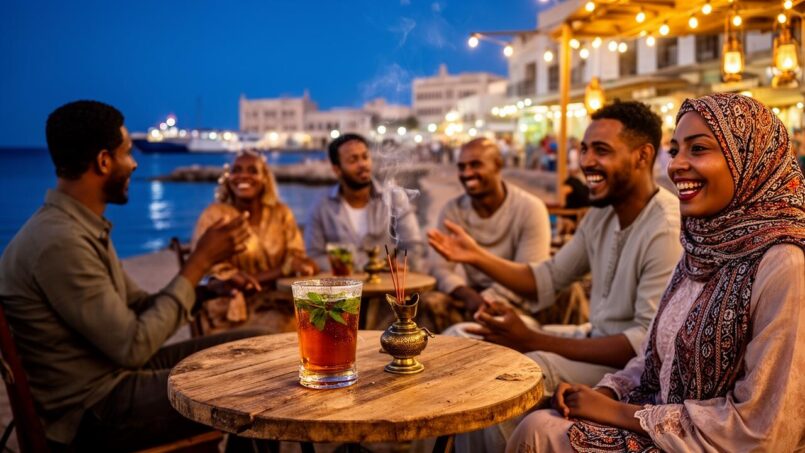
The Corniche, along the waterfront, is another key spot for a more relaxed evening. Bars and cafes come alive early in the night, with sea views, music, shisha, and a more family-friendly or group-of-friends atmosphere. People come here more to chat, watch the bustle, or smoke a shisha than to dance until morning.
This area concentrates bars and restaurants catering to expats, offering beer, Western cuisine, and a bistro atmosphere, with Place du 27 Juin 1977 often serving as a central landmark.
Conversely, the “African quarter” is described as the true beating heart of the city, more working-class, denser, with very lively cafes and small restaurants in the evening. Even if the strictly “nightlife” offerings (in terms of clubs) are more limited there, it’s a place to feel Djiboutian soul after dark.
Tadjourah, Moucha Island, and Weekend Getaways
Nightlife is not limited to the capital. Tadjourah and, especially, Moucha Island are mentioned as weekend destinations for those wanting to combine beach, snorkeling, seafood dinner, and an evening by the water.
Moucha Island is accessible by boat and features small beachside stalls serving freshly caught fish. The spot is renowned for its clear waters and sunsets. Bonfires on the sand are also organized there, an ideal activity for a more contemplative than festive evening.
A frequently given tip: reserve a late boat to reach or leave Moucha around sunset, so you can combine a sea cruise, dinner, and nighttime atmosphere on the beach.
Bars, Pubs, and Lounges: Where to Start the Evening
Bars in Djibouti City span a wide spectrum, from small local spots to luxury lounges within hotels. The average price for a local draft beer is around 1,000 Djiboutian francs (about $2.35 in stores, often more in bars or restaurants). It’s advisable to negotiate or at least clarify the price before ordering, especially in the livelier clubs and bars.
Here’s an overview of the main types of places to grab a drink in the evening.
Character Bars and Pubs
Several establishments cited in sources are identified as neighborhood bars or pubs frequented by both locals and expats. They often serve as classic starting points before moving on to clubs.
Among them are:
Discover a selection of establishments with a unique atmosphere for enjoying drinks and social moments in Djibouti.
A bar with a strong local identity, known for its warm and authentic atmosphere.
An Irish-style pub, known for its dynamic and lively atmosphere.
A bar where Djiboutian culture is well present in its decor and atmosphere.
Known for its varied drinks and particularly sociable atmosphere.
A friendly bar where local drinks flow in a relaxed atmosphere.
Some of these addresses are known for being affordable while still offering imported alcohol (beers, wines, spirits). In several clubs and bars, a “2 for 1” promotion on the first drink is mentioned, subject to asking for it directly at the counter.
Hotel Lounges and Upscale Bars
At the other end of the spectrum, Djibouti City has several lounges within international hotels, especially the five-star ones. They cater to a wealthier clientele and price accordingly, but offer a setting and service hard to match in the country.
The flagship establishment remains the Djibouti Palace Kempinski, one of the country’s only two five-star hotels. It houses several spaces:
This is the floor where the Sky Bar offers panoramic views of the sea and the city.
Typical hours for a bar like Grand Barra (an “African safari style” bar linked to a hotel) are 6 PM – 2 AM, daily. It offers cocktails, spirits, wine and cheese events, hot and cold snacks, a selection of cigars, and live music. The dress code ranges from smart casual to relaxed city wear.
The Sheraton Djibouti also offers nightlife options:
– Crystal Lounge, a luxurious lounge serving upscale cuisine in a very lively atmosphere.
– A restaurant with a coastal view, mixing Middle Eastern, French, and African influences, often chosen for special occasions or romantic dinners.
At these establishments, imported bottled beer (33 cl) costs more than elsewhere, and a glass of wine or cocktail can be significantly higher than the national average. Entry to a hotel like the Kempinski may even be charged (a fee of $15 is mentioned for certain areas).
Shisha Cafes and Hybrid Bars
A significant part of Djiboutian nightlife also takes place in cafes and restaurants that double as shisha bars. OKLM café, for example, combines dining and shisha. Others, like BEACH HOUSE (also written “Beach House”), combine café, bar, and shisha, right on the sand facing the sea.
Several downtown clubs and bars, notably BM Night Club & Lounge or certain clubs like La Galette, Le Maries, or Golden Club, also offer shisha (generally around 1,000 FDJ). In one case, customers can even create their own flavor mix.
These cafe-bars are often a good compromise for those who want to go out but not necessarily dance in a club: sip a juice, coffee, sometimes a beer, share a hookah, and watch the city come alive.
Clubs and Nightclubs: Where to Dance in Djibouti
Djibouti City’s clubbing scene doesn’t have dozens of venues, but a few clubs concentrate most of the action. Evenings generally start around 10 PM – 11 PM and can last until 2 or 3 AM depending on the day.
Iconic Downtown Clubs
Several nightclubs consistently appear in feedback from travelers and expats.
Club Menelik is probably the most iconic. Located on the ground floor of the Menelik Hotel (a three-star hotel run by Ethiopian owners), it is described as “the” party spot, where the music almost never stops. Dancing is mainly to Nigerian afrobeats and French pop, but also to other African and international music.
The clientele is very diverse (Djiboutians, Ethiopians, Americans, Europeans, Arab or Hispanic visitors). The club is considered one of the safest in the country, though basic vigilance regarding personal belongings is recommended. Drinks cost about 1,000 FDJ ($6.50) per glass, with a regular promotion offering a free drink after two purchased.
Among other notable clubs:
A selection of lively clubs, bars, and nightclubs to enjoy evenings in Djibouti, with varied atmospheres, practical tips, and indicative prices.
Right in the center, elegant decor, lineup of DJs and live acts. Rhythmic atmosphere with international hits and local sounds. Tip: arrive early on weekends and check the programming (guest DJs, themed nights).
Regularly recommended for a lively night out, with lots of music and dancing.
At the crossroads between restaurant and party spot, specializing in East African cuisine. A place for music and dancing.
Often described as a dance bar, very present in the local nightlife.
Club with dance floor, pool table, and shisha. Indicative prices: beer ~1,000 FDJ, pool 500 FDJ, shisha 1,000 FDJ.
Discreet underground bar-nightclub, with reinforced security at the entrance. Beer at 1,000 FDJ.
Underground club. Prices: beer 1,000 FDJ, cocktails 1,500 FDJ, shisha 1,000 FDJ.
Main space and a smaller bar upstairs, allowing you to change atmosphere within the same establishment.
Combines a dance floor near the bar with sofas at the back of the room, conducive to shisha (~1,000 FDJ).
Finally, BM Night Club & Lounge, in the heart of downtown, holds a special place: open from 7 PM to 2 AM (until 3 AM on weekends), with a resident DJ, it targets a “hip, beautiful, and famous” crowd, offering a wide choice of premium drinks and flavored shisha. It is described as one of the must-visit spots right now.
Hotel Clubs and Large Complexes
The rise in the quality of hotel offerings has seen the emergence of clubs integrated into luxury complexes. The Safari Nightclub at the Djibouti Palace Kempinski is presented as the largest in the country, benefiting from both international and local clientele. The venue capitalizes on the hotel’s infrastructure (security, service, sound system) to organize sometimes very busy nights.
Other hotels, like the Menelik, house an in-house nightclub (often identified as the most popular in the country), or a “three-star nightclub” described as a place where all generations come to dance to Nigerian and French sounds, sometimes until late into the night.
Description of a hotel in Addis Ababa
Some listings also mention establishments like BAR LOUNGE POOL DISCOTHEQUE on Ras Makonnen Street, which combine a pool, bar, and dance floor, creating hybrid spaces between club and leisure complex.
Going Out by the Sea: Beaches, Restaurants, and Cafes
Djibouti’s geography means the sea is never far away. For many, the real nightlife happens not in clubs but along the coastline, on terraces facing the waves.
Beach Restaurants and City Terraces
Several establishments are particularly popular in the late afternoon and evening:
For a peaceful start to the evening, Les Sables Blancs, on the beach of the same name, offers seafood and grilled dishes outdoors; arrive early for a table facing the sea. Café de la Plage offers a terrace with a view of the water, local and international cuisine suitable for couples and families, known for its grilled fish and fresh juices. For a lively atmosphere and ultra-fresh fish, Port de Pêche, located near the port, serves the day’s catch, with a special mention for its grilled lobster and large shrimp. Finally, for your feet in the sand, Beach House combines café, bar, and shisha in a beachside atmosphere very popular at sunset.
Other restaurants in Djibouti City, even if not strictly nocturnal, extend their hours into the evening and become meeting places: La Mer Rouge (fish, international cuisine, and energetic atmosphere), Restaurant Le Longchamp, Restaurant La Mer Rouge (sometimes also associated with sushi), Sixteen Eleven Kitch’n (local and international cuisine in a friendly setting), QG Pub & Resto, or Timeout Restaurant and Sport Bar, which attracts sports fans with its giant screens.
Beaches, Islands, and Nighttime Activities
The beaches of Khor Ambado and Dorale are popular during the day for swimming, relaxation, and water sports (equipment rental). At night, they might seem tempting for an evening by the water, but authorities recommend avoiding them from late afternoon due to their isolation, especially if alone.
Moucha Island is an ideal spot for beach bonfires, often organized in groups or for weekends. Days can be spent snorkeling, diving, or swimming with whale sharks (in season). In the evening, fish and lobster barbecues are prepared around the fire.
Casinos add another dimension to these seaside evenings. Treasure Bay Casino, Aden Bay Casino, or Supermarche Casino welcome fans of slot machines, roulette, and alcoholic drinks. Some customers go there after a terrace dinner to extend the night with games.
How Much Does a Night Out in Djibouti Cost?
Travelers are often surprised: the cost of living in Djibouti is overall about 35% lower than in the United States, but leisure and sports activities are, on average, 63% more expensive. In other words, going out in the evening can quickly add up, especially if you frequent hotel bars and well-known clubs.
Drinks and Meals
Available data gives a good idea of the price range:
| Product / Service | Average Price in DJF | Approximation in USD* |
|---|---|---|
| Local beer (draft, bar) | 1,000 | ~$6.50 (in club) |
| Imported beer (33 cl, bar) | 1,500 | ~$3.53 (in store) |
| Local beer (0.5 L, store) | – | ~$2.35 |
| Local beer (0.5 L, restaurant) | – | ~$5.62 |
| Imported beer (33 cl, restaurant) | – | ~$8.43 |
| Mid-range bottle of wine | 3,750 | – |
| Soda (12 oz) | 337 | – |
| Cappuccino | 650 | – |
| Bottle of water 1.5 L (store) | 100 | ~$0.56 |
| Inexpensive restaurant meal | 1,750 | – |
| Meal for 2, mid-range restaurant (3 courses, excluding drinks) | 14,500 | – |
| Fast-food combo meal | 2,250 | – |
| Fast-food cheeseburger | 540 | ~$3.10 |
| Shisha (in many clubs) | 1,000 | – |
| Cocktail (e.g., La Galette) | 1,500 | – |
*Exact conversions vary by location (store, bar, restaurant) and exchange rate.
At some establishments, you may get a ‘2 for 1’ deal on the first drink by asking at the counter. It is also recommended to always check the price of drinks before ordering, especially in very touristy areas or near major hotels.
Transportation and Accommodation for a Night Out
To plan a night out, you also need to consider mobility and lodging:
| Expense Item | Price Indication |
|---|---|
| Local bus ticket (one way) | 50 DJF |
| Taxi – base fare | 500 DJF |
| Taxi – per km rate | ~1,609 DJF |
| Taxi – 1 hour waiting | 5,000 DJF |
| Typical 8 km ride | ~$7.50 |
| Hostel night (budget) | from ~6,600 DJF (~$37) |
| Budget hotel night | from ~8,600 DJF (~$49) |
| 2-star hotel night | ~$72 |
| 3-star hotel night | ~$74 |
| 4-star hotel night | ~$125 |
| 5-star hotel night | up to ~$302 (~53,000 DJF) |
A budget traveler who nonetheless goes to a few bars or clubs can plan a daily budget of about $86, while a mid-range visitor (3-star hotel, restaurants) should count on at least $150. For a solo traveler, $93 to $120/day gives a realistic range if going out several evenings.
Budget Summary of a “Typical” Night Out
To give you an idea, here is the approximate cost of a classic evening for one person: dinner at a mid-range restaurant, two drinks at a bar, a visit to a club, plus round-trip taxi.
| Item | Estimated Cost in DJF |
|---|---|
| Dinner (mid-range) | ~7,250 (1/2 of 14,500 for 2) |
| Two beers at a bar | ~2,000 |
| Two drinks at a club | ~2,000 |
| Shisha at club (optional) | ~1,000 |
| Taxi round trip (cumulative trips) | 2,000 – 3,000 |
| Approximate Total | 14,250 – 15,250 |
You can see that the bill for a single evening can be close to the cost of a full day of budget travel. Hence the importance of choosing your evenings and neighborhoods wisely.
Rules, Local Culture, and Safety: What You Really Need to Know
Going out in Djibouti involves respecting both a strict legal framework and conservative social norms, rooted in a predominantly Muslim society.
Alcohol, Drugs, and Public Behavior
Alcohol is permitted but only in licensed establishments (hotels, restaurants, bars). However, drinking on the street, on a public beach, or in a park is prohibited. Public intoxication is considered a serious offense, punishable by up to two years in prison, along with fines.
Drug laws are particularly harsh: possession, use, or trafficking of drugs, including cannabis, carry very heavy prison sentences and fines. Khat, an euphoriant plant widely consumed by men in the afternoon, is legal locally but illegal in many other countries: taking it abroad is therefore a very bad idea.
In Djibouti’s clubs and bars, the presence of prostitutes is reported by several accounts. Travelers are explicitly advised to avoid them. Beyond moral issues, this environment is associated with safety risks (theft, scams, disease, police).
Dress Code and Attitudes
Djiboutian society is described as conservative. In the city, codes are more flexible than in rural areas, but a few simple rules apply:
For women, it is advisable to cover shoulders and knees, especially outside of hotels and private beaches. A scarf can be useful for visits to religious sites or in rural areas. For men, it is best to avoid tank tops and very short shorts in town; light pants and a short-sleeved shirt are appropriate. Swimwear is reserved for hotel pools, private beaches, or tourist coastal areas, preferably in a relatively covering version.
Public displays of affection (kissing, hugging, holding hands) are frowned upon, especially for heterosexual couples outside tourist areas, and can create tension.
While homosexuality is not criminally punished as such, it is socially unacceptable. Laws on “public morality” can be used against people showing signs of affection in public. There is no anti-discrimination legislation and no known LGBTQ+ organization.
Ramadan and Religious Calendar
During Ramadan, nightlife changes pace. Muslims fast from dawn to sunset, which affects habits:
It is expected not to eat, drink, smoke, or chew gum in public during the day. Loud behaviors (loud music, dancing) should also be avoided. Although some restaurants remain open for non-fasters in separate areas, the hours of administration and shops may change. In the late afternoon, increased fatigue may affect services or driving.
Conversely, after the evening meal breaking the fast, streets can be very lively, especially in working-class neighborhoods and around mosques, and some cafes and restaurants stay open late.
Safety: Risks and Precautions
Overall, violent crimes targeting tourists remain rare, but several risks exist:
Main risks include petty theft (pickpocketing, snatch thefts, especially in tourist areas and on public transport) and the terrorist threat, with past attacks on places frequented by foreigners. Driving is dangerous due to poorly maintained roads, animals on the road, and drivers under the influence; driving at night outside the capital is strongly discouraged.
Some practical tips:
– Avoid walking alone at night, especially in poorly lit or isolated areas.
– Keep passports, cameras, and valuables out of sight; use hotel safes when possible.
– Do not display any ostentatious signs of wealth (jewelry, luxury watches, wads of cash).
– Use taxis recommended by hotels or known drivers, and negotiate the fare before getting in.
– Stay away from demonstrations or political gatherings, which can turn violent.
– On isolated beaches like Dorale and Khor Ambado, avoid staying late and never go alone.
Photography and Restrictions
The rules are very strict regarding photos: it is formally forbidden to photograph sensitive infrastructure (ports, airports, government buildings, military installations, bridges, etc.) as well as mosques and religious sites.
In case of violation, authorities may confiscate equipment, impose a fine, or even carry out an arrest or expulsion. Before photographing people, always ask permission, especially for women, children, or people in religious attire.
Cultural Scene and Music Nights: Another Side of the Night
Djiboutian nightlife is not just about bars and clubs. It also features a cultural scene that is surprisingly rich for a country with a modest population.
Traditional Music, Dances, and Contemporary Fusion
Music in Djibouti is at the heart of oral tradition. Poetry, songs, stories, and dances hold a central place in social ceremonies (weddings, circumcisions, religious festivals) and festivals.
Several traditional genres and dances coexist:
– Guux, a kind of nomadic blues;
– Malaabo, sung by women from Tadjourah during ceremonies;
– Balwo, a sentimental Somali style;
– Qaraami, a fusion of regional music with jazz and funk;
– Dhaanto, a flagship category combining music and very rhythmic dance;
– Dances like dabal, nacna (dagger dance), horra (Afar warrior song), laale, saxag (courtship dance), Sadehleh, Zeili’i, Wilwilleh, Keeke, sadda…
In traditional Somali dances, women typically wear the *dirac*, a long flowing dress, accompanied by a *shash*, a light veil, and a *garbasaar*, a draped shawl. Men, on the other hand, may wear a *jile*, an ornamental curved knife, part of their costume.
Notable artists and groups on the local scene include: Soukouss Vibration Band, Dinkara, Aïdarous, Père Robert, Passengers (rasta reggae group), as well as historical figures like poet-composer Cabdilaahi Qarshe and artist Abdi Sinimo. Today, diaspora artists like Shay Lia (Shanice Dileita Mohamed), an R&B/soul singer based in Montreal, extend Djiboutian musical influence abroad.
The RTD Orchestra, the Radio Télévision de Djibouti ensemble, remains the iconic official group, regularly featured at public events.
Performance Venues and Cultural Events
Several organizations run or host this cultural nightlife:
Several establishments illustrate Djibouti’s cultural and nightlife vitality. Restaurant L’Étoile de Kokeb regularly offers *Lewat*, a dinner show with folk dances and live music. Menelik, a nightclub, is a gathering place for a wealthy and cosmopolitan youth, mixing modern music and African influences. Vogue, a gourmet restaurant and lounge club, organizes live concerts. The Arthur Rimbaud Cultural Center hosts an annual music festival blending traditional and contemporary genres. Finally, the Djiboutian Institute of Arts and God Gallery support and train the new generation of artists.
In terms of festivals, the offer is not abundant but notable:
– Fest’Horn, a regional festival dedicated to peace and cultural exchange, brings together artists from the Horn of Africa for concerts and events.
– The Djibouti Festival, held in the capital, highlights artistic performances, crafts, and gastronomy. Other events take place in Ali Sabieh, Dikhil, Tadjourah, or Arta.
Even outside these major events, it’s not uncommon to come across live music nights at bars like L’Historil, hotel spaces, or more intimate venues.
Practical Tips for Enjoying the Night in Djibouti
Ultimately, enjoying Djiboutian nightlife means finding the balance between curiosity, respect for codes, and prudence.
You can, for example, alternate:
– a “chic” evening with a cocktail at the Sky Lounge at the Kempinski, followed by a visit to the Safari Nightclub;
– a more “local” night, going from a fish dinner at Port de Pêche, to a few drinks at Scotch djibouti or 11 Degrees North, before finishing at Club Menelik or Golden Club;
– a quiet Friday at Les Sables Blancs or Café de la Plage, eyes on the waves, away from the club noise;
– a weekend getaway to Moucha Island, with sunset on the boat, seafood meal, and bonfire on the sand.
For a successful and safe nightlife experience in Djibouti, make sure you have a valid visa, a planned budget, and strictly follow the alcohol laws. Wear appropriate clothing and adopt basic safety reflexes. This will allow you to peacefully discover the country’s unique atmosphere, where modern infrastructure meets the rich culture of traditional music and the conviviality of local cafes.
Nightlife in Djibouti doesn’t try to compete with big party capitals. It offers something else: a more intimate face-to-face with a human-sized city, an omnipresent sea, and intertwined cultures that, once night falls, tell their story through music, dance, bursts of laughter, and glasses raised discreetly, away from the street’s gaze.
Disclaimer: The information provided on this website is for informational purposes only and does not constitute financial, legal, or professional advice. We encourage you to consult qualified experts before making any investment, real estate, or expatriation decisions. Although we strive to maintain up-to-date and accurate information, we do not guarantee the completeness, accuracy, or timeliness of the proposed content. As investment and expatriation involve risks, we disclaim any liability for potential losses or damages arising from the use of this site. Your use of this site confirms your acceptance of these terms and your understanding of the associated risks.

Cyril Jarnias is an independent expert in international wealth management with over 20 years of experience. As an expatriate himself, he is dedicated to helping individuals and business leaders build, protect, and pass on their wealth with complete peace of mind.
On his website, cyriljarnias.com, he shares his expertise on international real estate, offshore company formation, and expatriation.
Thanks to his expertise, he offers sound advice to optimize his clients' wealth management. Cyril Jarnias is also recognized for his appearances in many prestigious media outlets such as BFM Business, les Français de l’étranger, Le Figaro, Les Echos, and Mieux vivre votre argent, where he shares his knowledge and know-how in wealth management.





