
 Published on and written by Cyril Jarnias
Beaches along the Red Sea, a salt desert worthy of a sci-fi set, lush green mountains perched above arid plains… In this ultra-contrasted setting, the sports to practice in Djibouti are not limited to a few ball games and a dusty track. From the ubiquitous football to kitesurfing in windy bays, trail running in the northern mountains, racing across the Grand Bara desert, or beach volleyball at Carre Beach, the country offers a surprisingly diverse playground.
The sports landscape in Djibouti is marked by the popularity of beach sports, endurance sports, and water activities. New forms of sports coaching are also gradually transforming local practices.
Football, the Beating Heart of Sports in Djibouti
It’s hard to talk about sports in Djibouti without starting with football. It’s the king of sports, structuring weekends, schoolyards, infrastructure projects, and much of the national sports policy.
The discipline is overseen by the Djiboutian Football Federation (FDF), founded in 1979 and affiliated with FIFA since 1994. It also falls under CAF (Confederation of African Football) and the Union of Arab Football Associations. This federation runs the national championship, cups, youth teams, and the national team nicknamed the “Red Sea Sharks.”
The first division championship, often called the Djiboutian Premier League or Championnat National de 1ère Division, typically brings together ten clubs. A promotion-relegation system links this elite to Division 2 (also around ten clubs) and a Division 3 structured into two groups of eight teams. The fight for survival and promotion to D1 fuels intense sporting rivalry.
Notable clubs include ASAS Djibouti Télécom (the most decorated), AS Arta/Solar7, and Garde Républicaine (GR / SIAF). These clubs, linked to public institutions, security forces, companies, or neighborhoods, are essential both for competition and for nurturing young talent, thus providing a framework for thousands of young people.
A National Team Seeking Recognition
On the international stage, Djibouti’s national team has yet to qualify for the final phase of an Africa Cup of Nations or a World Cup. Still, the Red Sea Sharks keep running qualifying campaigns, regularly participate in the CECAFA regional tournament, and face much stronger opponents. Their first win in a FIFA-recognized match came in 2007 against Somalia (1-0) during the 2010 World Cup qualifiers.
Results are often tough against more powerful teams, but the stakes go beyond the scores: it’s about building a culture of competition, encouraging youth to dream of professional careers, and making football a vehicle for national cohesion. And in this regard, the investment is far from symbolic.
The Douda Academy: Talent Factory and Modern Showcase
The centerpiece of this strategy is the FIFA Talent Academy in Douda, touted as a unique center of excellence in East Africa. The facility has two artificial turf fields, separate dormitories for boys and girls, a gym, classrooms, and dining areas. The academy can accommodate up to 80 boys and 40 girls, with an initial cohort of around forty youngsters (including 20 girls) pursuing both school studies and an intensive football program.
Number of children reached through a network of six regional development centers overseen by eleven coaches.
This type of infrastructure is also changing daily practices: it normalizes regular training, access to physical monitoring, the presence of trained coaches, and opens more doors for girls, who have long been marginalized in football.
Football for All, Even in Schools
The project doesn’t stop at future professionals. Through the Football for Schools program, supported by FIFA and UNESCO, the sport officially enters schools. Teacher training workshops, equipment donations, and educational sessions blending education and sports aim to make physical activity a habit from childhood.
Installing mini FIFA Arena pitches in schools in working-class neighborhoods, such as in Palmeraie or Dogley, aims to bring football closer to children. The international goal is to create at least 1,000 such pitches by 2031, and Djibouti is one of the first African countries engaged in this effort.
Football and Gender Equality
One of the most remarkable aspects of football’s revival in Djibouti is the attention given to girls. A large-scale grassroots women’s football development program has been launched, bringing together 200 young girls from the regions of Tadjourah, Obock, Ali Sabieh, and Dikhil. Coached by specially recruited female trainers, these players receive long-term support.
In a context where certain mindsets still hinder women’s access to sports, this kind of initiative, backed at the highest state level, sends a clear signal: football is no longer reserved for men, and Djibouti’s pitches will now have to reckon with a new generation of girls with boots on their feet.
Running and Marathons: The Tradition of Endurance
While football dominates in numbers, running holds a significant place in the collective imagination. Djibouti has produced world-class marathoners and middle-distance runners whose achievements have left a lasting mark on the country.
In the 1980s, Ahmed Salah emerged as an iconic figure, notably winning the first World Marathon title in 1985 with a time approaching the best standards of the era (2h07’07”). Alongside him, runners like Ahmed Saleh Houssein (bronze medalist in the marathon at the 1988 Seoul Olympics), Robleh Djama, Mohamed Abdi, and Abdillahi Charmarké put Djibouti on the world endurance map.
More recently, Ayanleh Souleiman took over on shorter distances, becoming world indoor champion over 1500 m in 2014 and world indoor record holder over 1000 m in 2016. In 2018, he still posted the world’s best performance of the year over 1500 m indoor.
Djibouti’s tradition of excellence in athletics is built on training in a harsh, formative environment. Runners train on a hilly area nicknamed Tora Bora, on the outskirts of Djibouti City. The terrain features dusty ground, sharp rocks, thorns, and temperatures reaching 43 to 46 °C. A classic route for tough sessions is the Tora Bora–airport stretch, about 4 km. It’s in these extreme conditions that athletes are forged to later shine on the international stage.
The Grand Bara: Running on a Lake of Cracked Earth
If there’s one event that perfectly captures the encounter between Djibouti’s natural scenery and the taste for effort, it’s the Grand Bara crossing. Every year, a 15 km race takes place on this immense, perfectly flat, hard, and cracked white clay plain, once used as an emergency landing site for a space shuttle.
The Grand Bara crossing brings together several thousand participants, civilians and military, from Djibouti and beyond. French, American, and Japanese armed forces, the Garde Républicaine, and civilian clubs like Life Club or Al-Rahma gather at the starting line. In a recent edition, approximately 1,700 men and 100 women started, including a few foreign participants.
Performances are impressive: Moussa Omar Wais, a runner from the Garde Républicaine, completed the 15 km in just over 45 minutes. But the event is meant to be accessible to all, regardless of level, with a strong convivial aspect. A sponsor like BMMI Djibouti distributes dried fruit and cereal bars, and organizes music and entertainment at the finish line.
Djibouti International Half Marathon
Another major event: the Djibouti International Half Marathon, now in its 25th edition. The race attracts runners from various African countries (Ethiopia, Somalia, Kenya, Burundi, Angola, Zambia, South Sudan…), supported by the Djiboutian Athletics Federation and partners like Djibouti Télécom.
Alongside the main race, adapted events allow younger participants to take part in the event.
A 10-kilometer distance is offered for boys, providing an accessible and stimulating competition.
A 5-kilometer race is organized for girls, encouraging their participation in the sporting event.
Security forces (Garde Républicaine, army, gendarmerie) run alongside civilian participants.
The best soldiers regularly rank among the winners and stand on the podiums of these races.
When Endurance Meets Public Health
Beyond performances, the authorities have clearly understood that running can serve as a health lever. The country faces an alarming rate of sedentary lifestyles, especially among adolescents, and high mortality linked to cardiovascular diseases (over 1,300 deaths per year).
To address this, a “Sports and Health Week” has been established in schools. For seven days, schools across the country become mini fitness centers, combining health check-ups, educational workshops, and physical activities. The ambition is to make regular practice (two to three times a week) a reflex for students, and eventually for the entire population.
Beach Sports: Beach Volleyball, Swimming, Snorkeling
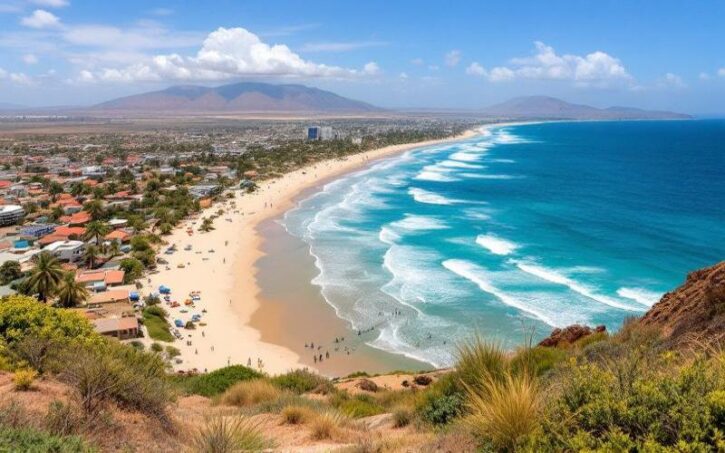
With its coastlines on the Gulf of Tadjoura and the Red Sea, Djibouti is naturally oriented toward the sea. Yet, the development of structured beach sports is still recent. Beach volleyball, however, is gradually establishing itself on the sand, and certain spots have become essential meeting points for players.
Carre Beach (Tritton Beach): The Unofficial Beach Volleyball Hub
Carre Beach, also known as Tritton Beach, is one of the iconic spots for beach volleyball in Djibouti. Located in the coastal zone (referenced by code J545+C27 on local maps), this beach has developed a genuine local beach volleyball culture.
You won’t necessarily find a heavy structure, but the spirit is simple: often, you just need to bring your own ball to join a game with locals or other visitors. Courts appear and disappear with the tides and gatherings.
The immediate surroundings enhance the site’s appeal for a sports day. Within a few hundred meters, you’ll find restaurants (Indian cuisine at Singh’s, Lebanese at Mont Liban, Djiboutian at Lac Abbé Restaurant), hotels (Alia Hôtel, Auberge le Héron, Atlantic Hotel, Hotel Rayan Djibouti, CITY GUEST), and several urban parks (Serpent Park, Jardin Public, Q Cinq Park, Stade Park, Makka Al Moukarama Park) offering relaxation spaces before or after the game.
The proximity of a shopping center (Bawadi Mall), shops (grocery stores, clothing stores, electronics stores), and establishments like Casino Aden Bay, lounges, and bistros gives Carre Beach the role of a true leisure hub.
For visitors from inland, access is relatively straightforward: from Ali Sabieh, you need to drive about 60 km toward the capital on the main road, then follow signs to the area marked J545+C27. Public transport (buses or shared taxis) between Ali Sabieh and Djibouti City is affordable, around 200 Djiboutian francs, plus the final taxi or bus ride to the beach (300 to 500 francs).
In addition to volleyball, Carre Beach is a convenient starting point for snorkeling, walks along the coastline, or simply swimming.
Green Tire Beach and Ras Bir: Beach, Volleyball, and Fresh Air
Green Tire Beach is another option for beach volleyball. The long beach, covered with golden sand, lends itself to impromptu games. You can swim, walk along the coast, sunbathe, collect shells, and practice snorkeling. Parking is available nearby, sometimes free, sometimes paid depending on the area, and street parking near the entrance remains an option.
Ras Bir Beach in Obock offers a preserved and peaceful setting with a long strip of golden sand and clear water with gentle waves, ideal for swimming. Many activities are possible: volleyball, camping, fishing, hiking, diving, snorkeling, jet skiing, sailing, and windsurfing. Parking is generally free, but there are no restrooms on site.
These two beaches, however, share an important common point regarding sports practice: they are not equipped for accessibility for people with reduced mobility, an issue still largely absent from most outdoor infrastructure in the country.
Beach Volleyball in Djibouti’s Sports Ecosystem
Volleyball practice, both indoor and on sand, is gaining popularity in Djibouti. A federation even organizes a national beach volleyball championship, proof that this sport is no longer limited to informal games on the sand. However, from an infrastructure standpoint, beach courts often remain temporary and non-standardized.
To get an idea of what a fully developed beach volleyball site could become, one must look elsewhere: for example, a beach equipped with three regulation-size courts, covered with ultra-fine silica sand, used for national championships, open free to the public year-round with extended hours. This kind of model shows the possible direction for Djibouti’s beaches if dedicated investments were made in the medium term.
Water Sports: Diving, Snorkeling, Kitesurfing, Sport Fishing
The Red Sea, the Gulf of Tadjoura, and the Ghoubbet Bay form an exceptional nautical playground. Warm waters (around 25–29 °C), underwater visibility reaching 20 to 30 meters, and richness in corals and tropical fish make diving and snorkeling flagship activities for visiting athletes and local enthusiasts alike.
Diving and Snorkeling: Spectacular Depths
Around the Moucha and Maskali islands, in the Gulf of Tadjoura, and especially in the famous Ghoubbet Bay (sometimes called “Shark Pit”), divers move among over 200 species of coral and more than a thousand species of fish. Parrotfish, clownfish, butterflyfish, moray eels, rays, turtles, dolphins, and even reef sharks are regularly observed. The seasonal presence of whale sharks between October and February turns Djibouti into a global “spot” for diving with these gentle giants.
Local dive centers, such as Aqua Club Diving Center, recognized by international training organizations, offer day trips or diving cruises, including equipment, supervision, and training. For beginners, snorkeling near the reefs already allows observing a colorful underwater spectacle.
The best season runs from November to March, when sea conditions are milder. The months of July and August can be trickier for diving due to more demanding sea conditions.
Kitesurfing and Windsurfing: Wind as the Engine
The same winds that slightly cool the coastline make the country particularly suitable for towed water sports. Kitesurfing is booming in bays like Ghoubbet, where gusts can reach 35 knots nearly 300 days a year. The combination of spectacular landscapes, nearly constant sun, and suitable water bodies attracts a community of demanding practitioners, even though the cost of equipment and the sport’s technicality remain barriers to mass adoption.
Windsurfing, older, is still practiced, as is dinghy sailing. Kayaking, stand-up paddleboarding, jet skiing, waterskiing, wakeboarding, towed tubes, and parasailing are gradually completing the offerings, especially departing from Djibouti City and some beaches accessible by boat.
Sport Fishing: Barracudas, Tuna, and Sharks
Sport fishing is one of the activities heavily promoted to visitors. Around the Ghoubbet, between Arta and the pass, or off certain coasts, enthusiasts come to hunt barracuda, yellowfin tuna, swordfish, grouper, jackfish, snapper, cobia, sharks, etc., often at sunrise or sunset.
Techniques range from surface lure fishing to surfcasting from the shore, or using “poppers” and swimming lures that thrill adrenaline seekers when a powerful predator bites the hook. Local operators remind, however, that the Ghoubbet is a complex area, with strong currents and potentially dangerous wildlife, requiring serious supervision.
Structures like Aden Fishing, with decades of experience, offer organized trips. For athletes, a day of fishing is as much about physical performance (handling gear, fighting catches, enduring the heat) as it is about contemplative experience.
Sports and the Desert: Sand Yachting, Sandboarding, Hiking
Djibouti is not just a sea country. The plains of the Grand Bara and Petit Bara, immense expanses of white clay dotted with dunes, offer a landscape both lunar and perfectly suited to some sports uncommon in East Africa.
Sand Yachting on the Grand Bara
The Grand Bara is a flat desert stretching dozens of kilometers, wide and open, with no major obstacles. All ideal qualities for sand yachting. Benefiting from regular winds, operators offer weekend initiations and half-day or full-day outings upon request. Learning the basics of piloting is reportedly quick, in about ten minutes for the most resourceful.
The Grand Bara site is not just a vast sliding area. It also hosts the famous Grand Bara Marathon and serves as a setting for various tourist activities. These include 4×4 excursions, bivouacs, and even hot air balloon flights, offering an aerial view to admire the perfect geometry of this immense salt plain.
Sandboarding and Night Bivouac
The dunes of the neighboring areas (Grand Bara, Petit Bara) are also ideal terrain for sandboarding. The activity can even be done at night for the bravest, when the heat subsides and the sky, free from light pollution, reveals thousands of stars. The descents, the uphill climbs, the gradual fatigue, and the night in camp add a sporting and contemplative dimension.
Trekking Between Salt Lakes and Mountains
The country also lends itself to multi-day treks, especially around Lake Assal (the lowest point in Africa) and Lake Abbé, famous for its smoking limestone chimneys. Accompanied by Afar nomads, some routes follow ancient caravan salt roads, by camel or on foot, over two to ten days, sometimes with 4×4 support vehicles.
These itineraries combine a sporting adventure, discovery of geological phenomena (volcanoes, rift faults, hot springs), and cultural immersion within local communities.
Hiking and Trail Running: The Green Mountains of Djibouti
Contrary to the purely desert image often associated with it, Djibouti is home to green mid-mountain areas, particularly sought after by hikers looking for cooler temperatures.
The Goda Mountains and the Day Forest
Northwest of the capital, the Goda Mountains rise to around 1,750 m in altitude. Up there, the climate cools, humidity increases, and the Day Forest, Djibouti’s only real forest, clings to the slopes.
Trails wind through ancient junipers, wild olive trees, acacias, fig trees, jujubes, and other species, sheltering a varied fauna: gazelles, warthogs, baboons, vervet monkeys, hyenas, and even leopards for the luckiest (or the most cautious). On the bird side, the local star is the Djibouti francolin, a very rare and endemic species, accompanied by sunbirds, bulbuls, Egyptian vultures, etc.
Distance in kilometers of a moderate difficulty hiking loop in the region.
Mount Moussa Ali and the Highlands
The country’s highest point, Mount Moussa Ali, exceeds 2,000 m, at the junction of borders with Ethiopia and Eritrea. An ancient volcano, its caldera, domes, and lava flows bear witness to the region’s intense tectonic activity. Getting there is an expedition in itself, reserved for experienced and well-supervised hikers, given the limited infrastructure.
Further south, in the Ali Sabieh region, the Arrey massif peaks at around 1,300 m, with a cool climate (around 15 °C) and frequent fogs during the cool season. It’s a popular area for challenging hikes, far from typical tourist circuits.
Arta, Djalelo, and Godoria: Other Playgrounds
Near Djibouti City, the Arta region offers great hikes, especially starting from the area marked “Randonnée pédestre d’Arta” along the RN4 road. It’s an ideal compromise for those wanting to try trekking without leaving for several days.
The Djalelo Valley, about an hour’s drive from the capital, is a sanctuary for wildlife, particularly antelopes like the gerenuk. Guided walks are organized there, allowing you to combine animal observation with a sporting hike.
Finally, the Godoria mangrove, to the north, offers a completely different setting: root tunnels, labyrinthine channels, seabirds, and shallow water. It is usually accessed by boat, for excursions mixing walking on sandbanks, swimming, nature observation, and moderate physical effort.
For all these hikes, the most pleasant period runs from October/November to March, when temperatures drop. Access to starting points often requires a 4×4, and guidance by a local guide, Afar or Issa, is highly recommended.
Pétanque, Martial Arts, and “French-style” Sports
Legacy of the colonial period, pétanque enjoys surprising popularity in Djibouti. In the evening, on waterfronts (like in Tadjourah) or along roads near the capital, groups gather for heated games under lamplight. Military personnel, notably French, mingle with local players, and structured competitions exist, overseen by the Djiboutian Federation of Boules Sports, a member of the international federation since 1983.
Besides pétanque, Djibouti hosts several imported sports like tennis, golf, and martial arts (karate, judo, taekwondo). A local martial art, Dakaïto Ryu, founded by a Djiboutian master, has its own federation.
For many residents, these disciplines offer a balance between physical activity, sociability, and preserving a certain cultural identity, whether through French heritage or local creations.
Traditional Sports: Camel Races, Wrestling, Archery
Major national holidays, especially Independence Day, are occasions to honor sports deeply rooted in regional traditions: camel races, horse races, wrestling, and strength games. These competitions are both spectacle, cultural affirmation, and demanding sporting events for those who participate.
The camel, companion of caravan routes, becomes a racing mount; wrestling, in its traditional forms, takes place before large crowds; archery and other more or less structured games complete this picture of a sport that also serves as a vector for transmitting values and know-how.
Traditional sport
When the State Makes Sports a Health Policy
All of this sports landscape – from football to hiking, kitesurfing to pétanque – is part of a broader policy. With the “Sports and Health for All Djiboutian Citizens” program, jointly led by the Ministry of Health and the Ministry of Youth and Sports, the goal is clear: fight sedentary lifestyles, which affects more than four out of five adolescents, and reduce the burden of cardiovascular diseases.
Schools organize an annual sports and health week, integrated into the school calendar. This initiative aims to promote regular physical activity, a healthy lifestyle, and diversity of activities, positioning sport as a key lever of public health rather than just a leisure activity.
Djibouti: A Discreet but Unique Playground
The popular sports to practice in Djibouti reflect the country’s unique geography and history. Here, a marathon is run on an ancient lake of cracked clay. There, a beach volleyball match is played facing waters inhabited by corals and whale sharks. Higher up, hikers cross paths with gazelles and a nearly extinct endemic bird. In town, schoolchildren learn to dribble on a brand-new mini-pitch while female footballers, still rarely seen a few years ago, fine-tune their technique at the academy.
For anyone wanting to play a sport in Djibouti – whether it’s volleyball on the sand, running in the intense heat, scuba diving, hiking in the Goda Mountains, or pétanque at sunset – the country offers an open-air laboratory. A demanding, sometimes harsh terrain, but one that richly rewards those who accept to play the game.
Disclaimer: The information provided on this website is for informational purposes only and does not constitute financial, legal, or professional advice. We encourage you to consult qualified experts before making any investment, real estate, or expatriation decisions. Although we strive to maintain up-to-date and accurate information, we do not guarantee the completeness, accuracy, or timeliness of the proposed content. As investment and expatriation involve risks, we disclaim any liability for potential losses or damages arising from the use of this site. Your use of this site confirms your acceptance of these terms and your understanding of the associated risks.

Cyril Jarnias is an independent expert in international wealth management with over 20 years of experience. As an expatriate himself, he is dedicated to helping individuals and business leaders build, protect, and pass on their wealth with complete peace of mind.
On his website, cyriljarnias.com, he shares his expertise on international real estate, offshore company formation, and expatriation.
Thanks to his expertise, he offers sound advice to optimize his clients' wealth management. Cyril Jarnias is also recognized for his appearances in many prestigious media outlets such as BFM Business, les Français de l’étranger, Le Figaro, Les Echos, and Mieux vivre votre argent, where he shares his knowledge and know-how in wealth management.





