
 Published on and written by Cyril Jarnias
Settling in Myanmar means entering a country where people don’t just ask “How are you?” but also “Have you eaten well?”. Food is at the heart of social, religious, and family life. For an expatriate, understanding what’s on the plate, where to eat it, and how to order it not only helps you eat better but also integrates you much faster.
Good to know:
This guide details how to discover Burmese cuisine, from the typical breakfast dish (mohinga) to curry dinners, including street food, markets, vegetarian options, and cooking classes. It aims to help you eat local with pleasure and peace of mind.
Understanding the spirit of Burmese cuisine
Burmese cuisine is often described as a living patchwork of flavors from India, China, and Thailand, blended with very old local traditions. It is built around a few simple ideas: rice as the foundation, a profusion of vegetables, generous use of fermented condiments, and an obsession with balance between salty, sour, sometimes spicy, and lots of umami.
Pork is considered the best meat, mango the best fruit, and tea leaves “the best of leaves.”
Local Lao saying
Unlike some Southeast Asian cuisines, Burmese curries use relatively little coconut milk. They rely on aromatic bases of ginger, garlic, onion or shallot, to which are added turmeric, chili, sometimes coriander or cumin. Oil is very present, especially in sibyan-style curries whose surface becomes covered with a layer of red-orange oil: it’s a sign of slow cooking and preservation, not a cooking mistake.
Example:
In Myanmar, salads, called *thoke* or *a thoke*, are much more than light side dishes. They are complete meals based on starches (rice, noodles, chickpeas), mixed with chopped vegetables, fresh herbs, crispy fried items, and seasoned sauces (flavored oil, tamarind, lime). They are eaten as a main meal, a quick snack, or a side dish for rice.
The basics: rice, noodles, teas, and fermented condiments
Rice (htamin) is the backbone of the diet. There are several varieties, including the highly prized paw hsan hmwe, a fragrant rice similar to jasmine, served daily, and sticky rice (kauk hnyin), more reserved for snacks and desserts. In many families, rice accounts for more than three-quarters of caloric intake.
Noodles, on the other hand, float between meals and snacks. Fine rice vermicelli (mont di), wheat noodles, egg noodles, wide rice noodles pad thai-style… you find them in soup, salads, stir-fried in a wok, or topped with tomato, sesame, or curry sauces.
Two major aromatic pillars structure the cuisine:
Tip:
Burmese cuisine primarily gets its umami flavor from fermented seafood, such as *ngapi* (a salted and fermented fish or shrimp paste), used in sauces, curries, broths, and dips. Another unique fermented ingredient is *lahpet*, fermented tea leaves eaten in a salad (*Lahpet Thoke*), often at the end of a meal or during ceremonies, making Myanmar one of the few countries where tea is eaten.
Added to these essentials are legumes (chickpeas, lentils, split peas), sesame and peanut oils, tamarind for acidity, and a variety of vegetables and herbs: lemongrass, curry leaves, cilantro, mint, galangal, young bamboo shoots, or roselle leaves.
Street food: the most authentic gateway
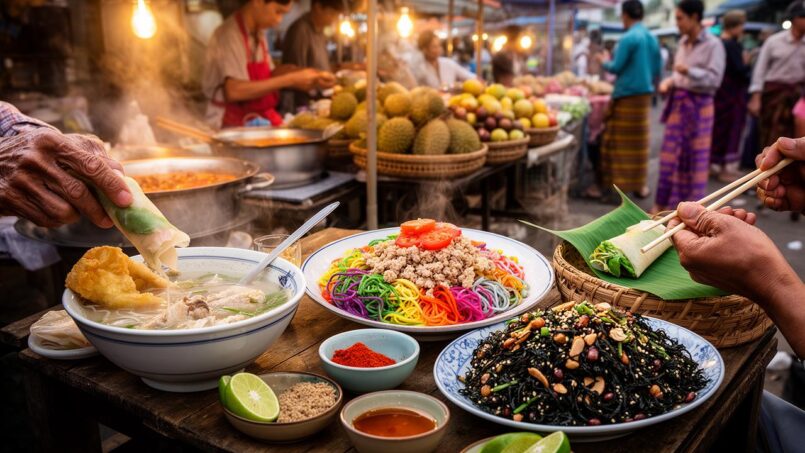
For an expatriate, street food is arguably the most direct way to discover Burmese cuisine. From Yangon to Mandalay, from the villages of the Irrawaddy Delta to the markets of Shan State, sidewalks and alleys transform at dawn into a vast open-air canteen.
Caution:
Food stalls are often highly specialized, with each vendor focusing on a single dish (like mohinga, a-kyaw fritters, skewers, or Shan noodles). This specialization has a major advantage: it allows perfect mastery of the dish, rapid turnover of products, and thus ensures greater freshness.
In the evenings, especially in Yangon, sidewalks fill with low tables, tiny plastic stools, and makeshift kitchens churning out bowls of noodles, grilled skewers, hotpots, and even sushi or dim sum. For an expatriate, returning several evenings in a row, observing the clientele, and daring to point at what looks good is a good strategy for gradually getting comfortable with the culinary scene.
Mohinga: the soup bowl that sets the pace for mornings
If a single dish had to symbolize Myanmar, it would be mohinga. This fish soup with rice noodles, fragrant with lemongrass, ginger, and banana stem, is considered the national dish and, for many, an essential morning ritual.
Good to know:
The broth is traditionally made from freshwater fish, thickened with rice or chickpea flour, and flavored with chunks of banana stem, spices, and fish paste. When served, rice noodles are plunged into this boiling broth, then the dish is topped with split pea fritters, fish cake slices, a half hard-boiled egg, fresh herbs, and chili according to preference.
For an expatriate, it’s the ideal dish to get familiar with the local aromatic palette. It is sold everywhere, from big cities to remote villages, especially very early in the morning. In Yangon, some stalls open only at dawn and are cleaned out before 9 a.m. In certain neighborhoods, you see customers sitting on small stools, downing bowls of mohinga and sweet milk tea before work.
Example:
Variations of the dish differ by region in Myanmar. In the coastal Rakhine State, the version is lighter and spicier, made with sea fish and tamarind. In contrast, Shan versions, further inland, incorporate tomatoes and fermented soybean paste, resulting in a milder, tangier taste.
Price overview for a typical street breakfast
| Dish / Drink | Average price (kyat) | Approximate equivalent (USD) |
|---|---|---|
| Bowl of mohinga | 1,000 – 2,000 | $0.30 – $0.60 |
| Bowl of Shan noodles | 1,500 – 2,500 | $0.45 – $0.75 |
| Milk tea (one cup) | 500 – 800 | $0.15 – $0.25 |
| Fried fritter (a-kyaw) | 200 – 500 (each) | $0.06 – $0.15 |
These prices explain why even expatriates with a comfortable budget end up adopting the local breakfast: for the price of a Western coffee, you can have a real, complete meal.
Lahpet Thoke and the universe of Burmese salads
For anyone discovering Myanmar, Lahpet Thoke surprises as much as it delights. It is a salad of fermented tea leaves, mixed with finely shredded cabbage, tomatoes, ginger, a shower of peanuts, crispy fried peas, sesame seeds, sometimes small dried shrimp, all bound together with flavored oil and a squeeze of lime.
Good to know:
The leaf tea dish, a traditional preparation, surprises with its initial bitterness and astringency but wins you over with its complex richness of flavors (crunchy, fatty, sour, slightly spicy). It is served as a snack in tea shops, as an appetizer in restaurants, and as an offering during ceremonies.
Around Lahpet Thoke gravitates a whole universe of salads:
– Gyin Thoke, based on grated ginger, mixing crunchy textures and a pungent flavor.
– Karyanchintheet Thoke, a tomato salad with onions, peanuts, and sesame, simple and always vegetarian.
– Myin Kwa Yuet Thote, a pennywort salad, fresh herb mixed with onions, peanuts, sesame, and lime.
– The many rice or noodle salads that turn leftover rice into a complete meal by adding vegetables, roasted chickpea flour, flavored oil, chili, and herbs.
For an expatriate, exploring these salads is doubly interesting: they make an excellent entry point for vegetarians, and they give a clear idea of how Burmese people play with textures.
Shan noodles, tofu, and other street food essentials
Shan State, in the east, strongly influences what is eaten throughout the country. Its noodles, in particular, have become one of the great street food classics.
Shan noodles often come in a dry version: rice noodles topped with a light tomato sauce, accompanied by marinated meat (pork or chicken) or, for vegetarians, tofu and pea fritters. Mustard pickles, fresh herbs, and chili oil are added. A soup version also exists, with a clear broth based on tomato and pork.
Shan State culinary specialties
Discover the must-try gastronomic delights of this region of Myanmar, including its famous unique tofu.
Shan Tofu
A regional staple, made from yellow pea flour or chickpea flour, cooked until it becomes a creamy mass that sets into a firm block. It is very different from soy tofu.
Enjoying Shan Tofu
It is eaten in many ways: fried, in salads, in soup, or accompanied by traditional sauces.
– in hot soup (Tohu Nway), like a soft polenta poured over noodles with chili and herbs;
– as fried fritters, crispy, served with a tamarind sauce;
– in a salad (Tohu Thoke), thinly sliced and mixed with cabbage, pickles, nuts, and a spicy condiment.
For vegetarian or vegan expats, this pea tofu is a blessing: high in protein, cheap, and very common in Inle, Mandalay, and Yangon.
In Mandalay, chapati stalls inspired by India are another staple. A hot flatbread cooked on a griddle, served with dhal or small vegetable curries, makes a complete meal for a few hundred kyat. One often-cited spot is near the ET Hotel on 83rd Street.
Getting your bearings in tea shops
Tea shops are at the heart of Burmese sociability. People come for breakfast, for the mid-afternoon snack, to talk politics, watch a football match, or simply watch the street.
They come in three main families:
Burmese Tea Shops
Discover the culinary diversity of Burmese tea shops, popular establishments where traditions and cultural influences blend.
“Burmese” Tea Shops
Typical places to enjoy traditional dishes like mohinga (fish noodle soup), noodles, simple curries, and salads.
“Muslim” Tea Shops
Often run by Burmese of Indian descent, they offer specialties like samosas, paratha, dhal, and biryani.
Chinese-style Tea Shops
Here you’ll find Chinese-influenced food: rice, stir-fried meats, jarred preserves, and fried noodles.
The tea served free in many establishments is a light green tea, unsweetened. For a sweet milk tea, you generally need to order separately, specifying your preference (more or less condensed milk).
For an expatriate, these places are invaluable: menus are rarely translated, but everything is visible in trays or display cases. Pointing is perfectly acceptable. And prices are low, allowing you to try several small things rather than a single dish.
Food safety concerns: eating on the street without getting sick
Hygiene standards in Myanmar are not always up to Western levels. NGOs and local associations frankly admit this. In Rangoon, a study by the consumer protection association indicated that more than 80% of downtown street stalls did not meet basic hygiene standards.
But this doesn’t mean you have to give up all street food. It is possible to eat on the street without multiplying digestive troubles, as long as you follow a few simple rules:
Prefer stalls that are busy with locals. A constant flow guarantees rapid turnover of dishes and limits food sitting for hours at room temperature. Peak hours are valuable: early morning for breakfast soups, late afternoon for fritters and snacks.
Caution:
To assess the quality and hygiene of a street stall, observe the cooking station carefully. A smoking wok or a boiling pot, indicating made-to-order preparation, are good signs. Conversely, food exposed to the open air, attracting flies, or visibly dirty utensils should make you avoid the place.
Choose cooked food that is very hot. A bubbling curry, skewers just off the grill, still-sizzling fritters are safer than a salad sitting in the sun. In areas with limited infrastructure, approach raw street vegetables, freshly squeezed sidewalk juices, homemade mayonnaises, and uncovered cold sauces with caution.
Good to know:
Tap water is not drinkable. Opt for bottled water, Chinese tea served boiling hot, or filtered water from jars available at some shops. Be wary of crushed ice sold on the street, whose origin can be risky.
Watch out for questionable reuse. Some vendors reuse disposable tableware that is theoretically single-use, or serve very greasy dishes reheated multiple times, like fried offal fried over and over to give the illusion of crispiness. These practices increase risks.
Many travelers, including long-term expatriates, manage very well by combining these reflexes with some backup medicine in their bag: antidiarrheals, rehydration salts, ginger (tea or candies), which is traditionally used locally to soothe stomach aches.
Eating vegetarian or vegan: mission possible
You might think a country where fish paste is everywhere and broths are almost always meat-based would be difficult for vegetarians. In practice, Myanmar is surprisingly welcoming for those who don’t eat meat, especially thanks to Buddhism and the historical influence of India.
From a local perspective, vegetarianism is understood as the absence of “life”, not just the absence of red meat. The key word is thet that lut or thut thut luh, literally “without living beings”. By saying it or showing it written in Burmese, you clearly express that you eat no meat, no fish, no seafood.
Tip:
In practice, many cooks still consider fish sauce or shrimp paste as neutral ingredients. For a strict vegetarian or vegan, it is therefore essential to explicitly state that you consume no fish, no eggs, no milk. It is recommended to memorize or note down on your phone the basic words for fish, milk, eggs, butter, cheese, and honey so you can show them if needed.
The good news is that many dishes are inherently vegetarian, especially in the family of salads and chickpea tofu preparations. Lahpet Thoke is almost always vegetarian; some versions add dried shrimp, but it’s often possible to omit them. Tomato salads, pennywort salads, ginger salads, and Shan tofu salads are almost systematically meat-free and often dairy-free.
Muslim tea shops and Indian restaurants complement this picture very well. A plate of vegetarian thali, a dosa with potato curry, a lentil-rich dhal are immediately understood by restaurateurs of Indian origin, who are very aware of the differences between vegetarian and non-vegetarian.
In tourist towns like Bagan, Nyaung Shwe (Inle Lake), Mandalay, and Yangon, a small scene of vegetarian or plant-forward restaurants has developed. Their menus often feature the word “vegetarian” or “vegan,” inherited from the Western clientele. Prices are slightly higher than at the hole-in-the-wall joints, but remain modest for an expatriate.
Markets, “zay,” and shopping for fresh ingredients
For those who cook at home, markets – zay in Burmese – are an indispensable resource. They exist in every neighborhood, from the metropolis to the small town. An expatriate discovers another face of the country there: vendors carrying meat baskets on their heads, still-flapping fish lined up in shiny rows, mountains of mangoes, papayas, bananas sold in whole bunches.
Good to know:
Meat is sold by the *viss*, a unit equivalent to about 1.6 kg. Payment is in kyats (sometimes abbreviated as *tha*). Haggling is common practice, especially for foreign visitors. Approaching negotiation with humor is advisable to get a fair price and maintain a pleasant relationship with the seller.
For vegetables and fruits, the diversity is impressive: roselle leaves, watercress, beans, eggplants, aromatic herbs, citrus fruits, jackfruit, durians, multiple varieties of mangoes. Prices remain very low compared to Western standards, especially in season.
Seafood and river products occupy a central place. Fresh or dried fish, fish paste, sardines, fatty hilsa reminiscent of salmon, small freshwater shrimp, large sea prawns, ducks and their eggs… As Myanmar is both a coastal country and one with major rivers, supply is abundant.
Good to know:
In Yangon, an organic network has developed to meet the needs of expatriates, with specialized shops, home delivery services for vegetable baskets, and farmers’ markets on Saturdays. Many partner farms provide pesticide-free produce, organic grains, and mountain honey to hotels, restaurants, and foreign families. This demand, driven mainly by the expatriate community, also benefits urban middle-class Burmese.
Supermarkets like City Mart, Ocean, and AEON Orange round out the offering, with aisles of imported products (pasta, breakfast cereals, plant milks, etc.) for those who occasionally need a “taste of home” break.
Table etiquette and social codes
For an expatriate, successfully managing a meal with Burmese colleagues or neighbors isn’t just about what’s on the plate. It’s useful to know a few codes.
Example:
In Myanmar, traditional meals are taken around a low round table called a daunglan. Diners sit on the floor on a bamboo mat or on small stools. Unlike a Western service with successive courses, all the dishes (curry, vegetables, rice) are placed in the center in bowls and shared. Each person picks directly from the various bowls, taking a bit of each preparation with their rice.
The right hand is considered the clean hand, the one used for eating. In more traditional families, you form small balls of rice with your fingers and dip them into the sauces. Western cutlery is becoming common, however, especially in city restaurants, and there’s nothing wrong with asking for a fork if you’re not comfortable using your fingers.
Good to know:
During a shared meal, the oldest person starts eating first. It is important to finish what is on your plate, as this is a sign of respect for the host. However, it is generally discouraged to take the last piece of a shared dish without asking other diners, as this last bite carries symbolic weight.
Meals often end on a simple note: a bit of palm sugar, or a small bowl of Lahpet. Desserts like ice cream, semolina cakes, or agar jellies are more like tea shop snacks, enjoyed throughout the day.
In pagodas and monasteries, attire must be modest, shoulders and knees covered, shoes removed. These rules also apply when a meal takes place in a religious setting (offerings, pagoda festivals).
Budget: from a dollar bowl of noodles to a gourmet dinner
One of the pleasures of living in Myanmar for an expatriate is the value for money of food. Some benchmarks give an idea of the daily cost of culinary life.
On the street, a bowl of mohinga, a plate of Shan noodles, or a tea leaf salad rarely exceeds 2,500 kyats, less than a dollar. In many neighborhoods of Yangon, a small plate of street food still costs between 500 and 1,500 kyats. A milk tea in a tea shop runs around 500 to 800 kyats.
5,000-20,000
A complete meal of curries with rice and side dishes costs between 5,000 and 20,000 kyats at a well-regarded local restaurant in Yangon or Mandalay.
The contrast between the two worlds is actually interesting for an expatriate to experience: lunch for a few hundred kyats at a popular café, then, from time to time, treating yourself to a dinner at a high-end restaurant that reinterprets local produce from a gourmet angle.
Cooking classes: stepping to the other side of the wok
To truly understand Burmese cuisine, watching isn’t enough. Handling it, smelling it, tasting it at every step changes everything. In major cities and tourist spots, several schools and initiatives offer cooking classes open to foreigners.
Example:
In Yangon, a few-hour format begins with a visit to a downtown market. Participants, accompanied by a guide, stop at vegetable, spice, and fish vendors to discuss product freshness and choose ingredients. The class continues in the kitchen to transform these purchases into a complete meal, typically including several dishes like a curry, a salad, a fried snack, and a local dessert. The experience ends with a convivial meal around the table to taste the preparations.
Some schools specialize in training domestic workers or women in difficulty, offering expatriates the chance to learn to cook while funding free nutrition and hygiene classes for Burmese women without resources. For a foreign resident, choosing this type of workshop allows you to combine pleasure with supporting a local initiative.
Good to know:
Around Inle Lake and in Bagan, Intha or Shan cooking classes are organized in family homes or heritage structures. They generally include a market visit (floating or village), a hands-on session in a traditional kitchen with typical utensils (charcoal fire, large pots), and detailed explanations of ingredients. Participants leave with a recipe booklet and practical skills to better understand and reproduce local cuisine at home.
For expatriates staying several years, these classes are also an opportunity to build a repertoire of dishes they can take with them to their next countries. It’s hard, after learning to properly assemble a mohinga or a pork curry with fermented bamboo leaves, not to want to make it again elsewhere.
Practical tips for expatriates: integrating food into daily life
Living in Myanmar isn’t just about going from restaurant to restaurant. It’s also about adapting your rhythm to the country and its way of organizing meals.
Many Burmese eat their biggest meal in the morning or at noon, when food is freshest and the heat isn’t yet too oppressive. An expatriate who adopts this pattern – big local breakfast, solid lunch, lighter dinner – syncs with the country’s energy and also limits the risk of nighttime digestive upset.
Tip:
Cash remains the most common payment method, especially in small businesses like street stalls or traditional restaurants, which often do not accept credit cards or international mobile payments. It is therefore advisable to always have small denomination bills on hand to facilitate transactions, as vendors may not have change for large notes.
The language issue is easier to manage than you might think. Few menus are fully translated outside of very touristy areas, but the pointing system works wonderfully. Adding a few basic words – Mingalaba for hello, a few phrases to say you don’t eat a certain ingredient – opens doors and often brings smiles.
Tip:
Outside of major cities, power outages are frequent and can catch you off guard, for instance during a late dinner. It is wise to carry a small flashlight or ensure your phone’s torch function is charged, so you can light your way if needed, even just to see your plate.
Finally, don’t underestimate the community dimension of meals. Accepting an invitation to eat at a neighbor’s house, sharing a dish at a tea shop with colleagues, tasting a dessert prepared for a local festival – all of these are seen as a sign of openness and respect. In Myanmar, they say, “One does not meditate on an empty stomach.” One might add that you don’t truly understand each other without having shared a table.
In place of a final course
Discovering local gastronomy in Myanmar, for an expatriate, is not about checking off a list of “must eats” but learning to read a country in its bowls and plates. Behind a simple bowl of mohinga lie the rivers, the markets, the rhythm of mornings; behind a tea leaf salad, centuries of ritual and social habits; behind a platter of curries, the art of sharing without counting.
By sitting on a small plastic stool on a street corner in Yangon, walking at dawn through a market in Mandalay, chatting with the cook preparing a Lahpet Thoke at a family stall in Bagan, the expatriate discovers much more than a new cuisine: a way of living, exchanging, and connecting with others.
Taking the time to learn the dishes, understand the codes, identify the good addresses, try a few cooking classes – that’s giving yourself an extra key to transform a stay into a true life experience in the country.

Cyril Jarnias is an independent expert in international wealth management with over 20 years of experience. As an expatriate himself, he is dedicated to helping individuals and business leaders build, protect, and pass on their wealth with complete peace of mind.
On his website, cyriljarnias.com, he shares his expertise on international real estate, offshore company formation, and expatriation.
Thanks to his expertise, he offers sound advice to optimize his clients' wealth management. Cyril Jarnias is also recognized for his appearances in many prestigious media outlets such as BFM Business, les Français de l’étranger, Le Figaro, Les Echos, and Mieux vivre votre argent, where he shares his knowledge and know-how in wealth management.





