
 Published on and written by Cyril Jarnias
Moving to Burma means accepting to enter a country of monsoons, heavy heat, and spectacular rains. For an expatriate, the climate shock can be as strong as the culture shock. Understanding how the climate works, what it implies on a daily basis, and how locals have adapted for generations is the first key to staying healthy… and keeping your spirits up.
Good to know:
For a successful stay, it is essential to understand the seasons and regional variations, assess the actual risks, and adopt practical habits for housing, clothing, work, and health. You must also take into account the already observable effects of climate change on the country.
Three seasons, several worlds: understanding the Burmese climate
Burma follows the rhythm of a tropical monsoon climate with three distinct major seasons. The calendar is fairly stable, but the intensity of weather events is already changing under the effect of global warming.
The basic structure is as follows:
| Season | Approximate overall period | Dominant characteristics |
|---|---|---|
| Cool and dry season | November – February | Milder temperatures, drier air |
| Hot season (pre-monsoon) | March – mid‑May (sometimes as early as mid‑February) | Extreme heat, light winds, very dry |
| Rainy season (southwest monsoon) | Mid‑May – October | Heavy rain, high humidity, flood risks |
The country is entirely within the Asian monsoon zone. In practice, this means nearly 95% of annual rainfall falls during the rainy season, under the influence of moist air from the Indian Ocean. From November to February, the wind reverses: the northeast monsoon brings drier and cooler air, although disturbances from the Bay of Bengal or the Andaman Sea can still cause rainy spells.
Example:
Burma’s north-south oriented mountain ranges create distinct climate corridors. The western and southeastern highlands capture rainfall, while the central plains remain drier. In the north, these mountains block cold air masses from Central Asia, allowing most of the country to be protected from severe cold, although snowfall can occur at high altitudes for about two months.
For an expatriate, this combination gives a disorienting impression: little variation in average temperature from month to month (generally 26 to 28 °C over the year), but very sharp contrasts depending on the region, time of day, and season.
When the monsoon sets in: a calendar to keep in mind
The rainy season does not start everywhere at the same time. For organizing a move, planning a job start, or a business trip, these benchmarks are valuable.
| Region / city | Typical arrival of southwest monsoon |
|---|---|
| Southern coast (Andaman Sea) | Around May 10–15 |
| Southern Burma | Around May 18 |
| Delta | Around May 23 |
| Yangon | Between May 20 and 25 |
| Central zone (Mandalay) | Between May 25 and June 1 |
| Northern country | Between June 1 and 10 |
From then on, the rains become a structuring element of daily life: flooded roads, slower transportation, intense rain possible for several hours a day, even several days in a row. May and September are often the wettest months, with monthly totals that can exceed 400 mm on some coasts in May, and climb to nearly 900 mm in August in certain southeastern mountainous areas.
Tip:
For an expatriate, adaptation comes from anticipating climate transitions. It is advisable to plan major household work before the monsoon arrives and, if possible, avoid moving during the peak of the rains. You must also learn to see a dark, low sky not as a catastrophe, but as the norm for several months.
Heat, daily range, and relative coolness
In absolute terms, average temperatures in Burma do not seem extreme: the country’s annual “axis” hovers around 26–28 °C. But the reality on the ground is harsher: March and April are generally the hottest months, with daytime averages peaking at 38 °C, and even higher in the most exposed regions.
A few numerical benchmarks give a sense of the scale of what one can experience on site:
| Indicator | Typical value |
|---|---|
| Average annual maximum temperature | ~33 °C |
| Average daytime temperature in April | ~38.2 °C |
| Average daytime temperature in December | ~26.6 °C |
| Warmest night (average) in May | ~25.7 °C |
| Coolest night (average) in January | ~17 °C |
| Daily range in Mandalay | About 12 °C over the year |
| Record extremes | 0 °C in January (Chin State) to 45 °C in May (Mandalay) |
What often surprises newcomers is the importance of the daily temperature range in the central dry zone (Mandalay, Bagan): nights can be relatively tolerable, even cool in the cool season, while the afternoon becomes <overwhelming, especially just before the monsoon. In Yangon and the delta, the day-night difference is smaller, but humidity makes the heat much more oppressive.
For a long-term stay, the question is therefore not simply “how many degrees”, but rather: what combination of temperature, humidity, and ventilation will accompany your daily life.
North, coast, plains, hills: choosing your region wisely
Living in Yangon is quite different from an extended stay on the coasts of Rakhine or in the mountains of Shan State. Each major zone has its advantages… and its constraints, especially in terms of heat, rain, and natural hazards.
Yangon and the delta: humid heat and marked monsoon
Yangon and the surrounding delta plains have a fairly typical tropical monsoon climate: heat nearly all year round, high humidity, intense rainy season. Annual rainfall is around 2,500–2,700 mm, with months from June to August often exceeding 500 mm of precipitation.
In the cool season, temperatures remain “summer-like” for a European, but the feeling is much more bearable. In the hot season, 40 °C is possible in March, with already significant humidity: this is a high-risk combination for heatstroke.
Attention:
Adaptation requires well-ventilated housing, protection against humidity and torrential rains, and awareness of urban monsoon risks such as electrocution, open sewers, and flash floods.
Mandalay and the Dry Zone: extreme heat, but less rain
Central Burma – Mandalay, Bagan and the entire “Dry Zone” – is paradoxically the most populated region and the one most at risk of water stress. Protected from monsoon rains by the surrounding mountains, it often receives less than 1,000 mm of rain per year, sometimes even around 600 mm in the driest areas.
Temperatures are high, with records near 45 °C in May, but with slightly drier air and cooler nights compared to coastal regions. The downside is water scarcity: poor soils, sparse vegetation, strong winds, and marked erosion.
Good to know:
For an expatriate in these agricultural or industrial areas, it is crucial to factor in the water constraint, which means planning storage capacity at home, adapting consumption habits, and understanding the local fragility of resources. The environment is also highly sensitive to climatic hazards, such as droughts, increased rainfall irregularity, and rising temperatures.
Coasts and mountains: torrential rains or cool nights
The western and southern coasts, fully exposed to the monsoon, receive more than 5,000 mm of rain per year in some areas. The combination of rain + cyclone makes these zones more unstable for long-term settlement, even if some coastal towns remain important economic anchors.
The mountains of the west and northeast, plateaus like Shan, offer relative thermal comfort, with nights that are sometimes very cool in the dry season. Taunggyi, for example, receives about 1,500 mm of rain per year, with a dry winter from November to April, but cold nights. These are often agricultural areas with more rustic lifestyles, and increased risks of landslides during rains.
For an expatriate, these regions can be interesting climate refuges from the extreme heat of the plains, but at the cost of sometimes more limited infrastructure and more difficult access to healthcare.
The changing climate: a parameter impossible to ignore
Burma is not just a country with a “classic” monsoon. It is also one of the territories most vulnerable to climate disruption. Between 1993 and 2022, the country ranked among the most affected in the world by natural disasters. According to a 2021 international index, it was even ranked as the second most exposed country to climate risks.
Meteorological data and feedback from locals converge: heat is increasing, extreme events are multiplying, seasons are shifting.
| Climate change indicator | Observed trend |
|---|---|
| Average daily temperature (1981–2010) | +0.25 °C per decade |
| Daily maximum temperature | +0.4 °C per decade |
| Period 1961–2015 | +0.2 °C annual average per decade |
| Projection by 2050 (high scenario) | ~ +1.5 °C average temperature |
On the ground, 94% of people surveyed in a study say they feel a rise in temperatures during the hot season, and 70% even during the so-called “cold” season. More than half perceive an increase in rainfall, but especially a change in its distribution: shorter monsoon, but more intense episodes.
Example:
For an expatriate, this translates very concretely into the need to manage double taxation, declare worldwide income in their home country according to specific rules (such as the expatriate regime in France), and pay taxes in the country of residence, while ensuring tax treaties to avoid double taxation.
– more days with extreme heat, especially in cities where the urban “heat dome” effect is felt;
– a monsoon that is sometimes more violent, with episodes of flash flooding;
– a possible expansion of vector-borne diseases (dengue, malaria in some areas) due to heat and humidity;
– increasing pressure on water resources, especially in the Dry Zone.
Local resilience initiatives
In a difficult national context, concrete actions are being implemented locally to strengthen adaptation to climatic and socio-economic challenges.
Coastal protection
Conservation of mangroves along the coasts to mitigate the impact of storms and erosion.
Adaptive agriculture
Crop diversification in the Dry Zone to ensure food security.
Water management
Installation of water storage systems to cope with droughts.
Ecological restoration
Reforestation programs to restore ecosystems and the services they provide.
Resilient infrastructure
Strengthening shelters and buildings to provide protection against cyclones.
For an expatriate, researching these dynamics is not just a “green” curiosity: it helps to understand the framework within which their settlement, real estate plans, and travel take place.
Clothing, daily rhythm, interactions: taking inspiration from locals
One of the best ways to adapt to the Burmese climate is to observe… how Burmese people dress, work, pray, and move around. Daily life is shaped by the weather in ways that can be surprising for a newcomer.
Dress for the climate, not for your passport
In a hot and humid environment, fabric matters more than imported style. Lightweight, breathable, quick-drying natural fibers reign supreme: cotton first and foremost, possibly blends with a little silk or linen. Conversely, thick or non-breathable synthetics become veritable “sauna suits.”
Good to know:
The longyi, worn by men (paso) and women (htamein), is a traditional Burmese garment perfectly adapted to the tropical climate. Airy, it facilitates air circulation, can be easily hitched up, and dries quickly. Many expats adopt it for daily wear, especially at home or in extreme heat.
Locally woven fabrics, made from Burmese cotton, often offer a thermal advantage over imported synthetic shirts: looser weave, natural dyes, better sweat evaporation. Even in a professional context, it is often possible to have lightweight shirts custom-made by local tailors at a moderate cost.
Beyond fabrics, a few habits quickly become essential:
– loose clothing rather than tight-fitting to promote ventilation;
– light colors to limit solar heat absorption;
– wide-brimmed hat or parasol during the day, especially in the hot season;
– light scarf or shawl for overly air-conditioned interiors, common in Yangon.
Adopting the rhythm of heat and monsoon
Daily life in Burma starts early: transport at 5 a.m., lively markets at dawn. This is not just a cultural quirk; it is a very pragmatic response to the heat. The most physical activities (carrying loads, outdoor work, walking) are concentrated early in the morning and late afternoon, with the middle hours reserved for calm tasks or a siesta.
Tip:
For an expatriate, gradually aligning your schedule with the host country’s rhythm can save a lot of energy.
– schedule long trips before 9 a.m. or after 4 p.m. when possible;
– reserve the hottest hours for indoor air-conditioned or ventilated activities;
– split meals to avoid the post-lunch slump under humid heat.
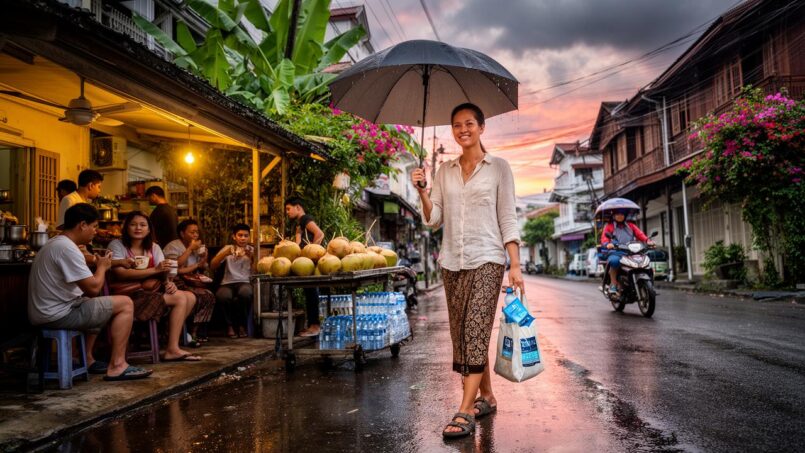
During the monsoon, your schedule must account for sometimes brutal downpours: always carry an umbrella or lightweight raincoat, allow extra time for travel, and find out which roads regularly flood. In cities, you quickly learn to memorize the safest sidewalks when gutters overflow.
Housing smartly: ventilation, elevation, materials
Adapting to the Burmese climate is not just about clothing choices. Housing is probably the most determining factor for long-term comfort. Yet local housing has a long tradition of “bioclimatic” architecture that is useful to know, even if modern urban offerings sometimes move away from it in favor of all-concrete, air-conditioned buildings.
Vernacular vs. concrete: two climate logics
Traditionally, Burmese houses are built from light materials: wood and bamboo together account for more than 70% of dwellings according to the 2014 census. They are often raised on stilts, with an open space under the floor. This configuration has several advantages: protection from floods, ventilation through the floor, reduction of thermal radiation from the heated ground, and use of the lower space for storage or animals.
Thatched or light tile roofs, combined with ventilated attics, filter solar radiation while allowing hot air to escape through gable openings. Wide eaves play a dual role: shading walls and protecting against driving rain while letting air and light through. Verandas and galleries serve as buffer zones between the scorching exterior and the living space.
Good to know:
This architecture relies on high air permeability (openwork walls, gaps, high openings, slits in the floor) to promote wind cooling in a climate with moderate day-night temperature differences. However, it requires regular maintenance to cope with humidity, insects, and ensure material durability.
More recent urban constructions often adopt the “concrete + brick + corrugated iron” model with glazed windows and air conditioning. They gain in solidity and protection from the elements, but lose natural ventilation. Comparative studies show, for example, that a highly ventilated vernacular house keeps the “felt” temperature within certain limits for a good part of the year, whereas a poorly designed solid house can accumulate and trap heat.
For an expatriate choosing accommodation, the ideal is often a compromise: a solid structure, better suited for seismic safety and urban life, but designed with some principles inherited from vernacular architecture.
A few simple principles for choosing or arranging your home
Without turning into a tropical architect, certain criteria can guide the choice of an apartment or house:
Attention:
For a comfortable and resilient home in Burma, prioritize a north-south orientation with service rooms on the east/west, a narrow shape for ventilation, protected windows on north/south facades, cross-ventilation, an insulated or ventilated roof, and elevation in flood-prone areas to avoid flooding.
Recommendations from organizations like UN‑Habitat for resilient architecture in Burma also stress the need to consider resistance to intense rains: sloped roofs with properly sized gutters, drainage of rainwater away from the plot, choice of water-resistant materials for lower parts, and limiting points of stagnant water (mosquito breeding grounds).
Air conditioning, electricity, and comfort strategy
In Yangon and major cities, new buildings rely heavily on air conditioning. It’s comfortable, but energy-intensive. In a context of a fragile power grid with blackout risks, it is wise not to rely entirely on AC.
A reasonable approach can be to:
– prioritize air conditioning in bedrooms at night and in a dedicated workspace, rather than the whole home;
– combine moderate air conditioning with fans (ceiling or standing) to improve the cooling sensation without dropping to very low temperatures;
– maintain a limited difference between indoor and outdoor temperatures to avoid thermal shock and reduce consumption;
– check minimal insulation of walls most exposed to the sun (thick curtains, reflective films, external shading).
Studies on Burmese building stock also suggest that in the long term, improvements to the “shell” – orientation, solar shading, materials – can reduce discomfort and electricity costs more effectively than simply oversizing air conditioning.
Heat, humidity, mosquitoes: protecting your health
Adapting to the Burmese climate also means, above all, reducing specific health risks linked to the heat‑humidity‑rain combination. The country indeed combines a high level of climate vulnerability with an unequally accessible healthcare system, especially in rural or conflict zones.
Understanding the main climate-related health risks
Several groups of diseases are directly linked to climatic conditions:
1. Waterborne diseases: acute diarrhea, cholera, typhoid, hepatitis A linked to contaminated water and food, particularly common during the rainy season and flooding, when wastewater mixes with surface water.
Good to know:
Dengue is very present in urban and rural areas, transmitted by mosquitoes that breed in stagnant water during the rainy season. Malaria mainly affects rural forested and mountainous areas (e.g., Shan State), with low risk in large cities like Yangon and Mandalay. Japanese encephalitis is associated with agricultural environments, especially rice paddies, from May to October.
3. Heat-related illnesses: heatstroke, dehydration, worsening of cardio-respiratory diseases. Recent heatwaves have already reached over 47 °C in some parts of the country.
4. Respiratory diseases and air quality: air pollution in Yangon and Mandalay, smoky season, dust in the Dry Zone.
In the background, Burma also remains a country where tuberculosis, measles, diphtheria, and some forms of polio can circulate, especially where vaccination coverage is incomplete. Climate change risks worsening the situation by expanding mosquito ranges and increasing flood episodes.
For an expatriate, anticipation is therefore essential: a medical consultation before departure to update vaccinations (DTP, hepatitis A, typhoid, MMR, possibly hepatitis B, rabies, or Japanese encephalitis depending on the lifestyle plan), and a possible discussion about malaria prophylaxis if staying in certain at-risk rural areas.
Managing heat daily
In a climate where the hottest period of the year precedes the monsoon, you must anticipate several weeks per year when the temperature‑humidity combination can become dangerous.
A few simple but vital principles:
– drink often, before you feel thirsty, preferring water (bottled or purified) over sugary, alcoholic, or highly caffeinated drinks;
– adjust physical exertion: avoid intense outdoor activities during the hottest hours; take regular breaks in shaded or air-conditioned areas;
– protect your skin from the sun with lightweight covering clothing, hat, sunscreen;
– be alert to signs of heatstroke (headache, confusion, nausea, hot dry skin, absence of sweating) and know the first steps (gradual cooling, hydration, call for help if necessary).
Good to know:
In cities, the heat island effect prevents sufficient nighttime temperature drops, hindering the body’s recovery. To remedy this, it is advisable to use an air conditioning system or, failing that, ensure very good ventilation at night.
Protecting against mosquitoes and contaminated water
During the rainy season, mosquitoes and dirty water become ubiquitous. A few reflex actions structure good adaptation:
– use a skin repellent containing DEET or picaridin, especially at dusk and night;
– sleep under a mosquito net, ideally impregnated, especially outside major urban centers;
– regularly check for stagnant water inside and around the home (saucers, buckets, blocked gutters) and eliminate them;
– prefer bottled or filtered water for drinking; avoid ice cubes of dubious origin; ensure food hygiene, especially raw products;
– wash your hands thoroughly, especially during the rainy season and flood episodes.
These actions may seem repetitive, but they significantly reduce the risk of diarrheal and vector-borne diseases. Certain local practices, such as applying turmeric paste to small wounds or paying attention to foot washing, illustrate the longstanding awareness of these health issues.
Preparing for hazards: floods, cyclones, extreme heat
Living in Burma also means accepting a real exposure to climatic hazards: floods, landslides, cyclones, heatwaves, and sometimes earthquakes. However, an expatriate has an advantage: easier access to information and certain material resources. You just need to know where to look and how to organize.
Staying informed: good weather and alert sources
The reference organization for meteorology and hydrology in Burma is the Department of Meteorology and Hydrology (DMH). It publishes:
– 24/7 daily forecasts;
– 10-day and monthly forecasts;
– specific bulletins on the monsoon, cyclones, heavy rain, and gale-force winds;
– alerts updated several times a day in case of severe phenomena (e.g., 3 to 5 times a day for a cyclone).
Good to know:
The Department of Meteorology and Hydrology (DMH) operates through a dense network of stations (meteorological, agrometeorological, and aerological) and collaborates with regional organizations such as the multi-hazard early warning system RIMES and the World Meteorological Organization (WMO).
In practice, for an expatriate, this translates into several useful tools:
– the DMH website and official bulletins;
– local mobile apps like “Weather Myanmar,” which aggregate data and offer personalized alerts;
– local media (radio, television) that relay storm and heavy rain advisories.
Learning to read these bulletins, knowing the vocabulary used for warning levels, and setting up smartphone alerts are part of good climate hygiene.
Organizing daily life around seasonal risks
Major risks do not affect everyone in the same way. On the coast, the danger comes more from storms and cyclones at the beginning and end of the monsoon. In lowland cities, it’s urban flooding, the electrical risk from live wires in water, and open sewers. In the mountains, landslides after heavy rains.
Tip:
A few basic principles can help limit exposure.
– identify frequently visited flood-prone areas (commute, schools, markets) and plan alternative routes;
– keep a minimal emergency kit (water, flashlight, first aid kit, copies of important documents) ready during the rainy season;
– check your home’s stability (drainage, roof anchoring, position of sockets and electrical equipment) if you live in a highly exposed area;
– stay informed about evacuation plans and shelters identified by authorities or local NGOs, especially in coastal regions.
In the event of a cyclone or severe storm warning, strictly following local instructions and avoiding relying on “weather instincts” acquired in another country is crucial: safe behaviors in Europe or North America are not necessarily adapted to Burmese realities.
Food, water, work: adapting your lifestyle
An expatriate’s climate adaptation is not just physical; it is also social and economic. Diet, work organization, and relationships with the community can either mitigate or exacerbate vulnerabilities.
Eating in a climate under pressure
Climate change is already affecting food production in the country, especially in the Dry Zone, which is highly sensitive to rainfall variability, and in deltas exposed to saltwater intrusion and cyclones. Many farming households report productivity declines linked to weather.
For an expatriate, these issues sometimes translate into: adapting to a new culture, managing language, reorganizing personal and professional life, and maintaining ties with the home country.
Attention:
Extreme weather events (droughts, floods) can lead to greater volatility in fresh produce prices (rice, vegetables, fruits), cause temporary supply disruptions during major disasters, and alter the sanitary quality of products if storage or transport infrastructure is damaged.
Staying informed about agricultural seasons, favoring reliable supply chains, diversifying sources (local markets, supermarkets, cooperatives, direct purchases from small producers) can limit these effects. On a personal level, reducing food waste – by adjusting purchased quantities to the reality of the cold chain, for example – contributes to the overall resilience of the system in a context where storage and preservation become more delicate in a hot climate.
Working in the heat: health, productivity, and hours
Heat also impacts working conditions. Prolonged heatwaves can reduce concentration, increase the risk of accidents, and pose particular problems for outdoor workers or those in poorly ventilated buildings.
For expatriates supervising local teams or managing projects, adapting to the climate also means:
– adjusting work hours according to the season, favoring cooler times for physical tasks;
– ensuring break periods, water stations, shaded or air-conditioned spaces for exposed employees;
– incorporating thermal comfort and air quality criteria into the choice of offices and meeting rooms;
– taking weak signals seriously: increased irritability, unusual fatigue, repeated small mistakes can be signs of heat stress.
An occupational health policy adapted to the Burmese context is an investment, not a luxury: it reduces absenteeism, improves productivity, and boosts satisfaction of local staff.
Putting down roots locally: learning from community practices
Finally, one of the most valuable resources for adapting to the Burmese climate is… Burmese society itself. In a country where the majority of the population lives in direct connection with natural resources, communities have developed many adjustment strategies, sometimes very sophisticated, sometimes very simple but effective.
Locals modify their crops, change seeds, diversify income sources, improve community savings, restore forests or mangroves, build shelters, install water tanks, and organize warning and solidarity systems. Women, often at the forefront of domestic and care tasks, play a central role in these dynamics, even if they remain underrepresented in formal decision-making spaces.
For an expatriate, finding your place in this fabric means:
– keeping informed about local initiatives (neighborhood committees, women’s groups, youth associations) around the environment, water, and safety;
– participating when appropriate, without imposing your own solutions but supporting ongoing efforts;
– respecting the dominant Buddhist culture, codes of respect (especially around the body, hierarchy, “saving face”), which condition how problems – including climate ones – are addressed collectively.
Example:
Climate adaptation becomes a shared adventure, where you learn to read the sky with your neighbors, prepare for the rainy season as a community, coordinate your travel with DMH warnings, and gradually integrate into your daily routine reflexes that initially seemed exotic.
—
Settling in Burma is not just about enduring the heat or facing the monsoon. It is accepting to live in a country where the climate structures everything: schedules, food, manners, house shapes, work organization, economic vulnerability, and the way communities come together in the face of a cyclone or drought.
By understanding the logic of this climate, by adopting a few basic principles on housing, health, weather information, clothing, and daily rhythms, an expatriate can not only reduce risks but also make the most of what Burma has to offer: a culture deeply adapted to its environment, ingenious architectures, and a capacity for collective resilience that, in the age of climate change, has much to teach.

Cyril Jarnias is an independent expert in international wealth management with over 20 years of experience. As an expatriate himself, he is dedicated to helping individuals and business leaders build, protect, and pass on their wealth with complete peace of mind.
On his website, cyriljarnias.com, he shares his expertise on international real estate, offshore company formation, and expatriation.
Thanks to his expertise, he offers sound advice to optimize his clients' wealth management. Cyril Jarnias is also recognized for his appearances in many prestigious media outlets such as BFM Business, les Français de l’étranger, Le Figaro, Les Echos, and Mieux vivre votre argent, where he shares his knowledge and know-how in wealth management.





