
 Published on and written by Cyril Jarnias
Settling in Myanmar, whether for an expat contract, a humanitarian project, studies, or a long journey, is an intense adventure. Between the power outages, the omnipresent Buddhism, the often indirect communication, internet restrictions, and a tense political context, the culture shock is guaranteed. And with it, homesickness.
That’s the percentage of expats who experience an episode of homesickness during their first year abroad.
Understanding homesickness to live with it better
Homesickness is not a weakness, let alone a disease. Researchers define it as emotional distress linked to separation from loved ones and one’s familiar environment. It’s a normal psychological reaction to losing your bearings, your routine, and your support network.
Dutch researchers proposed an interesting model: on one side, the “separation reaction,” on the other, the “adaptation reaction.” In Myanmar, these two forces often clash more violently than in other countries, because everything—language, religion, pace of life, digital access—differs radically from what most foreigners are used to.
Two reactions that collide
The separation reaction is everything that pulls you back to your former home: sadness, obsessive thoughts about your loved ones, a need to stay “connected” to your old life, a refusal (conscious or not) to truly invest in your new Burmese existence.
The adaptation phase involves accepting new professional roles, dealing with sometimes unpredictable infrastructure like internet outages, adapting to a slow bureaucracy and indirect communication styles. It also requires taming cultural and religious differences, and managing nostalgia by finding new distractions.
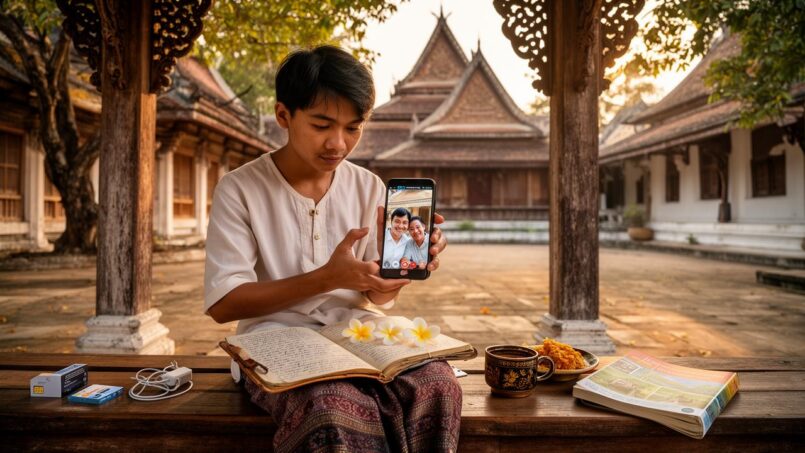
In practice, these two reactions mix. One day you’re exploring Yangon’s markets in a longyi with enthusiasm, the next you’re glued to your phone refreshing your friends’ Instagram stories back home, feeling strangely absent from your own life.
When homesickness turns into suffering
In itself, missing your family or your local coffee shop is nothing alarming. The problem is when these feelings settle in, become overwhelming, and end up stalling your adaptation.
Researchers estimate that 63% of people suffering from homesickness have sleep disorders. Among expats, nostalgia is also correlated with greater emotional distress, especially when isolation is strong. In Myanmar, where online social life can be brutally interrupted by an internet shutdown or a blocked app, the risk of being left alone with your thoughts is real.
Signs to watch for
Without trying to self-diagnose, it’s useful to recognize a few warning signs:
Distress manifests through three interconnected dimensions: emotional (sadness, anxiety, loneliness), behavioral (social withdrawal, loss of motivation, mistakes), and physical (fatigue, digestive issues, insomnia).
Symptoms of homesickness can resemble those of mild depression: frequent crying, sleep disturbances, difficulty concentrating, disengagement from social relationships. Untreated adjustment stress is also associated with a higher risk of depression.
In a country like Myanmar, where the healthcare system is underdeveloped and power outages are frequent, indefinitely postponing seeking help is not a good idea. Especially since resources do exist, including remotely.
Myanmar: a terrain that intensifies culture shock
To understand why homesickness can be particularly harsh in Myanmar, we need to look closely at what makes this country so specific for a newcomer.
A daily life far from Western standards
Myanmar is a country with a largely informal economy, almost entirely dominated by cash. Outside major cities, many residents are not connected to the national power grid. Even in Yangon, daily power outages and water shortages are part of the landscape. Internet is expensive, unstable, sometimes deliberately cut for political reasons; many social media platforms are officially blocked and only accessible via a VPN—itself in the authorities’ crosshairs.
Daily contact with the home country can slow an expat’s adaptation by 25%.
Climate, pace of life, religion: everything changes
The rainy season, from May to November, can feel like living under a permanent curtain of water. The heat, humidity, storms, early nightfall, religious chants over loudspeakers at dawn, and the near-total absence of real “nightlife” outside Yangon destabilize habits.
Daily life is deeply marked by Buddhism: monasteries, offerings, monks given priority in transportation, ceremonies, pagodas on every corner. The codes are strict: you remove your shoes and socks when entering a temple, cover shoulders and knees, never touch people’s heads or statues, avoid pointing your feet at someone or a religious symbol. In a conservative society where public displays of affection are frowned upon and homosexuality remains criminalized, some expats quickly feel out of place.
In Japan, communication avoids confrontation, public criticism, and outright refusals in order to preserve group harmony. This indirect style can confuse people unfamiliar with the culture, contributing to a feeling of not understanding one’s surroundings.
A heavy political context weighing on morale
The country has been under the heel of a military junta since 2021, in the midst of a civil war. Internet shutdowns are used as weapons; several hundred regional blocks have been recorded since the takeover. Many Burmese live under the threat of violence, the economy is in decline, and collective mental health is under severe strain.
For a foreigner, even relatively protected within the Yangon bubble, this climate is palpable: suppressed protests, checkpoints, surveillance, political conversations whispered. Many locals hesitate to speak freely about sensitive topics. This diffuse tension can add to your own homesickness and plunge you into a form of guilt (“Do I have the right to be sad for myself when my neighbors are going through much worse?”) which further complicates managing your emotions.
Anchoring yourself in Burmese culture to reduce nostalgia
From a psychological standpoint, the greater the cultural gap, the harder the adjustment. And Myanmar accumulates discrepancies: religion, social norms, communication, infrastructure. Yet, that is also precisely what makes it a resource: cultural immersion, when experienced actively, is one of the most powerful antidotes to homesickness.
In Myanmar, hierarchy, age, teachers, and monks are deeply respected. You address elders with specific polite forms, avoid contradicting them directly, never raise your voice. Humility is valued: boasting is frowned upon, while slight self-deprecation is seen as refined.
In some cultures, a “yes” in response to a question may actually mean “I don’t know” or “I can’t,” but is used to save face and avoid conflict. Similarly, silences are not perceived as awkward or empty, but as signs of deep thought or respect. Quickly understanding these subtle codes is essential to avoid misunderstandings that could fuel a sense of isolation.
Learning these nuances—through reading, cross-cultural training, or simply observation—allows you to shift from feeling “I am misunderstood, I don’t belong anywhere” to “I am learning a new social grammar.” This change in perspective significantly reduces the intensity of culture shock.
Playing along: longyi, thanaka, markets, and local cuisine
Testimonials from travelers and volunteers in Myanmar are unanimous: those who truly let themselves be swept up by local daily life experience a more intense culture shock… but often a milder homesickness.
Walking around in a longyi—that traditional wrap skirt worn by both men and women—or having thanaka applied to your face (that protective and cosmetic plant paste) often brings knowing smiles. Locals appreciate the effort and the playfulness, even if they warn you with a laugh that a longyi needs constant readjusting.
To avoid hasty judgments about local cuisine, it’s advisable to venture beyond tourist restaurants with translated menus. Discovering dishes like Shan noodles, freshly pressed sugarcane juice on the street, spicy salads, and very fresh fish from the Shan region or Inle Lake is a rich culinary experience and a good remedy for nostalgia.
Visiting markets, asking about products, watching jaggery (palm sugar) being made, learning to cook a few dishes in a local class: these are micro-experiences that plant roots in Burmese daily life. The denser your day is with interactions and concrete discoveries, the less mental space remains to brood over your nostalgia.
Exploring the country to give it a face
Staying cooped up in an air-conditioned apartment in Yangon feeds the feeling of being permanently in transit. Conversely, moving around, within the limits of safety conditions, helps turn the abstract Myanmar of the news into a real country you can become attached to.
A few places often recommended to expats when they can:
| Place / Region | Main appeal | Possible impact on homesickness |
|---|---|---|
| Yangon | Urban life, lakeside cafés, Shwedagon Pagoda | Creates routines and landmarks in the city |
| Bagan | Temples as far as the eye can see, timeless atmosphere | Gives the feeling of experiencing something unique |
| Inle Lake | Serene landscapes, stilt villages | Offers calm conducive to reflection and recentering |
| Ngwe Saung / Chaung Tha | Beaches, sea, break from urban chaos | Allows you to release pressure, to “breathe” |
Even simple excursions to Dala or Twantay by bike into the countryside, or visits to villages and farms, can completely change your perception of the country, especially for families.
Building a local network to defuse loneliness
All studies confirm it: cutting yourself off from others when you are homesick makes the situation worse. Yet Myanmar is not necessarily an easy place to make friends, especially beyond the expat circle.
Working both angles: expats and Burmese
Foreign communities are particularly present in Yangon, with their clubs, bars, restaurants, and international schools. Platforms like InterNations or expat forums organize regular events: brunches, parties, sports outings. Literature on expatriation describes a clear phenomenon: those who quickly accept these invitations, even if they feel shy, generally adapt better and faster.
In parallel, building ties with Burmese people is a powerful antidote to the feeling of living “next to” the country. Here again, you have to contend with the language barrier and political caution. But certain doors open more easily:
Advice for expats in Myanmar
– Sports clubs (football, tennis, running, yoga, hiking),
– Burmese language classes (or dance, or cooking) at local institutions,
– Participating in festivals and community events,
– Volunteering with local NGOs, educational projects, environmental activities.
The Burmese are known for their warmth. Although they may seem shy at first meeting, once a bond of trust is established, they become very welcoming and inclusive toward foreigners.
One piece of advice that well-integrated expats often give is simple: go to the same place often. A neighborhood café, a small gym, a market, a temple, a local pub: eventually, faces become familiar, exchanges flow more easily. These “micro-relationships“—the juice vendor who knows your order, the neighbor who greets you every morning, the building guard who strikes up a conversation—massively contribute to reducing the feeling of alienation.
An effective strategy is to combine:
| Type of network | Concrete examples | Role in managing homesickness |
|---|---|---|
| Expat community | InterNations, forums, Facebook groups | Immediate understanding of your experience, practical advice |
| Local Burmese ties | Neighbors, colleagues, shopkeepers, volunteering | Sense of belonging to the host country |
| Professional network | Colleagues, local partners | Stability, recognition, structuring life project |
| Professional support network | Psychologists, helplines, expat coaches | Dedicated space to unload emotional weight |
The more these circles overlap, the more your Burmese “home” solidifies.
Creating a stable daily life in an unstable environment
One major cause of homesickness is the disappearance of routine. Changes in housing, food, language, schedule, leisure—everything shifts at once. Rebuilding personal habits is therefore crucial.
Personal rituals: your anchor in the day
Psychologists emphasize the importance of rebuilding a daily framework, even a minimalist one: waking up at a fixed time, a moment of exercise, reading time, structured meals, a brief evening ritual. It doesn’t matter if it’s yoga on your balcony watching the sun rise over Yangon, a journal where you write three things you learned each day, or a daily walk in the same park.
Physical activity, especially regular walking, is strongly recommended to combat anxiety because it releases endorphins. In a context like Myanmar, where you can feel confined between air-conditioned offices and traffic jams, establishing a walking ritual (in a park, by a lake, or in a residential neighborhood) proves particularly beneficial for mental well-being.
Creating a “home corner” in your accommodation
Decorating your apartment with a few photos, a fabric brought from home, two books in your native language, a favorite cushion or mug is by no means trivial. It’s a way to maintain a psychological link with your identity without trying to completely recreate your previous life—which, according to studies, hinders adaptation.
Researchers mention the concept of ‘Heimatgefühle’, a feeling of belonging and familiarity that can be cultivated. For instance, a living room in Yangon doesn’t need to be an exact replica of one in Paris, Montreal, or Dakar. The important thing is to incorporate enough personal and familiar elements (objects, colors, memories) to feel a sense of security and comfort there, which is essential for well-being during expatriation.
Managing connections with home wisely
Staying connected to loved ones is a resource, not a mistake. Studies show that strong emotional ties reduce emotional distress. But the frequency and manner of communication matter.
In the Myanmar context of fragile connections and sometimes inaccessible social media, it can be tempting to jump on every Wi-Fi window to spend hours online. However, it’s recommended to limit calls to a few times a week and prioritize quality exchanges over compulsive scrolling through Instagram profiles that fuel FOMO (fear of missing out).
A balanced approach might look like this:
| Strategy for contacting home | How to implement it in Myanmar |
|---|---|
| Scheduled calls | Set 2–3 weekly slots adapted to time zones and internet outages |
| Shared activity via video | Cook a family recipe together, watch the same movie, read the same book and discuss it |
| Asynchronous messages | Use encrypted messaging (Signal, etc.) when possible, accept delays in replies |
| Limiting social media exposure | Turn off notifications, avoid spending entire evenings scrolling |
The goal is not to cut off, but to transform the connection into support rather than an exclusive refuge.
Taking care of your mental health… even far from major centers
Myanmar combines civil war, natural disasters, poverty, and a fragile healthcare system. Unsurprisingly, anxiety and depressive disorders are among the leading causes of years lived with disability. The good news is that recent years have seen the emergence of many mental health initiatives, sometimes also accessible to expats.
When homesickness requires professional help
It’s time to seek help when: you feel overwhelmed by emotional, mental, or physical problems that you can’t manage on your own.
– Homesickness has lasted several weeks without improvement,
– Your work or studies are clearly suffering,
– You are systematically isolating yourself, refusing all invitations,
– You have thoughts of despair, self-deprecation, or even self-harm.
Expatriation experts also observe that professional performance can drop: mistakes, lateness, client complaints, team tensions. That’s an indicator that the emotional burden is becoming too heavy to handle alone.
In such situations, psychological support, even online, makes a difference. There are now services specifically aimed at expats, capable of working remotely, in your language, and taking your cultural context into account.
Overview of useful resources
In Myanmar itself, an ecosystem has developed, often on the initiative of NGOs, private centers, and international organizations. Among the structures mentioned in reports:
A selection of organizations and platforms offering mental health support, helplines, and professional consultations.
24/7 suicide prevention hotline, individual and couples counseling, and disaster distress line.
Free online sessions some evenings, with safe spaces for suicidal individuals and their loved ones.
Consultations, psychosocial support, peer groups, art therapy, and care for disorders (anxiety, schizophrenia…). Based in Yangon.
Individual, family, and group therapy, in-person and online. Branches in Yangon and Mandalay.
Yangon-based center combining psychiatric services, psychotherapy, training, and support programs.
Online platform (English/Burmese) to anonymously book appointments with trained psychologists, psychiatrists, and counselors (CBT, EMDR…).
For foreigners preferring a professional who shares their native language and has a better understanding of the expat experience, solutions also exist:
Several specialized services exist to support expats in their mental well-being, taking into account the specific challenges of living abroad.
Services like Expat Well-Being or Expathy, which connect expats with psychologists who speak their language and are familiar with the realities of life abroad.
Therapists specializing in international trajectories are listed in dedicated directories, such as the International Therapist Directory.
Online counselors based in this region work specifically with expats and understand local realities (internet shutdowns, political instability, etc.).
The important thing is not to get stopped by the first logistical obstacle. In a country where everything—including VPN access—can become complicated, accepting a certain degree of improvisation (changing time slots, opting for audio over video, alternating emails and live sessions) is often the price to pay for genuinely helpful support.
Using local culture as a psychological resource
When facing distress, the Burmese rely heavily on religion, meditation, and community ties. Without becoming Buddhist or renouncing your own culture, an expat can draw inspiration from these resources to manage their own homesickness.
Meditation, mindfulness, and acceptance
Studies conducted among students and refugees from Myanmar show that meditation and self-reflection are often cited as coping strategies. The practice of vipassana, widespread, has been the subject of research evaluating its effect on stress and anxiety.
Incorporating short mindfulness exercises (breathing, non-judgmental observation of emotions, labeling thoughts) can help create distance from homesickness. Meditation apps (sometimes free for the first year) or multilingual podcasts are useful aids, to be combined with observing your new environment.
Buddhist teachings on the difference between pain (inevitable) and suffering (fueled by mental resistance) can also resonate with your own experience: you cannot erase the longing for your loved ones, but you can work on how you respond to that longing.
Community, sharing stories, and vulnerability
Qualitative studies mention the role of monasteries, meditation centers, support groups, community kitchens, artistic activities in psychological reconstruction after traumatic events like Cyclone Nargis or political repression.
To combat isolation and homesickness, share your experience with other expats or trusted Burmese friends, see a therapist, or engage in collective activities like music, dance, writing workshops, or group projects. Expressing vulnerability in a safe environment helps rebuild social connections.
Accepting the temporality of adaptation
Intercultural specialists often describe four major phases of adjustment: honeymoon, frustration, adaptation, acceptance. In Myanmar, this cycle can be accentuated by the harshness of the context. After the first few weeks of excitement (pagodas, markets, sunsets over the river), often comes what some call the “six months slump”: fatigue, irritability, saturation, a desire to throw in the towel.
During the difficult phase of expatriation, feelings of having made a mistake, of incompetence, or of wasted effort are common. Recognizing that this phase is normal, documented, and usually temporary—giving way to a more peaceful equilibrium—is in itself a calming factor.
You don’t have to “succeed” at your adaptation in record time. Figures show that cultural disconnect can lengthen the adjustment period by 30%. Myanmar checks all the boxes of a destabilizing country; it is therefore logical that you need more time than in neighboring Europe or in a highly globalized capital.
As a family: when homesickness also affects children
Children and teenagers are not spared. Separation from their friends, schooling in a foreign language, internet blocks (which complicate contact with friends back home), the diffuse fear related to the political context can leave marks.
Symptoms in them sometimes take different forms: withdrawal, irritability, acting out, academic difficulties. To help them, several levers exist:
To ease children’s adaptation in Myanmar, it is advisable to encourage them to learn Burmese and have daily contact with local children, through classes, games, or sports activities. It is also beneficial to involve them in local festivities, like Thingyan or the festival of lights, so they build positive memories of their “second home.” Maintaining familiar routines (bedtime stories, family rituals, preparing favorite dishes with local ingredients) contributes to their stability. Finally, if needed, you can turn to psychological support resources for children, such as certain UNICEF programs, centers like Metanoia, or specialized therapists through the MHPSS platform supported by UNFPA.
Building a “home away from home” for them doesn’t eliminate homesickness, but makes it less threatening, more manageable.
Staying the course: what you can expect from this experience
Research on expatriation shows that, when properly supported, this experience strengthens long-term resilience, adaptability, and open-mindedness. Myanmar, with its slow modernization, its cultural richness still little altered by globalization, its ethnic and religious kaleidoscope, its daily challenges, is an extreme but also deeply transformative terrain.
By learning to: navigate challenges and acquire new skills.
For successful integration in Myanmar, it is advisable to acknowledge your homesickness without dramatizing it, to balance ties with your home country and your investment on the ground, to lean on the local culture rather than endure it, to build solid networks with both other expats and Burmese people, and to ask for help if the cultural or emotional shockwave becomes too strong.
you give yourself the chance to experience this stage as something other than a painful parenthesis. It can become a demanding but foundational chapter in your personal story.
You may still, on some evenings, feel a pang in your heart thinking about your loved ones or your favorite coffee shop. Homesickness does not necessarily disappear; it transforms. In Myanmar, it can become that subtle thread connecting you to who you were, while you learn, day by day, to fully inhabit this new setting—with its golden pagodas, bustling streets, power cuts, shy smiles, and silences full of meaning.
Disclaimer: The information provided on this website is for informational purposes only and does not constitute financial, legal, or professional advice. We encourage you to consult qualified experts before making any investment, real estate, or expatriation decisions. Although we strive to maintain up-to-date and accurate information, we do not guarantee the completeness, accuracy, or timeliness of the proposed content. As investment and expatriation involve risks, we disclaim any liability for potential losses or damages arising from the use of this site. Your use of this site confirms your acceptance of these terms and your understanding of the associated risks.

Cyril Jarnias is an independent expert in international wealth management with over 20 years of experience. As an expatriate himself, he is dedicated to helping individuals and business leaders build, protect, and pass on their wealth with complete peace of mind.
On his website, cyriljarnias.com, he shares his expertise on international real estate, offshore company formation, and expatriation.
Thanks to his expertise, he offers sound advice to optimize his clients' wealth management. Cyril Jarnias is also recognized for his appearances in many prestigious media outlets such as BFM Business, les Français de l’étranger, Le Figaro, Les Echos, and Mieux vivre votre argent, where he shares his knowledge and know-how in wealth management.





