
 Published on and written by Cyril Jarnias
For a long time, Myanmar was seen as a destination where streets emptied at nightfall, far from the big party scenes of Bangkok or Hanoi. Yet once the sun goes down, the country reveals another face: between high-energy night markets, packed tea shops, high-BPM electronic clubs, and traditional shows at pagodas, the Burmese night is far richer than imagined. It remains more discreet than its neighbors, shaped by Buddhism and strong social conservatism, but it is rapidly changing, especially in Yangon, Mandalay, Bagan, and Naypyidaw.
Understanding the Burmese Night Before You Go Out
Nightlife in Myanmar developed late and remains in transition. Decades of political isolation, poverty, and frequent power outages long stifled the emergence of party scenes. Even today, in many small towns shops close early, public transport stops before nightfall, and drinking alcohol in public is frowned upon.
In this context, forget the idea of a country where you hop from bar to bar until dawn, except in a few urban pockets. Most Burmese still live on a morning-oriented rhythm, with buses or trains sometimes departing as early as 5 a.m. and restaurants shutting down their kitchens around 9 p.m. But in the big cities, a different landscape has emerged: lively beer stations, tea shops open very late, rooftop terraces with views of illuminated pagodas, EDM clubs, concert halls, and big street parties during festivals.
Caution:
Since the 2021 coup, the security situation in Myanmar has imposed variable curfews, especially in Yangon and Mandalay (e.g., midnight–4 a.m. or 1 a.m.–3 a.m.). Being on the street during these hours risks rough checks or arrest. Regulars adapt by heading home earlier and favoring places accessible by taxi.
Socializing Shaped by Buddhism and Modesty
Myanmar is predominantly Buddhist, and this culture strongly influences behavior. Alcohol is not really part of daily tradition. People drink local beer – affordable, between 700 and 3,000 kyats – at beer stations or bars, but without the exuberance seen elsewhere. Public displays of affection are frowned upon, for both straight and same-sex couples. Kissing, hugging, or even holding hands can make people uncomfortable.
Good to know:
Dress is a marker of respect: it is appreciated to cover shoulders and knees, especially near religious sites. Avoid tight minidresses, deep-cut tank tops, or sloppy attire. Burmese also place great importance on self-control: raising your voice, arguing in public, or being aggressive is very poorly seen and makes everyone involved lose face.
Money, Transportation, and Practical Safety at Night
In tourist areas, the night remains generally safe for those with common sense, even though opportunistic crime is on the rise: pickpocketing, bag snatching, thefts from unsecured hotel rooms. Violent assaults are rare but have been documented, including near Yangon’s Kandawgyi Lake or at night on poorly lit streets.
In the economic capital, taxis or apps like Grab remain the most reliable way to get around in the evening. Cars are sometimes in poor condition, and you often need to negotiate the fare before getting in. Long-distance nighttime road travel is more problematic: bad roads, exhausted drivers, cyclists without lights, risks of accidents or military checkpoints. Better to prioritize flights for long trips and limit nighttime travel to urban areas.
The busiest bars and clubs are concentrated in the “tourist kite” formed by Yangon, Mandalay, Bagan, and Inle Lake. Most serious incidents occur in peripheral conflict zones. For a night out, staying within this quadrilateral and following local advisories is a much safer choice.
Yangon: Capital of a Changing Night
Yangon, formerly Rangoon, is the beating heart of Myanmar’s nightlife. It’s the country’s largest city, a bustling port of over four million people, and a laboratory for all trends: electro clubs, cocktail bars, giant night markets, underground concert venues, experimental arts.
Since the 2010s, the city has gone from a sleepy atmosphere to a genuine nocturnal playground. Electronic music fans will find clubs pounding with hard techno, hardstyle, or drum and bass, while those curious about local culture can attend puppet shows, traditional dance, or satirical theater.
Chinatown and 19th Street: Skewers, Cold Beer, and Crowds
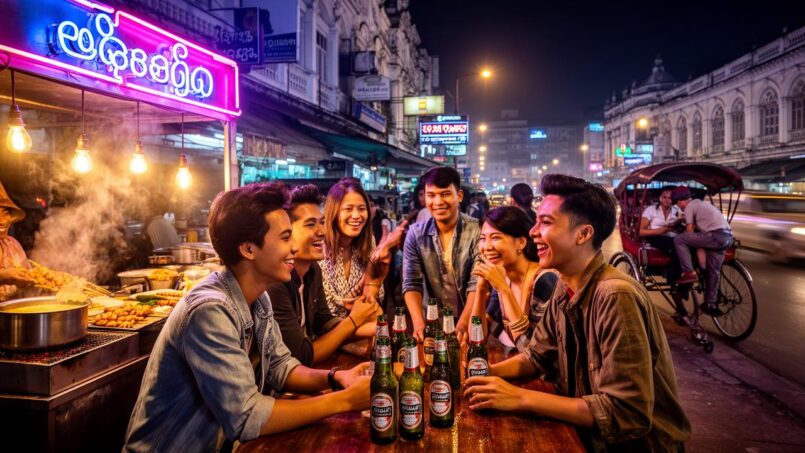
For a first taste of Yangon’s night, head to Chinatown, between 18th and 24th Streets. After dark, the famous 19th Street transforms into “drink street”: sidewalks disappear under low tables, plastic chairs pile up, grills smoke continuously. The smells of pork skewers, chicken, seafood, fried tofu, and dried fish mingle with the scent of freshly poured Myanmar beer.
Stalls set up at sunset, but the atmosphere peaks after 8 p.m. You can dine for just a few dollars, often between $1 and $6 per person, drinks included, making Chinatown a great budget-friendly spot. Myanmar beer usually costs less than $2, and some bars go as far as offering free shots to regulars.
A short walk away, the Anawrahta Road market, one of the busiest in the center, extends the experience. Fruits, vegetables, meat, fish, spices, fried snacks, coconut jelly desserts – everything spills onto stalls lit by bare bulbs. Between skewers, locals grab a pressed sugarcane juice or a tropical fruit smoothie.
Night Markets: Mirror of Urban Burmese Life
In Yangon, night markets are much more than places to eat. They are social spaces where office workers meet for cheap dinners, families come for shopping, and youth curious about culinary novelties from China, India, or Thailand gather.
Example:
Several markets structure evening social life, offering iconic spots to stroll after work. A summary table gives an overview.
| Market / Area | Main Feature | Recommended Vibe |
|---|---|---|
| Anawrahta Road Night Market | Very busy central market, varied products and street food | Very local, lively |
| Strand Road Night Market | New street food market, Burmese specialties and sweets | Trendy, casual |
| Thiri Mingalar Market | 24-hour market, especially lively at night | Raw, authentic |
| Kyi Myin Dine (Nya Zay) | Thrift and bargain paradise | For bargain hunters |
| Bogyoke Aung San Market | Large colonial market, mostly daytime, souvenirs and crafts | More touristy |
These markets are free to enter; you only pay for what you consume. Better to bring cash, as electronic payments are rarely accepted at stalls. Public restrooms, however, are often the weak point, with basic or poorly maintained facilities.
Tea Shops: The Real “Burmese Night”
Even before bars, the true social institution of the country is the tea shop. They line every street, from Yangon to the most remote villages, and for many serve as the equivalent of European bistros or British pubs.
Their peak activity is early morning for breakfast, then from 5 p.m. when the workday ends. Some stay open until 10 p.m., 11 p.m., or even midnight, making them a haven for night owls after other restaurants close. They serve the national drink, laphet yay, a very strong black tea with condensed milk and evaporated milk, served in tiny cups and refilled to the brim.
Around low tables, men – and increasingly women and families – discuss politics, football, local gossip, read the newspaper, or watch a Premier League match on a TV screen, all in a friendly din. Historically, these places played a key role in spreading information, especially during censorship periods, and even in political dissent.
Tip:
Located in a colonial building on Pansodan Street, the Rangoon Tea House reimagines the traditional tea shop with a design approach. It offers sixteen variations of Burmese tea, a very photogenic setting, and a menu of reimagined traditional dishes. A notable feature: you can enjoy mohinga (fish soup) until 10 p.m., breaking with the local custom of eating it only in the morning.
Bars, Pubs, and Rooftops: Moving Upmarket
Alongside these very popular spots, Yangon has seen a proliferation of cocktail bars, Western-style pubs, and panoramic rooftops, often concentrated in downtown, Sanchaung, Bahan, or around Inya Lake.
Among frequently mentioned addresses for a more sophisticated evening are hidden speakeasy-style cocktail bars, panoramic terraces with views of Shwedagon, or European-style bistros with DJ sets, salsa, or acoustic concerts. Prices are generally reasonable by Western standards, with cocktails around $4–$5 even in upscale venues.
The table below provides a quick overview of some types of nightlife venues in Yangon and what to expect:
| Type of Venue | Example Neighborhoods / Complexes | Experience Offered | Approximate Budget |
|---|---|---|---|
| Panoramic Rooftops | Sanchaung, Bahan, around Inya Lake | Cocktails, city views, illuminated pagodas | Moderate to high |
| Cocktail Bars / Speakeasies | Colonial downtown, modern complexes | Mixology, trendy vibe, expat & local crowd | Moderate |
| Beer Stations & Neighborhood Bars | Sanchaung, near Sule, 19th Street | Large tables, draft beer, snacks, loud music | Very affordable |
| International Hotel Bars | Strand, major downtown hotels | Classic cocktails, jazz, older clientele | Higher |
There are also entertainment complexes like The Heart of Rangoon (THOR), combining club, street food, and a large hall with live concerts. These attract a wealthier crowd but still have accessible prices for foreign visitors.
Clubs and Electronic Music: Yangon, Capital of BPM
For all-nighters, Yangon surprises with the intensity of its clubbing scene. Several major clubs specialize in fast electronic music – hard techno, hardstyle, high-BPM EDM, sometimes drum and bass – with a young, passionate, and enduring crowd. Partygoers often arrive around midnight and stay until 3 or 4 a.m., even if an official curfew sometimes requires lights out between 1 a.m. and 3 a.m. In practice, some clubs keep going with lights on, or even organize after-parties until 7 a.m.
5
The entry fee for a techno club in Ho Chi Minh City, often with one drink included.
Beyond electronic music, Yangon has a surprisingly rich live scene: indie rock, punk, hip-hop, reggae, jazz bands. Concert and open-mic culture grew as political restrictions eased in the 2010s. Bars like 7th Joint (reggae), coffeehouse-concerts, rooftops, or even a bowling alley (Right Track Bowling Centre) have hosted alternative events under the “Jam It!” banner, giving a stage to underground bands.
LGBT+ Nightlife: Fragile but Real Visibility
Legally, homosexuality is still technically illegal in Myanmar, with theoretical penalties including life imprisonment. In practice, the law is rarely enforced systematically, but it fosters a climate of insecurity for LGBT+ people. Public displays of affection between same-sex couples, already frowned upon for straight couples, can attract hostile reactions, especially outside big cities.
Nevertheless, Yangon has a small discreet but lively gay scene, with a few “gay-friendly” bars and themed parties like “FAB” night, held semi-regularly at various venues. Before the political situation deteriorated, pride marches and community events had begun to emerge, especially during large festivals like the Taungbyone Nat Festival near Mandalay, known for attracting many gay, lesbian, and transgender people.
For LGBT+ visitors, caution is advised: favor welcoming spaces, avoid public displays of affection, and inform yourself through discreet local networks rather than too-visible exposure.
Mandalay: Rooftops, Puppets, and Satirical Humor
The country’s second-largest city, Mandalay offers a unique blend of traditional culture and modern rooftops. Though the city quiets down relatively early compared to Yangon, it nevertheless offers several very different ways to experience the night.
Rooftop Bars: Cocktails Facing Mandalay Hill
In recent years, Mandalay has seen a proliferation of perched bars atop modern hotels, offering sweeping views of the city, the palace, and the surrounding hills. These rooftops have become popular spots to sip a beer or cocktail while watching the sun disappear behind pagodas.
Rooftops to Discover
Selected addresses offering a culinary experience and panoramic view, open from late afternoon into the evening.
Nova Rooftop Bar
Offers a fusion of Burmese, Thai, Asian, and European cuisine, with a wide selection of drinks. Service geared towards an international clientele.
Hangover Sky Bar
Offers a mix of Burmese, Thai, and Asian specialties in a high-altitude setting. Varied drinks and international atmosphere.
Wave Rooftop Bar and Restaurant
Restaurant and bar with Asian-European fusion cuisine, a full drink menu, and service catering to a diverse clientele.
A table allows a quick comparison of some typical options in Mandalay:
| Rooftop in Mandalay | Indicative Hours | Cuisine & Drinks | Highlights |
|---|---|---|---|
| Nova Rooftop Bar | 4 p.m. – 11:45 p.m. | European, Asian, Thai, Burmese, full bar | Irrawaddy River view, sunset |
| Hangover Sky Bar | 4 p.m. – 11:30 p.m. | Cocktails, local beers, snacks | Urban panorama, festive vibe |
| Wave Rooftop Bar & Restaurant | 4 p.m. – 11 p.m. | European, Asian | View of the palace & city |
Prices remain reasonable: they fall into “$$ – $$$” categories, which for a foreign traveler means bills around $10 to $20 per person depending on consumption.
Puppets, Zat Pwe, and Moustache Brothers: Mandalay’s Stage
Mandalay is also the historic center of Burmese performing arts. After dinner, instead of seeking a club, many visitors opt for a traditional show, more representative of local culture.
Puppet theaters, like the Mandalay Marionettes, perpetuate the art of yoke thé, the string puppets inherited from the royal court. On a modest stage, a full troupe – puppeteers, singers, musicians playing the saung (Burmese harp) and pat waing (drum circle) – reenact episodes from Buddhist legends, folk tales, or the great Ramayana epic. A show usually lasts an hour, divided into several colorful vignettes.
Mandalay Marionettes
Another special nighttime attraction in Mandalay is the Moustache Brothers. This comedy trio blends traditional dance, burlesque numbers, and political satire. For years, they were famous for their bold critiques of the military regime, landing them in prison. Today, they still perform in the evening on a small stage, often before a foreign audience, in an atmosphere that is both funny and poignant.
Bagan, Inle Lake, and Cruises: Softer Nights
In Bagan and around Inle Lake, don’t look for electro clubs or bars open all night. Here, the night is experienced differently: on a terrace by the river, before a puppet show, at a stilted resort, or even aboard a cruise boat on the Irrawaddy.
Riverside Dinners and Night Markets in Bagan
Bagan, famous for its thousands of temples, offers what is called a more “charming” nightlife. You dine in riverside restaurants watching the last sun reflections on the Irrawaddy, or at upscale hotels that regularly host traditional shows: classical dance, puppetry, live music.
A night market unfolds near Bu Pagoda, with over 80 stalls selling souvenirs and small restaurants. You can buy thanaka (traditional cosmetic applied to the face), local textiles, or fruit – Bagan’s mangoes have their fans. During certain festivals, a small carnival sets up with free concerts and attractions, including a Ferris wheel operated by arm power, as impressive as it is dubious.
Inle Lake: Flat Calm for Bars, Rich for Culture
At Inle (Nyaung Shwe), the conclusion is clear: no clubs, no pubs per se, no karaoke galore. The area is distinguished by a much more peaceful atmosphere. Evening activities are primarily cultural and take place within hotels or resorts.
Some establishments, like Inle Princess Resort, stage traditional dance performances or demonstrations of canoe racing, specific to the Intha, the lake’s inhabitants. Others, like Hotel Amazing Nyaung Shwe, showcase Shan and Intha dances accompanied by dinner. After these events, night falls quickly, and the silence of the lake replaces the bass of Yangon.
Irrawaddy Cruises: Deck Shows
Finally, part of Myanmar’s “nightlife” takes place on the water. Several companies operate 2 to 7-night cruises between Mandalay and Bagan, with dinner on board, sunset cocktails, and evening activities on the upper deck.
Example:
During the cruise, passengers can participate in various Burmese cultural activities: demonstrations of wearing the longyi and applying thanaka, historical lectures, as well as performances such as dances and dramas by Mandalay art schools, puppet shows, elephant dances (traditional acrobatics), Burmese karaoke, and quiz nights. Some cruises also offer a candlelit dinner on a sandy riverbank beach.
On these boats, the Burmese night is less about clubs than about contemplation: silhouettes of pagodas on the banks, villages falling asleep, clear skies dotted with rare lights. Onboard bars serve local beers, wines, cocktails, sometimes included in the fare with meals.
Naypyidaw: Muted Nights in Luxury Hotels
The administrative capital, Naypyidaw, has a very different nightlife from Yangon’s. Here, most evening activities are concentrated in major international hotels, with subdued bar atmospheres, cocktail lounges, jazz pianos, and poolside terraces.
Hotel Bars: Polished Cocktails and Calm Ambiance
Several venues stand out for an end-of-day drink. The Oak Room Bar at the PARKROYAL offers a classic atmosphere with dark wood paneling, leather armchairs, and dim lighting. Signature cocktails run between $10 and $15, local beers around $5–$8, single malt whiskies above $12. An early evening happy hour (5 p.m.–7 p.m.) often features “Buy One Get One” offers.
Good to know:
The Lobby Lounge & Bar at the Hilton Naypyidaw offers original creations using local ingredients, such as lemongrass-infused vodka, as well as a mixed menu (club sandwiches and Burmese salads). Happy hours soften prices, with cocktails between $8 and $12.
Other hotels, like the Kempinski (Poolside Bar) or The Lake Garden – MGallery (Garden Bar), favor terraces by the pool or ponds, with local beers at $3–$6, fresh herb cocktails, fruit juices, and small sharing plates (tea leaf salads, grilled meats, vegetable fritters).
A comparative table lets you visualize typical price ranges in these hotel bars:
| Bar in Naypyidaw | Type of Venue | Price Range (Drinks) | Primary Vibe |
|---|---|---|---|
| The Oak Room Bar (PARKROYAL) | Classic lounge bar | Cocktails $10–15, beer $5–8, wine $8+ | Chic, subdued, business |
| Lobby Lounge & Bar (Hilton) | Lobby bar | Cocktails $8–12, beer $4–6, soft drinks $4–7 | Casual, international |
| Poolside Bar (Kempinski) | Pool bar | Cocktails $10–14, mocktails $6–9, beer $5–8 | Resort, open air |
| Garden Bar (Lake Garden) | Garden bar | Beer $3–6, cocktails $8–12 | Quiet, lush |
| Jasmine Bar (Jasmine Hotel) | Modern bar | Beer $4–7, cocktails $7–11, wine $8–12 | Contemporary with local touches |
Most of these places welcome non-guests, but a reservation can be useful on weekends, especially when live concerts are scheduled.
From Water Fountain Garden to Local Bars
Outside hotels, Naypyidaw offers a few more popular options: bars-restaurants with live music, rooftop lounges, cafe-bars frequented by locals. Places like The Fox Bar & Restaurant, Excellent Music Bar, sky lounges, or simpler bars attract a mixed crowd, often families early evening and more festive later.
Good to know:
After nightfall, the Water Fountain Garden offers a light show with colorful fountain displays. The atmosphere is calm, suitable for leisurely walks and photos, providing a family-friendly alternative to more active nightlife.
Festivals, Pwe, and Puppets: The Other Face of the Night
In Myanmar, the night isn’t lived only in bars and clubs. A large part of nightlife consists of traditional shows and festivals, which can last until dawn.
Pwe, Zat, and Anyeint: Popular Theater Until Sunrise
The word pwe broadly refers to popular shows, often outdoors, combining music, dance, comedy, and sometimes social satire. Zat pwe, a very popular form, is a show that literally lasts all night, until sunrise. On a large stage set up near a pagoda or village, a star couple – the mintha (hero) and minthamee (heroine) – and a troupe of clowns take the audience through a succession of scenes mixing Jataka (stories of the Buddha’s past lives), royal dramas, folk legends, and current events.
Good to know:
The music is mainly provided by a traditional *hsaing waing* orchestra, consisting of circular drums, cymbals, flutes, and other instruments. However, some modern troupes also incorporate a pop band portion of the evening, adding hip-hop or breakdance influences.
Anyeint is another very popular show form, blending graceful dance, female choruses, and comedians who throw jabs at the audience. The humor may seem heavy to a Western eye, but the Burmese recognize a tradition of satire, sometimes politically sharp. Troupes like Shwe Man Thabin, active for over 80 years, are among the most renowned.
These shows often take place within major religious festivals, where food stalls, toy shops, gambling allowed for the occasion, and religious processions coexist with theater stages.
Festivals: When the Whole Country Stays Awake
The Burmese calendar, based on the lunar cycle, is punctuated by festivals that turn night into day. The most famous is Thingyan, the water festival, marking the end of the hot season and the arrival of the Burmese New Year around mid-April. For several days, stages lined along the streets of Yangon or Mandalay spray torrents of water on passersby, with music at full volume and dancing. While water battles calm at night, the daytime feels like a permanent party, even if most shops close.
10,000
Nearly 10,000 candles are lit at midnight during the Kyaikhtiyo Festival at the Golden Rock.
For a traveler, participating in these events is probably the most powerful nighttime experience Myanmar offers: you taste religious fervor, the blend of Buddhist and animist beliefs, the vitality of performing arts, and a nightlife that has nothing to do with Western codes, yet fulfills the same social functions of gathering, release, and celebration.
Conduct and Etiquette Tips for Going Out at Night
To fully enjoy Burmese nightlife means adapting your habits to a conservative and politically unstable environment.
Culturally, respect starts with dress and behavior. Covered shoulders and knees are appreciated, even in non-religious contexts. Avoid pointing your feet at others, touching someone’s head (a sacred part), or offering something with only your left hand, seen as impure. Politeness dictates giving or receiving an object with the right hand or both hands.
Caution:
Avoid public displays of affection, drunkenness, shouting, and arguments to not lose face and risk unpredictable intervention by authorities. It is also advised not to photograph or film law enforcement, demonstrations, official or military buildings, or to engage in political discussions with strangers.
Regarding security, it is better to stay informed about current curfews, avoid political gatherings, and ensure you can return to your accommodation at least one to two hours before curfew takes effect, to avoid being stranded without taxis. In bars, keep an eye on your belongings, especially in crowded places like 19th Street or night markets.
Caution:
In clubs where ‘working girls’ are present, it is crucial to consider the economic and social context. Behind the lighthearted night atmosphere, many of these women work in precarious conditions, and the line between nightlife and exploitation is often thin.
Finally, health-wise, health authorities and traveler feedback stress the importance of choosing busy food stalls where dishes are served piping hot, to avoid the dreaded “Burma Belly”. Tap water is not drinkable, and streets can be poorly lit, with uneven sidewalks and sometimes exposed electrical cables, especially during the rainy season.
A Night That Is Discreet, Intense, and Deeply Local
Myanmar’s nightlife is neither just a few high-energy clubs nor picturesque night markets. Through a mosaic of places and practices – crowded tea shops, beer stations, sophisticated rooftops, hotel bars, puppetry, zat pwe, religious festivals – it paints a portrait of a country that plays, debates, tells stories, and transforms after sunset.
In Yangon, the sounds of hard techno rub shoulders with melodies from a traditional orchestra at Karaweik Palace. In Mandalay, a rooftop cocktail coexists with a puppet theater from the royal court. In Bagan, the night market and riverside buffets extend the wonder of the temples. In Naypyidaw, hotel lounges and illuminated fountain gardens offer a more understated night. Everywhere, tea shops remain the matrix of social life, where people gather for one last tea, a cigarette, and a debate, sometimes until the middle of the night.
Going out at night in Myanmar means accepting a different definition of the night: shorter, more modest, shaped by religion and politics, but of an unsuspected social and cultural intensity. For those who can adapt, it becomes one of the best ways to understand the country, far beyond its temples and postcard landscapes.

Cyril Jarnias is an independent expert in international wealth management with over 20 years of experience. As an expatriate himself, he is dedicated to helping individuals and business leaders build, protect, and pass on their wealth with complete peace of mind.
On his website, cyriljarnias.com, he shares his expertise on international real estate, offshore company formation, and expatriation.
Thanks to his expertise, he offers sound advice to optimize his clients' wealth management. Cyril Jarnias is also recognized for his appearances in many prestigious media outlets such as BFM Business, les Français de l’étranger, Le Figaro, Les Echos, and Mieux vivre votre argent, where he shares his knowledge and know-how in wealth management.





