
 Published on and written by Cyril Jarnias
Moving to Myanmar isn’t just about changing countries; it’s entering a cultural universe deeply structured by Buddhism, hierarchy, and the constant pursuit of social harmony. For a foreigner, many behaviors can seem confusing: a “yes” that sometimes means “no”, a colleague who dares not ask questions, decisions made at the top without explanation, a smile that masks anger. Understanding these codes isn’t a “bonus”—it’s a prerequisite for working, living, and building relationships in the country.
This article is based on research, field studies, and analyses of the business and civil society sectors in Myanmar. Its aim is to provide concrete reference points to avoid missteps and win the trust of Burmese counterparts.
Burmese culture has been built over centuries around Theravada Buddhism, royal court traditions, and village customs. Nearly 90% of the population identifies with this Buddhist tradition, and it shows in every domain: respect for hierarchy, valuing patience, an obsession with not making others “lose face,” and the importance of generosity and restraint.
Two concepts are central to understanding daily life and professional life.
The idea of *pon*, or social harmony, prioritizes maintaining peaceful relationships over directly defending one’s individual interests. The concept of *ah‑nar‑deh* (or *anade*) describes an emotion of restraint that “paralyzes the will” when one’s own interest conflicts with another’s. It leads to avoiding asking, insisting, or refusing, for fear of bothering, upsetting, or imposing a burden.
Within this framework, an individual is defined first by their ties—family, community, religious—and only then by their personal project. Family and community come before individual needs, which may surprise expatriates from more individualistic cultures.
A society with high power distance
Research inspired by Geert Hofstede’s model classifies Myanmar among countries with “high power distance.” Practically, this means a very unequal distribution of power is accepted as normal. Everyone knows “their place”: parents, teachers, monks, superiors, political leaders occupy the upper rungs, and it doesn’t naturally occur to people to contradict them.
In the relevant culture, the head is considered the purest part of the body and the feet the lowest and most impure. This leads to strict taboos: never touch someone’s head (especially a child’s), point your feet at a person, a monk, a Buddha statue, or a pagoda, nor step over a person or their belongings.
This pattern extends into the family, where the father is traditionally the “lord of the house” (Ain Oo Nat), and into the religious sphere, with the figure of the monk (phongyi, literally “one who possesses great power”) holding immense prestige, in contrast to the lower status of nuns (thilashin). The Buddhist concept of hpon (power derived from karmic merit) is often invoked to justify the symbolic superiority of men over women, in both religious and political realms.
Greeting, addressing, standing: everyday codes
Even before talking about work, it’s crucial to master the basic gestures that shape interactions in Myanmar: how to say hello, how to stand, how to address someone.
The common greeting is “mingalaba”, literally a wish for “auspiciousness”, often accompanied by a slight nod of the head. In a more formal or respectful register, one joins the hands at chest or face level, bowing slightly—a gesture widely used toward elders, monks, or before a Buddha statue. Handshakes exist mainly between men, in urban and business contexts, but are far from systematic. It is strongly discouraged for a man to initiate a handshake with a Burmese woman or a monk.
In Burmese, it is essential to use honorific titles when addressing someone. You almost never address a person by their first name alone. You should use forms such as “U,” “Daw,” “Ko,” “Ma,” or professional titles like “Saya” (teacher) followed by the name.
| Category of person | Usual title | Approximate meaning |
|---|---|---|
| Older man / senior | U | Uncle / Mr. |
| Older woman / senior | Daw | Aunt / Mrs. |
| Man of same generation | Ko | Older brother / Mr. |
| Woman of same generation | Ma | Sister / Miss |
| Teacher, trainer, expert | Saya | Master, professor |
A 55-year-old teacher would thus be “U + name” or “Saya + name”. When in doubt, using “U” for men and “Daw” for women remains a safe bet, especially in professional contexts.
Body language also sends clear signals. Stand straight, speak softly, avoid conspicuously crossing your arms in front of a superior (which could be interpreted as a sign of attentive respect rather than defensiveness). Slightly lower your head when passing an elder or a monk. Use your whole hand, palm turned upward, to point at something or someone, never your index finger.
Ah‑nar‑deh: the key to understanding Burmese communication
Many foreigners sum up Burmese communication as an “indirect style.” That’s true, but reductive. Behind this indirectness lies precisely ah‑nar‑deh, that mix of modesty, fear of bothering others, and the desire to protect the other’s face.
Research shows this notion structures virtually all exchanges, except with close intimates. Not feeling ah‑nar‑deh toward someone is almost like treating them as a stranger, which can be perceived as a form of relational disinvestment. In society, each person is expected to sacrifice part of their interests, refrain from imposing themselves, and tolerate constraints so as not to make others uncomfortable.
Concretely, this produces several effects:
In certain professional cultures, it is important to avoid behaviors perceived as aggressive or rude. Blunt honesty, direct criticism, and categorical refusals are often experienced as aggressive. Similarly, openly expressing anger or raising one’s voice is generally avoided and seen as a sign of weakness rather than strength. Finally, self-promotion is frowned upon; praising oneself, boasting about one’s achievements or salary goes against the social norm of modesty.
This logic of restraint makes reading messages much more contextual. A “yes” can mean “yes,” but also “I don’t dare tell you no,” “I don’t know,” “we’ll see,” or even “it’s impossible but I don’t want to upset you.” Burmese people themselves learn to decode these nuances through tone, silences, smiles, and eye contact.
The “yes” that means “no”
For an expatriate, one of the major traps is taking every agreement at face value. Research describes formulations like “maybe,” “we will see,” “we will try,” “yes, but…” or even a prolonged silence as all possible signals of refusal or impossibility.
To check understanding without putting the person on the spot, avoid the closed question “Do you understand?” Prefer open-ended formulations like “Can you explain how you will proceed?” or “Tell me what you need to do this.” These questions create space for the interlocutor to clarify, ask questions, or flag obstacles without having to openly admit they didn’t understand.
The weight of the non-verbal
In this context, non-verbal signals take on decisive importance. Studies highlight the role of the smile, sometimes present even in anger, to avoid escalation and preserve face. A light laugh can serve to defuse an embarrassing situation, an overly long pause to express disagreement, an averted gaze to say “I cannot accept.”
Foreigners are often disconcerted by the coexistence of a smiling face and implicit bad news. It is therefore essential to pay as much attention to tone, rhythm, silence, and expressions as to the words themselves.
Working in Myanmar: hierarchy, trust, and apparent slowness
Applied to the world of work, the traits mentioned above yield a very specific corporate culture, where hierarchy is strong, personal relationships paramount, and negotiation an exercise in patience.
An omnipresent hierarchy
Local organizations, especially family businesses, are often highly centralized. Key decisions are made at the top, frequently by the owner himself. Middle managers have limited leeway, and employees generally expect detailed instructions rather than spontaneous autonomy.
This pattern sometimes clashes with the habits of multinational corporations, which value delegation and “flat” structures. Research shows that these differences in “power distance” are at the root of many misunderstandings and even expatriation failures. In some teams, a foreign supervisor addresses colleagues as near-equals; in the local culture, this egalitarian status is perceived as confusing, even as a lack of leadership.
The older you are, the wiser your mind.
Popular belief about age and wisdom
Authority, control, and micromanagement
Curiously, while employees often expect precise instructions, micromanagement in the Western sense—nitpicking control, constant suspicion—is poorly received. The management style deemed effective combines clear direction with special attention to team cohesion. Emphasis is placed on support, protection, and taking care of personal difficulties, in an almost paternalistic logic. Breaking group harmony directly harms motivation and performance.
For an expatriate, it is essential to be explicit about goals and steps. Criticism should be given in private, in a measured tone, avoiding public humiliation and harsh rebukes. In public, adopt an angle that presents a problem as collective, without singling out an individual culprit.
Silent meetings and restrained speech
It is common, in international companies or NGOs, to hold meetings where only the expatriates speak. Burmese colleagues remain silent, nod their heads, seem to agree—and sometimes leave with major misunderstandings.
Research on cross-cultural management in Myanmar insists: this silence is not synonymous with agreement. It is often the manifestation of hierarchical distance and ah‑nar‑deh. Asking a question exposes one’s ignorance. Proposing a different idea risks making the manager who just spoke lose face.
Creating a “safe bubble” then becomes crucial. The expatriate must repeatedly state that questions are welcome, publicly value those who dare to propose something, and never ridicule a contribution, even a clumsy one. Trust is not decreed: it is built over time, through consistent behaviors.
Negotiating, receiving, giving: everyday diplomacy
In Myanmar, business is “relational” before it is contractual. Negotiations only truly begin once personal trust has been established.
Building the relationship before the contract
Initial meetings often serve to talk about family, culture, current events, rather than immediately diving into numbers and clauses. Wanting to “get straight to the point” can be interpreted as coldness, even a lack of respect.
Once the relationship is more advanced, the negotiation itself remains slow. Several meetings are necessary, the main decision-makers may not be present at the start, and decisions must go up the chain of command. Research emphasizes that a rushed foreigner, pushing for a quick answer, risks encountering silent obstacles: rather than saying “no,” the interlocutor simply stops responding.
Agreements, even signed, often retain a certain flexibility, especially if the relationship is strong. Pragmatic adaptation to changing circumstances is seen as normal, as long as both parties respect each other.
Gifts, business cards, and hospitality
Gift-giving occupies an important place in Burmese culture, nourished by the Buddhist practice of dāna (generosity). In the professional world, small presents can accompany a first meeting or celebrate a success: specialties from your country, quality local products, small useful items. Overly expensive gifts may instead make the recipient uncomfortable or be seen as an attempt at corruption, especially since new rules strictly regulate this for civil servants.
Offer the gift with both hands, often accompanied by a slight nod. Out of modesty, the recipient may politely refuse once or twice before accepting. It is customary that they do not open the package immediately, so as not to appear greedy.
Exchanging business cards follows the same protocol: each card is offered and received with both hands, oriented toward the recipient. Look at it for a few seconds attentively before placing it before you or in a case. Storing a card directly in a back pocket or covering it with another document is very poorly regarded.
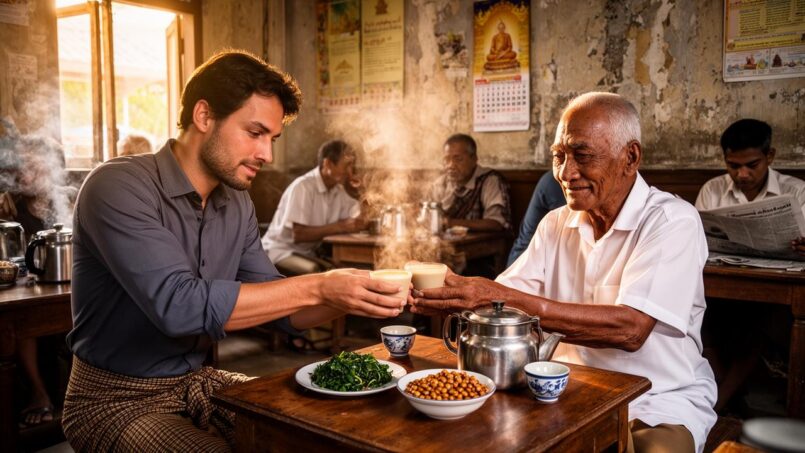
Abruptly refusing an offer of tea, coffee, or snacks is considered rude. To show your respect and appreciate the hospitality, it is advisable to always accept, even if you are not thirsty, and to drink at least a few sips.
Eating together: table rules and hierarchy
Sharing a meal, at a restaurant or someone’s home, is a privileged moment for building bonds. Traditional meals are often around a low table (daunglan), with all dishes placed in the center to be shared. The oldest or most senior person starts eating first. Even in the absence of elders, the first portion of rice is frequently set aside as a symbolic offering to parents (u cha).
Finishing your plate, avoiding waste, eating calmly without excessive noise, not blowing your nose at the table, politely asking before taking the last shared piece: these are all marks of respect. Drinks and desserts do not necessarily follow the Western starter-main-dessert pattern; soup may be drunk throughout the meal, and the end is sometimes marked by a piece of palm sugar or fermented tea leaves (laphet).
How you eat varies: right hand (after washing) to form a small ball of rice, spoon and fork, chopsticks for noodles. The left hand remains in principle reserved for “unclean” tasks.
Dressing, removing shoes, and behaving in sacred places
Myanmar is a conservative society when it comes to appearance. Modest dress is a form of respect, not only in religious places but also in the office and on the street.
The emblematic garment is the longyi, worn by both men and women. For men it is called paso; for women, htamein. For an expatriate, adopting the longyi on certain occasions—festivals, ceremonies, official meetings—is often perceived very positively, as a sign of integration. In the city, sober Western clothes are nonetheless common.
The main codes remain:
In places of worship (pagodas, monasteries, churches), it is imperative to cover shoulders and knees. Avoid tight, sheer, or very short clothing. In professional settings, favor sober colors. Ensure your clothes are always clean, without holes or fraying.
Removing shoes is a key moment of daily life. You systematically take off shoes and often socks before entering a house, monastery, temple, pagoda, and even some offices or shops, especially in rural areas. Trying to negotiate this rule for comfort reasons is deeply offensive. Many travelers and expats therefore move around in easy-to-remove sandals and carry a small bag for them.
In pagodas, in addition to the dress code, it is important to observe certain rules: walk clockwise around stupas, avoid turning your back to a Buddha image when taking photos, speak softly, and do not climb on statues. Sit cross-legged or with your feet folded to the side, making sure they are never pointing toward the statues.
Interactions with monks follow strict protocols. Give up your seat for them on public transport, do not sit above them, place offerings in front of them rather than in their hands, and women must avoid all physical contact.
Beyond formal respect, Myanmar remains structured by a powerful patriarchy. The concept of phon (or hpon) nurtures the idea that men possess a capital of power, glory, and sanctity that women do not. This view justifies a traditional division of roles: for men, the outside, decisions, representation; for women, the inside, care of the home, discretion. Popular sayings claim that “the husband is god and the son is master.”
In religious and political structures, a gender hierarchy is established: monks are highly valued while nuns are much less so. Political power is often equated with spiritual merit accumulated by men, making women’s access to leadership roles difficult. Those who do achieve them face persistent stereotypes.
Transgender and homosexual individuals suffer a double stigma. Research on “apwint“—men who adopt a feminine appearance and behavior—shows how exposed they are to family shame, police violence, and social marginalization. Their existence challenges the gender norms and ah‑nar‑deh that regulate family order; fathers, in particular, fear losing face due to neighborhood scrutiny. Many “opens” leave their families and recreate chosen kinship networks around beauty salons, mixing aesthetic work, spiritual mediumship, and sometimes sex work. These alternative “families” reproduce hierarchies, but through transposed forms of respect (transgender anade, symbolic “mother-daughter” relationships).
For an expatriate, it is crucial to adopt a cautious approach. Public displays of affection between heterosexual partners are generally poorly received, while holding hands with a same-sex friend is a common, friendly gesture without romantic connotation. It is also advisable to avoid jokes about gender or direct challenges to social norms, as this could make your interlocutors uncomfortable or even expose them to risks in their family environment.
Ethnicity, religion, and the challenge of trust
The image of a homogeneous Myanmar is misleading. The country is home to many minorities—Shan, Karen, Mon, Rakhine, Chin, Kachin, Kayah, and many others—with their own languages, customs, and governance systems. The Bamar majority (often called Burmese) occupies a dominant position, reinforced by decades of state policy centered on its culture and Buddhism.
That’s the number of officially recognized ethnic groups, or ‘taingyinthar’, in Myanmar, who enjoy more secure citizenship than other communities.
In this context, the notion of trust takes on a political dimension. Studies on building trust in Myanmar show how mistrust between citizens and institutions—fueled by the history of military rule—hinders the emergence of a more inclusive society. “Social cohesion” strengthening initiatives, led by organizations like Search for Common Ground or Oxfam, work to create spaces for dialogue between actors of different ethnicities and religions. Specific trainings have enabled hundreds of participants from the civil service, ethnic armed groups, and civil society to work on their prejudices, identity, and conflict resolution tools. Evaluations report a marked increase in mutual trust and the concrete application of these skills in the field.
For an expatriate in Myanmar, it is advisable to be cautious on certain topics. Avoid provoking discussions about politics or ethnic tensions, as this could put your interlocutors at risk. The recommended attitude is to let these themes come up naturally, without initiating them, and to refrain from any pronouncements on what the country “should” be. On the other hand, showing respect for diversity, whether in your hiring, professional relationships, or language, sends an extremely positive signal.
Anchoring your professional practice in these realities
Once these major principles are internalized, how do you translate them into daily life when you settle and work in Myanmar?
A first step is to adjust your own behavior: lower your tone, literally and figuratively; cultivate patience; give up public confrontations; learn a few Burmese words (including the very useful “mingalaba” and “cezu tin ba de” for thank you). Wearing a longyi on occasion, always accepting tea, removing your shoes without waiting to be asked, and avoiding abrupt gestures add a layer of visible respect.
To establish more participatory management, first clarify your authority while gradually encouraging expression. Give precise instructions, invite questions, publicly praise suggestions for improvement, correct in private, and avoid criticism in front of peers. These levers make it possible to reconcile a modern style with the local culture.
Finally, understand the central place of trust. International surveys show that a significant portion of expatriate assignments fail for cultural reasons rather than technical ones. In Myanmar, how quickly you “find your place,” the quality of relationships you build outside work (visits, meals, participation in local festivals, sincere curiosity about religion and traditions) often conditions the success of a project more than pure technical expertise.
Successful expatriation: combining respect and lucidity
Moving to Myanmar is neither naively marveling at an “exotic” culture nor judging it solely by the yardstick of one’s own values. It is accepting to enter a society where restraint, hierarchy, and modesty dominate, where open conflict is feared, where face and reputation matter more than raw transparency.
Despite a social framework sometimes perceived as rigid, Burmese society shows genuine hospitality, daily generosity, and a strong capacity for solidarity, especially visible in mutual aid networks during conflicts or disasters. Signs of evolution, such as social cohesion trainings, apologies from young Bamar activists to minorities, and interfaith dialogues, show a society aware of its challenges and in search of new balances.
For a foreigner, the challenge is to fit into this movement without exploiting it. Respecting the unwritten rules—from how to sit to how to say no—does not prevent you from bringing your own contribution, whether professional, civic, or human. On the contrary, it is by mastering these cultural differences that you gain the freedom to act, to dare, and ultimately to find your place in Myanmar.
Disclaimer: The information provided on this website is for informational purposes only and does not constitute financial, legal, or professional advice. We encourage you to consult qualified experts before making any investment, real estate, or expatriation decisions. Although we strive to maintain up-to-date and accurate information, we do not guarantee the completeness, accuracy, or timeliness of the proposed content. As investment and expatriation involve risks, we disclaim any liability for potential losses or damages arising from the use of this site. Your use of this site confirms your acceptance of these terms and your understanding of the associated risks.

Cyril Jarnias is an independent expert in international wealth management with over 20 years of experience. As an expatriate himself, he is dedicated to helping individuals and business leaders build, protect, and pass on their wealth with complete peace of mind.
On his website, cyriljarnias.com, he shares his expertise on international real estate, offshore company formation, and expatriation.
Thanks to his expertise, he offers sound advice to optimize his clients' wealth management. Cyril Jarnias is also recognized for his appearances in many prestigious media outlets such as BFM Business, les Français de l’étranger, Le Figaro, Les Echos, and Mieux vivre votre argent, where he shares his knowledge and know-how in wealth management.





