
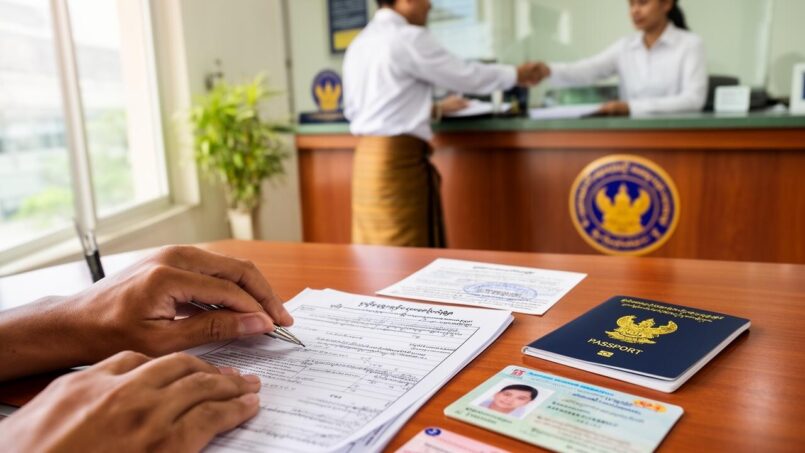
 Published on and written by Cyril Jarnias
Obtaining a passport in Myanmar has become a highly regulated, largely digitized process, and sometimes confusing for applicants who haven’t kept up with the latest reforms. Between the online appointment system, complex document requirements, and special provisions like the “Green Channel” or “Home Service,” it’s easy to get lost.
Good to know:
This guide details the steps to obtain or renew a Myanmar passport, based on official information. It helps you plan ahead, avoid mistakes, and choose the right process for your situation.
Understanding the Myanmar passport issuance system
In Myanmar, passport issuance falls under the Ministry of Home Affairs, through the Myanmar Passport Issuance Committee. Since 2023, the backbone of the system has been an online portal: all “standard” applications must go through a digital appointment booking before an in-person visit to the passport office.
Attention:
The administration has gradually expanded this system to major cities to streamline the flow and reduce waiting lines. At the same time, specific channels remain for emergencies, medical cases, and certain professions.
Key offices and stakeholders
The basic structure consists of a central office and a network of regional branches. The main center is in Yangon, but most regions now have an issuance office.
| Element | Detail |
|---|---|
| Responsible authority | Myanmar Passport Issuance Committee (Ministry of Home Affairs) |
| Official portal | www.passport.gov.mm |
| Main office | Corner of Saya San Road / Industrial (1) Road, Bahan Township, Yangon |
| Contact email (Yangon) | [email protected] |
| Phone (Yangon) | 01 546624 |
| Green Channel contact | 067 3411580 / 098 821 56633 |
Issuance offices are located in Yangon, Mandalay, Naypyidaw, Bago, Pathein, Myitkyina, Hpa‑an, Hakha, Monywa, Dawei, Magway, Mawlamyine, Sittwe, Taunggyi, Lashio, and Kengtung. The online appointment system started in Yangon and was gradually rolled out to these other cities.
The www.passport.gov.mm portal: the heart of the system
For a citizen residing in Myanmar who wishes to obtain or renew an ordinary passport, the general rule is simple: no online appointment, no application processing. The site www.passport.gov.mm is therefore the mandatory entry point.
Creating and validating the appointment
The standard procedure takes place in several steps, all of which must be strictly followed, or you may have to start over.
– 1. Access the site and choose the submission method
The applicant goes to www.passport.gov.mm. Two main options are presented on the homepage:
– a button for the standard “Online Appointment”;
– a “Green Channel” button reserved for applications supported by a ministry for urgent cases (health, education, official missions, etc.).
Example:
When applying for a visa for Myanmar, the user must first select the issuing office (for example, Yangon or Mandalay). Then they must specify the number of applicants, as the system allows group applications, especially for families. It is important to note that the information for each group member must be entered individually in the form.
3. Entering personal data
The interface presents several pages to complete, including a “Biographic Data (1)” section covering basic information (identity, date and place of birth, citizenship card number, etc.) and a “Biographic Data (2)” section including more detailed information, including family and sibling details.
If filling out this information online proves too complicated, the administration allows some family details to be completed by hand on the paper form provided at the office. However, essential identity data must be accurate and consistent between the portal and the documents presented.
4. Adding multiple people
For a family application, after filling in the first person’s details, the applicant clicks “Add to List” before moving on to the next person. This step must be repeated until all members are registered.
Tip:
After entering all profiles, use the ‘Review and Submit’ button to check all the information. Review each individual entry. If an error is found, use the ‘Edit’ button to correct it. The final submission of the form via ‘Submit Form’ is only possible after checking the validation box, which certifies the accuracy of the data.
– 6. Obtaining the appointment letter
After submission and payment (see below), the system generates an Appointment Letter containing a QR code and the full appointment details (date, time, location). This letter can be:
– saved as a photo on a phone;
– printed;
– or retrieved via the email provided during registration.
This letter is the key to entry at the passport office. Without it, access is generally denied.
Strict rules on date and identity
The system leaves no room for maneuver regarding appointment management. Two major constraints apply to everyone:
Attention:
The applicant must appear exactly on the date and time indicated. It is not possible to come early or late. If you miss your appointment, the booking process must generally be started from scratch.
– Perfect data match
The information entered on the portal (name, date of birth, citizenship card number, etc.) must match the person who physically appears at the counter. The administration has warned that no use of a third party’s QR code or NRC data will be tolerated.
An online tracking system also allows you to check the status of your application using the application number, NRC card number, or date of birth. If the application number is lost, the file can be retrieved using a combination of name, father’s name, and date of birth.
Required documents for a passport application
The list of required documents varies depending on the applicant’s profile (student, seafarer, monk, company employee, etc.). However, some basic documents are always required.
Common supporting documents
Every passport applicant in Myanmar must prepare originals and copies of their main civil status documents in advance.
| Document | Standard requirement |
|---|---|
| National Registration Card (NRC) / Citizenship Card | Original + 2 photocopies |
| Household List | Original + 2 photocopies |
| Birth certificate (child) | Original + 2 copies (generally for children under 10 to 12 years old, depending on the source) |
| Smart Card with UID number | Original + 2 copies (if applicable) |
| Old passport (renewal) | Original booklet + 2 copies of the photo page |
In addition, you will need a duly completed application form, a personal history sheet (personal history), and in some cases, a signature specimen to be reproduced consistently on all documents.
Specific requirements by profile
In many cases, providing the usual identity documents is not enough. The administration requires additional documents depending on the purpose of travel or profession.
Students and candidates going abroad for studies
People going abroad to study must prove acceptance by an institution:
– Invitation or admission letter from the school or university (original + copies);
– Copy of student ID (if applicable);
– For some cases, copy of I-20 or equivalent document.
These documents are considered for both the standard application and a possible Green Channel route if there are time constraints.
Overseas workers and PJ/PE passports
Applicants for employment abroad must provide:
500 or 1000
The fee in kyats for obtaining a Labour Card, required for the PJ (work) passport type in Myanmar.
For PE (education) passports, an original and copy of the invitation letter from the educational institution is also required.
Seafarers and PS passports
Seafarers are subject to very specific conditions:
– Basic Sea Survival Safety Training certificate, original + 2 copies;
– For a renewal: passport booklet and Seaman’s Continuous Discharge Certificate (CDC), each with copies.
For a PS (seafarer) passport, these documents are mandatory.
Monks, nuns and religious figures
Members of the Buddhist clergy or religious orders must provide:
– Religious Membership Card, original + 2 copies;
– Recommendation letter from the Township Sangha Nayaka Committee, original + at least 1 copy.
These documents attest to both their status and the approval of local religious authorities.
Company employees and business people
Applicants with a professional reason linked to a company must attach:
– Company Registration certificate, original + copy(ies);
– Official company form (Form 6/26 or 26/26 as applicable), original + copy.
These documents confirm the legal existence of the employer.
Civil servants, military personnel and their families
For public officials, a document from the ministry authorizing travel or specifying the right to travel abroad is required. Families of military personnel must produce an official recommendation from the military hierarchy (KA).
Criminal cases and prison releases
Individuals with a criminal record may need to present: supporting documents regarding their reintegration, proof of financial stability, psychological follow-up and professional references.
– Prison release certificate (original + copy).
Good to know:
This document is required by the administration to check the absence of any travel ban or other judicial measures that could prevent the issuance of a passport.
Special cases: children and dual nationals
Myanmar closely regulates passport applications for children born to one Burmese parent and one foreign parent. For a child in this situation, the application must be submitted within one year of birth and include:
– the application form filled out in the child’s name;
– copy of the parents’ marriage certificate;
– child’s birth certificate;
– a written declaration stating that the child has not acquired another citizenship;
– letters of consent signed by each parent approving the issuance of a Burmese passport.
For minors in general, the standard documents (birth certificate, parents’ documents) must also be provided. For very young children, the authority accepts that the eyes may not be perfectly open in photos, but still requires a clearly visible face and a compliant background.
Passport photos: a formality not to be overlooked
A large number of rejections and delays are due to non-compliant photos. Burmese requirements are close to international standards, with a few technical specifications.
Technical specifications
Photos must meet several cumulative criteria.
| Criteria | Requirement |
|---|---|
| Number | Generally 2 identical color photos |
| Paper size | 35 x 45 mm or 2 inches x 2 inches depending on the instructions used |
| Background | Strictly white or off-white, no patterns or shadows |
| Date taken | Less than 6 months before submission |
| Face proportion | Approximately 70-80% of the photo height; face well-centered |
| Quality | Sharp image, not blurry, no pixels or blemishes |
| Expression | Neutral, mouth closed, looking straight at the camera |
| Undesirable effects | No red or white eyes, no reflections or blown-out areas |
In some cases, the administration also requires a digital version (on CD) meeting specific pixel dimensions (e.g., 826 x 1062 or 800 x 1200) and a limited file size (often under 300 kB), in JPEG, PNG, GIF, BMP, or PDF format.
Clothing, accessories, and retouching
Clothing must be ordinary, no uniform or official attire. Ideally, wear a color that contrasts with the white background so the silhouette stands out clearly.
The following rules apply:
– no headwear, except for religious or medical reasons clearly justified by a signed certificate or attestation;
– the face must remain fully visible, without shadowed areas;
– glasses are generally not allowed, except for proven medical necessity, with no reflections or areas obscuring the eyes;
– no earbuds, headphones, or electronic devices in the photo;
– jewelry is tolerated as long as it does not obstruct the face.
Digital retouching is strictly regulated: beauty filters, feature corrections, or skin color modifications may lead to photo rejection. Only minor brightness or contrast adjustments are accepted.
Fees and payment methods: what to expect
Applying for a passport in Myanmar involves several types of fees: those for the booklet itself, for loss or damage, and for certain ancillary services.
Official fee schedule for an ordinary passport
Within Myanmar, the main amounts are as follows:
| Type of application | Official amount |
|---|---|
| New passport or standard renewal | 45,000 kyats |
| Replacement for lost or damaged passport | 101,000 kyats |
| Passport booklet issuance fee upon collection | 3,000 kyats |
Additional peripheral costs may apply, for example for photos, forms, or certain services, often totaling around 25,000 kyats (photos, printing, service fees).
Attention:
If the old passport is deemed damaged (torn pages, water damage, etc.), the fee automatically applies is 101,000 kyats. An online payment of only 45,000 kyats for such a document will result in a request for an additional 56,000 kyats on-site and a risk of the application being blocked.
Online payment via KBZ Pay and MPU cards
The portal www.passport.gov.mm includes an electronic payment module. Two methods are accepted:
– KBZ Pay (widely used e-wallet);
– MPU bank cards from all Burmese banks, provided they have been previously activated for online commerce (e-commerce) with the issuing bank.
The process involves:
1. selecting the individual invoice number for each applicant;
2. choosing the payment method (KBZ Pay or MPU);
3. finalizing the transaction.
Good to know:
Successful payment is confirmed by email, along with the appointment details. The references provided (invoice number, transaction ID) should then be used to check the application status on the dedicated portal.
Payments at the passport office
Some services are not covered by online payment and must be paid in cash directly at the passport office. These include, for example: some services are not covered by online payment.
– the taxed fee for certain renewals or recommendations;
– the additional penalty for a damaged passport that was not correctly declared;
– the 3,000 kyats due upon collection of the booklet.
The Burmese administration prefers cash payment in these cases, so you should come to the office with the exact amount.
The visit to the passport office: step by step
Once the appointment is confirmed and documents are ready, the physical phase at the issuing office follows a well-established protocol with multiple stations.
Entry checks
Upon arrival, three successive checkpoints filter entry:
1. verification of the appointment letter (paper or phone);
2. scanning the QR code generated by the system;
3. security check (body check).
This screening ensures that only people who actually have an appointment access the counters.
Counters and biometric data registration
Inside, applicants queue in separate lines depending on the nature of their application:
– a specific counter (e.g., counter 1) for renewals;
– several counters (often numbered 2 to 6) for first-time applications.
The officer checks the documents, enters or confirms certain information, and takes an initial fingerprint (usually the left thumb). Then, the applicant is directed to the photo area where the following are done:
– official photo capture;
– full fingerprint capture (both thumbs together, then other fingers in groups);
– electronic signature on a tablet.
Good to know:
After submitting your application, you will receive a collection slip. This document indicates the exact date from which your new passport will be available for pickup.
Processing time and collection
The standard processing time announced is approximately 10 days. If the 10th day falls on a public holiday, collection is on the next working day.
To pick up the passport, the applicant must present:
– the original collection slip (with the applicant’s name, signature, NRC number, and phone number written on the back);
– original NRC card.
The collection procedure often takes place via a side entrance of the building, with a roll call. The applicant then pays the 3,000 kyats issuance fee and receives the booklet.
The Green Channel: a regulated fast track
For cases where time is critical, the Burmese administration has established an accelerated procedure called the Green Channel. It is not for everyone and follows a more administrative than digital process.
Who is eligible for the Green Channel?
This channel is reserved for cases involving urgency or priority interest as determined by the authorities, including:
– medical emergency (treatment abroad);
– imminent departure for studies;
– migrant workers leaving under bilateral agreements (MoUs);
– members of religious organizations traveling;
– cultural or official exchange missions;
– seafarers, travel agents involved in tourism development;
– civil servants or officials on government missions.
5
Announced processing time for a passport through this channel after application submission.
A procedure led by ministries
Unlike the standard procedure, the Green Channel is not initiated directly by the citizen on the portal. It requires the involvement of a supervising ministry:
Example:
To initiate a passport application in Myanmar, the competent ministry (health, education, labor, religious affairs, etc.) must compile a file and write an official letter addressed to the Chairman of the Myanmar Passport Issuing Committee. This letter must be signed by a Director General or an equivalent-level authority within the ministry. The entire file is then sent, usually by postal mail, to the address of the Chairman of the Passport Committee.
Individual applicants may also send a file by mail to the same address, but always within the framework of explicit ministerial support.
Once the file is accepted under the Green Channel, it is no longer the online portal that assigns the appointment date: the passport office itself sets and notifies the date to the applicant.
Contact and timelines
Applicants or administrations seeking information about the Green Channel can contact the Passport Committee at the following numbers:
– 067 3411580
– 098 821 56633
The five-day processing of eligible files makes this channel a significant advantage for sensitive cases, but access remains strictly controlled by the ministries.
Home Service: when the office comes to the applicant
Recognizing that some people cannot travel, the passport services have set up a targeted Home Service. This program covers:
– people over 60 years old;
– hospitalized patients or those undergoing heavy treatment;
– people physically unable to go to the office for health reasons.
Good to know:
In some situations, officers travel to collect biometric data and necessary documents. Beneficiaries must meet the same document requirements, but avoid traveling. This service is generally activated upon recommendation or after preliminary steps with administrative services.
Lost, stolen, or damaged passport: what to do
Losing your passport or seriously damaging it complicates the process and increases costs. The administration clearly distinguishes between a standard renewal and a replacement for loss or damage.
In Myanmar: declaration and penalty
For a lost passport within Myanmar, the procedure involves several steps:
1. Loss declaration
The holder must file a complaint or report with the police station closest to the incident and obtain a copy of that report.
Attention:
You may be required to publish a notice in an official state newspaper stating the name, father’s name, NRC number, and lost passport number. A waiting period, for example six months, may then be imposed before a new application can be submitted.
– 3. Assembling the file
When submitting at the passport office, the applicant must provide:
– copy of the old passport (if available);
– original police report;
– application and personal history forms (multiple copies);
– possible personal guarantee letter.
4. Payment of increased fees
Replacement of a lost or severely damaged passport costs 101,000 kyats (or, in some specific arrangements, 65,000 kyats combining penalty and booklet cost). These amounts are significantly higher than a simple renewal.
Abroad: the role of embassies
For losses abroad, the procedures go through embassies and consulates of Myanmar:
Procedure for replacing a lost passport abroad
Steps to follow to obtain a duplicate passport when the loss occurs outside the national territory.
Loss declaration
File a loss report with local police authorities to obtain an official report.
Submission to the consulate
Present the police report obtained to the competent Myanmar consulate or embassy.
File assembly
Submit the complete file including required forms, copies of identity documents, and photographs.
Fees and payment
Pay the penalty and the cost of the new booklet. Payment can be made in foreign currency (USD or local currency) according to the consular post’s fee schedule.
In some cases, when the loss occurs during a stay abroad but the holder needs to return to Myanmar, they may be required to surrender their citizenship card (CI) upon arrival at the border, then regularize their situation (pay the loss penalty abroad) before reapplying for a passport.
Distinguishing between a passport and an e-Visa: two separate systems
A common point of confusion for travelers is the distinction between a passport and a Myanmar e-Visa. Both systems use online platforms, but they serve different purposes.
– A passport is an identity and travel document issued to Burmese citizens to travel abroad. Everything related to application, renewal, and replacement (loss, damage) is handled via www.passport.gov.mm and the issuing offices.
Tip:
The e-Visa is an electronic visa system managed by the Ministry of Immigration and Population of Myanmar. It allows entry into the country after submitting an online application on a dedicated government website. Once approved, the application generates an approval letter to present upon arrival, generally valid for a single entry within three months of issuance.
The two systems are therefore complementary: a Burmese citizen needs a passport to leave the country; a foreigner needs a visa or e-Visa to enter.
Practical tips to maximize your chances
Given the complexity of the system, a few good practices are essential to successfully complete your passport application.
Plan appointments in advance
Available slots on the portal can be saturated, especially in large cities like Yangon or Mandalay. Authorities recommend that people with non-urgent travel book a slot three months in advance. This leaves time to adjust documents and react in case of problems.
Double-check all data carefully
Civil status information must be consistent everywhere:
– spelling of the name in English;
– date of birth;
– NRC number;
– place of birth.
Attention:
Any discrepancy between the NRC card, Household List, old passport, and online forms can cause delays or even rejection of the application. It is imperative to re-read each field before clicking “Review and Submit” and to check the box confirming the accuracy of the data.
Bring plenty of copies
To avoid back-and-forth trips, it is wise to come to the office with: a laptop, necessary documents, a charger, and any other required work materials.
– more than two copies of key documents (NRC, Household List, birth certificate, old passport);
– at least two compliant photos, and if possible, an up-to-date digital file.
This allows you to handle any additional requests from an officer.
Use the right channels for specific cases
Urgent situations (medical emergency, imminent departure for studies, official mission) are more likely to be processed quickly if they use the appropriate channel from the start, in coordination with the competent ministry. Trying to force the standard procedure at the last minute often leads to setbacks.
For the elderly or sick, inquiring about the Home Service from the passport office or local administration can prevent exhausting trips.
Conclusion: a demanding but predictable system
The current Myanmar passport issuance system is based on a central principle: everything starts online, everything ends at the counter. The portal www.passport.gov.mm handles appointment booking, data entry, and payment. The offices spread across major cities handle final checks, biometric capture, and booklet issuance.
While the whole process may seem rigid, it becomes relatively predictable once you:
Tip:
For a successful application, it is crucial to strictly follow the established procedure: book an appointment, make the payment, and present the appointment letter with its QR code. You must also prepare all documents specific to your situation (student, seafarer, religious, civil servant, child, etc.). It is recommended to anticipate processing times and avoid peak periods. Finally, special programs like the Green Channel or Home Service should only be used if you meet all the required conditions.
By taking the time to familiarize yourself with these rules and assembling a complete file before even clicking “Submit,” you can obtain your Myanmar passport without unpleasant surprises, whether for a first trip abroad, studies, a work contract, or simply renewing an expired booklet.

Cyril Jarnias is an independent expert in international wealth management with over 20 years of experience. As an expatriate himself, he is dedicated to helping individuals and business leaders build, protect, and pass on their wealth with complete peace of mind.
On his website, cyriljarnias.com, he shares his expertise on international real estate, offshore company formation, and expatriation.
Thanks to his expertise, he offers sound advice to optimize his clients' wealth management. Cyril Jarnias is also recognized for his appearances in many prestigious media outlets such as BFM Business, les Français de l’étranger, Le Figaro, Les Echos, and Mieux vivre votre argent, where he shares his knowledge and know-how in wealth management.





