
 Published on and written by Cyril Jarnias
Settling in Myanmar with your dog or cat is not just about buying an IATA crate and booking a flight to Yangon. Between sometimes contradictory health requirements, an increasingly extreme tropical climate, unclear quarantine rules, and the post-coup reality on the ground, a poorly prepared project can quickly turn into a nightmare… for you and your pet.
This article details the necessary administrative procedures, pitfalls to avoid, transport constraints, and living conditions on the ground in Yangon, based on both official rules and real-world practice.
Understanding the general framework: Who regulates what for animals in Myanmar?
Before talking about vaccines or plane tickets, you need to know who sets the rules. In Myanmar, several levels of authorities are involved in the importation of pets.
The Livestock Breeding and Veterinary Department (LBVD), under the ministry in charge of livestock and animal development, plays a central role. It enforces the main national laws on animal health (laws of 1993 and 2020 in particular) and specific regulations on import and export of animals and animal products, regularly amended.
The LBVD:
The Department of Livestock and Veterinary Services performs several key missions for animal health at the country’s entry points.
Defines and controls the health conditions required for the entry of animals into the territory.
Issues recommendations and official veterinary certificates required for animal exports.
Inspects imported animals upon arrival, primarily at Yangon International Airport.
Coordinates the implementation of prevention and control measures for contagious animal diseases.
The Ministry of Commerce intervenes to grant the import license when animals are treated as goods (livestock, exotic species, etc.). For standard pets (dogs, cats) entering with their owner, the status is more ambiguous, which explains some of the contradictions between sources.
For protected species, Myanmar also applies the CITES Convention (Convention on International Trade in Endangered Species of Wild Fauna and Flora), ratified by more than 180 countries. A parrot, turtle, or reptile can therefore be stopped at the border without the proper CITES permits, even if it has been your pet for years.
Dogs, cats, and other animals: Who is allowed to enter Myanmar?
Myanmar’s rules do not treat all animals the same way. Even before opening the vaccination record, you need to check if your companion is eligible for import.
Dogs and cats: The most common case, but not without restrictions
Domestic dogs and cats are the most frequently imported animals, whether pets or service dogs. For them, Myanmar applies a relatively standard set of rules, but with breed restrictions that should not be ignored.
Certain dog breeds are banned from entry into the territory, including their crosses:
– Pit Bull (and Pit Bull types),
– American Staffordshire Terrier,
– American Staffordshire Bull Terrier.
Wolf hybrids are banned from import. Savannah or Bengal cats are only accepted from the 5th generation (F5 or higher) relative to their wild ancestor, and this lineage must be proven by an official pedigree.
Service dogs or guide dogs are subject to the same health criteria, even though they sometimes benefit from travel accommodations with airlines.
Other species: Rabbits, birds, reptiles, exotic pets
As soon as you move beyond the classic dog–cat duo, the framework becomes stricter:
The importation of non-conventional pets such as rabbits, ferrets, birds, reptiles, amphibians, tropical fish, and rodents is strictly regulated. It absolutely requires two documents: an import permit, to be obtained from the competent ministry or the LBVD, and a species-specific health certificate. These formalities are mandatory for all Exotic Pets (NAC).
– If the species is listed in a CITES appendix, you must also obtain CITES export and import permits, otherwise the animal may be confiscated and penalties applied.
For these species, Myanmar authorities review cases individually, via a permit application. Delays can be long and requirements are hard to decipher without professional help.
Summary table of allowed or restricted animals
| Type of Animal | Entry Status in Myanmar | Main Special Conditions |
|---|---|---|
| Dog (non-banned breeds) | Allowed | Microchip, vaccines, health certificate, airport inspection |
| Cat (excluding too-close hybrids) | Allowed | Microchip, vaccines, health certificate, airport inspection |
| Pit Bull & types, Amstaff, Amstaff Bull | Banned | Entry refused even if vaccinated and identified |
| Wolf hybrids | Banned | |
| Savannah / Bengal F1–F4 | Banned | |
| Savannah / Bengal F5+ | Allowed with conditions | Proof of generation, same regime as other cats |
| Rabbits, ferrets, exotic pets, birds, reptiles | Allowed with conditions | Import permit, health certificate, possibly CITES |
| CITES-listed species | Heavily controlled, sometimes banned | CITES permits + national import permit |
The “pet passport” for Myanmar: A file, not a booklet
When specialists talk about the Burmese “pet passport”, it is not an official blue passport like in Europe, but a set of collected documents meeting the country’s requirements.
This “passport” for Myanmar generally includes:
To legally import a pet into Myanmar, several documents are mandatory. These include proof of identification of the animal (usually an electronic microchip), up-to-date vaccination certificates (especially against rabies), and an international veterinary health certificate specific to Myanmar. Depending on the animal species, an import permit may also be required. Proof of recent antiparasitic treatments must be provided if these treatments were carried out. Finally, for animals from certain countries, specific forms endorsed by the national health authority of the country of origin (such as USDA for the United States or SENASA for Argentina) are necessary.
This file must be complete before boarding in the departure country, because no one in Yangon will help you catch up on a missing certificate once the animal is in the hold.
Step 1: Microchip identification – the foundation of the entire file
Myanmar requires that dogs and cats be formally identified before entering the territory, according to the practices of the country of origin. The most accepted and practical form is the 15-digit electronic microchip.
To be compliant, the microchip must:
– comply with ISO 11784 or Annex A of ISO 11785,
– be readable by standard veterinary service readers.
All documents (health certificate, vaccination records, import forms) must mention the exact microchip number.
If your animal is already identified with a non-ISO compliant microchip (such as some older American models), two solutions are available to regularize its situation.
– have a second ISO chip implanted, clearly indicating both numbers on the documents,
– or travel with a compatible reader and be able to present it to authorities upon arrival.
In any case, the chip must be implanted by a veterinarian, clinic, or trained professional, and you must have proof of registration (national database or manufacturer).
Step 2: Mandatory vaccines, focus on rabies
Rabies vaccination is the cornerstone of Myanmar’s health requirements for dogs and cats. Since Myanmar is not considered a rabies-free country, authorities are attentive to the validity of this vaccination.
Rabies vaccine: Timing and validity
Key points:
– The dog or cat must be at least 3 months old at the time of the first rabies vaccination.
– The vaccine must be administered at least 21 to 30 days before entry into Myanmar (texts vary; better to aim for 30 days to avoid any debate).
– The vaccination must be currently valid at the time of travel:
– often less than 12 months for a 1-year vaccine,
– within the validity period for a 3-year vaccine if that is used.
Rabies must be administered at least 30 days before arrival.
Proof can take several forms, all signed and stamped by the veterinarian:
– a dedicated rabies vaccination certificate,
– a national vaccination record,
– a European pet passport (if coming from the EU).
Animals from countries officially declared rabies-free by the World Organisation for Animal Health (WOAH) may, in some texts, be exempt from vaccination. In practice, many veterinarians and airlines still prefer to require a rabies vaccine, especially for transits.
Other recommended or required vaccines
For dogs, Myanmar requires or strongly recommends “combination” vaccines covering:
– distemper,
– adenovirus type 2 and hepatitis,
– parvovirus,
– parainfluenza,
– leptospirosis (often two serovars).
For cats, protection is expected against:
– panleukopenia,
– rhinotracheitis (feline viral rhinotracheitis),
– calicivirus.
These additional vaccinations must be recent (less than 12 months) and recorded on the international health certificate. In a tropical country where infectious diseases are common, traveling with an under-vaccinated animal is a major risk.
Is rabies serological titration required?
Unlike other destinations, Myanmar does not require a rabies serological test (antibody titration) regardless of the animal’s origin. However, note that this titration cannot replace proof of vaccination. A laboratory result or veterinary “exemption” is not sufficient without a compliant vaccination certificate.
Step 3: Antiparasitic treatments – strongly recommended
Official texts speak of recommendation, not formal obligation, but in a tropical context with rapid climate change, not treating your animal against internal and external parasites is a very bad idea.
Veterinarians generally advise:
To protect your dog, three types of treatments are recommended: a broad-spectrum internal dewormer against nematodes and cestodes, a long-lasting treatment against fleas and ticks, and a preventive product against sandflies and mosquitoes, especially important in areas at risk for leishmaniasis or heartworm disease.
These treatments can be recorded:
– either on the international health certificate,
– or on a separate treatment document.
Before any long trip, especially with heat and humidity, also have your animal checked to ensure it is free of visible parasites. Myanmar has ideal conditions for the proliferation of ticks, fleas, mosquitoes, and the infections they carry.
Step 4: International health certificate – the key document
Almost all countries, and Myanmar is no exception, require an original veterinary health certificate for each animal. This document “condenses” all the necessary information for import.
– It must include:
– a clear introduction,
– structured development,
– a relevant conclusion.
To establish a valid veterinary certificate for exporting a pet to Myanmar, ensure it contains the following information: full contact details of the owner; country of origin, destination country (Myanmar), and travel details; precise identification of the animal (species, breed, sex, age, color, microchip number); complete list of vaccinations with dates, batch numbers, and veterinarian signatures; mention of antiparasitic treatments if administered. Finally, the certificate must clearly attest that the animal is clinically healthy, shows no signs of contagious disease at the time of examination, and does not come from an area subject to rabies-related restrictions.
This certificate must be completed by a veterinarian authorized by the health authority of the departure country (USDA-accredited in the United States, official veterinarian via SENASA in Argentina, etc.) and must be:
– issued shortly before departure: sources mention a period of 7 to 10 days before entry into Myanmar,
– then endorsed/visaed by the official veterinary service of the country (USDA APHIS, SENASA, competent ministry, etc.), with original stamp and signature.
For some countries, an electronic system like VEHCS (United States) allows the veterinarian to send the certificate digitally to the authority for validation, but the final approved version must physically accompany the animal.
Step 5: Import permit or not for dogs and cats?
This is one of the most delicate points, as texts and testimonies are not always aligned.
Two scenarios coexist:
– according to several sources, dogs and cats traveling with their owner do not need a separate import permit;
– other documents, and some providers, state that an LBVD import permit is necessary, even for a standard pet.
In practice, many expatriates choose to secure their file by obtaining the permit anyway, often with the help of a specialized agency, to avoid any unpleasant surprise at customs in case of regulatory changes.
For other species (rabbits, birds, reptiles, etc.), the import permit is clearly mandatory. It generally requires:
– a detailed description of the animal (species, breed, sex, date of birth, color, microchip number),
– vaccination records,
– a copy of the owner’s passport,
– a photo of the animal,
– travel details (flights, dates, airports),
– full departure and arrival addresses in Myanmar.
Applications must be submitted several weeks before departure (at least 2 weeks according to some providers), to allow the LBVD time to process the file.
Step 6: Puppies, kittens, and young animals – a special case
Myanmar follows international recommendations: rabies vaccination is not given before 3 months. Therefore, puppies and kittens under 3 months cannot have a complete rabies vaccination before departure.
Several texts provide a possible entry:
Young animals can be imported without rabies vaccination under certain conditions: their mother must have been up-to-date on rabies vaccination at the time of birth, the exact age of the animal must be provable by the breeder or owner, and the export region must not have recorded any rabies cases in the 90 days preceding travel.
In reality, this scenario remains difficult to get accepted, especially when there are transits in very strict countries. With a long journey, most specialists recommend avoiding exporting animals that are too young and waiting until they can be vaccinated and properly immunized.
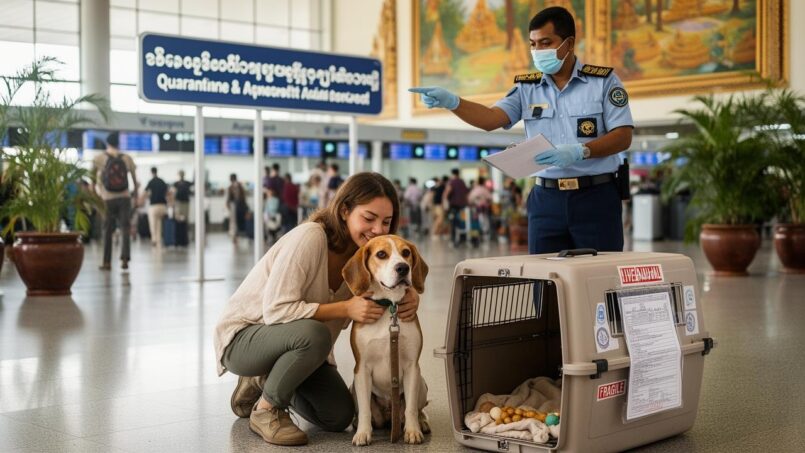
Arriving in Myanmar: Airport, checks, quarantine
All pets must arrive in Myanmar via Yangon International Airport. Entry by land or sea is not recognized as a normal import channel for private individuals.
Accepted transport modes
According to regulations:
– animals can enter as checked baggage (in the hold, accompanied by the owner),
– or as air freight (cargo), which is mandatory for some countries or airlines, and for oversized animals.
In all cases, the transport crate must be compliant with IATA standards (size, ventilation, strength, locking system).
On arrival:
The owner must be present for customs clearance. Veterinary services inspect the animal and its documents, checking for signs of disease transmissible to humans.
If the animal appears sick or if a document is missing, authorities may impose additional examinations at the owner’s expense.
Quarantine: Mandatory, conditional, or nonexistent?
Again, sources contradict each other:
– some texts indicate that dogs, cats, and domestic birds entering with all their paperwork in order are not subject to systematic quarantine;
– others mention a minimum quarantine of 30 days in approved facilities, even if everything is compliant.
Health authorities have the power to impose quarantine when they deem it necessary, according to the established substantive rule.
– a document is deemed non‑compliant,
– the animal’s origin raises questions,
– the animal shows suspicious symptoms.
If quarantine is imposed, it:
– takes place in approved facilities,
– can last at least 30 days,
– incurs costs to the owner (texts mention 10,000 kyats per dog or cat for certain inspection/quarantine services, excluding care).
In case of serious non‑compliance, the options mentioned in the texts are drastic: prolonged quarantine, re‑export to the country of origin or, as a last resort, euthanasia. Hence the importance of having an impeccable file.
Choosing your airline and mode of transport
Myanmar’s regulations set the framework upon arrival, but the journey depends as much on the airlines chosen as on the rules of the departure or transit country.
Main airline profiles and policy examples
Several major international airlines serve or connect to Yangon and accept pets to varying degrees.
– EVA Air
– Accepts dogs, cats, rabbits as checked baggage (hold), but no animals in cabin (except service dogs).
– Does not accept pregnant animals or those younger than 4 months.
– Limit: max. 2 crates per seated passenger, one animal per crate.
– Max. 5 crates per flight, with restrictions on certain aircraft (A321 prohibits animals in hold, strong restrictions on B787 long‑haul).
– Must notify the airline at least 48 hours before departure and complete a declaration for transport of live animals to present at check‑in.
– Myanmar National Airlines
– Does not accept any animals in cabin.
– Transports dogs, cats, and pet birds in hold as checked baggage with variable fees depending on routes.
– Requires direct coordination with the airline (local phone).
Myanmar Airways International (MAI) allows animals on certain flights, under specific conditions. For precise details (types of animals accepted, transport conditions, fees), it is essential to contact the airline directly by email or via its call center before your trip.
– Lufthansa, Air Canada, Alaska Airlines, Hawaiian Airlines, US airlines
– Policies vary greatly depending on flight type (domestic vs. international), animal size and breed.
– Many airlines apply restrictions for brachycephalic breeds (pug, bulldog, Persian cat, etc.) in the hold, or even ban them entirely.
– Many no longer allow animals in the cabin on long‑haul international flights, or limit it to very small animals under the seat.
– Fees can range from 100 to 150 USD or more per trip, sometimes per animal and per segment.
Some regional airlines, like Spirit or Frontier, completely exclude animals (except service dogs) from international flights.
Cabin, hold, or cargo: How to choose?
The options can be summarized as follows:
The cabin (PETC) is reserved for small dogs and cats that can stand, turn, and lie down comfortably in an approved crate placed under the seat. This option is more comfortable for the animal and reassuring for the owner. However, the number of animals accepted per flight is severely limited, and this transport is completely prohibited on certain international flight segments.
– Hold (checked baggage):
– Suitable for medium-sized animals or dogs that cannot travel in the cabin.
– Subject to temperature embargoes (heat in summer, extreme cold depending on stopovers).
– To be avoided for brachycephalic breeds, which are more vulnerable to heat and respiratory stress.
– Cargo (freight):
– Mandatory for large dogs or in countries that do not accept animals as baggage (the United Kingdom, for example, generally requires cargo).
– Heavier logistics but often better supervised (tracking, specific handling).
For a trip to Myanmar, it is crucial to:
– 1. First check the rules of the destination country (Myanmar: hold or cargo possible, no “cargo only” constraint like the UK). 2. Then check the rules of the transit country (for example, a transit in Europe may impose additional conditions, or even cargo). 3. Choose the airline accordingly, taking into account:
– the season (risk of refusal in case of heatwave),
– the breed (brachycephalic breeds heavily restricted),
– size and total weight (animal + crate).
Using specialists: When and why?
Given the complexity of the rules and their sometimes fluctuating application, many expatriates choose to use pet relocation companies accustomed to working with Myanmar.
Among the known players:
– DNS Pet Relocation Services-Myanmar (DNS Mobility Ltd)
– Based in Myanmar, offers door‑to‑door service.
– Handles import/export permits, customs clearance, air freight, and even road transport to/from Thailand.
– Highlights more than 10 years of experience and an international network, especially for corporate executives.
Air Animal Pet Movers transports animals to more than 165 countries worldwide.
– Air Transport Animal
– Offers “Eco”, “Easy”, “Easy+”, “Premium” or “EuroNational” packages adaptable to each project.
– Can arrange pet taxi, administrative formalities, escort at Yangon airport.
– Transcon Pet Movers, AirPets (India), Dawood Movers (Yangon)
– Offer international or regional services, with veterinary coordination, flight booking, crate cleaning, sending photos/videos during travel, etc.
If you are traveling with multiple animals, particular species, or from/to countries with strict regulations, these providers can make the difference between a smooth journey and weeks of administrative deadlock.
Living in Myanmar with an animal: Climate, health, and local realities
Arriving legally with a dog or cat is only the beginning of the story. Myanmar, a tropical country subject to strong climatic hazards, imposes a very concrete daily adaptation.
An increasingly extreme tropical climate
Myanmar has three main seasons:
– a “cool” season (actually hot for a European) from November to February,
– a very hot season from March to April, with heat peaks,
– followed by a rainy season, shorter than before but with more intense precipitation.
Observed and projected climate trends include:
– increase in annual temperatures, especially inland,
– rise in the number of extreme heat days, particularly from March to May,
– more frequent episodes of heatwaves, droughts, but also torrential rains, flash floods, landslides,
– cyclonic winds, flooding, storm surges on some coasts,
– deterioration of air quality during forest fire episodes.
For pets, this translates into:
The rise in temperature and humidity exposes animals to a high risk of heatstroke and dehydration. It also favors the proliferation of parasites (ticks, fleas, mosquitoes) and thus the transmission of vector-borne diseases. Other consequences include an increase in skin fungal infections and humidity-related irritations, as well as an increased respiratory risk when exposed to smoke.
Brachycephalic breeds (pug, bulldog, shih‑tzu, Persian…) are particularly vulnerable. Importing a Husky or a Northern Spitz under these conditions can be considered involuntary mistreatment: their bodies struggle to withstand these temperatures, their immune defenses suffer, and their life expectancy may be reduced.
Adapting the animal’s lifestyle to the Burmese climate
Once settled in Yangon or elsewhere, you need to rethink the daily routine:
– prefer walks during the coolest hours (early morning, late evening),
– avoid any intense exertion as soon as the thermometer rises,
– always have plenty of water points with clean, ideally cool water,
– organize a ventilated, cool living space, limiting direct sunlight:
– blackout curtains,
– cross ventilation,
– cooling mats, elevated beds,
– secure fans for animals, or even judicious air conditioning.
Diet can also be adapted:
– rations richer in water (wet food, compatible vegetables),
– splitting meals to ease digestion during periods of high heat,
– weight monitoring: an overweight animal will suffer more from the heat.
During the rainy season or cyclone episodes, provide a secure indoor space for the animal, with its familiar items (mat, toys, familiar smells) and an emergency kit (food, medication, copy of documents, transport crate ready).
Veterinary care and local culture of animal welfare
The perception of pets is changing rapidly in Myanmar, especially in Yangon:
– dog and cat ownership has become more common, although it remains more frequent among affluent circles,
– a growing number of owners consider their animal a full member of the family,
– new veterinary clinics, grooming salons, and specialized stores have emerged.
An iconic example: the Pyay Veterinary Clinic in Yangon, open since 1981, which presents itself as a full-service clinic offering:
– preventive medicine,
– vaccinations,
– imaging and diagnostics,
– surgery,
– dental care,
– microchipping.
The growth rate of veterinary pharmacies in the Yangon region between 2023 and 2025.
However, some cultural specificities remain:
– sterilization is still a minority practice, with many local owners fearing karmic consequences,
– euthanasia is rarely performed, often only in extreme cases, for religious reasons,
– some unscrupulous pet shops have been accused of using steroids on puppies and neglecting vaccines, leading to rapid mortality after purchase.
For an expatriate, this means: the opportunity to explore a new culture, develop professional skills, and have unique experiences.
– avoid pet shops to adopt an animal,
– prioritize shelters, which often house hundreds of abandoned dogs and cats, even more so since the coup and economic crisis,
– carefully check the credibility of the chosen veterinary clinic (experience, diagnostic capability, emergency availability).
Finding accommodation in Yangon with an animal: Hotels, neighborhoods, and constraints
Yangon is often described as the “Garden City of Asia”, with its parks, lakes, and old tree‑lined avenues. For a pet owner, this setting is generally favorable, provided you carefully choose your neighborhood and accommodation.
Pet‑friendly neighborhoods and hotels
Downtown Yangon, as well as areas around Kandawgyi Lake and certain major arteries, concentrate hotel offerings. Some establishments accept pets, sometimes with dedicated services (dog beds, bowls, nearby green spaces).
Among the addresses listed as “pet‑friendly”:
Discover different accommodation options for your stay in Yangon, from luxurious to more economical.
Chain or upscale hotels near the city center or lake shores for a comfortable and central stay.
Some more affordable 3‑ or 4‑star hotels on the outskirts but reasonably close to the city center.
Simpler guesthouses and hostels, sometimes accepting pets upon request for a small additional fee.
Prices can range from around twenty dollars per night in the most modest establishments to over 150–180 USD in very well‑located 5‑star hotels.
Indicative price range table for pet‑friendly accommodation
| Type of Accommodation in Yangon | Example observed price range (USD/night) | Pet‑related remarks |
|---|---|---|
| Hostel / simple guesthouse | 10 – 30 | Pet accepted case by case, often on request |
| 2–3 star hotel | 25 – 60 | Frequent pet supplement, basic equipment |
| 4 star hotel | 50 – 120 | More structured pet policy, sometimes services |
| 5 star hotel / luxury residence | 80 – 190+ | High variability, sometimes size restrictions |
There are also serviced apartment‑type residences that accept pets, practical for long‑term stays.
Booking platforms allow filtering by “Pet friendly” under amenities. But it is prudent to: check each property’s specific policies regarding pets, as they can vary considerably.
Before booking accommodation for a stay with your pet, it is crucial to carefully read the **specific conditions** announced (such as size or breed restrictions, number of animals allowed, and any additional fees). It is also recommended to contact the establishment directly to confirm acceptance of your companion, a precaution especially important if traveling with a large dog.
Walking areas and outing spots
Dog parks in the Western sense are rare, but Yangon offers:
– large lawns and paths at Kandawgyi Park, popular with dog owners for walks along the lake,
– walks along the Yangon River,
– certain tree‑lined residential neighborhoods to walk your pet (Bahan, Kamayut, etc.).
Around iconic sites like the Shwedagon Pagoda, animals can generally access the outer gardens, but not the interior of sacred areas. Respect for local rules and religious sensitivities is essential: keep the dog on a leash, pick up waste, avoid barking near places of worship.
After settling in: Registration, veterinary follow‑up, and post‑coup realities
Once settled, other requirements may come into play.
Animal registration
In Yangon, the municipal authorities (YCDC) at one point made registration of all pets mandatory, a process described as confusing and difficult to enforce. On the ground, enforcement varies, but it is prudent to inquire locally, through your landlord, employer, or veterinarian.
Ongoing veterinary care
With Myanmar’s climate and urban density in Yangon, regular veterinary check‑ups are essential:
To keep your dog healthy, it is crucial to adhere to its vaccine booster schedule, especially against rabies in endemic countries. Antiparasitic treatment should be administered year‑round for protection. Finally, occasional health check‑ups, such as blood tests, help detect vector‑borne diseases or organ insufficiencies early.
Before leaving, some experts recommend having: a complete health check‑up.
– a complete blood workup (CBC, biochemistry),
– a comprehensive health report to give to the Burmese veterinarian upon arrival, to have a baseline.
Political and socio‑economic context: Impact on animals
Since the military coup, many reports indicate:
Since the coup, many families flee in emergency, sometimes leaving their animals locked inside. Other owners try to evacuate them to Thailand via informal networks. Shelters are overwhelmed by abandonments, and financial difficulties push some to entrust their animals to monasteries or associations, unable to feed them.
Relocation companies have set up land transport to Thailand, reaching Bangkok by road, at costs around 500 USD for some trips. However, these roads are often informal and expose animals to long and grueling journeys.
For an expatriate, this means having a plan B:
– what would happen to your pet in case of a hasty departure,
– what are the emergency boarding or relocation solutions,
– which documents keep handy for quick re‑export of the animal if necessary.
In summary: Building a realistic and responsible project
Preparing an expatriation with a pet to Myanmar requires combining:
– administrative rigor: microchip, vaccines, official certificates, possible permits,
– logistical caution: choice of airline, season, cabin vs. hold vs. cargo, suitable IATA crate, stopovers,
– health and climate realism: adaptation to tropical climate, parasite management, selection of suitable breeds,
– cultural and ethical sensitivity: respect for local beliefs, support for shelters, refusal of dubious breeders.
Myanmar offers a pleasant living environment for animals with its parks and lakes, and a developing pet culture. For a successful experience, it is crucial to anticipate constraints, such as giving up certain breeds or avoiding travel during extreme heat, and to surround yourself with competent professionals (veterinarians, relocation specialists).
A well‑prepared project, where each step – from the first vaccine to landing in Yangon – is documented and verified, remains the best guarantee that your companion will cross borders… and smoothly adapt to its new life in Myanmar.
Disclaimer: The information provided on this website is for informational purposes only and does not constitute financial, legal, or professional advice. We encourage you to consult qualified experts before making any investment, real estate, or expatriation decisions. Although we strive to maintain up-to-date and accurate information, we do not guarantee the completeness, accuracy, or timeliness of the proposed content. As investment and expatriation involve risks, we disclaim any liability for potential losses or damages arising from the use of this site. Your use of this site confirms your acceptance of these terms and your understanding of the associated risks.

Cyril Jarnias is an independent expert in international wealth management with over 20 years of experience. As an expatriate himself, he is dedicated to helping individuals and business leaders build, protect, and pass on their wealth with complete peace of mind.
On his website, cyriljarnias.com, he shares his expertise on international real estate, offshore company formation, and expatriation.
Thanks to his expertise, he offers sound advice to optimize his clients' wealth management. Cyril Jarnias is also recognized for his appearances in many prestigious media outlets such as BFM Business, les Français de l’étranger, Le Figaro, Les Echos, and Mieux vivre votre argent, where he shares his knowledge and know-how in wealth management.





