
 Published on and written by Cyril Jarnias
Land of golden pagodas, misty mountains, and long, still-unspoiled beaches, Myanmar is also a land of sport. Here, disciplines are not merely entertainment: they are intimately linked to national identity, religious festivals, village life, and collective pride. From chinlone in the backstreets of Yangon to golf courses facing the stupas of Bagan, from trekking in the Shan Hills to high-level sepak takraw matches, the range of activities to try is surprisingly rich.
This article provides an overview of the most popular sports to play in Myanmar, blending traditional sports with modern disciplines. With a simple question running through it all: what do you actually do when you come to “play” in Myanmar?
Chinlone: The Beating Heart of Burmese Sport
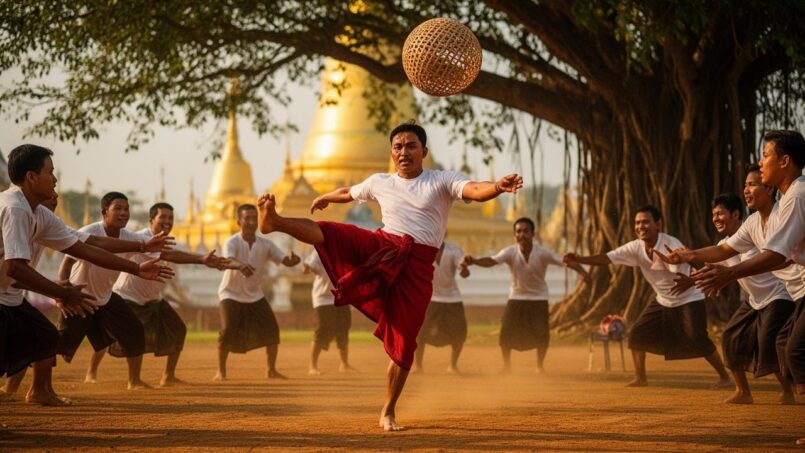
It is impossible to talk about sports in Myanmar without starting with chinlone, considered the national sport. It is also known as caneball or cane ball, but its Burmese name – ခြင်းလုံး, pronounced “chin-lone” – says it all: a “sort of round basket,” referring to the small woven rattan ball.
More than a sport in the competitive sense, chinlone is a collective performance, halfway between a game, a dance, and a display of virtuosity.
A Cooperative Game, Not a Duel
Traditionally, a team of five or six players forms a circle. The goal is clear: keep the ball from touching the ground without ever using the hands. Feet, knees, shoulders, head: every other part of the body is allowed. Players walk, pivot, cross paths, creating a continuous flow of passes, seeking fluidity and beauty of movement more than raw efficiency.
In freestyle football, a designated ‘soloist’ stands in the center of a circle formed by his partners. He performs a series of technical and choreographed movements, such as kicks with the toe, outside or inside of the foot, as well as controls using the knee, sole, or heel. The other players send him balls with perfect precision to maintain the sequence. If the ball drops, the sequence starts over from the beginning, like rewinding a film.
This non-competitive nature is deeply rooted in chinlone culture: at its core, it is not about beating an opponent, but about creating something beautiful together for the audience watching.
Between Art and Sport, from the Streets to Competitions
In the alleys of Yangon’s working-class neighborhoods, in schoolyards, on corporate grounds after work, the dry clicking of the rattan ball has become a familiar sound. Men, women, and children play together, sometimes barefoot, sometimes with special thin shoes that let them feel the contact of rattan and ground. The attire is simple: loose, often traditional clothing for full freedom of movement. In many cases, a percussion ensemble accompanies the game, reinforcing the feeling of watching a performance rather than a match.
The year sports authorities established the official rules of chinlone, codifying the discipline and enabling its competitive development.
Today, in international competitive versions, certain events require six basic movements, judged on control, execution, team coordination, and number of drops. The team that drops the ball the least wins.
A Discipline Well Suited for Team Building
The cooperative aspect of chinlone makes it particularly suitable for group cohesion contexts. Some real estate companies and businesses already use this sport to build bonds among colleagues, with timed sessions, guidance from local coaches, and an emphasis on safety (surface choice, footwear, warm-up).
The idea is simple: you play together, without pressure to win, but with a real technical challenge. It forces communication, trust, acceptance of mistakes – the ball will inevitably fall – and enjoyment of shared progress.
Chinlone Key Points Summary
| Aspect | Main Detail |
|---|---|
| Type of sport | Cooperative, artistic game, close to dance |
| Number of players | Generally 5–6 in a circle |
| Objective | Keep the rattan ball in the air, without hands |
| Body parts | Feet, knees, shoulders, head |
| Level of competition | From informal street play to judged events at regional games |
| Participants | Men, women, children, often mixed |
Football: Mass Passion, Burmese Style
If chinlone is the iconic sport, football is the mass sport. In villages and large cities alike, a single ball is enough to bring people together. From makeshift fields to modern stadiums, Myanmar lives to the rhythm of championships, local achievements, and the more challenging journeys of its national team.
A Structured Organization Around the MFF
Burmese football is overseen by the Myanmar Football Federation (MFF). This federation governs the men’s and women’s national teams, youth selections, as well as futsal and beach soccer. It manages professional club competitions, women’s championships, and futsal leagues.
The Myanmar National League (MNL) is the top division of Burmese football. It consists of 12 clubs competing in a season of 22 matches (home and away). The points system awards 3 points for a win and 1 point for a draw. A promotion and relegation system is in place with the MNL-2 (second division), followed by lower, more amateur levels.
A Still-Young League, Already Marked by a Few Giants
The MNL, officially born in 2009, has profoundly transformed the face of Burmese football. Before its creation, the main championship was limited to Yangon clubs, often attached to ministries, in a context of suspected favoritism and low appeal.
The creation of a national professional league, with regionally based clubs funded by private investors and the ability to recruit up to five foreign players and one foreign coach per team, revolutionized the championship. The dominant clubs of this era are Yadanarbon, Yangon United, and especially Shan United, which won several consecutive titles in the mid-2020s.
The MNL in a Few Figures
| Element | Indicative Data |
|---|---|
| Number of clubs (MNL) | 12 |
| System | Double round-robin, 22 matches per team |
| Promotion / Relegation | 2 relegated to MNL-2, 2 promoted from MNL-2 |
| Champion prize money | 100,000,000 kyats |
| Total squad value | Approximately 17.23 million euros |
For football enthusiasts, Myanmar therefore offers several entry points: attending an MNL match in a stadium in Yangon or Taunggyi, following a regional derby, or simply kicking a ball around on a neighborhood field where young and old mix together.
Sepak Takraw: Acrobatics Over the Net
In the large family of ball sports in Southeast Asia, sepak takraw holds a very special place in Myanmar. Halfway between volleyball and football, this spectacular discipline demands extraordinary flexibility, explosiveness, and coordination.
A Highly Regulated “Volleyball with the Feet”
The principle is reminiscent of volleyball: two teams separated by a net try to make the ball land in the opponent’s court. But here, using the hands is out of the question. The three players per team can only use their feet, knees, head, and chest. The rallies are fast, tense, punctuated by backflip spikes and stretched strikes at the net.
This discipline is characterized by spectacular moves such as somersaults, bicycle kicks, and reflex defenses, making it as captivating to watch as it is to play.
A High-Performing Nation at the Regional Level
Myanmar is one of the great nations of sepak takraw. Its national team has collected a total of 75 medals (20 gold, 23 silver, 32 bronze) at the Asian Games and Southeast Asian Games. On the Asian stage, it has particularly distinguished itself in doubles and regu events (team of three), both for men and women.
At major events like the Asian Games or ISTAF tournaments, Burmese teams regularly dominate the podiums. For example, they won gold in men’s and women’s doubles in Guangzhou and Incheon, as well as in the men’s ‘quadrant’ event more recently.
Burmese chinlone teams
Some Benchmarks on Burmese Performances
| Competition | Myanmar’s Overall Sepak Takraw Result |
|---|---|
| Asian Games + SEA Games | 75 medals: 20 gold, 23 silver, 32 bronze |
| Asian Games (partial tally) | 6 gold, 8 silver, 11 bronze |
| China–ASEAN Tournament 2025 | 4 medals: 2 gold (men’s regu & quadrant), 2 bronze (women) |
| ISTAF World Cup 2025 | 4 medals: 1 gold (women’s doubles), 2 silver, 1 bronze |
For a visitor, playing sepak takraw often means joining informal games in a park or sports field, or signing up for supervised sessions at a club. The equipment is simple (a court, a net, a rattan or synthetic ball), but the learning curve is steep: even completing three consecutive good passes is a small feat for a beginner.
Lethwei: The Burmese Art of Nine Limbs
At the opposite end of cooperative games like chinlone, lethwei embodies the most brutal face of Burmese sporting culture. Often presented as one of the most violent forms of fighting in the world, this “Burmese boxing” is nicknamed “the art of nine limbs”: fists, feet, elbows, knees… and head.
A Very Ancient Warrior Heritage
The origins of lethwei date back more than a thousand years, with possible traces as early as the Pyu city-states, well before the 12th century and the Kingdom of Pagan. At that time, it was a bare-handed combat system for soldiers, depicted in Bagan murals: fighters bare-chested, hands simply wrapped in cloth.
For a long time, fights took place in sand pits, with no time limit and no gloves. The principle was radical: no point-scoring, no judge’s decision. You win by KO or by total incapacitation of the opponent. A fighter could issue a public challenge, and any volunteer could step up, regardless of social class.
The journey of lethwei, a Burmese martial art, from its decline to its modern 20th-century revival.
The practice of lethwei was hindered and declined during the period of British colonization in Burma.
The martial art experienced a revival thanks to the decisive action of Kyar Ba Nyein, a Burmese boxer who participated in the Olympic Games.
Kyar Ba Nyein helped establish modern rules for the discipline and introduced the use of a ring.
He played a key role in promoting and spreading lethwei throughout the country.
Rules That Favor Total Commitment
Even today, lethwei stands out from most boxing styles with several very specific rules:
– No gloves, but cloth hand wraps, sometimes reinforced with tape.
– Almost all body weapons are allowed: punches, elbows, knees, kicks, sweeps, throws, and especially headbutts.
– Extensive clinch fighting, where fighters strike, pull, and throw each other.
– Biting and eye attacks, however, are strictly forbidden.
Another particularity: the victory system. In the traditional format, you only win by KO, by surrender, or by the opponent’s corner throwing in the towel. If there is no KO, it is a draw. A surprising rule also allows a fighter’s corner to call a two-minute timeout to try to “revive” him after a knockdown, except in the final round.
Fights take place over 3, 4, or 5 rounds of three minutes, with two minutes of rest between rounds. Championships are exclusively five rounds. A fighter cannot suffer more than three knockdowns in a single round, nor more than four knockdowns throughout the entire fight; otherwise, the fight is stopped by KO.
From Village Festivals to the International Ring
Lethwei is part of village and town life, especially in the south of the country and in Kayin State, which is strongly associated with this tradition. Fights are common during pagoda festivals or major celebrations, accompanied by an orchestra playing traditional percussion. Before the fight, athletes perform a ritual dance (Lethwei yay) and the lekkha moun gesture, a kind of challenging salute.
In recent years, the discipline has crossed Burmese borders and gained notoriety, with foreign champions coming to test themselves against the harshness of the traditional rules. Despite this openness, the heart of lethwei remains deeply rooted in the local culture, as a symbol of courage, tenacity, and pride.
For a foreign combat sports practitioner, training in Yangon or other cities offers a radically different approach to classic kickboxing, with a strong emphasis on physical condition and mental toughness.
Golf: A Discreet Paradise for Players
Like several countries in the region marked by the colonial period, Myanmar inherited a lasting passion for golf. This passion, once mostly reserved for political and military elites, has gradually democratized. The country is even said to have historically had one of the densest networks of courses in Southeast Asia.
Historic Courses and Modern Creations
Myanmar offers a surprising mix of old clubs created by the British in the early 20th century and state-of-the-art complexes designed by renowned architects.
Founding year of the Yangon Golf Club, one of the oldest golf courses in the country.
Another central figure on the golf scene: the Pun Hlaing Golf Club, designed by South African Gary Player. Located half an hour from central Yangon, this 18-hole course (par 72, about 6,000 yards) is known for its spectacular views of the Hlaing River and, in the distance, the famous Shwedagon Pagoda. It has been named “best course in the country” several times by regional awards, earning the nickname “The Pride of Myanmar.”
The Myotha National Golf Club spans a vast area of over 680 hectares.
Golf Destinations Across the Country
Golf is not limited to Yangon. Mandalay, Naypyidaw, and tourist sites like Bagan or the area around Inle Lake have attractive courses, often set in postcard-perfect landscapes: misty hills, pagodas in the distance, surrounding rice paddies.
Summary of a few standout courses:
| Course / Resort | Location | Holes / Par | Approx. Length |
|---|---|---|---|
| Yangon Golf Club | Yangon outskirts | 18 / 72 | 6,585 yards |
| Royal Mingalardon Golf & CC | Yangon | 18 / 72 | 7,200 yards |
| Pun Hlaing Golf Links | Yangon Region | 18 / 72 | 6,000 yards |
| Myotha National Golf Club | South of Mandalay | 18 / 72 | 8,000 yards |
| Bagan Golf Resort | Near Bagan | 18 / 72 | 7,417 yards |
| Aye Thar Yar Golf Resort | Near Inle Lake | 18 / 72 | 7,380 yards |
Green fees are generally lower than in neighboring destinations like Thailand or Vietnam, with a typical range of $30 to $150 depending on the prestige and location. For a traveling golfer, this makes it possible to combine cultural discoveries with almost daily rounds on varied courses.
Cycling: Explore the Country at a Pedaling Pace
For many travelers, bicycles have become one of the best ways to experience “authentic” Myanmar. Quiet roads, varied landscapes, welcoming villages: everything contributes to making cycling a particularly enjoyable activity.
A Growing Network of Routes
Dedicated cycling platforms now list over 1,300 cycling routes in the country, covering more than 100,000 kilometers total. From small urban loops to large cross-regional treks, the possibilities are nearly endless. Road profiles are often flat or gently rolling, especially in the central plains, with more challenging sections in the Shan Hills or mountain foothills.
Cyclists particularly appreciate several regions of Myanmar, including Shan State, Magway Region, Sagaing Region, Kayin State, and parts of Kachin. Among the top destinations within these areas, the cities and sites of Mandalay, Bagan, Inle Lake, Kalaw, Pindaya, Hsipaw, Hpa-An, and Mawlamyine are frequently mentioned.
Bagan, Inle, Mandalay: The Great Classics
Bagan, a UNESCO World Heritage site, is undoubtedly the most iconic setting for cycling. Pedaling amidst thousands of pagodas and stupas on dirt or sandy tracks is a unique experience. Visits often involve segments of 20 to 40 kilometers, punctuated by stops at major temples like Shwezigon, Ananda, or Dhammayazika.
Around Inle Lake, the route combines cycling and boat crossings. It allows you to ride through villages, rice paddies, and sunflower fields, with stops at artisans’ workshops (silk weaving, cigar making, tofu workshops). Dugout canoe sections are used to reach the opposite shores of the lake.
Between Mandalay and the former royal capitals of Sagaing, Ava (Innwa), or Amarapura, secondary roads offer beautiful stages, sometimes culminating in a sunset over the U Bein Bridge.
Example of Cycling Route Segments
| Sector | Typical distance per cycling stage |
|---|---|
| Bagan – main temples | 20 to 40 km |
| Mandalay – Sagaing – Ava | 30 to 50 km |
| Inle Lake – surrounding villages | 25 to 60 km (with boat sections) |
| Kalaw – Pindaya | 40 to 60 km |
| Long “adventure” stages | Up to 80–90 km per day |
Many organized tours offer trips from 1 to 25 days, often presented as “accessible to all levels.” The idea is not performance, but maximizing encounters: remote villages, local markets, monasteries, agricultural landscapes, river crossings by ferry, etc. Support vehicles follow the group to transport luggage and allow less fit riders to hop on board occasionally.
Hiking and Trekking: Still-Unspoiled Trails
While Myanmar is beginning to make a name for itself as a trekking destination, its trails are significantly less crowded than those of neighboring countries. Mountainous terrain in the north, Shan Plateau, remote hills of Chin State: hikers of all levels find plenty to do, far from the crowds.
From Kalaw to Inle: The Great Classic
The trek from Kalaw to Inle Lake is undoubtedly the most famous. Over two to three days, you cover about 60 kilometers through a patchwork of hills, cultivated fields, and small villages belonging to Pa-O, Danu, Taungthu, or Shan communities. Nights are spent in monasteries or village houses, on simple mattresses, with shared meals prepared by the locals. Upon arrival, a boat takes hikers across the lake, past floating gardens and fishermen rowing with one leg.
The technical level of the trek is moderate, making it ideal for a first experience in Myanmar. However, there are more physically demanding variants on some routes, particularly between villages near Kalaw.
In the North, the Call of the High Peaks
Experienced hikers turn to Putao, in Kachin State, as a base for more challenging expeditions. On the program: dense forests, very isolated villages, rare wildlife, and for the most adventurous, attempts on peaks like Hkakabo Razi (the country’s highest point at nearly 5,900 meters) or more accessible summits around 3,600 meters. These excursions require permits, experienced guides, and heavy logistics, but they open up a world that very few people get to see.
Chin State and Mount Victoria
Further west, Chin State and Nat Ma Taung National Park (Mount Victoria) attract with their wild landscapes and the cultural richness of surrounding villages. The summit of Mount Victoria peaks at just over 3,000 meters. Treks there last from two to seven days, passing through Chin villages where you can still encounter women with traditional facial tattoos.
Other Notable Trekking Areas
– Hsipaw in northern Shan: starting point for one- or two-day hikes to Palaung villages, with swims in waterfalls and homestays.
– Pindaya: known for its caves filled with thousands of Buddha images, it also provides access to two- to three-day itineraries in the surrounding hills.
– Hpa-An in Kayin State: climb Mount Zwekabin via a long staircase to the summit monastery, with views of the surrounding karst peaks.
– Loikaw: walks to Padaung (Kayan) villages where some women still wear brass coils that elongate their necks.
The ideal period for hiking generally runs from November to February, when the climate is cooler and drier. It is highly recommended to use local guides. Their role is essential for safety and navigation, but also to facilitate respectful encounters with the communities you pass through.
Water Sports and Aquatic Activities
With a long coastline facing the Bay of Bengal, major rivers like the Irrawaddy or the Chindwin, and a myriad of lakes and waterfalls, Myanmar is conducive to water sports. From swimming and diving to kayaking or rafting, the options are numerous.
Swimming and Beaches: The Relaxation Option
The country has several beach resorts, still far from the tourist density of other countries in the region. Ngapali stretches its white sand beaches lined with coconut palms for kilometers, with hotels and bungalows offering kayaking, sailing, and sometimes diving. Ngwe Saung, another long strip of sand, and Chaungtha, more popular and affordable, complete this trio of well-known beaches.
Swimming in rivers and waterfalls is a popular activity in Myanmar. Near Mandalay, sites like Dee Doke, Pwe Gauk, or Dat Taw Gyaint are known for their natural pools. In the rainy season, places like the village of Sakyin also become popular. It is essential to observe safety precautions, especially regarding water depth, current strength, and the presence of rocks.
Diving and Snorkeling: Head for the Mergui Archipelago
In the south, in the Andaman Sea, the Myeik (or Mergui) Archipelago boasts more than 800 virtually untouched islands. Liveaboard diving trips explore drop-offs, fringing reefs, rocky pinnacles, with sites like “Shark Cave” known for tawny nurse sharks and grey reef sharks. Snorkeling, sea kayaking, and sometimes marine life observation are also practiced in this still-pristine environment.
Other areas, like around Ngapali or Ngwe Saung, offer more limited but accessible diving and snorkeling opportunities.
Rafting, Kayaking, and River Sports
In the north of the country, particularly in Kachin State, the mountain-fed rivers are well suited for rafting. On the Nam Lang, the May Kha, or the Malikha, multi-day descents combine class III–IV rapids, camping under tents, encounters with local villages, and sometimes nights in mountain lodges. Milder forms exist, such as floating downriver on bamboo rafts.
On lakes and calm waters like Inle Lake, kayaking and canoeing are practiced. On major rivers such as the Irrawaddy, cruises are available, ranging from simple local boats to luxury river steamers, especially on the route between Bagan and Mandalay, and sometimes towards more remote northern regions.
Stand-Up Paddleboarding and Sailing in Yangon
In Yangon, Inya Lake has become a small hub for urban water sports. A sailing club organizes sailing outings, as well as stand-up paddle (SUP) training sessions lasting two hours. It is both a leisure activity and a gateway to environmental engagement, through bank and water cleanup campaigns.
Volleyball and Modern Team Sports
Beyond football, other team sports structure Burmese sporting life, whether in schools, clubs, or at the international level.
Sitting volleyball, a parasport discipline, is well developed in Myanmar. The men’s team has won several gold medals at the ASEAN Games. The rules are similar to traditional volleyball, but players sit and the net is lower. This practice promotes inclusion and serves as a vector of resilience and visibility for people with disabilities.
In schools and villages, many local “standing” volleyball tournaments are organized, overseen by the national federation and regional associations. Their goals go beyond simple sporting results: spotting new talent, encouraging female participation, using sport as a driver of social cohesion.
Basketball, tennis, athletics, modern martial arts like wushu or Olympic boxing complete the picture, supported by public investment in infrastructure and sports academies, particularly in Yangon, Mandalay, and Naypyidaw.
Lesser-Known but Thriving Traditional Sports
Alongside the major mainstream disciplines, the country hosts a wealth of traditional games and sports that express the diversity of its ethnic groups and regions.
Naban wrestling, partly inspired by Indian wrestling, is practiced mainly in rural areas and among groups like the Kachin or Chin. The holds target all parts of the body, including joint locks, chokeholds, strikes to sensitive points. It is often integrated into a broader martial arsenal.
Among the Rakhine, a wrestling style called kyin pits two opponents against each other under strict rules: strikes to the face and hits below the belt are forbidden. The fight is preceded by a ritual warm-up dance called ‘kyin kwin.’ Victory is awarded by a clean throw of the opponent to the ground.
A multitude of children’s games – forms of tag, human obstacle jumping, races through lines guarded by “defenders” – attest to a rich play culture. Even if it is not always easy for a traveler to join in, watching a few games in a schoolyard or during a village festival offers a touching glimpse into the transmission of traditions through play.
Choosing Your Sport in Myanmar: Some Practical Pointers
In a Myanmar where very ancient martial arts, unique cooperative sports, and international disciplines coexist, the question is not “are there sports to play?” but rather “how do you choose?”
For an authentic experience in Myanmar, prioritize traditional sports like chinlone (ball game), lethwei (Burmese boxing, even just as a spectator), and sepak takraw. These activities offer direct access to the collective values, sense of spectacle, and relationship with the body that are characteristic of the local culture.
Outdoor enthusiasts will favor cycling and trekking, two activities that allow you to travel through entire regions in contact with locals, far from major roads. Myanmar has the particularity of offering still-preserved itineraries where the “tourist on a bicycle” or “the hiker” remain relatively rare figures, often sparking curiosity and spontaneous hospitality.
Golfers can enjoy uncrowded courses in a tropical and heritage setting. Water lovers have the choice between beaches, lakes, and rivers, or a diving expedition in the Mergui Archipelago.
Whatever the choice, one constant stands out: in Myanmar, sport is almost never detached from its social and cultural context. You don’t just play to win or to stay fit. You play to build bonds, to honor traditions, to share a moment beyond language barriers. This may be, even more than the diversity of disciplines, the true sporting richness of the country.
Disclaimer: The information provided on this website is for informational purposes only and does not constitute financial, legal, or professional advice. We encourage you to consult qualified experts before making any investment, real estate, or expatriation decisions. Although we strive to maintain up-to-date and accurate information, we do not guarantee the completeness, accuracy, or timeliness of the proposed content. As investment and expatriation involve risks, we disclaim any liability for potential losses or damages arising from the use of this site. Your use of this site confirms your acceptance of these terms and your understanding of the associated risks.

Cyril Jarnias is an independent expert in international wealth management with over 20 years of experience. As an expatriate himself, he is dedicated to helping individuals and business leaders build, protect, and pass on their wealth with complete peace of mind.
On his website, cyriljarnias.com, he shares his expertise on international real estate, offshore company formation, and expatriation.
Thanks to his expertise, he offers sound advice to optimize his clients' wealth management. Cyril Jarnias is also recognized for his appearances in many prestigious media outlets such as BFM Business, les Français de l’étranger, Le Figaro, Les Echos, and Mieux vivre votre argent, where he shares his knowledge and know-how in wealth management.





