
 Published on and written by Cyril Jarnias
Traveling in Myanmar Without Blowing Your Budget is possible… as long as you know how to use public transportation. Between urban buses in Yangon, long-distance night buses, the iconic circular train, classic taxis, apps like Grab or Oway, and a galaxy of more local means (trishaws, tuk-tuks, shared pick-ups…), the options are abundant, sometimes confusing, and often very cheap.
This practical guide summarizes key information from several studies and reports to make your travels in Myanmar easier, with special attention to Yangon, the country’s main entry point.
Understanding the Public Transport Landscape in Myanmar
Myanmar’s transport system is a mix of networks inherited from the colonial era and newer services, sometimes very modern (ride-hailing apps, VIP buses, electronic payment cards). Overall, it remains far from the efficiency standards of Thailand or Vietnam: slowness, frequent delays, aging infrastructure, and a heavy reliance on cash.
Across the country, the main options are buses, trains, boats, domestic flights, and a multitude of local transport, from taxis to trishaws. For travelers and locals alike, buses remain the most common and cheapest way to get around, though air travel dominates for long distances.
A Network Focused Around a Few Key Hubs
Most tourist travel concentrates on what agencies sometimes call the “tourist kite”: Yangon, Mandalay, Bagan, Inle Lake. Between these hubs, connections are plentiful by bus and plane, with trains being slower but sometimes very scenic.
Yangon is the Burmese city with the highest density of public transport services, including buses, trains, taxis, and BRT.
For the visitor, this means two things: it’s relatively easy to get between major destinations, but you have to accept a lot of unpredictability and slowness as soon as you leave the main arteries or use the most local transport.
Urban Buses in Yangon: How to Use the Yangon Bus Service
In Yangon, the backbone of public transport is the Yangon Bus Service (YBS). This network replaced in 2017 an older, very chaotic system of nearly 300 poorly coordinated lines. The reform aimed to simplify, modernize, and centralize network management.
From Ma Hta Tha to YBS: A Major Overhaul
Before 2017, Yangon’s buses were overseen by a committee called the Yangon Motor Vehicles Supervisory Committee, better known by its nickname “Ma Hta Tha”. Private companies operated a patchwork of routes, serving the majority of the 2.8 million daily commuters but with very little clarity for the user.
On January 16, 2017, the Yangon Bus Service was launched, initially under the authority of the Yangon Region Transport Authority (YRTA). The network was deeply restructured: about 300 lines were reduced to around a hundred at first, then expanded later. The YRTA was dissolved in 2021 and replaced by the Yangon Region Public Transport Committee (YRTC), but the YBS acronym remained.
Figures vary depending on the source, but we can provide orders of magnitude:
| Key indicator for Yangon bus network | Approximate value |
|---|---|
| Number of lines (old network) | ≈ 300 |
| Lines at YBS launch | ≈ 100 |
| Lowest current estimate | 70 lines in service |
| Highest current estimate | > 250 lines |
| Registered buses (old system) | 7,800 |
| Buses running daily (old) | 4,000 |
| Commuters transported per day (current) | > 2.5 million |
This diversity of numbers reflects a reality: the network is alive, evolving, with lines being added, merged, or disappearing. For a traveler, the key is less about memorizing numbers than knowing how to navigate today.
Operating Hours, Comfort, and Basics
YBS buses generally run between 5 a.m. and 9 p.m.. They remain by far the cheapest way to cross the city, with a standard fare around 200 kyats, just a few cents in USD.
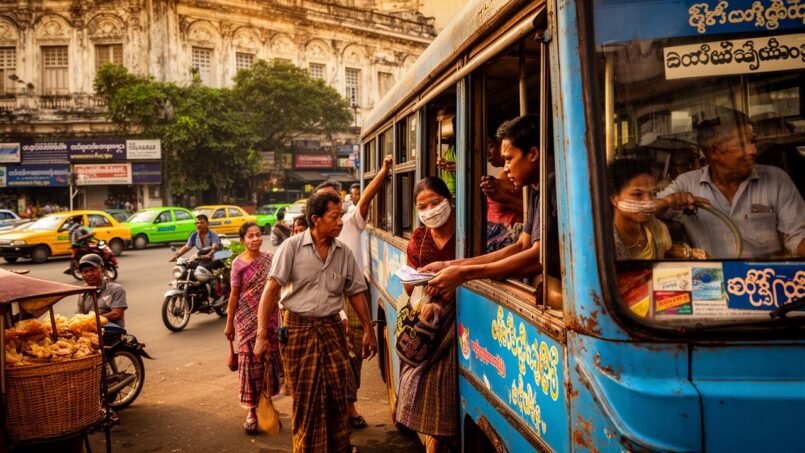
Buses are often old, rarely air-conditioned, and very crowded during peak hours. Although a few newer, air-conditioned vehicles appear on main routes, they remain a minority. In the hot season, the crowding and heat can make trips exhausting.
Locals recommend always having small bills (100 or 200 kyat notes) to pay your fare. Payments are still mostly in cash, although an electronic card system called Yangon Payment Service is being rolled out. A company, Asia Starmar Transport Intelligence, won the contract to equip about 4,000 buses starting in 2019. On the ground, we’re still in a cash/card coexistence phase.
A Network That Can Daunt Newcomers
For those arriving in Yangon fresh, buses can seem intimidating. The combination of signs in Burmese, numerous lines, sometimes poorly marked stops, and chaotic traffic makes the system feel “complex.”
Yet a few simple reference points can help you take advantage of it: it’s about identifying key indicators or accessible reference points—like sector averages, seasonal trends, or measurable goals—to turn raw information into actionable insights without requiring deep expertise.
– buses stop at designated terminals and stops, not just anywhere;
– the line’s terminus is usually well indicated on the line signs, sometimes in bold;
– routes are segmented by color according to the areas served.
This last feature is invaluable for finding your way.
YBS Line Color Codes
YBS bus lines are classified by color, each color corresponding to a major zone of the city. These colors appear on the vehicles and help identify which neighborhoods they serve.
Here’s a summary chart:
| Bus Color | Main Zone Served | Example Line Numbers |
|---|---|---|
| Blue | Northern District | 1, 11, 20, 21, 22, 23, 35, 36, 37, 39, 40, 41, 42, 61, 68, 69 |
| Brown | Downtown | 56, 57, 58 |
| Green | Major thoroughfares connecting districts | 43, 44, 45, 46, 47, 48, 49, 50, 51, 52, 53, 54, 55, 60, 62, 66, 67 |
| Purple | Southern District | 8, 9, 10, 31, 32, 33, 34, 70 |
| Red | Eastern District | 2, 3, 4, 5, 6, 7, 12, 13, 15, 16, 17, 18, 19, 24, 25, 26, 27, 28, 29, 30, 38, 59, 63, 64 |
For example, to reach downtown from a northern neighborhood, you can combine a blue line (e.g., 58) to Sule Circle, Yangon’s major central hub, then a green or red line depending on your final destination. A typical combination cited in sources is taking bus #58 to Sule, then #36 to continue north.
Geographical Landmarks Along the Lines
YBS buses connect most of Yangon’s iconic locations: Sule and City Hall, Botahtaung Pagoda, Shwe Dagon Pagoda Road, markets like Mingalar, Yuzana Plaza, or San Pya Market, major roundabouts (Tamwe Circle, Thar Kay Ta Circle), universities (Dagon University, University of Business, National University of Technology), and even more specific places like Yangon Psychiatric Hospital or Tha Khin Mya Garden.
To get around efficiently by bus in a new city, first download an offline map (like Google Maps). Identify your starting point and the nearest major thoroughfare. Then ask hotel staff or locals which line to take. You can also use Google Maps to find routes, but always double-check information locally, as bus lines are subject to change.
Yangon BRT: The “Fast and Air-Conditioned” Bus Option
Alongside the YBS, Yangon has a bus rapid transit service, the Yangon BRT. The idea is to offer a more comfortable and predictable alternative on certain major routes.
Features of the Yangon BRT
The Yangon BRT was launched in early 2016. It is operated by a public-private company, Yangon Bus Public Company Limited. All BRT buses are air-conditioned, a major advantage in Yangon’s climate, and operate as an integrated system with stops only at dedicated stations and terminals.
Some practical details:
| Aspect | Yangon BRT |
|---|---|
| Service type | Rapid bus on main arteries |
| Operator | Yangon Bus Public Company Limited |
| Partnership | Public-private |
| Total fleet | 65 buses |
| Fleet composition | 15 King Long, 15 Higer, 15 Daewoo, 15 Hyundai, 5 Scania Marcopolo |
| Operating hours | Approximately 6 a.m. – 7:30 p.m. |
| Fare | Flat rate 300 kyats regardless of distance |
| Payment | Dedicated cards, Burmese prepaid cards |
| Air conditioning | Yes, 100% of the fleet |
The relatively new and uniform fleet contrasts with classic buses. For the user, this means superior comfort and a more straightforward experience: same stops, same vehicle types, single fare.
Limitations and Constraints
The BRT only covers a small part of the city and is mainly intended for users on major corridors. For a tourist, it can be useful if your accommodation is near a station, but it doesn’t replace the flexibility of the YBS or a taxi.
Information on constraints and accepted payment methods for using transport services in Myanmar.
Payment is accepted exclusively via payment cards or Burmese prepaid cards. Cash payments are not accepted.
This constraint forces users to obtain a Burmese card or consider other modes of transport for their trips.
The Yangon Circular Train: Daily Transport and Travel Experience
Another pillar of urban transport in Yangon: the circular line. This slow train, which loops around the metropolis, is not only a nearly unbeatable way to see local life; it’s also a vital infrastructure for hundreds of thousands of residents.
A Rail Loop Around the City
The Yangon Circular Railway, sometimes called the Yangon Circle Line, is a rail loop about 46 km long that serves around thirty stations around the metropolis. Depending on the source, it’s referred to as having 37, 38, or 39 stations, reflecting differences in counting (main stations vs. secondary stops).
The most detailed data mentions:
| Circular Line Indicator | Approximate Value |
|---|---|
| Total loop length | ≈ 45.9 – 46 km |
| Number of stations (depending on source) | 37 to 39 |
| Time for a full loop | 3 to 3.5 hours |
| Maximum daily capacity (one source) | 150,000 passengers |
| Broad usage estimate (another source) | 100,000 to 200,000 passengers/day |
| Number of trains/day (older figures) | ≈ 20 to 21 |
| Total number of cars | ≈ 200 |
The train departs and arrives at Yangon Central Station, a large building a short walk from Bogyoke Aung San Market and Sule Pagoda, making it easily accessible for travelers.
A Dense Network Linking Center, Suburbs, and Rural Areas
The line connects the economic center to many outlying neighborhoods, industrial zones, markets, and small semi-rural towns. Among the important or notable stations:
– Yangon Central (departure/arrival);
– Insein, near the prison of the same name;
– Mingaladon and Mingaladon Bazaar, providing access to the airport area;
– Danyingon, a major railway junction;
– Paywetseikkon, Yegu, Tamwe, Pazundaung, etc.
Some stations are close to tourist or religious sites: Myitta Nyunt for the Chauk Htat Kyi and Ngar Htat Gyi pagodas, Yaegu for Kabar Aye Pagoda, Tadalay for the Tooth Relic Pagoda. The circular train thus theoretically allows you to connect the airport, downtown, and peripheral neighborhoods without a taxi, but in practice the trip is long and transfers can be tricky.
Schedule, Frequency, and Reliability
Circular trains run every day, from early morning until evening. Some time ranges mention a first service around 3:45 a.m. and a last one around 10:15 p.m., but not all trains cover the entire loop. Another set of figures gives trains from 6:10 a.m. to 5:10 p.m. for full circuits.
Several practical points to remember:
Trains run in both directions (clockwise and counterclockwise) with a frequency varying from 30 to 60 minutes depending on the time. Not all trains make the full loop: some stop midway, which may require getting off and changing. Punctuality is erratic, with frequent delays, sometimes early departures, and last-minute platform changes.
Schedules posted on signs or online are therefore only indicative. At Central Station, a small booth on platforms 6/7 is dedicated to selling tickets for the circular line, with staff who sometimes speak English.
Fares, Ticket Purchase, and Travel Conditions
The circular line is one of the cheapest means of transport in Yangon, both for locals and visitors.
Based on collected data:
| Type of trip on the circular line | Indicative fare for locals |
|---|---|
| Short trip (a few stops) | ≈ 100 kyats |
| Full loop in standard car | ≈ 200 to 300 kyats |
| Air-conditioned car (“air-con”) | ≈ 500 kyats |
Tourists are sometimes automatically offered a ticket for a slightly more expensive air-conditioned car (around 250–500 kyats), while Burmese pay a symbolic sum. Tickets are usually handwritten and purchased directly on the platform, not at the main station entrance.
In some versions of the system, a ticket is valid for several hours. During that time, you can get off and reboard, allowing you to make multiple stops to explore markets or neighborhoods along the way.
Conditions on board are reminiscent of a suburban train from a bygone era: hard plastic benches, often malfunctioning ceiling fans, open windows instead of air conditioning, deteriorated toilets. Cars are sometimes packed during peak hours, with many vendors carrying goods, vegetables, medicine, and snacks destined for markets.
For the traveler, it’s both an immersion into daily life and a rather slow, uncomfortable journey, especially in the afternoon. The best time to enjoy the atmosphere without suffocating is early morning, just after dawn.
Traveling Between Cities: Long-Distance Buses, Trains, and Boats
Even though the main focus of this article is urban transport, understanding how connections between major destinations work helps you better organize your trips to and from Yangon, the starting point for most journeys.
Long-Distance Buses: The Budget-Friendly King
Across the country, intercity buses are the most used, most widespread, and, for the most part, cheapest means of transport. Many private companies operate on nearly all tourist routes, offering a range from very basic local buses to VIP air-conditioned coaches with reclining seats.
On major routes (Yangon–Bagan, Yangon–Mandalay, Mandalay–Inle Lake…), VIP buses are highly recommended: modern vehicles, 2+1 configuration (only three seats per row), effective air conditioning, blankets, water, and sometimes snacks or a toothbrush provided. The price difference compared to a standard bus remains modest.
Some examples of travel times and fares collected:
| Main Route | Approximate Duration | Typical Bus Type | Price Range (Indicative) |
|---|---|---|---|
| Yangon → Bagan | 9–10 hrs | 48-seater A/C or 27 VIP | 18,000–25,000 MMK (≈ $6–9 USD) |
| Yangon → Mandalay | 8–10 hrs | 48-seater A/C or 27 VIP | 15,000–24,000 MMK (≈ $5–8 USD) |
| Mandalay → Bagan | 5–6 hrs | 48-seater or medium bus | ≈ $10–15 USD |
| Mandalay → Inle Lake | ≈ 8 hrs | Long-distance | ≈ $12 USD |
| Yangon → Inle Lake | ≈ 11 hrs | 48-seater or VIP | 20,000–28,000 MMK (≈ $7–10 USD) |
| Inle → Bagan | ≈ 9 hrs | 48-seater or VIP | ≈ $10–15 USD |
Most of these buses run at night, with departures between late afternoon and evening, and arrivals at dawn. This is a good way to save a night’s hotel stay, but it means arriving sometimes at 3–5 a.m. at a peripheral bus station, far from the center.
On these routes, buses are generally faster and more reliable than trains. For a reliable service, choose companies like Mandalar Minn Express, JJ Express, or Elite Express. It’s advisable to book one or two days in advance during high season (November to April) or on heavily traveled routes.
Intercity Trains: Slow, Scenic, but Very Unpredictable
The Burmese railway network, about 6,200 km long, is the second-largest rail infrastructure in Southeast Asia. It largely dates from the British colonial period, between the late 19th and early 20th centuries, and has only been partially modernized.
On paper, trains connect Yangon to Mandalay, Bagan, Inle Lake (via Shwenyaung), Myitkyina, Lashio, and other cities. In practice, speeds range between 24 and 32 km/h, sometimes slower, and delays of several hours are common. Some iconic journeys, like crossing the Goteik Viaduct between Pyin Oo Lwin and Hsipaw, have become famous for their spectacular nature rather than their punctuality.
Burmese Railway Network
Available classes range from very basic wooden seats to compartment sleepers, with an “Upper Class” offering more comfortable armchairs. Fares are generally higher than buses for the same route, while being slower and more tiring.
Note: according to the most recent information, long-distance train tickets are no longer sold to foreigners “for security reasons,” a tightening linked to the political context and recent infrastructure damage. However, the Yangon circular train still seems to operate for travelers.
Boats: An Alternative on Some Stretches
On certain routes, notably the Irrawaddy River between Mandalay and Bagan, boats remain a very popular option. Between fast express boat (5–10 hrs for about $25–30 USD) and slow ferry (14–17 hrs for about ten dollars), the journey offers a different perspective on the country.
These connections only play a complementary role in daily life for locals. For a traveler, they are more of an experience than a practical means of urban or suburban transport.
Taxi, Ride-Hailing, and Local Means of Transport
In urban areas, especially Yangon, buses aren’t always enough. For certain trips (night travel, curfew hours, connections to a bus station or airport, poorly served areas), taxis or ride-hailing services are often the simplest solution.
Traditional Taxis
Taxis are very common in large cities, especially Yangon. Most are old Japanese sedans, sometimes worn out and without seatbelts. Meters are rare, hence the importance of negotiating the price before getting in.
Some rough estimates:
| Urban trip (classic taxi) | Indicative range |
|---|---|
| Typical city ride | 2,000–8,000 kyats (≈ $1–4 USD) |
| Yangon Airport → downtown | 8,000–15,000 kyats depending on source, sometimes more if arranged in the terminal |
| Aung Mingalar Bus Station → downtown | ≈ $7 USD for a private taxi |
Drivers do not expect tips. At large bus stations like Aung Mingalar, you can also find shared taxis (“ferry”), cheaper than a private taxi but requiring a wait until the vehicle is full.
Grab, Oway, and Other Ride-Hailing Apps
Since 2017, Grab has established itself in Myanmar, particularly in Yangon, Mandalay, and Bagan. The app allows you to order a taxi (GrabTaxi) or a slightly more comfortable service (GrabTaxi Plus) with guaranteed car models (Toyota Crown, Hyundai Sonata, etc.). The price is displayed in advance and calculated on a fixed + distance + time basis, avoiding any negotiation.
In Myanmar, Grab is not the only option. The local service Oway Ride, originating from an online travel agency, is considered the largest ride-hailing service in the country. It offers car taxis, moto-taxis, and three-wheelers (called “Mini Oway”). The service is available in several cities, including Yangon, Mandalay, Bagan, Pyin Oo Lwin, and Mawlamyine.
Other names exist (Hello Cabs, FastGO, GetRide, OK Taxi, FARY Taxi…), with varying degrees of coverage and reliability. For a traveler, the main advantage of these apps is twofold: price transparency and real-time vehicle tracking, valuable in a city where few drivers speak English and addresses can be vague.
Local Transport: Trishaw, Tuk-Tuk, Moto-Taxi, Pick-up
Alongside buses and taxis, a set of “Burmese-style” means of transport complete the picture:
An overview of the different typical transport modes used by travelers to get around Myanmar, with their characteristics and indicative fares.
Three-wheeled pedal vehicle, slow but cheap for short distances (500–1,000 kyats). Very common in small flat towns, rarer in metropolises.
Less ubiquitous than in Thailand, but present around temples and bus stations. Fares are negotiable, with the possibility of asking the driver to wait for a round trip.
Particularly common in Mandalay or rural areas, very practical for a single person, with fares often under 5,000 kyats. Banned for foreigners in some places (e.g., Bagan) and prohibited from central Yangon.
Small trucks with two benches in the back, operating on fixed routes. They serve as collective taxis, very economical but uncomfortable and often overloaded.
For occasional urban trips, taxis (classic or via app) remain the simplest solution, especially for a non-Burmese-speaking visitor.
Transport and Accessibility to Yangon Airport
Since almost every trip to Myanmar begins or ends in Yangon, it’s useful to understand the transport options between the international airport and downtown.
The Airport and Its Location
The international airport is located in the Mingaladon area, about 16–18 km north of the center, depending on the route taken. It groups international and domestic terminals side by side.
Main Transport Options
Upon exiting, several options are available to passengers:
| Mode of transport | Time (excluding heavy traffic) | Typical cost (order of magnitude) |
|---|---|---|
| Classic taxi from the official queue | 20–30 min (up to 1 hr+) | 8,000–15,000 kyats (sometimes more) |
| Grab or other ride-hailing | ≈ 30 min | price shown in the app, often similar to taxis |
| Airport shuttle bus (YBS/Omni Focus) | ≈ 50–60 min | 500 kyats |
| Public YBS bus (e.g., route 37) | ≈ 40–60 min | 200–300 kyats |
| Train from a nearby station | ≈ 1.5 hrs to downtown | 100–500 kyats |
The airport shuttle of the YBS type, operated by Omni Focus, runs 24/7 on several routes connecting the airport to strategic points like Sule Pagoda, Myanmar Plaza, Central Station, or Yangon University. It costs 500 kyats, no change given, and generally leaves every 15 minutes. The departure point is in front of the departure terminal, requiring a short walk from arrivals.
To save even more, note that a few standard public bus lines, like YBS route 37, also serve the area. However, this option requires a better knowledge of the transport network.
The simplest solution for a first contact with Yangon is often a taxi (classic or via app), saving buses and the circular train for the following days once you’ve gotten your bearings.
Making Good Use of Public Transport in Myanmar: Practical Tips
Beyond the numbers and systems, a few common principles allow you to approach Burmese public transport more serenely.
Always Plan Ahead… and Stay Flexible
Whether it’s an urban bus, a night coach, or a train, the main constant of the system is its unpredictability: delays, chronic traffic jams in Yangon, weather, checkpoints, or mechanical issues regularly extend travel times.
For a connection with an international flight or long-distance bus, it’s wise to add a good margin: take an earlier bus, prefer a taxi over a local bus if the schedule is critical, or spend the previous night in the departure city rather than attempt a tight connection.
Prepare for a “Low-Tech, Cash Only” Experience
The vast majority of payments are made in cash, in kyats. Card systems like Yangon Payment Service on buses are still being rolled out and remain a minority, while international bank cards don’t work everywhere.
Concretely, this means:
For your travels, always carry small change for the bus. Remember to withdraw enough cash from ATMs in large cities, anticipating possible outages. Finally, don’t rely on contactless payment, which may not be available for all your trips.
Online bookings (long-distance buses, domestic flights, sometimes trains) are starting to develop via platforms like 12Go.Asia or MMBusTicket.com, but the bulk of the market is still handled at physical counters, often without English, and by phone.
Use Offline Maps and Ask Locals for Help
Printed bus maps are rare and often out of date. The most useful tool remains an offline mapping app: Google Maps downloaded locally, Maps.me, or equivalent.
An effective approach is to identify on the map:
– your current location;
– the nearest main road;
– an obvious landmark (pagoda, market, roundabout) near your destination.
Then ask your hotel, a shopkeeper, or a taxi driver which bus to take. Burmese people are used to guiding foreigners, and by combining their directions with the map, you avoid most major mistakes.
Comfort, Safety, and Health
Burmese public transport does not meet Western standards for safety and comfort. In a crowded YBS urban bus or an old suburban train, expect:
During bus journeys, be prepared for varying conditions. Vehicles may not have seatbelts and roads can be in poor condition, leading to sudden stops. Air conditioning is often very strong on long-distance buses, so it’s advisable to have a sweater or scarf. Finally, cleanliness standards can vary from bus to bus.
For the Yangon circular train and local buses, it’s best to avoid peak hours if you’re uncomfortable with crowds. For overnight intercity buses, bring earplugs and a sleep mask, as screens and music may stay on late.
Transport Budget: A Modest Line Item in Overall Trip Cost
For a mid-budget traveler, transport in Myanmar remains cheap. By mainly using buses (urban and long-distance), you can keep transport expenses between $3 and $10 USD per day. Adding a few domestic flights or systematically choosing VIP buses and private taxis pushes it more toward $15–30 USD per day.
Over the course of a trip, this leaves plenty of room for accommodation, food, sightseeing, and perhaps a few more comfortable experiences like a BRT ride or a cruise on the Irrawaddy.
In Summary: Getting the Most Out of Public Transport Without Getting Lost
Public transport in Myanmar, and particularly in Yangon, requires patience and flexibility, but offers a valuable immersion into the daily life of the country.
The YBS bus network, economical but often crowded, forms the basis of mobility. The BRT offers a more modern and comfortable service on certain routes. The circular train, though slow, passes through typical neighborhoods. For more flexibility, a multitude of private options exist: taxis, ride-hailing, trishaws, moto-taxis, and shared pick-ups. The choice will depend on your budget, tolerance for comfort, and schedule.
For those who accept these rules of the game, public transport is not just a way to get from point A to point B: it becomes one of the keys to understanding the country, its rhythms, its geography, and how its inhabitants live and move daily.
Disclaimer: The information provided on this website is for informational purposes only and does not constitute financial, legal, or professional advice. We encourage you to consult qualified experts before making any investment, real estate, or expatriation decisions. Although we strive to maintain up-to-date and accurate information, we do not guarantee the completeness, accuracy, or timeliness of the proposed content. As investment and expatriation involve risks, we disclaim any liability for potential losses or damages arising from the use of this site. Your use of this site confirms your acceptance of these terms and your understanding of the associated risks.

Cyril Jarnias is an independent expert in international wealth management with over 20 years of experience. As an expatriate himself, he is dedicated to helping individuals and business leaders build, protect, and pass on their wealth with complete peace of mind.
On his website, cyriljarnias.com, he shares his expertise on international real estate, offshore company formation, and expatriation.
Thanks to his expertise, he offers sound advice to optimize his clients' wealth management. Cyril Jarnias is also recognized for his appearances in many prestigious media outlets such as BFM Business, les Français de l’étranger, Le Figaro, Les Echos, and Mieux vivre votre argent, where he shares his knowledge and know-how in wealth management.





