
 Published on and written by Cyril Jarnias
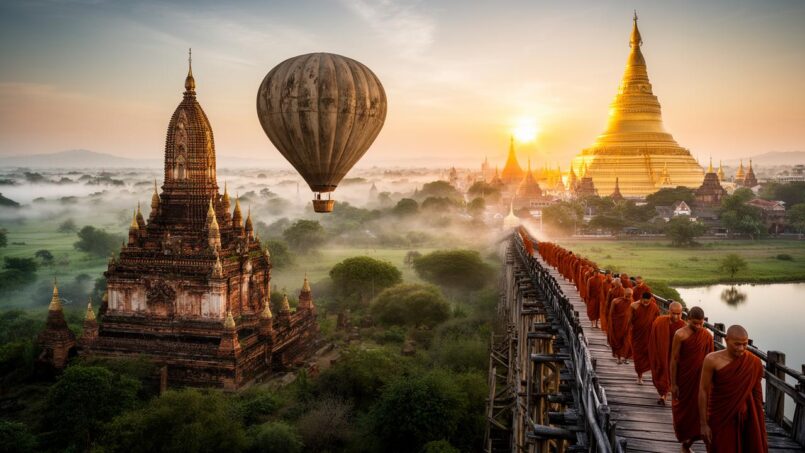
Land of golden pagodas, misty lakes, and temple-dotted plains, Myanmar fascinates as much as it raises questions. Between Buddhist legends, exceptional architectural heritage, and complex political realities, preparing a trip to the country requires balancing dream and caution. At the heart of this discovery, a route stands out: the famous “tourist kite” connecting Yangon, Bagan, Mandalay, and Inle Lake, extended by a few side trips to mythical sites like the Golden Rock or the beaches of the west coast.
This article details the country’s must-see sites (history, architecture, climate, culture). It provides practical information on visiting conditions, costs, and safety recommendations. Note that several countries currently advise against travel to Myanmar. The goal is to provide keys to understanding, not to encourage a departure.
Traveling to Myanmar Today: Context, Safety, and Formalities
Even before talking about temples and lakes, the context must be addressed. Since the 2021 military coup, the country has been going through a period of severe instability. Clashes are taking place between the army, ethnic armed groups, and resistance forces. The United States, the United Kingdom, Australia, Canada, and Singapore, among others, formally advise against all travel. Washington classifies Myanmar at “Do Not Travel” (Level 4), the highest alert level.
The region faces active armed conflicts, bombings, landmines, and severe political repression. Infrastructure, especially hospitals, is fragile, particularly outside major cities. Any activity perceived as critical of the regime, including online, can lead to arbitrary arrest.
Within this landscape, one area stands out as relatively more stable: the famous “kite” connecting Yangon, Bagan, Mandalay, and Inle Lake. These tourist hubs still function, with hotels, restaurants, and transportation services. But “relatively more stable” does not mean “risk-free.” Tensions persist, and the situation can change rapidly.
For a trip to Myanmar, several conditions are mandatory: a passport valid at least six months after arrival, a tourist visa (often obtainable via an online eVisa for a 28-day stay), proof of accommodation at registered hotels or guesthouses, an outbound travel ticket, and travel insurance covering medical evacuation. When active, the eVisa system allows for a secure online application, payment of fees, and presentation of a printed approval letter upon arrival. The stay must be exclusively in officially registered accommodations.
Add to this sometimes severe legal rules: the impossibility of using a drone without prior authorization, a ban on photographing military installations or police, and a prohibition on entering restricted areas without a permit. Even conversation topics can become sensitive: politics, the military, and criticism on social media must be handled with extreme caution. In this context, a trip to Myanmar should be approached as a very high-risk project, requiring up-to-date information from embassies and consular services.
Yangon: Gateway and Modern Spiritual Heart
Yangon, the former capital and largest city in the country, is often the first contact travelers have with Myanmar. A sprawling metropolis, bristling with gleaming pagodas and dilapidated colonial buildings, it condenses a large part of the Burmese soul: omnipresent Buddhism, a mix of religious communities, noisy tea shops, and lively markets.
Shwedagon, the Iconic Pagoda
It’s hard to imagine a trip to Myanmar without the silhouette of the Shwedagon Pagoda. Rising on Singuttara Hill, it dominates the city at 99 meters (325 feet), entirely covered in gold leaf and set with thousands of diamonds and rubies—over 4,500 diamonds for the main stupa alone. The Burmese consider it the most sacred Buddhist site in the country, as it is said to house relics of the Buddha, including several strands of hair.
The site includes a vast complex with secondary temples, statues, and pagodas. Its atmosphere changes throughout the day: calm at dawn, lively in the late afternoon, and surreal at dusk. Access is subject to Burmese religious rules: shoulders and knees must be covered, clothing must not be tight or transparent, and shoes and socks must be removed to enter the sacred enclosure barefoot.
Pagodas, Markets, and Daily Life
Around Shwedagon, Yangon holds other must-see stops. In the city center, the Sule Pagoda sits in the middle of a roundabout, a golden island surrounded by traffic. Considered even older than Shwedagon, it shows how the sacred blends into urban daily life here.
Further north, the Chaukhtatgyi Paya houses a massive Reclining Buddha with feet delicately decorated with 108 segments, a highly symbolic number in Buddhism. The facial features, enormous eyes, and inlaid ornaments give the statue an almost human presence.
To feel the pulse of the city, Bogyoke Aung San Market remains a must. In this historic market, a legacy of the colonial era, paved aisles gather stalls of fabrics, handicrafts, jewelry, wood carvings, as well as a food court where you can taste local snacks and typical dishes. Other urban parks like Kandawgyi Nature Park, with its large lake, offer a green respite, while the central station—starting point of the circular train—allows you to observe Burmese life through the carriages.
Cultural Codes to Respect
In Yangon as elsewhere, a number of rules of conduct condition visits to religious sites. The Burmese, overwhelmingly Buddhist, consider pagodas as places of worship, not mere tourist curiosities. It is therefore essential to speak softly, avoid loud laughter, not disturb people who are praying or meditating, and not use flash during ceremonies.
For example, it is important to never turn your back directly on an image of the Buddha, avoid pointing your feet at a statue, monk, or elderly person, and not climb onto a pedestal for a photo. Sitting cross-legged or with legs folded to the side is a preferred posture, while sitting higher than a monk or a sacred effigy is strictly prohibited.
When greeting, “Mingalaba” is sometimes accompanied by a slight bow. Handshakes exist between men but are rare; with women and monks, physical contact is to be avoided. The head is considered the most sacred part of the body, so no one should be touched there, especially children. Conversely, feet are seen as impure: do not point with them, step over someone, or step over their belongings.
Bagan: The Plain of Thousands of Temples
The former capital of the Kingdom of Pagan, Bagan is often presented as the pinnacle of a trip to Myanmar. Over about fifteen square miles (forty square kilometers) stretches a sea of stupas and temples, remnants of a golden age that saw the construction, between the 11th and 13th centuries, of some 13,000 Buddhist monuments. Today, more than 2,000 of them still stand, each a brick or gold silhouette dotting an arid plain bordered by the Irrawaddy River.
A Foundational Royal Heritage
The construction of Bagan took place over several reigns, from the kingdom’s founder, King Anawrahta, to the rulers of the 12th and 13th centuries. It was during this period that Burmese culture crystallized, nourished by Mon influences, and the city became a major religious and intellectual center. Under the long reign of King Narapatisithu, considered the kingdom’s apogee, many important monuments were built.
The current town, often called Old Bagan, is now only a small cluster of hotels and villages amid the ruins; but the archaeological zone, a UNESCO World Heritage site, remains one of the largest Buddhist sites on the planet.
Major Temples to Discover
It is impossible to visit all the temples of Bagan; even spending several days there, you have to make choices. Several structures stand out clearly for their historical importance, architecture, or atmosphere.
Ananda, the Preserved Jewel
The Ananda Temple is often presented as one of the most beautiful and best-preserved on the plain. Built over 900 years ago under the reign of King Kyanzittha, it still serves as a major pilgrimage site today. Its harmonious plan, ornate galleries, numerous Buddha statues, and courtyard paved with glazed tiles make it an unmissable visit.
The site is very crowded, especially during the high season, with a procession of devotees, vendors set up around the edges, and guides offering their services. To fully appreciate the architectural details and spiritual atmosphere, it is recommended to go early in the morning or late in the afternoon.
Dhammayangyi, the Monumental Mass
More massive, the Dhammayangyi Temple is the largest temple in Bagan. Built in the 12th century by King Narathu, known for having murdered several family members, it impresses with its thick walls and the quality of its brickwork. Visible from afar, it serves as a visual landmark on the plain. Numerous legends surround its construction, often linked to the supposed cruelty of its patron.
Gawdawpalin, the Architecture of Maturity
Also built in the 12th century, the Gawdawpalin Temple, sometimes called the “temple of forgiveness,” offers a remarkable example of Bagan’s late architecture. A legend says that King Narapatisithu, who became blind after committing a serious fault, regained his sight when he had this sanctuary built to atone for his acts. Tall and slender, the temple dominates the surroundings and makes for a nice bike ride destination.
Other Iconic Temples
The Htilominlo Temple, a gigantic red brick structure over 45 meters (148 feet) high, stands out for its tapered spire and interplay of volumes. It is named after the king who had it built in the 13th century.
The Sulamani Temple, also attributed to Narapatisithu, is renowned for its fine carvings and delicately worked bricks. In a different style, the Shwezigon Pagoda, whose first stupa dates back to the 11th century, displays a gold coating and a structure similar to large urban pagodas like Shwedagon. It is among the oldest monuments in Bagan and has been enriched over the centuries with ancillary sanctuaries.
Finally, visitors looking for popular viewpoints for sunset often turn to structures like Taung Guni, whose wide terrace offers a panorama of the surrounding temples. However, a major regulatory shift has transformed the way these landscapes are discovered.
Panorama, Balloons, and New Regulations
For a long time, travelers freely climbed the temple terraces to admire sunrise and sunset. Faced with disrespectful behavior by some (illegal overnight stays on roofs, dancing, damage to fragile structures), the authorities banned climbing on almost all monuments in 2016. Only five temples—Shwesandaw, Pyathard Gyi, North Gunni, South Gunni, and Thitsaw Wati—still officially escape this ban, but the situation may evolve.
This pagoda is one of the few authorized observation points. For a spot at the top at sunrise, arriving as early as 3:30 AM is recommended, because arriving around 5 AM may be too late for the highest level. Note that the softest light for photography occurs about an hour after sunrise, when the crowd has thinned out, and views from levels 4 and 5 are very similar.
In parallel, flying over the plain in a hot-air balloon has become the iconic experience of Bagan. Between October and April, balloons take off at dawn over the temples, offering spectacular perspectives of the checkerboard of stupas, the meanders of the Irrawaddy, and the morning mists. During the monsoon (June–September), these flights are generally suspended.
Climate, Seasons, and Organizing a Visit
Located in a tropical monsoon climate zone, Bagan experiences three main seasons: a cool, dry season (November–February), a hot, dry season (March–May), and a rainy season (May/June to September/October). Visiting conditions vary significantly depending on the chosen period.
It can be summarized as follows:
| Period | Season | Average Temperatures | Main Advantages | Main Drawbacks |
|---|---|---|---|---|
| Nov.–Feb. | Dry winter (high season) | Approx. 64–86°F (18–30°C) | Dry weather, moderate heat, clear skies, balloons | Peak crowds, higher prices |
| Mar.–May | Late dry season (very hot) | Around 95°F (35°C), often >100–104°F (38–40°C) | Fewer people, good deals | Difficult heat, outdoor visits unpleasant |
| Jun.–Sept. | Monsoon (low season) | Around 79°F (26°C) | Fewer tourists, lowest rates | Frequent rain, muddy tracks, limited access |
| Late Sept.–Oct. | End of monsoon / shoulder season | Pleasant temperatures | Fewer crowds, Bagan often relatively dry | Weather still variable |
The November–February period remains the most recommended to combine pleasant weather, clear skies, and the hot-air balloon season. But it also corresponds to the high tourist season; hotels and balloons must be booked well in advance, and the main temples, like Ananda, are packed at peak hours.
To optimize your visit, plan for at least two full days, ideally three. The first day can be dedicated to the major temples with a guide to understand the history, architecture, and symbols. The second day is good for exploring more remote temples by bicycle or e-bike. A third day allows you to revisit your favorite temples, take advantage of the best light for photography, or take a sunset boat ride on the Irrawaddy.
Practical Tips on Site
The Bagan plain is vast and provides little shade. The sun is strong, even in winter, and the omnipresent dust in the dry season gives way to mud during the monsoon. Exploring temples and paths in the middle of the day can become grueling as early as March. It is better to schedule visits early in the morning (before 8 AM) and late in the afternoon (after 4 PM), taking a long break in the shade or at the hotel during the hottest hours.
E-bikes remain a very popular way to get around, with daily rentals around $4 to $6. Regular bicycles are still possible, but the distances and heat can quickly become tiring. In any case, it is essential to bring plenty of water, sunscreen, a wide-brimmed hat, and insect repellent, especially if you plan to explore remote areas.
Entry to the “Bagan Archaeological Zone” is paid and is usually settled at a checkpoint upon arrival. Prices vary by period but range from about $10 to $25.
Finally, while most of the large temples attract many visitors, many more remote stupas receive only a handful of people each year. Leaving early to reach them can sometimes allow you to enjoy a sanctuary entirely to yourself, with only the sound of birds and the wind in the trees for company.
Mandalay and Its Ancient Royal Capitals
The second-largest city in the country, Mandalay combines royal heritage, Buddhist fervor, and intense artisan life. Founded in 1857 by King Mindon, it became the last capital of the Burmese kingdom before annexation by the British in 1885. Today, it is the main economic, educational, and cultural center of northern Myanmar, an ideal starting point for exploring the neighboring ancient capitals: Ava, Sagaing, Amarapura, and Mingun.
The Mandalay Palace, Symbol of a Lost Kingdom
In the heart of the city, a vast square bounded by high walls and a wide moat encloses the royal palace. The original complex, built between 1857 and 1859, reused some materials from the old palace of Amarapura, transported by elephants to the new site. Over more than 1,000 acres (400 hectares), about forty buildings housed audience halls, thrones, a library, a monastery, and royal quarters.
The capture of the city by British troops, and especially the Allied bombings of World War II, almost completely destroyed the palace. Only the mint building and an observation tower survived. In the 1990s, the authorities undertook a reconstruction of the complex using modern materials like corrugated metal and concrete, based on old plans.
The palace, a symbol of Mandalay, is accessible with a combination ticket. Foreign visitors must present their passport at the entrance. The visit allows you to appreciate the scale of the site, especially by walking along the 1.2-mile (2 km) walls and the approximately 200-foot-wide (60 m) moat.
Pagodas, Monasteries, and the “World’s Largest Book”
A short distance from the palace, the slopes of Mandalay Hill concentrate an impressive density of sanctuaries. A tradition holds that the Buddha, while traveling, prophesied that a great Buddhist city would be founded at the foot of this hill, which inspired the choice of location by King Mindon.
Climbing the covered steps, or taking the road to the summit, you pass pagoda after pagoda until you reach a spectacular viewpoint over the city, the palace, and the Irrawaddy. At the top stands the Sutaungpyei Pagoda, a place for prayer and sunset viewing.
At the foot of the hill, the Kuthodaw Pagoda deserves a thorough visit. It is famous for housing what the Burmese call “the world’s largest book”: 729 marble slabs, each protected by a small white stupa, on which the entire Pali Canon is engraved. This monumental project, ordered by King Mindon, aimed to preserve Buddhist teachings in stone. Nearby, the Sandamuni Pagoda features a similar layout, with a forest of small stupas.
The Shwenandaw Monastery is the only original teak structure from the 19th-century palace still standing in Mandalay.
The Ancient Cities Around Mandalay
Mandalay is best explored with multiple excursions into its hinterland, where former capitals and religious centers follow one another.
To the south, Amarapura—the “city of immortality”—was a royal capital before the court moved to Mandalay. Today, it is best known for its teak bridge, U Bein, about 0.75 miles (1.2 km) long, crossing Taungthaman Lake. Built in the mid-19th century from teak posts taken from dismantled palace buildings, it is often presented as the world’s longest teak bridge. At sunrise and sunset, its silhouette stands out against the water as monks, villagers, and visitors cross it.
Still in Amarapura, the Mahagandayon Monastery houses over a thousand monks. At certain times, lines of saffron robes gather for meals, a scene popular with photographers but requiring respect and discretion.
Further south and west, the city of Ava (or Inwa), a former capital several times between the 14th and 19th centuries, is discovered after a short river crossing by boat, followed generally by a horse-cart ride. On the agenda: the Bagaya teak monastery, remains of ramparts and palaces, the brick Maha Aung Mye Bonzan monastery, villages, and rice paddies. It all forms a landscape where ruins and rural life are intimately intertwined.
Number of sanctuaries recorded in Sagaing, the religious heart of Myanmar.
Finally, heading up the Irrawaddy from Mandalay, a cruise of about an hour leads to Mingun. There, the enormous unfinished mass of the Mingun Pahtodawgyi testifies to the immense ambition of King Bodawpaya, whose giant pagoda project was never completed. Beside it, the brilliant white Hsinbyume Pagoda symbolizes Mount Meru with its undulating rings, and the giant Mingun Bell, weighing about 90 tons, claims the title of the largest intact ringing bell in the world.
Mandalay, a Crossroads of Crafts and Culture
Beyond religious monuments, Mandalay is also renowned for its artisan workshops: hand-beaten gold leaf, kalaga embroidery, wood carving, lacquerware, not to mention jewelry production in the Mogok area, about 60 miles (100 km) away, famous for its rubies.
The city also houses a zoo—the Yadanabon Zoological Gardens—where you can see, among others, the rare Burmese roofed turtle. For a cultural evening, the Mandalay Marionettes Theater perpetuates the art of articulated puppet shows, which appeared as early as the 11th century and were long used to convey spiritual stories and royal histories.
Inle Lake: Floating Villages and Gardens on the Water
On the Shan Plateau, at an altitude of about 3,000 feet (900 meters), Inle Lake offers a gentle setting: long expanses of water framed by green hills, houses on stilts, floating gardens, fishermen balancing on one leg at the stern of their boats. The second-largest lake in the country, it stretches about 12 miles (20 km) long and 6 miles (10 km) wide. The region is home to around 200,000 people, mostly from the Intha ethnic group, literally “sons of the lake.”
A Way of Life Centered on Water
The Intha are believed to have begun settling on the lake about five centuries ago, fleeing tribal conflicts. Over time, they developed a culture and techniques adapted to this aquatic environment. The most spectacular is undoubtedly the leg-rowing technique: fishermen stand at the back of their canoe, one foot on the boat, the other wrapped around the oar. This gesture, it is said, frees their hands to manipulate nets and traps while offering better visibility over the weed beds. Women, for their part, row seated using their arms.
Fishing relies on conical bamboo traps and nets; a stick tapped on the water is used to scare fish into the catching devices. Common species include the Inle carp, catfish, eels, and various types of barb.
The open water surface of the lake decreased by about 32% between 1935 and 2000, partly due to the expansion of floating gardens.
Houses, on the other hand, are built on stilts, often of wood and bamboo. An open ground floor serves as a boat “garage,” while the main level houses the living spaces, sometimes with an additional floor for bedrooms. Canals serve as streets, sometimes connected by small wooden bridges. In this lacustrine world, children learn to swim and handle a boat very early on, and the daily diet combines lake fish, garden produce, and rice.
Boat Rides, Markets, and Pagodas
For travelers, the gateway to the lake is the small town of Nyaung Shwe, connected to the eastern shore by a canal. From there, you embark for a day—or more—on long motorized canoes that ply between villages and gardens, sometimes at the cost of engine noise, which has become an environmental issue.
An iconic example is the annual Phaung Daw Oo Pagoda festival on Inle Lake. For 18 days, four of the five sacred Buddha statues, unrecognizable under the gold leaf applied by devotees, are placed on a golden barge. This barge is towed around the lake by boats of leg-rowers. The festivities also include leg-rowing canoe races and conclude with the Thadingyut Festival of Lights.
On a more intimate note, the Nga Phe Chaung Monastery, sometimes called the “jumping cat monastery,” attracts visitors for its wood carvings and peaceful atmosphere. Another popular excursion is the trip up the small Indein River to the village of the same name. Following a waterway lined with bamboo, you reach a complex of pagodas, Shwe Indein Pagoda, where ancient steles and vegetation-covered stupas recall the golden age of Buddhism in the Shan hills.
In the region, itinerant markets, called “five-day markets,” move from village to village. They gather farmers and artisans from various ethnic groups (Shan, Pa-O, Danu, etc.) and offer a wide range of products: vegetables, spices, tea, fish, meat, fabrics, and tools. When they are held on the lake or in its villages, they become “floating markets.” Although some are very touristy, they all reflect local cultural and economic diversity.
Crafts, Accommodations, and Environment
Around the lake, many workshops perpetuate traditional skills: weaving of silk and lotus fiber, cheroot cigar making, silversmithing, boat building. Lotus weaving, in particular, is extremely specific to the region: filaments are extracted from lotus stems to produce a “thread” used to make scarves, fabrics, and even robes for dressing Buddha images in some temples.
On the tourism front, the lake offers a wide range of accommodations, from guesthouses in Nyaung Shwe to high-end complexes like Villa Inle, whose overwater bungalows overlook the floating gardens. A Shan cultural museum housed in a former princely residence in Nyaung Shwe provides useful insight into the plateau’s minorities.
But Inle does not escape ecological challenges: pollution, accelerated sedimentation, eutrophication from fertilizers, untreated wastewater discharge, overfishing. The noise from tourist boats is becoming a concern for wildlife. The site was proposed to UNESCO as early as 1996 but still does not appear on the list of inscribed natural properties, partly due to these tensions between development and preservation.
The Golden Rock: Kyaiktiyo, Sacred Balance on the Edge of the Void
Southeast of Yangon, in Mon State, an enormous golden boulder perched in precarious balance on the edge of a cliff has attracted crowds of pilgrims for centuries: the Golden Rock, or Kyaiktiyo Pagoda. This granite block, weighing over 600 tons and about 25 feet (7.6 m) high, encircled by a painted lotus-shaped base, supports a small 24-foot (7.3 m) stupa. The whole sits at an altitude of 3,600 feet (1,100 m) atop Mount Kyaiktiyo, in a line of eastern hills.
A Rock Held by a Single Hair of the Buddha
Legend has it that the rock is kept in balance by a single hair of the Buddha, enshrined in the stupa. This hair was supposedly entrusted to a hermit, Taik Tha, who asked a king with supernatural powers—son of an alchemist and a dragon princess (naga)—to enclose it in a rock resembling a hermit’s head. The king allegedly spotted this block at the bottom of the sea, hoisted it onto a boat that was later petrified (visible today as the Kyaukthanban Pagoda, the “stone boat stupa,” a few hundred meters away), and installed it on the mountain with the help of the celestial king Thagyamin.
For the faithful, seeing the Golden Rock is a source of spiritual merit, and touching it (a privilege reserved for men) brings them closer to the Buddha. It is the third most important Buddhist sanctuary in Myanmar, after the Shwedagon Pagoda in Yangon and the Mahamuni Temple in Mandalay.
Pilgrimages, Rituals, and Ideal Season
The site is open day and night year-round, but the peak pilgrimage season is between November and March. Thousands of devotees then come to pray, chant, meditate, offer candles, and burn incense around the rock. During the Festival of Nine Thousand Lights, up to 90,000 candles can be lit simultaneously, creating a crown of fire at the foot of the golden block.
Men cross a small walkway over the void to press gold leaf onto the rock, a gesture of devotion repeated for generations. Women, according to local rules, cannot touch the stone or use this walkway, but they pray from nearby platforms.
Pilgrims and local devotees
As everywhere in Myanmar, visitors must remove shoes and socks before entering the sacred enclosure and dress modestly. Some accounts mention the requirement to wear a longyi, but this rule seems to vary.
Access: Between Adventure and Comfort
Most visitors begin their ascent from the village of Kinpun, which serves as a base at the foot of the mountain. From Yangon or Bago, buses reach Kinpun in a few hours (about 4 hours from Yangon, 2 hours from Bago). From there, open trucks fitted with crowded benches transport pilgrims to a drop-off point called Yatetaung, about 0.75 miles (1.2 km) from the summit. The ride, about thirty minutes, is reputed to be impressive and very packed.
From Yatetaung, a paved sloping path leads to the summit in about 1 hour on foot. Options exist: sedan chairs or a cable car (round-trip ticket in kyats). Some pilgrims walk the entire way from Kinpun (7 miles / 11 km, 3 to 6 hours of walking). According to local belief, making this pilgrimage three times in a year brings prosperity and recognition.
At the summit, a village of guesthouses, small restaurants, offering shops, and observation platforms has developed around the main square. A large panoramic terrace allows you to admire the rock from all angles and contemplate the surrounding hill landscape, especially at sunrise and sunset. The site can be very crowded, but the atmosphere of fervor, especially at night when the rock is illuminated with amber reflections by spotlights, leaves a lasting impression on many visitors.
Other Must-See Sites: Beaches, Mountains, and Ancient Cities
Beyond the classic “kite”, Myanmar holds a multitude of other major places, even if access to some of them is now compromised by the security situation.
West Coast Beaches
Ngapali Beach, on the coast of the Bay of Bengal, is often cited as the most beautiful beach in the country. A long stretch of white sand lined with coconut palms and turquoise waters, it juxtaposes luxury hotels with fishing villages, where oxcarts are a common mode of transport. The best time to stay is from November to March, before the heavy monsoon rains.
Myanmar’s beach destinations like Ngwe Saung and the Mergui Archipelago, although offering pristine landscapes and renowned marine life, are now classified as high-risk zones by many governments.
Mount Popa and Perched Monasteries
Not far from Bagan, Mount Popa, an ancient volcano rising from the plains, houses an important cult center for the Nat spirits, protective entities unique to Burmese tradition. On an adjacent pinnacle, the Taung Kalat Monastery stands atop a rocky cone. To reach it, you must climb 777 steps, often accompanied by mischievous monkeys. From the top, the view encompasses the plains, and sometimes, on clear days, stretches all the way to the temples of Bagan on the horizon.
Bago, Monywa, Mrauk U, and Other Remarkable Sites
In the Bago region, northeast of Yangon, the Shwemawdaw Pagoda dominates the city at 374 feet (114 meters), making it possibly the tallest in the country. Nicknamed the “Great Golden God,” it is said to house several relics of the Buddha and features a summit set with diamonds. The complex also includes many small stupas, statues, and pavilions.
Length in feet (76 meters) of the Naw Daw Gyi Reclining Buddha, a remarkable statue in Bago.
Further north, near Monywa, the region is famous for the Thanboddhay Pagoda, with its thousands of small colorful statues, and for the gigantic standing Buddha of Laykyan Sekkya, accompanied by another monumental reclining Buddha.
To the west, Mrauk U presents, in a landscape of hills and rice paddies, the remains of an ancient Arakanese capital, a mix of fortified temples and stone monuments. This site, like others in Rakhine State, is however now located in an area considered dangerous due to ethnic and political conflicts.
Customs, Cuisine, and Daily Life Around the Sites
Visiting major sites in Myanmar is not limited to observing monuments. Every pagoda, every village, every market is also a gateway to a rich and codified daily culture.
Dress Codes and Behavior in Sacred Places
For visits to temples, pagodas, and monasteries, rules are consistent across the country: shoulders and knees covered, no transparent, tight, or torn clothing, no tank tops or short shorts. Many travelers enjoy adopting the longyi, the traditional wraparound skirt worn by men and women; this is viewed positively by locals, especially at religious sites. Women wear a version called htamein.
Inside sacred enclosures, you must take off your shoes and sometimes socks too, including on outdoor stairways that can be scorching hot during the day. Walking barefoot on marble or tile floors is an integral part of the local spiritual experience.
In the presence of monks, respect is essential: women must not touch them or their robes, or hand them an object directly. Donations are placed in front of them. Men also avoid shaking hands with a monk. Sitting at a slightly lower level and behaving discreetly are signs of respect.
Politeness, Gestures, and Interactions
In daily life, Burmese society remains more conservative than that of some neighboring countries like Thailand or Laos. Public displays of affection (kisses, hugs, holding hands) are frowned upon. Public fits of anger, loud arguments, and abrupt gestures are considered very rude and likely to cause everyone to “lose face.”
To point at something, avoid using your index finger, a gesture considered aggressive; instead, use an open hand or a chin gesture. Beckoning someone by curling your index finger towards yourself is also poorly perceived. On public transport, it is customary to give up your seat to the elderly, pregnant women, and monks.
The system of honorifics also structures interactions: older men are called “U”, older women “Daw”, men of similar age “Ko”, women “Ma”. These titles preceding the given name indicate respect.
Table and Cuisine: Mohinga, Shan Noodles, and Curries
Around the major tourist sites, Burmese cuisine is discovered in tea shops, street stalls, and small restaurants. Traditional meals are often taken around a low table, sitting on mats or cushions. Rice is central, surrounded by vegetable dishes, salads, curries, soups, and condiments. You eat with your right hand or with a spoon and fork (knives are rarely used). You wait for the eldest person to start eating before serving yourself, and it is polite to finish what is on your plate.
Mohinga, a fish noodle soup often considered the national dish, is especially enjoyed for breakfast during the Thingyan festival (Water Festival in April). Shan noodles, from the Shan Plateau, are also very popular with their clear broth, rice noodles, meat (chicken or pork), herbs, and peanuts. Burmese curries, milder than some Thai curries, are made with meat or fish and served with vegetable and condiment accompaniments.
The salad of fermented tea leaves, laphet thoke, mixes tea leaves, peanuts, seeds, tomatoes, and sometimes dried shrimp, with a lemony and oily dressing. It holds a strong cultural place, served as both a snack, a dish, and a symbol of hospitality. Coastal regions, especially around Yangon and the beaches, are known for their seafood dishes and coconut milk curries, while the north and the Shan Plateau are distinguished by chickpea tofu variations and sour soups.
Budgets, Transportation, and Accommodations Around Major Sites
Myanmar long remained a relatively affordable destination, especially for backpackers. However, costs vary greatly depending on travel style and season. To give some ballpark figures:
| Expense Type | Indicative Range (USD) |
|---|---|
| Street food / snack | $0.30 – $1 |
| Meal at small local restaurant | $2 – $7 |
| Meal at “Western” restaurant | $3.50 – $10 |
| Bottle of water (1 liter) | $0.20 – $0.40 |
| Local beer | $2 – $5 |
| Dormitory bed (hostel) | $4 – $15 |
| Simple private room | $6 – $50 |
| Tuk-tuk in city | $0.15 – $0.40 for short trips |
| Scooter/motorbike rental (day) | $3.60 – $36 |
| E-bike (Bagan, day) | $4 – $6 |
| Long-distance bus | $4.50 – $22 |
| Taxi airport – Yangon center | $6 – $10 |
| SIM card with data | ≈ $8.50 |
| Bus Yangon – Bagan | ≈ $13.50 |
| Bus Bagan – Mandalay | $7 – $9 |
| Common domestic flight | $80 – $140 (some routes $40 – $200) |
| Entry Shwedagon Pagoda | ≈ $5 |
| Entry Bagan Archaeological Zone | ≈ $10 – $25 |
An “ultra-budget” traveler can aim for $20 to $40 per day, while a “comfortable” traveler will be more in the range of $50 to $90, and a high-end stay will easily exceed $200 per day. For two people, a combined daily budget of $100 to $200 often allows for a already high level of comfort (good hotel, restaurant meals, some domestic flights).
For major sites like Shwedagon, Bagan, or some museums in Mandalay, entry fees are mandatory. These fees contribute to the upkeep of the sites, and possibly to the regime’s finances. Regarding accommodation, the offer ranges from simple dormitories to luxury hotels, with prices highly sensitive to seasonality: high season from November to February and low season during the monsoon.
Domestic travel is done by bus, train, or plane. Roads can be in poor condition and driving erratic, hence the importance of choosing reputable companies and limiting night travel. The train, while scenic, remains often slow and uncomfortable. Domestic flights save time between Yangon, Bagan, Mandalay, and Inle Lake, at the cost of a higher budget.
Between Fascination and Responsibility
The must-see tourist sites in Myanmar—Bagan and its thousands of temples, Yangon and its gleaming Shwedagon, Mandalay and its neighboring capitals, Inle Lake and its floating gardens, the Golden Rock and its nocturnal pilgrimages, the beaches of Ngapali and the isolated pagodas—form a mosaic of some of the most striking places in Southeast Asia. They tell of the deep roots of Buddhism, the ingenuity of lacustrine societies, the symbolic power of kings, and the cultural exchanges between peoples of the plains and mountains.
Despite its wonders, the country faces an extremely fragile political and security situation. Fighting, population displacement, and serious human rights violations affect vast areas, including several border states and some central regions. Most foreign governments advise against or formally prohibit travel to the country.
In this context, taking an interest in Myanmar, its sacred sites, its landscapes and its people, can also take the form of a remote learning approach: reading, researching, supporting, sometimes, cultural or humanitarian projects carried by local or exiled actors. For those who might still consider a trip, preparation must be of absolute rigor: daily verification of travel advisories, assessment of personal risks, scrupulous respect for local laws and codes, awareness of the ethical issues related to tourism in a country under military rule.
In any case, the temples of Bagan, the terraces of Mandalay Hill, the canoes of Inle Lake, or the Golden Rock will continue to nourish the imagination of travelers for a long time. It remains to be hoped that, tomorrow, they can be discovered in a more peaceful climate, for the benefit of the communities that surround them and the visitors who dream of contemplating them.
Disclaimer: The information provided on this website is for informational purposes only and does not constitute financial, legal, or professional advice. We encourage you to consult qualified experts before making any investment, real estate, or expatriation decisions. Although we strive to maintain up-to-date and accurate information, we do not guarantee the completeness, accuracy, or timeliness of the proposed content. As investment and expatriation involve risks, we disclaim any liability for potential losses or damages arising from the use of this site. Your use of this site confirms your acceptance of these terms and your understanding of the associated risks.

Cyril Jarnias is an independent expert in international wealth management with over 20 years of experience. As an expatriate himself, he is dedicated to helping individuals and business leaders build, protect, and pass on their wealth with complete peace of mind.
On his website, cyriljarnias.com, he shares his expertise on international real estate, offshore company formation, and expatriation.
Thanks to his expertise, he offers sound advice to optimize his clients' wealth management. Cyril Jarnias is also recognized for his appearances in many prestigious media outlets such as BFM Business, les Français de l’étranger, Le Figaro, Les Echos, and Mieux vivre votre argent, where he shares his knowledge and know-how in wealth management.





