
 Published on and written by Cyril Jarnias
The Greek real estate market enters a phase of maturity in 2026. Prices continue to rise, but at a more measured pace than in 2023–2024. For a buyer or investor, the real question is no longer “is it going up?” but “where and at what price?” Athens, Thessaloniki, Crete, and Corfu illustrate four very different faces of this widespread increase: a metropolitan capital, a booming northern city, a large tourist-driven island, and a high-end Ionian destination.
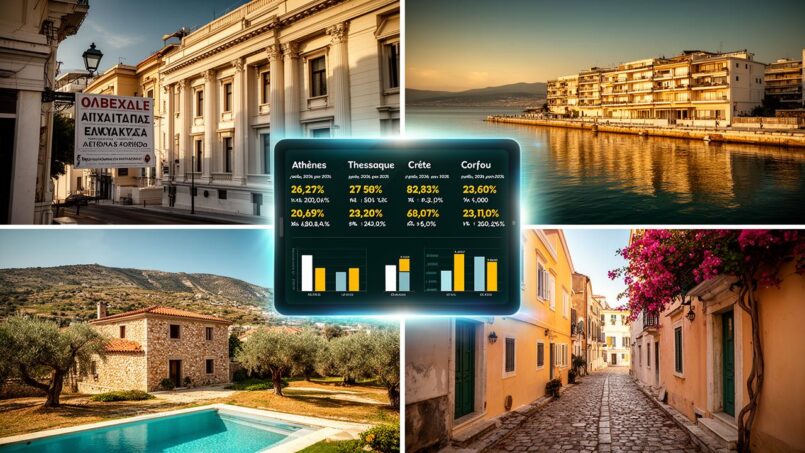
This article compares four real estate markets using tables to analyze prices per square meter, their evolution, and the properties accessible with a given budget.
A Greek market still rising, but more selective
Before zooming in on each destination, we must recall the national framework. In 2026, the median price of a home in Greece is around €190,000, with an average price close to €260,000. Per surface area, this translates to a median price of about €1,900/m² and an average price around €2,200/m². These averages mask enormous gaps between regions, but they provide a useful basis for comparison.
The aggregated data shows that:
The housing price index in urban areas rose by 7.69% year-over-year in the third quarter of 2025, with a real increase of 4.94% after inflation.
For 2026, most forecasts converge toward a “normalized” increase of about 3 to 6% per year for all of Greece, with a central scenario around 4–7%. The most sought-after markets—certain neighborhoods in Athens and tourist islands—may go beyond, while less dynamic areas risk slowing significantly.
In this context, Athens, Thessaloniki, Crete, and Corfu do not behave the same way. Their fundamentals—infrastructure, tourist season, supply tension, appetite of foreign investors—explain strong divergences in prices and trajectories.
Athens: national engine and laboratory of price gaps
Athens remains the heart of the Greek real estate market. The capital concentrates the largest volume of transactions, the majority of renovation projects, and a significant share of investments linked to the Golden Visa program.
In 2026, several benchmarks emerge for the city and its metropolitan area:
– average price around €2,900/m², all segments combined;
– central range in the center between about €3,000 and €3,500/m²;
– average near €2,770/m² for Athens Center in spring 2026, i.e., +8.46% year-over-year;
– prices above €4,000/m² on the southern Riviera (Glyfada, Voula, Vouliagmeni, Elliniko), with new build programs routinely exceeding €10,000–12,000/m².
Athens, a multi-speed city
The intra-urban variations are impressive. A few subway stops apart, prices can be cut in half.
A table helps visualize the major sub-markets of Athens in 2025–2026.
| Athens area (major subzones) | Average asking price (€/m²) | Recent annual change |
|---|---|---|
| South Athens (Riviera) | ≈ 4,000–4,167 | +7 to +9.2% |
| North Athens | ≈ 3,222–3,323 | +6.8 to +7.4% |
| Athens Center (broad average) | ≈ 2,317–2,770 | +8.5 to +11.8% |
| West Athens | ≈ 2,055–2,154 | +9.3 to +12.5% |
| East Athens | ≈ 2,281–2,316 | +6.5 to +9.5% |
| Piraeus | ≈ 2,522 | slight decline (-1.3%) |
The figures show two simultaneous dynamics. On one hand, the very prime areas—South and North—remain expensive but are now rising at a slightly less explosive pace than some catch-up sectors. On the other hand, Athens Center, West, and East continue to see double-digit or near-double-digit increases, driven by gentrification, the future metro Line 4, and conversions of homes for rental.
Here are some emblematic benchmarks that illustrate the gaps mentioned in the article, with details on the observed differences.
– the South Riviera is the most expensive area in the country, with an average around €4,125/m² in late 2025 and micro-markets well above: Vouliagmeni exceeds €7,400/m² on average, with coastal villas at over €8,000/m² and “trophy” properties well above €10 million;
– Glyfada, another hub of the Riviera, averages between €4,250 and €5,000/m² for older properties, but high-end new builds there reach €7,500 to €12,000/m²;
– Kolonaki, a bourgeois central neighborhood, hovers around €4,000/m², while Pangrati is around €2,900/m²; Kypseli, Galatsi, or certain parts of Exarchia still remain under €2,500/m², but directly benefit from metro Line 4 works.
Concrete example: how much does a “typical” apartment cost in Athens?
Using the benchmark of Athens Center at about €2,770/m², a 70 m² apartment has an asking price close to €194,000 excluding fees. For an 80 m² apartment in Athens, a “typical” transaction occurs around €240,000, i.e., about €3,000/m².
You can compare this cost to that of a similar home in Thessaloniki, Crete, or Corfu later in the article.
Pressure on affordability and role of credit
The price surge in Athens is accompanied by growing tension on affordability. Many reports indicate that a household can spend 40 to 50% of its income on rent in the capital. Eurostat estimates that in 2024, Greek households spent on average 35.5% of their disposable income on housing, the highest percentage in the European Union.
In November 2025, the average rate for fixed-rate loans up to 5 years stood at 3.04% in Greece, one of the lowest in the eurozone.
Athens in 2026: moderate but sustained growth
Most estimates place the residential price increase in Athens around 4 to 6% for the year 2026, after +7.6% over twelve months at the start of the year. Over five years, projections indicate a cumulative progression of about 25% for the city, which would bring the average price in the center from about €2,900/m² today to nearly €3,600/m² by around 2031.
The capital therefore remains the engine of the Greek market, but the progression is no longer uniform. Neighborhoods already at the top of the European scale, such as certain sectors of the Riviera, seem close to a ceiling; conversely, districts like Peristeri (where the price per square meter went from €1,350 in 2020 to €2,245 in 2024, i.e., +42.3%) or neighborhoods along the metro Line 4 belt still have catch-up potential.
Thessaloniki: fastest growth and more accessible entry
If Athens draws attention, the real locomotive of price increases in 2025–2026 is Thessaloniki. The country’s second-largest city shows the highest growth rates among major Greek metropolises, while remaining significantly more affordable than the capital and prime islands.
A booming market
The figures from the Bank of Greece and listing portals converge. Thessaloniki recorded:
– a 9.61% increase in residential values year-over-year in Q3 2025;
– a 10% rise in apartment prices in Q1 2025 compared to the previous year;
– a 9.7% increase in asking prices in Q1 2026, higher than that of Attica (about 6.5%) over the same period.
Over a longer period, between 2021 and 2025, the average asking price in the city jumped 63.5%, compared to 41.5% for the Attica region. Over a decade, nominal values have roughly increased by 70%, i.e., about +45% in real terms (excluding inflation).
The table below summarizes the current orders of magnitude.
| Thessaloniki 2026 indicator | Approximate value |
|---|---|
| Average price (all zones, Q2 2026) | ≈ €1,720/m² |
| Current range (city) | €2,300–3,000/m² (center/prime) |
| Average price municipality (center) | ≈ €2,600–2,700/m² |
| Average price broad suburbs | ≈ €2,050/m² |
| Average price rest of prefecture | ≈ €1,205/m² |
| Median price of an apartment | ≈ €169,000 |
| Average price of a home | ≈ €216,000 |
| Typical price apt. 90 m² center | ≈ €210,000 (≈ €2,330/m²) |
| Typical price apt. 90 m² suburb | ≈ €185,000 (≈ €2,055/m²) |
The increases are not uniform. The suburbs of Thessaloniki saw prices rise about 13.6% year-over-year, while the central municipality posted a more moderate increase of 9.4%. Peripheral sectors of the prefecture, long lagging, progressed even faster, with +15.3% for areas outside the center and suburbs.
Demand and transactions: a very liquid market
The dynamic is not limited to prices. The pace of sales is high:
– more than 4,800 residential transactions in Q2 2026;
– share of foreign buyers around 22% over the same period;
– average time on market reduced to 65 days, compared to 82 a year earlier.
In other words, well-priced and well-located properties sell quickly. The market is practically a seller’s market in the most sought-after central sectors (downtown, waterfront, university districts), and more balanced in peripheral municipalities.
The average asking rent in the Thessaloniki region reached €8.63/m² per month in January 2026.
Infrastructure effect: the metro as catalyst
A key element to understanding Thessaloniki’s appeal is the infrastructure timeline. The main metro line is now operational with 13 stations, from the New Railway Station to Nea Elvetia. The extension to Kalamaria—five additional stations to the east—is expected to be completed during 2026.
The specific value premium for properties located in close proximity to the stations, in the context of the Thessaloniki metro extension.
Thessaloniki vs. Athens: price advantage
Compared to Athens, Thessaloniki offers a price-to-size ratio that is significantly gentler, while maintaining a strong growth dynamic. Where the Athenian center now sits around €3,000–3,500/m², Thessaloniki’s center remains close to €2,600–2,700/m², with suburbs at about €2,050/m². For a 70 m² apartment:
– in Athens Center, the purchase range is often between €150,000 and €250,000, with a median around €194,000;
– in Thessaloniki, a similar product trades between €90,000 and €150,000 depending on the neighborhood.
This difference explains why the northern city is seen as a “rising star” for investors: comparable price growth, significantly lower initial investment, decent returns, and upside potential in metro corridors and redevelopment zones.
Projections for 2026 anticipate a price increase of 4 to 7% over the year for Thessaloniki, with a more optimistic scenario at 8–9% in sectors directly served by the metro and waterfront renovation projects.
Crete: large island, structured market, and highly variable prices
Crete occupies a unique place in the Greek real estate landscape. It is one of the few islands able to combine large size, long tourist season, international airport(s), and a diversified economic structure. Result: a market both highly sought after by foreigners and large enough to offer very different price levels depending on the region.
The available figures for 2025–2026 provide several benchmarks.
At the aggregate level, the average asking price in Crete was around €2,105/m² in 2025 according to Spitogatos data, up more than 40% since 2019. Early 2026, other sources indicate an average of about €2,456/m² on the island, confirming this upward trend but with significant gaps between the West (more expensive) and the East (more affordable).
A table by micro-zones helps better visualize these differences.
| Crete zone (main subregions) | Low price (€/m²) | Median price (€/m²) | High price (€/m²) |
|---|---|---|---|
| Elounda (Lassithi) | 3,500 | 4,200 | 6,000+ |
| Agios Nikolaos | 2,500 | 3,000 | 3,800 |
| Chania (city) | 2,800 | 3,400 | 4,500 |
| Rethymno (city and historic center) | 2,500 | 3,100 | 4,000 |
| Hersonissos / Malia | 2,000 | 2,600 | 3,500 |
| Ierapetra | 1,500 | 2,000 | 2,800 |
| Sitia | 1,500 | 2,000 | 2,600 |
| Makrigialos / Analipsi (southeast) | 1,600 | 2,000 | 2,500 |
| Rural villages of the East | 800 | 1,300 | 2,000 |
A few observations stand out clearly. Chania is, by far, the most expensive market on the island, with an average level between €2,800 and €3,400/m², and peaks above €4,500/m² in the old town or along the waterfront. Elounda, a high-end tourist hotspot, also posts very high prices, with a median around €4,200/m² and villas beyond €6,000/m².
Eastern Crete is much more affordable than the West, with a 30 to 40% gap for similar properties. In Ierapetra, Makrigialos, or Sitia, prices for apartments and houses in good locations range between €1,800 and €2,500/m², and can be even lower for older properties needing renovation in the interior.
Recent increase and buyer profiles
Between 2019 and 2025, average asking prices in Crete rose by about 40.4%. In the first four months of 2026 alone, the average price based on actual transactions went from about €442,000 to €456,600 for the observed properties, i.e., +3.3%. In 2025, the average spending per buyer had already jumped 37.3% to reach €450,000.
For vacation homes, demand is driven by:
The tourist season runs from Easter to October, or even beyond, longer than on other islands. The island attracts Northern European retirees and teleworkers thanks to a reasonable cost of living, direct flights, medical infrastructure, and services adapted to foreign residents.
Non-prime vacation homes on the island often trade between €250,000 and €450,000, while high-end villas, particularly in the Chania area or Elounda, range more from €1.2 to €6 million in the very luxurious segment.
Yields and acquisition costs
On the rental side, Crete ranks among the most interesting markets for yield-oriented investors, especially around Chania. Gross yields there frequently reach 5.5 to 7% for apartments or houses used for seasonal rentals, with a smaller price gap than in hyper-prime islands like Mykonos or Santorini.
In 2026, new homes in Greece cost on average 15 to 25% more than equivalent older properties due to energy performance and no immediate renovation needed.
Crete: a structured alternative to ultra-prime islands
In summary, Crete offers a rare compromise in the Greek landscape:
– average prices (around €2,100–2,450/m²) lower than the luxurious Cyclades (where the Cyclades average is around €4,000/m²);
– an extended tourist season, which secures rental income over a large part of the year;
– a varied choice ranging from lively historic centers (Chania, Rethymno) to quiet eastern villages still relatively inexpensive.
For a budget up to €400,000, it is possible to consider not only apartments but also houses or small villas in many sectors outside the most expensive hotspots. This is what makes Crete one of the most recommended markets by many analysts for a balance between entry price, demand, and appreciation potential.
Corfu: prestige island, supply tension, and high-end surge
Corfu increasingly occupies the top spot in the imagination of international investors. It is the spearhead of the “Ionian corridor” in real estate investment, with a rare combination: UNESCO heritage, historic destination for wealthy European families, tourist attendance exceeding one billion euros in annual revenue, and a rapidly growing luxury market.
Price levels: from declining mid-range to triumphant luxury
Available data indicates that the price range per square meter in Corfu broadly spans from €3,400 to €8,000/m² depending on location. The northeast coast, between Nissaki and Kassiopi, concentrates a large part of the high-end segment, with prestige villas ranging between €3,500 and €6,000/m². In the old town and nearby sectors like Kontokali and Gouvia, apartments and houses of 80 to 120 m² generally sell between €220,000 and €650,000.
The following table summarizes the orders of magnitude.
| Corfu zone (examples) | Typical price (€/m²) | Comment |
|---|---|---|
| Northeast beach (Nissaki–Kassiopi) | 3,500–6,000 | Luxury segment, villas with sea view/pool |
| Old town / Kontokali / Gouvia | 3,400–5,000 (approx.) | Renovated apartments and houses |
| Entire island (overall range) | 3,400–8,000 | Wide dispersion by location |
| “Affordable” properties (villages, older) | < 2,500 | Less sought after, slower market |
Since 2019, prices on the Greek islands have risen sharply, and Corfu is no exception. According to a 2025 study, the average value of properties in Corfu increased by more than 10% year-over-year, placing the island ahead of most other islands in terms of capital appreciation. In 2025 alone, prices are estimated to have risen by about 12%, with a projection of a further 6 to 8% increase for 2026.
The dynamic is however very polarized.
Local agencies
– a 60 to 70% drop in low- or moderate-income clientele;
– a decline of up to 15% in sale prices in the mid and low segments (small village houses between €50,000 and €200,000);
– an increase of up to 10% for luxury properties, especially coastal villas.
In other words, the mid-range is declining in volume and price, while the high-end is becoming more expensive driven by wealthy buyers from Israel, the United Kingdom, the United States, Australia, Arab countries, or China. Between 65 and 70% of buyers in Corfu are now foreigners.
Yields: very profitable high-end
The combination of a tourist season now spread over about eight months and a limited supply of luxury villas creates a very supportive rental environment. A frequently cited example: a modern 300 m² villa with sea view, private pool, and 4–5 bedrooms, listed between €1.5 and €2 million, can generate in high season:
– a weekly income of €10,000 to €15,000;
– over 16 to 18 “full” weeks, i.e., €160,000 to €240,000 in annual gross income.
Net yield can reach up to 8% for renovated apartments in the old town, intended for short-term or premium long-term rental.
Corfu vs. Crete and Athens
At first glance, some aggregate statistics indicate that it might still be possible to find “good properties” under €2,500/m² in Corfu, especially in more popular neighborhoods or in the island’s interior. But this figure does not reflect what is truly driving the market: the scarcity of coastal villas with panoramic views and sea access, the heritage protection of the old town, and strong competition for waterfront plots.
The average price per square meter for a mid- to high-end property in Corfu often exceeds €4,000.
In terms of price dynamics, Corfu ranks among the three Greek islands most in demand by foreign buyers, just ahead of or on par with icons like the Athenian Riviera or Mykonos. The Kassiopi area on the northeast coast even figures among the island neighborhoods with the strongest progression, recording increases of around 14 to 16% year-over-year in early 2026.
Comparative table: Athens, Thessaloniki, Crete, Corfu
Placing the four markets side by side helps better grasp the differences in price levels and trajectories. The table below summarizes the main indicators for 2025–2026.
| Indicator / Destination | Athens (metropolitan area) | Thessaloniki | Crete (overall) | Corfu |
|---|---|---|---|---|
| National average / median (reminder) | ≈ €2,580–2,900/m² (city) | ≈ €1,720/m² (Q2 2026) | ≈ €2,105–2,456/m² | ≈ €3,400–8,000/m² (range) |
| Local central range | Center: €3,000–3,500/m² | Center: €2,300–3,000/m² | Chania: €2,800–3,400/m² | Northeast: €3,500–6,000/m² |
| Most expensive zone | South Riviera: > €4,000/m², up to €12,000+ | Historic center / Kalamaria: ≈ €3,000/m² | Elounda, Chania: €3,500–6,000/m² | Northeast (Nissaki–Kassiopi): €3,500–6,000 |
| Most affordable zone | West / emerging neighborhoods: ≈ €2,100–2,200 | Rest of prefecture: ≈ €1,205/m² | Eastern villages / interior: €800–1,500/m² | Interior villages: < €2,500/m² |
| Recent annual increase | ≈ +5–8% depending on subzones | ≈ +9–11% (Q3 2025, Q1 2026) | ≈ +10–12% since 2019, +3.3% early 2026 | ≈ +12% in 2025, +6–8% expected in 2026 |
| Typical budget 70–80 m² (urban) | €150,000–250,000 (center) | €90,000–150,000 (center/suburb) | €180,000–300,000 (Chania/Rethymno) | €220,000–650,000 (Corfu town and nearby) |
| Usual gross yields | 3.2–4.6% (Riviera), 4.5–5.8% (ports) | 4.7–9% depending on product | 5.5–7% in Chania, depending on type | 5.5–7.5% on luxury villas, 8% in old town |
| Projected increase 2026 | +4–6% | +4–7% (up to 8–9% locally) | +4–7% (10–12% possible on hotspots) | +6–8% |
These data clearly show a hierarchy: Thessaloniki is the most affordable to buy, Athens sits above the national average but remains far from the top prices of the iconic islands, Crete occupies a broad mid-range with a prime segment, while Corfu establishes itself as a prestige market where the entry bar rises quickly as soon as one targets a sea view and a strong tourist area.
What you can buy with different budgets
To make these gaps more tangible, it is useful to think in terms of budgets rather than just prices per square meter.
Entry budget: €100,000–150,000
With a budget of €100,000 to €150,000, the room for maneuver varies greatly depending on the destination.
– Athens: one looks at a 45–50 m² apartment built in the 1970s in a “reasonable” northern suburb (Marousi, Chalandri), or 30–45 m² in gentrifying areas like Kypseli, Metaxourgeio, or Sepolia. Prices per square meter then range between €2,800 and €3,000 for the more established northern sectors, and between €2,000 and €2,500 in western/emerging sectors.
– Thessaloniki: a 70 m² apartment in a decent neighborhood of the city or suburbs remains feasible. The benchmarks given for 70 m² apartments show ranges between €90,000 and €150,000. The city therefore offers the best size/price ratio in this budget.
In western Crete (Chania, Rethymno), this budget corresponds to an older apartment of 40–50 m² or a small home in a less central neighborhood. In the East (Ierapetra, Makrigialos, Sitia) or interior villages, it allows purchasing 60–80 m², or even a small house to renovate.
– Corfu: this budget mainly gives access to village houses or older apartments in non-tourist areas, precisely those where local demand is declining and prices have fallen up to 15%. On the coast or in the old town, it will be difficult to find anything other than a small studio or a property in need of major renovation.
Mid-range budget: €250,000–400,000
In this bracket, we enter the heart of the national market, which covers about 80% of transactions (80% of Greek properties sell between €110,000 and €450,000).
– Athens: a 70 m² apartment in an established central neighborhood (Kolonaki, Pangrati, Koukaki) trades between €150,000 and €250,000. At €300,000–350,000, one can start targeting more generous surfaces or renovated properties of a certain standard. On the South Riviera, this budget generally only allows small surfaces or older properties in Glyfada or Palaio Faliro.
Realistic property prices range between €120,000 and €350,000. For €250,000 to €400,000, you find renovated family apartments in the historic center, Kalamaria or Panorama, as well as small houses in the eastern periphery like Thermi.
– Crete: this is the island’s “sweet spot” budget. It allows considering large apartments in Chania or Rethymno, or houses/semi-detached homes in coastal areas in the East, while staying below the very high prices of Elounda. A good number of second homes and rental investments with decent yields are concentrated in this range.
– Corfu: €250,000–400,000 provides access to medium-sized apartments or houses in the old town or around Kontokali/Gouvia, often already renovated. On the northeast coast, this budget sometimes allows more modest properties or those needing modernization, but competition is strong on this coastal strip where international demand is highest.
High-end budget: €900,000–2,500,000
Above €900,000, we enter the “luxury” segment of the Greek market, which represents a typical envelope for high-end villas or apartments/houses of 150 to 220 m² in premium locations.
This budget opens the door to high-end properties on the Riviera and in the historic center.
Villas and large houses with sea views and high energy performance in Glyfada, Voula, and Vouliagmeni.
Duplexes and exceptional apartments in Kolonaki, Plaka, or around the Acropolis.
– Thessaloniki: the city is much more accessible. Properties exceeding €900,000 remain rare. They concern entire buildings, high-end compounds in Panorama or Kalamaria, or properties with strong redevelopment potential.
– Crete: in this bracket are villas with pool, sea view, and large plots in the Chania area, as well as branded villas or those integrated into five-star complexes in Elounda. These are the products that come closest to the positioning of Mykonos or Santorini in terms of image and price.
– Corfu: this is the heart of the local luxury market. Prestige villas range from €500,000 to €10 million, with a very strong focus on the coast from Nissaki to Kassiopi. It is in this price range that you find the highest yields (5.5–7.5% net) combined with strong capital appreciation potential, especially for properties with direct sea access and mooring possibilities.
2026 trends: where are prices going in these four markets?
The Greek macroeconomic environment in 2026 remains favorable for continued price increases, but without overheating. GDP growth is expected around 2.1–2.2%, inflation under control, and mortgage rates, although higher than in the past, remain relatively low compared to the rest of the eurozone.
Market players agree that:
In 2025, record tourism reached approximately 37 million visitors, supporting housing demand.
For Athens, forecasts point to an annual increase of 4 to 6%, driven by large-scale projects such as Ellinikon (€8 billion redevelopment of the former airport into an urban park and residential neighborhoods), the future metro Line 4, the redevelopment of Faliro Bay, and the expansion of the international airport.
Prices in Thessaloniki are expected to increase by 4 to 7%, or even 8 to 9% near the new metro stations and port or logistics areas, thanks to a low starting level and appeal to investors compared to Athens.
In Crete, most estimates speak of a progression of 4 to 7% over the year, with 8–12% possible in a few overheating micro-markets, such as Agia Marina near Chania (already up 17–19% year-over-year) or certain western waterfronts. The less exposed eastern areas should see more moderate increases, but also start from lower levels.
Corfu finally, after about 12% cumulative increase up to 2025, seems headed for an annual increase of 6 to 8% for 2026, primarily concentrated in the luxury segment. Mid- and low-end segments may remain stagnant or slightly down, absent a significant recovery in local demand.
Conclusion: which market for which buyer profile?
Taken together, Athens, Thessaloniki, Crete, and Corfu offer a representative sample of possible strategies in Greek real estate in 2026.
– Athens suits those looking for a liquid, highly structured market with depth of domestic and international demand, and a long-term logic (infrastructure, Golden Visa, major urban projects). Intra-urban price gaps still allow finding catch-up neighborhoods, particularly along the future metro Line 4, but the investor must accept very strong intellectual and financial competition.
Thessaloniki attracts investors seeking yield and growth with a moderate entry ticket. It records the strongest increases among major cities, rental demand supported by students and the tertiary sector, and will soon benefit from the effect of the new metro, similar to the line extension in Peristeri in Athens.
– Crete offers a rare compromise between quality of life, average prices still reasonable given international demand, and rental yield potential particularly interesting in structured tourist areas. For a balanced investor, seeking both personal use and rental income, it is probably one of the most coherent destinations in Greece.
Corfu targets high-end segments and investors attracted by scarcity and prestige. Premium villas and apartments are expensive, but protected by supply constraints (geography, heritage protections, limited land) and solid international demand. The mid-range is declining, reinforcing the polarization toward luxury.
In any case, the time when “everything was going up everywhere” is over. The 2026 Greek market rewards selectivity: precise location, energy quality, real rental potential, and purchase price in line with the segment reality. Athens, Thessaloniki, Crete, and Corfu illustrate this new reality: four rising markets, but four very different stories behind the same percentages.
A wealth project or a question? Contact us now to speak with a wealth management expert.
Disclaimer: The information provided on this website is for informational purposes only and does not constitute financial, legal, or professional advice. We encourage you to consult qualified experts before making any investment, real estate, or expatriation decisions. Although we strive to maintain up-to-date and accurate information, we do not guarantee the completeness, accuracy, or timeliness of the proposed content. As investment and expatriation involve risks, we disclaim any liability for potential losses or damages arising from the use of this site. Your use of this site confirms your acceptance of these terms and your understanding of the associated risks.

Cyril Jarnias is an independent expert in international wealth management with over 20 years of experience. As an expatriate himself, he is dedicated to helping individuals and business leaders build, protect, and pass on their wealth with complete peace of mind.
On his website, cyriljarnias.com, he shares his expertise on international real estate, offshore company formation, and expatriation.
Thanks to his expertise, he offers sound advice to optimize his clients' wealth management. Cyril Jarnias is also recognized for his appearances in many prestigious media outlets such as BFM Business, les Français de l’étranger, Le Figaro, Les Echos, and Mieux vivre votre argent, where he shares his knowledge and know-how in wealth management.





