
 Published on and written by Cyril Jarnias
Kavala is emerging today as one of Greece’s most dynamic real estate markets. A major industrial port, a Blue Flag-certified seaside resort, a booming logistics hub, and a historic city built amphitheater-style around a turquoise bay, it combines advantages rarely found in a single destination. Long considered a well-kept secret, it is now being called the “Monte Carlo of the North” and presented as a true Mediterranean hub for investors.
The Greek real estate market has entered a mature phase where automatic appreciation is no longer guaranteed. For an investor or Golden Visa candidate, it is crucial to analyze the real potential, rules, prices, yields, and risks. The example of Kavala shows that spectacular price increases are tied to specific factors: shortage of new properties, port development, major infrastructure projects, and an influx of foreign investors.
Kavala: Strategic Port City and Lifestyle Destination
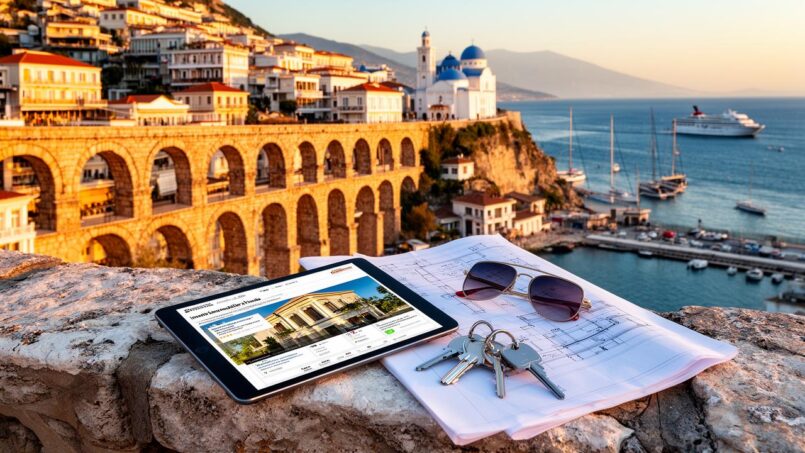
Located on the northern coast of the Aegean Sea in Eastern Macedonia, Kavala serves multiple functions: commercial port, tourist town, administrative center for northern Greece, and a logistics hub in the making. The city is built amphitheater-style around a bay facing the island of Thassos. Its often steep streets offer sweeping views of the sea, the Byzantine castle, the Kamares aqueduct, and the former tobacco warehouses, now converted into character lofts.
The quality of life is a major selling point for investors targeting long-term rentals or personal relocation. The city offers:
– a historic center (Panagia / Palia Poli) with fortress, neoclassical mansions, Ottoman mosques, and museums (tobacco and archaeology);
– a lively waterfront, a large marina, and a promenade lined with cafes and restaurants;
– quality Blue Flag beaches accessible on foot from the center;
– nearby natural attractions (Nestos River wetlands, hiking trails, renowned beaches like Ammolofoi, Keramoti, and Nea Iraklitsa).
The region benefits from solid infrastructure that enhances quality of life: a campus of the International Hellenic University, one of the most advanced general hospitals in northern Greece, private diagnostic centers, fiber optics, and the “Alexander the Great” International Airport (KVA) 20 minutes away. This airport is connected to several European hubs and is seeing increasing business aviation traffic.
The local economy rests on a diversified base: commerce, cargo port, fishing, tourism, agriculture, oil-related activities, and public services. Kavala thus functions as a true year-round city, which is essential for rental demand stability.
A Real Estate Market in Controlled Overdrive
The numbers confirm the strong momentum. Since 2018, housing prices in Kavala have surged by more than 63%. After a long period of stagnation around €1,000/m², the curve took off starting in 2023.
Recent Price Trends
The trajectory in recent years can be summarized as follows:
| Year / Period | Indicative Average Price (€/m²) | Approx. Annual Change |
|---|---|---|
| 2018 | ~1,000 | — |
| Low point (≈ 2020-21) | ~950 | Slight decline |
| 2023 | ~1,300 | Rise resumes |
| 2024 | ~1,600 | +23% |
| August 2025 | ~1,870 | +15% to 21% depending on source |
| Early 2026 | peak +12% over a few months |
In the municipality of Kavala, the average asking price in May 2025 is around €1,699/m², up nearly 20% from a year earlier. For the entire prefecture, the average reaches approximately €1,888/m² in August 2025, a +15.7% increase over twelve months.
Coastal apartments with high rental demand in Greece typically trade between €1,800 and €2,400/m².
Internal Disparities Within the Prefecture
Not all areas of the prefecture are moving at the same pace. Data from 2025 highlights very marked gaps:
| Municipality (Kavala Prefecture) | Average Sale Price (€/m²) – August 2025 |
|---|---|
| Orfano | 2,557 |
| Eleftheres | 2,536 |
| Thassos | 2,196 |
| Keramoti | 1,945 |
| City of Kavala | 1,791 |
| Pieria | 1,055 |
| Filippoi | 976 |
| Chrisoupoli | 937 |
| Eleftheroupoli | 757 |
| Oreino | 490 |
The city of Kavala is thus neither the most expensive nor the cheapest market in the prefecture, but it concentrates the main value drivers: port, urban renewal projects, growing tourism, and heavy infrastructure.
An Increasingly Selective Market
The broad price increase across Greece (about +85% in the north since 2017) is pushing the country into a mature phase. Professionals describe a context where “buying at random” is no longer enough. The structural supply deficit – it is estimated that around 5,000 new homes are needed annually nationwide – supports prices, but investors must now choose their micro-locations, property types, and strategies (long-term, renovation, Golden Visa) with much greater care.
In Kavala, some owners are anticipating further price increases and are deliberately delaying sales, which is reducing the supply of quality properties. Prices have risen sharply, with villas moving from €250,000 to €400,000 or more. Buildable land rarely trades below €150–200/m², and well-located plots are becoming increasingly scarce.
Projections for 2026 point to further price growth in the 6% to 10% range. At the same time, more than one observer notes the risk of “overheating” and the possibility of a pause or technical correction, especially if the international market normalizes.
Rental Market: Mixed Yields but Pockets of Performance
For an investor, the question is not just capital appreciation, but also rental yield. In Kavala, the picture is nuanced: rents are rising much more slowly than purchase prices, which compresses gross yields in some areas, while other segments remain very profitable, especially for well-located modern apartments.
Residential Rent Levels
Rents depend heavily on the neighborhood, size, and condition of the property. Market figures generally show:
| Property Type | Location | Average Monthly Rent (approx.) |
|---|---|---|
| 1-bedroom | City Center | ~€325 (range €300–550) |
| 1-bedroom | Outskirts | ~€250 (€200–400) |
| 3-bedroom | City Center | ~€550 (€450–850) |
| 3-bedroom | Outskirts | ~€400–420 (€350–500) |
On average, the prefecture sees a rent of about €6.3/m² per month in 2025, after a slight decline from €6.44/m² in 2024. Over two years, the peak was just over €6.5/m², with a low around €5.6/m².
This nearly flat trend contrasts with the surge in sale prices. The result: average gross yields broadly between 3.3% and 4.3%, with disparities depending on the apartment type.
| Apartment Type | Typical Purchase Price | Estimated Average Gross Yield |
|---|---|---|
| 1-bedroom | ~€115,000 | ≈ 4.2% |
| 2-bedroom | ~€165,000 | ≈ 3.5% |
| 3-bedroom | ~€240,000 | ≈ 2.8% |
In the city center, some calculations show gross yields around 3% for larger properties, a level closer to mature Western European markets.
Pockets of High Yield
This overall picture should not mask significantly more attractive segments. Modern, energy-efficient apartments (Class A or A+), located in urban regeneration areas or near the waterfront, can generate estimated gross yields between 5.8% and 7.2%. This outperformance is due to several factors:
The market is characterized by a shortage of high-end housing for solvent local clientele, coupled with strong demand from expatriates and international executives, stimulated by projects such as the “Philippos II” port expansion and the Egnatia Aviation Academy. The tourist season now extends into November, while “workation” and remote work stays are growing, attracted by the moderate cost of living and good internet connectivity.
For an investor targeting these specific segments (contemporary 2- to 3-bedroom apartments near the port or bay, with good amenities), Kavala can currently deliver higher net yields than many more expensive southern Greek destinations.
Short-Term Rentals: A Powerful but Regulated Market
Analysis of seasonal rental platforms confirms strong demand. Approximately 800 active listings are recorded in the Kavala region, more than 90% on Airbnb, and an overwhelming majority (nearly 97%) are entire homes. The core inventory consists of small units: 1-bedroom and 2-bedroom apartments account for over 80% of listings.
This phrase indicates the presence of data on performance, without specifying a numerical value.
| STR Indicator (Airbnb & co.) | Median / Average Value |
|---|---|
| Median occupancy rate | ~31% |
| Top 25% occupancy rate | ≥ 53% |
| Top 10% occupancy rate | ≥ 72% |
| Median monthly revenue | ~$908 |
| Top 25% revenue | ≥ $1,659 |
| Top 10% revenue | ≥ $2,591 |
| Median ADR (avg. price/night) | ~$85 |
| Top 25% ADR | ≥ $114 |
In peak season (June to August), the combination of occupancy rates above 60% and an ADR exceeding $100 results in monthly revenues that approach or exceed $2,000 for the best properties, with peaks of over 80% occupancy among the most professional operators.
Specialists in short-term management indicate that using an experienced manager can increase revenues by about 40%, by optimizing listing quality, yield management, and calendar scheduling.
A major factor for foreign investors: the new rules related to the Golden Visa. Properties purchased under the program in dense urban areas like Kavala are subject to a freeze on short-term rentals. Using a Golden Visa-eligible asset on Airbnb exposes you to a €50,000 fine and risks to your residency permit. For such properties, you must plan for a long-term or corporate rental model, not pure seasonal lettings.
Golden Visa in Kavala: Strategic Arbitrage and €250,000 Niches
For non-Europeans, access to the Greek Golden Visa is a key motivation. However, the reform of investment thresholds has redrawn the map of opportunities. While in metropolises like Athens or Thessaloniki the ticket has risen to €800,000 for a single property of at least 120 m², Kavala is in a more advantageous position.
Applicable Thresholds in Kavala
Two main regimes coexist in the city:
| Regime / Zone | Minimum Investment | Main Conditions |
|---|---|---|
| High-demand urban market | €800,000 | Single residential property, ≥ 120 m² |
| Regional growth zone | €400,000 | Single residential property, ≥ 120 m² |
| Strategic “€250,000” exception | €250,000 | Conversion commercial→residential or listed building, no minimum area |
In practice, most standard apartments in the municipality fall under the €400,000 threshold with a minimum area of 120 m² for a single lot. This rule has helped stimulate the development of large new homes in programs like “The Nea Polis,” designed to meet these criteria (A+ residences with comfortable sizes, often in high-end gated communities).
An exception to the minimum 120 m² threshold for the Golden Visa exists for two types of operations: converting commercial spaces into residential units and restoring listed buildings (heritage properties). These investments, starting at €250,000, allow the acquisition of smaller properties, such as lofts in former warehouses or apartments in neoclassical buildings, particularly in neighborhoods like Panagia or near the port.
This “strategic exception” has become the driver of the revival of historic buildings. Many investors are transforming former 19th-century tobacco warehouses into luxury lofts, perfectly aligned with international demand for character properties, while remaining eligible for the Golden Visa at a lower threshold.
Constraints to Consider
The Greek Golden Visa remains one of the most flexible programs in Europe (five-year renewable residence permit, access to the Schengen Area, family reunification for spouses, children up to 21, and parents on both sides). However, the new regulations impose some safeguards:
To be eligible, the property must be a single lot and not a fragmented portfolio. Its use for short-term rentals is regulated in dense urban centers. Investments require full traceability, including a digital cadastre and 100% digital transfer. The application process, accelerated in Kavala (90–120 days on average), requires rigorous legal preparation.
For more limited budgets, the €250,000 route via renovation or conversion is particularly interesting in Kavala, as it aligns with a stated municipal policy of redeveloping tobacco heritage and old neighborhoods.
Where to Invest in Kavala: A Detailed Look at Neighborhoods
Kavala’s topography, built in tiers around the bay, creates a complex real estate geography: some areas enjoy spectacular panoramic views, others are primarily industrial, and still others are undergoing full renewal. The 2026 master plan encourages investors to target so-called “Sustainable Urban Development” zones rather than the more industrial eastern fringe.
Palio and Profitis Ilias: High-End Amphitheater Villas
Set back from the center, Palio and Profitis Ilias concentrate a good share of contemporary high-end villas, often built in steps with large terraces facing the sea and the island of Thassos. In Palio, a typical example is a villa of about 260 m² over two levels on a 1,100 m² plot, with living room, fireplace, separate kitchen, multiple bathrooms, storage spaces, and large sea-view balconies, priced around €1,000,000.
These areas target an affluent clientele seeking very high-end primary or secondary residences. For an investor, gross rental yields may be lower, but a long-term approach can be justified by asset appreciation, land scarcity, and strong foreign demand.
Panagia / Old Town: Historic Charm and €250,000 Golden Visa
The Panagia district, which encompasses the fortified old town, tobacco warehouses, and Ottoman or neoclassical mansions, is at the heart of the conversion strategy. It is here that many projects take advantage of the €250,000 threshold to restore listed buildings into luxury residential lofts, highly sought after by an international clientele looking for character.
The area’s tourist appeal – narrow alleys, fortress, museums, overlooking views of the port – makes it a prime location for high-end seasonal rentals, subject to regulatory compliance if the property is linked to a Golden Visa. Accommodation prices can reach €150–250/night in high season for prestigious villas or lofts, demonstrating the potential.
Perigiali and “The Nea Polis”: Laboratory of the New City
East of the center, the Perigiali district is home to an iconic urban regeneration project: “The Nea Polis”. This investment of about €150 million aims to create gated residential communities with high energy performance, modern amenities, and secure access, positioned to meet Golden Visa criteria (large areas, high comfort level).
Budget in euros for the modernization of drainage and stormwater networks, co-financed by the ERDF, to transform Perigiali into a sustainable urban zone.
For an investor, the combination of still-reasonable prices (compared to southern Greek coastal standards), new A+ homes, and proximity to the logistics port creates an ideal profile for executive rentals and long-term value.
Agia Varvara, Kalamitsa, Depos: Classic Residential Options
Neighborhoods like Agia Varvara, Kalamitsa, and Depos offer opportunities for mid-sized apartments, often between 50 and 100 m², well-suited to local clientele or long-term assignment executives.
In Depos, an apartment of about 96 m² is offered at €180,000. It includes a living room, separate kitchen, two bedrooms, one bathroom, and storage space. With a price per m² below €2,000 (about €1,875/m²), this purchase can target an attractive yield by dedicating it to long-term rental, where demand is stable.
Kalamitsa, with its urban beach and family-friendly atmosphere, shows remarkable short-term occupancy rates (sometimes around 85% even into the shoulder season). Even though the new tourist rental rules must be taken into account, the neighborhood remains very promising for hybrid strategies (medium-term, remote workers, families on extended stays).
Nea Peramos and the Western Shore: Beach and Upscaling
Moving a bit further west from the city, Nea Peramos offers a sought-after seaside environment with privileged access to Ammolofoi beach. The area is identified as one of the poles with the highest tourist growth potential, particularly among travelers seeking authenticity.
For the investor, these localities combine prices still lower than the more famous islands, strong tourist seasonality but an extended season (April–November), and a client profile that includes both Greek and foreign visitors, cushioning fluctuations in international demand.
Heavy Infrastructure: Why the Port Changes Everything
If Kavala is attracting so much investor attention, it is also because the city is at the center of several structuring projects on a regional and even European scale.
The “Sea2Sea” Corridor and Rail to the Port
The centerpiece is the “Sea2Sea” corridor, a multi-billion euro project aimed at connecting the Aegean Sea to the Black Sea via a rail and logistics axis bypassing the Bosphorus. At the heart of this system: the “Philippos II” cargo port in Kavala, connected to the national network by a “Railway to the Port” project worth around €240 million, linked to Bulgaria.
Minimum amount of mandatory investments for the extension of the Philippos II port terminal in Kavala.
The concession runs for forty years, with total estimated royalties of €34 million for the Greek state. A sign of the project’s strategic importance, a large portion of the revenue is allocated to the modernization of the “Apostolos Pavlos” passenger port, whose master plan includes developing a marina and improving the fish market.
Impact on Rental Demand
These transformations are driving the arrival of a sustainable contingent of executives, technicians, logistics managers, and maritime company personnel, looking for quality housing, often for periods of several months or years. This is structuring a real market for “corporate rentals,” less sensitive to tourist seasons and willing to pay a premium for recently built, tastefully furnished apartments near the port or with good access.
Several drinking water network projects are funded at over €5 million each by European funds.
For an investor, the combined effect of these projects solidifies Kavala in the category of “structurally demand-driven” markets, where rental vacancy can remain relatively low provided a suitable location is chosen.
Cost of Living, Taxation, and Financing: The Practical Framework
Beyond gross profitability, the reality of an investment also depends on the ability to finance the acquisition, cover costs, and navigate the Greek tax system.
Cost of Living: A Competitive Advantage
Kavala has a cost of living significantly lower than Athens, Thessaloniki, and even the Greek average (about 6.3% cheaper than the rest of the country). For a single person, the average monthly budget, excluding rent, is estimated around €570; for a family of four, around €1,730, also excluding rent. Including housing, it typically comes to about $1,000 per month for a single person and $2,450 for a family of four, according to international indices.
Basic utility bills (electricity, heating, water, garbage) for a standard 80–90 m² apartment generally range between €140 and €300 per month. High-speed internet costs on average €20 to €40 per month, and a mobile phone plan (voice + data) is around €18.
Rents in Greece must be assessed relative to the local median net salary, which is between €730 and €880. This situation makes Greek households very sensitive to increases, but represents an attractive argument for foreign retirees or remote workers from higher-cost countries.
Investor Taxation
On purchase, the investor pays a transfer tax of 3.09% on the objective value (or the price, if higher), plus notary fees (about 1–2%), legal fees (often around 1%, but variable), and agency commission (usually 2% from both buyer and seller). The total acquisition cost is generally between 8% and 10% of the property price.
Each year, the owner pays ENFIA, the Greek property tax. It consists of a main tax per square meter, with rates depending on the zone, use, floor, building age, and ownership percentage, and a supplementary tax above a certain real estate asset threshold (threshold of approximately €500,000 for individuals, progressive rates up to ~1.15% on the highest bracket). A municipal tax (TAP) of around 0.025% to 0.035% of the objective value is added via the electricity bill.
Rental income in Greece is subject to Greek income tax at progressive rates. A flat deduction of 5% is applied to the gross rental amount. Additionally, certain energy renovation expenses may qualify for tax deductions spread over several years. For a non-resident investor, only the portion of income from Greek sources is taxable in Greece. It is crucial to consult the applicable bilateral tax treaties to prevent any risk of double taxation.
Upon resale, a 15% capital gains tax is provided for, but its application is regularly suspended by the authorities. Even when applicable, ownership exceeding five years may qualify for an exemption. As these rules are subject to change, guidance from a tax attorney is strongly recommended.
Access to Credit
Greek banks grant mortgage loans to foreign buyers, but with stricter criteria than for residents. A non-resident should expect:
– a loan-to-value (LTV) ratio limited to 50–65%;
– a down payment of at least 35–50%;
– a requirement for stable income documented over at least two years;
– a 20-year fixed rate around 4.3–5%.
In practice, many foreign investors prefer financing from their home country or purchase with cash, especially in the €150,000–€300,000 price range.
Investment Strategies Tailored to Kavala
Based on market data and the regulatory context, several strategies emerge for those looking to invest in Kavala.
50–70 m² Apartments Near the Port and Tourist Areas
This approach, frequently recommended by local professionals, targets mid-sized 1- to 2-bedroom apartments, ideally located near the port, center, and waterfront. The arguments:
– high resale liquidity (these are the most sought-after sizes by local and foreign households);
– good adaptability to both long-term and medium-term rentals (expatriates, remote workers, students);
– gross yields that can approach 5–6% for well-managed modern products.
In this segment, prioritize recent buildings (Energy Class A or A+), even if it means paying 12–15% more per m² than an older building, because running costs will be lower and demand stronger.
Betting on Urban Regeneration Projects
Investing in Perigiali and “The Nea Polis” means seeking the first wave of capital appreciation. You pay more per m² than for an aging peripheral apartment, but you position yourself in a district where the city and region are investing heavily in infrastructure (sanitation, roads, public spaces) and where the Golden Visa and corporate clientele are concentrated.
This strategy is consistent for profiles that some analysts call “Regeneration Pioneers”: investors willing to tie up significant capital, with a long-term horizon and tolerance for sometimes modest immediate rental yields, but betting on future value.
Analysts
Heritage Renovation and Tobacco Lofts
Rehabilitating tobacco warehouses or historic buildings in Panagia is suited to another profile, the “heritage niche”. It requires:
For this type of project, you should budget renovation costs of approximately €600 to €800 per square meter. It is also necessary to anticipate increased administrative complexity, especially for listed buildings or those subject to strict conservation standards. Finally, the project must be designed to target a high-end rental market, such as cultural tourism or an international clientele.
In return, these operations benefit from the reduced Golden Visa threshold of €250,000, bypass the 120 m² constraint, and result in nearly unique, highly differentiated products in investment portfolios.
Strategic Base: The “Northern Gatekeeper” Approach
Some investors seek less of a maximum yield and more of a foothold in northern Greece: a pied-à-terre that is more pleasant and manageable than Thessaloniki, but better connected and more urban than the islands. For them, Kavala plays the role of a “Northern Gatekeeper”: a personal base that can be rented out part of the year, with strong future liquidity thanks to the city’s rising profile.
This profile will be attentive to the steepness of the streets (topography can be a challenge for people with reduced mobility), proximity to health services, and the quality of beaches accessible on foot.
Risks and Points of Vigilance
Despite its strengths, Kavala is not a risk-free market. The savvy investor must keep several elements in mind.
First, the rapid price increase makes a consolidation scenario plausible, especially if foreign investment flows stabilize after their 2024 peak. A sharp downturn is not the central scenario, given the supply shortage and structuring projects, but a period of price stagnation over a few years is possible.
The freeze on seasonal rentals for new properties acquired via the Golden Visa in dense zones limits Airbnb-type strategies. Investors must therefore orient their business plans toward long-term or corporate rentals. Any violation exposes them to heavy fines and may have consequences on their resident status.
The city also has a heavily industrialized eastern part on the bay. Buying in the wrong location, without considering the 2026 urban development plan, could lead to a less liquid property with more fragile rental demand. Similarly, properties too far from the port or beaches carry a significantly higher risk of rental vacancy and require professional management.
To these elements add more general constraints in the Greek market: high construction costs, shortage of skilled labor, administrative red tape in obtaining permits, and regional geopolitical risks.
Conclusion: A Hidden Gem to Approach with Method
Kavala presents itself today as a “hidden gem” in the European real estate market: a port city in full transformation, placed at the center of a strategic logistics corridor, endowed with rare historical heritage, quality coastline, and an attractive quality of life, all with prices still below the major southern Greek markets.
Kavala’s real estate market data reveals strong price growth (+63% since 2018), a stabilization of rents at an affordable level, growing foreign demand, an extended tourist season, and a solid executive rental market around the port and institutions. To succeed, the investor must avoid speculative reflexes, rely on reliable local professionals (agencies, managers, lawyers), and make careful choices.
– locations aligned with major development axes (port, Perigiali, center, structured seaside neighborhoods);
– property types suited to demand (modern 1- to 2-bedroom apartments, sea-view villas, heritage lofts);
– a strategy consistent with regulations (long-term Golden Visa, corporate rental, heritage investment).
2026 appears as a pivotal year to verify the sustainability of current growth. But the fundamentals – scarcity of qualitative land, heavy public investments, growing attractiveness of northern Greece, and a favorable price/quality-of-life arbitrage – suggest that Kavala will continue to establish itself as a Mediterranean real estate destination to watch very closely.
Disclaimer: The information provided on this website is for informational purposes only and does not constitute financial, legal, or professional advice. We encourage you to consult qualified experts before making any investment, real estate, or expatriation decisions. Although we strive to maintain up-to-date and accurate information, we do not guarantee the completeness, accuracy, or timeliness of the proposed content. As investment and expatriation involve risks, we disclaim any liability for potential losses or damages arising from the use of this site. Your use of this site confirms your acceptance of these terms and your understanding of the associated risks.

Cyril Jarnias is an independent expert in international wealth management with over 20 years of experience. As an expatriate himself, he is dedicated to helping individuals and business leaders build, protect, and pass on their wealth with complete peace of mind.
On his website, cyriljarnias.com, he shares his expertise on international real estate, offshore company formation, and expatriation.
Thanks to his expertise, he offers sound advice to optimize his clients' wealth management. Cyril Jarnias is also recognized for his appearances in many prestigious media outlets such as BFM Business, les Français de l’étranger, Le Figaro, Les Echos, and Mieux vivre votre argent, where he shares his knowledge and know-how in wealth management.





