
 Published on and written by Cyril Jarnias
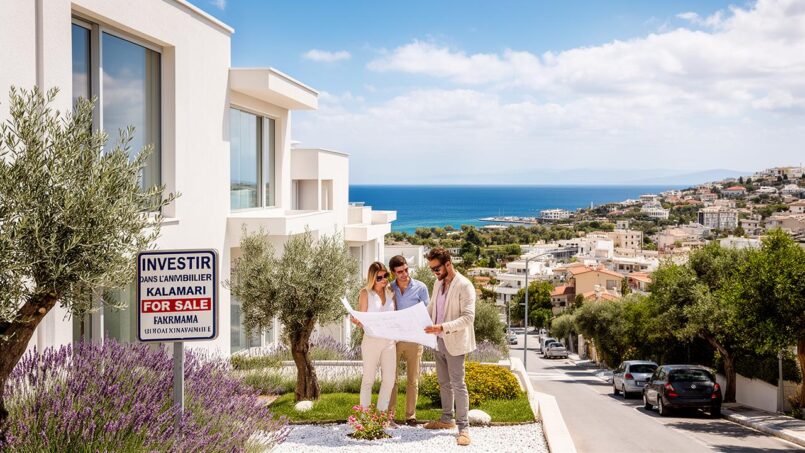
Kalamariá has established itself as one of the most sought-after real estate markets in Thessaloniki. A coastal neighborhood, high level of services, arrival of the metro, strong rental demand, and continuous price increases: all the ingredients come together to make it a key territory for investors, whether Greek or international.
Investing in Kalamariá requires analyzing precise figures, tax specifics, local dynamics, and concrete risks, beyond the flattering portrait of the destination.
Kalamariá, a Prized Coastal Neighborhood of Thessaloniki
Located east of Thessaloniki, Kalamariá is a district directly integrated into the urban area but with a distinct personality. The neighborhood combines a decidedly residential character with a sought-after seaside facade, waterfront promenades, marinas, and a dense commercial fabric.
Kalamariá is considered one of the best neighborhoods in Thessaloniki for residents and expatriates. This reputation is due to several advantages: its proximity to the city center, excellent public transportation connections, numerous parks and sports facilities, renowned schools, and a comprehensive range of shops and leisure activities. This combination offers a high quality of life, suitable for both families and young professionals.
The coastal part, particularly in Aretsou, Nea Krini, and Karabournaki, enjoys an excellent reputation among foreign communities settled in Thessaloniki. These areas offer a quieter daily life than the historic center, but with quick access to the city, the airport, and, tomorrow, the metro.
A High-End and Strained Real Estate Market
Kalamariá clearly sits in the top tier of Thessaloniki neighborhoods, both in terms of purchase prices and rents. It offers a wide range of properties: new apartments with views of the Thermaic Gulf, renovated 1970s–80s buildings, single-family homes and small houses on quieter streets, offices and shops on major thoroughfares like Komninon or Ethnikis Antistaseos.
Price Levels and Recent Trends
The most recent data show a market in strong growth.
| Indicator (Kalamariá, Residential) | Value |
|---|---|
| Average sale price (Jan. 2025) | 2,749 €/m² |
| Average sale price (Jan. 2026) | 2,964 €/m² |
| Annual price increase (2025 → 2026) | +7.82% |
| 2-year low (March 2024) | 2,677 €/m² |
| 2-year high (Jan. 2026) | 2,964 €/m² |
In central Kalamariá, levels are even more significant: the area ranks among the three most expensive in the urban area, with prices ranging between 2,800 and 3,100 €/m², and a cumulative appreciation estimated at 45–55% over the past five years for the neighborhood center.
Median price per m² in Thessaloniki at end of 2025, with Kalamariá above, ranging from 2,200 to 3,800 €/m².
Data from a major platform also indicate that the higher the number of rooms, the higher the price per square meter, reflecting strong appetite for large family apartments in this area.
| Apartment Type (Kalamariá) | Median Price per m² |
|---|---|
| 2-room | 2,632 €/m² |
| 3-room | 2,975 €/m² |
| 4-room | 3,196 €/m² |
In addition, the luxury segment is particularly dense for a neighborhood of modest size. On an international platform like JamesEdition, over 70 high-end properties for sale are listed in the municipality, with an average price around $704,673 and properties that can exceed $2.5 million. Single-family homes dominate this segment, along with high-end apartments often featuring an elevator, air conditioning, balcony, and fireplace.
A Market Driven by Quality of Life and Land Scarcity
Several factors explain this upward price pressure in Kalamariá:
The local real estate market is characterized by a stock of good-quality housing, modernized or undergoing renovation, and limited developable land, especially near the waterfront. It benefits from sustained demand from creditworthy households seeking a specific quality of life (proximity to schools, shops, and promenades). This dynamic is accentuated by a concrete anticipation effect linked to the metro extension, which revalues the neighborhoods served by the new line.
Buyers are willing to pay a premium for an apartment in a recent, well-insulated building with parking and easy access to transport or services. This “quality-of-life premium” logic is particularly pronounced in Kalamariá, and it is reflected in how quickly well-positioned properties sell.
A Deep and Dynamic Rental Market
Investing in Kalamariá is not just about betting on price increases: the rental market is also very strong, whether for long-term rentals, furnished rentals, or seasonal rentals near the waterfront.
Rent Levels and Trends
Data over two years show steady rent increases in a context of strong demand.
| Indicator (Kalamariá, Residential) | Value |
|---|---|
| Average rent (Jan. 2025) | €8.55/m² / month |
| Average rent (Jan. 2026) | €9.16/m² / month |
| Annual rent increase (2025 → 2026) | +7.13% |
| 2-year low (March 2024) | €8.14/m² / month |
| 2-year high (Nov. 2025) | €9.17/m² / month |
| Average rent Center area (Jan. 2026) | €9.16/m² / month |
In the center, data from mid-2025 confirm this trend:
| Central Kalamariá | June 2024 | June 2025 | Change |
|---|---|---|---|
| Average rent (€/m² / month) | 8.31 | 8.63 | +3.85% |
| Average sale price (€/m²) | 2,711 | 2,844 | +4.91% |
When broken down by property type, the average monthly rents observed in the neighborhood give a concrete picture of the rental entry point.
| Apartment Type (Kalamariá) | Average Monthly Rent | Number of Listings |
|---|---|---|
| 1-bedroom | €496 | 10 |
| 2-bedroom | €984 | 20 |
| 3-bedroom | €1,053 | 35 |
| 4-bedroom | €1,666 | 3 |
High-end apartments or very well-located ones, especially in the most expensive areas of Thessaloniki like Kalamariá, can reach – or exceed – €700 to €900 per month, and some luxury furnished properties rent for much more, up to several thousand euros in exceptional configurations.
Rental Demand: Profiles and Criteria
Rental demand in Kalamariá is described as “structurally strong.” It is fueled by several segments:
Developing neighborhoods in Alicante attract various population profiles: families seeking quality schools, green spaces, and safety; employees looking to reduce their commute thanks to the future metro; students or young professionals preferring a well-served residential environment over the noisy city center; and expatriates prioritizing proximity to the beach and a relaxed atmosphere.
Tenants are increasingly demanding on certain criteria: recent renovation, good energy performance, independent heating (gas or other), air conditioning, double glazing, an elevator, a parking space, and quick access to transport and main roads. Properties that meet these features rent quickly, often within a few weeks, sometimes days, and allow owners to charge higher rents.
Conversely, old, unrenovated apartments see their vacancy periods lengthen. The market thus operates at two speeds, with a real premium placed on property quality, which must be factored into any investment strategy in Kalamariá.
Yields: More of a Wealth-Building Area than a “Gross Yield” Play
On a national scale in Greece, average gross yields hover around 4.8% and can, in the best cases, exceed 6.5%. Thessaloniki, especially in its more affordable neighborhoods, even stands out as one of the most profitable rental markets in the eurozone, with gross yields potentially reaching 6.5 to 9%.
Kalamariá is classified in the category of areas with relatively low gross yields, around 3 to 4.5%, for a simple reason: prices have risen faster than rents. In other words, you pay a high price per square meter for a rent that, although high, does not generate the same yield percentages as in the popular suburbs.
Kalamariá
This positioning does not mean you should avoid Kalamariá for a rental investment. It simply implies that you are more in a “wealth-building + value growth” profile than in a purely “cash-flow” oriented strategy. For investors targeting medium-term appreciation, combined with deep rental demand and low vacancy risk, the neighborhood remains particularly attractive.
The Decisive Role of the Thessaloniki Metro Extension to Kalamariá
The variable that changes everything in the Kalamariá equation is the metro. The extension of Line 2 to the eastern coast of the city is arguably the main catalyst for price increases and demand reinforcement.
A Structuring Project: Five New Stations at the Heart of Kalamariá
The so-called Kalamaria extension (Line 2) adds nearly 4.6 to 4.8 km of tunnels and five underground stations: Nomarchia, Kalamaria, Aretsou, Nea Krini, and Mikra. Heavy construction (tunnels, structural work) is largely complete, technical tests began in late 2025, and commercial opening is announced for February 2026.
This extension extends the existing line from Nea Elvetia to Mikra, at the gateway to the corridor leading to the airport. Mikra station is set to become a major intermodal hub, with connections to airport buses and regional coaches. The fully automated, driverless line is expected to allow frequencies of 3.5 minutes during peak hours, with a target of 90 seconds in the long term.
The estimated travel time between Mikra and the city center with the new project, compared to 35 to 50 minutes currently.
Expected Impact on Property Prices
The Thessaloniki metro has already shown, on existing sections, its ability to drive up prices in served areas, with increases potentially reaching +30% in some neighborhoods. For the extension to Kalamariá, analyses converge on a significant impact:
| Estimated Metro Impact on Prices in Served Areas | |
|---|---|
| Expected increase near new stations | +10 to +15% |
| Overall effect on served areas | +5 to +15% |
| Expected annual growth in Kalamariá (2026) | ~8 to 12% (high end) |
| Estimated annual increase in some zones (Aretsou, Nea Krini, Mikra) | 12 to 15% |
Kalamariá is thus ranked among the Thessaloniki neighborhoods where prices are rising fastest as 2026 approaches. The metro opening is described as the biggest “trigger” for buyer demand across the entire city, and more broadly as the most influential infrastructure project on real estate prices in Greece at this time.
Addresses near future stations will benefit from accelerated revaluation, interesting for any type of investment.
Properties intended for personal occupancy see their value increase with improved transport accessibility.
Rental demand is strongly correlated with transport connections, promising solid rental yields.
Addresses within walking distance of Aretsou, Nea Krini, Kalamaria, Nomarchia, and Mikra stations are particularly affected.
Urban and Tourism Effects
Beyond the strictly real estate impact, the metro extension to Kalamariá is set to transform how the eastern waterfront is used. Direct access to the seafront, the Nea Krini promenade and fish taverns, and better connections to marinas will promote a rise in leisure activities.
The project also aims to reduce the number of private vehicles on the road each day by 12,000, with an announced reduction of 43 tonnes of CO₂ per day. Decreased traffic on major coastal roads and improved air quality will further enhance the neighborhood’s residential appeal, which in turn will translate into an additional premium for well-located properties.
Investment Strategies in Kalamariá: What to Buy and for What Goal?
A single neighborhood can accommodate several investor profiles, from the owner-occupier aiming for a quality primary residence to the landlord seeking a sustainable income stream. In Kalamariá, it is useful to distinguish wealth-building logics from more opportunistic strategies.
Buying to Live In: Securing a Prime Location
For those considering Kalamariá as a place to live, the priority naturally goes to daily comfort. The most sought-after properties in this context are:
– 3- or 4-room apartments in recent or renovated buildings, ideally with good energy performance (rating A, A+, or at least B),
– a location near a future metro station or main bus routes,
– the ability to easily walk to schools, parks, and shops,
– a parking space or garage, which has become a decisive criterion in a neighborhood where parking is highly sought after.
Sale price of a renovated 119 m² apartment 70 meters from the sea in Karabournaki.
In this residential perspective, the prospect of price increases linked to the metro adds an extra argument: buying before the actual opening can lock in a price before a new wave of revaluation.
Buying to Rent Long-Term: Aiming for Stability
For a classic rental investor, Kalamariá’s strength lies in three main elements: deep and solvent rental demand, structurally low vacancy for quality properties, and a neighborhood considered a “safe bet” within Thessaloniki.
The most relevant segments in this case are:
– apartments of 60 to 90 m², market standard, with 2 or 3 bedrooms, an elevator, and independent heating,
– homes near Aretsou, Nea Krini, or Mikra stations, which attract families and employees using public transport,
– recently renovated properties with good insulation and modern amenities (air conditioning, double glazing, armored door).
The total return over five years (appreciation + rents) deemed realistic for renovated apartments in the best Thessaloniki neighborhoods.
Investing in High-End and Waterfront Properties
Kalamariá also hosts a very active premium submarket, particularly around Karabournaki, Nea Krini, and the vicinity of the marina. Investors then target:
– large apartments with sea views,
– houses and villas of 250 to over 600 m² with a garden, possibly a pool, ample parking,
– properties combining use as a secondary residence with seasonal or medium-term rental.
Products listed internationally (e.g., a 805 m² villa with 5 bedrooms and 5 bathrooms for around $2.8M) are clearly aimed at a high-net-worth clientele, often international, who see Kalamariá as a quieter and more affordable alternative to certain neighborhoods in Athens or the most expensive Aegean islands.
In this market segment, gross rental yields are below the national average. The investment is primarily driven by a logic of long-term wealth appreciation and geographic portfolio diversification.
Seasonal and Short-Term Rentals: Potential, but Regulatory Framework to Watch
Proximity to the sea and Thessaloniki’s overall tourist appeal make Kalamariá a promising ground for short-term rentals. Apartments near the waterfront, served by the future metro, are particularly well-suited for this use.
The Greek regulatory context is, however, evolving rapidly regarding furnished tourist rentals. The government tends to further regulate this type of activity, notably through:
– increased safety and quality requirements,
– strengthened tax controls made possible by data digitization and the national MIDAS platform,
– specific rules for Golden Visa investors, who in some cases are no longer allowed to rent out their properties on a short-term basis.
It is therefore crucial for an investor targeting seasonal rentals in Kalamariá to engage local advisors (lawyer, tax specialist, specialized agency) to structure the activity compliantly, optimize taxation, and limit the risk of reclassification as a hotel business subject to VAT.
Macroeconomic and Tax Environment: What an Investor Needs to Know
Investing in Kalamariá means investing in Greece. It is therefore essential to place the neighborhood within the national context regarding growth, property prices, taxation, and regulation.
National Trends and the Thessaloniki Market
Nationally, residential prices have risen by about 14.5% since 2020 and are expected to increase by a further 3 to 6% per year in 2026, according to projections. Some observers believe the market is now “overvalued,” but without calling it a bubble, as rents and incomes remain broadly in line with prices, especially in the provinces.
Thessaloniki, and Kalamariá in particular, are outperforming the national average. Over the past decade, city prices have surged by about 70% in nominal terms and 45% in real terms (after inflation). In 2025 alone, Thessaloniki recorded an increase of around 10 to 11%, higher than Athens. The combination of a lower price base, metro construction, development of the port logistics, and student demand (over 88,000 students at Aristotle University) explains this dynamic.
Real Estate Taxation: Key Points to Watch
Greece has undertaken a deep reform of its real estate tax system, with extensive digitization of data and increased cross-referencing of information. For an investor in Kalamariá, several mechanisms need to be considered.
Annual Property Tax (ENFIA)
All property owners pay an annual property tax (ENFIA), calculated based on location, size, floor, building age, and use. The effective rate generally ranges between 0.15% and 0.60% of the property’s tax value. A reduction scheme is available for homes insured against natural disasters, with discounts of 20% to 10% depending on the insured value.
Tax values (“objective values“) are frozen until 2027, providing a degree of medium-term stability. From 2026, a new approach based on market values is expected to be gradually implemented via a modernized tax cadastre.
Purchase Taxes
For the purchase of an existing property not subject to VAT, the transfer tax is around 3.09% of the taxable value. For new constructions, a VAT rate of 24% normally applies, but a temporary suspension has been extended until December 31, 2026, for many residential programs. In practice, this means that in many cases, a new apartment in Kalamariá will be subject to the same transfer rate as existing properties during this period, improving the attractiveness of new builds for buyers.
The total transaction cost for purchasing a property, including taxes and professional fees, ranges between 7% and 10% of the property price.
Taxation of Rental Income
Rental income is taxed according to a progressive scale, with an important change effective from 2026 income.
| Rental income tax scale | Until 2025 (2025 income) | From 2026 (2026 income) |
|---|---|---|
| Bracket 1 | 15% up to €12,000 | 15% up to €12,000 |
| Bracket 2 | 35% from €12,001 to €35,000 | 25% from €12,001 to €24,000 |
| Bracket 3 | 45% over €35,000 | 35% from €24,001 to €36,000 |
| Bracket 4 | — | 45% over €36,000 |
From 2026, a practical but important detail changes: all rents must be paid through the banking system. If not, the landlord loses a 5% tax deduction on declared income. Tax transparency therefore becomes central, especially since the MIDAS system automatically cross-references cadastral, banking, and declaration data.
A scheme offers a tax exemption on rental income for 36 months for homes under 120 m² (limit raised with children) that were previously vacant or used for short-term rentals. This measure applies to three-year leases signed between September 2024 and the end of 2026, under strict conditions. It can facilitate a transition from tourist rental (e.g., Airbnb) to standard rental, particularly in areas like Kalamariá.
Capital Gains Tax on Resale
Greece applies a capital gains tax on real estate, but its application is suspended until the end of 2026. In practice, an investor buying today and selling before that date would benefit from a more favorable tax environment on realized gains, subject to legislative changes.
Golden Visa and Raised Thresholds in Thessaloniki
For non-European investors interested in the residence-by-investment program, it is essential to note that Thessaloniki, and therefore Kalamariá, is among the high-threshold zones. Since the 2024 reform (Law 5100/2024), an investment of at least €800,000 in a single residential property of at least 120 m² is required to qualify for the Golden Visa in the city.
The government has also specified that buildings converted from commercial to residential, listed buildings, and certain plots with building permits may be eligible under specific conditions, sometimes at a reduced threshold (€250,000). However, properties held under the Golden Visa can no longer be easily rented on a short-term basis, which de facto directs these investments toward primary residence, long-term rental, or secondary use.
Management, Local Agencies, and Support
A real estate project in Kalamariá, especially from a distance, often requires relying on local professionals. The district concentrates a large number of agencies and management companies, from international networks to specialized local structures.
For example, there are brands like Invista, present in Kalamariá since the early 2000s, or franchises like Aspis Real Estate, which has a wide national network and offers services ranging from property management to property valuation, including legal support. Other players have specialized in more complex operations, combining portfolio management, development consulting, energy renovation, or investment project structuring.
For a foreign investor, property management agencies offer a set of key services: property selection, technical and legal verification, rent estimation, marketing, rent collection, and ongoing management. Their compensation typically consists of management fees representing 8% to 12% of collected rents, plus a commission equivalent to half or one month’s rent when placing a new tenant.
For a non-resident owner, these costs must be factored into the calculation of net yield, knowing that, generally in Greece, the gap between gross and net yield (before income tax) is around 1.5 to 1.6 percentage points.
Kalamariá in the Thessaloniki Landscape: Comparison with Other Neighborhoods
To gauge the interest of an investment in Kalamariá, it is useful to recall how the other neighborhoods of Thessaloniki stack up.
Overview of the main Thessaloniki neighborhoods, their characteristics, and their real estate market.
High prices (≥ €3,100/m²) for renovated apartments. Strong tourist and student demand, but noisy and dense environment.
Green, elevated residential neighborhood offering panoramic views and large family homes. Prices comparable to Kalamariá.
Recent and dynamic neighborhood, mixing residential and commercial. Attracts young professionals and international residents with new housing.
Low purchase prices (€1,500–1,800/m²) and attractive rental yields (>5% gross). Less prestigious environment and specific tenant base.
Kalamariá thus stands out as a high-end compromise: more expensive than average, less profitable in gross percentage but more stable, more “prime” and supported by strong catalysts (metro, marina development, quality of life). For an investor who values investment security, resale liquidity, and the prospect of capital appreciation, this positioning makes a lot of sense.
Outlook: What Future for Real Estate in Kalamariá?
Several elements suggest that Kalamariá will continue to outperform the rest of the city in the coming years.
1. Long-lasting metro effect The opening of a heavy transport line does not only produce an initial “boost.” Experience from other cities shows that revaluation extends over several years, as residents reorganize their commutes, businesses set up around stations, and new real estate projects emerge. The municipality of Kalamariá should therefore benefit from the metro well beyond 2026, especially since land scarcity will limit mass construction.
Future berth capacity of the Kalamariá marina, increasing from the current 242 to accommodate boats up to 40 meters.
3. Limited supply of quality housing In Thessaloniki, building permits are insufficient to meet demand for modern, well-located apartments. This imbalance is particularly pronounced in central and eastern sectors like Kalamariá, where available land is scarce and new projects often sell off-plan. This relative shortage supports prices and limits the risk of overbuilding in the short term.
Greek economic growth is forecast at around 2.2%, with relatively contained mortgage rates and a political environment focused on major infrastructure, providing a more stable framework than ten years ago. Although risks persist, such as a potential rise in eurozone rates, the baseline scenario does not anticipate a massive price correction in a dynamic city like Thessaloniki.
In this context, Kalamariá appears to be a neighborhood set to remain in the top three most sought-after areas of Thessaloniki, with price appreciation expected at the high end of the range for the coming years.
Conclusion: Which Investor Profile Suits Kalamariá?
Investing in real estate in Kalamariá is not about chasing the maximum gross yield on the Greek market. It is about betting on a premium coastal neighborhood, within a city undergoing renewal, driven by a brand-new metro, high quality of life, and a waterfront being upgraded.
The neighborhood is particularly well-suited to several profiles:
The real estate market in the Thessaloniki region primarily attracts four profiles: the wealth-building investor seeking a quality, liquid property in a stable environment; the landlord-owner prioritizing regular income and solvent tenants despite modest gross yields; the foreign buyer desiring a well-located residence close to the sea and transport infrastructure; and owner-occupiers (families, working couples) wanting to combine urban life with a seaside atmosphere near the city center.
The success of a project in Kalamariá then depends on execution quality: choosing the right micro-location (ideally near a metro station), targeting an energy-efficient and well-maintained property, calibrating financing with full consideration of entry costs and taxation, and relying on local professionals for management.
In a Greek market that is generally rising but already well-valued, Kalamariá thus embodies a form of “safety premium”: you pay a high price, but for solid fundamentals. For those seeking a real estate investment that is both tangible, clear, and backed by heavy infrastructure, the neighborhood clearly deserves a spot at the top of the shortlist.
Disclaimer: The information provided on this website is for informational purposes only and does not constitute financial, legal, or professional advice. We encourage you to consult qualified experts before making any investment, real estate, or expatriation decisions. Although we strive to maintain up-to-date and accurate information, we do not guarantee the completeness, accuracy, or timeliness of the proposed content. As investment and expatriation involve risks, we disclaim any liability for potential losses or damages arising from the use of this site. Your use of this site confirms your acceptance of these terms and your understanding of the associated risks.

Cyril Jarnias is an independent expert in international wealth management with over 20 years of experience. As an expatriate himself, he is dedicated to helping individuals and business leaders build, protect, and pass on their wealth with complete peace of mind.
On his website, cyriljarnias.com, he shares his expertise on international real estate, offshore company formation, and expatriation.
Thanks to his expertise, he offers sound advice to optimize his clients' wealth management. Cyril Jarnias is also recognized for his appearances in many prestigious media outlets such as BFM Business, les Français de l’étranger, Le Figaro, Les Echos, and Mieux vivre votre argent, where he shares his knowledge and know-how in wealth management.





