
 Published on and written by Cyril Jarnias
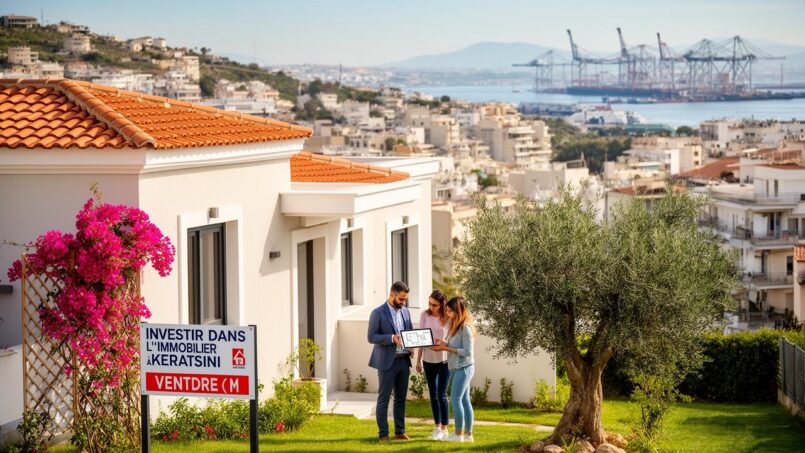
Keratsíni is increasingly attracting investors looking for a compromise between reasonable prices, decent returns, and upside potential. Located in the Piraeus area, at the heart of the main Greek port hub, the municipality now rides the wake of a Greek real estate market that is rapidly changing—more selective, yet still dynamic. Between new Golden Visa rules, favorable capital gains taxation, and gradually rising rents, Keratsíni is beginning to establish itself as a true “premium second choice” compared to Athens’ already overheated neighborhoods.
This article analyzes the local real estate market of Keratsíni, including price levels, rents, and potential returns. It also details the applicable Greek tax framework and offers concrete investment strategies for this city in 2026.
A Greek market reaching maturity, favorable to patient investors
The Greek real estate market has moved beyond the explosive catch-up phase into a period of more moderate and selective growth. National data show continuous price increases for 27 consecutive quarters, with annual growth of about 7–12% since 2022, then an expected slowdown to around 4–7% for 2026. For 2024 as a whole, the national house price index rose 8.72% nominally (5.55% in real terms), and in 2025 the trend remains solid: +7.69% year-on-year for urban housing in the third quarter.
Foreign direct investment in Greek real estate reached €2.75 billion in 2024.
For the investor, this means the era of “easy bargains everywhere” is over. Performance is now determined at the level of micro-markets and property types: some neighborhoods of Athens and Thessaloniki are rising very quickly, others stagnating, while peripheral areas like Keratsíni are beginning to catch up.
Keratsíni: an affordable market within Piraeus’ orbit
Keratsíni is located in the province of the Piraeus suburbs, alongside municipalities such as Drapetsona, Nikaia, Korydallos, Moschato, Perama, and Tavros. It is a municipality with a strong industrial and port identity, with a coastal front on the Saronic Gulf. It borders Nikaia, Korydallos, Piraeus, and Drapetsona, placing it at the heart of the labor and service pool of the port area.
The urban fabric is dense but balanced by parks, small squares, and green spaces. The waterfront offers views of the gulf and the local market is lively. Accessibility is a major asset, with proximity to the Port of Piraeus, good road connections to Athens, easy parking in inner neighborhoods, and organized parking near the port area.
Within the Athens–Piraeus conurbation, Keratsíni stands out for its attractive price-to-quality ratio. Prices are significantly lower than those of central Athens neighborhoods or already gentrified parts of Piraeus, while offering stable demand driven by families and young professionals working around the port or in central Athens.
Price levels: a still accessible market
Data from September 2025 provides a precise picture of Keratsíni:
| Indicator (Keratsíni) | September 2025 Value | Annual Change |
|---|---|---|
| Average sale price (residential) | €1,899/m² | +3.49% |
| Average listing rent (residential) | €7.92/m²/month | +4.07% |
| Sale price range | €1,498–€2,190/m² | — |
| Rent range | €3.15–€8.66/m²/month | — |
Over the past two years, the average price peaked in September 2025 (€1,899/m²) and hit its low in March 2024 (€1,713/m²). The trend is therefore upward, but without overheating, suggesting further appreciation potential, especially given Piraeus’ prospects and major metropolitan projects (Ellinikon, infrastructure upgrades).
For the investor, Keratsíni represents a “value” market with prices (around €1,900/m²) below the average for Piraeus suburbs (€2,134/m²), while benefiting from positive momentum. This position is intermediate and clearly affordable within the basin, compared to Moschato (€2,850/m²) or Ágios Ioánnis Réntis (€1,595/m²).
Focus on Keratsíni’s neighborhoods: a mosaic of micro-markets
Keratsíni is not a homogeneous market. Prices vary significantly from one sub-neighborhood to another, both for purchases and rentals. For an investor, understanding this internal geography is crucial for choosing a strategy (yield vs. capital appreciation, target tenant profile, budget).
Sale prices by sub-neighborhood
2025 data reveals a clear gradient between more “popular” areas and sectors that are already more sought-after or better located.
| Sub-neighborhood | Average sale price (€/m²) |
|---|---|
| Charavgi | 2,170–2,190 |
| Kokkinovrachos | ≈ 2,045–2,078 |
| Tourkovounia | ≈ 2,023–2,070 |
| Amfiali | ≈ 1,977–2,026 |
| Kato Amfiali | ≈ 1,934–1,962 |
| Port Area | ≈ 1,878–2,146 |
| Kokkinia | ≈ 1,878 |
| Agios Georgios | ≈ 1,806–1,853 |
| Evgenia | ≈ 1,771 |
| Anastasi | ≈ 1,755–1,814 |
| Agios Ioannis Rendis | ≈ 1,582 |
| Agios Panteleimonas | 1,498–1,545 |
Charavgi and Kokkinovrachos are at the upper end of the range, likely due to their residential environment and sustained demand. Conversely, Agios Panteleimonas and Agios Ioannis Rendis offer lower entry points, suitable for budget-conscious investors or renovation strategies.
Maximum price per square meter for new apartments under 5 years old in Keratsíni
Rents by sub-neighborhood
Rents also reflect a contrasting landscape, with a center of gravity around €7.5–8/m²/month but significant extremes.
| Sub-neighborhood | Average rent (€/m²/month) |
|---|---|
| Tourkovounia | ≈ 8.64–8.66 |
| Amfiali | ≈ 8.07–8.27 |
| Kokkinia | ≈ 8.27 |
| Port Area | ≈ 8.27 |
| Kato Amfiali | ≈ 7.79–7.99 |
| Agios Georgios | ≈ 7.94–8.01 |
| Anastasi | ≈ 7.64–7.92 |
| Evgenia | ≈ 7.52–7.84 |
| Agios Panteleimonas | ≈ 7.03–7.27 |
| Agios Ioannis Rendis | ≈ 7.30 |
| Kokkinovrachos | ≈ 5.42–7.17 |
| Charavgi | ≈ 3.15–5.95 |
The highest values are logically concentrated near the port and in Amfiali, as well as in Tourkovounia, which shows the highest average rents (around €8.6/m²). Conversely, Charavgi, despite sale prices at the upper end of the range, has very variable average rents depending on the source, ranging from €3.15 to nearly €6/m², which is striking: this may be data influenced by atypical listings (very old homes, large surfaces, low-price family rentals, etc.). For a yield-oriented investor, it is crucial to verify actual transaction rents neighborhood by neighborhood.
The average rent per m² per month in Keratsíni, lower than the average for Piraeus suburbs.
Rental yields: Keratsíni within the Greek landscape
At the national level, gross rental yields on housing in Greece hover around 4.4–4.8% in 2025–early 2026, with significant variations by city and neighborhood. Athens averages around 5.43%, Patras around 4.81%, while more expensive markets like Kavala offer barely 3.47%.
Small urban units (studios and one-bedrooms of 25–55 m²) generally generate the best yields, often between 5.5% and 6.5% gross. Older buildings needing renovation can approach or exceed these levels, especially if repositioned for student or young professional demand.
In Keratsíni, the rent-to-price ratio is around the national average (approximately 4.8–5% gross annual). To achieve higher gross yields, around 5.5–6.5% or more, it is advisable to target high-demand neighborhoods like Amfiali, the port area, or Tourkovounia, and to focus on investing in small units.
Sample yield calculation in Keratsíni
Here is a schematic example based on observed orders of magnitude:
– Purchase of an older 45 m² apartment in Amfiali at around €1,950/m²
→ Gross acquisition price: €87,750
– Average rent in Amfiali: around €8.1–8.3/m²/month
→ Theoretical monthly rent (45 m² × €8.2): €369
→ Annual gross rent: ~€4,430
– Gross yield: €4,430 / €87,750 ≈ 5.0%
The calculation shown does not include the effects of purchase negotiation (e.g., buying at €1,800/m² instead of market price) or repositioning after renovation (e.g., splitting into two studios, optimizing expenses). By incorporating these factors, gross yield can increase significantly, approaching 6% to 6.5%.
Conversely, buying a new apartment at €2,300–2,400/m² in an already expensive neighborhood like Charavgi, with a moderate rent, will produce a yield closer to 3.5–4.5%. This type of investment bets more on medium-term capital appreciation than on immediate cash flow.
Investment profiles in Keratsíni
The local market offers several strategic scenarios, depending on budget, risk appetite, and investment horizon.
Strategy 1: Small older apartment to renovate for yield
Neighborhoods like Agios Panteleimonas, Agios Ioannis Rendis, Anastasi, or Evgenia host a large stock of older homes at prices between €1,500 and €1,700/m². By adding a renovation budget (which, at the national level, is often between €600 and €800/m² for a thorough energy and technical upgrade), the investor can transform an aging property into an attractive rental product, especially for students and young households.
This investment approach is suitable for investors targeting high gross yields, typically between 5.5% and 6.5%. It involves accepting a higher management burden and a slightly higher rental risk in exchange for these potential superior returns.
Strategy 2: Recent or new apartment in an up-and-coming neighborhood
In sub-neighborhoods like Charavgi, Kokkinovrachos, Amfiali, or Tourkovounia, there are more recent residences and an urban fabric that is gradually improving. Prices are higher, around €2,000–2,400/m² for recent builds, but these areas are well positioned for future appreciation, especially if the momentum of Piraeus and the entire Athenian coast continues.
Rental yield is more modest, but these properties cater to a more stable clientele, and resale in the medium term could be facilitated by the “soft gentrification” effect.
Strategy 3: Arbitrage between Keratsíni and other Piraeus suburbs
Compared to Moschato, Tavros, or some areas of Korydallos, Keratsíni remains significantly cheaper, while sharing many advantages (proximity to Piraeus, road access, employment pool). For a given budget, the investor can thus obtain a larger surface area or a better-located property within Keratsíni than by targeting Moschato or other already more expensive neighborhoods directly.
The investment strategy consists of targeting Keratsíni, whose prices are still attractive, following the sharp rise observed in neighboring suburbs. This approach is supported by the fact that the “Drapetsona/Keratsíni border area” is cited among those with the highest growth potential in Greece.
Rental demand: who rents in Keratsíni?
Demand in Keratsíni is fueled by several complementary segments. The municipality primarily attracts families and young professionals who work in Piraeus or western Athens and seek affordable rents. Neighborhoods close to the port and Amfiali in particular capture employees from maritime, logistics, and industrial activities.
Over 600 properties are listed for rent, indicating a deep rental market with a wide range of budgets.
Data by property type gives an idea of demand:
| Type of property rented in Keratsíni | Average rent (€/month) | Number of listings |
|---|---|---|
| Houses | ≈ 1,214 | 55 |
| Apartments | ≈ 829 | 549 |
| Studios | ≈ 668 | 173 |
| Student housing | ≈ 400 | 48 |
Studios and small apartments are therefore very common and relatively affordable, confirming that the target clientele is rather young and price-sensitive. For an investor, this market structure reinforces the relevance of targeting small units, which are more liquid and more profitable.
Legal and tax framework: what an investor needs to know
One of the strong points of Greece for foreign investors is a relatively simple and open legal framework. All nationals, whether European or not, can acquire real estate for personal use or rental. The procedure is broadly the same for a Greek and a foreigner, with some specifics for non-EU nationals in certain border areas (which do not concern Keratsíni).
Purchase process: the main steps
To buy a property in Keratsíni, it is essential to obtain a Greek tax identification number (AFM), available from the local tax office, either directly or through an authorized representative with a power of attorney. Opening a bank account in Greece is strongly recommended to manage payments, taxes, and rents.
Buying a property in Greece requires a notarial deed signed before a Greek notary, followed by registration with the land registry or cadastre. It is imperative to have a lawyer verify the legal status of the property (titles, mortgages, easements, building permit compliance) and a civil engineer check its structural condition, permit compliance, and absence of illegal constructions. An energy performance certificate is also mandatory.
Using a power of attorney (notarized authorization) allows you to delegate the entire process to a local lawyer, which is very practical for a non-resident investor.
Total acquisition cost
Beyond the sale price, the buyer must account for several layers of fees and taxes. In practice, the total additional cost usually ranges between 8% and 12% of the price, combining:
– Property transfer tax (FMA): 3.09% for older properties (a rate that also applies to new builds as long as VAT is suspended until December 31, 2026).
– Notary fees: approximately 0.5% to 2% of the price.
– Cadastre/land registry registration fees: 0.5% to 1%.
– Lawyer fees: generally 1% to 2%.
– Agency commission: often around 2% for the buyer.
– Engineer fees: frequently on the order of €500 to €1,000.
– VAT on professional fees (standard rate 24%).
When signing a preliminary sale agreement, a deposit of around 10% is typically paid. If the buyer withdraws without valid reason, they lose it. If the seller backs out, they must refund double the amount.
Annual holding taxation
Every property owner in Greece, resident or non-resident, must pay ENFIA, an annual tax calculated on the official “objective value” of the property, with rates per square meter depending on the zone, floor, building age, and use. For buildings, the rate ranges from €2 to €16.20/m², and for land from €0.0037 to €9.25/m².
Large real estate holdings (total taxable value above €500,000) incur an additional surcharge of 5% to 20% on the ENFIA amount. Additionally, a municipal tax (TAP) of 0.025% to 0.035% of the objective value applies. ENFIA is now payable in 12 monthly installments, notably online via the AADE tax platform.
Taxation of rental income
Rental income received in Greece is subject to income tax, according to a progressive scale specific to property income:
| Annual rental income bracket (2026 income) | Tax rate |
|---|---|
| Up to €12,000 | 15% |
| €12,001 – €24,000 | 25% |
| €24,001 – €35,000 | 35% |
| Over €35,000 | 45% |
The owner can however deduct certain expenses: a flat 5% deduction for maintenance, up to 60% of renovation and energy efficiency improvement costs (capped at €16,000 over three years), as well as municipal taxes. Note that from 2026, rents must be paid by bank transfer for the landlord to retain their tax benefits.
Capital gains and exit taxation
In principle, real estate capital gains realized by individuals are taxed at 15% in Greece, but this regime is suspended until December 31, 2026. Concretely, this means that an individual reselling an apartment in Keratsíni before then will not be taxed on the gain, except in exceptional reclassification as business income if authorities consider it a repeated speculative transaction.
As a general rule, capital gains on real estate are tax-exempt when the property is resold after at least 5 years of ownership. This rule, which does not apply during the suspension period, is a strong argument in favor of a long-term investment strategy.
Golden Visa and foreign investors: what opportunities in Keratsíni?
The Greek residency-by-investment program, the Golden Visa, has greatly contributed to the market’s growth, but it has recently been tightened. Thresholds have been raised, notably to €800,000 for Attica (which includes Keratsíni and Piraeus), Thessaloniki, Mykonos, and Santorini, and to €400,000 for most other regions. One exception remains: a €250,000 threshold still applies for converting commercial assets into residential use, even in Athens and Piraeus.
For an investor with a typical budget (€150–300,000) targeting only Keratsíni, the Golden Visa is no longer the main argument, except in the case of converting a commercial space into residential. Demand in this area comes mainly from buyers seeking either attractive rental yields or affordable primary residences.
For very high-budget profiles who might want to combine Keratsíni with other investments, it remains possible to structure a diversified portfolio reaching the €800,000 threshold in Attica, while including one or more properties in Keratsíni to target a better yield than in upscale Athens neighborhoods.
Property management and operation: how to organize remotely
A point often overlooked by foreign investors is day-to-day property management. In Keratsíni, as elsewhere in Greece, specialized companies offer full-service management: tenant search and screening, lease drafting, rent collection, bill payment, maintenance oversight, dispute management, etc.
Agencies and managers active in Athens and Piraeus offer a full range of services for property owners.
Analysis and setting of market rent to maximize your rental income.
Management of legal and regulatory obligations related to leasing.
Showcasing your property on major Greek real estate platforms.
Handling vacancy periods and finding new tenants.
Remote monitoring of your investment performance via detailed reports.
For a non-resident investor, working with an experienced local manager helps secure operations, reduce the risk of unpaid rent through rigorous tenant screening, and ensure compliance with the many rules governing rentals in Greece (tax filings, contracts, possible indexations).
Keratsíni within the broader dynamics of Piraeus and Athens
Experts identify Piraeus as one of the promising areas in Greece for the next five years, alongside other segments of the Athens metropolis. The expansion of the port, improved transportation (metro extensions, enhanced rail and road links), and the major coastal redevelopment project (Ellinikon project, development of the Athenian Riviera) are gradually reshaping the map of real estate value.
The neighborhoods of Drapetsona and Keratsíni, considered “inner peripheries” of Athens in transformation, already show one of the highest anticipated price growth rates in Greece. This status is a key indicator for investors looking to get involved before the gentrification cycle is fully reflected in the real estate market.
At the same time, the tightening of Golden Visa rules in central Athens and the limitation of short-term rentals in some very touristy neighborhoods are pushing some investors toward secondary markets like Piraeus and its surroundings. Keratsíni benefits from this movement without suffering the speculative excesses that have sometimes destabilized certain Athenian neighborhoods.
Risks and points of vigilance
No market is without risks, and Keratsíni is no exception. Several factors warrant particular attention:
– Pressure on housing affordability: at the national level, the Bank of Greece warns of deteriorating affordability for households, which could eventually lead public authorities to adopt stricter regulations on rents or rental use in certain areas. Keratsíni, as an still affordable market, might however be less targeted than hyper-centers.
Construction and renovation costs are rising sharply due to a shortage of skilled labor and surging material prices. For any investment project based on renovation, it is crucial to include a significant safety margin in the budget to absorb these unforeseen overruns.
– Dispersion of rents by neighborhood: the very wide range of observed rents, particularly in Charavgi, shows that it is essential to analyze comparable cases in detail and not rely solely on aggregate averages.
Greece is modernizing its cadastre, which can lead to discrepancies between old records and new data. Particularly rigorous legal due diligence is therefore essential before any property purchase.
– Possible evolution of taxation: the ongoing discussion about a future property wealth tax system based on actual income generated (rather than on “objective value”) could, by 2027, change the game for certain profiles of owners with high rental income.
These risks do not undermine Keratsíni’s attractiveness, but they warrant a professional approach: support from local lawyers and engineers, prudent yield scenarios, and a sufficiently long investment horizon to absorb cyclical shocks.
Conclusion: Keratsíni, a smart entry point into the Greek market
Investing in real estate in Keratsíni means betting on a municipality still under the general public’s radar, but already on the radar of Greek market observers. Prices remain significantly lower than in the most publicized neighborhoods of Athens and Piraeus, even as real growth is occurring, rental demand is deep and diverse, and expected yields can sit at the upper end of the national range for those who know how to select properties.
The Greek macroeconomic environment is favorable. The capital gains tax is suspended until the end of 2026, and the acquisition tax remains moderate at 3.09%. The legal framework is open to foreign investors, both European and non-European. To succeed, it is essential to analyze micro-markets carefully (neighborhoods, streets, building age), control acquisition and renovation costs, and adopt a rental management approach suited to local profiles.
For investors willing to step slightly away from Athenian postcards and look toward the country’s largest port, Keratsíni today offers a particularly interesting playing field: a market in a catch-up phase, still reasonably valued, but already driven by the major economic dynamics of Piraeus and the Athens conurbation. In a context where selection has become the watchword of Greek real estate, Keratsíni appears as one of those “smart” locations where one can still reconcile affordability, yield, and capital appreciation potential.
Disclaimer: The information provided on this website is for informational purposes only and does not constitute financial, legal, or professional advice. We encourage you to consult qualified experts before making any investment, real estate, or expatriation decisions. Although we strive to maintain up-to-date and accurate information, we do not guarantee the completeness, accuracy, or timeliness of the proposed content. As investment and expatriation involve risks, we disclaim any liability for potential losses or damages arising from the use of this site. Your use of this site confirms your acceptance of these terms and your understanding of the associated risks.

Cyril Jarnias is an independent expert in international wealth management with over 20 years of experience. As an expatriate himself, he is dedicated to helping individuals and business leaders build, protect, and pass on their wealth with complete peace of mind.
On his website, cyriljarnias.com, he shares his expertise on international real estate, offshore company formation, and expatriation.
Thanks to his expertise, he offers sound advice to optimize his clients' wealth management. Cyril Jarnias is also recognized for his appearances in many prestigious media outlets such as BFM Business, les Français de l’étranger, Le Figaro, Les Echos, and Mieux vivre votre argent, where he shares his knowledge and know-how in wealth management.





