
 Published on and written by Cyril Jarnias
Níkaia, long seen as merely a backdrop to the port of Piraeus and Athens, is now establishing itself as a full-fledged market in its own right for real estate investors. Recent figures show a steady rise in prices, strong rental demand, and an urban environment undergoing transformation, driven by the major infrastructure projects in the Piraeus metropolitan area.
This article analyzes the Níkaia real estate market, including price dynamics, rental levels, and rental yields. It details specifics by neighborhood and property type, assesses the potential of long-term and short-term rentals, and presents the tax framework and financing options. Specific points of caution for foreign buyers are also addressed.
Níkaia, “Jewel of Attica” Between Athens and Piraeus
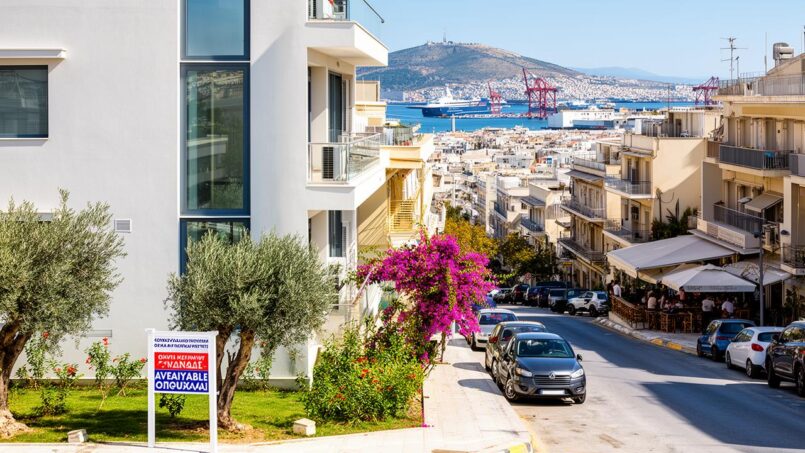
Níkaia is a municipality in the Attica region, integrated into the urban fabric of Piraeus and, beyond, the Athens metropolitan area. It benefits from a strategic location: quick access to central Athens, immediate proximity to the port of Piraeus, and connections to road arteries and the metro network.
An environment described as lively and dense, with a real neighborhood vibe including cafés, tavernas, small shops, markets, tree-lined squares, schools, and healthcare facilities. This area, sometimes nicknamed ‘the jewel of Attica,’ is locally perceived as more affordable than central Athens neighborhoods while offering a highly sought-after quality of life and connectivity.
The urban planning mixes traditional Greek architecture, newer apartment buildings, some higher-end villas, and streets with a strong popular character. Certain properties benefit from sea views or are close enough to the coastline to offer a lifestyle between city and seaside, which enhances residential appeal.
A Dynamic Real Estate Market, Steadily Rising
The most recent data confirms the trend: prices in Níkaia are rising steadily, without speculative surges, but with a very real progression that is attracting investors’ attention, including foreigners (notably from Northern Europe, the UK, Germany, and the US).
Recent Evolution of Sale Prices and Rents
In November 2025, the average listing price for homes in Níkaia reached €2,153/m². A year earlier, in November 2024, it was €2,019/m². That represents an increase of about 6.64% over twelve months. Over the two preceding years, the low point was recorded in March 2024, around €1,890/m², illustrating a clear upward trajectory.
The average long-term rental rate stands at €8.48/m² per month in November 2025.
So this is a market where:
– sale prices are climbing at a rate above 6% per year,
– rents are following the same trend,
– all while remaining, despite this increase, more affordable than many central Athens neighborhoods or certain coastal areas.
The Níkaia real estate market is dynamic, with a record price of €2,430/m² and a median listing price for a house around €516,342. However, it shows strong segmentation between expensive areas like ‘Níkaia-Upper’ and more affordable sectors like ‘Lower Níkaia,’ where prices are around €1,790/m².
Price Structure by Property Type
Intermediary statistics detail the market structure: in July 2025, the median price of an apartment in Níkaia was around €2,364/m², while for a house it stood at €1,491/m². In other words, houses remain, on average, cheaper per square meter than apartments, which is fairly typical of urban peripheries where houses often occupy larger plots of land.
For apartments, data by type shows a logical gradient:
| Apartment Type | Median Price (€/m²) |
|---|---|
| Studio | 1,867 |
| 2-room | 2,345 |
| 3-room | 2,936 |
The larger the surface area and number of rooms, the higher the price per square meter, a sign of strong demand for well-located family apartments.
Reading Rental Yields in Níkaia
The average gross yield is not directly provided for Níkaia, but three useful blocks of information are available:
1. Average sale prices and by area. 2. Rents per m² for long-term rentals. 3. Performance of short-term rentals (Airbnb type) in the municipality of Níkaia–Agios Ioannis Rentis.
By combining these elements, a fairly accurate picture of yield potential can be drawn.
Quick Indicator: Rents and “Theoretical” Yields
Taking the average level for November 2025:
– Average sale price: €2,153/m²
– Average rent: €8.48/m²/month
Purely for illustration, a 70 m² apartment purchased at the average price would cost about €150,710. At the average rent, it would rent for €593.60/month, i.e., €7,123/year. The theoretical gross yield would then be around 4.7% (7,123 / 150,710).
In practice, gross yields vary depending on property type, neighborhood, quality of renovation, and strategy (long-term vs. short-term rental). To get an idea, one can observe levels reached in Cyprus, where comparable urban markets like Nicosia average 4.5% to 5.5% gross yield on apartments, with peaks above 6% on small units and in high-demand neighborhoods. Níkaia, with rising rents and still competitive prices, is likely in a similar range, or even slightly higher for well-targeted properties.
Rent Breakdown by Níkaia Neighborhood
Rents per m² vary noticeably from one sector of Níkaia to another. In November 2025, data shows the following distribution:
| Neighborhood / Area | Average Rent (€/m²/month) | Average Sale Price (€/m²) |
|---|---|---|
| Evaggelistria | 9.41 | 2,221 |
| Agios Ioannis Chrisostomos | 9.09 | 2,232 |
| Agios Georgios | 8.50 | 2,061 |
| Mitropoli | 8.36 | 1,915 |
| Neapoli | 8.28 | 2,325 |
| Ano Neapoli | 8.34 | 2,020 |
| Aspra Chomata | 8.24 | 2,220 |
| Chalkidona | 7.87 | 2,164 |
| Katrakeio Theatre – Alsos Deks. | 7.70 | 2,404 |
| Alsos Vokou | 7.00 | 2,372 |
| 3rd Cemetery of Athens | 3.79 | 2,099 |
| Cemetery | — | 1,816 |
It is immediately apparent that some micro-markets show a very attractive price/rent ratio. For example, Evaggelistria combines one of the highest rents with a per-meter price that is rather in the high average, while the Cemetery sector shows the lowest sale prices, but without reliable rent data.
Sectors combining high rent per m² and still reasonable sale prices, ideal for a yield-oriented portfolio.
Area showing a good balance between high rent per square meter and accessible acquisition price.
Sector conducive to rental investment with attractive yields.
Neighborhood combining significant rental potential and competitive sale price levels.
Area particularly well-suited for building a yield-oriented rental portfolio.
Focus on Evaggelistria: A Micro-Market to Watch
Evaggelistria illustrates this underlying dynamic well: in May 2025, the average sale price there reached about €2,024/m², up 2.53% year-over-year, with a high rental range around €8.45/m²/month at that time, before peaking at €9.41/m² in November.
This neighborhood therefore combines: the assets of the city with the charm of a peaceful environment.
– an upward trend in sale prices,
– high rents,
– notable residential appeal.
For an investor targeting the long term, this type of area can offer an interesting compromise between potential capital gain and rental yield.
Property Types and Investment Profiles
The Níkaia market is described as diversified, suitable for very varied budgets and strategies.
The main categories of properties encountered include: apartments and flats (from studios to family apartments with 3 or 4 bedrooms),
– apartment buildings or small condominiums,
– houses and villas, often on the outskirts or in quieter areas,
– commercial premises (ground-floor shops, offices, service spaces),
– building plots or parcels in neighborhoods undergoing change.
Old buildings, typical of the Piraeus suburbs, attract investors looking for renovation projects, especially for long-term rentals or to enhance the property by repositioning its offering.
Real estate investors
Concrete Examples of Listings in Níkaia and Surroundings
Even though the listings recorded cover a broader perimeter (Piraeus, Keratsini, Drapetsona, etc.), they provide a very useful order of magnitude for Níkaia, which shares similar characteristics:
| Property (example) | Area | Rooms | Total Price | Approx. Price/m² |
|---|---|---|---|---|
| Apartment 90 m², 3 rooms | 90 m² | 3 | €230,000 | €2,555/m² |
| Apartment 110 m², 3 rooms | 110 m² | 3 | €260,000 | €2,363/m² |
| Detached house 91 m² | 91 m² | — | €250,000 | €2,747/m² |
| Apartment 97 m² | 97 m² | — | €250,000 | €2,577/m² |
| Apartment 100 m², 4 rooms | 100 m² | 4 | €315,000 | €3,150/m² |
| Apartment 70 m², 2 rooms | 70 m² | 2 | €230,000 | €3,285/m² |
| Apartment 80 m², 3 rooms | 80 m² | 3 | €290,000 | €3,625/m² |
We can see a fairly standard entry ticket for a comfortable apartment: between €220,000 and €300,000 for areas of 70 to 110 m² depending on location and condition. Studios or small units can of course be acquired for less, and new builds or high-end renovations can climb well above, especially in the most sought-after areas.
Old vs. New: A Classic Trade-off
Two main strategies emerge for an investor in Níkaia:
– Betting on old properties to renovate, in neighborhoods undergoing change (areas around new metro stations, proximity to main arteries towards Piraeus, etc.). Advantage: lower purchase price, potential for revaluation with successful renovation. Disadvantage: managing renovations, technical and legal risks (compliance with permits, urban planning, etc.).
– Opting for new or recent properties, with better energy efficiency, fewer renovations, sometimes the possibility of benefiting from VAT suspensions or advantageous national tax regimes. Disadvantage: often higher per-square-meter price, gross yield sometimes slightly compressed.
Long-Term Rentals: Solid and Diverse Demand
Níkaia benefits from its dual proximity: to central Athens and to the port of Piraeus. This location makes it an ideal ground to attract:
The Piraeus real estate market mainly attracts four types of buyers: families looking for a well-connected primary home that is more affordable than central Athens; employees working in the port, logistics, maritime sector, or large local businesses; students, thanks to the proximity of the University of Piraeus and good transport to Athens campuses; and young professionals who weigh price, commute time, and quality of life.
Observed rents (€8.48/m² on average, with neighborhoods above €9/m²) show that this demand is willing to pay for quality properties that are well-located and properly maintained. The diversity of available types – studios, two-bedrooms for students or young couples, three-bedrooms and more for families – allows investors to calibrate their investment according to the target audience.
Long-term rental platforms indicate, for Níkaia, a substantial supply: several hundred apartments available for rent, with a rent spectrum ranging from €200/month for the most modest units to €3,500/month for very well-equipped or higher-end homes.
Short-Term Rentals: A Niche but Real Airbnb Market
The short-term rental market in Níkaia–Agios Ioannis Rentis remains a niche segment, with about 30 active listings recorded, but it offers an interesting angle for experienced investors.
Average Performance of Short-Term Rentals
Available data describes a market:
– highly regulated, with about 77% of listings having a license,
– composed of nearly 97% entire homes (studios and apartments),
– dominated by 1 and 2 bedrooms (nearly 97% of the market).
Average performances break down as follows:
| Indicator (Airbnb Níkaia–Agios Ioannis Rentis) | Typical Value |
|---|---|
| Median monthly revenue | ~$679 |
| Top 25% monthly revenue | ≥ $1,075 |
| Top 10% monthly revenue | ≥ $1,459 |
| Median occupancy rate | ~36% |
| Top 25% occupancy rate | ≥ 56% |
| Top 10% occupancy rate | ≥ 69% |
| Median nightly rate (ADR) | ~$62 |
| Top 25% ADR | ≥ $80 |
| Top 10% ADR | ≥ $102 |
Seasonality is marked: the best revenue months are generally observed in February, September, and October, while January and May are weaker. In high season (February, September, October), properties average a revenue of $887/month, with an occupancy rate of 46.3% and an average nightly price of $71.
What Does This Mean for the Investor?
This market profile means that an investor who already masters short-term rentals can, by positioning their property correctly (proximity to metro, careful decoration, excellent ratings), aim for the higher revenue brackets and occupancy. However, local regulations are strict, the number of listings is still limited, and obtaining a license is almost indispensable.
This market should be considered as a diversification, taking into account the evolution of Greek legislation which is tightening regulations on short-term rentals in dense urban areas.
Impact of Infrastructure and Major Projects Around Piraeus
Níkaia’s attractiveness cannot be understood without looking at what is happening at the level of Piraeus as a whole. The port is undergoing a vast modernization plan, valued at several hundred million euros, with joint funding from the European Union, the European Investment Bank, and private stakeholders.
Among the structuring projects:
– extension of the passenger terminal to accommodate large cruise ships,
– significant increase in capacity of the container terminal,
– creation of new logistics centers,
– modernization of the ship repair zone,
– environmental initiatives such as “cold ironing” to power ships at berth.
In parallel, public transport connections have been profoundly strengthened with:
Athens’ transport network is expanding with metro line 3 extended from Piraeus to the international airport, new stations at Maniatika, Piraeus, and Dimotiko Theatro, planned developments towards Níkaia, and the tram extension.
All these projects translate into a clear improvement in accessibility and the image of the entire Piraeus basin. And Níkaia, directly connected to this network and close to major employment hubs (port, offices, university, commerce), captures a good part of the housing demand generated by this transformation.
Major real estate operations such as “Piraeus Gate” or the renovation of the Piraeus Tower also signal an upscaling of the commercial offering, attracting executives and businesses, and in turn fueling the need for modern, well-located housing just a few metro or bus stops away.
Financing a Purchase in Níkaia as a Foreigner
The Greek framework is relatively open: foreigners, whether EU citizens or not, can buy a property in full ownership in Níkaia, with rights similar to those of Greek nationals, except in very specific areas near the borders, which is not the case here.
Access to Mortgage Loans
The major Greek banks (Alpha Bank, Eurobank, National Bank of Greece, Piraeus Bank, etc.) have developed products tailored to non-residents, with a few guidelines:
For non-EU residents, the maximum loan-to-value ratio for a property purchase in Spain is generally between 50% and 65% of the property value.
In practice, the process is document-heavy and requires:
– obtaining a Greek tax number (AFM),
– opening a bank account in Greece,
– providing proof of income, assets, and professional status, etc.
Public programs, such as “My Home II” for first-time buyers or “Upgrade my home” for energy renovation, exist, but they are mainly intended for residents and have specific eligibility conditions (income caps, age, primary residence, etc.).
Golden Visa and Residence Through Real Estate
Níkaia is located in the greater Piraeus region, one of the areas long favored by candidates for Greece’s residence by investment program (“Golden Visa”), particularly in the €250,000 tranche of projects.
Investment threshold maintained for specific cases such as converting commercial premises into housing or renovating listed buildings in Greece.
For an investor looking at Níkaia from this perspective, it is therefore crucial to check:
– whether the targeted project meets the precise conditions of the Golden Visa (amount, minimum area, permitted use, etc.),
– whether short-term rental use is allowed (in some tiers it is prohibited),
– and to keep in mind that Greek bank financing cannot be used to reach the minimum required amount: funds must come from abroad.
Taxation: What an Investor in Níkaia Should Anticipate
Real estate taxation in Greece is structured around three phases: purchase, ownership, and resale, not forgetting taxation of rental income.
Purchase Costs and Taxes
For an old property (or a new one benefiting from VAT suspension), the buyer mainly pays: property transfer tax or registration duties.
– transfer tax (FMA) at 3.09% of the taxable value,
– notary fees (generally between 0.5% and 1.2% of the price),
– land registry/cadastre registration fees (0.5–1%),
– lawyer’s fees (often around 1–2%),
– real estate agent commission (often around 2%, paid by the buyer).
In total, it is prudent to budget 8–12% of the purchase price for ancillary costs, especially if using a lawyer to secure the transaction, which is highly recommended for a foreign investor.
Taxes on Ownership
Every property owner in Greece, whether tax resident in the country or not, must pay the annual ENFIA, the national property tax. Its amount depends on numerous parameters (location, area, floor, age, use, etc.), with rates per m² and, beyond certain cumulative value thresholds, additional surtaxes.
In addition to property tax, owners must pay the Professional Activity Tax (TAP), generally between 0.025% and 0.035% of the property’s objective value, often billed through electricity consumption. Various municipal service fees, such as waste collection and street lighting, are also added.
Taxation of Rental Income
Rents collected in Níkaia are taxed under the Greek scale for individual property income:
– 15% up to €12,000 of gross income,
– 35% between €12,001 and €35,000,
– 45% beyond that.
From 2026, a 25% bracket for the €12,001–€24,000 range is expected to refine this progressivity. Deductions are possible (estimated maintenance at 5% of gross rent, part of renovation and energy improvement costs, etc.).
For investors using a Greek corporate structure, taxation is at the corporate income tax rate of 22%. All expenses related to the property can be deducted.
During a transitional period, incentive measures exist to encourage moving from short-term to long-term rentals: temporary exemption from rental income tax for certain three-year contracts, provided the property was previously vacant or operated as a short-term rental.
Capital Gains Tax on Resale
Greece applies, in principle, a capital gains tax on real estate at 15% for individuals, but this tax is currently suspended until the end of 2026 for sales by individuals outside the scope of a business activity. In practice, for an investor who sells their property before this deadline, there may be a window for disposal without capital gains taxation, subject to meeting conditions and not being reclassified as a professional activity.
The Purchase Process for a Foreigner in Níkaia
Investing in Níkaia requires following the classic steps of an acquisition in Greece, with some specificities for non-residents.
The typical process includes: needs analysis, defining objectives, searching for solutions, evaluating options, implementation, and monitoring.
Acquiring real estate in Greece follows a structured process. First, obtain a tax number (AFM) and open a local bank account. Appointing a specialized lawyer, often via a power of attorney, is crucial to oversee due diligence (cadastral checks, property titles, compliance). Then, a preliminary agreement is signed committing both parties with a deposit (around 10%). The final deed is signed before a notary, with payment of the balance and taxes, followed by registration with the cadastre. Finally, update your tax status (E9 declaration) and transfer utility contracts.
In principle, almost all of these steps can be done remotely via power of attorney, except for specific requirements (e.g., providing biometric fingerprints for a Golden Visa application).
How to Position Yourself Strategically in Níkaia?
The wealth of available data allows us to outline three main investment approaches in Níkaia.
1. The “Secured Rental Income” Approach
It consists of targeting:
– 2–3 room apartments in high-demand rental neighborhoods (Evaggelistria, Neapoli, Agios Georgios, Agios Ioannis Chrisostomos),
– with a good metro/bus connection to central Athens and the port of Piraeus,
– in buildings in good condition or recently renovated.
The goal is to aim for a gross yield around 4.5–6%, with limited rental risk: target stable tenants (families, employees, students), moderate vacancy, management easily outsourced via an agency.
2. The “Medium-Term Value Appreciation” Approach
It targets more wealth-oriented profiles, ready to:
To invest in Piraeus, focus on three axes: target areas catching up like the Cemetery district or certain streets in Lower Níkaia for their accessibility, acquire properties requiring significant renovation to add value, and anticipate overall territorial appreciation driven by major projects (new port terminals, transport improvements, and urban regeneration).
The capital gain over a 7–10 year horizon can be significant, especially if you manage to reposition the property on a segment of growing demand (student co-living, modern family apartments, etc.).
3. The “Mixed/Short-Term Rental” Approach
More technical and riskier, this strategy aims to exploit:
To maximize income from a rental investment in Athens, prioritize small, well-located units, ideally within walking distance of a metro station, in a pleasant environment and at a reasonable distance from the port and city center. Adopt a mixed rental strategy, combining long-term and short-term rentals (like Airbnb) to adapt to tourist seasonality. Ensure strict compliance with local regulations, including obtaining necessary licenses, respecting applicable rent caps, and any zonal restrictions.
The Airbnb market in Níkaia–Agios Ioannis Rentis shows that it is possible for the top 10–25% of properties to achieve a monthly income significantly higher than a traditional lease. But the complexity of management, regulatory risk, and greater exposure to tourism trends mean this segment is mainly reserved for experienced investors.
Níkaia in a Reshaping Greek Context
Finally, it is necessary to place Níkaia in the broader landscape of Greek real estate. The country is increasingly attracting international investors, notably for:
– the ability to combine personal use (second or primary home) with rental yield,
– prices still reasonable compared to other European capitals,
– the stable legal framework within the European Union,
– incentive programs (Golden Visa, non-dom tax regimes, VAT suspensions, etc.).
Increase in the housing price index by end of 2024 according to Eurostat.
Níkaia, with its pivotal location between Athens and Piraeus, its transport links, neighborhood life, and still competitive prices, ticks many boxes sought by investors: accessibility, appreciation potential, risk diversification compared to already very expensive hyper-centers, and the possibility of targeting different rental markets (families, students, workers, possibly urban tourism).
—
Investing in Níkaia requires rigorous analysis: study micro-neighborhoods, verify the legal status of properties, factor in real taxation (beyond theoretical gross yield), surround yourself with professionals (lawyer, notary, local agent, tax advisor), and anticipate that major infrastructure projects may take several years to fully impact prices.
But for those who accept this structured approach, Níkaia today appears as one of the most interesting markets on the outskirts of Athens: neither too speculative nor saturated, but clearly on an upward trajectory, both from a residential and a rental perspective.
Disclaimer: The information provided on this website is for informational purposes only and does not constitute financial, legal, or professional advice. We encourage you to consult qualified experts before making any investment, real estate, or expatriation decisions. Although we strive to maintain up-to-date and accurate information, we do not guarantee the completeness, accuracy, or timeliness of the proposed content. As investment and expatriation involve risks, we disclaim any liability for potential losses or damages arising from the use of this site. Your use of this site confirms your acceptance of these terms and your understanding of the associated risks.

Cyril Jarnias is an independent expert in international wealth management with over 20 years of experience. As an expatriate himself, he is dedicated to helping individuals and business leaders build, protect, and pass on their wealth with complete peace of mind.
On his website, cyriljarnias.com, he shares his expertise on international real estate, offshore company formation, and expatriation.
Thanks to his expertise, he offers sound advice to optimize his clients' wealth management. Cyril Jarnias is also recognized for his appearances in many prestigious media outlets such as BFM Business, les Français de l’étranger, Le Figaro, Les Echos, and Mieux vivre votre argent, where he shares his knowledge and know-how in wealth management.





