
 Published on and written by Cyril Jarnias
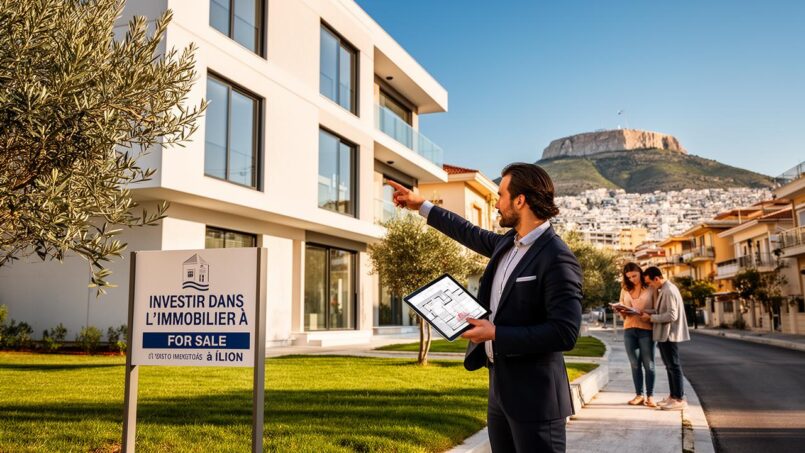
Located west of Athens, the municipality of Ílion is attracting more and more investors looking for a market that remains accessible yet fueled by very favorable dynamics. At the crossroads of major infrastructure projects, a broadly positive Greek context, and strong rental demand, Ílion is emerging as one of the most promising territories in the metropolitan area.
For an investor, it is crucial to analyze the market structure, price outlook, yield and liquidity, as well as the legal, tax, and financial conditions of transactions, especially in Greece and Ílion, based on the most recent data.
Ílion in the Athenian ecosystem: position, profile, and potential
Located in the western part of Athens, Ílion is the second largest municipality in the sector, both in area and population. It shares borders with Agioi Anargyroi, Peristeri, Petroupoli, and Kamatero, communes that have also seen significant price increases in recent years.
The example of Ílion illustrates the requalification of a former working-class suburb of Athens, now promoted for its integrated green, environmental, cultural, and sports infrastructure. The vast Antoni Tritsi Park, one of the largest green spaces in the capital, is its flagship symbol. Paradoxically, despite this enhancement, the surrounding neighborhood remains one of the cheapest in the local real estate market.
Accessibility still mainly relies on bus lines, but this reality is changing. The extension of Athens Metro Line 2 to Ílion, a project already included in the major works program, is the key driver of the upcoming valorization.
Prices in Ílion: a rising market, but still affordable
The latest available data for September 2025 shows a market in an upward phase, without yet being overheated.
Price levels and recent trends
In September 2025, the average asking price for homes for sale in Ílion reached €2,104/m², up 3.75% year-on-year (€2,028/m² in September 2024). Over the previous two years, the recent low was observed in February 2025 at €1,959/m², while the peak was reached in September 2025.
On the rental side, the average asking rent stood at €7.88/m² per month in September 2025, a more modest increase of 0.77% over one year (€7.82/m² a year earlier). Over two years, the peak was €7.91/m² in August 2024, and the low €7.67/m² in December 2024.
Sale prices are rising faster than rents, a widespread phenomenon in Greece that leads to a slight compression of gross yields.
Neighborhoods with contrasting profiles
Within Ílion itself, the differences between neighborhoods are significant, offering real arbitrage opportunities for an investor attentive to micro-location.
| Ílion Zone | Sale Price (€/m²) | Rent (€/m²/month) |
|---|---|---|
| Center | 2,051 | 8.15 |
| Palatiani | 2,133 | 8.18 |
| Micheli | 2,229 | 7.35 |
| Parko Antoni Tritsi | 2,034 | 3.52 |
| Riminiton | 2,075 | 7.87 |
| Politeknon | 2,095 | 8.21 |
| Zoodochos Pigi | 2,055 | 7.78 |
| Nea Sepolia | 1,858 | 6.00 |
| Agios Fanourios | 2,002 | 7.57 |
The September 2025 data highlight a few key points:
Micheli is the most expensive neighborhood to buy in Ílion, with a price of €2,229/m².
An example of a tight submarket: Micheli
The Micheli neighborhood illustrates the ongoing dynamic in western Athens. In June 2025, its average asking price reached €2,117/m², a surge of more than 15% year-on-year (€1,837/m² in June 2024). Over two years, the low had been observed at €1,706/m² in December 2023.
Rents, however, have declined over the period: €7.36/m² in June 2025 vs. €7.88/m² a year earlier, a drop of –6.6%. The recent peak (€8.23/m²) was in August 2024, followed by a correction. This combination—rapid price increases, slightly falling rents—reflects strong anticipation of future appreciation (especially related to the metro) and increased pressure on yields.
Yields and ratios in Ílion: what the numbers say
Beyond prices, a savvy investor first looks at yield and sustainability of a purchase relative to local incomes.
The aggregate indicators for Ílion are as follows:
| Indicator | Value |
|---|---|
| Price to Income Ratio | 13.11 |
| Mortgage as % of Income | 98.69% |
| Loan Affordability Index | 1.01 |
| Price to Rent Ratio (center) | 27.02 |
| Price to Rent Ratio (outside center) | 26.36 |
| Gross rental yield (center) | 3.70% |
| Gross rental yield (outside center) | 3.79% |
A Price to Rent Ratio around 26–27 years and gross yields of 3.7–3.8% place Ílion slightly below the Greek average (4.4% gross residential yield at end of 2025, with a peak over 5.4% for Athens according to Global Property Guide). However, this remains consistent for an urban market in a major metropolis, especially in a context of sustained price increases.
For an investor, the main argument lies not in seeking exceptional cash flow, but in identifying a reasonably attractive yield/appreciation combination. This approach is reinforced by the additional security offered by a liquid market and structurally supported rental demand.
Illustration with a real high-yield case
In the Ílion area, an income-generating asset is described as fully leased, occupied by high-creditworthy tenants, generating €414,000 in annual rents. The leases run until August 31, 2040, and the stated yield is 7.13%. Even though the sale price is not specified in the raw data, it can be estimated at around €5.8 to 5.9 million (€414,000 / 0.0713).
This type of asset (often commercial or mixed-use) illustrates Ílion’s potential for strategies oriented toward long-term income, very different from simple buy-and-sell of apartments.
The structuring effect of the metro: Line 2 extension to Ílion
Ílion’s shift into a new development phase is largely linked to the extension of Athens Metro Line 2.
A concrete project, an impact already priced in
The Line 2 extension is set to connect the current Anthoupoli station to Agios Nikolaos, with three new stations: PALATIANI, ILION, and AGIOS NIKOLAOS. The estimated project cost is €350 million. This is the first extension of this line since 2013, targeting densely populated areas like Ílion and Agioi Anargyroi.
Planned structuring investments for the Athenian agglomeration, including transport projects and a planned tender.
A call for tenders for the infrastructure extension was planned at the beginning of the decade and is included in the Greek state’s priority portfolio.
In the Athens metropolitan area, major structuring projects (metro, tram, roads, suburban railway) represent over €4.3 billion.
Empirically, new metro stations tend to cause significant appreciation in the neighborhoods they serve. In Peristeri, a municipality bordering Ílion, the metro extension has been associated with a price increase of over 40% since 2021. It would be surprising if Ílion did not follow a similar trajectory, though the speed and magnitude will depend on the precise timeline of the works.
Ílion at the heart of a wave of investments in Attica
Broadening the view to the Attica region helps better understand the context. Around Athens, the Ministry of Infrastructure is overseeing:
– the new Metro Line 4, a major public project worth €1.8 billion, with its first section (Alsos Veikou – Goudi) including 15 underground stations;
– several extensions of the suburban railway network toward Rafina, Lavrio, or Elefsina-Megara;
– a Salamis–Perama underwater road link (€400 million);
– highway projects such as the extension of Kymi Avenue or the Hymettus ring road.
In parallel, a vast regional program, partly funded by the European Union, aims to improve accessibility, urban attractiveness, competitiveness, and social inclusion. Over €1 billion is being injected into sustainable mobility, research, innovation, and the environment in Attica.
For an investor, this means that the map of Athenian real estate values is being redrawn in favor of well-connected sectors and those set to become better connected. Ílion, future metro-served and bordering Peristeri and Petroupoli, clearly fits into this logic.
How does Ílion compare to the rest of Athens and Greece?
Comparing Ílion with other segments of the Greek market helps measure its relative appeal.
Against the Athens market
The statistics available for Athens show:
– an average price of around €2,580–2,900/m² at the start of 2026, with an 80 m² apartment around €240,000;
– a rise of about 7–8% over 2024 and still nearly 7% in 2025, with a gradual slowdown after the double-digit increases of 2022–2023;
– gross yields generally ranging between 4 and 6% depending on the neighborhood, but below 4% in the wealthier areas of the southern coast (Glyfada, Voula, Vouliagmeni).
At an average of €2,104/m², Ílion is clearly below the Athenian average, while still being part of the metropolitan area and fully benefiting from price dynamics. In other words, this is more of a “value” market than a “prime” one.
Analysis of the Ílion real estate market
Against the overall Greek market
Nationally, the average price of a home in Greece is estimated at €1,650/m² at the start of 2026, or about €140,000 for 85 m² outside the most expensive areas. Prices rose about 7–8% in 2025, after over 8.7% in 2024. The trend remains upward, but with a moderation expected around 4–7% annual growth in 2026.
In terms of yield, Greece offers an average of 4.4% gross, with peaks over 5% in some cities (Athens, Patras) and much lower levels in narrow markets like Kavala.
Ílion therefore sits slightly above the national average price but well below central or coastal Athens neighborhoods, with yields a bit lower than the Greek average, yet supported by very strong local liquidity.
Market access: foreigners, Golden Visa, and tax residency
One of Greece’s major strengths is offering an investment framework open to foreigners, simple in its broad strokes, yet sophisticated enough to offer optimizations.
Rights of foreign buyers
Foreign nationals, whether EU citizens or third-country nationals, can freely buy real estate in Greece, with the same property rights as Greeks. Most of the country is fully open. Restrictions exist in certain so-called “border” areas where non-Europeans need special authorization from the Ministry of Defense, but this does not apply to Ílion or the Athens metropolitan area.
After acquiring a property, the owner enjoys a right of ownership that is both free (without inherent restrictions) and perpetual (valid for an unlimited duration).
Golden Visa: relevance for Ílion?
The Greek residence-by-investment (Golden Visa) program has been tightened, especially in Attica. Since the reform effective in fall 2024, four investment tiers coexist:
| Golden Visa Tier | Minimum Amount | Area Concerned | Main Conditions |
|---|---|---|---|
| Tier 1 | €800,000 | Attica (including Athens and Piraeus), Thessaloniki, Mykonos, Santorini, islands >3,100 inhabitants | Single property of at least 120 m², personal use/long-term rent, no short-term rentals |
| Tier 2 | €400,000 | Rest of Greece (mainland + small islands) | Single property of at least 120 m², same restrictions |
| Tier 3 | €250,000 | Conversion of commercial space into housing | Conversion completed before the application |
| Tier 4 | €250,000 | Restoration of a historical property | Complete renovation required |
For Ílion, located in Attica, the threshold is therefore €800,000 for a standard residential property, which is far above the local average ticket. For an investor oriented toward the Golden Visa, this implies either:
– buying a large home or a single residential building, beyond what is typical for the local market;
– or using Tier 3 (conversion of commercial to residential) if a suitable opportunity arises in the municipality.
Properties acquired via the Golden Visa (€400k and €800k tiers) cannot be used for short-term rentals (e.g., Airbnb). Only personal use and long-term rentals are permitted.
Tax residency and Non-Dom regime
For high-net-worth investors looking to move their tax residency to Greece, a particularly advantageous Non-Dom regime exists:
– flat tax of €100,000 per year on all foreign-source income, regardless of amount;
– valid for up to 15 years;
– extendable to family members (€20,000 additional per person per year);
– investment condition: at least €500,000 in Greece (real estate, securities, or business) within three years.
A non-European will in practice need to combine this regime with a residence permit, often via the Golden Visa.
Understanding Greek real estate taxation before buying in Ílion
The net profitability of an investment largely depends on good anticipation of taxes and levies. The Greek system is structured around four main layers: purchase, ownership, rental income, and resale/transfer.
At purchase: transfer tax or VAT
Most resale properties, like those one would buy in Ílion, are subject to the Fóros Metavivasis Akinítou (FMA), the real estate transfer tax.
– Base rate: 3% of the taxable value (the higher of the deed price and the objective value set by the administration);
– Municipal surcharge: 3% of this amount, bringing the effective rate to about 3.09%.
New-build properties subject to VAT (24%) are in principle exempt from this FMA, but VAT on new construction is currently suspended until the end of 2025 (this period may change). For any purchase in Ílion, it is therefore essential to check whether the property is subject to VAT (permit post-2006, never occupied) or not.
To these acquisition taxes add:
Acquisition costs for a property in Switzerland can represent up to 8.3% of the purchase price, including notary, registration, legal, agent, and appraisal fees.
In practice, a foreign buyer should budget 7 to 10% in transaction costs on top of the property price.
In ownership: ENFIA and municipal tax
ENFIA is the national property tax, owed by all owners, residents or not. It is calculated based on the objective value, with a rate per square meter typically ranging from €2 to €16.2/m² for buildings, adjusted by zone, building age, use, and other coefficients.
For a standard 60 to 90 m² apartment in a “normal” urban area like Ílion, the annual ENFIA budget is roughly between €200 and €600. A house or large apartment may go up to €500–1,500 depending on size and neighborhood.
Added to this is a municipal tax (TAP) of about 0.025–0.035% of the objective value, usually collected via the electricity bill. This tax covers public lighting, waste collection, and various local services.
Starting in 2025, a 20% reduction in the property tax (ENFIA) is granted for real estate insured against natural disasters, for a taxable value up to €500,000. This measure makes home insurance particularly advantageous for investors.
Rental income: progressive taxation
Rents received in Greece are taxable, including for non-residents. For individuals, the scale is progressive:
– up to €12,000 in annual rents: 15%;
– from €12,001 to €35,000: 35%;
– above €35,000: 45%.
A flat-rate expense deduction (around 5%) is allowed but does not cover all possible charges. For companies, rental income is included in the result and taxed at the flat rate of 22%, with full deduction of expenses (maintenance, loan interest, etc.).
Starting in 2025, an incentive regime allows a three-year income tax exemption for homes put back into long-term rental after being vacant or used for short-term stays. To qualify, the home must not exceed 120 m² and the lease must be at least three years. This measure may interest long-term investors, particularly in municipalities with strong rental demand like Ílion.
Resale and capital gains: a window of opportunity
Theoretically, capital gains on real estate for individuals are taxable at 15% if the resale occurs within five years of purchase. In practice, however, the application of this tax is suspended until December 31, 2026. In other words, an investor buying today and selling before that date will not pay capital gains in Greece, as long as they do not carry out more than two sales in two years and it is not a professional activity.
For companies, capital gains are treated as business income and taxed at 22%, on the difference between the sale price and the net book value (acquisition cost plus improvements, minus depreciation).
For an investment in Ílion with a 3- to 5-year horizon, this tax window strengthens the appeal of a capitalization-oriented strategy.
Financing: credit conditions in Greece and impact on profitability
The financing structure plays a major role in the performance of an investment in Ílion.
Mortgage rate trends
Data from the Bank of Greece and the ECB shows a rise in rates since 2022, followed by stabilization and then a slight decline:
– 2021: average rate around 2.7–2.8%;
– 2022: gradual increase to about 3.6% by year-end;
– 2023: peak around 4.4% in the fourth quarter;
– 2024: gradual easing, from 4.45% at the start of the year to 3.71% in the fourth quarter;
– 2025: continued decline, around 3.55–3.69% over the first three quarters.
In October 2025, the average rate on new home loans was 3.51%.
It should be kept in mind that a 1% rate difference changes monthly payments by 10 to 12%. With Greek household solvency already under pressure, a moderate rate environment is rather favorable to continued price increases without excessive overheating.
Access to credit for foreigners
Several major Greek banks (Alpha Bank, Eurobank, etc.) offer home loans to non-residents. Typical conditions are:
Main conditions and requirements to obtain a mortgage in Greece as a foreign investor.
30 to 50% of the property price. Banks typically finance 50 to 70% of the market value for non-residents.
Often between 4% and 5.5% for a non-resident, representing a slight premium over the national average rate.
Up to 25–30 years, with a maximum borrower age condition, usually set at 75 at loan maturity.
Mortgage on the property, proof of income (tax returns, pay slips, bank statements), Greek tax number (AFM), and mandatory local bank account.
For the Golden Visa, the minimum investment cannot be financed by a Greek mortgage: funds must come from abroad and be paid in full.
Given the modest gross yields in Ílion (3.7–3.8%), a high leverage effect is not advisable; it is better to opt for a reasonably prudent financing structure to avoid excessively negative cash flow, especially in case of vacancy or unexpected repairs.
The purchase process in practice in Ílion
The acquisition procedure in Ílion is the same as anywhere in Greece and remains relatively standardized.
1. Financial planning Define a budget that includes not only the property price but also the 7–10% in ancillary costs (taxes, notary, lawyer, agent, land registry, engineer), as well as potential renovation work and financing costs.
2. Property search Use Greek real estate portals (Spitogatos, xe.gr, Properstar, etc.) and/or a local agent. In Ílion, several specialized agencies (including international networks like Engel & Völkers) list apartments, houses, and land.
3. Obtaining an AFM (Greek tax number) Mandatory for any purchase. It can usually be obtained in one day at the tax office (DOY) upon presentation of a passport and a form stating the reason (real estate purchase).
It is highly recommended to open a bank account in Greece to facilitate the management of real estate-related payments, such as the purchase price, charges, taxes, and rents. Note that physical presence in the country is often required for this step.
5. Hiring a lawyer Essential, preferably French- or English-speaking and specialized in real estate. They will check property titles at the Ktimatologio (land registry), ensure there are no mortgages, seizures, or easements, and may represent you via power of attorney.
6. Offer and pre-contract Once the property is found and the price negotiated, a preliminary agreement (pre-contract or symfono/agora) is signed, along with a deposit (usually 10%). If the seller backs out, they must return double the deposit; if the buyer does, they lose the deposit.
Before a real estate purchase, it is crucial to have the property inspected by an engineer or surveyor. This professional checks compliance with permits and plans, identifies any illegal additions, structural issues, or hidden defects. This step, at the buyer’s expense, is particularly important in a country where undeclared extensions are common.
8. Payment of the transfer tax (FMA) The lawyer submits the FMA declaration online, and the tax must be paid before the final deed is signed. The receipt is presented to the notary.
9. Signing the deed The deed of sale (symvolaiografiki praxi) is signed before a notary in the presence of the parties and the lawyer. Payment is made via bank transfer or bank check, accompanied by a “pink slip” attesting to the source of funds for large international transfers.
10. Registration at the land registry After signing, the deed is registered with the Ktimatologio, which legally finalizes the transfer of ownership.
11. Post-purchase tax declaration The new owner declares the property via the E9 form on the online tax platform (myAADE), for ENFIA assessment.
Rental management in Ílion: organizing remotely
A foreign investor who does not reside in Greece would be well advised to delegate day-to-day management to a local provider.
Specialized management companies for Greek residential real estate, as well as more general players, offer:
Discover all key services provided for smooth and professional management of your real estate assets.
Full support for listing the property, including rigorous tenant screening and lease drafting.
Oversight of collections: collecting rents, following up with late payers, and managing defaults.
Ongoing maintenance oversight and coordination of necessary work with contractors.
Detailed rental accounting and regular reports to the owner.
Management of charges, payment of utility bills, and preparation of tax declarations.
Fees for long-term rental management typically range around 8–12% of collected rents. For tourist rentals (less suited to Ílion than the historic center or islands), the commission rises to 15–25%.
In Ílion, where rental demand is driven by local households, civil servants, private-sector employees, and families seeking a greener environment than central Athens, the natural model is long-term rentals, with moderate vacancy rates and reasonable tenant turnover.
Why Ílion appears as an interesting bet in 2026
Putting together all the contextual elements helps understand why Ílion stands out as an increasingly sought-after target.
1. Strategic geographic position Close to central Athens (just under 6 miles), connected to Piraeus (about 10 miles), and surrounded by municipalities undergoing significant revaluation, the city already benefits from a central location in western Athens.
2. Price dynamics still in a catch-up phase With an average of €2,104/m², Ílion remains cheaper than many Athenian neighborhoods, even as the rise accelerates. The commune is identified as the most affordable area in the western sector despite significant appreciation—suggesting convergence potential with its neighbors.
Experience from neighborhoods already connected to or awaiting metro lines, such as Peristeri or those affected by the future Line 4, shows that real estate markets strongly anticipate the arrival of a station. Part of this increase is already priced into Ílion’s current values, but real upside potential remains as long as the infrastructure is not yet operational.
4. Structural rental demand Rents are rising more slowly than prices, but remain on an upward trend, supported by a shortage of renovated homes and a national context where homeownership is becoming less accessible (declining ownership rate, tighter credit conditions).
The Greek economy is experiencing moderate and steady growth. Mortgage rates have stabilized at reasonable levels, and the ECB is adopting a gradual easing stance. Additionally, national authorities are more strictly regulating short-term rentals, creating a favorable environment for medium- to long-term investors in residential neighborhoods like Ílion.
6. Tax window on capital gains until end of 2026 For an investor who enters the market quickly and plans an exit in the coming years, the suspension of the capital gains tax offers an opportunity to capture appreciation without taxation in Greece, subject to conditions.
7. Demonstrated liquidity Market data shows a relatively short median time on market, with many properties receiving multiple offers and selling near the asking price. Even though the monthly transaction count may seem limited in aggregate statistics, the market’s competitiveness indicates satisfactory liquidity for an investor buying at the right price.
What a savvy investor should monitor
Investing in Ílion, like anywhere, is not without risks. A few points of attention:
Average gross yields (3.7–3.8%) leave limited margin after charges, taxes, and potential credit costs. Analysis must be based on net yield, including ENFIA, management fees, and income tax. Rental regulations, especially regarding short-term rentals, may evolve. Older apartments often require costly renovations (€600–800/m²). An inspection by an engineer is essential to check construction quality, moisture, and legal compliance.
On the other hand, the prospects for value growth over 5–10 years are solid. Projections for Greece indicate a cumulative residential price increase of about 35–60% over ten years, with an average annual pace of 3–5%. Ílion, as a well-served, still relatively inexpensive metropolitan submarket, is highly likely to be in the upper part of this range.
—
Ílion represents a real estate investment opportunity for medium budgets. This neighborhood is well integrated into the Athens metropolitan area but has not yet fully benefited from the appreciation linked to the metro, public investments, and demographic pressure toward second-ring suburbs, making it a territory with upside potential.
For a patient investor, willing to accept moderate current yields in exchange for probable capital appreciation and a well-positioned asset within the Athens metropolitan area, Ílion stands out as a particularly relevant option within the Greek real estate market of 2026.
Disclaimer: The information provided on this website is for informational purposes only and does not constitute financial, legal, or professional advice. We encourage you to consult qualified experts before making any investment, real estate, or expatriation decisions. Although we strive to maintain up-to-date and accurate information, we do not guarantee the completeness, accuracy, or timeliness of the proposed content. As investment and expatriation involve risks, we disclaim any liability for potential losses or damages arising from the use of this site. Your use of this site confirms your acceptance of these terms and your understanding of the associated risks.

Cyril Jarnias is an independent expert in international wealth management with over 20 years of experience. As an expatriate himself, he is dedicated to helping individuals and business leaders build, protect, and pass on their wealth with complete peace of mind.
On his website, cyriljarnias.com, he shares his expertise on international real estate, offshore company formation, and expatriation.
Thanks to his expertise, he offers sound advice to optimize his clients' wealth management. Cyril Jarnias is also recognized for his appearances in many prestigious media outlets such as BFM Business, les Français de l’étranger, Le Figaro, Les Echos, and Mieux vivre votre argent, where he shares his knowledge and know-how in wealth management.





