
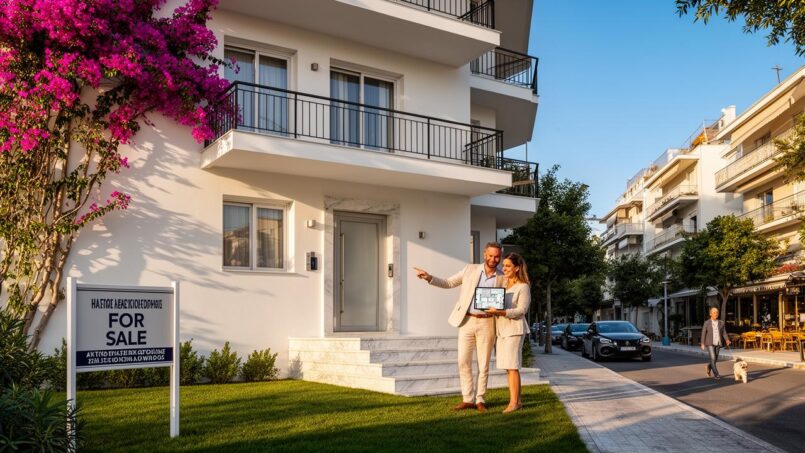
 Published on and written by Cyril Jarnias
Nestled in the southern suburbs of Athens, between the historic center and the coastline of the Athens Riviera, Nea Smyrni has established itself in recent years as one of the most sought-after real estate markets in the Greek capital. A lively, well-connected, and distinctly family-oriented neighborhood, it attracts Greek households, young professionals, students, and a growing share of foreign investors seeking solid rental returns close to Athens and the beaches.
Athens’ real estate market is currently tight, with rents and prices rising sharply since 2021 and demand far outstripping the supply of quality housing. However, compared to ultra-premium coastal neighborhoods like Glyfada or Voula, Nea Smyrni represents a more reasonable entry point into the southern part of the city, offering a good balance between purchase prices, rental levels, and appreciation potential.
This report offers a deep dive into the local market: context, sales and rental prices, yields, sub-districts, long-term rental dynamics and Airbnb-type rentals, as well as the key legal framework for a foreign investor.
A strategic location between Athens and the Riviera
Nea Smyrni is located in the southern suburbs of Athens. It is bordered by Neos Kosmos to the north, Agios Dimitrios to the east, Palaio Faliro to the south, and Kallithea to the west. In other words, it occupies a pivotal position between the city center and the first coastal neighborhoods like Alimos or Glyfada.
Historically, the area emerged as a refugee settlement after the Asia Minor disaster. Its population grew from 210 inhabitants in 1928 to approximately 72,900 today, making it the 13th largest city in Greece. This simple figure gives an idea of the urban density and local vitality.
The area in acres of the large park Alsos Nea Smyrni, a vast green space very popular with locals.
On a practical level, the main avenues, such as Eleftheriou Venizelou, are lined with supermarkets, shops, and services. The quality of infrastructure is considered good: efficient public transport, quick access to central Athens and the coast, good air quality (10.2 µg/m³), and proximity to major university hubs, notably the National and Kapodistrian University of Athens (ranked 233rd globally).
It is this blend of urban life, greenery, local shops, and fast connections that led, as early as 2020, some international media like The Guardian to rank Nea Smyrni among the best urban neighborhoods in Europe.
A market driven by the Athens dynamic
To understand what is happening in Nea Smyrni, the neighborhood must be placed within the broader context of Athens. The Greek capital is considered one of the most promising real estate markets in Europe. Between 2021 and 2025, average prices increased by about 35%, an annual rate of approximately 7.6%, with projections of further increases of 4 to 7% per year through 2026.
Athens remains significantly cheaper than most major Western European capitals: prices are 30 to 40% lower than comparable metropolises. In 2025, the average price is around 2,480–2,580 €/m², with the market driven by:
Main engines supporting the growth and attractiveness of the Greek real estate market.
The tourism sector, vital to the economy, strongly boosts demand and property values.
Foreign investors account for about 35 to 40% of transactions, a sign of renewed confidence.
The residency-by-investment program (Golden Visa) attracts capital and stimulates the market.
Transformative projects such as the metro extension, the Ellinikon development, and the redevelopment of Faliro Bay are reshaping the area.
The southern, seaside neighborhoods benefit more than the average from this dynamic, with value increases exceeding 7–8% annually recently. Areas with good transport links (especially near future metro stations) are expected to outperform in the medium term. Nea Smyrni falls precisely in this southern, connected, residential zone, but still below the prices of the ultra-luxury waterfront areas.
Nea Smyrni: profile of an investment neighborhood
Nea Smyrni is identified by several analyses as one of the best Athenian neighborhoods for a “balanced” residential investment. It is described as an area that is:
– well-connected, minutes from the center,
– family-friendly, with parks and schools,
– with a strong sense of community,
– benefiting from easy access to both central Athens and the Athens Riviera.
Demand is structurally strong, driven by several groups:
The profiles attracted to these renovation neighborhoods are varied: families seeking a residential setting while staying in the city, young professionals and expats working in the city center or southern business districts, as well as students drawn by the proximity to major campuses and more affordable rents than in the hyper-center. There are also, in smaller proportion, tourists and short-term visitors.
This profile translates into a fluid long-term rental market (very high occupancy rates at the Athens level) and demand for new, highly energy-efficient homes, much sought after by households looking to reduce their utility costs.
The spectacular evolution of prices in Nea Smyrni
Available figures show impressive price growth over a few years. In April 2021, the average sales price in the municipality was around 1,913–2,290 €/m² depending on the sub-area, with an aggregated average mentioned at 1,163 €/m² (likely a value from a broader index or perimeter). By 2025, the average list price for residential properties rose to about 3,306 €/m², and in January 2026 it reached 3,387 €/m², representing:
– an increase of about 4.06% compared to February 2025 (3,255 €/m²),
– an all-time high over the past two years, with the lowest value recorded at 3,193 €/m² in April 2024.
For an investor, it is useful to distinguish between sub-districts and the age of the properties, as the gaps are significant.
Prices by sub-area: Center, Ano Nea Smyrni, Agios Sostis
Mid-2025 data allows for a clear comparison of the main sectors:
| Nea Smyrni Sub-area | Average Sales Price 2025 (€/m²) | Average Rent 2025 (€/m²/month) |
|---|---|---|
| Center | 3,437 | 10.56 |
| Ano Nea Smyrni (Upper) | 3,355 | 11.16 |
| Agios Sostis | 2,627 | 10.44 |
In 2021 already, the breakdown showed nuances:
| Sub-area (April 2021) | Sale (€/m²) | Rent (€/m²/month) |
|---|---|---|
| Ano Nea Smyrni | 2,290 | 7.14 |
| Agios Sostis | 1,913 | 7.55 |
| Chrisaki | 2,072 | 7.91 |
| Center | 2,236 | 7.93 |
Therefore, we see a dual trend:
Between 2021 and 2025–2026, the real estate market experiences a strong and widespread increase in prices. This trend is accompanied by a widening gap between already dynamic and expensive sectors, such as the Center or Ano Nea Smyrni, and more affordable areas like Agios Sostis.
Ano Nea Smyrni now stands out in rentals with the highest rent per square meter, explained by its quieter environment, quality residential buildings, and the presence of recently built homes.
New vs. old: a two-speed market
The segmentation by building age is very clear:
– New apartments (less than 5 years old) sell for between 3,600 and 3,800 €/m²,
– Apartments over 35 years old trade around 2,500–2,700 €/m².
In this second category, unrenovated properties remain at the lower end of the range, while fully renovated homes, ideally located near transport routes or major commercial hubs, reach the upper end of 2,700 €/m².
Concretely, this means an investor can target two approaches:
Two strategies are available to the investor: pay a higher price for a new home with A or A+ energy ratings, thus benefiting from reduced running costs and immediate rental appeal; or opt for an older, well-located property in need of renovation, purchased at a lower price. This second option allows for value creation through work and benefits from the strong demand for modernized homes, thereby catching up with the initial premium of new properties.
Examples of transactions and developments
Recent listings illustrate these figures:
– A new building with high standards (energy class A, prices starting from €235,000 and €4,500/m²) offers units from 52 to 164 m², several already sold before the expected completion at the end of 2025;
– A corner penthouse of 50 m² under construction in Ano Nea Smyrni, to be delivered early 2026, is listed at €200,000, i.e., €4,000/m²;
– In the same development, apartments of 80 m² are offered from €280,000 to €312,000, i.e., €3,500–3,900/m²;
– A 115 m² top-of-the-range apartment, A+, with forest view, under construction in Ano Nea Smyrni, is positioned at approximately €6,358/m², demonstrating the existence of a high-end segment close to the prices of some coastal neighborhoods.
These examples confirm that the best locations and the most energy-efficient projects command a significant premium.
A tight rental market with rising rents
On the rental side, the progression is equally marked. In April 2021, the average rent for a primary residence in Nea Smyrni was around €7.45/m² per month (ranging from 7.14 to 7.93 €/m² depending on the sub-area). Two years later, we are no longer at the same levels.
In February 2025, the average rent on listings is €10.51/m², then rises to €10.96/m² in January 2026, an increase of 4.28% in less than a year. The peak of the previous two years is reached in December 2025 at €10.99/m², with the low point at €9.90/m² in April 2024.
In other words, in four years, the rent per square meter has increased by approximately 45–50%, mirroring the national trend of rapidly rising rents, while the quality of supply struggles to keep up.
Concrete rental levels
Market data detail the following orders of magnitude:
The average monthly rent for a standard apartment under 65 m².
On one platform, there are 412 one-bedroom apartments for rent in Nea Smyrni, clearly reflecting strong demand in this segment, particularly from students, expats, and young employees.
On average over the last 30 days analyzed, the monthly rent in Nea Smyrni is estimated at €823, which is about 27% less than the average for the rest of the Attica region. This price differential, for a well-located, relatively safe, and very lively neighborhood, largely explains the interest from tenants… and therefore from investors.
Pressure on households and cost of living
These rents occur in a context where, on a Greek scale, 68% of residents consider rents unaffordable. In Nea Smyrni, the total cost of living for a single person, including rent, is estimated at $1,281 per month, with $705 for rent and utilities, while the net median salary reaches only $1,039.
In the most sought-after Athenian neighborhoods, a ‘full good salary’ is sometimes almost entirely absorbed by the rent. For example, the median salary only covers 0.8 months of current expenses, including rent. Nea Smyrni is in an intermediate zone, more expensive than many peripheral neighborhoods, but below the rates of Glyfada or Voula.
A real estate expert
Long-term rental yields
Various sources give estimates of gross yield in Nea Smyrni between 3.6% (in some calculations compressed by the recent rise in purchase prices) and 5–6% on older bases or for optimized properties. A comparative study of several Athenian neighborhoods indicates:
| Neighborhood | Price (€/m²) | Rent (€/m²/month) | Approx. gross yield |
|---|---|---|---|
| Nea Smyrni | 3,316 | 10.77 | 3.9% |
| Athens Center | ~2,480 | — | ~5.6% (average) |
| Glyfada (south coast) | 5,100–5,750 | ~€13/m² | ~3.6–3.9% |
We see that Nea Smyrni behaves like a “semi-premium” neighborhood: more expensive than the Athens average, but less than the high-end coastal neighborhoods, with a gross yield around 4% for a purchase at market price. For properties acquired below the average price (e.g., €3,000/m² instead of €3,316/m²) and rented for €900–1,000/month, some calculations show a gross yield of around 5.3%.
Keeping in mind that net yields, after charges (ENFIA, condominium fees, maintenance, accounting) are generally 25 to 45% lower than gross yields, one can realistically aim for 2.8–4% net in Nea Smyrni, which remains competitive for a sector with strong appreciation potential.
Comparison with southern Athens neighbors
To place Nea Smyrni in the landscape of southern and coastal Athens neighborhoods, a few figures are telling:
| Area | Average rent (80–110 m², > 1st floor, post-2000) | Approx. rent €/m² |
|---|---|---|
| Family neighborhoods of Athens (16 zones) | €815–1,140/month for 100 m² | €8.15–11.4/m² |
| Palaio Faliro | ~€1,095/month for 100 m² | ~€10.95/m² |
| Kallithea | ~€850/month for 100 m² | ~€8.5/m² |
| Glyfada | ~€13/m² | very high |
| Voula | ~€11.5/m² | high |
| Nea Smyrni (average) | €10.96/m² (January 2026) | intermediate |
Nea Smyrni thus positions itself in the upper range of family-friendly zones in Athens, at the same level as Palaio Faliro and below Glyfada or Voula. Purchase prices, meanwhile, are also lower than those of the true “Riviera” (Glyfada, Vouliagmeni, Voula), where new properties typically sell between €5,000 and €7,500 per m², or even more.
For an investor, Nea Smyrni therefore offers a fairly rare combination:
– Rents close to those of the ‘classic’ coastal areas,
– Significantly more contained prices,
– A rental profile more oriented towards permanent residents than pure tourism, which stabilizes income.
Internal sub-markets: Center, Ano Nea Smyrni, Agios Sostis
Dividing into sub-zones is crucial for refining an investment strategy.
Center: urban life and liquidity
The center concentrates the main square, cafes, shops, and a significant segment of economic activity. In 2025, the average sales price there is around €3,437/m², the highest in the municipality. Rents are slightly lower than in Ano, at €10.56/m², but demand is supported by proximity to all amenities.
This sector is particularly suitable for studios and one-/two-bedroom units, targeting young professionals, students, or couples without children. Its appeal lies in its dynamic atmosphere and good access to transport.
Ano Nea Smyrni: high-end residential
Ano Nea Smyrni (Upper Nea Smyrni) combines quietness, residential environment, presence of recent buildings, and open views. This is where you find:
– an average sales price of €3,355/m² in 2025,
– but above all, the highest rent per square meter, at €11.16/m².
Some prestigious new apartments in this sub-district reach prices above €6,000 per square meter.
This is an ideal playground for an investor betting on the upgrading of the neighborhood and the scarcity of high-end housing in the southern zone.
Agios Sostis: more accessible entry point
Agios Sostis offers lower purchase prices — €2,627/m² in 2025, far behind the Center and Ano — for similar rents (€10.44/m²). Historically, it was the most affordable sub-zone in 2021 (€1,913/m²), and it remains relatively so.
Gross yields are mechanically slightly better there, making it an attractive target for yield-seeking investors rather than prestige, especially on small, modernized apartments near transport links.
The short-term rental market in Nea Smyrni
While the dominant profile of Nea Smyrni is clearly long-term rentals to residents, the neighborhood also has an Airbnb-type rental market, though described as a “niche.”
In 2025, there are approximately:
– 140 active short-term rental listings in the municipality,
– of which 92.9% are entire homes (apartments or condos in 95.7% of cases),
– with a very strong dominance of one-bedroom units: one-bedroom properties represent 54.3% of the stock, with one- and two-bedroom units combined at 83.6%.
Demand comes largely from international visitors (77%), mainly from the United States, predominantly young (post-2000 generation). On average, a unit can accommodate 3.5 people, but the most common capacities are 2 and 3 guests.
Financial performance of Airbnb
The average financial indicators for the period May 2024 – April 2025 give a good picture of the potential:
| Performance segment | Monthly revenue ($) | Occupancy rate | ADR (price per night, $) |
|---|---|---|---|
| Top 10% (best-in-class) | ≥ 2,086 | > 80% | ≥ 131 |
| Top 25% (high performance) | ≥ 1,512 | ≥ 62% | ≥ 97 |
| Median (typical) | ~ 935 | ~ 37% | ~ 67 |
| Bottom 25% (entry-level) | ~ 496 | ~ 20% | ~ 49 |
With a median revenue around $935 and a median occupancy rate of 37%, it is clear that only well-positioned, well-rated, and well-managed listings manage to reach the upper tier of the market.
Seasonality and volatility
Seasonality is pronounced:
Analysis of average revenue, occupancy rate, and average daily rate (ADR) according to the time of year.
May, June, July: Average revenue of around $1,600/month, with an occupancy rate of 48.9% and an ADR of $83.
Average revenue of $1,061/month, with an occupancy rate of 41.9%.
January to March: Average revenue of $721/month and an occupancy rate of 33.8%.
The most favorable month averages $1,704 in revenue, 54.3% occupancy, and an ADR of about $85, while the weakest month drops to $694, 32.7% occupancy, and $76 per night. Revenue typically peaks in May, July shows the best occupancy, while March is often the low point, and February has the lowest nightly rates.
Bookings are made on average 31 days in advance, this lead time rising to 46 days for stays in May.
Regulations and licenses
The Airbnb market in Nea Smyrni is heavily regulated:
– 82% of declared listings have a license,
– the municipality is known to be very strict, making obtaining a license practically essential.
Unlike central Athens, where a freeze on new short-term rental licenses was introduced in early 2025, Nea Smyrni is not among the areas subject to this freeze, but the Greek regulatory environment is evolving rapidly and is generally tightening against STRs. In this context, long-term renting remains, for now, the clearest and most stable strategy in 2026.
Who rents in Nea Smyrni and why?
On the long-term market, the main clienteles are:
Analysis of the real estate market reveals three main profiles of new residents in this renovation neighborhood: Greek families seeking a calm urban environment with schools, parks, and shops; young professionals working in the center or business areas, prioritizing connectivity (bus, tram, road routes) and nightlife; and students looking for a compromise between moderate prices, accessibility to campuses, and a friendly urban atmosphere.
Studios and one-bedroom units near transport stops or commercial arteries are particularly sought after. Throughout Greece, this format of small space in a well-connected area often offers the best gross yields (5.5–6.5%), and Nea Smyrni follows this logic, especially in still slightly undervalued sectors like Agios Sostis or certain streets set back from the center.
Buying in Nea Smyrni as a foreigner: framework and costs
Greece is a market accessible to non-residents, whether EU citizens or from third countries. In Nea Smyrni, as everywhere else outside sensitive border areas, there are no particular restrictions on purchase by a foreigner.
The procedure is, however, formalized and involves several key steps:
– Obtaining a Greek tax number (AFM),
– Possibly opening a Greek bank account,
– Legal and urban planning due diligence,
– Signing the preliminary contract and paying a deposit (usually 10%),
– Signing the final deed before a notary,
– Registering the property with the Land Registry (Ktimatologio),
– Paying transfer taxes and other fees (notary, lawyer, agency, registry).
The AFM is mandatory for any real estate transaction, to open a bank account, pay taxes, and subscribe to services (electricity, water, etc.). The application is made at the local tax office (DOY), often within a day, or by proxy through a lawyer.
A Greek bank account is not strictly necessary, but is strongly recommended to facilitate flows (purchase price, taxes, rents), especially since the law now requires all rents to be paid by bank transfer.
Acquisition costs
Ancillary costs for a real estate purchase in Greece generally amount to between 8 and 10% of the sale price, broken down as:
The total transfer tax rate (FMA) for purchasing a property, including the municipal surcharge.
Note: for new constructions, VAT at 24% applies in principle instead of the transfer tax, but its application is suspended until December 31, 2025 for developers who have opted for this regime, thereby reducing the entry tax to 3.09% on these properties as well during the suspension period.
Holding and rental taxation
Once a property owner in Nea Smyrni, the investor is subject to the following main taxes:
– ENFIA (annual property tax): calculated on the “objective” value of the property, with basic rates between €2 and €16/m² for buildings, to which a supplementary tax may be added for properties exceeding €500,000 in taxable value,
– Municipal tax (TAP): 0.025–0.035% of the objective value,
– Tax on rental income: progressive scale ranging in 2026 from 15 to 45%, with the introduction of a new bracket at 25% for the portion of annual rents between €12,001 and €24,000.
To establish a realistic rental business plan, it is essential to include all recurring charges, excluding loan payments. These include: property tax, insurance premiums (PNO and/or GLI), condominium fees, property management costs (if a manager is appointed), provisions for routine maintenance work, as well as costs related to vacancy periods (unpaid rent, follow-ups).
– ENFIA: often €200–800/year for a “standard” apartment,
– Condominium fees (koinochrista): €50–150/month depending on the building, sometimes more in complexes with central heating or services,
– Accounting fees for tax returns (if non-resident): €300–700/year.
Overall, on a Greek scale, net yields hover around 2.8–4% depending on the area and level of delegated management, with a typical spread of 1.5–1.6 points between gross and net. Nea Smyrni, with a gross yield around 4% at current prices, logically falls at the lower end of this net range, but compensates with solid long-term appreciation prospects.
Resale and capital gains
The tax on real estate capital gains, set at 15%, is currently suspended until December 31, 2026. In practice, this means that an investor selling a property before this date will not be taxed on the gain realized, which enhances the appeal of medium-term strategies, particularly in high-growth areas like the southern suburbs of Athens.
Beyond 2026, and depending on future legislative decisions, the capital gains tax could be reactivated. Until then, the window is favorable for those entering the market.
Investment strategies in Nea Smyrni
With all this data in mind, what types of strategies are emerging for an investor in Nea Smyrni?
A first approach is to capitalize on long-term family and professional demand, targeting:
– Recent two- or three-bedroom apartments of 60 to 100 m² in Ano Nea Smyrni or the Center, which rent quickly to stable households,
– with a rent level for an 80–100 m² property typically ranging between €900 and €1,200/month depending on quality and location.
A second approach focuses more on yield and pressure on small units:
The approach consists of acquiring older studios or one-bedroom units, well-located near the main square, major arteries, or transport stops. These are then fully renovated (kitchen, bathroom, insulation, air conditioning, windows) before being rented out furnished on a long-term basis. The target renters are young professionals or students, with rents varying from €550 to €800/month for units of 25 to 45 m², depending on the level of finish provided.
Greek figures clearly show that this type of property, ideally between 25 and 55 m², offers the best gross yield per square meter.
A third approach, more opportunistic, combines value-add and yield:
To maximize profitability in Nea Smyrni, focus on three main axes: target the most affordable sub-zones like Agios Sostis, where purchase prices remain significantly lower than in the Center or Ano; undertake renovation or repositioning of properties to align them with current market expectations (improving energy efficiency, installing air conditioning, modernizing kitchens, adding an elevator); and thus capture a price differential at resale as well as an increase in rent per square meter, benefiting from the neighborhood’s gradual convergence towards the levels of neighboring, more expensive areas.
Finally, a more specialized strategy can focus on medium-term furnished rentals (1 to 11 months) for a clientele of expats, employees on assignment, or international students, leveraging the already predominantly international profile of short-term guests and the neighborhood’s good connectivity.
What could still drive prices up
Several external factors suggest that Nea Smyrni has not yet exhausted its potential:
The overall price dynamic in Athens forecasts a cumulative increase of about 25% over the next five years. This trend is accentuated in the south by major coastal projects like the Ellinikon development and the redevelopment of Faliro Bay, which pull up all southern suburbs. The market is marked by permanent pressure on the stock of quality housing, with a national deficit of renovated and energy-efficient properties. Finally, southern Athens maintains lasting attractiveness for international investors, especially those seeking a compromise between lifestyle, accessibility, and still-reasonable prices.
It is also known that neighborhoods near new metro stations often see their prices increase by 15 to 25% in the two or three years following the opening. If future network extensions or transport improvements further strengthen Nea Smyrni’s connections, the neighborhood could benefit from another boost.
Risks not to be underestimated
Like any rapidly rising market, Nea Smyrni is not risk-free for the investor:
Gross profitability is compressing (around 3.9%), while regulatory risk on short-term rentals and higher taxation (new 25% bracket from 2026) are increasing. This context is exacerbated by strong social and political pressure, with more than 30% of households renting and rents absorbing over 40% of the average salary in tight areas.
There is also a more technical risk: that of overpaying for an old, poorly maintained property with no real value-add potential, in a building with high fees, which could reduce the net yield to unattractive levels.
Hence the importance, more than ever, of:
– Relying on an independent lawyer for all title, condominium regulations, and planning checks,
– Having a technical audit carried out by an engineer, particularly to verify the compliance of any extensions or modifications,
– Very finely comparing prices per square meter by sub-area, building age, and level of renovation.
Nea Smyrni, a long-term bet on southern Athens
Bringing together all the elements, Nea Smyrni appears as a coherent choice for investors who are looking for:
The neighborhood is already well-established and recognized, benefiting from deep and diversified rental demand. Sales prices are significantly lower than those of ultra-premium coastal areas, while offering indirect exposure to the transformations of the Athens Riviera. The yield is moderate but stable over the long term (about 4% gross at current prices), with potential for improvement through value creation. Resale is facilitated by good liquidity, due to the permanent tension on housing supply.
It is not currently the destination for the highest gross yields in Greece — for that, one should look at neighborhoods like Kypseli or certain parts of Piraeus — but it is probably one of the best Athenian compromises between security, quality of life, appreciation potential, and rental profitability.
For a foreign investor ready to adopt a 7 to 10 year perspective, valuing both financial performance and the intrinsic quality of the asset (location, environment, infrastructure), Nea Smyrni clearly deserves a place on the shortlist of neighborhoods to analyze closely.
Disclaimer: The information provided on this website is for informational purposes only and does not constitute financial, legal, or professional advice. We encourage you to consult qualified experts before making any investment, real estate, or expatriation decisions. Although we strive to maintain up-to-date and accurate information, we do not guarantee the completeness, accuracy, or timeliness of the proposed content. As investment and expatriation involve risks, we disclaim any liability for potential losses or damages arising from the use of this site. Your use of this site confirms your acceptance of these terms and your understanding of the associated risks.

Cyril Jarnias is an independent expert in international wealth management with over 20 years of experience. As an expatriate himself, he is dedicated to helping individuals and business leaders build, protect, and pass on their wealth with complete peace of mind.
On his website, cyriljarnias.com, he shares his expertise on international real estate, offshore company formation, and expatriation.
Thanks to his expertise, he offers sound advice to optimize his clients' wealth management. Cyril Jarnias is also recognized for his appearances in many prestigious media outlets such as BFM Business, les Français de l’étranger, Le Figaro, Les Echos, and Mieux vivre votre argent, where he shares his knowledge and know-how in wealth management.





