
 Published on and written by Cyril Jarnias
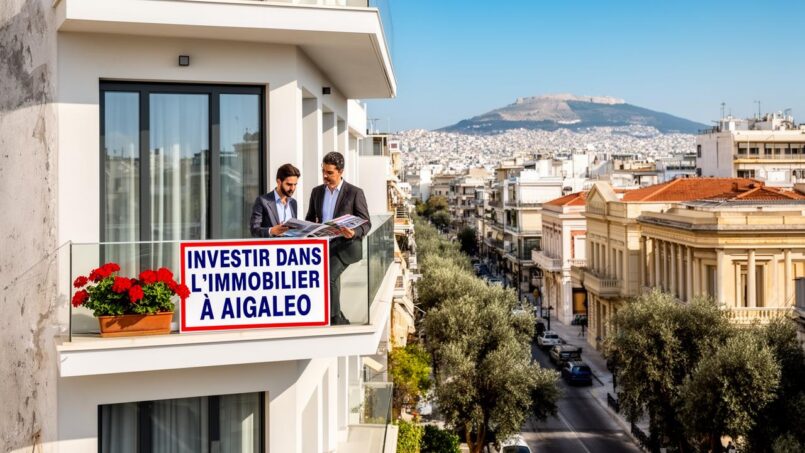
Stuck for years in the shadow of Athens’ “star” neighborhoods, Aigáleo is changing categories. This residential sector in the western suburbs now checks several boxes highly sought after by investors: high yield, still accessible prices, solid rental demand, and a clearly upward urban dynamic. In an Athenian market already considered one of the most profitable in Europe, Aigáleo stands out as one of the places where the balance between risk, price, and yield is most interesting.
Aigáleo in the Context of the Athenian Market
To understand Aigáleo’s appeal, you first need to place the neighborhood within Athens’ real estate landscape. The Greek capital shows average gross yields around 5% citywide, with peaks of 6–9% for well-located apartments in the center and for small units. Renovated studios and one-bedroom apartments in central areas, especially those frequented by students or tourists, regularly achieve 7–9% gross yield.
This is the gross rental yield, as a percentage, that a real estate investment in Athens can generate, significantly higher than the European average.
In this already attractive landscape, Aigáleo positions itself above average: the gross rental yield there is estimated at 6.9%, placing the sector among the best in Athens, on par with reputed neighborhoods like Amerikis Square or Kypseli. In other words, you find “inner city” profitability with “working-class suburb” prices.
A Suburban Neighborhood in Full Transformation
Aigáleo is a suburban sector in western Athens, traditionally oriented toward middle classes and families. Several factors are now converging to make it one of the most promising markets in Attica.
Proximity to metro stations (Aigaleo, Agia Marina, Elaionas) strongly stimulates purchase and rental demand. The opening of the station has already led to a price increase, as in Aigáleo where the average price has exceeded €1,900/m², and a mechanical decrease in rental yields, from about 8.2% to 6–7%.
Next, the urban environment. Aigáleo’s surroundings are developing, with new residential and commercial projects along axes like Iera Odos. The presence of the University of West Attica constitutes another major driver: it creates structural rental demand, fueled by students, staff, and young professionals attracted to the campus. Result: very low vacancy, stable leases, and a young population that contributes to the neighborhood’s vitality.
Aigáleo is described as one of the most promising real estate markets in Attica, with perceived relatively low risk, price appreciation already underway, and significant long-term growth potential. It is a “smart choice” for balancing profitability, controlled budget, and appreciation prospects.
Real estate analysts
Price Levels and Recent Trends in Aigáleo
Recent data allow us to concretely measure the local market trajectory. In August 2025, the average asking price for homes for sale in the municipality of Aigáleo reached €2,020/m². This is both a two-year record and an increase of 2.75% year-over-year compared to August 2024, when the square meter was trading at an average of €1,966. The recent low was observed in April 2025, at €1,917/m², giving an idea of the recent variation range.
The price range of real estate properties in Aigáleo in August 2025 illustrates the heterogeneity of the local market, where micro-location and property condition are determining factors. Values ranged from €573/m² in the TEI Athinon area to €2,382/m² in the Lioumi sector, with several neighborhoods showing intermediate prices between these two extremes.
The table below summarizes the average sale prices by sub-area of Aigáleo (August 2025):
| Aigáleo Area | Average Sale Price (€/m²) |
|---|---|
| TEI Athinon | 573 |
| Votanikos | 1,362 |
| Elaionas | 1,452 |
| Ntamarakia | 1,727 |
| Neo Aigaleo | 1,874 |
| Anagennisi | 1,907 |
| Sotiraki | 1,934 |
| Kato Aigaleo – Estavromenou | 2,052 |
| Ierapoli | 2,106 |
| Mparoutadiko | 2,186 |
| Lioumi | 2,382 |
Several elements stand out from these figures. On one hand, the possibility of buying very low in areas like TEI Athinon – in practice sectors near the former technological institutes – suggests renovation or repositioning operations with high leverage. On the other hand, sectors like Lioumi or Ierapoli are already approaching price levels of the most sought-after western suburbs, while still maintaining, for now, an attractive profitability.
Average price per square meter in the Athens-West province in August 2025, up 4.73% year-over-year.
| Municipality (Athens-West) | Average Sale Price (€/m²) |
|---|---|
| Agia Varvara | 1,439 |
| Acharnes | 1,588 |
| Kamatero | 1,841 |
| Nea Philadelfia | 1,867 |
| Nea Chalkidona | 1,825 |
| Aigáleo | 2,020 |
| Ilion | 2,075 |
| Peristeri | 2,120 |
| Chaidari | 2,202 |
| Metamorfosi | 2,459 |
| Nea Ionia | 2,458 |
| Galatsi | 2,667 |
For an investor, Aigáleo is therefore clearly positioned as an intermediate market: more expensive than the most struggling areas, but more affordable than the already highly valued municipalities. This median position often offers the best yield / capital appreciation potential combination.
A Very Favorable Rental Market
The strength of rental demand is the other pillar of Aigáleo’s appeal. In August 2025, the average asking rent for homes for rent in the municipality reached €9.41/m² per month. Again, this is a two-year record, slightly above the previous high point, and an increase of 1.62% compared to the €9.26/m² of summer 2024. The recent low dates back to March 2024, at €8.63/m².
The Aigáleo neighborhood is experiencing one of the strongest rent increases in the Athens metropolitan area, with an annual increase of 15.2% in the third quarter of 2025. This trend, similar to that observed in neighborhoods like Gazi-Metaxourgeio-Votanikos or Petroupoli, reflects growing rental tension in the area.
Even within Aigáleo, rent gaps are impressive. In August 2025, rents ranged from only €1.84/m² in Mparoutadiko to €10.11/m² in Lioumi. These very low values in Mparoutadiko likely reflect unrepresentative data (few listings, specific buildings), but highlight how crucial micro-area selection is.
| Aigáleo Area | Average Rent (€/m²/month) |
|---|---|
| Mparoutadiko | 1.84 |
| Votanikos | 4.41 |
| Elaionas | 7.60 |
| Ntamarakia | 8.87 |
| Ierapoli | 8.68 |
| Anagennisi | 9.52 |
| Kato Aigaleo – Estavromenou | 9.54 |
| Sotiraki | 9.55 |
| Neo Aigaleo | 9.70 |
| Lioumi | 10.11 |
Relating these rents to purchase prices, we find that gross yield around 7% that makes Aigáleo’s reputation. For example, in Neo Aigaleo, an average price of €1,874/m² for a rent of €9.70/m² translates, at first glance, into a gross yield of about 6.2–6.5%, before negotiation and adjustment. In Lioumi, where the average sale price is higher (€2,382/m²) but the rent long above €10/m², we find comparable yields, with a more “premium” profile.
Average rent in euros per square meter in the Athens-West province in August 2025, up 2.77% year-over-year.
| Municipality (Athens-West) | Average Rent (€/m²/month) |
|---|---|
| Acharnes | 6.75 |
| Agioi Anargyroi | 7.58 |
| Ilion | 7.86 |
| Kamatero | 7.92 |
| Nea Chalkidona | 8.01 |
| Nea Philadelfia | 8.05 |
| Agia Varvara | 8.13 |
| Petroupoli | 8.29 |
| Peristeri | 8.92 |
| Chaidari | 8.91 |
| Galatsi | 8.88 |
| Nea Ionia | 9.18 |
| Aigáleo | 9.41 |
The combination of high rents, rapid increases, and still-contained sale prices explains why Aigáleo is regularly ranked among the most profitable areas in Athens, with a yield of 6.9% that rivals safe bets like Kypseli (6.4–7%), Exarchia (6–7%), or Amerikis Square (around 7%).
Winning Neighborhoods Within Aigáleo
Aigáleo is not a homogeneous block. For an investor, the choice of sub-area is decisive, whether to maximize profitability, seek appreciation potential, or target a specific tenant profile.
The sectors around the Aigaleo, Agia Marina, and Elaionas metro stations concentrate the strongest demand. The ability to reach central Athens quickly by public transport remains, for the majority of tenants, a decisive criterion. Prices are higher there than in outlying areas, but liquidity and ease of re-renting largely offset this gap.
Presented by professionals as one of the most promising urban areas in western Athens, Neo Aigaleo offers a good compromise between still-reasonable prices and a gradual upgrading of the building stock. Key criteria for evaluating a property are proximity to the metro, building age, floor level, and degree of renovation. Market surveys mention prices around €1,874/m², but transactions can reach over €3,000/m² for recently built and very well-located products.
Lioumi and Ierapoli, with average prices above €2,100/m² and rents near or above €10/m², embody the “prime” side of Aigáleo: proximity to transport, more cared-for environment, often newer or well-renovated buildings. These are interesting sectors for an investor seeking a more stable profile, with solvent tenants and better protection against market fluctuations, even if it means accepting a slightly lower yield than in more “raw” areas.
Neighborhoods like TEI Athinon, Votanikos, and Elaionas show very low prices per m², but irregular rental demand and complex urban issues. They may suit heavy renovation or repositioning strategies, provided you accept higher risk and carefully analyze the urban fabric.
Renovation Projects and Income Properties: Fertile Ground
The building profile in Aigáleo, largely consisting of old, multi-story buildings, is particularly well-suited for value creation through renovation strategies. An emblematic example cited in market data illustrates the type of asset you can find there: a three-story residential building, built in 2005, fully renovated, with a total surface area of 300 m², comprising five independent units, and offered at €450,000. Located in a quiet neighborhood, close to a square and transport, this type of property is clearly positioned as an ideal support for mixed rental operation, long or short term.
Discover the strategic advantages of investing in rare and accessible assets in Aigáleo, enabling an optimized industrial approach.
Acquisition of assets that have become rare in hyper-central neighborhoods, at prices that remain more affordable in Aigáleo.
Deployment of several small units within the same building for a reproducible and efficient investment strategy.
Pooling and optimization of expenses related to renovation, day-to-day management, and property maintenance.
Maximization of overall yield through the synergy created by group management of a concentrated portfolio.
The European context further reinforces the interest of this type of operation. An international report on office building obsolescence highlights that nearly half of the global stock will need heavy investment to remain compliant with energy performance and usage expectations. While these figures primarily concern commercial real estate, the trend also applies to residential: old, poorly insulated, inefficient buildings are under pressure, but offer those who renovate them to a high standard an opportunity for strong value creation.
In Athens, renovated older homes sell on average 10 to 15% more than similar non-renovated properties.
Yields, Risks, and Aigáleo’s Position in the Athenian Hierarchy
In the architecture of the Athenian market, the different areas can be arranged in a kind of risk/return matrix. “A” neighborhoods – high-end, very central, or ultra-coastal like Kolonaki or Glyfada – offer lower yields (3.5–4.5%), in exchange for greater liquidity, a wealthy clientele, and appreciation potential driven by major development projects like Ellinikon or Faliro Bay.
This is the gross rental yield of the Aigáleo neighborhood, which embodies the typical profile of balanced investment zones.
In comparison, some sectors highly sought after for their pure yield, like certain stretches of the Patision–Acharnon corridor or Victoria and Attiki squares, can offer yields above 7%, but with a rougher urban environment, more potential vacancy, and a more fragile clientele. Conversely, prestige areas like Palaio Psychiko or Vouliagmeni are clearly bets on appreciation and capital preservation, not cash flow.
This is the percentage increase in apartment prices in Piraeus since 2022, the strongest growth among the areas cited.
Infrastructure Effect: When the Metro Drives Prices Up
The case of Aigáleo perfectly illustrates a widely documented phenomenon in other cities: the impact of transport infrastructure on real estate values. In Athens, metro extensions have several times triggered waves of speculation and revaluation, as in Peristeri, where prices have jumped more than 40% since the opening of new stations.
Percentage increase in value of homes located near a new metro or train station in the years surrounding its opening.
For Aigáleo, the existing metro line has already played this role. The shift from a gross yield of 8.2% to about 6–7% is not a sign of deterioration, but the result of rising sale prices driven by this improved accessibility. On the rental side, the impact remains positive: rental demand is strengthening, rents are rising rapidly (+15.2% year-over-year), and the occupancy rate remains very high.
For an investor, it is often more profitable to enter a market like Aigáleo before all the effects of new infrastructure are fully priced in. Currently, the valuation dynamic continues thanks to urban developments around the metro stations, the upgrading of the housing stock, and the growing attractiveness of western Athens, suggesting an unfinished real estate convergence with more expensive neighboring municipalities like Peristeri.
Demand Structured by the University and Families
While transport explains part of the demand, the presence of the University of West Attica is another pillar of the rental market’s strength. As in other student neighborhoods in Athens – Amerikis Square is a good example, with yields close to 7% – the student population provides a base of demand that is little sensitive to economic cycles.
Studios and small apartments located near the university campus are in high demand and rent quickly, often furnished, with rental yields above average. Demand comes not only from students, but also from university staff, teachers, and young workers active in the institution’s environment. This clientele specifically seeks the combination of an still-accessible rent, quick access to the city center, and the presence of local services.
At the same time, Aigáleo attracts many families, drawn by gentler prices than in the northern or southern suburbs, by commercial diversity, and by the presence of schools, parks, and neighborhood squares. This dual clientele, student and family, smooths out risks: you depend neither exclusively on tourism nor on a single type of tenant.
This demographic profile corresponds to major observed trends in European cities: smaller households, rise in single-parent or childless households, increase in older but wealthier households than in the past. In this context, medium-sized apartments well-connected to transport, as found in numbers in Aigáleo, are likely to remain sought after.
Legal and Tax Framework for Investors in Aigáleo
From a legal standpoint, investing in Aigáleo is like investing in any other Greek neighborhood: there are no specific restrictions for foreigners in this area. Any individual, regardless of nationality, can become a property owner in Greece, with the same rights as Greek citizens. All procedures – obtaining a tax number (AFM), opening a bank account, cadastral verifications, signing the deed, registering with the land registry – are standardized and increasingly digitized.
At purchase, the main tax is the transfer duty of 3.09%, calculated on the sale price or the tax-assessed value if higher. For new builds, the 24% VAT is generally suspended until end of 2026, meaning the 3.09% tax also applies in most cases.
Adding notary fees (about 0.5–2%), land registry fees (0.5–1%), agency commissions (often 2% for each party), and lawyer fees (1–2%), the total entry cost generally ranges between 8 and 12% of the property price. For an apartment of €150,000 in Aigáleo, you should therefore budget, roughly, for an envelope of €12,000 to €18,000 in ancillary costs.
During ownership, the main tax is ENFIA. Its amount depends on surface area, age, floor, and especially the official “zone value.” In Aigáleo, it remains moderate compared to more expensive neighborhoods. National rates range from €2 to €16.20/m², with a surcharge if the total value of real estate assets exceeds €500,000. This cost must be factored into the net yield calculation.
Rental income is taxed according to a progressive scale specific to rental income, with brackets ranging from 15% to 45%, a standard deduction of 5%, and the possibility to deduct a significant portion of renovation and energy upgrade work. In practice, for gross yields around 6.5–7%, net profitability after taxes and charges typically falls around 3.5–5%, which remains very competitive on a European scale.
Finally, the suspension of the capital gains tax for individuals until the end of 2026 reinforces the attractiveness of the Greek market for those planning to resell in the medium term. Resales of apartments in Aigáleo during this period are therefore, as a general rule, not subject to capital gains tax, which encourages buy-renovate-sell strategies.
Aigáleo and the Rise of Foreign Investors
Aigáleo’s dynamic fits into a broader movement seeing foreign investors returning en masse to Athens. In 2025, nearly 40% of transactions in the capital already involved non-resident buyers, very often motivated by the combination of attractive rental yield + still-low entry price + Golden Visa program.
The residence by investment program now requires a ticket of €250,000 for renovations and €800,000 for standard properties in desirable areas like Athens. This influx of international capital, although concentrated on upscale neighborhoods and high-end new builds, has a ripple effect on the entire market. It generates a spillover of demand toward more affordable but well-located neighborhoods, such as Aigáleo, Peristeri, or Korydallos.
Large institutional players – REICs, real estate funds, alternative investment vehicles – remain for now more focused on the center, major commercial arteries, and logistics developments. But experience shows that areas combining good connection to the center, a solid rental base, and still-affordable prices eventually come onto their radar. This is what happened in Koukaki, Neos Kosmos, or Pagrati, today much more expensive than ten years ago. Aigáleo, already identified in some reports as an emerging zone in western Athens, could follow a similar trajectory.
Aging Housing Stock and “Value-Add” Opportunities
One of the major current debates in the real estate market, in Greece as elsewhere, concerns the viability of old buildings in the face of new energy, environmental, and usage standards. An international report estimates that about half of the office stock in major metropolises will need heavy investment to remain “up to standard.” While these figures primarily concern commercial real estate, the principle also applies to housing: the future will capitalize on buildings capable of meeting expectations in terms of energy performance, comfort, connectivity, and flexibility.
This is the cost in euros per square meter of a targeted renovation to reposition an apartment into the upper rental bracket in Aigáleo.
Surveys of asset managers in Europe show, however, that this type of strategy requires genuine rigor: you must include a sufficient renovation budget from the outset, verify the feasibility of upgrades, anticipate the evolution of environmental regulations, and not underestimate the higher recurring maintenance costs on older buildings. But the experience of major funds specialized in urban regeneration, including in Athens itself, shows that the most successful operations are precisely those that bet early on still-underestimated neighborhoods, like Metaxourgeio or Keramikos a few years ago.
How to Position an Investment Strategy in Aigáleo
For an individual investor or small operator looking to position themselves in Aigáleo, several approaches naturally emerge, depending on risk appetite and budget.
A first path consists of targeting the most established micro-locations, like Lioumi, Neo Aigaleo, or Kato Aigaleo–Estavromenou, close to the metro and main axes. The idea then is to favor properties already in good condition or requiring light renovation, intended for a family or young professional clientele, on leases of three years or more. You aim for a gross yield around 6–7%, reduced vacancy risk, and steady capital appreciation over five to ten years.
One strategy is to acquire properties in cheaper areas of Athens (like TEI Athinon, Elaionas, or Votanikos), where prices per m² are very low. The typical approach is to renovate entire buildings or large surfaces to create small, well-equipped units, adapted to student or young professional demand. With a good location, the gross yield can exceed 8%, offering significant appreciation potential if the neighborhood gentrifies.
A third, more wealth-management approach involves looking at income-producing assets like the 300 m² building mentioned above. Even though the entry ticket is higher, the possibility of managing several units in the same building, pooling maintenance, playing on lease mix (long-term for some units, more flexible for others), and structuring the operation in a quasi-professional logic can significantly improve overall performance and reduce management friction.
In all cases, the basic rules remain the same: systematically verify the property title and cadastral status, have an engineer check the structure and installations, anticipate the impact of ENFIA (property tax) and rental income tax in your calculations, and keep in mind that the best gross yields are not always those that ultimately offer the best risk/return combination.
Aigáleo, a Bet Already Underway but Far from Exhausted
The revaluation movement of Aigáleo is no longer in its early stages. Since 2022, prices have already risen by more than 30%, in the wake of other western suburbs like Ilion or Peristeri. But this increase must be placed in the broader context of the Athens metropolitan area, where the center has seen its prices soar by nearly 40% in three years, Piraeus by more than 45%, and the northern suburbs by nearly 30%.
Early investors, present at the time of the metro opening or the university boom, have already benefited from the initial rise. Current investors are entering at higher prices, but in an environment where demand is solid and fundamentals are quality, offering more visibility.
At a time when the Greek market as a whole seems to be entering a phase of more moderate but healthier growth – prices still rising, but at more sustainable rates, foreign capital inflows slightly decreasing but still high, stricter regulation of certain segments like short-term rentals – Aigáleo offers a pragmatic answer to a simple question: where to invest in Athens when you are looking for regular income, a reasonable budget, and a still credible appreciation potential?
The Aigáleo neighborhood benefits from a central position at the crossroads of transport, university dynamics, and growing family demand, supported by the gradual transformation of western Athens. For a successful real estate investment, it is crucial to carefully select the street, the building, and the tenant profile. Aigáleo thus presents itself as one of the best choices in Athens to combine rental yield and growth potential in the coming years.
Disclaimer: The information provided on this website is for informational purposes only and does not constitute financial, legal, or professional advice. We encourage you to consult qualified experts before making any investment, real estate, or expatriation decisions. Although we strive to maintain up-to-date and accurate information, we do not guarantee the completeness, accuracy, or timeliness of the proposed content. As investment and expatriation involve risks, we disclaim any liability for potential losses or damages arising from the use of this site. Your use of this site confirms your acceptance of these terms and your understanding of the associated risks.

Cyril Jarnias is an independent expert in international wealth management with over 20 years of experience. As an expatriate himself, he is dedicated to helping individuals and business leaders build, protect, and pass on their wealth with complete peace of mind.
On his website, cyriljarnias.com, he shares his expertise on international real estate, offshore company formation, and expatriation.
Thanks to his expertise, he offers sound advice to optimize his clients' wealth management. Cyril Jarnias is also recognized for his appearances in many prestigious media outlets such as BFM Business, les Français de l’étranger, Le Figaro, Les Echos, and Mieux vivre votre argent, where he shares his knowledge and know-how in wealth management.





