
 Published on and written by Cyril Jarnias
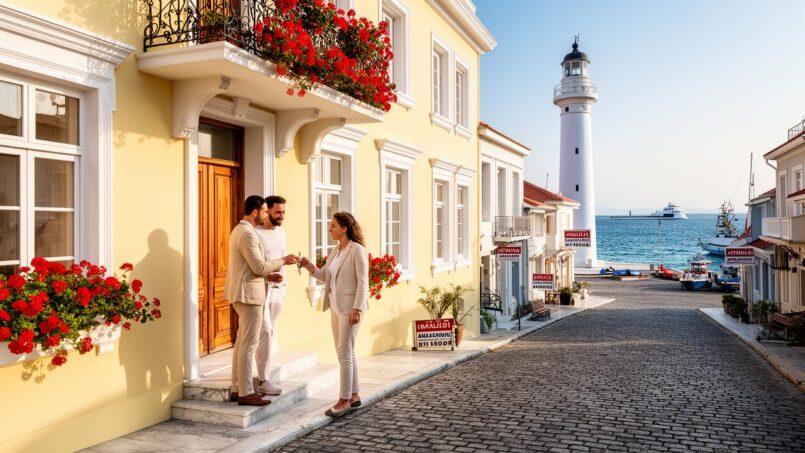
Situated at the northern end of the Aegean Sea, near the Turkish border, Alexandroupoli is gradually establishing itself as one of the most promising real estate markets in Greece for a patient investor attuned to geopolitical dynamics. A port city, capital of the Evros region, energy and military hub, and a booming seaside destination: all these factors converge in a territory of 72,000 inhabitants where prices remain significantly lower than in Athens or Thessaloniki, even as infrastructure projects multiply.
For an investor, understanding the dynamics of Alexandroupoli is crucial. The city is experiencing rising residential prices and strong tourist pressure, notably driven by Turkish visitors. Its port is transforming into a strategic platform for energy and logistics. However, the market is also marked by political tensions related to mass property purchases by foreigners. This unique mix of opportunity and sensitivity makes it a market that is both attractive and demanding.
A still-affordable real estate market, but accelerating sharply
Recent data clearly show that the Alexandroupoli market is emerging from the shadows. In August 2025, the average asking price for residential properties for sale in the municipality reached €1,895/m². A year earlier, it was €1,718/m². Over twelve months, this represents an increase of 10.30%, higher than the average growth seen in many European cities and comparable to the dynamics of so-called “secondary” Greek cities in a catch-up phase.
Over the past two years, the low point was recorded in March 2024 at €1,679/m², and the high point in August 2025 at €1,895/m², confirming a continuous upward trend without any real correction phase. For an investor, this means two things: on one hand, the market is no longer “cheap” as it was after the Greek crisis; on the other hand, prices remain well below the national average for major metropolitan areas.
To situate Alexandroupoli within the Greek landscape, it suffices to compare a few benchmarks:
| Market | Average asking price (2025) | Comment |
|---|---|---|
| Greece (average, 2025) | ≈ €2,600/m² | National level, pulled upward by Athens and luxury islands |
| Athens (center, Q1 2025) | €2,317/m² | +11.77% year-on-year |
| Thessaloniki (municipality, Q1 2025) | €2,558/m² | +12.54% year-on-year |
| Alexandroupoli (municipality, Aug 2025) | €1,895/m² | +10.30% year-on-year |
Alexandroupoli thus clearly sits below the two major urban centers, while exhibiting a robust upward trend. For a value-oriented investor, this is typically the profile of a city in catch-up mode: still affordable, but driven by powerful economic engines (port, energy, tourism, military).
Rising rents and demand driven by tourism
The rental segment follows the same upward trajectory. In August 2025, the average asking rent reached €8.77/m² per month, compared to €8.06/m² a year earlier. That’s an increase of 8.81% over twelve months. Again, the two-year low point dates back to March 2024 (€7.35/m²/month), indicating that the trend is upward without any clear reversal.
In September 2025, the average asking rent in the city center reached €8.93/m²/month, up 8.51% year-on-year.
This yields a price-to-rent ratio fairly favorable for the classic residential investor, especially when compared to Athens, where price increases have sometimes compressed yields. Nationally, gross residential yields generally range between 3.5% and 6.5%, with an average around 4.8%. In regional or medium-sized cities, they can climb above 5.5%. Combining Alexandroupoli’s current rents with its still-contained sale prices puts you typically in this upper range, especially for small apartments, historically the most profitable per square meter in Greece.
Housing costs below the Greek average
Another point in Alexandroupoli’s favor: the cost of living is slightly lower than the rest of the country, and housing is significantly cheaper than the national average. According to comparative data, the overall cost of living is about 0.5% lower than the Greek average, but crucially, housing costs are 8.8% lower than the national average.
In areas where the average net salary is around €900/month, a rent of €400–500 for a two-bedroom or small three-bedroom is more easily manageable for tenants. This improves the ratio between potential rent and local income, thereby limiting, in the short term, the risk of defaults or structural vacancy, provided rental levels remain reasonable.
The typical rental profile can be summarized as follows:
| Property type | Average observed monthly rent | Comment |
|---|---|---|
| 1-bedroom, center | ≈ €400 | High-demand segment from young professionals and couples |
| 2-bedroom, center | ≈ €367 (observed average) | Good compromise for light roommate arrangements or young households |
| 3-bedroom, center | €500–700 | Targets local families or expats with children |
| 4-bedroom, center | ≈ €627 | Still affordable segment compared to major Greek cities |
Additionally, utilities (energy, water, internet) remain around the Greek average, without the excesses of some very expensive seasonal tourist islands.
Price mapping: from the Makri coastline to the Sikorrachi countryside
One of the advantages of Alexandroupoli is the strong diversity of its micro-markets. Within a relatively compact area, prices range from true rural “entry tickets” to seaside sectors already oriented toward high-end clientele.
In August 2025, the price range per square meter within the municipality spanned from €114/m² to €2,397/m². This exceptional spread stems from the coexistence of old rural areas and highly sought-after coastal zones.
| Area / Neighborhood | Type | Average asking price (Aug 2025) | Investment profile |
|---|---|---|---|
| Makri | Residential coastline | €2,397/m² | Villas, sea-view residences, affluent clientele, quality seasonal rentals |
| City center | Dense urban | €1,861/m² (Sep 2025) | Apartments for residents, students, military, urban tourism |
| Nea Chili | Coastal suburban | €1,000–2,500/m² (sea view) | Vacation homes, family residences, tourism products |
| Sikorrachi | Rural | €114/m² | Long-term speculative investments, agricultural or agri-tourism projects |
| Avantas | Suburban / rural | rents ≈ €5.27/m²/month | Relaxed rental market, low entry prices, potential yield |
Makri and Nea Chili concentrate the highest demand for sea-view residences. Land and apartments in these areas generally range between €1,000 and €2,500/m², with the upper end corresponding to direct sea views, immediate proximity to the coastline, and high-end new builds.
The city center, structured around the port and coastal axes, features a classic apartment real estate market. Demand is driven by a diverse clientele: civil servants, military personnel, employees in logistics and energy sectors, students, and a growing number of city-break tourists. With prices around €1,850–1,900/m², this sector remains more affordable than the centers of Athens or Thessaloniki.
Conversely, Sikorrachi exemplifies those rural areas in the Evros hinterland where the average square meter was trading at €114 in 2025. These are territories marked by an aging population, shrinking households, and vacancy of some homes. It is also where concerns about property purchases by foreigners, especially Turks and Bulgarians, crystallize, requiring particular vigilance from investors.
Tourism: the Turkish wave and the rise of foreign visitors
Alexandroupoli is experiencing a real tourism transformation. The city is no longer just a stopover to the islands or a transit port; it is becoming a destination in its own right, especially for Turkish, Bulgarian, and Romanian visitors.
Each week, approximately 3,000 Turkish nationals cross the border to come to Alexandroupoli. They now account for nearly half of the city’s total tourists. According to a local survey conducted in August 2025, the average spending of a Turkish family reaches €1,490, more than double the spending observed among Greek visitors. This clientele focuses on electronics, clothing, spirits, as well as hospitality and dining.
Number of Bulgarians who have acquired real estate in northern Greece in recent years
Direct consequence: the share of foreign visitors in overnight stays now exceeds 25% in the city, whereas a decade ago, overnight stays were overwhelmingly domestic. High-end hotels concentrated in Alexandroupoli (the most numerous in the Evros prefecture) reported occupancy rates already exceeding 58% in 2015, with average daily rates of €65 for upscale establishments, versus €40 for budget hotels.
This market structure hasn’t fundamentally changed, but demand has evolved: rise of city breaks, casino clientele (gambling is banned in Turkey), increasing use of platforms like Airbnb. And this is where tensions emerge.
Airbnb and pressure on rents
As in the rest of Greece, the growth of short-term rentals has contributed to the rapid rise in rents, to the detriment of local households. In Alexandroupoli, investments in apartments for short stays have multiplied, encouraged by Turkish and Bulgarian demand, but also by the influx of military personnel and staff related to energy projects.
This situation generates two simultaneous effects:
– higher yields for owners able to optimize their seasonal occupancy rate;
– growing pressure on affordability for long-term residents, who struggle to find affordable housing in the city center.
In the long run, this imbalance could lead to stricter regulatory measures, as has already been seen in some major European cities. Savvy investors in Alexandroupoli would therefore be wise to diversify their strategies (long-term, medium-term, corporate clientele) rather than betting exclusively on Airbnb.
A port, energy, and military hub: structural driver of demand
Beyond tourism, what sets Alexandroupoli apart from many other Greek coastal cities is the convergence of several major infrastructure projects that are reshaping its geopolitical role.
The city’s port has been elevated to the rank of major logistics platform for the United States, NATO, and energy flows toward Eastern Europe. This rise is built around several axes.
The port: from regional crossroads to strategic hub
The Alexandroupoli Port Authority (APA S.A.) holds an exclusive concession with the Greek state until 2062. It manages not only the main port but also the facilities at Makri and those on the island of Samothrace (Kamariotissa and Therma). Its activities cover bulk cargo, logistics, coastal passengers, storage, and increasingly defense-related flows.
The port has been identified as a key link in the Baltic–Aegean axis, capable of absorbing part of the traffic that typically transits through the Turkish straits (Bosphorus). This strategic repositioning has been accompanied by heavy projects, integrated into the national recovery plan “Greece 2.0” and largely financed by the European NextGenerationEU mechanism.
Among these projects, two developments are particularly structuring:
| Project | Budget | Main objective |
|---|---|---|
| 1.5 km road connecting the new commercial quay to the ring road | €4M | Divert heavy truck traffic to the Egnatia Odos, avoiding the city center |
| Dredging of the basin and access channel | Part of the €18.2M plan | Restore depths to accommodate larger draft vessels |
In total, a strategic plan of €18.2M is already underway to modernize infrastructure. Simultaneously, a second program of €24M has been approved to further boost port capacity, still within the recovery plan framework. The port is also working on a business plan foreseeing more than €70M in additional investments, notably for acquiring container and agricultural bulk handling equipment.
The Port Authority plans to create a new multipurpose terminal in the eastern part to increase container handling capacity. Other developments include a modern marina, a Schengen-compliant passenger terminal, ship repair workshops, and the installation of renewable energy production (vertical wind turbines or photovoltaic panels) on available spaces.
For real estate, these developments translate into a sustained increase in demand for offices, warehouses, and housing for port employees and logistics companies. Commercial and industrial property prices already range between €1,000 and €2,000/m², with concrete examples in the city center:
| Commercial property (example) | Area | Asking price | Approx. price per m² |
|---|---|---|---|
| Space on Arda 88 (Center) | 336 m² | €200,000 | ≈ €595/m² |
| Space on Alexandroupolis street (Center) | 190 m² | €200,000 | ≈ €1,053/m² |
| Space in Nea Chili (Leoforos Makris 50) | 420 m² | €360,000 | ≈ €857/m² |
| Small commercial space (Center) | 33 m² | €60,000 | ≈ €1,818/m² |
These values show a still-accessible market for those wishing to acquire spaces to convert into offices or neighborhood shops, with growth potential linked to rising port traffic.
The rise of energy: LNG and gas corridors
The opening of a liquefied natural gas (LNG) terminal off Alexandroupoli has reinforced the city’s role as an energy entry point for Southeastern Europe. The project, led by Gastrade, takes the form of a floating storage and regasification unit (FSRU) with a capacity of 5.5 billion m³ per year, about 70% of which is destined for export to the Balkans and Central Europe. Bulgarian operator Bulgartransgaz holds a 20% stake, illustrating the regional dimension of the facility.
This terminal is part of a broader set of energy projects: the Greece–Bulgaria gas interconnector (IGB), 182 km long; the Trans-Adriatic Pipeline (TAP); the future Alexandroupoli–Bourgas oil pipeline; and underground gas storage at Kavala. Together, they outline a “vertical gas corridor” supported by the United States and the European Union, aimed at reducing dependence on Russia.
Energy corridor in Southeastern Europe
The impact on the local market is twofold: first, the creation of direct and indirect jobs in the energy sector; second, the long-term relocation of executives, engineers, and technicians, who require quality housing, often for medium- or long-term rental. The demand for well-located, recent apartments with good energy efficiency is mechanically strengthened.
The military and logistics dimension
Alexandroupoli has become a logistics pivot for NATO and U.S. operations in Eastern Europe, particularly in the context of the war in Ukraine. The port is regularly used as a transshipment base for military equipment, reinforcing the city’s strategic importance in the eyes of Athens and Washington.
This military dimension has two consequences for real estate:
– steady demand for housing for military personnel, consultants, and subcontractors;
– reluctance on the part of the Greek state to fully privatize the port, as evidenced by the abandonment of a plan to sell 67% of the Port Authority’s shares after a tender that had nonetheless attracted major American, French, Belgian, and German groups.
The state has clearly chosen to retain control of the port for national security reasons, while leaving the door open to partial concessions and private investment in infrastructure or services. For a real estate investor, this ensures a form of institutional stability around major projects, even if it limits some direct privatization opportunities.
Tensions, concerns, and “silent colonization”: a sensitive context
The rise of foreign investment in Evros real estate, especially in Alexandroupoli and surrounding villages, is not without debate. Several political figures, notably from the nationalist Greek Solution party, have raised the risk of “silent colonization” by Turkish capital, accused of targeting land and properties near the border.
In rural localities like Soufli or certain depopulated hamlets, numerous transactions have taken place on abandoned houses, often bought by Turkish or Bulgarian families, or even by foreign companies. In the short term, these operations revive villages in demographic decline; in the long term, they fuel identity and security fears, exacerbated by the tense context between Athens and Ankara.
Mayor Ioannis Zampoukis acknowledges the economic benefits of Turkish investments for tourism and services, but warns about the insufficiency of local infrastructure (road network, water, sanitation, housing) in the face of the influx of visitors and new residents, making it a central political issue.
For the foreign investor, this political dimension requires a responsible approach:
– avoid purely speculative acquisitions of sensitive land immediately adjacent to the border;
– prioritize renovation of existing properties within the urban fabric rather than new land development;
– rely on local professionals (agencies, lawyers) who are well-versed in the region’s sensitivities.
Investment strategies: residential, commercial, tourism, and agribusiness
Alexandroupoli and its hinterland are not a monolithic market. Several segments emerge, each with its own risk and return profiles.
Urban and suburban residential
The most obvious segment remains the urban apartment, mainly in the city center and neighborhoods near the sea. Price data show a center around €1,850–1,900/m², with rents close to €9/m²/month. By focusing on modest-sized units (25–55 m²), you can target the highest gross yields, as is the case throughout Greece.
This type of property is suitable for:
– long-term rentals to young professionals, port employees, military personnel, civil servants;
– medium-term rentals to consultants or engineers passing through for energy projects;
– a mixed use of pied-à-terre + rental, especially for European investors who regularly visit Greece.
Discover the characteristics and investment opportunities in this family-friendly neighborhood, ideal for roommate arrangements or medium-term rental projects.
Prices range from €1,000 to €2,500/m². This variation depends mainly on the view and distance from the sea.
The neighborhood consists of single-family homes and small apartment buildings, offering a variety of housing suitable for families.
Properties are particularly well-suited for family roommate projects or medium-term rentals.
Sea-view residences in Makri and Nea Chili
The seaside segments of Makri and Nea Chili lend themselves more to second-home projects or villas intended for seasonal rentals. Prices per square meter reach the upper end of the local range (up to €2,500–2,400/m²), but remain far below those of major tourist islands like Mykonos or Santorini, where average prices can exceed €5,000–7,000/m², with peaks above €10,000/m² for luxury properties.
For an investor looking to combine personal use and seasonal profitability, Alexandroupoli thus offers a much less costly alternative, while benefiting from:
– excellent road access (Egnatia Odos);
– an international airport;
– regular cross-border clientele (Turkey, Bulgaria, Romania).
Demand for sea-view villas is mainly concentrated in spring and summer. To ensure good occupancy in the off-season, it is advisable to target other clienteles such as business travelers, long-stay visitors, or European retirees.
Commercial and logistics real estate
The development of the port, the LNG terminal, and the road and rail corridors opens up a range of possibilities in the commercial and industrial segment:
– warehouses near the axes toward Egnatia and the train station;
– spaces for logistics companies, freight forwarders, port services;
– retail spaces in the center to capture high-spending Turkish and Bulgarian clientele.
Data on shop rents show a highly varied market. There are approximately 156 commercial spaces available, totaling over 714,000 m², with an average asking rent of €60/m²/year. The range goes from €1/m²/year to €576/m²/year, illustrating a heterogeneous market with opportunities for “repositioning” underutilized spaces.
A few sample rents illustrate this dispersion:
| Shop | Area | Monthly rent | Annual rent per m² |
|---|---|---|---|
| Small store (40 m²) | 40 m² | €300/month | ≈ €90/m²/year |
| Medium store (70 m²) | 70 m² | €450/month | ≈ €77/m²/year |
| Large space (6,900 m²) | 6,900 m² | €350/month | ≈ €0.61/m²/year |
These figures show that some large spaces are rented at symbolic levels, likely for very specific uses or in peripheral areas, while small city-center shops achieve higher levels, linked to tourist and local foot traffic.
Agribusiness and rural tourism in the hinterland
Moving away from Alexandroupoli, the Evros region and towns like Orestiada or Didymoteicho offer diversification opportunities:
This region stands out for a combination of agricultural wealth and cultural heritage, offering diversified development prospects.
Fertile lands dedicated to growing cereals, sunflowers, and vegetables.
Rise of organic farming and development of agro-industrial projects.
Strong tourism potential with historical monuments in Didymoteicho and traditional villages like Nea Vyssa, Rizia, or Pythio.
Prices in Didymoteicho, for example, range between €500 and €1,200/m² for residential real estate, well below Alexandroupoli. Projects for small boutique hotels, cultural centers, or agri-tourism can be considered with lower entry tickets, albeit at the cost of more uncertain demand and a less liquid market.
For an investor already positioned in Alexandroupoli, these areas can serve as a “second tier” for diversification, but it is prudent to approach these rural markets as patient capital, with longer investment horizons than for the city.
Legal framework, Golden Visa, and border specifics
Any real estate investment in Greece operates within a specific legal framework that is essential to master before proceeding, especially in a border region like Evros.
Foreign property rights and procedure
Greece allows all foreigners, regardless of nationality, to acquire real estate with the same legal protections as Greek citizens. However, the procedure remains highly formalistic, relying on notarial deeds and land registry entries. Procedural errors can render a transaction unenforceable or invalid, hence the need to use an independent lawyer, separate from the real estate agent and notary.
The main steps of a standard purchase include:
– obtaining a Greek tax number (AFM);
– opening a local bank account;
– possibly signing a preliminary agreement with a deposit (often 5–10%);
– legal checks (titles, mortgages, easements) and technical checks (building compliance, structure);
– payment of transfer tax (3.09%);
– signing the final deed before a notary;
– registration with the land registry (Ktimatologio);
– tax declaration (Form E9).
This is the percentage that ancillary costs (notary, lawyer, etc.) represent relative to the price of a property.
Specific to Alexandroupoli: its location in a sensitive border region. In certain areas near non-EU borders, Greek law requires non-EU nationals to seek authorization from the Ministry of National Defense to acquire real estate. This mechanism aims to protect national security.
The procedure involves a security review by the prefectural council, with timelines ranging from two to six months. In practice, authorizations are generally granted, except in cases of clear risk. For EU citizens, this constraint does not apply.
For a non-European investor interested in Alexandroupoli, it is therefore crucial to check, with a local lawyer, whether the target property is located in a zone requiring prior authorization, and to plan accordingly.
Golden Visa: the residence advantage, but with restrictions
The Greek Golden Visa program is another important aspect for non-European investors. This residence-by-investment scheme allows obtaining a renewable five-year residence permit, covering the spouse, dependent children, and parents.
Recent reforms have tightened conditions, segmenting the territory into several tiers:
– Minimum €800,000 for properties over 120 m² in the most sought-after areas (Attica, Thessaloniki, Mykonos, Santorini, islands with a population over 3,100);
– €400,000 for other regions (including Alexandroupoli), also with a minimum floor area of 120 m² and one property per investor;
– €250,000 for commercial properties converted into housing or for restoration of listed buildings, under strict conditions.
Another key point: properties acquired under the Golden Visa cannot be used for short-term rentals like Airbnb. In case of non-compliance, the investor risks revocation of the residence permit and a fine of €50,000. For Alexandroupoli, this means a non-European aiming for both residency and profitability via short-term rentals will have to arbitrate or structure their investment accordingly (e.g., use one property for the Golden Visa, another for seasonal rentals).
Local services and support ecosystem
The real estate market in Alexandroupoli is now sufficiently developed that a foreign investor can be supported end-to-end by local teams.
Several agencies operate specifically in the city and Evros region: ALEXpolis – akinita, PROPERTY EXPERTS (also present in Thessaloniki), RE/MAX City, Misailidis Realty, agency Chatzimichail with over twenty years of experience, akinita-24.gr (Aggeliki Grasneli), Efi Koukouzika Real Estate (active since 2003), Thraki Mesitiko (Evroshome), and Ggroup (Bee At Home – Ilias Grigorakis & Partners), which also covers Samothrace.
Companies like ALand offer comprehensive support, from property selection to transaction management, relying on specialized legal partners like GH Legal s.r.o. for due diligence, tax planning, and cross-border aspects.
For a non-resident investor, this ecosystem is valuable: it allows delegating most procedures (obtaining AFM, opening a bank account, signing by power of attorney, liaison with notary and administrations), while benefiting from a detailed understanding of local specifics, whether concerning sensitive zones, rental trends, or upcoming infrastructure projects.
Alexandroupoli in the Greek market: opportunity or cycle peak?
To properly assess the potential of Alexandroupoli, one must place the city within the general cycle of the Greek market. Nationally, prices have returned to and sometimes exceeded pre-2008 crisis levels. The increase has been particularly marked in metropolitan areas and renowned islands, driven by tourism, the Golden Visa, and the return of growth.
Average gross rental yield expected by end of 2025, slightly down from 2024.
In this context, Alexandroupoli appears as an attractive “second tier” market:
– prices remain below the average of major urban centers;
– the dynamic is supported by structural factors (port, energy, logistics, military) that are not solely correlated to tourist waves;
– foreign demand is strong but diversified (Turks, Bulgarians, Romanians, Greeks from other parts of the country).
The downside is a more sensitive environment geopolitically and identity-wise. The nearby Turkish border, the military role, and debates around foreign purchases require the investor to favor a long-term strategy, aligned with the city’s sustainable development, rather than a simple short-term speculative bet.
Conclusion: a high-potential market to be approached methodically
Investing in real estate in Alexandroupoli means positioning oneself in a territory at the crossroads of three dynamics: the rise of a strategic port and energy hub, a tourism boom driven by its immediate neighbors, and the reconfiguration of the Greek market under the influence of foreign capital and major infrastructure projects.
The figures speak for themselves: over 10% annual increase in residential prices, nearly 9% for rents, prices still below those of Athens or Thessaloniki, and a range of segments from small city-center shops to sea-view villas, including warehouses and agri-tourism projects.
To capitalize on these opportunities, three principles are essential:
To invest effectively, it is crucial to understand the specific local economic dynamics. This means analyzing key economic flows such as port, military, or LNG-related activities, as well as tourism from countries like Turkey and Bulgaria. Then identify neighborhoods where rental demand is both structural and resilient to economic cycles. Finally, prioritize properties that meet real market needs: well-located small apartments for professionals, family homes for the middle class, or commercial spaces on high-traffic axes.
2. Respect legal and political specifics: use a local lawyer, check border zone constraints if non-European, integrate the new Golden Visa rules (short-term rental ban, investment thresholds, minimum floor area).
It is advisable to plan for holding the property for a minimum of 5 to 10 years. This period allows waiting for the completion of major planned infrastructure (such as rail corridors, LNG development, and port expansion) and gives the city time to absorb the current demographic influx while adapting its urban planning.
Alexandroupoli is not a quick “flip” destination like some highly speculative islands. It is a fundamental market where growth rests on long-term economic and geopolitical fundamentals. For the investor who accepts this timeline and surrounds themselves with the right partners, the city offers a rare combination in Greece: still-reasonable prices, powerful growth drivers, and plural demand—residential, tourist, military, logistical—that limits the risk of dependence on a single revenue source.
That is precisely what makes Alexandroupoli one of the most interesting laboratories of the contemporary Greek real estate market.
Disclaimer: The information provided on this website is for informational purposes only and does not constitute financial, legal, or professional advice. We encourage you to consult qualified experts before making any investment, real estate, or expatriation decisions. Although we strive to maintain up-to-date and accurate information, we do not guarantee the completeness, accuracy, or timeliness of the proposed content. As investment and expatriation involve risks, we disclaim any liability for potential losses or damages arising from the use of this site. Your use of this site confirms your acceptance of these terms and your understanding of the associated risks.

Cyril Jarnias is an independent expert in international wealth management with over 20 years of experience. As an expatriate himself, he is dedicated to helping individuals and business leaders build, protect, and pass on their wealth with complete peace of mind.
On his website, cyriljarnias.com, he shares his expertise on international real estate, offshore company formation, and expatriation.
Thanks to his expertise, he offers sound advice to optimize his clients' wealth management. Cyril Jarnias is also recognized for his appearances in many prestigious media outlets such as BFM Business, les Français de l’étranger, Le Figaro, Les Echos, and Mieux vivre votre argent, where he shares his knowledge and know-how in wealth management.





