
 Published on and written by Cyril Jarnias
Nestled between sea and mountain, connected to Athens by a bridge and a train line, Chalcis is attracting more and more investors looking for a Greek market that is still reasonably accessible but already mature enough to offer attractive returns, particularly through long-term rentals and seasonal rentals. The available data now makes it possible to paint a fairly precise picture of the local market, its prices, profitability, and risks.
Real estate in Chalcis has a specific price structure and yields to analyze, especially via tourist rentals. A comparison with the region of Central Greece is essential. For a foreign buyer, a practical framework exists, but it is crucial not to underestimate the main risks identified.
Chalcis, a seaport one hour from Athens
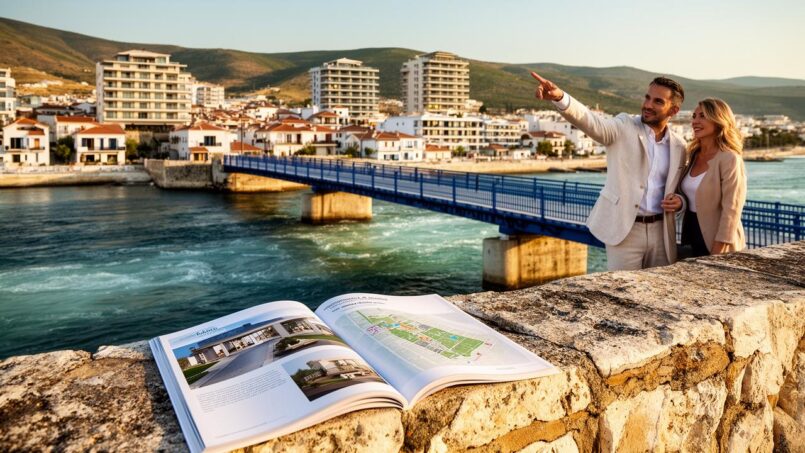
Chalcis, also known as Chalkida or Chalkis, is located on the island of Euboea (Evia), about 99 km from Athens and about 130 km from the international airport. The city stretches along the Evripos Strait, famous for its “crazy waters,” with the North Euboean Gulf on one side and the Greek mainland on the other.
The city has major assets for real estate investment: a pedestrian seaside promenade, a pedestrian shopping center, a marina, urban beaches (Asteria, Kourendi), and a bus and train network that facilitates connections with Athens. The scenic and heritage appeal, with views of Mount Dirfis and the presence of the Karababa fortress, also contributes to rental value.
In its immediate orbit, you’ll find seaside or residential areas such as Drosia, Nea Artaki, Alykes, Avlona, Sykies, Chaina, as well as Eretria or Skala Oropos within driving distance. For an investor, this means a diversified demand pool: local residents, workers commuting to Athens, and Greek and foreign tourists looking for a “sea + city” stay without Athens prices.
Price levels: where does Chalcis stand on the Greek scale?
Price indices show that Chalcis sits in an intermediate zone: more expensive than some rural areas of Euboea, but below the major metropolises or ultra-popular islands. The most useful data concern prices per square meter by property type and location.
Sales prices: apartments, houses, and regional comparison
Several sources converge on the following orders of magnitude.
First, at the national level of Central Greece, an index provides house prices per m²:
| Location (houses) | Average price per m² | Comment |
|---|---|---|
| Amarynthos | €2 377 | Increase of about 10% |
| Eretria | €1 604 | Nearby seaside resort |
| Chalcis | €1 517 | Intermediate level |
For Chalcis, finer data distinguish apartments and houses:
| Property type in Chalcis | Median price per m² | Note |
|---|---|---|
| Apartments (overall) | €2 294 | +3% over the recent period |
| Houses (overall) | €1 517 | Cheaper than apartments |
| Houses – overall median | €1 808 | All types of houses combined |
In other words, an apartment in Chalcis costs significantly more per m² than a detached house, which makes sense in a compact port city where sea views, central neighborhoods, and proximity to services are highly valued.
There are also medians by number of rooms, useful for refining a project:
| Segment | Median price per m² (houses) |
|---|---|
| 4 rooms | €1 624 |
| 5 rooms | €1 644 |
| 6 rooms | €2 023 |
| 7 rooms | €1 963 |
| 8 rooms | €1 805 |
It can be seen that houses with 6 rooms are valued significantly more than smaller ones, reflecting a premium for large family villas, often situated on generous plots with sea views and pools.
The median price per square meter for 3-room apartments is €1 879.
Finally, on the purely statistical side of transaction prices, one index mentions a median selling price for apartments at €1 931/m² at the local level, which is midway between “broad market” values and the peaks of the most sought-after areas.
Concrete listing examples: from studio to luxury complex
The listings recorded in Chalcis and its immediate surroundings illustrate the breadth of the price range. A few examples in dollars to give an idea (amounts remain indicative but reflect the market spectrum):
| Property type | Size | Price (USD) |
|---|---|---|
| Studio 36 m² | 36 m² | ~$50 000–54 000 |
| Apartment 35 m² | 35 m² | $82 092 |
| Apartment 79 m² | 79 m² | $179 576 |
| Apartment 90 m² | 90 m² | $215 491 |
| Apartment 135 m² | 135 m² | $492 551–528 055 |
| Villa 300 m² | 300 m² | $1 282 685 |
| Building 455 m² | 455 m² | $308 032 |
| Plot 232 m² | 232 m² | $44 005 |
| Plot (other listing) | – | $1 980 205 |
In the high-end category, waterfront villas or those very close to Chalcis fetch prices in the millions, especially in Drosia, Kronia, or Anthidona, with built areas of 200 to 565 m² on plots of 2 000 to over 4 000 m², with pools, tennis courts, landscaped gardens, outbuildings, etc.
The price of an apartment in Chalcis, while land can exceed one million euros depending on location and features.
Price per square meter: city center vs. outskirts
Averaged figures for the entire city indicate:
| Area | Purchase price per m² (apartments) |
|---|---|
| City center | €1 800 |
| Outside center | €1 600 |
These values are consistent with the fact that Chalcis, while still much cheaper than Athens (where some southern districts exceed €4 000/m²), now shows a clear differential between center and periphery.
For an investor, this means a trade-off is required between yield (often better on the outskirts) and appreciation potential and occupancy (generally stronger in the center).
Rental profitability: what Chalcis’s ratios tell us
One of Chalcis’s main advantages for investors is the clarity of its rental ratios. Available data covers average rents, gross yields, and price-to-rent ratios.
Current rents: monthly income indicators
Average monthly rents are as follows:
| Property type | Location | Average monthly rent |
|---|---|---|
| 1 bedroom | City center | €450 (range €400–500) |
| 1 bedroom | Outside center | €325 (range €250–400) |
| 3 bedrooms | City center | €683.33 (range €500–800) |
| 3 bedrooms | Outside center | €516.67 (range €300–650) |
Related to the purchase prices mentioned above, these rents already give an idea of gross yields.
Moreover, another source, in dollars, confirms these orders of magnitude, with, for example, a 1-bedroom in the center at about $425–603/month, and a 3-bedroom in the center around $728/month. The differences are due as much to exchange rates as to collection periods, but overall consistency remains.
Gross yields and price-to-rent ratios
The composite indicators for Chalcis are revealing:
| Indicator | City center | Outside center |
|---|---|---|
| Gross rental yield | 5.07% | 4.20% |
| Price-to-rent ratio | 19.72 | 23.82 |
A price-to-rent ratio around 20 means it would take about 20 years of rents (before expenses and taxes) to “pay back” the property’s price, assuming constant rent and full occupancy. This is typical of balanced markets where pure speculation is limited, but where use value and long-term appreciation potential remain real.
The gross yield in the city center is about 5%, higher than in the most expensive European capitals and comparable to the Greek average (4.5–5.6%). Outside the center, it drops to just over 4%, requiring greater selectivity in property choice.
If we remember that the net yield (after expenses, vacancy, maintenance, taxes) is generally 1.5 to 2 points lower than the gross, we can roughly anticipate net yields around 2.5–3% in the center for an investor managing their property properly, more if management is optimized and costs are contained.
Local purchasing power and affordability pressure
Two other indicators complete the picture:
| Indicator | Value |
|---|---|
| Price-to-income ratio | 9.63 |
| Credit installment cost / income | 76.28% |
| Credit affordability index | 1.31 |
A price-to-income ratio close to 10 means it takes nearly ten years of average net salary to buy a typical home, placing Chalcis in the range of markets that have become demanding for local households, without reaching the extremes of major metropolises.
The fact that a mortgage installment can represent more than 75% of the average income illustrates an important truth: homeownership in Chalcis via bank financing is tight for residents, which fuels rental demand, especially in affordable segments (1 to 2 bedrooms) and in neighborhoods well connected to transport.
The average monthly net salary after tax is around €880–950 depending on the source, which positions a rent of €450 for a 1-bedroom in the city center at just over half the average salary. This confirms that rental demand remains strong, but that the potential for rent increases is limited by local purchasing power, hence the interest of complementary tourist demand.
Tourist rentals: a pool of 230 properties and growing demand
Short-term rentals have become a pillar of the investment strategy in Chalcis. The database of seasonal homes allows measuring both market depth and its level of professionalization.
Size of the stock and type of supply
Aggregated data indicates:
| Segment | Number of properties | Starting price | Comment |
|---|---|---|---|
| Vacation rentals (all categories) | 230 | $20/night | +4 200 reviews total |
| Apartments/condos | 60 | $52 NZD/night | +1 100 reviews |
| Accommodations with beach access | 100 | €26/night | +2 100 reviews |
About 80 accommodations are identified as “family-friendly,” 50 accept pets, 80 offer a dedicated workspace. Everything is available: studios from 18 to 30 m², apartments from 40 to 70 m², villas up to 420 m², individual houses, hotels, etc.
A large share of properties offer sea views, gulf views, mountain views, or views of the old Evripos bridge, with modern amenities (private pools, gardens, terraces, jacuzzis, barbecues, parking, air conditioning, equipped kitchens, Wi-Fi, washing machines). Some homes stand out with a unique concept, such as “Tree Haven,” presented as the first “tree-inspired” house in Greece, or very recent full renovations.
Platforms, occupancy, and seasonality
Distribution statistics show a landscape heavily dominated by Airbnb:
| Platform | Share of listings |
|---|---|
| Airbnb only | 85% |
| Vrbo only | 1% |
| Present on both | 14% |
Regarding annual property availability:
| Number of nights open for booking per year | Share of listings |
|---|---|
| 1–90 nights | 6% |
| 91–180 nights | 23% |
| 181–270 nights | 12% |
| 271–365 nights | 59% |
Nearly 6 out of 10 listings are therefore accessible for more than nine months a year, signaling a deliberate positioning toward tourist or hybrid rentals rather than just occasional income supplements. Additionally, about 91% of listings are for entire homes, compared to 9% for private rooms.
Aggregated performance scores confirm the dynamism of the segment:
| Indicator (short-term rental) | Score (0–100) | Annual change |
|---|---|---|
| Rental demand | 65 | +3% |
| Revenue growth | 76 | +4% |
| Seasonal pattern (demand) | 51 | +3% |
| Regulatory environment | 57 | +6% |
The total number of available listings is about 481, up 3%, and the number of active listings has increased by 8% year-over-year. The average monthly occupancy rate, measured over five years, has risen by 3% over the past year, as has the average revenue per listing, while the average daily rate has climbed by 5%.
In short, Chalcis is seeing the development of a short-term rental market where demand, prices, and occupancy are growing slightly but steadily, within a regulatory framework that is tightening marginally but is not yet as restrictive as in some neighborhoods of Athens or Thessaloniki.
Tourist positioning: sea, culture, and Athenian getaways
Chalcis’s tourist appeal rests on several pillars: accessible beaches (Asteria, Kourendi, Papathanasiou, Markopoulou), a lively waterfront with cafes, bars, and taverns, cultural events like the fish festival at the port in August, visits to the archaeological museum or the Karababa fortress, and nature activities (hiking, cycling, horseback riding, wind or kite surfing).
Strolling along the waterfront in the evening to enjoy the cafés and street artists
Local recommendation
For a seasonal rental investor, this mixed positioning – seaside but urban, close to Athens – is valuable: it reduces dependence on the peak summer season by also attracting couples or families on spring and autumn weekends, as well as remote workers seeking extended stays in accommodations with a workspace.
Cost of living, expenses, and local economic context
A reasonable rental investment depends as much on rents collected as on expenses and operating costs.
Recurring charges and services
Day-to-day consumption data shows:
| Expense item | Average cost |
|---|---|
| Basic utilities (85 m²) – water, electricity, heating, garbage | ~$206–216/month (≈ €175–200) |
| Internet (50+ Mbps) | $31.5/month (≈ €26.7), range $22–41 |
| Prepaid mobile phone (per minute) | $0.76 |
In other words, a standard 2–3 room apartment will represent, for the owner-landlord, technical expenses relatively comparable to other mid-sized Greek cities. To this must be added “koinochrista,” the shared condominium fees, which depend on the building (elevator, central heating, garden, pool, etc.).
The cost of housing in Chalcis is 5.7% higher than the Greek national average.
Hotels: a benchmark for nightly rates
Average hotel rates provide another indicator:
| Hotel category | Average weekend price (USD) |
|---|---|
| 3-star | $79 |
| 4-star | $160 |
For an investor in short-term rentals, this serves as a benchmark for positioning a quality apartment or studio: a well-located, modern, and well-rated property can be charged at a nightly rate competitive with these hotels, while offering travelers the flexibility of a kitchen and a living space.
Chalcis in the context of the Greek market: a strategic “second tier”
The Greek real estate market is going through a phase of maturity. After several years of post-crisis catch-up, price increases have moderated while remaining solid: the housing price index in urban areas rose by nearly 7.7% year-on-year in the third quarter of 2025, compared to over 14% in 2023. Data from platforms like Spitogatos confirms an average increase in asking prices of about 10% year-on-year.
The new investment amount required for the Golden Visa in major Greek cities like Athens and Thessaloniki.
In this landscape, Chalcis plays a particular card:
– Proximity to Athens (doable as a day trip).
– Attractive maritime setting for both primary and secondary residences.
– Rental yields in line with Greek averages.
– Lower entry price per property than central Athens neighborhoods or very touristy islands.
Admittedly, Chalcis is not part of the “Golden Visa premium” zones where regulatory investment amounts skyrocket. But it is precisely this relative “discretion” that keeps prices from overheating and offers still reasonable buying opportunities, with medium-term appreciation potential if the spillover effect continues.
Financing an investment in Chalcis: Greek credit, down payments, and ancillary costs
Greek real estate remains largely dominated by cash purchases: about 80% of transactions are concluded without credit. This is due to several factors: aftermath of the banking crisis, caution from banks, and domestic buyers’ appetite for equity-based real estate investment.
For a foreign investor, however, financing solutions do exist.
Real estate loans in Greece: the rules of the game
Greek banks offer mortgage loans to both residents and non-residents, but with strict conditions:
The minimum down payment required to buy a property in Greece, to which must be added about 8 to 12% of the price in taxes and fees.
The main lenders are the National Bank of Greece, Piraeus Bank, Alpha Bank, Eurobank, as well as non-bank institutions and, in some cases, developer-backed financing solutions.
Transaction costs and acquisition taxes
The total cost of an acquisition in Greece always exceeds the “listed” price of the property. In Chalcis, as elsewhere in the country, the following must be included:
| Item | Order of magnitude | Borne by |
|---|---|---|
| Transfer tax (FMA) | 3.09% of taxable price | Buyer |
| VAT (FPA) on new builds (if applicable) | 0% or 24% (temporary suspension on much new construction) | Buyer |
| Notary | ~0.5–1.2% | Buyer |
| Land registry / Cadastre | ~0.5–0.8% | Buyer |
| Lawyer | ~1–1.5% | Buyer |
| Real estate agency | ~2% (often per party) | Buyer and/or seller |
| Engineer / technical inspection | €500–1 000 | As agreed |
All in all, it is prudent to budget 8–12% in additional costs on top of the sale price.
Administrative process for a foreign buyer
A non-resident, whether an EU citizen or not, must follow a well-defined path:
To buy real estate in Greece, you first need to obtain a Greek tax number (AFM) from the tax office (DOY) with your passport. Then, open a local bank account by presenting the AFM, proof of address, income evidence, and, if you are not an EU national, your residence documents. It is strongly recommended to hire a local lawyer, ideally by power of attorney, to carry out essential legal checks (title deed, easements, mortgages or “ypothekes,” and planning compliance). After these checks, sign a preliminary contract and pay a deposit (usually 10% of the price); note that if the buyer withdraws without valid reason, they lose this deposit, while if the seller backs out, they must repay double. The final deed of sale is signed before a notary (symvoliografiki praxi), where the balance of the price, taxes, and fees are settled. Finally, register the property with the Land Registry (Ktimatologio) or local cadastre, then declare the property via form E9 for the annual property tax calculation (ENFIA).
For Chalcis specifically, no specific restrictions hinder purchases by foreigners, unlike certain border areas where a non-EU national must obtain authorization from the Ministry of Defense.
Investment strategies in Chalcis: long-term, seasonal, or hybrid?
Based on the available data on prices, rents, rental demand, and expenses, several strategy models can be identified, each with its advantages and constraints.
1. Long-term rental in the city center
Typical target: one or two-bedroom apartment in central Chalcis, close to the waterfront, shops, and train station.
Average parameters:
– Purchase price: €1 800–2 300/m² (depending on exact location and property condition).
– Monthly rent: €450 for a 1-bedroom, €680–700 for a 3-bedroom.
– Gross yield: around 5%.
– Occupancy: supported by the difficulty of buying for locals and the presence of workers commuting between Chalcis and Athens.
This scenario is suited for investors seeking stability, with a more limited risk of demand fluctuations than tourist rentals, at the cost of more modest net returns.
2. Seasonal “sea + city” rental
Typical target: sea-view apartment, house or small villa in Drosia, Nea Artaki, Alykes or other coastal neighborhoods, well-decorated, with terrace, Wi-Fi, and good accessibility.
Indicative parameters:
Overview of key indicators for seasonal rental investment, based on the data provided.
Range of €1 600 to €2 500/m², varying according to view, distance to the beach, and amenities. High-end villas can far exceed this threshold.
Wide price range. The cheapest seafront listings start around €26/night. Villa rates are significantly higher.
On average increasing, but with marked seasonality, indicated by a score of 51/100.
Significantly above 5% for a well-positioned and well-managed property. Exploiting off-peak weekends helps optimize revenue.
This model suits investors willing to manage operations (or delegate to a professional manager), who accept income variability and regulations that may evolve.
3. Hybrid strategy: long-term lease + short-term rental periods
A relevant option in Chalcis is to combine an annual lease base (e.g., with a remote worker) with short-term rental periods when the unit is vacant, or conversely: a 9-month lease to workers or students, then summer exploitation for 3 months.
The market structure – a high share of entire homes available for more than 270 nights – shows this practice already exists. It allows smoothing income over the year while capturing summer price peaks, but requires careful calendar management, municipal permits, and tax considerations.
Risks and points of caution specific to Chalcis and Greece
No real estate investment is risk-free. Chalcis is no exception, even if the city does not present any particular political risk.
1. Market and financing risks
The Greek market has already experienced violent episodes, and even though the current phase is more measured, the main general risks remain valid:
– Medium-term price volatility if the economic situation turns.
– Possible rise in interest rates, which would reduce the solvency of new entrants and put pressure on prices.
– Relative illiquidity: selling a property in Chalcis will take longer than in central Athens or on an iconic island.
To limit risks, it is prudent not to over-leverage the investment. A gross yield of 4–5% can turn into a much lower net yield if costs, renovations, and interest are underestimated, as many international examples show.
2. Legal and planning risks
The specifics of the Greek system require increased vigilance:
– Check for the absence of unsettled mortgages or seizures (“ypothekes”) on the property.
– Confirm planning compliance, especially for houses and plots: some undeclared extensions can make the property difficult to transfer, or excluded from certain regimes (such as future use for a residency permit).
– Ensure that condominium fees and property taxes (ENFIA) are up to date.
Before any signature, thorough due diligence carried out by a lawyer and an engineer is essential. The engineer must perform a technical inspection and verify the project’s alignment with the building permit.
3. Operational risks in seasonal rentals
Short-term rentals in Chalcis, as elsewhere, involve specific uncertainties:
– Tourist season sensitive to economic or geopolitical fluctuations.
– Possible increase in regulation (night caps, registration requirements, stricter safety standards).
– Growing competition: the number of listings is increasing, and many properties are already managed very professionally by “Superhost” hosts or structured managers.
This does not negate the segment’s appeal, but calls for careful differentiation of the property (view, decoration, amenities, photo quality, and service) and a business plan that incorporates scenarios of declining occupancy rates or prices.
How to select a property in Chalcis: some concrete guidelines
Beyond ratios, real estate investment remains deeply tied to location. Several criteria emerge from the data and observation of the local market.
In terms of location, high-potential areas combine:
– Direct proximity to the waterfront, the pedestrian promenade, and urban beaches.
– Good access to the train station and bus stops.
– Clear views of the gulf, the Evripos bridge, or the surrounding mountains.
– South or southwest exposure for properties used seasonally (interest in sunsets, mentioned in some villa listings).
Studios and one-bedroom apartments, especially in good locations, offer very attractive rental yields. Conversely, large houses of 6 rooms or more, although valued highly per m², require higher maintenance and furnishing budgets.
Finally, building quality and energy rating have become key parameters across the Greek market: properties with high energy ratings (A or A+) sell faster and at higher prices, and cost less to operate. In Chalcis as elsewhere, older properties from the 1980s–1990s often require €600–800/m² in thermal improvement and modernization work to meet current standards, a cost to anticipate in any business plan.
Conclusion: Chalcis, an interesting compromise between yield, risk, and quality of life
Investing in real estate in Chalcis means betting on a human-scale city, very well connected to Athens, on the sea, whose real estate market has already begun its transformation but still maintains reasonable price levels compared to major Greek destinations.
Gross yields hover around 5% in the center for long-term rentals, a level compatible with a cautious wealth strategy, while short-term rentals open up higher prospects for well-positioned properties, at the cost of greater operational risk and higher management needs.
The Greek legal system, while favorable and non-discriminatory towards foreigners, is complex. For a successful investment in Chalcis, it is essential to be accompanied by a local lawyer, notary, and engineer. This rigorous preparation must be complemented by choosing a location that offers both a good quality of life and long-term appreciation potential.
For an investor willing to look beyond the most publicized metropolises, Chalcis thus offers a rare blend: a lively year-round city, an attractive coastline, a structured rental market, and a prospect of gradual appreciation, at the heart of a Greece where seeking promising “second tiers” is becoming the new norm.
Disclaimer: The information provided on this website is for informational purposes only and does not constitute financial, legal, or professional advice. We encourage you to consult qualified experts before making any investment, real estate, or expatriation decisions. Although we strive to maintain up-to-date and accurate information, we do not guarantee the completeness, accuracy, or timeliness of the proposed content. As investment and expatriation involve risks, we disclaim any liability for potential losses or damages arising from the use of this site. Your use of this site confirms your acceptance of these terms and your understanding of the associated risks.

Cyril Jarnias is an independent expert in international wealth management with over 20 years of experience. As an expatriate himself, he is dedicated to helping individuals and business leaders build, protect, and pass on their wealth with complete peace of mind.
On his website, cyriljarnias.com, he shares his expertise on international real estate, offshore company formation, and expatriation.
Thanks to his expertise, he offers sound advice to optimize his clients' wealth management. Cyril Jarnias is also recognized for his appearances in many prestigious media outlets such as BFM Business, les Français de l’étranger, Le Figaro, Les Echos, and Mieux vivre votre argent, where he shares his knowledge and know-how in wealth management.





