
 Published on and written by Cyril Jarnias
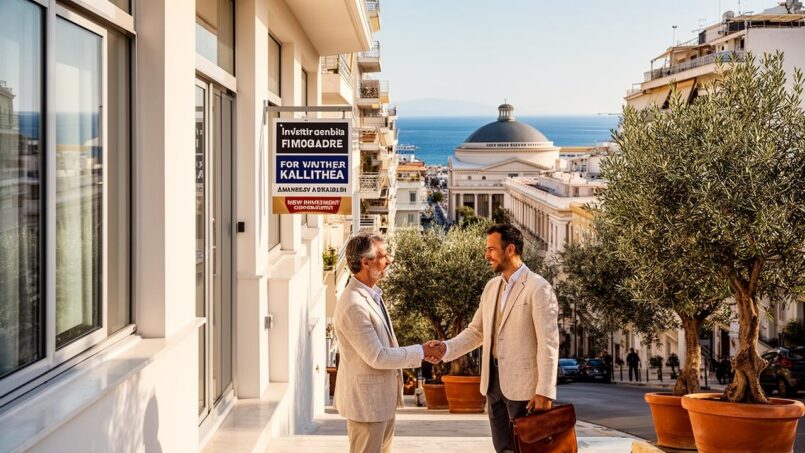
Wedged between Athens’ historic center and the Athenian Riviera, Kallithea long remained a “pass-through zone.” In just a few years, this highly urban district, with its evocative name meaning “beautiful view,” has become one of the favorite playgrounds for foreign and local investors. Still affordable prices, solid yields, major infrastructure projects, strong long- and short-term rental demand: all signals are converging.
To invest wisely in Kallithea, it is crucial to analyze several factors: the level of property prices, the current tax regime, competition from other Athens neighborhoods, and the impact of new rules on the Golden Visa program.
Kallithea, a Strategic Bridge Between Center and Coast
Kallithea is part of the southern suburbs of Athens, roughly 4 km from downtown, and just minutes from the Faliro coast. The district boasts over 100,000 residents and offers a rare combination in the Greek capital: immediate proximity to the center, easy access to the sea, a lively urban atmosphere, and prices still below the most expensive Riviera areas.
This Athens neighborhood particularly attracts young professionals, families, and students, notably due to the presence of two universities (Panteio and Harokopeion) which generate strong demand for small housing units. It offers an authentic local atmosphere with its cafes and neighborhood shops, within a dense, orthogonal urban fabric preserved since its origins. Kallithea thus combines the advantages of a lively district with excellent accessibility, located just ten minutes from the Acropolis or Syntagma and in close proximity to Piraeus.
In terms of infrastructure, the area long suffered from a lack of green spaces and comfortable pedestrian walkways, in a very mineral environment. Several major projects are precisely disrupting this: metropolitan parks, soft mobility corridors, metro extensions, “smart city” programs, and initiatives against heat islands. For the investor, this means an “infrastructure-driven revaluation” already underway.
Still Competitive Prices in a Tight National Market
The Greek real estate market is experiencing a period of sustained growth. In large urban areas, residential prices in city zones rose by nearly 8 to 9% per year in 2024, with a 6.5% increase in Athens in the third quarter of 2025. Southern Athens now shows average prices around €4,000/m², and the Athens average hovers around €2,900/m² for an 80 m² apartment.
In this tight context, Kallithea appears as an interesting “middle ground”: neither a speculative hyper-central district nor an unaffordable Riviera. The most recent data puts:
Average sale price in Kallithea in September 2025, up nearly 3% year-over-year.
The recent price trend in Kallithea shows a clear direction: the low point over the past two years was around €2,701/m² (February 2025), reaching a peak of €2,848/m² in September 2025. The dynamic is therefore upward, but without an apparent bubble, with a growth rate consistent with the rest of the metropolis.
For an investor seeking a trade-off between price and capital appreciation potential, Kallithea sits at the intersection of several trends: relative undervaluation, improved transport links, proximity to major coastal projects, and a gradual shift in demand from segments that have become too expensive (Riviera, premium neighborhoods).
Rental Yields: Where Does Kallithea Stand Compared to the Rest of Greece?
On a national scale, Greece displays an average gross rental yield of around 4.4 to 4.8%, with a common range between 3.5 and 6.5%. The net average (before income tax) is approximately 3.2%, with expenses – notably the ENFIA property tax – typically shaving 1.5 to 2 percentage points off the gross yield. Within Athens, yields are more generous: the city averages around 5.0 to 5.4% gross, with some central districts reaching 6 to 9% for small, well-located units.
Kallithea, for its part, sits in the upper part of the average, while remaining slightly behind the most aggressive “hot spots” of the historic center. Available data indicate:
Estimated gross rental yield for the central sub-sector of Kallithea, falling within a broader range of 5% to 6% for the entire residential area.
To understand the real appeal, it’s useful to compare different zones of Kallithea by cross-referencing sale prices and rents. Based on September 2025 figures, one can calculate a theoretical gross profitability (rent * 12 / price):
| Kallithea Sub-sector | Avg. Sale Price (€/m²) | Avg. Rent (€/m²/month) | Estimated Gross Yield |
|---|---|---|---|
| Lofos Filaretou | 2,596 | 10.27 | ≈ 4.7% |
| Chrisaki | 3,004 | 10.07 | ≈ 4.0% |
| Charokopou | 2,655 | 10.14 | ≈ 4.6% |
| Lofos Sikelias | 3,074 | 9.55 | ≈ 3.7% |
| Agia Eleousa | 2,694 | 10.00 | ≈ 4.5% |
| Tzitzifies | 3,221 | 10.71 | ≈ 4.0% |
| Center | 2,603 | 10.07 | ≈ 4.6% |
We can see here that the best price/rent combinations are not necessarily in the most expensive areas. Lofos Filaretou, Charokopou, Agia Eleousa, and the center offer yields around 4.5 to 4.7%, whereas Lofos Sikelias and Tzitzifies, more expensive, drop to around 3.7–4%. This doesn’t mean the latter should be avoided: they benefit from other levers (immediate proximity to the coast, long-term capital appreciation prospects), but they are less “rentier” in the short term.
At the municipal level, the average rent is €10.07/m²/month, up 3.2% year-over-year. After a low of €9.62/m² in April 2024, it reached a peak of €10.07/m² in September 2025. This steady growth, similar to that of prices, reflects the persistent rental market tightness in the Athens basin.
Long-Term vs. Short-Term: Two Distinct Rental Markets
One of the specificities of Kallithea is that it is both a solid market for long-term rentals and an interesting ground for short-term rentals like Airbnb, without reaching the excesses of the purely tourist center.
Long-Term Rentals: A Stable Income Base
In the conventional residential segment, Kallithea benefits from:
– a demand base made up of university staff, students, and employees in the financial, legal, and technology sectors, working in Athens or Piraeus;
– general tightness in the Greek market, where rents are rising faster than inflation, and where the housing shortage is estimated at around 250,000 units;
– growing appeal of small and medium-sized apartments, especially between 25 and 55 m², which offer the best per-square-meter yields.
The average rent for a one-bedroom apartment in Kallithea is around $850 (approximately €780–800) per month, with starting rents as low as $385 for the most modest properties. In practice, well-renovated studios and one-bedroom units near transport axes easily reach the upper end of per-square-meter rents.
In Athens, long-term rental properties in central areas show occupancy rates between 90% and 97%. For Kallithea, located between the center and the south, this indicates an anticipated very low vacancy rate. The market is dynamic with quick turnover: the average time to sell a property in comparable sectors is about 58 days, testifying to the market depth.
Short-Term Rentals: A Growing but Regulated Market
The short-term rental (STR) market has gained significant traction in Kallithea, without reaching the saturation of some hyper-touristic neighborhoods. Across the municipality, an AirROI analysis (Sept. 2024 – Aug. 2025) lists:
– 384 active listings, for a total of 639 available properties in the broader area;
– an annual supply growth of about 3%, and 8% for truly active listings;
– an overwhelming majority of entire apartments (over 92% of listings), dominated by one- and two-bedrooms (more than 86% of the STR stock).
In terms of performance:
Analysis of price, revenue, and occupancy data for tourist accommodations.
Peaks at around $102 in June (high season) and drops to between $75 and $77 in low season.
Around $1,022. The top 10% of performers exceed $2,760 per month.
Hovers around 45%. The best 25% exceed 70% and the top 10% reaches over 84%.
In the shoulder season (spring/fall), a “standard” property can generate around $1,300 in monthly revenue, with 47% occupancy. In high season (July, August, September), a well-managed apartment averages $1,700 per month with about 54% occupancy.
A second dataset covering a specific submarket of Kallithea (only 25 listings) shows a very different profile: all listings are licensed, regulatory requirements are high, and top 10% performance soars (ADR above $190, monthly revenue potentially reaching $2,483 at the August peak). However, extreme seasonality is observed, with nearly empty months in the low season.
This contrast well illustrates the new Greek reality: short-term rentals can offer gross yields of 8 to 15%, but they require professional management, proper licensing, and incur significant expenses (20 to 25% management fees typically, plus taxes and costs). In Kallithea, regulations vary from one micro-zone to another: some parts of the municipality remain lightly constrained, others – more touristy or sensitive – impose strict licensing and controls.
Infrastructure and Major Projects: The Silent Value Accelerator
One of the major arguments in favor of Kallithea lies in the convergence of several major infrastructure projects around the district. These developments are not theoretical: some are already underway, others are funded and planned for the 2028 horizon.
Delta Falirou and the Redevelopment of Faliro Bay
Along the neighboring coastline, the Greek state is steering a vast urban reclamation program: Delta Falirou. The goal is to transform Faliro Bay into a continuous waterfront, combining parks, sports facilities, environmental infrastructure, and soft mobility.
The main elements include: objectives, resources, stakeholders, and timelines.
The project includes creating a metropolitan park of over 500 hectares, of which 343 hectares are green spaces (about 75% of the total). It integrates a 22 km pedestrian and cycling corridor linking Elliniko to Voula, along with cultural spaces, artificial lakes, open-air cinemas, and exhibition areas. Environmental measures such as planting nearly 2,900 trees, creating underground parking lots, and transforming the old coastal road into flood-protection infrastructure round out the development.
Nearby, the Aenaon Park, a metropolitan park of 600 acres (nearly 1 km²), is expected to be completed around 2028. This is the largest creation of “green space” in southern Athens since 2016. Kallithea is on the front line to capture the residential demand this new environment will attract, especially from households wanting to enjoy large parks while staying close to the center.
Metro Extensions: The Real Location Premium
Another catalyst: the metro network extension. Four new stations are planned to serve Kallithea by 2028, including a “Filaretou Hill / Tzitzifies” station less than two kilometers from avenues like Thiseos. An extension of Line 1 (green line, ISAP) will connect Thisio to the Stavros Niarchos Cultural Center (SNFCC) via several stops in Kallithea: Plateia Davaki, Filaretou / Tzitzifies, and the terminal stop at the SNFCC.
In the 24 months following the opening of new stations, rents within an 800-meter radius have risen 8 to 12% faster than the municipal average.
For an investor in Kallithea, positioning now in the future station catchments (Tzitzifies, Lofos Filaretou, center) means betting on an accelerated rental revaluation in the medium term, without this premium yet being fully priced in.
SNFCC, GRID, and Smart Cities: Kallithea as an Urban Laboratory
The Stavros Niarchos Foundation Cultural Center, located on the edge of Kallithea, is already a symbol of this transformation: 170,000 m² of cultural facilities and parkland, housing the National Opera, the National Library, and a large landscaped park, with high energy performance.
The GRID project deploys in Kallithea and Moschato-Tavros digital and nature-based solutions to combat heat, develop green corridors, and promote walking and cycling. It relies on climate sensors, real-time data, simulation tools (digital twin), and involves residents in co-designing improvements.
In parallel, Kallithea is one of the municipalities targeted by the national “Smart Cities” program, funded by the European recovery plan (RRF and ERDF funds), for smart parking, connected bus stops, digital twins, etc. Combined with massive investments in transport and park infrastructure, this positions the district as one of the most advanced grounds for the Greek “smart city”.
Over time, this combination – world-class culture, large parks, techno-urbanism, metro – strengthens residential appeal, particularly for the 28–42 age group that favors car-free mobility and lively but relatively affordable neighborhoods. For an investor, the demand from this segment is an asset: it tends to be stable, solvent, and eager for modern or renovated homes.
Property Types and New Developments: Where to Position Yourself in Kallithea?
The real estate landscape of Kallithea consists of a mix of: residences, shops, offices, and green spaces.
– older condominiums, often pre-1980, with strong renovation potential;
– modern or recent residential buildings;
– new developer projects targeting either rental investors or the local upper-middle class.
The national shortage of energy-efficient housing – over 70% of Athens’ stock was built before 1980 – works in favor of new builds or complete renovations.
Estimated maximum budget for renovating an 80 m² apartment in Athens, which can reach €1,200/m² for premium quality.
Kallithea notably concentrates several new or nearly new developments, for example:
The Athens real estate market offers small-scale residences like “Celestia,” “Skra 8 & Doiranis,” or “Panayi Tsaldari 175,” offering one-bedrooms, studios, two-bedrooms, and some duplexes, often with sizes between 38 and 85 m². Meanwhile, specialized developers like Oikos Property Developments are developing targeted projects, such as a complex of 54 one-bedroom units named “Boulevard” on Thiseos Avenue, explicitly designed for investors and young urbanites.
This type of product perfectly reflects the demand profile in Kallithea: compact, well-equipped apartments with outdoor spaces (balconies, terraces), near transport axes, and suitable for both long-term and short-term use. One-bedrooms and smaller entry-level units are especially sought after for traditional rentals (students, young professionals), while well-located two-bedrooms find their niche in family or business short-term rentals.
Golden Visa and Taxation: What to Know Before Buying in Kallithea
For non-residents, real estate investment in Greece is often associated with the Golden Visa, a renewable five-year residence permit in exchange for a real estate investment. However, the framework has changed in recent years, and Kallithea falls into a zone with stricter conditions than elsewhere.
Golden Visa: A Raised Threshold in Kallithea
A new law (5038/2023), supplemented by subsequent reforms, has redefined the investment thresholds:
– In specific high-demand areas, including Kallithea, the minimum required can reach €500,000 to obtain residency, to be invested in a single property.
– For most other regions, the general threshold remains at €250,000, sometimes €400,000 depending on the period and nature of the investment.
– An interesting exception remains: if an investor buys a commercial asset and converts it to residential use before applying, the €250,000 threshold may apply.
The minimum investment amount required to benefit from the favorable tax regime for non-residents in Greece.
For the investor interested in Kallithea, the challenge is calibrating the entry ticket: a budget of €250,000–300,000 is sufficient for one or two apartments in less regulated Greek areas, but more is often needed to stay within the Kallithea perimeter while complying with current Golden Visa rules.
Charges, Taxes, and Net Yield
Beyond the Golden Visa, the real profitability of an investment in Kallithea depends on current taxation:
Buying a property in Greece incurs a 3% transfer tax (increased to 3.09% with municipal surcharge) on the objective value or price, plus notary, lawyer, and agent fees, bringing the total transaction cost to 6–9% for the buyer. Upon ownership, the owner must pay the ENFIA property tax, calculated per m² (between €2 and €16.20/m² depending on the zone, building age, and floor), as well as a municipal TAP tax of around 0.025 to 0.035% of the objective value. Rental income is subject to progressive taxation from 15 to 45%, with a possible 5% flat-rate deduction for certain non-resident profiles. Lastly, for short-term rentals, if the activity takes on a quasi-hotel character (with services provided), VAT (at 13 or 24%) may apply.
Add to these the typical operational expenses (management, insurance, maintenance, repairs), often estimated at 20–25% of gross rent for short-term rentals, and 10–15% for long-term (including professional management). This reality explains why net yield often shaves 1.5 to 2 points off the gross yield: a 5.5% gross yield in Kallithea will frequently translate to 3–4% net before income tax, which remains competitive on a European scale when considering capital appreciation potential.
Comparison with Other Athens Neighborhoods: Kallithea, Compromise or Best Value?
To gauge the interest of Kallithea, it is useful to compare it with other Athens neighborhoods:
Gross yield and price per m² vary considerably across Athens neighborhoods. Gentrifying areas like Kypseli or Metaxourgeio offer high yields (6.5–8%) at moderate prices (€1,700–2,200/m²), but are perceived as riskier. Prestigious zones (Kolonaki, Glyfada, Plaka) have very high prices (€3,500–10,000/m²) for low yields (2.5–4.5%), mainly attracting primary residence buyers. Neighborhoods like Pagrati or Koukaki combine good yields (5–7%) and strong capital appreciation potential, but their prices have already risen significantly.
Kallithea, for its part, sits:
– above the hyper-popular neighborhoods in terms of price, but below the premium Riviera zones;
– with yields around 5–6% on average, therefore competitive, without being extreme;
– on a sustained growth trajectory, driven by infrastructure, but without having yet reached the overheated levels of the trendiest sectors.
For an investor with a 5–10 year horizon, market analyses emphasize that Kallithea is one of the “undervalued” neighborhoods promising outperformance, notably because it belongs to the block of “southern alternatives” benefiting from the spillover effect of Ellinikon and the redevelopment of Faliro Bay, without bearing the entry ticket of these showcase zones.
Risks and Points of Vigilance
No market is without risk, and Kallithea is no exception to several challenges:
Several factors could slow down the strong appreciation of the Greek real estate market. First, affordability is already very strained for local households, who spend an average of 35% of their income on housing (a European record), limiting the capacity to absorb rent increases. Second, chronic delays in major infrastructure projects (over five years on average) could slow the expected revaluation in certain areas. Third, regulations on short-term tourist rentals (like Airbnb) are likely to tighten, with stronger controls through tools like the MIDAS registry. Finally, growing energy requirements could depreciate older, unrenovated properties compared to a more efficient new or renovated stock.
To mitigate these risks, due diligence must be particularly rigorous: cadastral verification, urban planning check by an engineer, analysis of building regulations, precise study of rental potential (long or short term) zone by zone, and guidance from a lawyer and tax specialist familiar with Athenian practice.
Investment Strategies in Kallithea: Some Concrete Ideas
In this landscape, several strategies emerge for the investor:
A first approach is to target one-bedroom and small two-bedroom units that are new or very recently renovated, ideally within a radius that will be served by the new metro stations, such as Lofos Filaretou or Tzitzifies. These properties, well-suited to the demand of young professionals, offer a good trade-off between yield (around 5–6% gross possible) and value appreciation prospects thanks to the network effect.
Acquiring older apartments (60–80 m²) in neighborhoods like the center, Charokopou, or Agia Eleousa, followed by a complete renovation to modern energy standards, is a viable strategy. Although the cost of work is high (€600–800/m²), the renovated property becomes attractive for urban families and shared housing. This approach also benefits from tax breaks, notably a 40% tax credit on certain works (capped over five years).
A third path targets short-term rentals, but in a targeted way: rather than opening Airbnbs everywhere, it can be wise to identify the micro-sectors of Kallithea where regulations are clear, licenses are granted, and where proximity to attractions (SNFCC, city center, quick access to the sea and Piraeus) supports high ADRs. In these zones, a well-decorated property with good management can approach the performance of the top 25% of listings: over $1,700–2,000 per month in peak season.
Some institutional or wealth investors adopt a ‘core’ approach in Kallithea, acquiring entire buildings or portfolios for gradual value enhancement. This strategy benefits from the temporary suspension of the capital gains tax (valid until end of 2026) and favorable tax regimes offered by REIC-type structures. Kallithea thus plays a pivotal role between real estate flows from the city center and those generated by the Riviera and the Ellinikon project.
Conclusion: Why Kallithea is Essential in an Athens Portfolio
Kallithea combines several rare characteristics on the scale of Athens and, more broadly, Greece:
Analysis of the real estate strengths and potential of this rapidly transforming Athens neighborhood.
A pivotal location between the historic center, the port of Piraeus, and the Riviera, benefiting from enhanced accessibility via the metro and revaluation potential thanks to parks and major Faliro Bay projects.
Still reasonable per-square-meter prices compared to premium zones, driven by sustained demand, suggesting a catch-up rather than a speculative bubble.
Yields in the upper range of the national average, particularly for smaller units, offering a balance between profitability and controlled risk.
A dynamic market fueled by both long-term rentals (students, young families, professionals) and short-term rentals (urban tourists, business travelers).
A district transformed by ‘smart city’ programs, large-scale green infrastructure, and internationally renowned cultural institutions.
In a Greek market entering a phase of maturity, where simply chasing a “cheap” Golden Visa is no longer a sufficient strategy, Kallithea well illustrates the new paradigm: value now lies at the intersection of mobility, urban quality, energy performance, and solid rental demand.
For the patient, selective investor, well-supported legally and tax-wise, Kallithea thus offers a prime ground to combine steady income streams and capital appreciation, at the heart of one of the most dynamic metropolises in the Mediterranean.
Disclaimer: The information provided on this website is for informational purposes only and does not constitute financial, legal, or professional advice. We encourage you to consult qualified experts before making any investment, real estate, or expatriation decisions. Although we strive to maintain up-to-date and accurate information, we do not guarantee the completeness, accuracy, or timeliness of the proposed content. As investment and expatriation involve risks, we disclaim any liability for potential losses or damages arising from the use of this site. Your use of this site confirms your acceptance of these terms and your understanding of the associated risks.

Cyril Jarnias is an independent expert in international wealth management with over 20 years of experience. As an expatriate himself, he is dedicated to helping individuals and business leaders build, protect, and pass on their wealth with complete peace of mind.
On his website, cyriljarnias.com, he shares his expertise on international real estate, offshore company formation, and expatriation.
Thanks to his expertise, he offers sound advice to optimize his clients' wealth management. Cyril Jarnias is also recognized for his appearances in many prestigious media outlets such as BFM Business, les Français de l’étranger, Le Figaro, Les Echos, and Mieux vivre votre argent, where he shares his knowledge and know-how in wealth management.





