
 Published on and written by Cyril Jarnias
At first glance, Public Transport in Djibouti: A Practical Guide may seem like a simple topic. In reality, understanding how mobility in the capital and beyond works—between informal networks of minibuses, shared taxis, ferries, and the train to Ethiopia—is essential to avoid unpleasant surprises. In a country where only 3% of households own a car, shared transportation is the heart of the system… but it remains largely unstructured.
Good to Know:
This guide provides a concrete overview of getting around Djibouti, covering the central neighborhoods of Djibouti City, connections to Tadjourah, Obock, and Addis Ababa, as well as the airport and taxi network. All numerical information comes from institutional reports and recent field surveys, adapted for practical use.
Understanding Djibouti’s Transport Landscape
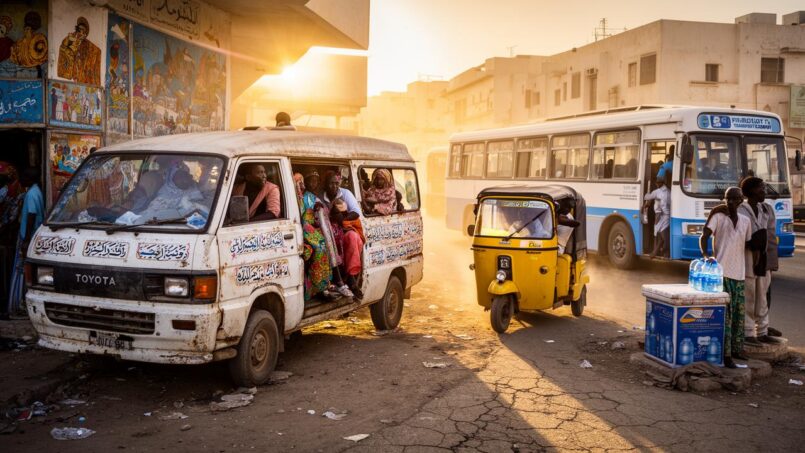
Getting around Djibouti relies on a patchwork of transportation modes rather than an organized public network in the European sense. In the capital, the backbone of the system consists of minibuses, midibuses, shared taxis, and rickshaws (Bajaj), supplemented by private taxis, a few intercity buses, coastal ferries, car rentals, and the modern railway line connecting Djibouti to Addis Ababa.
Attention:
Despite significant transport infrastructure, daily mobility relies on a private and informal network, with no official routes or fixed schedules, leading to unpredictable service and varying quality.
In this context, traveling in Djibouti is not a matter of complete improvisation, but requires flexibility, a bit of preparation, and a good understanding of local codes, especially regarding price negotiation and road safety.
Getting Around on Foot and by Bike in the Capital
Walking remains an important mode of transport in the central neighborhoods of Djibouti City. The center is relatively compact, with shops, services, restaurants, and markets accessible on foot. But this apparent ease has several limitations.
First, the heat. In the middle of the day, temperatures make long walks exhausting, even dangerous for those not acclimatized. Most residents therefore prefer walking early in the morning or late in the afternoon, and rely on collective transport for slightly longer distances.
Tip:
Outside city centers and main roads, the pedestrian environment can be challenging: sidewalks are often absent or deteriorated, roads are narrow with heavy traffic, and safe crossings are very rare. On many roads, the lack of shoulders and sidewalks forces pedestrians and livestock to share the roadway directly with vehicles, day and night.
Biking remains marginal. The combination of sometimes chaotic traffic, the near-total absence of bike lanes, and high temperatures limits its use to a few expats or very motivated locals. Bike rental services are virtually non-existent. For the passing traveler, biking is therefore not a truly practical mode of transport for daily trips, especially in areas of dense traffic.
The Heart of the System: Minibuses, Midibuses, and Rickshaws
The backbone of urban public transport consists of minibuses (12–14 seats), midibuses (30–35 seats), and Bajaj-style rickshaws. These vehicles handle the majority of trips between downtown Djibouti and the major peripheral neighborhoods, especially Balbala.
Routes are not formalized with maps, but they follow clear axes: the main roads connecting residential neighborhoods to employment and commercial areas. Place Mahmoud Harbi (often called Place Harbi or Place Rimbaud) is the central hub of the system, while terminals like Hayableh and PK12 structure service on the Balbala side.
Key takeaways about this informal network are summarized below.
How Minibuses and Midibuses Work
Minibuses and midibuses operate on relatively fixed routes, but with great flexibility for stops. There are no marked stops, official signs, or schedules. Vehicles stop when a passenger requests it or when they spot people on the roadside. Filling up is the priority: vehicles leave when they are deemed sufficiently full.
Good to Know:
Service hours generally run from 5–6 a.m. to 9–10 p.m. On the busiest routes, frequency is high, especially during peak hours, which limits waiting times. However, this frequency should not obscure the fact that overall capacity remains limited relative to the city’s population size and heavy dependence on these services.
A mapping initiative carried out with the World Bank showed that, across all routes, the system offers fewer than 5,000 seats per hour per direction. For a metropolitan area of over 600,000 residents, of whom only 3% own a car, the network is clearly undersized. Over three peak hours, roughly 15,000 people can theoretically board, not counting transfers. Even doubling that capacity, it still falls well short of demand.
Fares, Payment, and Cost for Residents
In the city, fares are low in absolute terms, but high relative to local incomes. A standard urban trip costs between 100 and 200 Djiboutian francs (DJF), often around 150 DJF. A usage study shows that a regular rider spends an average of 150 DJF per day and uses three buses for a door-to-door trip.
Example:
For a person with a median income, transport costs remain manageable. However, for the poorest households, this expense represents such a large share of their budget that many forgo certain trips due to lack of means. Thus, although officially affordable, public transport is perceived as costly and inequitable in practice.
Payment is made in cash, directly to the driver or conductor, preferably in small bills. Change can be hard to come by in very crowded vehicles, so it is best to prepare the approximate fare in advance.
Comfort, Safety, and Accessibility
The vast majority of buses are old, uncomfortable, and often poorly maintained. Air conditioning is rare, suspensions are worn, and passenger space is limited. It is not uncommon to travel standing up or very cramped, especially during peak hours.
Attention:
The main safety risks identified relate to driving, with high accident rates. These are attributed to dangerous behavior, often due to very long workdays and, for some drivers, khat consumption.
For people with reduced mobility, access is extremely limited. There is no systematic provision for wheelchairs, steps are high, and infrastructure (sidewalks, ramps) around informal stops is rarely adapted. Djibouti has established a National Agency for Persons with Disabilities, but concrete progress in urban transport remains, for now, very modest.
Where to Catch Minibuses and How to Find Your Way
Without an official map, navigation relies on urban landmarks and word of mouth. Place Mahmoud Harbi, near the center, serves as a major bus station for intercity minibuses and some urban services. Connections to Balbala and its major terminals (Hayableh, PK12) are mainly taken from around Place Harbi.
The following table summarizes key characteristics of the informal urban network.
| Feature | Situation in Djibouti City |
|---|---|
| Vehicle types | Minibuses (12–14 seats), midibuses (30–35 seats), Bajaj/rickshaws |
| Network organization | Informal routes, no public map or posted schedules |
| Typical hours | Approx. 5 a.m.–6 a.m. to 9 p.m.–10 p.m. |
| Urban fares | 100–200 DJF per trip |
| Payment | Cash, directly to driver/conductor |
| Frequency | High on major arteries, low elsewhere |
| Comfort | Old vehicles, often crowded, little to no air conditioning |
| Accessibility for disabled | Very limited (no adapted buses, unsuitable sidewalks) |
| Main hubs | Place Mahmoud Harbi (Place Rimbaud), Hayableh, PK12 |
| Average travel time | 43–44 minutes door-to-door |
For a visitor, the best approach is to ask for advice on the ground (hotel, locals, shopkeepers) and have someone explain which minibus to take depending on your destination. Once the logic of main axes is understood, the system becomes more readable, even if it remains unpredictable.
Shared Taxis and “Djib-Cabs”: Between Bus and Taxi
Between the classic bus and the private taxi, Djibouti has developed a dense network of shared taxis, often called “Djib-cabs” or collective taxis. They mainly run between major neighborhoods and the center, but also between the capital and some regional towns.
The principle is simple: the driver follows a given route, picking up passengers along the way, each paying a fixed or negotiated share. This is the most used mode for many residents for faster trips or when no minibus passes nearby.
Good to Know:
Identifiable by their green and white bodywork, these taxis have no official routes. Their operation relies on local habits and major landmarks like stations or markets. To use them, simply clearly state your destination to the driver to get on or off at any point along the journey.
In absolute terms, these shared taxis are very cheap, with fares around those of minibuses for short urban trips. But again, the comparison must be made with local wages: for part of the population, even these low amounts remain a barrier.
Private Taxis: Comfort, Negotiation, and Pitfalls to Avoid
Private taxis complement the offering for more occasional trips, nighttime travel, or airport transfers. They are especially visible around Place Ménélik, major hotels, and the airport. Many are official “green taxis.”
The absence of meters is the norm. Negotiation is an integral part of local taxi culture: never get in without agreeing on the price, even for seemingly standard trips like the airport or Place Ménélik. Many indicative fares exist, sometimes posted at the airport exit, but they serve mainly as a basis for discussion.
Here are some useful fare benchmarks, to be taken with caution as amounts remain sensitive to time, day, and bargaining ability:
| Trip (indicative) | Approximate daytime fare | Main remarks |
|---|---|---|
| City center ↔ city center | 500–1,000 DJF | Depending on distance, traffic, driver’s mood |
| City center → airport (approx. 6 km) | 3,000–4,000 DJF | Official fares posted at airport exit |
| Airport → Place Ménélik | 3,000–4,000 DJF | About a 15-minute drive |
| City center → Arta (round trip) | ~8,000 DJF | Negotiate well before departure |
| Urban trips at night | +50% compared to daytime fare | Common surcharge at night and on weekends |
Several points of caution are in order. First, safety: some agencies advise against using street taxis due to reckless driving and cases of overcharging. Many expats prefer to go through their hotel, which can book a known and more reliable driver, or through private transfer companies, often more expensive but more regulated.
Tip:
Many taxi drivers have little change. To avoid prolonged discussions when getting change, it is advisable to have small bills (500 and 1,000 DJF) on you rather than large denominations.
Finally, price gouging: competition among taxis is strong, especially around tourist spots. This works in the passenger’s favor, provided you are willing to bargain, or even move slightly away from the most touristy points to find a more reasonable fare.
Intercity Buses and Minibuses: Connecting Djibouti to the Regions
Outside Djibouti City, public transport is mainly focused on road connections via minibuses and intercity buses. These services constitute the only real collective transport option between major towns, aside from private taxis or rental cars.
The nerve center for these departures is in Djibouti City, around Place Mahmoud Harbi and a few specific areas depending on the destination. Again, there are no fixed schedules or online ticketing: you need to show up early in the morning, find the right vehicle, settle in, and wait until it fills up.
Some typical connections illustrate the structure of this network.
| Main destination | Departure point in Djibouti City | Indicative fare (DJF) | Main specifics |
|---|---|---|---|
| Tadjourah | Behind the UNFD building | ~1,500 | Complemented by a ferry service from Djibouti |
| Obock | Behind the UNFD building | ~2,000 | Frequent maritime alternative |
| Dikhil | Balbala livestock market | ~700 | Crosses the interior |
| Ali Sabieh | Balbala livestock market | ~600 | Hub for Ali Addé, Hol Hol |
| Arta | Balbala livestock market | ~500 | Nearby destination, often combined with taxi |
| Ethiopian border | Various, depending on crossing (Damerdjog, Balho, etc.) | Variable | Road conditions vary greatly |
In areas with lower demand, you find “bush cabs”: taxis or minibuses chartered to serve isolated villages and “lost” roads. They sometimes run only on certain days of the week, or when enough passengers show up. Information about these services is essentially held by locals; for a traveler, the National Tourism Office or a reputable local agency is often the best entry point.
Attention:
Intercity buses have a poor safety reputation, with reports citing poorly maintained vehicles, erratic driving, and low compliance with traffic laws. For long trips, especially in mountainous or landslide-prone areas, embassies often recommend avoiding these buses and opting for a private vehicle with an experienced driver.
Ferries, Dhows, and Maritime Shuttles: To Tadjourah, Obock, and the Islands
The Gulf of Tadjoura shapes both the geography of transport and the road network. To reach the northern coast or certain islands, the sea is often the most logical option, or even the only one.
From L’Escale port in Djibouti City, a ferry carries both passengers and vehicles to Tadjourah and Obock. This service is the main public maritime link. Schedules are regular outside the summer period, which is often disrupted by rougher sea conditions.
A good way to visualize these connections is to look at average durations and fares.
| Maritime link | Approximate duration | Usual frequency | Passenger fare (DJF) | Main remarks |
|---|---|---|---|---|
| Djibouti → Tadjourah | 3–4 hours | Several times a week | ~700 | Beach, access to Goda mountains |
| Djibouti → Obock | 4–5 hours | A few times a week | ~800 | Gateway to Moucha and Maskali |
| Slow dhow crossing | Variable | On demand, weather-dependent | ~500 | Traditional boats, basic comfort, negotiable price |
| Shuttles to islands (Musha…) | 30–45 minutes | Per demand, via agencies | Variable | Book through agencies or boatmen |
Exact schedules change frequently and services can be suspended, especially between July and August or on holidays. It is therefore essential to check schedules on the ground, either at L’Escale port or at the tourism office.
Good to Know:
Conditions on board ferries vary: some offer cabins or sheltered areas, others are more basic. It is advisable to bring water and snacks, as food services are limited. During hot weather, the crossing can be grueling, especially on dhows where shade is often scarce.
For connections to the nearby islands (Musha, Maskali, Moucha), the easiest is to go through an agency or hotel, which charters boats based on demand. These trips are very popular with divers, snorkelers, or those seeking a day on a secluded beach.
Djibouti–Addis Ababa Train: The Modern Route to Ethiopia
On a regional level, the major change in recent years is the commissioning of the new electrified railway line between Djibouti and Addis Ababa. About 750 kilometers long, this infrastructure has replaced the century-old narrow-gauge line that previously connected the two capitals.
The full journey now takes 10 to 12 hours, whereas the road can take several days when conditions are poor. The train offers a level of comfort and safety far superior to the road, especially for avoiding the dense traffic of Ethiopian trucks on major highways.
Good to Know:
Trains depart from Nagad station, about 15 km from Djibouti City. Departures are limited to certain days and tickets sell out quickly. It is advisable to buy your ticket in advance at Nagad station or at the Al Gamil counter in town, and to arrive at least 2 hours before departure for formalities and security checks.
Fares vary by distance and class. For a segment like Djibouti–Ali Sabieh, there are significant differences between national and foreign rates, and for the Djibouti–Addis trip, tickets range from a few thousand Djiboutian francs depending on the chosen category.
For a traveler wishing to reach Ethiopia without facing the road and its risks (poor lighting, overloaded vehicles, large numbers of trucks, landslides), the train is by far the preferred option, provided you align your schedule with operating days.
The Airport and Connections to the City
Djibouti-Ambouli International is the main air entry point. Recently renovated, the airport remains modest in size, with generally quick formalities, a few information counters, and small dining areas.
An important detail for organizing your arrival: no public transport connects the airport to downtown. No city bus, no public shuttle. The only option is a taxi, whether classic, official “green,” or a private driver booked in advance via a hotel or transfer company.
3000-4000
Daytime price in Djiboutian Francs for a 15-minute taxi ride to downtown.
Whenever possible, especially if arriving late, it is best to have your transfer arranged by your accommodation or a reliable agency. Cases have been reported of people impersonating pre-booked drivers by gathering information from luggage tags.
Renting a Car: Freedom and Caution
To explore the country beyond Djibouti City – volcanic lakes, Goda massifs, desert plateaus – a car is often essential. Many major tourist sites are only accessible by 4×4, and often with a driver who knows the terrain well.
Tip:
Several rental agencies (international like Hertz or Europcar, and local) are available at the airport and in town. To leave main roads, renting an off-road vehicle is strongly recommended due to road conditions: secondary roads are often unpaved, have ruts, cross flood-prone areas or rocky tracks, and frequently lack passing areas, making driving difficult.
The road system has a strong duality. Some recent national roads (RN1, Tadjourah road) are in good condition, relatively safe by day, and built for heavy truck traffic. Conversely, many secondary sections are narrow, poorly maintained, with little or no lighting at night, and often have landslides, potholes, and wildlife (livestock, goats, camels) freely present on the road.
Attention:
It is imperative to avoid driving at night outside the capital, to prefer traveling in two-vehicle convoys in remote areas, and to bring plenty of water, fuel, and a first aid kit. The gas station network is limited outside Djibouti City, and while diesel is generally available in larger towns, gasoline may run short in some areas.
For short stays or visitors unfamiliar with desert driving, the most sensible option is often to rent a vehicle with a driver. Many agencies and hotels offer this service, sometimes more affordable than expected when sharing costs among three or four people.
Accessibility, Inequalities, and Reform Challenges
Djiboutian public transport is not just a practical concern for travelers: it is a major social issue for residents. With a motorization rate of only 3%, the vast majority of the population depends on minibuses, shared taxis, and walking to access employment, services, and leisure.
Good to Know:
Studies indicate that the current transport system is costly and inequitable. For the poorest households, the cost of daily use represents a disproportionate share of the budget, potentially leading them to forgo essential trips such as job seeking, healthcare access, or training.
Geographic accessibility is also a concern. In neighborhoods south of the peninsula, close to employment areas, access to transport and opportunities is relatively good: within 45 minutes combining walking and collective transport, a large share of available jobs can be reached. But recent urban expansion is happening rather to the north and west of Balbala, areas less well served, which risks lengthening travel times and widening gaps.
Attention:
For people with disabilities, accessibility remains very limited: few adapted facilities, buses not equipped for wheelchairs, and some hospitals difficult to reach. Despite the creation of a National Agency and government objectives, concrete improvements in transport are still awaited.
Finally, service quality – safety, comfort, driver behavior – limits the system’s acceptability. Users complain mainly about long waits, discomfort, and dangerous driving. The price is paradoxically less often cited as a problem by regular network users, partly because the poorest, for whom the cost is truly prohibitive, use collective transport little or not at all.
Tools for Getting Around: Maps, Apps, and Local Information
In the absence of an official website like “Djibouti bus network”, traveler information still relies heavily on the ground. A general map (Google Maps, HERE, MAPS.ME, or a dedicated app like “Map of Djibouti Offline”) helps with city navigation, but does not provide minibus routes.
Good to Know:
Only a few general offline navigation apps offer basic data for driving or walking. No specialized local app (like Moovit) accurately covers minibus and shared taxi networks. Some global tools may occasionally indicate intercity bus stops or the ‘Bus Line 1’ serving the airport.
In practice, three sources of information prove most reliable:
1. Locals themselves, who know routes and the most practical boarding points by heart.
2. Hotels and guesthouses, accustomed to directing travelers to the right minibuses or calling trusted taxis.
3. The National Tourism Office and a few reputable agencies, useful especially for organizing trips to underserved regions (Lake Assal, Tadjourah, Obock, natural sites).
In an environment where even drivers sometimes adapt their route based on fare opportunities, it would be illusory to seek an information level equivalent to that of major global capitals. Adaptability and human contact remain the best navigation tools.
Practical Tips for Using Public Transport in Djibouti
Bringing together the previous elements, a few simple reflexes make it possible to get around more smoothly within the framework of Public Transport in Djibouti: A Practical Guide.
Always allow a little extra time than needed, especially if you have to combine several modes (minibus + taxi + walking). Urban trips average around 40 to 45 minutes door-to-door, but variations are significant due to congestion, transfers, and departures conditional on vehicle occupancy.
Prefer cooler hours when possible. The heat weighs heavily on both pedestrians and travelers waiting for a minibus in full sun. Leaving early in the morning helps avoid extreme temperatures and increases your chances of finding a vehicle for intercity connections.
Tip:
It is advisable to always negotiate the price of private taxis before the trip. To ensure a fair fare, it helps to ask hotel staff what the normal price is for your desired destination. This precaution helps avoid unpleasant surprises and know how far to push negotiation with the driver.
Take road safety instructions seriously, especially outside Djibouti City: avoid driving at night, stick to paved roads, inquire about road conditions and the possible presence of risk areas (flash floods, isolated tracks). For trips in mountainous or desert regions, travel if possible with two vehicles or with an experienced driver.
Tip:
To get to the airport, do not rely on public transport. The only option is a taxi, whether classic, green, or pre-booked. Remember to allow time for price negotiation and travel, especially during peak hours. Also plan for a surcharge for nighttime trips.
Finally, keep in mind that the system, despite all its limitations, works daily for hundreds of thousands of residents. By showing patience, respect for local customs, and a minimum of preparation, it is possible to take advantage of this mosaic of minibuses, shared taxis, ferries, and trains to discover Djibouti beyond the usual tourist circuits.
Public transport in Djibouti does not resemble a turnkey model, but it says a lot about the country: its fast-changing economy, its regional role between the Red Sea and Ethiopia, its tourism ambitions, and the social challenges of a city growing faster than its infrastructure. Understanding it is already stepping into the daily life of Djiboutians, far beyond the postcards.

Cyril Jarnias is an independent expert in international wealth management with over 20 years of experience. As an expatriate himself, he is dedicated to helping individuals and business leaders build, protect, and pass on their wealth with complete peace of mind.
On his website, cyriljarnias.com, he shares his expertise on international real estate, offshore company formation, and expatriation.
Thanks to his expertise, he offers sound advice to optimize his clients' wealth management. Cyril Jarnias is also recognized for his appearances in many prestigious media outlets such as BFM Business, les Français de l’étranger, Le Figaro, Les Echos, and Mieux vivre votre argent, where he shares his knowledge and know-how in wealth management.





