
 Published on and written by Cyril Jarnias
Settling in Myanmar means entering a world where religion permeates almost everything: how you greet, dress, eat, celebrate, discuss politics, or resolve a conflict. For an expatriate, understanding these codes is not a mere matter of politeness; it is essential for a smoother daily life, better professional relationships, and often, personal safety.
Myanmar is a multi-religious country where Buddhist practices are predominant, but Christian, Muslim, Hindu, and animist communities also coexist. This guide provides practical advice on gestures and behaviors to adopt to respect these traditions in daily life, especially for foreigners residing in the country.
A Religious Landscape Dominated by Buddhism, but Deeply Pluralistic
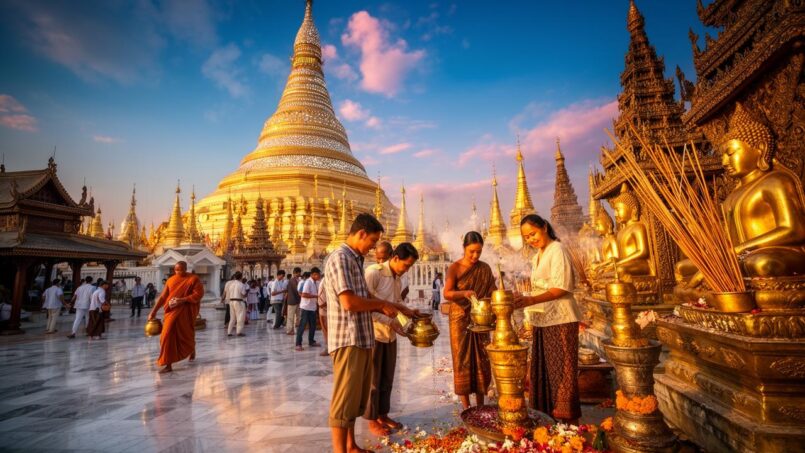
Myanmar is one of the most religious countries in Southeast Asia, and it shows everywhere: golden pagodas, monasteries on every corner, processions, celebrations, the crescent moon on a minaret, a statue of the Virgin Mary atop a hill, a small animist shrine at the foot of a tree.
An Officially Buddhist Country with an Overwhelming Majority
The Myanmar Constitution recognizes a “special status” for Buddhism, presented as the faith of the vast majority of citizens. The numbers confirm this: according to a 2024 government census, 91.3% of the population identifies as Buddhist. This is overwhelmingly Theravada Buddhism, practiced by the country’s main ethnic groups.
There is notably strong adherence among the Bamar (majority), the Shan, the Rakhine, the Mon, many Karen, and part of the Chinese community.
The table below, based on data from successive censuses, shows the stability of this Buddhist dominance but also the actual weight of other religions:
| Census | Buddhists | Christians | Muslims | Hindus | Tribal Religions | Other | No Religion |
|---|---|---|---|---|---|---|---|
| 1973 | 88.8% | 4.6% | 3.9% | 0.4% | 2.2% | 0.1% | N/A |
| 1983 | 89.4% | 4.9% | 3.9% | 0.5% | 1.2% | 0.1% | N/A |
| 2014 | 87.9% | 6.2% | 4.3% | 0.5% | 0.8% | 0.2% | 0.1% |
| 2024 | 91.3% | 4.6% | 3.3% | 0.6% | 0.2% | 0.0% | 0.0% |
For the expatriate, this means that the implicit social norm is Buddhist: calendars, public holidays, daily rhythms, vocabulary, architecture, and even political debates constantly reference Theravada Buddhism.
A Mosaic Where Religion and Ethnicity Intertwine
Myanmar is not monolithic, however. The religious map often follows the ethnic map. In certain peripheral states, Christian or Muslim minorities are structurally significant.
To understand this spiritual geography, it is useful to refer to some fundamental landmarks. For instance, the distinction between major pilgrimage sites and retreat centers, or how religious traditions attribute particular sacredness to natural elements like mountains, springs, or forests. These landmarks help map beliefs and practices across territories.
– Buddhism is the majority in all Regions (Ayeyarwady, Bago, Sagaing, Magway, Mandalay, Yangon, Tanintharyi, Nay Pyi Taw) as well as in Shan, Kayah, Kayin, Mon, and Kachin States.
– Christianity dominates in Chin State and forms a significant bloc in Kachin and Kayah.
– Islam is particularly present in Rakhine State (notably among the Rohingya), but also in certain neighborhoods of Yangon, Mandalay, and pockets in several Regions.
– Hinduism remains a minority and is closely tied to the Indian diaspora in urban centers.
This diversity is clearly visible at the regional level in the following data (excerpts from a census):
| Region / State | % Buddhists | % Christians | % Muslims | % Hindus | % Animists |
|---|---|---|---|---|---|
| Ayeyarwady | 92.2% | 6.3% | 1.4% | 0.1% | ~0% |
| Bago | 93.5% | 2.9% | 1.2% | 2.1% | 0.1% |
| Chin | 13% | 85.4% | 0.1% | 0% | 0.4% |
| Kachin | 62.2% | 32.9% | 1.6% | 0.3% | 0.2% |
| Kayah | 49.9% | 45.8% | 1.1% | 0.1% | 1.9% |
| Kayin | 80.8% | 9.1% | 4.3% | 0.6% | 0.1% |
| Rakhine | 63.3% | 1.2% | 35.1% | 0.3% | 0.1% |
| Shan | 81.7% | 9.8% | 1% | 0.1% | 6.6% |
| Yangon | 91% | 3.2% | 4.7% | 1% | 0% |
For a foreigner, this religion/ethnicity intertwining is essential: criticizing a local religious practice often touches on an already fragile ethnic identity, thus entering explosive territory.
Christian, Muslim, and Hindu Minorities: Presence and Vulnerability
Christians represent around 6–8% of the population according to recent sources, primarily among the Chin, Kachin, Karen/Karenni, and some Naga and Lisu groups. In practice, about two-thirds are Protestant (mostly Baptist), one-sixth Catholic, and the rest Anglican or other denominations.
Percentage of the population that Islam represents in Myanmar, with significant underreporting due to the contested status of the Rohingya.
Hindus (about 0.6%) are mostly linked to communities of Indian origin, concentrated in major cities like Yangon.
For the expatriate, these minorities are often key interlocutors (English teachers, NGO partners, colleagues in NGOs or businesses), but they are also populations exposed to targeted violence. Conversations about religion or citizenship must be conducted with extreme caution.
Living in a Deeply Buddhist Country: Codes, Rites, and Calendar
To understand daily life in Myanmar, one must first grasp the place of Theravada Buddhism, both as a personal faith and as a cultural system that structures time, space, and social relationships.
Theravada Buddhism: Concrete Anchoring in Everyday Life
Theravada is based on the Pāli Canon (Tipitaka) and the Four Noble Truths, with the Noble Eightfold Path as the way to awakening. In Burmese practice, this translates less into metaphysical debates than into a few very visible elements: the importance of karma, the obsession with “merit,” respect for the Sangha (the monastic community), and the omnipresence of pagodas.
One can find, sometimes in the same village:
– A large pagoda (paya), center of religious life;
– A monastery (kyaung) also serving as a school and meeting place;
– A small shrine dedicated to a spirit (nat), hanging from a tree or at the village entrance.
Buddhist monks (Sangha) follow a highly codified daily routine, including 227 disciplinary rules, celibacy, a prohibition on solid food after noon, and a ban on music and dance, as well as the obligation to beg for their food during the morning alms round.
Laypeople support them materially (food, clothing, monastery repairs) hoping to accumulate merit for a better rebirth. Offering, serving, and giving are actions saturated with religious meaning.
The Lunar Calendar and Its Major Festivals
Burmese time is governed by a lunar calendar where almost every month has its major festival, primarily Buddhist. An expatriate working with local teams will quickly see the impact of these events on attendance, travel, and general mood.
Among the key moments:
The calendar is marked by several major festivals. Thingyan (mid-April) is the Burmese New Year, or “water festival,” where people splash water on each other to wash away the impurities of the past year; families clean altars and visit pagodas. The full moon of Kason (May) is the most sacred day, commemorating the birth, enlightenment, and death of the Buddha, marked by the ritual watering of Bodhi trees. The full moon of Waso (June/July) begins the Buddhist Lent (Vassa), a three-month retreat for monks during which marriages are traditionally avoided. Thadingyut (September/October) celebrates the end of Lent with the “Festival of Lights”: pagodas and homes are illuminated, and respect for elders is renewed. Finally, Tazaungmon (October/November) is the season for offering robes to monks (Kathina), with nocturnal weaving competitions and large regional festivals.
To these major dates are added countless local “pagoda festivals,” often huge fairs around a pagoda, mixing religious fervor with a carnival atmosphere.
For an expatriate, integrating this calendar into project planning, training sessions, or travel avoids many frustrations. Schedule a key training session on a major festival day, and your participants will be physically or mentally elsewhere.
Respecting Buddhist Places of Worship: What You Absolutely Must Know
Pagodas and monasteries are everywhere; you will visit them for work, with colleagues, or simply to explore. An etiquette mistake in these places can easily offend, even if your interlocutors will often be too polite to say so.
Dressing Decently: The Basics of Respect
Myanmar remains very attached to modest dress, especially in religious spaces. The requirement is simple: shoulders and knees covered for everyone, no tight or see-through clothing.
Concretely, to visit a pagoda or monastery:
– Opt for light trousers or a skirt/dress below the knee;
– Choose a short-sleeved or 3/4-sleeved top, no thin straps or tank tops;
– Avoid anything very tight or low-cut.
The traditional garment, the longyi—a tubular sarong—is ideal: practical, breathable, and perceived as very respectful. In its male (paso) or female (htamein) version, it is worn daily both in Yangon and rural areas. You can easily buy one at markets or shopping centers.
Clothing considered too revealing (very short shorts, backless tops, low-rise jeans showing underwear, swimwear outside private beaches) can be shocking, even if direct remarks are rare.
Bare Feet in the Sacred Enclosure: A Non-Negotiable Rule
Another non-negotiable element: the obligation to remove footwear. In Myanmar, you take off shoes and socks not only at the entrance to the main hall, but from the entire sacred perimeter of a pagoda or monastery. This often includes stairs, terraces, and galleries, even in full sun or after rain.
A few reflexes to adopt:
– Wear easy-to-remove sandals;
– Bring a small bag to carry your shoes if the site is vast;
– Accept being truly barefoot, including socks;
– Imitate locals by observing the areas where they remove their shoes.
The symbolic status of the foot—considered the most “impure” part of the body—explains this requirement. Historically, the issue of shoes in pagodas even fueled anti-colonial resentment: the fact that Britons walked shod in sanctuaries was experienced as a humiliation.
Historical and Cultural Context
Gestures, Postures, and Silences Before Sacred Images
Most rules of conduct in a pagoda derive from two principles: preserve the peaceful character of the place, and never symbolically “crush” the Buddha, monks, or elders.
This yields very concrete codes:
– Speak in a low voice, avoid loud laughter, do not play music (at Shwedagon, it is explicitly forbidden on the esplanade);
– Never sit pointing the soles of your feet toward a Buddha image, pagoda, monk, or elder;
– Prefer sitting cross-legged (for men) or with legs folded to the side (for women);
– Avoid turning your back conspicuously to a large Buddha image to take photos or rest;
– Circumambulate stupas and sacred images in a clockwise direction, considered respectful.
The head is considered the noblest part of the body and the feet the lowest. It is important not to step over someone, not to put your feet on a chair or table, not to touch an adult’s head, and always to ask before petting a child’s head.
Photographing Without Humiliating
In a country where tourists have sometimes turned pagodas into Instagram backdrops, photography is a sensitive subject. The implicit rule: any shot that humiliates or “uses” the sacred as an accessory is unwelcome.
A few simple principles:
– Ask permission before photographing someone praying, a monk, a nun, or a child;
– Skip the photo if someone seems uncomfortable, even without saying so;
– Never climb on a statue, stupa base, or image plinth for a better angle;
– Avoid “fun” or suggestive poses in front of a Buddha statue.
Some places completely ban photography inside (for example, certain temples in Bagan) or require a specific ticket, notably at Shwedagon. Again, simply observe the signs and the behavior of devotees.
Interacting with Monks, Nuns, and Devotees: The Invisible Hierarchy
For an expatriate, the temptation may be to “normalize” the relationship with religious figures, approaching them like any other interlocutor. In Myanmar, this quickly leads to awkwardness because the symbolic hierarchy is very pronounced.
Novices, Monks, and Nuns: Central Figures in Society
From the age of seven, a boy can become a novice (shin). The novitiate ceremony (shinbyu) is a major event, often more celebrated than a wedding: processions in princely costume, head shaving, entering the monastery to learn the basics of Buddhism and good manners.
Adult monks undergo strict training, with 227 rules to follow. They renounce family life, money, and worldly leisure. Nuns (thilashin), in light saffron robes, also follow a strict code (over 300 rules), even if their status is lower in the official religious hierarchy.
In social life, they are owed systematic deference:
– Give up your seat on buses or in queues;
– Let them pass first;
– Avoid sitting at a higher level.
Physical Contact and Gender Issues
Physical contact between monks and women is a very strong taboo. A woman does not touch a monk or his robe, and does not hand an object directly to him: instead, she places the offering within reach or passes it through a male intermediary.
Men, for their part, also refrain from any physical contact and do not offer handshakes to monks. It is the entire Burmese code of distance between genders that is reinforced here: little or no affectionate gestures in public, contactless greetings, great bodily restraint.
For an expatriate, it is necessary to adjust one’s reflexes by avoiding spontaneous hugs, maintaining physical distance, and limiting contact, even friendly, with women who are not well known, particularly in religious contexts.
Addressing a Religious Figure, Making an Offering
In a professional or project context (visiting a partner monastery, meeting with an abbot), it is appreciated if the foreigner adopts some local codes:
– Use a respectful tone and honorific vocabulary (U for an elderly man or a monk, Daw for a woman of a certain age);
– Sit at a lower level, with legs properly arranged;
– Present donations (books, medicine, in-kind aid, financial contribution) with both hands, without flaunting the amount;
– Do not offer solid food to a monk after noon, which would go against his vows.
Intention matters more than the amount: a small gesture made calmly, without expectation of return, is perceived as a meritorious act of generosity.
Beyond Buddhism: Christian, Muslim, Hindu, and Animist Practices
Even though Buddhism dominates the public sphere, Myanmar is traversed by other religious traditions with their own codes. As an expatriate, you may find yourself visiting churches, mosques, Hindu temples, or animist places of worship, whether for work, friendship, or curiosity.
Christianity: Ethnic Churches and the Faith of Often Marginalized Minorities
Arriving with European missionaries as early as the 17th–18th centuries, then massively in the 19th century, Christianity took root mainly among the mountain minorities: Chin, Kachin, Karen, Karenni, Naga, Lisu, etc. In these regions, churches are at once places of prayer, community centers, and symbols of ethnic identity.
A few guidelines for behaving respectfully:
– Decent dress is also expected: no too-short or too-tight clothing, especially in villages;
– Services are often held in the local language (Chin, Kachin, Karen…), with much singing;
– Crosses on foreheads or processions may be surprising in a very Buddhist environment, but they are deeply rooted.
Christians in Chin, Kachin, and Kayah States suffer church destruction, forced displacement, and discrimination, worsened since the 2021 coup. A foreigner is perceived as a sympathetic ear but also as a potential risk if the conversation turns political. It is better to listen more than to speak and to avoid exposing your interlocutors.
Islam: Daily Practice, Major Festivals, and Climate of Suspicion
Islam has a long history in Myanmar, through Arab and Indian traders from the first millennium, and later via colonial-era migrations. Today, Muslims are present in all major cities but remain highly stigmatized, with a peak of violence against the Rohingya and anti-Muslim riots in recent years.
A few etiquette points in mosques and Muslim neighborhoods:
– Dress modestly and cover arms and legs;
– Remove shoes at the entrance to the prayer hall, as in a pagoda;
– Avoid entering during the five daily prayers if you are unfamiliar with the ritual;
– Ask permission before photographing the interior of a mosque or worshipers.
Ramadan, Eid al-Fitr, and Eid al-Adha are widely celebrated. In some neighborhoods, the festive atmosphere is palpable, but the general climate remains marked by fear: the UN describes the Rohingya as one of the most persecuted populations in the world. A foreigner would do well to show benevolent neutrality, avoid debates on the legitimacy of different communities, and never relay anti-Muslim rumors.
Hinduism and Indian Traditions
Hindu temples, especially in Yangon and Mandalay, are not uncommon, reflecting the long Indian presence. As elsewhere on the subcontinent, people bring flowers, food, and small offerings, often into donation boxes (hundi).
Basic codes are similar:
– Covering clothing, shoulders covered;
– Shoes left outside;
– Respect queues in front of main shrines;
– Photos only after agreement.
Again, Hinduism is often associated with a visible minority (Burmese Indians), sometimes targets of historical discrimination.
Animist Beliefs and the Nat Cult: The Invisible Layer
Myanmar is not only Buddhist; it is also deeply animist. The worship of spirits (nats) historically predates Buddhism and, far from having disappeared, has merged with it. Many Burmese Buddhists, Muslims, and even Christians acknowledge the existence of these spirits that inhabit mountains, forests, trees, or villages.
A few keys to spotting this dimension:
– Small altars at the base of a tree, at the edge of a field, at the entrance to a village;
– A green coconut hung in a house, surrounded by perfume or flowers;
– Red and white flags or garlands on vehicles to invoke the protection of spirits.
Every Burmese village typically has a shrine dedicated to the “village guardian nat” (ywa saung nat or Bo Bo Gyi). These spirits are part of a complex hierarchy, including an official pantheon of 37 major nats. Most are former humans who died violently or unjustly and were integrated into the Buddhist system by King Anawrahta in the 11th century.
For the expatriate, the important thing is to understand that these practices are not seen as competing with Buddhism, but as complementary: one prays to the Buddha for future liberation, and turns to the nat to solve very concrete problems (health, harvest, business success).
Nat Pwe: Spirit Festivals, Trance, and Music
The major animist ceremonies—nat pwe—are spectacular: traditional music (hsaing waing), dances, spirit possession through mediums (nat kadaw, literally “spirit wives,” often women or LGBTQ+ individuals). There is drinking, singing, laughter, and substantial offerings of food, alcohol, and money.
The most famous example is the Taungbyone Festival near Mandalay, or the pilgrimages to Mount Popa, a major nat center. These events, while sometimes criticized as “superstitious” by stricter religious figures, continue to play a role in social cohesion and the relationship with the environment (some forest or mountain spirits discourage the destruction of natural sites).
An expatriate is often welcome as a spectator, provided they remain discreet, do not mock what they see, ask before photographing mediums in trance, and do not disrupt the ritual.
Religious Etiquette in Everyday Life
Beyond the big principles, religion shapes seemingly trivial gestures: how to greet, sit, give an object, eat in a group, or behave when visiting a Burmese home.
Greeting, Giving, Receiving: The Details That Make All the Difference
The standard greeting is “Mingalaba,” often accompanied by a slight nod. You can join your hands in front of your chest, but this prayer-like gesture is rather reserved for formal or respectful situations (before a monk, an elder, a Buddha image).
A few practical rules:
– Avoid systematic handshakes, especially with women or religious figures;
– Use the right hand or both hands to give or receive an object, gift, or money;
– Never point a finger directly at a person or statue: use an open hand gesture instead.
It is customary to wait for the oldest person to start eating before you begin, to avoid serving yourself first, and to finish what you have taken on your plate.
At the Home of a Colleague or Neighbor
An invitation to a Burmese home is an honor; how you behave will reflect on the professional or friendly relationship.
The reflexes to adopt are clear:
– Remove your shoes systematically before entering;
– Avoid overly casual attire (worn beach flip-flops, tank top); hosts often dress up to receive you;
– Modestly refuse the very abundant dishes once, then accept;
– Bringing a small gift is not mandatory but appreciated (food items, good-quality toiletries…);
– Avoid alcohol unless you know the family is comfortable with it.
It is common for the host not to unwrap your gift in your presence. This gesture is not a sign of indifference, but a mark of modesty, so as not to appear greedy.
Social Life, Religion, and Sensitive Topics
Post-coup Myanmar is a polarized country, marked by violence against religious and ethnic minorities. Many Burmese have relatives who have been displaced, imprisoned, or killed, including among Christians and Muslims.
In this context, an expatriate benefits from: gaining international experience, expanding their professional network, discovering a new culture, improving language skills, enjoying tax advantages, and accessing unique career opportunities.
– Avoid sweeping statements about “Buddhists,” “Muslims,” or “the Rohingya”;
– Do not lecture others on religion, even with good intentions;
– Do not photograph or publish without consent vulnerable people (refugees, displaced persons, religious figures targeted by conflict);
– Listen to colleagues’ stories without interrupting with quick analyses.
Simply respecting places of worship scrupulously—whether Buddhist, Christian, or Muslim—is already a form of silent solidarity with those for whom these spaces are threatened.
Preparing as an Expatriate: Learning and Building a Support Network
Many training organizations and expatriation programs now include cultural awareness modules on Myanmar, with a strong religious component. These trainings emphasize the same fundamentals: modesty, caution, respect for Buddhist codes, understanding of minority vulnerabilities.
Some programs for English teachers or volunteers thus provide:
An immersion program to explore the country’s spiritual and historical richness through authentic experiences and encounters.
Exploration of iconic pagodas like Shwedagon, as well as monasteries and convents, to discover the architecture and religious fervor.
Exchanges and teachings (Dhamma talks) with monks to understand the foundations and practice of Theravada Buddhism.
Meetings and stays in villages of ethnic communities, whether Christian or Buddhist, to share their daily life.
Analysis sessions on the country’s religious history and its influence on social dynamics and periods of conflict.
Even without taking a full training course, it is possible to educate yourself: read about Burmese Buddhism, take an interest in the nat cult, respectfully attend a Chin or Kachin church, quietly discuss religious festivals with your colleagues.
As a Guiding Thread: Humility, Observation, Consistency
Living in Myanmar forces you to question certain reflexes inherited from more secularized societies. Here, religion is not a purely private matter: it structures public space, institutions, festivals, and hierarchical relationships.
For an expatriate, three attitudes form a solid guiding thread:
To show respect in Myanmar, adopt a humble attitude by accepting that you don’t understand everything, asking questions, and acknowledging your mistakes. Practice observation by watching how Burmese people behave before acting, whether in a place of worship, a village, or a family gathering. Finally, be consistent by applying the same standards of respect to all religious groups, including the most stigmatized minorities.
This is not just a matter of politeness. In a country where religious freedom is fragile and where temples, mosques, and churches have been targeted, every gesture of respect—removing your shoes without complaint, covering your shoulders, staying silent before someone in prayer, saying “Mingalaba” sincerely—also becomes a discreet political act: that of recognizing everyone’s right to believe and practice according to their own codes.
Disclaimer: The information provided on this website is for informational purposes only and does not constitute financial, legal, or professional advice. We encourage you to consult qualified experts before making any investment, real estate, or expatriation decisions. Although we strive to maintain up-to-date and accurate information, we do not guarantee the completeness, accuracy, or timeliness of the proposed content. As investment and expatriation involve risks, we disclaim any liability for potential losses or damages arising from the use of this site. Your use of this site confirms your acceptance of these terms and your understanding of the associated risks.

Cyril Jarnias is an independent expert in international wealth management with over 20 years of experience. As an expatriate himself, he is dedicated to helping individuals and business leaders build, protect, and pass on their wealth with complete peace of mind.
On his website, cyriljarnias.com, he shares his expertise on international real estate, offshore company formation, and expatriation.
Thanks to his expertise, he offers sound advice to optimize his clients' wealth management. Cyril Jarnias is also recognized for his appearances in many prestigious media outlets such as BFM Business, les Français de l’étranger, Le Figaro, Les Echos, and Mieux vivre votre argent, where he shares his knowledge and know-how in wealth management.





