
 Published on and written by Cyril Jarnias
Kalamata today ticks almost all the boxes for the demanding real estate investor: a mid-sized city, an economy active year-round, an international airport 10 minutes away, a 10-kilometer Blue Flag beach, a university, a general hospital, and a market still affordable compared to Athens or the star islands. Above all, prices have already risen sharply since 2020, but remain below those of more “glamorous” destinations, leaving credible room for further increases.
This data-driven overview presents the reasons and methods for investing in real estate in Kalamata. It covers second-home projects, long-term rentals, tourist rentals, as well as the framework of the Greek Golden Visa program.
A market at a crossroads
Kalamata has become in just a few years one of the most closely watched cities in the Peloponnese by investors. The city of 73,000 residents, the administrative and commercial capital of Messinia, is not a vacation village dependent on a three-month summer, but a true regional center where the economy runs on twelve months thanks to four distinct pillars: education, healthcare, commerce, and public administration.
The increase in real estate prices in Kalamata between 2020 and today, driven by infrastructure improvements.
The Peloponnese region, of which Kalamata is one of the major urban hubs, has seen a rise in residential prices of about 15 to 20% since 2020, with a pace now stabilized around 3 to 5% per year. In the most sought-after micro-markets, such as certain coastal areas, plausible scenarios even speak of an increase of 5 to 10% over twelve months. Kalamata is among these dynamic pockets.
Kalamata in the Greek context: a “second choice” becoming first
On a national level, Greece has entered a phase of more controlled growth after the very strong post-crisis real estate rebound. Prices in urban areas rose by nearly 9% in 2024, after more than 14% in 2023, and the third quarter of 2025 was still up more than 7% year-over-year. Rents are also rising faster than general inflation, a sign that rental demand is durably strong.
Average price per square meter for a property in the Peloponnese, an affordable alternative to the most popular Greek islands.
In Kalamata, prices are clearly above this regional average, reflecting its status as a highly sought-after coastal urban hub, without reaching the heights of Costa Navarino or the ultra-touristy island destinations. Apartments are most often traded between 1,200 and 1,800 €/m², and the average price per square meter, all categories combined, stood at 2,464 €/m² in September 2025, an increase of nearly 8% year-over-year. In other words, the city sits on an intermediate price plateau: more expensive than the Peloponnese average, but well below national hotspots.
A solid economic environment: university, hospital, tourism, and “green city”
One of the major assets of Kalamata, and therefore of its rental market, is the diversity of its economic base. Far from relying solely on summer visitors, the city is supported by:
– a major general hospital complemented by private clinics;
– four faculties of the University of the Peloponnese, attracting thousands of students;
– a commercial and administrative fabric that irrigates all of Messinia;
– a growing tourism sector, driven both by the coastline, by the proximity of the Mani villages, and by the rise of the luxury resorts of Costa Navarino 45 minutes away.
The city, selected by the European Commission among the 100 climate-neutral cities by 2030, is rolling out an ambitious program including pedestrianization, smart grids, waterfront redevelopment, and a pilot smart district. This orientation has major real estate consequences: strict energy requirements for new builds, increased importance of energy rating for older properties, and a value premium of up to 12 to 15% for the most energy-efficient homes (A+).
In parallel, Kalamata benefits from excellent connectivity. By road, Athens is about 240 km away, or 2 h 30 via the modern Olympia Odos and Moreas highways. The international airport, located 9 km from the city center, operates year-round with several daily rotations to Athens and seasonal connections to major European cities, particularly from the United Kingdom, Germany, and the Netherlands. Airport arrivals have further increased by nearly 10% over the first eight months of 2025, directly fueling demand for short and medium-term accommodation.
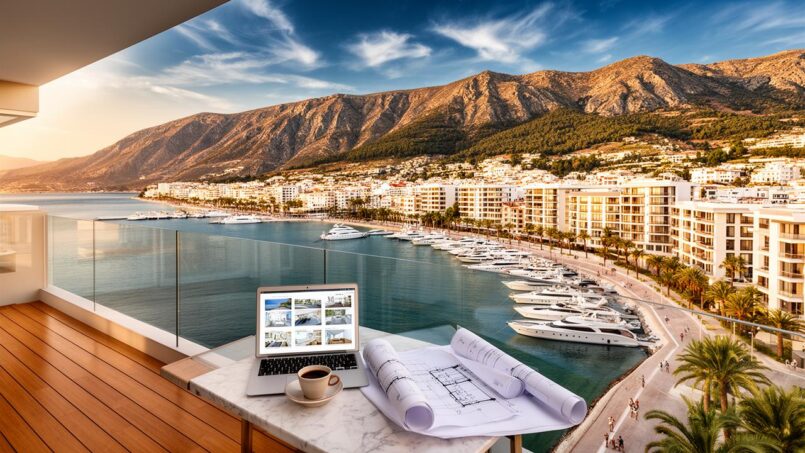
The current marina, which has about 250 berths, is set to be expanded to a capacity of 450 berths. This project aims to strengthen Kalamata’s position on the yachting map of the Eastern Mediterranean. For an investor, these port infrastructures represent an important catalyst for future demand, particularly in neighborhoods located near the port.
Price overview: highly differentiated micro-markets
The appeal of Kalamata for the investor also lies in the diversity of its neighborhoods, with very different profiles, prices, and types of tenants. A few key figures help provide a better understanding.
Overview of sale prices
In September 2025, the range of prices per square meter in the municipality extended from 748 €/m² (Artemisia) to 3,188 €/m² (Mikri Mantineia). The main sectors were in the following range:
| Kalamata Area | Average Sale Price (€/m²) – Sept. 2025 |
|---|---|
| Mikri Mantineia | 3,188 |
| Paralia Vergas | 3,021 |
| City Center | 2,478 |
| Elaiochori | 2,178 |
| Leika | 1,611 |
| Karveli | 1,848 |
| Asprochoma | 1,276 |
| Antikalamos | 1,179 |
| Artemisia | 748 |
These figures illustrate the considerable gap between a premium waterfront (Mikri Mantineia, Paralia Vergas) and more rural or peri-urban sectors inland (Artemisia, Antikalamos). For an investor, it is therefore a matter of choosing a return/risk couple suited to their strategy: better potential appreciation and increased liquidity in expensive areas, but often higher gross rental yield in more affordable sectors.
Focus by major investment neighborhoods
Several neighborhoods stand out as particularly strategic for an investment:
The modern neighborhood of the marina and the Navarinou waterfront is highly sought after by young professionals, yachtsmen, and tourists. Apartment prices vary by view: from 300,000 to 600,000 € for waterfront, from 250,000 to 500,000 € with marina view, and premium penthouses can reach 400,000 to 750,000 €. An example of a new 89 m² unit was offered around 260,000 €. In short-term rentals, this area commands the highest nightly rates in the city.
– City center & University district: key sector for long-term rentals to students, professors, healthcare staff, and local executives. Modern apartments here generally sell between 200,000 and 400,000 €, properties targeted for student shared housing between 150,000 and 300,000 €. Mixed-use buildings (commercial on the ground floor and housing above) frequently range from 350,000 to 700,000 €.
– Historic center (Palia Poli): a charming district with an old urban fabric, ideal for renovation projects of stone houses or neoclassical buildings. Restoration projects are mostly in a range of 300,000 to 750,000 €, traditional houses between 250,000 and 500,000 €, and character apartments between 150,000 and 350,000 €. Commercial spaces here are often worth between 400,000 and 1,000,000 €.
Discover the amphitheater-like hillsides prized for their panoramic views over the Messinian Gulf, an upscale area popular with expats.
Prices range between 500,000 € and 1,000,000 € for contemporary properties.
Investments between 700,000 € and 1,500,000 € for exceptional properties.
Price per m² generally between 100 € and 200 €.
Villas available for summer rental at rates from 150 € to 300 € per night.
– Coastal suburbs and family neighborhoods (Asprochoma, north of the city, suburbs near the beaches): beachside houses between 250,000 and 500,000 €, family villas between 400,000 and 800,000 €, new build programs between 3,000 and 4,000 €/m². These sectors, located 5 to 10 minutes from the center, are particularly appealing to local families and buyers seeking a compromise between price and proximity to the sea.
Overall, the entry ticket for a quality property in Kalamata is around 200,000 €, while neighboring markets like Pylos or Kardamyli require 300,000 to 400,000 € and Costa Navarino often starts around 800,000 €. It is this price differential, coupled with a higher level of amenities (hospital, university, urban life), that explains Kalamata’s growing appeal.
A tight and increasingly selective rental market
On the rental side, the city combines several sources of demand that severely limit vacancies:
– students from the University of the Peloponnese;
– staff of the general hospital and clinics;
– employees and civil servants;
– local families;
– digital nomads and remote workers;
– transient tourists, especially during the April–October period.
Regional data show vacancy rates for major Peloponnese cities (including Kalamata) between 4 and 7%, well below what is observed in smaller inland towns that often exceed 10%. In highly demanded sectors of Kalamata – center, marina, proximity to the beach – vacancies are described as “tight” in high season and remain “manageable” the rest of the year, provided the property is in good condition and well located.
Rent levels and tenant profiles
In 2025, average observed rents for apartments in Kalamata generally fall within the following ranges:
| Property type (long-term) | Typical monthly rent in Kalamata (2025) |
|---|---|
| 1-bedroom apartment | 380 – 520 € |
| 2-bedroom apartment | 480 – 650 € |
| 3-bedroom apartment | 600 – 850 € |
Based on listings, the average rent was 8.56 €/m² in September 2025, up about 4.1% year-over-year. Central neighborhoods show the highest values (8.74 €/m² in the center), while areas like Leika remain much cheaper (4.36 €/m²).
Tenant requirements have become much more refined, creating a two-speed market. Modern or renovated properties that meet contemporary comfort criteria (recent renovation, independent heating, good insulation, air conditioning, elevator, parking, and easy access to the city center) rent very quickly. Conversely, older, energy-inefficient apartments struggle and remain on the market longer.
The regional study on tenants in the Peloponnese shows a typical structure in which Kalamata fits easily: about 40 to 45% local employees, 35 to 40% profiles related to universities (especially in Patras and Rio, but also in Kalamata) and 15 to 20% “lifestyle renters,” i.e., people attracted by the quality of life, which is rising sharply in Messinia.
Student market: a stable demand base
The presence of four faculties in the city creates an almost mechanical flow of demand:
– furnished studios typically rented between 250 and 350 €/month;
– furnished two-bedroom apartments for student shared housing between 400 and 600 €/month;
– rooms in shared flats around 200 to 300 €/month.
The occupancy rate for student housing reaches about 95% during the academic year.
Long-term rentals for professionals
Rentals aimed at managers, doctors, professors, and other higher-income profiles are in higher price ranges:
– two-bedroom apartments: 500 to 800 €/month;
– three-bedroom houses: 800 to 1,500 €/month;
– “prime” properties: up to 1,200 to 2,000 €/month for particularly well-located and finished properties.
This segment is concentrated mainly around the center, the marina district, and sought-after coastal suburbs. It is particularly interesting for the investor aiming for high annual occupancy with stable tenants.
Seasonal and Airbnb rentals: a market already mature
Kalamata also has a very structured short-term market. Over the period February 2025 – January 2026, the municipality recorded 819 active listings, subject to what is described as “strong” regulation. Most (nearly 99%) are for entire homes, and more than two-thirds are apartments.
The key indicators of this market are as follows:
| Indicator (Municipality of Kalamata) | Value (Feb. 2025 – Jan. 2026) |
|---|---|
| Active listings | 819 |
| Average daily rate (ADR) | $123 |
| Average occupancy rate | 37.4% |
| Median annual revenue per listing | $10,905 |
| Annual revenue growth | 15% |
| Revenue peak | August |
| Weakest month | February |
The top 10% of listings achieve monthly revenues of at least $2,625, with an occupancy rate of 71% or higher and an average nightly price of at least $197. At the other extreme, the bottom quarter hovers around $509 monthly, $70 per night, and much lower occupancy rates.
Over the year, a clear distinction can be made:
– a high season (July, August, September) with:
– average monthly revenue around $2,362,
– occupancy rate of about 53%,
– average ADR of $135;
– shoulder seasons where:
– average monthly revenue falls to around $1,132,
– occupancy is about 33%,
– the daily rate is around $115.
Converted to euros, and reasoning in terms of local price levels, we find:
– city apartments: 60 to 100 €/night;
– properties in the marina district: 80 to 150 €/night;
– villas in Verga: 150 to 300 €/night.
Annual gross yields for tourist rentals are generally estimated between 5 and 8%. Here again, there is a significant performance differential depending on the quality of the offering, the positioning (luxury or family, work/”workation”, etc.), and the capacity (two-bedroom apartments are often cited as a good compromise between revenue and operational complexity).
Returns and appreciation: where does Kalamata stand?
By cross-referencing price and rental data, it is estimated that gross yields for modern apartments in the city center or near the beach in Kalamata average between 5.5 and 7%, above the Greek national average (about 4.4%) and in the upper range of yields observed in the Peloponnese (4.5 to 5.5% in most prefectures).
For properties located near the university, advertised rental yields are typically 5 to 7%. Seasonal rentals can offer a comparable or slightly higher gross annual yield, around 5 to 8%, depending on pricing level and occupancy rate. However, this type of rental involves heavier management (guest reception, cleaning, marketing, etc.), often delegated to specialized companies whose fees represent 15 to 20% of revenue, which reduces the final net yield.
The price dynamic is also favorable. At the regional level, the Peloponnese recorded a 6 to 8% increase in residential prices in 2024, and nearly 9% between June 2024 and June 2025. Kalamata stands out with an even slightly higher rise recently, e.g., +7.9% between September 2024 and September 2025. In the medium term, projections for the region suggest annual price growth around 3% but with potential for 5 to 10% in the most coveted micro-markets, among which are the coast of Kalamata and the waterfront.
In an investment scenario of 5 to 7 years – often cited as a minimum to hope to exit with a net capital gain once transaction costs are accounted for – the combination of rental yields of 5–7% and price increases of 3–5% per year traces an interesting overall performance trajectory for an asset in euros within an economy that has returned to ‘investment grade’ rating.
Real estate investment scenario
Annex costs, taxation, and transaction costs
Investing in Greece, and therefore in Kalamata, means factoring in specific transaction costs and taxation.
For the purchase, the main item is the transfer tax, set at 3% of the official value of the property, to which a small municipal levy of 0.09% is added. For new builds, a VAT of 24% exists in theory but its application is suspended on new constructions, with the suspension extended until the end of 2026: in practice, the buyer therefore pays, even for an eligible new build, the standard transfer tax, i.e., about 3.09%.
Added to this: it is essential to respect deadlines and to communicate effectively with all team members.
The median percentage of notary fees in a real estate transaction, supplemented by registration fees and an agency commission.
Overall, it is estimated that acquisition costs for an investor in Kalamata range from 6 to 10% of the price, with a core of mandatory expenses around 4 to 5% and the rest in professional fees.
Maximum amount in euros per square meter per year of the Greek property tax (ENFIA) for a property in Kalamata, in premium areas.
Regarding rents, rental income is taxed under income tax with progressive brackets. For short-term rentals, certain situations may trigger the application of VAT, particularly for investors who operate a significant number of properties with “para-hotel” services.
Finally, regarding resale, Greece provides for a 15% capital gains tax on real estate, but this is suspended until the end of 2026, which currently limits direct taxation on capital gains at the end of the investment. Still to be taken into account are agency commissions (2–3% + VAT), possible legal fees, and loan repayment costs if applicable.
Golden Visa: Kalamata, a lower-cost entry point compared to Athens
For non-European investors, Greece has offered a residence-by-investment scheme since 2013, the famous Golden Visa. Recent reforms have significantly raised investment thresholds in the tightest areas (Athens, Thessaloniki, major islands), where it is now necessary to inject at least 800,000 € into a residential property of at least 120 m². The Peloponnese, on the other hand, falls into the category of reduced-threshold areas.
In the case of Kalamata, access to the Golden Visa is based on:
– a minimum investment of 400,000 € in a single residential property;
– an interior area of at least 120 m²;
– the impossibility of operating this property as a short-term rental (Airbnb and similar) under the specific rules applied to Golden Visa properties in central urban areas. Non-compliance can result in a fine of up to 50,000 € and threaten the residence permit.
For an investment of 250,000 €, an alternative avenue to purchasing a new property is to finance the conversion of a commercial space into a residence or the complete restoration of a listed building. This option is valid throughout the country, including in Kalamata. It has the advantage of not being subject to the minimum area constraint of 120 m². One imperative condition: the works for change of use or renovation must be fully completed before filing the residence permit application.
Kalamata lends itself well to this, especially in its historic center where former warehouse buildings (e.g., once linked to olive oil) can be transformed into character residences. Some neoclassical or stone houses eligible for the restoration scheme at 250,000 € also fall into this category.
Practical advantages of the Greek Golden Visa
The Golden Visa offers a five-year renewable residence permit, with no residency requirement or Greek language exam. It provides access:
The holder of a residence permit has the right to freely travel within the Schengen area. They are also entitled to apply for family reunification to include their spouse, dependent children up to 21 years old (and up to 24 if they are students), as well as the parents of both spouses.
Access to Greek citizenship remains separate: it requires having actually resided in Greece (as a tax resident) for at least seven years with significant physical presence each year and passing a B1-level Greek exam.
For an investor targeting the Golden Visa and rental income, Kalamata is therefore attractive due to its reduced threshold (400,000 € versus 800,000 € in Athens or the star islands) and the possibility of targeting a high-quality large-area property, or a restoration project at 250,000 €. However, the plan must be aligned with the prohibition on short-term rental for the visa-qualifying property, which directs towards high-end long-term rentals or personal use.
Which type of property to favor: new build or resale?
The debate between new build and existing concerns the entire Greek market, and Kalamata is no exception.
New build programs offer:
– recent seismic and thermal standards;
– high energy ratings (A or B, even A+);
– reduced operating costs;
– minimal upgrades needed for several years;
– smoother access to certain schemes like the Golden Visa.
The price per square meter of a new home can be 30 to 60% higher than that of an older home in the same neighborhood.
Existing properties, especially in the city center or historic center, are priced lower and often offer more square meters for the same budget, or even a larger plot on the outskirts. This allows targeting high gross yields, particularly through renovation and upgrading. The downside is the need for renovation work (600 to 800 €/m² for a thermal and heating upgrade on an older building) and vigilance on the structure, especially in a seismic country.
For a financial investor seeking a simple asset, a new apartment in the marina or a recent coastal suburb, rented year-round to executives or digital nomads, is a solid option. Target gross yields are attractive (5.5% to 7%) for a euro-denominated asset of this quality, with very good liquidity on resale.
For a more opportunistic investor, willing to take on a renovation project in the historic center or on the slopes of Verga, existing properties potentially offer significant value creation margin: buying below the price of new builds, investing in a complete renovation, aiming for above-average rents (short or long term depending on regulations), and capturing a price increase driven by the growing scarcity of renovated character properties.
Risks and points of vigilance
Like any dynamic market, Kalamata presents risks that it is prudent to map out.
Regulation of short-term rentals, especially via Airbnb, is already strict in Greece and is tightening, with prohibitions for Golden Visa properties in urban areas. Authorities are monitoring the market and could further tighten rules in areas where pressure on rents is excessive. Investment strategies based solely on Airbnb, particularly on the waterfront, should therefore be cautious and plan for a possible conversion to standard furnished rentals.
The second point of vigilance concerns the differential between recent properties and the older housing stock. The gap in demand and rent between a renovated Class A or B apartment and a poorly insulated unit without independent heating is already very marked and should widen. An investor who buys an old property without a solid renovation budget risks ending up in the least liquid segment of the market.
With total transaction costs of 10 to 14%, a resale after 2 or 3 years rarely generates a net capital gain, even with an annual increase of 5 to 7%. An investment horizon of 5 to 7 years is therefore a reasonable minimum for targeting a positive exit.
Finally, as everywhere in Greece, issues of property titles and urban planning compliance must be taken seriously. The implementation of the digital cadastre in Messinia has significantly improved transparency, but it remains essential to have verified:
– the absence of undeclared constructions;
– consistency of areas between deeds and reality;
– compliance with building permits;
– validity of energy and seismic certificates.
Support from a local lawyer and civil engineer is still strongly recommended.
In practice: which positioning to adopt in Kalamata?
In summary, several investment profiles emerge, each with a particular positioning in the city.
A buyer primarily seeking long-term appreciation and regular income could look towards:
– a modern or new apartment in the marina district or a close coastal suburb, rented year-round to young professionals, healthcare staff, or remote workers;
– a large renovated apartment near the university, optimized for student shared housing or young professionals.
An investor oriented towards tourist rentals, ready to manage seasonality, will favor:
A two-bedroom waterfront apartment, offering very good visibility on booking platforms, and a villa located in Verga or Mikri Mantineia, targeting families and groups seeking panoramic views, over a rental season often extending from April to October.
A candidate for the Golden Visa with a budget of at least 400,000 € could aim for:
– a large apartment or modern house in the northern neighborhoods or in Verga, over 120 m², intended for high-end long-term rental or dual use (second home + rental);
– a restoration project eligible at 250,000 € in the historic center, possibly combining this property with other investments to diversify risks (while respecting visa rules).
Finally, a more heritage profile, sensitive to charm and the “sustainable” dimension, will naturally be drawn to stone houses to renovate in the historic center, to the amphitheater properties of Verga, or small character buildings in the city center, with a logic of transmission over several decades.
Conclusion: Kalamata, a coastal metropolis still undervalued on a Mediterranean scale
Investing in real estate in Kalamata today amounts to positioning oneself in a city that combines several favorable trends: upgrading of infrastructure, European recognition as a “climate-neutral city,” continuous growth of tourism in the Peloponnese, a growing influx of digital nomads and foreign retirees, while maintaining per square meter values far below those observed in other comparable coastal areas in Greece, Italy, or Spain.
The combination of a year-round active local economy, a growing international airport, a university, a hospital, an expanding marina, and still reasonable prices in many neighborhoods creates favorable conditions. This translates into solid rental income, a credible appreciation outlook, and satisfactory liquidity on resale, provided that well-located and quality properties are targeted.
As always, the success of an investment will depend on rigorous selection of micro-locations, a thorough reading of regulations (especially regarding short-term rentals and the Golden Visa), and a realistic approach to ancillary costs (renovation, taxation, management). But for those seeking a human-sized city offering a complete Mediterranean lifestyle and a market still in a catching-up phase, Kalamata stands out today as one of the most serious prospects in mainland Greece.
Disclaimer: The information provided on this website is for informational purposes only and does not constitute financial, legal, or professional advice. We encourage you to consult qualified experts before making any investment, real estate, or expatriation decisions. Although we strive to maintain up-to-date and accurate information, we do not guarantee the completeness, accuracy, or timeliness of the proposed content. As investment and expatriation involve risks, we disclaim any liability for potential losses or damages arising from the use of this site. Your use of this site confirms your acceptance of these terms and your understanding of the associated risks.

Cyril Jarnias is an independent expert in international wealth management with over 20 years of experience. As an expatriate himself, he is dedicated to helping individuals and business leaders build, protect, and pass on their wealth with complete peace of mind.
On his website, cyriljarnias.com, he shares his expertise on international real estate, offshore company formation, and expatriation.
Thanks to his expertise, he offers sound advice to optimize his clients' wealth management. Cyril Jarnias is also recognized for his appearances in many prestigious media outlets such as BFM Business, les Français de l’étranger, Le Figaro, Les Echos, and Mieux vivre votre argent, where he shares his knowledge and know-how in wealth management.





