
 Published on and written by Cyril Jarnias
Amiens is increasingly checking boxes for investors: major university city, recognized quality of life, major urban development projects, upcoming rail connection to Roissy and the TGV high-speed rail network, and a market that remains accessible while major metropolitan areas have already skyrocketed. Result: the Picardy capital is attracting both private landlords and more seasoned investors looking for solid returns without blowing their budget.
This article analyzes the relevance of investing in Amiens real estate, examining price and rental trends, target neighborhoods, applicable tax regimes, and potential risks to consider.
Amiens, a green, well-located major student city
Amiens is the capital of the Somme department, in the heart of the Hauts-de-France region, halfway between Paris and Lille. The city has approximately 133,000 to 136,000 inhabitants depending on the source and nearly 296,000 inhabitants in its wider metropolitan area. It’s the 27th largest city in France by population, with a very clear characteristic: a young and heavily student population.
Demographics that support rental demand
The demographic data outlines a very favorable profile for rental investment:
– over a quarter of the population is under 20;
– nearly half of residents are under 30;
– the employment rate for ages 15–64 is around 66%;
– the proportion of renters reaches about 63 to 67% depending on the area (city or wider metropolitan area).
The housing stock is predominantly apartments (approximately 65 to 69%), and there are over 70,000 primary residences, with a relatively moderate vacancy rate (around 9–10%). Importantly, owner-occupiers represent only about one-third of households, leaving ample room for rental investment.
A major university city
With over 30,000 students in the metropolitan area, Amiens is the second most “student-oriented” metropolis in France after Nancy, with about 170 students per 1,000 inhabitants. The University of Picardy Jules Verne (UPJV), regularly cited in international rankings, and around forty schools and institutions (IAE, engineering schools like UniLaSalle, ESPE, etc.) are spread throughout the city.
The CROUS offers only a little over 2,000 individual housing units per year to meet more than 6,000 requests.
An attractive living environment, between heritage and nature
Amiens holds the “City of Art and History” label, boasts one of the largest Gothic cathedrals in the world (Notre-Dame d’Amiens, a UNESCO World Heritage site), a Jules Verne house, canals and market gardens (“hortillonnages”), vast parks (281 hectares of green spaces), a zoo, a university hospital with 1,200 beds, and a very dense cultural and sports offering (theaters, cinemas, stadiums, pools, gyms).
Amiens has been designated “the most attractive city in France” and is regularly ranked among the greenest cities in the country. This mix of heritage, nature, and amenities helps retain residents and attract new workers.
Le magazine L’Entreprise
Greatly improved accessibility
Already today, Amiens is connected to Paris in about 1h30 by regional train (TER), and to Lille in about 1h30. Five major highways connect it to the French and European network. But the real game-changer will be the Roissy-Picardie rail project: this new link, starting in 2027, will allow direct travel from Amiens to the Roissy hub and the TGV high-speed rail network without going through Paris.
The time savings are significant: the Amiens-Paris journey would drop below the one-hour mark, with the added bonus of much quicker access to Charles‑de‑Gaulle Airport and the high-speed lines to Lille, Brussels, London, Lyon, or Bordeaux. The experience of cities like Reims or Bordeaux, where the arrival of the TGV led to price increases on the order of 40 to 50% in a few years, suggests this connection could play a major role in boosting the Amiens market’s value.
A price market still affordable but on the rise
For an investor, Amiens stands out for its fairly rare price-to-potential ratio for a city of this size. It is both more affordable than major metropolitan areas and undergoing an upgrade, particularly in certain neighborhoods and market segments (new builds, small units, areas close to the train station or university).
Price levels: where do things stand?
Several sources converge around an average price of around 2,600 €/m² for the overall resale market. Detailed data provides an even more precise picture.
Average prices and ranges
| Indicator | Approximate Value |
|---|---|
| Overall average price (sale) | ~ 2,606 €/m² |
| Median price all properties (Dec. 2025) | 3,098 €/m² |
| Median price existing property | 2,254 €/m² |
| Median price new construction | 3,624 €/m² |
| Median price house | 2,110 €/m² |
| Median price apartment | 3,381 €/m² |
| Range covering 90% of the market (MeilleursAgents) | ~ 1,617–3,127 €/m² |
| Overall low / high range | ~ 1,745–4,219 €/m² |
A two-tier market is emerging: apartments, especially well-located small units, sell for significantly more per square meter than houses, while new construction significantly outperforms existing properties. This hierarchy is fairly typical in regional cities, but in Amiens the levels remain contained compared to Lille, Reims, or major southern cities.
In 2024, the average price per square meter for a studio sold exceeded 4,100 euros.
Recent price trends
Price trends show a mixed dynamic across segments but are generally oriented upwards over the medium term.
| Segment | 1-Year Change | 5-Year Change |
|---|---|---|
| Apartment (median) | +4% | +37% |
| House (median) | -2% | +11% |
| New construction (all properties) | +1% | +25% |
| Existing property (all properties) | -2% | +13% |
Over a five-year horizon, the appreciation is clear, particularly for apartments and new construction. Over one year, a slight easing is observed for houses and existing properties, after several years of increases: this slight “respite” can be seen as an interesting entry window for investors.
For 2025, forecasts indicate an increase of approximately 9.4% in the average price of apartments year-on-year and 3.5% for houses, confirming that the underlying market trend remains upward despite some occasional stabilization phases.
A still dynamic market despite a drop in sales volume
In 2024, approximately 645 properties were sold in Amiens, representing a drop of nearly 60% in the number of transactions over two years. This contraction in volume fits the national context of rising interest rates and tightening credit conditions. Nonetheless, prices haven’t collapsed: the FNAIM index reports annual growth around 3% in early 2026, and average selling times remain reasonable (about 3 months).
This gap between declining volumes and resilient prices reflects a market where demand remains solid, driven by student demographics and the job market, while supply adjusts only slowly. For an investor, this means not waiting for a “crash” to enter the market, but rather taking advantage of moments when sellers are more open to negotiation.
Rentals boosted by student demand and family housing needs
On the rental side, Amiens displays levels significantly higher than purchase prices would suggest, explaining the attractive gross yields compared to many large French cities.
How much does it rent for in Amiens?
Rental data highlights a clear segmentation between furnished apartments, unfurnished apartments, city center, and outskirts.
| Rental Type | Average Monthly Rent per m² |
|---|---|
| Furnished apartment | ~ 18 €/m² |
| Unfurnished apartment | ~ 14 €/m² |
| Apartment (all) | ~ 13.4 €/m² |
| House | ~ 10.4 €/m² |
| All properties combined | ~ 12.3 €/m² |
Looking at “actual” rents rather than averages per m², we get:
| Property Type | Average Monthly Rent (city) |
|---|---|
| 1-bedroom city center | ~ 580 € (range 470–750 €) |
| 1-bedroom outside center | ~ 428 € (range 380–600 €) |
| 3-bedroom city center | ~ 650 € (range 600–700 €) |
| 3-bedroom outside center | ~ 500 € |
It’s noted that studios and small 1-bedroom apartments in the city center can achieve high rents per square meter, especially when furnished, which pulls the yield upwards.
Rental yields: Amiens well-placed nationally
Based on average prices and rents, we get highly competitive gross yields for a city of this size.
| Indicator | Value in Amiens |
|---|---|
| Average gross yield furnished | 6.46% |
| Average gross yield unfurnished | 5.75% |
| Average gross yield Amiens East (furnished) | 6.68% |
| Furnished yield range (city) | 5.25–7.71% |
| Gross yield city center (overall) | ~ 3.4–4% (all properties) |
These figures, from listing data and observatories, place Amiens above the French average (around 4.7–4.8%). The city also outperforms many metropolitan areas: Paris, Lyon, Bordeaux, Toulouse, or Nantes often offer gross yields below 4%.
In certain micro-zones, rental yields can be particularly high. For example, the Marivaux neighborhood shows an average yield close to 9.84% for furnished properties. Furthermore, targeted products in student residences or shared housing occasionally exceed 9 to 10% gross.
A tight but generally healthy rental market
Data shows a rent increase of approximately 5.1% in one year for apartments, with a more marked increase for 1-bedroom units (+7.6% over one year, +11.1% over five years). 3-bedrooms and larger also increase around 6% year-on-year.
In a market marked by persistent tension due to student needs and population growth, rents are experiencing moderate but steady increases. This trend supports the profitability of real estate investments, provided ancillary costs such as local taxes, co-ownership fees, and renovation expenses are well managed.
Where to invest in Amiens: neighborhood overview
As in all large cities, the yield and liquidity of an investment in Amiens depend largely on the neighborhood. A detailed understanding of the sectors allows for balancing profitability, rental risk, and appreciation potential.
Hyper-center and Saint‑Leu: the bustling student and heritage heart
The city center and Saint‑Leu concentrate a large share of student life, shops, restaurants, and transportation. You’ll find the SNCF train station, shopping streets, and many of the university facilities there.
Prices there are logically higher than the average, especially for highly sought-after studios and 1-bedrooms.
| Neighborhood / Type | Average Price per m² (indicative) |
|---|---|
| City Center – studio | ~ 3,400 €/m² |
| City Center – 1-bedroom | ~ 3,369 €/m² |
| City Center – 2-bedroom | ~ 2,542 €/m² |
| City Center – 3-bedroom | ~ 2,319 €/m² |
| Saint-Leu (apartment) | ~ 2,700 €/m² (order of magnitude) |
In these sectors, the investor primarily targets:
– furnished studios or small 2-bedrooms for students, young professionals, or business tourism;
– characterful existing properties to renovate, likely to generate significant capital gains after work, especially with the upcoming Roissy–Picardie link;
– private student residences or serviced apartments (like the Appart’City residence near the station), with commercial LMNP leases.
The trade-off for this centrality is a higher price per square meter at purchase. However, rental vacancy rates are low here and resale is generally easy, especially for small units.
Henriville, Saint‑Honoré and southern neighborhoods: upscale and appreciation potential
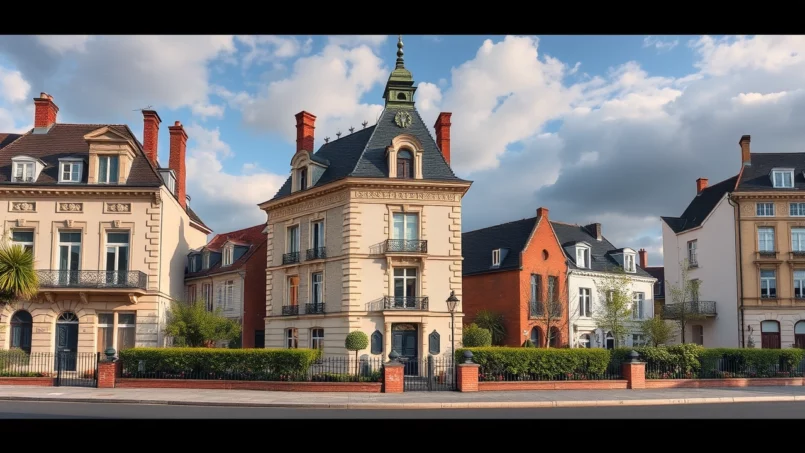
To the south, neighborhoods like Henriville or Saint‑Honoré attract an affluent clientele of managers and families. They feature large bourgeois houses, 19th-century brick buildings, and a quiet residential environment close to the center.
Some price benchmarks:
| Neighborhood / Type | Average Price per m² (indicative) |
|---|---|
| Henriville – studio | ~ 3,094 €/m² |
| Henriville – 1-bedroom | ~ 2,939 €/m² |
| Saint‑Honoré – studio | ~ 4,017 €/m² |
| Saint‑Honoré – 1-bedroom | ~ 3,200 €/m² |
| Saint‑Honoré – 2-bedroom | ~ 3,306 €/m² |
These levels reflect an upscale positioning for Amiens. Gross yields there are generally a bit lower than in more popular neighborhoods, but the long-term appreciation is promising, especially for:
– large houses converted into upscale shared housing;
– 3–4 room family apartments intended for a clientele of managers from the university hospital, university, or large companies;
– energy renovation projects taking advantage of public aid to enhance the green value of the property.
Amiens East, Saint‑Pierre, Sainte‑Anne: compromise between price and yield
Neighborhoods located to the east or northeast offer a good balance between purchase price and rents, with gross yields often above average.
Example with Amiens East:
| Amiens East Indicator | Value |
|---|---|
| Average sale price | ~ 2,314 €/m² |
| Average furnished rent | ~ 16 €/m² |
| Average unfurnished rent | ~ 13 €/m² |
| Average gross yield furnished | ~ 6.68% |
| Average gross yield unfurnished | ~ 5.92% |
| Price studio / 1-bed / 2-bed / 3-bed | ~ 2,937 / 2,859 / 2,202 / 2,139 €/m² |
These are particularly interesting figures for investors looking for profitability without targeting the most popular neighborhoods. These sectors are close to major infrastructure, sometimes to the station or campuses, and benefit from urban and transportation projects.
Discover city sectors offering good value for money, while remaining well-served and close to amenities.
A neighborhood with competitive prices, benefiting from good proximity to services and public transport.
An affordable sector combining transport accessibility and proximity to everyday services.
Marivaux and Val d’Avre: yield niches and quality
The Marivaux neighborhood stands out in the data with an average gross yield for furnished units of about 9.84%, making it one of the best spots in the city for those who know how to select their property. Rents there are sufficiently high relative to purchase prices to generate good profitability, without venturing into overly exotic products.
Meanwhile, Val d’Avre has the highest average property quality rating (3.9 out of 5). This indicates a particularly recent or well-maintained housing stock, leading to:
Key benefits to consider for an informed rental investment
Greater appeal to creditworthy tenants, ensuring more stable profitability.
Potential reduction in renovation expenses in the early years, preserving your cash flow.
An interesting position for long-term strategies, growing your asset’s value over time.
ZAC Gare‑la‑Vallée, Intercampus, and other major projects
Alongside existing neighborhoods, Amiens is undertaking several major urban projects that could transform the opportunity map.
– ZAC Gare‑la‑Vallée: vast development around the station, combining about 2,000 housing units, 200,000 m² of offices and shops, two new parks. The goal is to create a true business and living district around the rail hub, a prime playground for investors betting on the future Roissy–Picardie service.
– Intercampus Eco-neighborhood: to the south, near the university hospital and campus, this neighborhood plans for about 1,900 housing units, with a strong environmental focus (soft mobility, renewable energy, biodiversity). Proximity to the hospital and university guarantees a base of lasting rental demand.
– ZAC Paul‑Claudel, Renancourt, other ZACs: several developments totaling over 5,000 housing units by 2027 are planned, which will gradually renew and densify the supply, particularly in 1-2 bedrooms (over 70% of permits since 2014).
For an investor, these “up-and-coming” sectors offer a double bet: securing rental income thanks to major infrastructure (station, campus, hospital) and benefiting from progressive appreciation as the projects advance.
Local taxation and charges: a point of vigilance to consider
Amiens has a reputation, documented by some landlord association studies, for being among the French cities where property tax is among the highest. This should not discourage investment but requires careful calibration of your financing plan.
Property tax: high rates, but for what services?
For 2023, property tax on built properties in Amiens is characterized by:
| Component | 2023 Rate in Amiens |
|---|---|
| Municipal portion (built property tax) | 49.75% |
| Inter-municipal portion | 6.12% |
| Unbuilt property tax – municipal portion | 14.49% |
| Unbuilt property tax – inter-municipal portion | 4.75% |
These rates place Amiens at the high end of the national ranking for the municipal portion. Part of this pressure is explained by the gradual disappearance of the residence tax on primary residences, whose departmental portion was transferred to municipalities, and by the role of a central city assumed by Amiens, which funds facilities used beyond its borders (hospitals, cultural venues, sports infrastructure).
Concretely, the property tax amount depends on:
– the cadastral rental value set by the tax authorities;
– the rates voted by the City and the inter-municipal body;
– the annual state revaluation (7.1% in 2023).
Average annual property tax amount for a home, significantly impacting the net profitability of investments.
TEOM, residual residence tax, and others
The waste collection tax (TEOM) is set at 9.53%, a level considered rather low for a metropolis of this size. It is passed on to the tenant via service charges, limiting its direct impact for the landlord.
The residence tax on primary residences is virtually abolished but remains due for secondary residences and some affluent households: a point to integrate if you target a non-resident clientele occupying the property occasionally.
For unbuilt land, specific tax rates may apply, often including an inter-municipal surtax of about 43.74%. These provisions mainly concern property development operations and are less relevant for classic rental investment.
Other costs to anticipate
In addition to local taxes, the investor must factor in:
– notary fees: approximately 8% for existing properties, 2–3% for new construction;
– co-ownership fees: often between 20 and 50 €/m²/year for buildings with elevators, green spaces, collective heating;
– renovation work: as an indication, base prices noted from professionals in Amiens are around 240 €/m² for a simple refresh, 490 €/m² for a light renovation, 860 €/m² for a complete renovation, 1,200 €/m² for a major rehabilitation.
For a 70 m² 3-bedroom, a budget of around 50,000 € is thus mentioned for a complete renovation. This kind of amount must be weighed against the potential rent increase and property appreciation, as well as the available aid (MaPrimeRénov’, energy saving certificates, local schemes).
Investment strategies in Amiens: from student studios to family houses
In light of this data, several investment strategies emerge. Each has its strengths and constraints.
1. Furnished studio or 1-bedroom in the city center or Saint‑Leu
This is the archetype of Amiens investment: a small furnished property intended for a student or young professional.
The numbers speak for themselves:
– studio acquisition price: often between 70,000 and 100,000 € depending on the neighborhood and condition;
– possible rents: between 400 and 600 € /month furnished for a well-located 18–20 m², sometimes more in very high-end properties.
Several concrete examples illustrate this model:
– a 19 m² studio in Saint‑Leu bought for 92,000 € (fees included), rented at 520 €/month, yielding a gross return close to 6.8%;
– a simulation for a 20 m² studio at around 53,000 €, rented at 500 €/month, gives a theoretical gross yield over 11%.
In practice, the net profitability will be slightly lower once property tax, charges, management, and possible work are included. But this type of product often allows aiming for 5–7% net pre-tax, especially with an LMNP regime under real accounting.
Another strategy suited to a tight student market: acquiring a 3 or 4-bedroom, or even a house, to convert into shared housing.
A theoretical example was mentioned in the content, although its specific details were not developed. It serves to illustrate a concept or situation hypothetically, without reference to a particular concrete case.
– a 100 m² house in Saint‑Acheul for 226,500 €, rented at 1,400 €/month, yielding a gross return of 7.4%.
A well-optimized furnished shared housing, close to a campus or a major bus line, can generate an interesting cash‑flow, especially if financing was obtained at a decent rate and the work allowed good energy optimization (to avoid bans on renting energy-inefficient properties).
3. New construction in a student residence or eco-neighborhood
New construction in Amiens sells on average around 3,500–3,600 €/m², with occasional promotions in certain developments. In return for a higher price, the buyer benefits from:
– reduced notary fees (2–3% instead of 8%);
– better energy performance (RE 2020, RT 2012 standards);
– possible temporary property tax exemptions;
– the possibility to use the Pinel scheme (zone B1) in certain areas;
– LMNP taxation with depreciation in student residences or serviced apartments.
A 30 m² studio bought for 79,440 € and rented for 650 € per month under a commercial lease generates a gross yield of about 9.8% on the pre-tax rent. The trade-off for this high yield is dependence on the residence operator and a resale that is often less liquid than for a classic studio.
In eco-neighborhoods like Intercampus, new housing can target a mixed clientele (students, hospital staff, young families). The gross profitability may be slightly lower than for an existing property to renovate, but with lower technical and regulatory risk.
4. The family house for the long term
Finally, investment in a single-family house (often around 2,100–2,300 €/m²) targets more of a long-term asset horizon than maximum gross profitability.
A well-located house in a sought-after residential neighborhood (Saint‑Acheul, Henriville, Saint‑Honoré, some nearby villages like Dury or Boves) will offer:
– a more moderate rent per m², but a solid overall rent ticket due to the size;
– a more stable family clientele, limiting turnover and default risks;
– significant resale potential, especially if the TGV service pushes values upward.
This strategy suits investors willing to commit a bit more capital, in exchange for a balanced yield / appreciation combination.
Tax schemes and structuring: how to optimize your investment
The French framework offers, alongside sometimes heavy local taxation, an arsenal of schemes favorable to rental investment, which can apply in Amiens.
The status of non-professional furnished landlord (LMNP) is particularly relevant in Amiens, given the strong demand for furnished housing for students or young professionals.
Main conditions:
– rent out a furnished property (minimum list of equipment to respect);
– annual rental income under 23,000 € and representing less than 50% of the household’s total income to remain “non-professional”.
Tax-wise, two regimes are possible:
– Micro-BIC: flat-rate deduction of 50% on rents, simple but less optimized if expenses are high;
– Real regime: deduction of actual expenses (loan interest, work, management fees, property tax, depreciation of furniture and building structure), which often allows neutralizing taxation for many years.
Applied to a studio with a 6–7% gross yield, the LMNP (Non-Professional Furnished Landlord) regime under real accounting can offer a very attractive net after-tax yield. To achieve this, it’s essential to maintain rigorous accounting and be supported by professionals, like an accountant or tax advisor.
Pinel and similar schemes for new construction
As Amiens is eligible for zone B1 of the Pinel scheme, some new construction investments may qualify for tax reductions in exchange for commitments to rent at capped rents and under tenant income conditions.
Key points:
– tax reduction spread over 6, 9, or 12 years (rates of 12, 18, or 21% depending on duration for previous versions, scales currently evolving);
– rents and tenant income capped by decree;
– new or similar housing (off-plan, rehabilitated) meeting energy standards.
In a city where new construction prices remain reasonable compared to other metropolises, Pinel can help finalize financing, provided you choose an area with genuine rental demand (proximity to campuses, station, or an employment hub).
Censi‑Bouvard and serviced residences
Student residences or aparthotels (like the Appart’City Confort Amiens Gare residence, 146 apartments, services included) sometimes allow investment via the Censi‑Bouvard scheme (in gradual phase-out) or under a “managed” LMNP with VAT recovery.
Advantages:
– management delegated to an operator;
– rent guaranteed by commercial lease (subject to the operator’s solvency);
– possibility to recover VAT on the purchase price under conditions;
– tax reduction (Censi‑Bouvard) on part of the investment.
This type of product suits investors looking for a “turnkey” investment but requires careful analysis of the operator’s financial health, the commercial lease clauses, and resale liquidity.
Unfurnished regimes (micro-land, real) and SCI/SARL
For properties rented unfurnished, the classic regimes apply:
– Micro-land: 30% deduction up to 15,000 € annual rent;
– Real regime: deduction of all actual expenses (work, interest, insurance, management fees, etc.).
For larger portfolios (multiple properties, total value exceeding 500,000 €), forming a company (SCI under income tax or family SARL) can be relevant to optimize inheritance, share management, or choose between property income taxation and corporate taxation.
Risks and points of caution in Amiens
Investing in Amiens is not done blindly. Several risks and constraints must be considered.
High property tax
As seen, property tax is a significant expense item. It erodes net profitability, especially on small, high-price-per-m² units. It is essential to request the latest property tax bills before buying and include this charge in your simulations.
New construction market: risk of temporary oversupply
Urban studies indicate strong new housing production, with a peak of deliveries around 2019–2020 and another expected around 2024–2025, and a stock of developments for sale corresponding to about two years of sales.
Despite sustained demand, especially for 1 and 2-bedrooms, temporary oversupply of small new units in certain ZACs could exert temporary downward pressure on rents or lengthen rental times. It is therefore advisable to avoid concentrating investments solely on the same formats as all other market players. A more robust strategy involves diversifying the type of property (size, standard) and its geographical location.
Regulatory evolution on energy-inefficient properties
As everywhere in France, properties poorly rated on the Energy Performance Certificate (F or G) are gradually banned from rental: some G are already prohibited, F must be renovated by 2028, then E by 2034 according to current timelines.
In Amiens, a large part of the housing stock predates 1970. An investor acquiring an older property must plan for energy renovation work (insulation, heating, windows), at the risk of the property becoming unsellable or losing value. Conversely, anticipating this work using public aid secures rental and enhances the asset’s value.
Market dependent on university and economic attractiveness
The strength of rental demand in Amiens relies heavily on:
– the presence of the university and grandes écoles;
– the weight of the university hospital and administration;
– the services, warehouse, logistics, SME/SMI network.
A sustained weakening of these pillars (closure or major restructuring of an institution, structural decline in student numbers) could affect some market segments, especially studios near campuses. This risk is currently limited: student numbers are growing, major urban projects reinforce existing hubs, and rail service prospects enhance economic attractiveness.
How to practically approach an investment in Amiens?
Beyond the numbers, some methodical principles can maximize your chances of success.
1. Precisely define your project
Even before visiting, it is essential to clarify:
– your total budget (down payment + borrowing capacity);
– your holding horizon (5, 10, 20 years or more);
– your risk appetite (new vs. old, renovation, shared housing, etc.);
– your main objective: yield, capital gain, portfolio diversification, retirement planning, etc.
An investor seeking a 7% gross yield over 10 years will not make the same choice as a household aiming for an asset to pass on occupied by a family.
2. Target neighborhoods consistent with your strategy
For a purely rental investment with high yield, prioritize:
– studios / 1-bedrooms furnished in Saint‑Leu, near the station, in Sainte‑Anne – Faubourg Noyon, Amiens East, Marivaux;
– shared housing or 3/4-bedrooms close to campuses, the university hospital, or grandes écoles.
For a mixed yield/appreciation portfolio strategy, consider instead:
The Amiens real estate market presents two main trends: mid-size apartments in central neighborhoods (Saint-Leu, Henriville, Saint-Honoré) and houses in southern residential neighborhoods or the first ring of suburbs (Dury, Boves, Longueau, Rivery). These suburban areas are all the more attractive as they will benefit from the future TGV service, a major asset for mobility and property appreciation.
3. Integrate urban projects and transportation
The arrival of the Roissy–Picardie link and major projects like ZAC Gare‑la‑Vallée or the Intercampus eco-neighborhood must be seen as levers for appreciation, but also as temporary sources of nuisance (construction, new supply).
Buying “just before” a major project is often a good strategy, provided you don’t overestimate the future increase: the history of Tours, where prices remained moderate despite the TGV, reminds us there’s no automatic effect.
4. Finely tune the financial and tax setup
With credit rates that have risen significantly compared to the 2010s but remain reasonable (rates around 3–4% over 20 years are mentioned), profitability depends heavily on:
Three factors are decisive for rental investment profitability: the quality of purchase price negotiation, mastery of ancillary costs (optimizing work, controlling charges, selecting sound co-ownerships), and choosing the most suitable tax regime (like LMNP real versus micro-BIC, or the Pinel scheme versus classic unfurnished rental).
A comprehensive simulator integrating purchase price, notary fees, local taxes, work, charges, rents, and taxation allows you to verify the project holds up, building in a safety margin (rental vacancy, tax increases, unexpected work).
5. Surround yourself with local professionals
Even though online data is plentiful, nothing replaces the insight of a professional closely following the Amiens market. Local agencies and networks specialized in transactions and rental investment can:
– refine rent estimates neighborhood by neighborhood;
– flag co-ownerships to avoid or highly sought-after streets;
– assist with administrative, banking, and tax procedures;
– offer suitable rental management (unfurnished, furnished, short-term).
This management aspect is all the more crucial if you don’t live in Amiens or if you’re targeting demanding formats (shared housing, furnished rentals with frequent turnover).
Conclusion: a window of opportunity before “full” valuation
Investing in real estate in Amiens today means positioning yourself in a city that combines:
– a still affordable market (around 2,600 €/m², well below Lille, Reims, or major metropolitan areas);
– gross yields above the French average (6–7% common furnished, more in certain targeted neighborhoods);
– a very strong student rental base and a solid job market;
– a significant urban development program and a future strategic rail connection with Roissy and the TGV network.
Property tax is high and some segments of the new construction market risk oversupply. Furthermore, energy performance requirements are increasing. To succeed, it is essential to analyze the market neighborhood by neighborhood, properly structure your financing and taxation, and opt for rigorous management. This approach can make Amiens a solid pillar, offering a remarkable yield/risk balance for a city of this size in France.
Disclaimer: The information provided on this website is for informational purposes only and does not constitute financial, legal, or professional advice. We encourage you to consult qualified experts before making any investment, real estate, or expatriation decisions. Although we strive to maintain up-to-date and accurate information, we do not guarantee the completeness, accuracy, or timeliness of the proposed content. As investment and expatriation involve risks, we disclaim any liability for potential losses or damages arising from the use of this site. Your use of this site confirms your acceptance of these terms and your understanding of the associated risks.

Cyril Jarnias is an independent expert in international wealth management with over 20 years of experience. As an expatriate himself, he is dedicated to helping individuals and business leaders build, protect, and pass on their wealth with complete peace of mind.
On his website, cyriljarnias.com, he shares his expertise on international real estate, offshore company formation, and expatriation.
Thanks to his expertise, he offers sound advice to optimize his clients' wealth management. Cyril Jarnias is also recognized for his appearances in many prestigious media outlets such as BFM Business, les Français de l’étranger, Le Figaro, Les Echos, and Mieux vivre votre argent, where he shares his knowledge and know-how in wealth management.





