
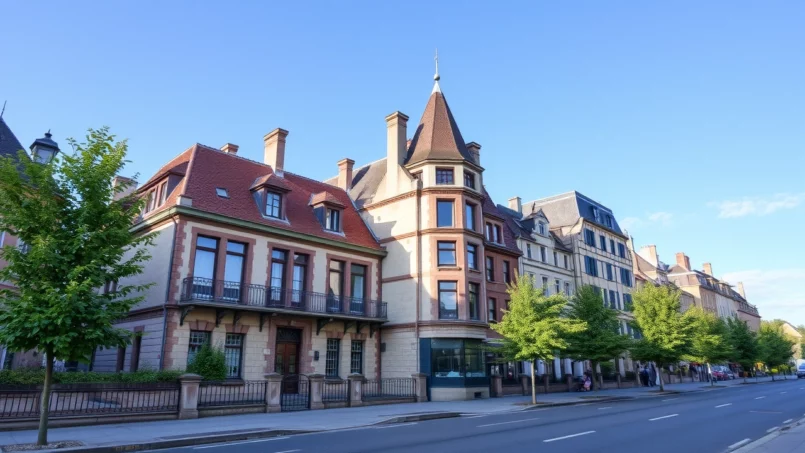
 Published on and written by Cyril Jarnias
Mulhouse is back on investors’ radar. Long associated with deindustrialization and an image of insecurity, the city in the Haut-Rhin department is repositioning itself as one of France’s most profitable real estate markets, with still very low prices per square meter, high yields, and proactive urban policies. However, this potential comes with real risks: high unemployment, significant vacancy in certain sectors, fragile co-ownership structures, and stark contrasts between neighborhoods.
Before investing in Mulhouse, it is essential to decipher the local market’s strengths and weaknesses. This analysis must be based on available data to obtain a concrete picture of current opportunities and risks.
A tight real estate market… in a still affordable city
The first unique aspect of Mulhouse is this paradox: a very tight local market, even though prices remain among the lowest of major French cities.
The real estate tension is maximal. Statistics show that the number of buyers is 18% higher than the number of properties for sale, resulting in a market tension score of 10 out of 10. A property put up for sale stays on the market for an average of 99 days, indicating sustained transaction volume despite the economic context. This pressure is partly explained by a population that is overwhelmingly tenants (64% of households), creating a pool of potential buyers as soon as access to ownership becomes possible.
The average price per square meter for an apartment in Nancy is €1,199.
This positioning can be summarized in a first table.
| Key Indicator | Mulhouse |
|---|---|
| Average apartment price (€/m²) | 1,199 (range 718 – 1,961) |
| Average house price (€/m²) | 1,800 (range 1,350 – 2,701) |
| Global median price (Dec. 2025, €/m²) | 2,266 (all properties combined) |
| Increase over 5 years | +59 to +63% depending on sources |
| Percentage of tenants | 64% |
| Market tension | 10 / 10 |
| Buyers vs sellers | +18% more buyers than properties |
| Average time to sell | 99 to 105 days |
The contrast is striking with other regional cities. Strasbourg is around €3,800 to €4,100/m², while Mulhouse is therefore significantly lower, despite having seen price increases on the order of 59 to 63% over five years depending on the periods analyzed. In other words, the bulk of the revaluation has already begun, but current levels remain attractive, especially for an investor coming from more expensive markets.
Price dynamics: a rising market, but not linearly
Zooming in on recent years, the Mulhouse market does not progress in a straight line. Recent data shows sometimes contradictory movements between houses and apartments, and marked monthly variations.
Between December 2025 and January 2026, house prices rose another 1.38% (from €1,886 to €1,912/m²), while apartments gained 1.12% (from €1,166 to €1,179/m²). But during other periods in 2025, the curves diverged: apartments slightly declining on one side, houses proving resilient or even rising on the other.
These oscillations can be illustrated over a few key months.
| Period 2025‑2026 | Apartments (€/m²) | Change | Houses (€/m²) | Change |
|---|---|---|---|---|
| Sept. → Oct. 2025 | 1,259 → 1,234 | –2.0% | 1,844 → 1,879 | +1.9% |
| Nov. → Dec. 2025 | 1,229 → 1,166 | –5.13% | 1,868 → 1,886 | +0.96% |
| Dec. 2025 → Jan. 2026 | 1,166 → 1,179 | +1.12% | 1,886 → 1,912 | +1.38% |
Over a rolling year, some sources indicate a decline of about 2.4% for apartments, while houses continue to progress (up to +5.2% in February 2025 compared to a year earlier).
The price gap between houses and apartments illustrates the specific demand of households. Family houses, very rare in the city center, are particularly sought after by families and cross-border workers, which keeps their prices at a high level. Conversely, apartments, more numerous on the market, see their value fluctuate more depending on financing conditions and investors’ allocation decisions.
Despite these fluctuations, the overall picture remains that of a market that has significantly increased in value over five years, particularly in the segment of older apartments. In December 2025, the median price for an apartment reached €2,334/m², representing +33% over one year and +74% over five years according to one data set. Median houses are listed at €2,023/m², with more moderate increases (+4% over one year, +17% over five years).
For the investor, the potential for capital gain is not exhausted, but the era of speculative operations massively overvaluing a property in a few years is probably over. Now, value creation relies increasingly on the intrinsic quality of the project, notably its location, renovation work done, and energy optimization, rather than on speculation alone.
Relatively stable rents and strong rental demand
On the rental side, the observation is different: rents change little in the short term, but the levels still allow for high yields given the purchase prices.
At the city scale, the average rent is around €13/m², with some nuances depending on property types.
| Property Type | Average Rent (€/m²/month) | Observed Range (€/m²) |
|---|---|---|
| Apartment (all types) | 12.1 to 13.6 | 9 to 18 |
| House | 11.7 to 15.1 | 9 to 17 |
| City Center (1-bed) | ~€542/month | €350 to €800 (1 bedroom) |
| Outskirts (1-bed) | ~€438/month | €350 to €500 |
| City Center (3-bed) | ~€1,080/month | €650 to €1,500 |
| Outskirts (3-bed) | ~€962/month | €700 to €1,200 |
Recent data series confirm a remarkable stability. Between December 2025 and January 2026, apartment rents remained fixed at €13.60/m², while those for houses barely progressed by €0.20/m². During the fall of 2025, apartment rents increased by only 0.4%, those of houses by 0.3%. This relative calm contrasts with the nervousness of the sales market, where monthly variations can exceed 5%.
The rental market is generally balanced between supply and demand, with 64% tenants and a large young population. About one-third of tenants are students, mainly looking for small units (studios, 1-bed, 2-bed), while two and three-room apartments are the most in-demand in the urban area, despite significant variations between neighborhoods.
There is also a growth in annual furnished rentals at the expense of seasonal rentals in some sectors, with better-equipped and higher-quality properties entering the long-term market. At the same time, rental arrears increased significantly in 2024, a risk element that an investor cannot brush aside.
Yields significantly above the national average
This is probably the most commented-on argument: Mulhouse regularly ranks among France’s most profitable cities for rental investment. Sources vary, but all converge towards gross yields significantly higher than those of many major cities.
At the city scale, several indicators coexist:
Synthesis of various gross yield estimates for a rental real estate investment, based on different methodologies and scenarios.
An average gross yield of about 6.41%, calculated based on a general data set.
An estimate of 7.62%, deduced from a purchase ratio of €1,577/m² for a rent of €13/m².
An average yield around 11.3% in a city comparison, corresponding to strategies like co-living, furnished rentals, or investment in high-yield, popular neighborhoods.
The following orders of magnitude can be synthesized:
| Yield Indicator | Value for Mulhouse |
|---|---|
| Average gross yield (source A) | 6.41% |
| Gross yield (comparison table) | 7.62% |
| High estimate (optimized investment) | ≈ 11.3% / 11.28% |
| City center yield | ~5.72% |
| Outside center yield | ~5.76% |
| Average return on investment period | 23.1 years |
The gaps are explained by the types of properties considered, the assumptions of expenses, and the geographic scope. Another, very detailed data set specifies the average yields by apartment type.
| Apartment Type | Average Purchase Price (€) | Average Monthly Rent (€) | Estimated Gross Yield |
|---|---|---|---|
| 1-room (1-bed) | 65,250 | 470 | 8.64% |
| 2-room (2-bed) | 128,920 | 610 | 5.63% |
| 3-room (3-bed) | 175,900 | 720 | 4.89% |
| 4 rooms and up | 199,950 | 800 | 4.77% |
It is clear that smaller units offer the best yields, at the cost of potentially higher vacancy and faster tenant turnover. For a 1-bed, it exceeds 8.5% gross yield, while a large apartment is capped under 5%.
The average gross profitability of a furnished property in the Côteaux neighborhood, the highest mentioned in the study.
To measure Mulhouse’s comparative advantage, one only needs to place it back in its departmental environment. In the Haut‑Rhin department, the average yield is around 3.97% for an average price of €3,390/m² and a rent of €660/month. Mulhouse, with a yield of 6 to 8% in many segments, acts as the department’s locomotive.
Zoom on neighborhoods: highly contrasting yields
Speaking of the “Mulhouse market” in the singular is misleading. The city is extremely fragmented, with very clear gaps in price, vacancy, building quality, and image from one neighborhood to another. This is where the success or failure of an investment largely plays out.
Historic Center: compromise between centrality and yield
The historic heart concentrates nearly a third of the city’s rental listings and displays rents in the upper average of the market. The average sale price there is around €1,768/m², with an average surface area of 88.7 m² and a property condition rated as fair (score 3.3/5). For rentals, furnished units rent for about €12/m², unfurnished for €10/m².
The yields observed in this area remain solid: roughly 7.3% gross furnished, 6.53% unfurnished. Sale prices there have accelerated strongly: +14.24% just in February 2025 for sales, and +4.05% for rents. This is a balanced sector: good demand, correct turnover, improving image, but without exceptional profitability.
For investors seeking a compromise between yield and rental security, the Historic Center constitutes an interesting foundation, provided the building is well chosen (state of the co-ownership, energy performance, fees).
Côteaux: record yield, but extreme volatility
At the other end of the spectrum, the Côteaux neighborhood concentrates the typical “high yield / high risk” profile of certain Mulhouse sectors. Sale prices are lower there, around €1,583/m² for an average surface area of about 84 m², but with properties often rated only 2.5/5 in condition.
Furnished rents can reach €19/m², compared to €9/m² for unfurnished. It is this differential that explains theoretical yields exceeding 14% furnished and around 13% unfurnished. But the trade-off is clear: in March 2025, sale prices plunged more than 20%, and rents show a spectacular drop of over 54% in a reference month. This is a sector where demand is very sensitive to economic conditions, social policies, and perceptions of safety.
An investor venturing there must be seasoned, master the management of more fragile tenants, anticipate periods of vacancy, and high value volatility. The cash-flow potential is real, but long-term sustainability will largely depend on the success of urban renewal programs.
Rebberg, Lower Rebberg, heritage neighborhoods
Yields in these sectors are generally between 3% and 5%. Investment there is more motivated by wealth consolidation, resale, and capital preservation than by the search for high current yield. Demand is supported by many cross-border workers employed in Switzerland or Germany, which helps maintain prices and offers good prospects for capital gains.
Fonderie, Daguerre, Dornach: optimization levers around campuses and innovation hubs
The Fonderie neighborhood, east of the train station, illustrates Mulhouse’s urban renewal. A former industrial wasteland, it now hosts the Faculty of Law, Economics, and Social Sciences, the University of Haute‑Alsace campus, and the KMØ digital hub. It’s a young neighborhood, with a median age around 29, mostly composed of apartments (nearly 98% of the stock), where prices remain contained (around €700 to €1,700/m² for apartments) and rents supported by student demand.
Rental yield targeted in high-yield sectors like Fonderie or Dornach, which can be exceeded with fine-tuning.
Popular neighborhoods and QPV: high profitability, demanding management
The sectors Bourtzwiller, Drouot, Wagner, Cité Briand, Doller, Côteaux, Franklin‑Fridolin or Vauban‑Neppert are part of priority urban renewal programs. They concentrate a significant share of the most fragile population, high unemployment, vacancy rates above average, and an old housing stock often poorly insulated.
Their advantage, for an investor accustomed to this type of market, lies in very low purchase prices, allowing for gross yields of 8 to 10% in “classic” rental, and up to 10 to 13% with well-calibrated co-living or furnished setups. But these figures come with time-consuming rental management (more frequent arrears, rapid turnover, need for on-site presence or an experienced manager), risk of degradation of common areas, and a high dependence on city policy orientations.
Understanding the socio-economic context is crucial to appreciating the real estate risk. Mulhouse has about 108,000 inhabitants, with a very young population (median around 35, over 40% under 30) and great diversity (140 nationalities, over 21% foreigners). This youth is seen as an asset for the future in urban diagnostics, but it comes with marked social fragility.
The unemployment rate in Mulhouse can reach 28.1% for the population aged 15 to 64, significantly above the national average.
The city shows a high concentration of vulnerable households, with a Gini index of 0.48, a sign of marked inequalities. In 2018, nearly 40% of 18‑29 year olds were considered at risk of poverty. Families with more means tend to settle in the peripheral municipalities, while precarious households are more concentrated in certain neighborhoods of the city center.
For the investor, this implies two things. First, a considerable reservoir of rental demand, notably for affordable, small, and family housing. Second, an increased risk of arrears, precarious occupancy, and management difficulties in certain segments. Caution regarding tenant profiles, guarantees, and the possible recourse to rent guarantee insurance is therefore particularly recommended.
An old housing stock to renovate, with real energy issues
Another Mulhouse-specific feature: the age of the housing stock. Nearly three-quarters of apartments rented in 2024 were built before 1970, and only 5% after 2007. Many co-ownership buildings in the center and popular neighborhoods suffer from poor energy performance, degraded common areas, and sometimes financial fragility.
68% of rented housing in the urban area have a D or E EPC rating, average energy classes.
For the investor, this situation is both a warning and an opportunity. On one hand, buying a poorly insulated property in a poorly managed co-ownership can lead to imposed heavy renovations, rental restrictions (future ban on renting the most severe energy “passes”), and a discount at resale. On the other hand, the possibility of “forcing” appreciation through targeted energy renovation is real, especially since national aid (like MaPrimeRénov, ANAH grants) can provide support.
The cost of major energy renovations, such as moving from an F/G rating to D or better, can reach several tens of thousands of euros. However, this investment can be profitable in the medium term by enabling a rent increase, improving occupancy rates, and strengthening the property’s market position.
Local taxation: property tax and upcoming cadastral reform
Regarding local taxation, Mulhouse has already made a catch-up effort. After six years of stability, the city increased the built property tax rate by 4.88% in 2023, raising the municipal rate from 41.01 to 43.01%. The Mulhouse Alsace Agglomération urban community also raised its rate from 1.58% to 3.58%. Since then, the municipality has chosen to stabilize this rate for 2024 and 2025, citing the limited contributory capacity of property owners.
The property tax finances about one-third of the municipal budget, covering schools, roads, culture, sports, and projects. In Mulhouse, the taxable base remains among the lowest of major cities in the East, limiting the average amount despite national increases in bases (+7.1% in 2023 and +3.9% in 2024).
In the shorter term, the national reform planned for 2026 on cadastral bases could result in a specific increase for some properties currently under-declared (lack of mention of a bathroom, heating, etc.). At the French national level, the administration estimates the average increase at €63 per affected dwelling, but significant variations are possible depending on the actual quality of the property. The investor therefore has every interest in factoring in a margin for property tax progression in their cash-flow calculations.
Acquisition costs: notary and financing fees to anticipate
Investing in Mulhouse, as elsewhere in France, requires mastering the real acquisition cost beyond the displayed price alone. For an older property, one must generally account for between 7 and 10% of the price in so-called “notary” fees, which are in reality nearly 80% duties and taxes paid to the state and local authorities. A rule of thumb places these fees just below 8% for an older dwelling, around 3 to 3.5% for a new build.
For a €100,000 apartment in Mulhouse, budget about €8,000 for notary fees. Agency fees (often 5-6% of the price, usually included in the listing) and financing costs (bank file, guarantee, insurance) may be added. For a non-resident, the minimum down payment required by banks is often higher, typically 25-30%, or even more for nationals outside the European Union.
Loan rates at the national level have experienced a peak then a decline. The year 2024 ended with an average close to 3.72% for mortgage loans, while the Eurozone was around 4.34%. Forecasts for 2026 envision 20-year fixed rates between 3.8 and 4.2%, or even between 3 and 4% for the best profiles, placing financing in a still bearable cost zone for well-calibrated projects. In Mulhouse specifically, the observed average for a 20-year fixed loan is around 3.46%.
Mortgage credit in France includes borrower insurance (generally 0.2 to 0.5% of the annual capital) and a strict solvency rule: the overall debt-to-income ratio, including all debts, must not exceed 35% of gross income. These requirements, combined with sometimes modest median incomes, can limit borrowing capacity and help explain the high proportion of tenant households.
Structural risks: vacancy, arrears, fragile co-ownerships
The displayed profitability of Mulhouse should not make one forget the structural risks found less in more “premium” markets.
First, vacancy. The city has about 8,735 vacant dwellings, representing 15.3% of the stock, a rate well above the national average. This vacancy is highly concentrated in certain old blocks in the center and in struggling neighborhoods. The reasons are multiple: poor quality housing, lack of parking, poor energy performance, co-ownerships in great financial or legal difficulty. Investing in a building where half the units remain empty is rarely a good calculation, even if the purchase price is tempting.
Local data indicates a significant increase in rental arrears this year. This situation highlights the crucial importance of rigorous tenant selection, implementing solid guarantees (deposit, Visale guarantee, GLI), and regular follow-up. It should be noted that the sectors with the highest gross yields are also those where the risk of arrears is strongest.
Co-ownerships, finally, constitute a key point of vigilance. A non-negligible part of central Mulhouse is composed of small private co-ownerships, sometimes aging, with weak governance, unpaid fees, and considerable renovation needs. An investor focusing solely on price per square meter risks getting stuck in a complex where renovation decisions are blocked, with a risk of rapid depreciation.
A changing environment: major urban projects and cross-border attractiveness
Alongside these risks, Mulhouse benefits from important structural assets that support real estate demand and long-term valuation.
The city is part of the trinational metropolitan area of Basel–Mulhouse–Freiburg, a region with a very high GDP per capita. Its transport network is very dense: two highways (A35 and A36), a TGV station to Paris, Strasbourg, Lyon, and Basel, and EuroAirport about 25 km away (soon to be connected by train). Within the city, mobility is ensured by three tram lines, over twenty bus lines, and an extensive cycling network.
Added to this is a very proactive urban strategy. The “Mulhouse Grand Centre” program has profoundly transformed the city center, reducing commercial vacancy by 40%, revitalizing local commerce, and improving the city’s image. Extensive urban renewal programs (PRU, NPNRU) are underway or upcoming in six priority neighborhoods, for over €300 million in investment concentrated notably on old buildings.
Flagship projects (KMØ, DMC District, Fonderie, new schools, greening) aim to revalue neighborhoods and improve the quality of life. These public investments could, in the long term, positively influence real estate prices, especially for well-located properties.
Finally, the proximity of Switzerland and Germany attracts cross-border workers, who benefit from higher salaries while seeking more affordable housing on the French side. Departmental data shows that foreign buyers (especially Germans and Swiss) represent a significant share of the Haut-Rhinois market, with average transaction prices around €332,000 for Swiss buyers.
Profitability vs security: how to arbitrate in Mulhouse?
Faced with this panorama, how can an investor concretely approach the Mulhouse real estate market?
A first strategy consists of targeting high gross yield zones (Côteaux, Bourtzwiller, Drouot, Cité Briand, certain blocks of Doller or Franklin‑Fridolin), with the idea of maximizing current cash flow. This is where yields close to 10 to 13% are found in furnished or co-living setups. This approach assumes accepting a high level of rental risk, relying on very solid on-site management, and properly factoring in the possibility of heavy renovations, vacancy, and more difficult arbitrage at resale.
The practical rental yield, less spectacular but more stable, in balanced residential sectors close to the center of Mulhouse.
Finally, a third strategy, with a wealth-building focus, concentrates on more affluent neighborhoods like Rebberg, or certain sectors highly sought after by cross-border workers. Gross profitability there readily falls below 5%, but liquidity and capital gains prospects are better, as is tenant quality.
In all cases, the central point in Mulhouse is to work on a micro-local scale: the performance difference from one street to another can be considerable. The same 2-bed, in a sound and well-managed building in a neighborhood under renewal, has nothing to do with a similar 2-bed in a degraded co-ownership with high vacancy.
Conclusion: a city with high potential for prepared investors
Investing in real estate in Mulhouse means accepting a unique compromise: the possibility of obtaining some of the highest yields in France, in a city undergoing full transformation, but without the security or fluidity of a prime market like Strasbourg, Lyon, or Bordeaux. The low prices constitute a formidable leverage effect for those who know how to choose their properties, analyze their co-ownerships, anticipate renovations, and navigate a contrasting social fabric.
The success of an investment in Mulhouse relies on thorough preparation. This must include a detailed study of neighborhoods and an understanding of local social dynamics. It is also crucial to account for future mandatory energy renovations, perform a strict simulation of all expenses (property tax, renovation costs, rental management fees), and be particularly vigilant on financing terms. This rigor allows transforming the potential of the Mulhouse market into concrete success. For investors ready to go off the beaten path and accept a certain complexity, Mulhouse can thus evolve from a ‘risky market’ to a true ‘gem’ in terms of yield.
Disclaimer: The information provided on this website is for informational purposes only and does not constitute financial, legal, or professional advice. We encourage you to consult qualified experts before making any investment, real estate, or expatriation decisions. Although we strive to maintain up-to-date and accurate information, we do not guarantee the completeness, accuracy, or timeliness of the proposed content. As investment and expatriation involve risks, we disclaim any liability for potential losses or damages arising from the use of this site. Your use of this site confirms your acceptance of these terms and your understanding of the associated risks.

Cyril Jarnias is an independent expert in international wealth management with over 20 years of experience. As an expatriate himself, he is dedicated to helping individuals and business leaders build, protect, and pass on their wealth with complete peace of mind.
On his website, cyriljarnias.com, he shares his expertise on international real estate, offshore company formation, and expatriation.
Thanks to his expertise, he offers sound advice to optimize his clients' wealth management. Cyril Jarnias is also recognized for his appearances in many prestigious media outlets such as BFM Business, les Français de l’étranger, Le Figaro, Les Echos, and Mieux vivre votre argent, where he shares his knowledge and know-how in wealth management.





