
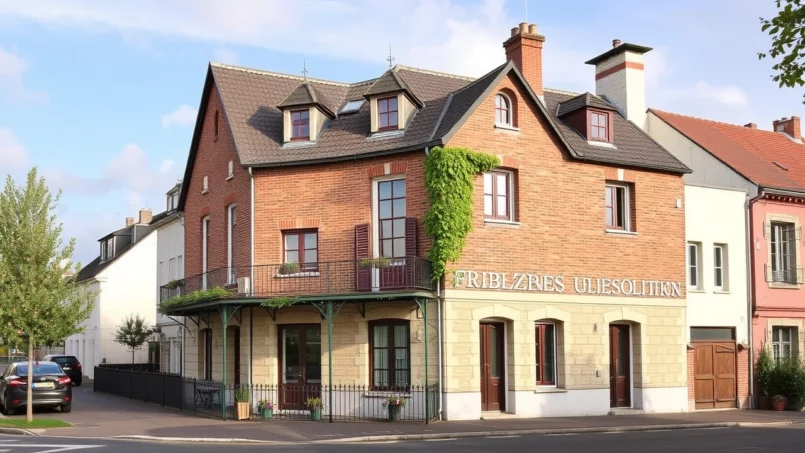
 Published on and written by Cyril Jarnias
Reims is ticking more and more boxes for investors: 45 minutes from Paris by TGV, a large student population, a tight rental market, major urban projects… and square meter prices still significantly lower than in the capital. But, as everywhere, not all streets and property types are equal, and yields can vary by a factor of two depending on the choices made.
This article analyzes the real estate market in Reims, including prices, rents, and yields by property type. It details the main neighborhoods, the specifics of student and tourist rentals, and discusses future challenges such as new regulations (Energy Performance Diagnostics), urban projects, and the end of the Pinel scheme.
Reims: A well-connected mid-sized city, simultaneously student-oriented, economic, and tourist-friendly
Investing in real estate in Reims is first and foremost betting on a mid-sized city with a particularly advantageous location. The city is located in the Marne department, in the heart of the Grand Est region. It has around 180,000 inhabitants and ranks as the 12th largest city in France by population.
The TGV connects Reims station to Paris-Est in about 45 minutes.
Local transportation relies on the CITURA network: two tram lines and over twenty bus lines serve the neighborhoods. This accessibility, combined with a lively downtown and a dense cultural offering (opera, conservatory, theater, museums, seven media libraries…), partly explains the city’s residential appeal.
Reims has a diversified economic fabric with key sectors such as agri-food (notably champagne), healthcare, automotive, banking-insurance, real estate, metal, and glass. The city is home to over 3,700 establishments in commerce, transportation, and services, and hosts a unique bioeconomy ecosystem around the Bazancourt-Pomacle biorefinery, generating over 1,200 direct jobs.
Finally, it is a city of art and history, with three sites classified as UNESCO World Heritage (Notre-Dame Cathedral, Palais du Tau, former Saint-Remi Abbey). The great champagne houses and about 300 million bottles sold annually reinforce massive tourism (7.4 million visitors in 2024). This mix of tourism, students, and mobile professionals fuels a diverse rental demand.
Demographics, resident profiles, and housing stock structure
To gauge the rental potential, one must understand who lives in Reims and in what type of housing.
The population ranges between 179,000 and 185,000 depending on sources, with a median age of 34. The city has just over 100,000 households, comprising 91,254 primary residences (90.6% of the stock), 1.6% secondary residences, and 7.8% vacant homes.
The most striking feature for an investor is the weight of renters: 71.3% of residents live in rental housing. This is well above the national average and reflects a typical “renter’s city” market.
The distribution of primary residences by number of rooms shows a relatively balanced housing stock. It’s important to note the significant share occupied by small units, a property type often sought for rental investment.
| Housing type (primary residences) | Approximate share |
|---|---|
| Studios | 12.0 % |
| 2-room apartments | 18.1 % |
| 3-room apartments | 25.2 % |
| 4-room apartments | 22.5 % |
| 5-room apartments and more | 22.2 % |
Economically, the median annual income is around €23,500. Employment remains fragile: 18.7% unemployment for 15-64 year-olds, with a recent increase in this rate. This context fuels significant demand for affordable rental housing, particularly for affordable units or those suitable for shared housing.
Regarding universities, Reims welcomes over 37,000 students each year: University of Reims Champagne-Ardenne (URCA), NEOMA Business School, Sciences Po Europe-America campus, ESAD, CNAM, CESI, SUPINFO, CentraleSupélec… One in six residents is a student. For an investor, this means a structural clientele for studios, 1-bedroom, and small 2-bedroom apartments, but also for 3-bedroom units used for shared housing.
Price and rent levels: Where does Reims stand nationally?
The most recent data show a market that is both dynamic and still affordable.
Purchase prices
According to various sources, the average price per square meter in Reims generally ranges between €2,500 and €3,000 for an apartment, with slight variations depending on whether one looks at new or existing properties and by neighborhood.
Some key figures:
| Indicator | Indicative value |
|---|---|
| Average price per m² (all properties) | ≈ €2,935 |
| Average price per m² apartments (overall) | €2,572 – €2,717 |
| Average price per m² houses (overall) | €2,658 – €3,161 |
| Average property price | ≈ €198,000 |
| Average property size for sale | 75 m² |
Another source mentions, for early 2026, a price around €2,631/m² for apartments and €3,016/m² for houses. In the city center, some areas (Voltaire, Diderot, Saint-Symphorien streets) climb towards €3,800/m², while the north of the city still offers opportunities around €1,700/m² for an apartment.
Nationally, Reims’ real estate prices (around €2,930/m²) are slightly below the French average. However, at the regional level in Grand Est, the city proves relatively expensive, surpassing agglomerations like Troyes or Charleville-Mézières. This intermediate position makes it affordable for investors from tighter markets, such as Île-de-France or other major metropolises.
The long-term trend is clear: +25% over five years, over +30% over ten years. Another data series reports a rise of nearly 16% over five years and 21.9% over a decade, with a clear acceleration after the TGV became operational. The post-Covid frenzy was real, but the market is now “calming,” with more moderate expected increases of +1 to +3% per year depending on the neighborhood.
Rents charged
On the rental side, the average rent is around €590 per property, with an average of about €12/m² for unfurnished rentals and €16/m² for furnished rentals.
Practical information and essential reference points to guide you.
Check available slots to plan your visit or procedures.
Find your way easily with our detailed directions and maps.
Find all ways to contact us for your questions or specific needs.
Access a selection of useful documents and links to deepen your research.
| Rental type | Average rent per m² | Typical monthly rent |
|---|---|---|
| Unfurnished rental (overall) | ≈ €12/m² | ≈ €590/month |
| Furnished rental (overall) | ≈ €16/m² | |
| 1-bedroom city center | — | ≈ €587/month |
| 1-bedroom outside center | — | ≈ €524/month |
| 3-bedroom city center | — | ≈ €1,100/month |
| 3-bedroom outside center | — | ≈ €800/month |
Rents have also increased, but much less quickly than prices: +1.56% in one month in one data series, versus +9.11% for sale prices over the same period. In the long term, this decoupling explains an average yield now closer to 4.5-5.5% gross than the 7-8% observed in some very affordable cities like Saint-Étienne or Charleville-Mézières.
Yields: What does a real estate investment in Reims return?
Various sources converge towards an average gross rental yield between 4.5 and just over 5.5%, with strong variations depending on the property, neighborhood, and strategy (furnished, shared housing, short-term, etc.).
Average yield and market tension
One indicator gives an overall gross yield of 4.56%, with 5.32% for furnished and 4.76% for unfurnished. Other studies mention an average yield of about 5.5%, even 6% and more in certain sectors or for optimized operations (furnished, shared housing, subdivision).
The rental market is described as very tight, with a “rental tension score” noted as 10/10, even 16.51/10 in another methodology. The number of potential tenants far exceeds the number of available homes, particularly for furnished student accommodations. Reims is classified as a “tense zone” by the tax administration, which allows access (when they exist) to certain schemes and regulates conditions for landlords to repossess the property.
The average investment payback period for a real estate purchase is about 28 years at the city level, before taxes and renovations.
Yield by property type
Data by apartment type is particularly telling. For investors, small units win in terms of gross yield, even if large apartments remain interesting for shared housing or secure family rentals.
| Apartment type | Average sale price | Average monthly rent | Average annual income | Average gross yield |
|---|---|---|---|---|
| 1-room (T1) | €115,000 | €480 | €5,760 | ≈ 5.01 % |
| 2-room (T2) | €170,600 | €630 | €7,560 | ≈ 4.43 % |
| 3-room (T3) | €223,950 | €820 | €9,840 | ≈ 4.42 % |
| 4-room and more | €353,100 | €1,090 | €13,100 | ≈ 3.69 % |
It clearly appears that: climate change has a significant impact on our ecosystems and societies.
– Small units (T1/T2) offer the best gross yields, especially if switching to furnished or shared housing.
– Large apartments require a larger acquisition budget, with a lower gross yield, but they target a different clientele (families, co-livers, relocated professionals) less volatile than students.
This is the average net yield rate for a furnished rental investment in Reims, with peaks at 6.60% in some neighborhoods.
Differences between neighborhoods: from single to double
Yields by neighborhood (all property types combined) range from about 3.4% in the most expensive areas to 7.2% in the most profitable. One study even cites an average of 7.31% for some optimized operations.
Another ranking places the most profitable neighborhoods in the following order:
| Neighborhood | Indicative gross yield |
|---|---|
| Saint-Remi | ≈ 6.68 % |
| Verrerie | ≈ 6.61 % |
| Laon Sud | ≈ 6.24 % |
| Citywide average | ≈ 5.50 % (order of magnitude) |
Conversely, the historic center or some upscale areas offer lower yields (about 3.7% in the hyper-center), compensated by excellent resale liquidity and stronger long-term asset value.
For an investor, the question is therefore not just “where are rents the highest?”, but above all “in which neighborhoods is the price/rent balance the best?”. This is the core of the trade-off between yield and asset security.
Neighborhood focus: Where to invest in Reims based on your profile and strategy?
Reims’ main strength is the diversity of its neighborhoods: high-end historic center, areas undergoing urban renewal, student zones, family residential areas, etc. Here is an overview of the sectors most cited in investment studies.
City Center / Grand Centre: Heritage and maximum liquidity
The city center concentrates the iconic landmarks: Notre-Dame Cathedral, Place Drouet d’Erlon, Place Royale, canal, Hautes Promenades… This is the most sought-after, liveliest, and most expensive sector. Prices range around €3,000/m², with peaks above €3,500/m² near monuments or the canal.
This neighborhood attracts:
– professionals working in Paris but wanting to live outside the capital,
– families seeking a downtown lifestyle,
– students at prestigious schools,
– tourists drawn to historic charm.
For rentals, tension is high and vacancy is very low. The city center lends itself well to:
– classic LMNP (furnished long-term rentals),
– short-term rentals (Airbnb, seasonal), within a highly regulated framework,
– small units (studios, T2) which remain safe bets.
The gross yield is moderate (about 3.7% in the hyper-center according to some sources), but the probability of a quick resale and preservation of asset value is high.
Boulingrin: A central village in transition
Located 5 minutes from the center and 10 minutes from the station on foot, Boulingrin was long considered a popular neighborhood, centered around its market halls and champagne culture. It is now in full transition, appreciated by families and young professionals.
Prices range between €2,500 and €3,000/m². The supply mainly consists of T2 to T4 apartments, sometimes in entire buildings under single ownership. Rental demand is rising and rental tension is favorable.
Boulingrin is very well suited.
Boulingrin
– to long-term LMNP,
– to seasonal rentals oriented towards “champagne tourism”,
– to rental apartment buildings to renovate, for those aiming for a long-term asset strategy.
Saint-Thomas and Laon-Nord-Est: Betting on the future and student rentals
To the north, on the other side of the station and the Hautes Promenades, the Saint-Thomas neighborhood is about a ten-minute walk from the center. It extends to the former docks of Reims. A former popular neighborhood, it offers a real neighborhood life and, importantly, service by a north-south tram line.
The arrival of the new NEOMA campus and planned renovations are set to accelerate the transformation of this area. Prices are attractive, averaging between €2,000 and €2,500/m². One finds small apartment buildings, houses, and recent constructions.
For an investor, this is typically a bet on the future, both on:
– the gradual increase in rents,
– long-term appreciation, as the neighborhood upgrades.
The premier strategy here remains furnished student rentals (LMNP) for T2/T3 units, or even controlled shared housing.
Saint-Maurice / Saint-Rémi / Barbâtre: High yield and sought-after living environment
The Saint-Maurice/Saint-Rémi/Barbâtre area stretches from the Saint-Remi basilica towards the center and the canal. It offers a highly sought-after environment: beautiful buildings, green spaces, shops, market, village atmosphere, proximity to the canal, and presence of the Sciences Po campus.
Prices per square meter range between €2,500 and €3,000, with references around €2,576/m² for apartments and €2,506/m² for houses (ranges between €1,900 and €3,600/m² depending on location). Despite these price levels, profitability can be excellent: a yield of around 6.68% is mentioned in some studies, above the city average.
The clientele mainly consists of: regular clients, new visitors, families, students, and professionals.
– students and recent graduates,
– young professionals,
– couples with or without children.
LMNP remains the preferred option to maintain a high occupancy rate, for example via furnished T2/T3 units or small shared apartments.
Clairmarais: The new business district around the station
Clairmarais illustrates the impact of the TGV on the city. A stone’s throw from the central station, this neighborhood has been profoundly transformed into a business district, with the creation of 70,000 m² of offices and about 500 housing units, all in a restructured environment (Promenades, green spaces, nearby Boulingrin market halls).
Prices reach about €2,500 to €3,000/m², with a recent figure around €2,942/m². The target clientele:
– executives and senior professionals working in Reims or Paris,
– employees in the district’s offices,
– students from nearby prestigious schools.
Rental demand is strong, with yields potentially climbing towards 6% for well-located properties, especially if favoring small furnished units for mobile professionals.
Clémenceau and Jean-Jaurès: Family residential and on the rise
Southeast of the historic center, Clémenceau charms with its gardens, shops, and reassuring atmosphere. The tramway passes through, and the neighborhood remains just a few minutes by transport from the cathedral or champagne houses.
Average prices are more contained, around €2,100/m², with peaks at €2,470/m² for the most sought-after locations. Another source, however, indicates higher figures, around €2,753/m² for apartments and €3,265/m² for houses, proof that the situation can vary from street to street. This is a sector very popular with families, with strong demand for T3, T4, and T5 units.
The average price per square meter in the Jean-Jaurès neighborhood in Reims, with variations that can reach €3,562/m² for houses.
Over 66% of residents are tenants, making it favorable ground for long-term family rental investments, with good resale potential.
Student neighborhoods: Courlancy, Croix-Rouge, Orgeval, Europe
For student rentals, several areas stand out:
– Courlancy, south of the center, near health faculties and NEOMA, not far from the university and Léo Lagrange park.
– Croix-Rouge, a large neighborhood undergoing massive renovations (over €370M as part of the New National Urban Renewal Program), very well-connected to the campus.
– Orgeval and Europe, on the near outskirts, with more affordable prices and good transport links.
In these zones, prices often remain between €2,000 and €2,500/m², for competitive rents that ensure interesting yields, particularly in shared housing or furnished student accommodations.
Murigny, Neuvillette, Trois Fontaines: Green periphery and profitability
Murigny, to the south, combines large housing complexes, residential areas, houses, and amenities (schools, sports fields). It’s the neighborhood where the average gross yield for furnished rentals reaches 6.60%, a city record according to some indicators.
La Neuvillette – Trois Fontaines, to the north, offers reasonable prices for houses (€2,667/m² at Trois Fontaines) in a family-friendly, very green setting. Neufchâtel, often associated, attracts a young population (largely under 40), with apartments around €2,266/m² and houses at €2,731/m². These sectors are very interesting for those seeking townhouses or large apartments to operate as family or intergenerational shared housing.
Student rental investment: A pillar of the Reims market
With over 37,000 students and one in six residents enrolled in higher education, Reims regularly features in rankings of the best mid-sized cities for student rental investment. A network like Orpi places it in the top 3 alongside Lille and Rouen.
What type of property to rent to students?
Several formats coexist:
– Furnished studios and T1s: budgets of €400 to €550/month, often around 20‑25 m². They represent a quarter to a third of the furnished supply.
– Furnished T2s: rents around €500 to €600/month, suitable for couples or a two-person shared housing.
– Rooms in shared T3/T4/T5 apartments: about €350 to €450 per room, depending on location and standard.
This is the minimum monthly price for housing in a CROUS residence, well below private residences.
For a private investor, shared housing in a well-located T3/T4 can offer an excellent compromise: it allows capturing high total rents while remaining affordable for each student, with the added benefit of solid parental guarantees.
Furnished, LMNP, and taxation
Furnished rentals are a must both for market reasons (students, young professionals, temporary stays) and tax reasons. Under the LMNP regime (non-professional furnished landlord), it is possible to benefit either from:
– the micro-BIC with a flat-rate 50% deduction on rents collected,
– the actual regime, allowing the deduction of actual expenses and, crucially, the depreciation of the property and furniture, which significantly reduces the taxable base for many years.
The standard furnished lease has a minimum duration of one year (9 months for students). The tenant’s notice period is one month and the security deposit is limited to two months’ rent. This type of lease is particularly well-suited to Reims, where student demand is strong, especially in the Courlancy, Croix-Rouge neighborhoods, the expanded city center, and areas near campuses.
Housing benefits and tenant solvency
The vast majority of eligible students can receive housing benefits from the CAF (Housing Allowance, Social Housing Allocation) of up to about €150/month depending on the case. To qualify, they need notably:
– a lease in their name,
– a French bank account,
– proof of rent,
– a residence permit for foreign students.
For the landlord, this strengthens solvency and limits the risk of unpaid rent, especially when complemented by a parental guarantor.
Seasonal rentals and Airbnb: A complement to handle with caution
Reims’ tourist dimension – UNESCO heritage, champagne houses, major events – fuels a very active short-term rental market. Aggregated data on platforms like Airbnb show nearly 1,600 to 1,700 active listings, over 90% of which are entire homes, predominantly apartments.
Some figures on the short-term market
| Indicator (Airbnb & similar) | Indicative value |
|---|---|
| Number of active listings | ≈ 1,600 – 1,700 |
| Share of entire homes | ≈ 93 % |
| Average capacity | ≈ 3.5 people |
| Average occupancy rate | ≈ 55 % (201 nights/year) |
| Average price per night (ADR) | ≈ €85 |
| Estimated average annual revenue | ≈ €16,900 |
Seasonality is marked, with revenue peaks in August, September, and October, periods of harvest and champagne tourism. The best properties (top 10%) achieve monthly revenues above €2,600 with occupancy rates over 80%, but the market median remains more modest, around €1,000/month.
Regulation and risks
Reims applies strict regulations on short-term rentals, with declaration obligations and, in many cases, requirements for change of use or compensation. The majority of listings are declared “compliant” but this assumes having followed the administrative procedures.
For an investor, short-term rentals should not be seen as a foolproof or simple solution. However, it can represent a good complement to a broader investment strategy.
– on hyper-central small units,
– with professional management (platforms like GuestReady, local concierge services),
– while controlling regulatory risks, notably recent changes (“Le Meur law”, regulation of tourist furnished rentals).
New, existing, taxation: Which strategies to favor in Reims after the end of Pinel?
Reims was classified in zone Pinel B1, which strongly supported the development of new-build programs for rental investment. With the Pinel scheme closed to new acquisitions since early 2025, the game has changed, but new-build retains advantages.
Investing in new-build
Recent and ongoing projects (the Sernam/Bezannes area, operations like “L’Opéra“, “Alfred & Jules“, “BeZen” in Bezannes) appeal to investors seeking:
– modern comfort (RT 2012 / RE 2020 standards, good energy performance),
– little to no renovations for many years,
– enhanced attractiveness for tenants sensitive to energy bills.
Average price of a new-build T3-type apartment of about 67 m², including parking.
Without Pinel, many investors are turning to furnished rentals (LMNP) to optimize taxation, or towards setups like managed residences (Censi‑Bouvard) when still available, or regimes like the real estate deficit (for existing properties to renovate) or Denormandie in eligible areas.
Investing in existing properties
Existing properties remain the El Dorado for investors seeking yield and strong potential added value through renovations. In Reims, many older buildings benefit from Art Deco or classical architecture, in areas like the historic center, Saint-Remi, or Boulingrin.
Applicable schemes are varied:
– LMNP actual regime to heavily depreciate renovations and furniture,
– real estate deficit to offset renovation costs against rental income (or even global income within certain limits),
– Denormandie in eligible perimeters, combining renovation and tax reduction,
– Malraux or Historical Monuments schemes for buildings in protected sectors, with very high tax reductions on works (up to 30%).
Existing properties, however, confront the investor with Energy Performance Diagnostic (EPD) issues: homes rated F or G can no longer be rented (G since 2025, F in 2028). Energy-inefficient properties will face increasing discounts, but also offer buying opportunities at reduced prices for those able to finance a high-performance thermal renovation.
Financing: Loan conditions, purchasing power, and leverage effect
The national context has improved for borrowers. Interest rates, after peaking around 4% in 2023, have come back down to around 3% on average for new loans in 2025. In Reims, a fixed rate over 20 years was negotiated around 3.1‑3.7% in spring 2025.
Gain in livable square meters accessible in one year for the same financial effort due to lower rates, allowing the acquisition of about 56 m².
Banks remain vigilant about:
– the debt-to-income ratio (generally 33‑35% maximum),
– income stability,
– personal contribution (often 10 to 20% of the property price, excluding fees).
For investors, the leverage effect of credit remains a powerful ally, especially when combined with an advantageous tax regime (LMNP, real estate deficit, etc.) and a market where rental demand is structurally strong.
Urban projects, EPD, outlook: Why Reims remains a safe long-term bet
Investing in real estate in Reims is not just about reading a static snapshot of the market. Urban dynamics and regulatory changes will play an increasing role in property values.
Major structuring projects
Several large-scale operations are underway or forthcoming:
An overview of the main urban, cultural, mobility, and health projects transforming the city of Reims.
Transformation of 100 hectares of wasteland and promenades into public facilities, offices, housing, and green spaces.
Re-development of the historic axis linking the Saint-Remi basilica to Notre-Dame Cathedral.
Eco-district project developed on a former industrial wasteland northeast of the city.
Renovation and extension of the Museum of Fine Arts (€54M) and updating of the Palais du Tau museum.
Opening of a new University Hospital Center and construction of the new NEOMA campus with additional university facilities.
Deployment of a BHNS network (‘super bus’), massive investments in bike lanes, redevelopment of major arteries, and gradual closure of the ring boulevard to through traffic.
These projects will not all translate into immediate rent increases, but they reinforce quality of life, economic attractiveness, and thus, in the medium term, residential demand and the asset value of the concerned sectors.
Growing importance of EPD and energy renovations
The new French rules progressively banning the rental of energy-inefficient properties (class G since 2025, F in 2028) have a direct impact on Reims’ existing housing stock. Investors are focusing more on:
– properties already well-rated (EPD A to C), which see their value maintained or even progress above average,
– properties needing heavy renovation but at a discounted price, provided renovation financing is available.
Banks are integrating the Energy Performance Diagnostic (EPD) as a risk criterion. From 2026, it will become a key element for obtaining credit and will directly influence the negotiability of real estate properties.
Market outlook: Moderation rather than a bubble
In the short term, observers expect moderate price progression in Reims, on the order of +1 to +3% per year on average over the coming years, with stronger variations from one neighborhood to another. In a national environment where prices are stabilizing after a correction in 2023‑2024, Reims retains serious advantages:
– high proportion of tenants,
– stable student and tourist demand,
– structuring urban projects,
– TGV connection with Paris,
– prices still well below those of Île‑de‑France.
This combination argues for a “solid as a rock” city for the investor: low risk of a sudden crash, progressive valuation, and a rental market sufficiently tight to absorb new supply, provided one is well-positioned in terms of quality, location, and price.
How to position yourself concretely to invest in real estate in Reims?
Beyond the numbers, some guidelines emerge for those wishing to invest in real estate in Reims.
A wealth-focused investor, prioritizing security and liquidity, would be wise to target:
– the city center, Boulingrin, Saint-Remi, Barbâtre,
– quality properties, ideally energy-efficient,
– small to medium-sized units (T1 to T3), furnished or unfurnished depending on appetite for management.
A yield-oriented investor might turn to:
– transitioning sectors like Saint-Thomas, Laon Sud, Croix-Rouge, Murigny, Orgeval, Europe,
– T2/T3 apartments to convert into shared housing,
– older rental apartment buildings, to renovate and optimize (subdivision, creation of furnished units, improvement of EPD rating).
Finally, a more opportunistic profile could explore:
A real estate investor can structure their portfolio by combining several approaches: hyper-central short-term rentals, subject to very strict regulation; acquisitions in new-build properties on the periphery (like in Bezannes, Sernam, or eco-districts), betting on the future appreciation of these areas; and the use of specific tax setups (such as LMNP actual regime, real estate deficit, or other wealth management schemes) in historic sectors to optimize profitability.
In all cases, the key element remains a fine mastery of the price/rent ratio by micro‑sector, and the ability to anticipate the effects of the EPD and major urban projects.
In summary, investing in real estate in Reims means betting on a well-connected mid-sized city, still affordable, endowed with a powerful student and tourist engine, and engaged in a profound urban transformation. An attractive playing field, provided one accepts the constraint: in Reims more than elsewhere, the quality of the property and the neighborhood makes the difference between a good investment and a mere speculative purchase.
Disclaimer: The information provided on this website is for informational purposes only and does not constitute financial, legal, or professional advice. We encourage you to consult qualified experts before making any investment, real estate, or expatriation decisions. Although we strive to maintain up-to-date and accurate information, we do not guarantee the completeness, accuracy, or timeliness of the proposed content. As investment and expatriation involve risks, we disclaim any liability for potential losses or damages arising from the use of this site. Your use of this site confirms your acceptance of these terms and your understanding of the associated risks.

Cyril Jarnias is an independent expert in international wealth management with over 20 years of experience. As an expatriate himself, he is dedicated to helping individuals and business leaders build, protect, and pass on their wealth with complete peace of mind.
On his website, cyriljarnias.com, he shares his expertise on international real estate, offshore company formation, and expatriation.
Thanks to his expertise, he offers sound advice to optimize his clients' wealth management. Cyril Jarnias is also recognized for his appearances in many prestigious media outlets such as BFM Business, les Français de l’étranger, Le Figaro, Les Echos, and Mieux vivre votre argent, where he shares his knowledge and know-how in wealth management.





