
 Published on and written by Cyril Jarnias
Investing in real estate in Chambéry is no longer a speculative bet. The capital of Savoy now ticks almost every box sought by an investor: a sharply rising yet still affordable market, rental demand driven by a dynamic university, housing scarcity, major urban projects, and tax-efficient strategies through furnished rentals, co-living, or new-build schemes. All this in the heart of the Alps, an hour from the first ski resorts and major lakes.
This data-driven overview demonstrates that the City of Dukes offers opportunities for rental investment, whether the goal is yield, capital appreciation, or a combination of both.
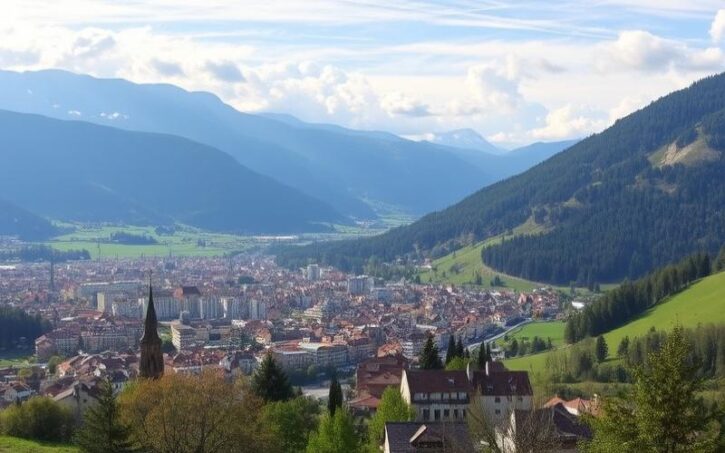
Chambéry: A Strategic Alpine Hub Attracting Residents, Students, and Tourists
Chambéry (73000), the prefecture of Savoie, has approximately 59,000 to 61,000 inhabitants and nearly 120,000 in the greater urban area. The population is growing (+2 to +3% over five years, depending on the source), a rare trend among mid-sized cities, driven by several simultaneous factors.
Geographic location plays a key role. The city lies at the heart of the Alpine corridor, halfway between Annecy and Grenoble, about 100 km from Lyon, 80 km from Geneva, and close to the Italian border. Two major international airports (Lyon Saint-Exupéry and Geneva) are accessible in under an hour, and the TGV high-speed train connects to Paris in about two hours. The A41 and A43 motorways place Chambéry at the crossroads of several major economic basins.
Chambéry combines a rich cultural heritage (Dukes of Savoy Castle, cathedrals, museums) with omnipresent nature (urban parks, bike paths, proximity to Lake Bourget and Lake Annecy, the Bauges and Chartreuse mountain ranges, and seven ski resorts within an hour). This quality of life attracts a diverse population: tourists, athletes, remote workers, and retirees.
This appeal is complemented by a solid economic fabric: 23,000 businesses in the urban area, nearly 11,000 in the city itself, with well-known industrial and service players (Cafés Folliet, Geodis, Alpina Savoie, Opinel, Ugitech) and competitive clusters in agri-food, electro-intensive industries, mountain development, and renewable energy. The nearby Technolac technology park concentrates innovative SMEs and research centers. The activity rate (nearly 72% among 15‑64 year-olds) is above the national average.
A True University Town: The Engine of Rental Demand
The presence of the University of Savoie Mont Blanc and several grandes écoles (business school, Arts et Métiers ParisTech, Polytech Annecy‑Chambéry, preparatory classes, vocational degrees) ranks Chambéry as the second university city among French mid-sized cities. It is home to about 10,000 to 15,000 students, representing nearly 10% of the population, including a significant share of international students.
Student housing is structured around two main campuses: one in downtown Chambéry and another in Le Bourget‑du‑Lac, located 30 minutes by bus from the center. Students can also live in CROUS university residences, private residences (such as Studélites or ARPEJ), youth workers’ hostels, or various studios and two-bedroom apartments in the private sector.
However, public supply is very limited: around 1,059 beds in CROUS residences across all campuses, while over 13,000 students seek housing away from their family home each year. The result: a structurally much higher student demand than supply. Studios and one-bedroom units are the most sought-after, followed by two-bedroom apartments for couples or co-living for two. About 20% of students turn to co-living, a rising figure, mainly for budgetary and comfort reasons.
This persistent pressure on student demand secures occupancy and supports rents, especially for well-located, renovated small units (city center, immediate proximity to campuses or major bus lines).
A Real Estate Market in Full Rebound: Strong Growth, Yet Still Competitive
After a period of relative stagnation, the Chambéry real estate market has experienced a true boom in recent years. Driven by diverted demand from more expensive cities (Lyon, Annecy, Geneva, Paris), the rise of remote work, and the appeal of “green” mid-sized cities, prices have soared.
In 2024, the average price is around €3,600/m² for all property types, ranging from about €2,050 to €5,854/m² depending on the address. By late 2025, the median is around €3,889/m², up approximately 36% over five years. Between 2020 and 2025, some sources even mention a median increase of over 50%.
Median price per square meter for apartments in Paris in 2025, including both old and new.
The table below summarizes some recent price benchmarks.
| Indicator (2025) | Approximate Value |
|---|---|
| Median price all property types | €3,889/m² |
| Average price apartments (old + new) | €3,200–3,400/m² |
| Average price houses | €3,900–4,000/m² |
| Low range (city) | ~€2,050–2,700/m² |
| High range (city) | ~€4,900–5,800/m² |
| Median increase over 5 years | +36% approx. |
This increase has not come at the expense of relative affordability: a two-bedroom apartment around €140,000 in Chambéry compares, in terms of rent, to a similar property easily worth €200,000 in Lyon. Typical investment budgets of €80,000 to €160,000 allow the purchase of a studio to renovate, a one-bedroom plus, or a two-bedroom in attractive areas, which remains competitive compared to Annecy, Aix‑les‑Bains, or Geneva.
Old vs. New: A Price Gap and a Fee Gap
The market remains heavily oriented towards older properties, considered “safe bets” in the city center. Median prices in 2025 for older properties are around €2,929/m², compared to €4,109/m² for new builds. This differential reflects both the superior energy quality of recent projects (RE2020 standards), their warranties (10-year, perfect completion), and their often prime locations in major development zones (Vetrotex, Cassine, etc.).
Buying a new-build property offers a significant advantage on notary fees, which amount to about 2–3% of the price, compared to 7–8% for an older property. For example, for a 70 m² three-bedroom at €254,350, fees are around €5,200 for new builds versus €18,000 for older ones.
In a context of historically increased interest rates, these fee savings and energy performance can be significant for an investor, even if the entry price per square meter is higher.
An Extremely Tight Rental Market: Near-Zero Vacancy
Perhaps the most striking feature of the Chambéry market for investors is the rental pressure. Nearly 58 to 60% of households are tenants of their primary residence, and the vacancy rate is around 0.7%, an exceptionally low level.
Observed average rents are between €13 and €14/m² per month for the entire stock, around €13/m² for apartments and €15/m² for houses. Studios stand out clearly, with an average rent close to €17.5/m², compared to €12.6/m² for two-bedrooms and around €10.6/m² for large apartments.
Price ranges observed in recent listings for different types of housing.
Typically rents for €450 to €650 depending on location and condition.
Rent is around €550 to €600 per month.
In good condition, monthly rent is about €1,180 to €1,200.
The following table summarizes order of magnitude for rents.
| Property Type | Indicative Average Rent |
|---|---|
| Studio / One-Bedroom (≈ 20 m²) | €450–650/month |
| Two-Bedroom (40–50 m²) | €550–700/month |
| Three-Bedroom (60–75 m²) | €900–1,200/month |
| Room in Co-Living | ≈ €400/month |
| Room in Private Residence | ≈ €300/month |
This scarcity of supply is fueled by several factors: population growth, high proportion of working households (nearly 60% of the population), weight of students (about 10% of residents), influx of new arrivals (remote workers, retirees, families leaving major cities), and tourism dynamism (proximity to ski resorts, tourists in summer and winter).
For a landlord, this configuration means in practice very limited vacancies, provided the property is well positioned (location, quality, market price).
Rental Yields in Chambéry: An Interesting Compromise Between Cash Flow and Capital Appreciation
Various data sets converge towards an average gross yield around 4.3 to 5% for Chambéry, with contrasting situations depending on property type, neighborhood, and strategy (furnished, co-living, seasonal).
“Historical” analyses based on 2018 prices show particularly high gross yields for small units:
| Property Type (apartments, 2018 basis) | Estimated Gross Yield |
|---|---|
| Studio | 7.68% |
| 2-room | 5.79% |
| 3-room | 6.14% |
| 4-room | 5.10% |
| 5-room | 6.84% |
For houses, gross yields were slightly more modest:
| Property Type (houses, 2018 basis) | Estimated Gross Yield |
|---|---|
| 3-room | 5.35% |
| 4-room | 4.64% |
| 5-room | 3.95% |
Since then, rising prices have mechanically compressed yields, but well-positioned investors can still often achieve a 5–6% gross range on small, renovated, and furnished housing (or even more via co-living or short-term rentals), while the national average is around 4.8–5%.
A local framework considers that in Chambéry a “good” investment corresponds to:
– a gross yield ≥ 5%
– a net yield (after operating costs) ≥ 3.5%
– a net-net yield (after tax) ≥ 2.5%
Cross-referencing median rent per square meter and purchase prices, a well-bought and furnished older studio still fairly often exceeds these thresholds, especially if taxation is optimized under the real LMNP regime. Conversely, a large family house in a sought-after residential area will offer high potential capital appreciation rather than large short-term cash flow.
Real Estate Profitability Analysis
Net Income Simulation for Typical Unit Sizes
Calculations for 2025, incorporating costs and taxation for a taxpayer at a 30% marginal tax rate and 17.2% social charges, provide order-of-magnitude annual net incomes for three typical properties (after costs, then after taxes):
| Property Type (furnished, 2025 basis) | Size | Annual Net Income After Costs | Annual Net Income After Taxes |
|---|---|---|---|
| Studio | 25 m² | ≈ €1,808 | ≈ €955 |
| Two-Bedroom | 50 m² | ≈ €3,616 | ≈ €1,909 |
| Three-Bedroom | 70 m² | ≈ €5,062 | ≈ €2,673 |
These amounts are obviously indicative (purchase price, financing, actual taxation, rental type, and chosen regime can change everything), but they illustrate that a well-bought, well-rented, and well-tax-optimized property in Chambéry generates a non-negligible net flow, while retaining significant appreciation potential.
Where to Invest in Chambéry: A Detailed Look at Neighborhoods and Prices
One of Chambéry’s assets for an investor is the diversity of its neighborhoods, with very different positioning in terms of price, target audience, appreciation potential, and yield. The city is roughly divided into six main sectors (Center, Biollay, Bissy, Chambéry‑le‑Vieux, Laurier, Hauts‑de‑Chambéry), plus micro-neighborhoods like La Cassine.
City Center: The Vibrant Heart, Expensive but Safe
The historic city center concentrates shopping streets, cultural venues, a large part of the campuses, and the train station. It mainly features older buildings, sometimes without parking, but with strong heritage value.
Prices often exceed €4,000/m² for the best locations (most sought-after streets, historic squares), with a median around €3,500–3,700/m² depending on sources. Rental demand is very strong, especially for:
– Studios and one-bedroom plus units for students, young professionals, interns,
– Renovated two and three-bedroom apartments for couples and executives.
The average gross yield is around 4.5%, but can rise above 5% by targeting small units to optimize (renovation, switching to furnished, two-bedroom co-living).
Bissy and Chambéry‑le‑Vieux: Sought-After Residential Areas
Bissy, long perceived as peripheral, is now a neighborhood in full transformation, well connected by road, popular with families, with a supply of recent apartments and some houses. Prices are slightly lower than the hyper-center, averaging around €3,500–3,750/m², but some high-quality pockets reach over €4,000/m².
A triplex or a three-bedroom townhouse can rent for around €1,100 per month in Chambéry-le-Vieux.
These sectors are typically targeted by investors seeking a yield/longevity compromise: more frequent parking, larger spaces, stable clientele (families, retirees), appreciation potential linked to the scarcity of houses.
Biollay, Hauts‑de‑Chambéry, Laurier: “Value” Opportunities
Biollay was historically an industrial district; it is now undergoing vast redevelopment and urbanization. Prices remain contained, around €3,300–3,500/m² on average for apartments, but some sub-sectors are rising sharply (up to over €5,000/m² in areas closest to the center). It is an interesting pool for those looking to buy below the city’s median price with catch-up potential.
This sector, with varied landscapes mixing large housing complexes and single-family homes, has prices around €3,000–3,200/m². Rental yields are slightly lower than in the city center, but the area attracts a significant family clientele. Its attractiveness is reinforced in the medium term by major urban renovation programs, including a new school, public space rehabilitation, and a biomass heating plant.
The Laurier‑Les Charmettes and Laurier‑Mérande neighborhoods, well-served, green, and equipped with schools and retirement homes, are popular with families and seniors. Prices there are close to the city’s high average, around €3,500/m² for apartments, more for houses. For investment, one would aim more for stability and long-term appreciation than for maximum gross yield.
La Cassine and Vetrotex: Betting on New Green Neighborhoods
Two major urban projects deserve special attention: the La Cassine district, at the junction of the train station, motorway, and cliffs, and the Vetrotex eco-district, on a former industrial site north of the city.
The La Cassine district is evolving from a transit zone into a mixed-use eco-district focused on soft mobility and the train station. A recent €13M program delivered 26 social housing units and a social residence with 127 units. Other projects will follow, with high environmental performance architecture, making this neighborhood a promising urban showcase in terms of capital appreciation.
Vetrotex, to the north, follows a similar logic on a former industrial site, with the creation of a park (Blainville), pedestrian walkways, shared gardens, hundreds of trees, and residential and commercial buildings delivered gradually. The first lots of housing and offices are expected from 2026‑2027. Again, these are typically neighborhoods where the per-square-meter price for new builds is high, but where heritage value and energy performance can attract long-term oriented investors, notably through the Pinel scheme or furnished rentals.
Winning Investment Strategies in Chambéry
With this landscape outlined, the key question becomes: how to invest intelligently in this city? Several approaches stand out, depending on the investor’s profile, risk appetite, and time horizon.
Furnished Studio or Two-Bedroom Near Campuses: The Profitable “Classic”
With about 10% of the population being students, a significant portion of whom cannot find a place in CROUS residences, studios and one-bedroom/one-bedroom plus units in the hyper-center or near university hubs are a cornerstone of rental investment in Chambéry.
In older stock, a studio to renovate can still be found for around €80,000. A one-bedroom plus, around €100,000, and a two-bedroom between €120,000 and €140,000. By renovating properly (modern kitchen and bathroom, optimized storage, good light) and then renting it furnished, one can:
– Increase the rent by 15 to 25% compared to unfurnished,
– Benefit from the LMNP (Non-Professional Furnished Landlord) status, very advantageous tax-wise (real regime: property depreciation, deduction of expenses),
– Target gross yields around 5.5–6.5%, or even more on a good deal.
Gross yields for studios in 2018 were close to 7.7%, a segment that remains strong due to rental pressure and the appeal of furnished rentals.
Co-Living: Optimizing Large Apartments
Co-living addresses both the budgetary constraints of students and young professionals and the lack of quality housing at reasonable prices. In Chambéry, a large four-bedroom rented to a family for around €900/month can, if rented by the room to 3 or 4 co-tenants, generate €1,200/month or more, an income increase of 20 to 40%.
Given the demographic profile (young and active population, many students, employees from nearby job centers), demand for co-living rooms around €400/month is strong, especially near transportation and amenities.
In practice, this strategy involves:
– Buying a three or four-bedroom apartment in a well-served neighborhood (Center, Laurier, Bissy, Biollay under redevelopment),
– Reconfiguring the property (creating a third bedroom, sharing a large living space),
– Focusing on amenities (fully furnished, high-speed internet, pleasant common areas).
The real LMNP (Non-Professional Furnished Landlord) regime allows for a significant reduction in tax on rental income for several years through property depreciation, while benefiting from the potential capital appreciation of a growing real estate market.
Seasonal and Short-Term Rentals: Leveraging Alpine Tourism
Between art and history, proximity to mountains, lakes, and ski resorts, Chambéry benefits from solid tourist traffic, in a country that welcomes 90 to 100 million tourists per year. Short-term rentals like Airbnb or Booking are therefore an additional string to the investor’s bow, notably:
– In the hyper-center, for city-break/business clientele,
– On the outskirts near access routes to resorts, for ski or hiking stays.
Occupancy rates for short-term rentals average around 60% annually in Chambéry, with marked peaks during school holidays and winter weekends. Specialized companies like GuestReady or local concierge services (YourHostHelper, for example) offer turnkey management (calendar optimization, cleaning, check-in, platform management).
This strategy can generate gross yields significantly higher than traditional rentals, but it involves:
Short-term rental presents specific challenges, including higher management costs and greater revenue volatility. Furthermore, it is imperative to closely monitor regulatory developments, which may impose quotas, mandatory registration, or limits on the number of nights, especially in tourist cities. While Chambéry is not yet subject to constraints as strict as Paris or Chamonix, this regulatory vigilance remains necessary.
Investing in New Builds: Energy Performance and Pinel Tax Benefits
New developments in Chambéry are mainly concentrated in transforming neighborhoods (Vetrotex, Cassine, North-Center sectors…) and target high exit prices: studios around €130,000–205,000, two-bedrooms at €200,000–310,000, three-bedrooms at €290,000–400,000, large four/five-bedrooms up to €600,000.
The interest for an investor lies in several points:
– Reduced notary fees (≈ 2–3%),
– Controlled condo fees initially,
– Excellent Energy Performance Certificate (DPE) (A or B), crucial with the Climate & Resilience Law which progressively bans renting energy-inefficient properties (DPE F and G already prohibited, minimum performance thresholds to meet),
– Possibility to use the Pinel scheme for a tax reduction of up to 21% of the price (capped) in exchange for a rental commitment with rent caps,
– Increased attractiveness for tenants sensitive to modern comfort, energy savings, and amenities (elevator, parking, terraces).
This choice appeals more to profiles seeking security, simplified management, and tax reduction, even if it means accepting a more moderate gross yield than on optimized older properties.
Understanding Rental Taxation to Maximize Net Yield
Investing in real estate in Chambéry also requires mastering the main lines of French rental taxation. Two points make a particular difference in net yield: the nature of the rental (unfurnished or furnished) and the chosen tax regime.
Unfurnished Rental: Micro-Property or Real Regime
Income from an unfurnished rental is taxed as property income. Two regimes are possible:
– The micro-property regime, applied automatically if gross annual rents do not exceed €15,000. It grants a flat-rate deduction of 30% for expenses. Simple to manage, but not optimized if one has significant expenses (loan interest, renovation).
– The real regime, mandatory above €15,000 in gross rents, but which can be chosen below this threshold. It allows deduction of actual expenses (interest, renovation, insurance, property tax, management fees, part of condo fees, etc.). It is particularly useful for major renovations (property deficit, deductible from property income, sometimes from overall income under conditions).
Cost per square meter for a major renovation in Chambéry, depending on the scope of work.
Furnished Rental: LMNP, Micro-BIC or Real Regime
Furnished rental is considered a commercial activity and falls under the category of Industrial and Commercial Profits (BIC). Again, two main options:
– The micro-BIC, accessible if annual revenues remain below a certain ceiling (over €70,000 for classic furnished rentals). It applies a flat-rate deduction of 50% (and 71% for certain classified tourist furnished rentals).
– The real BIC regime, optional but often very powerful for investors. It allows deduction of all real expenses (interest, renovation, insurance, costs, management fees) and, crucially, depreciation of the property and furniture, which can neutralize almost all tax for many years.
The LMNP (Non-Professional Furnished Landlord) status is a suitable option for investing in Chambéry, provided revenues remain under certain thresholds and the activity is not professional. Currently, one of the most effective strategies is to acquire a furnished two or three-bedroom and opt for the real LMNP regime, thus benefiting from high student rents and still reasonable purchase prices.
Costs, Taxes, Social Charges: Impact on Yield
Numerous costs must be factored in to move from gross to net: property tax (about €1,500–1,600/year for a standard house in Chambéry), condo fees (sometimes €20 to €100/m²/year depending on standard), management fees or unpaid rent insurance if using an agency, routine maintenance, provisions for renovation, etc.
On the tax side, France applies a progressive income tax (marginal rates from 11% to 45% depending on bracket) and social charges at 17.2% on property and BIC income, except in special cases. Overall, the net yield of a property grossing 5.5–6% will often turn out to be 3–4% net of costs, then 2.5–3% net-net after tax, for a household taxed at 30%.
This is precisely what makes the choice of status (unfurnished vs. furnished), tax regime, and the quality of renovation work crucial. A poor decision on these points can erase the initial advantage provided by the Chambéry rental pressure.
Acquisition Costs and Financing: What to Include in the Business Plan
Beyond the listed price, purchasing in Chambéry involves a series of additional costs that must be budgeted for.
Notary Fees and Additional Costs
What are commonly called “notary fees” actually mainly consist of taxes collected by the state and local authorities. For an older property, they generally represent 7 to 8% of the sale price, compared to 2 to 3% for a new property. The notary themselves only keeps about 1% of the amount as their fee.
Additionally, there may be:
Average percentage for mortgage or guarantee fees relative to the loan amount.
For an older 70 m² apartment purchased for €254,350, one could thus have around €18,000 in notary fees, plus several thousand euros in financing fees. Conversely, for a new build, notary fees would be more on the order of €5,000 for a property at the same price.
Renovation: A Lever to Handle Precisely
Renovation costs in Chambéry follow national standards:
The minimum price for a simple makeover of a property, including paint, flooring, and some adjustments, is €240 per square meter.
A 70 m² three-bedroom needing a major overhaul could therefore require a €70,000 budget. But these renovations are also a tremendous opportunity to create value: improving the DPE to avoid constraints of energy-inefficient properties, repositioning the rent 10 to 15% higher, tax deductibility (property deficit or depreciation under LMNP).
In a market where prices have already risen significantly, the best deals are often found on properties to be intelligently renovated rather than on “turnkey” products.
Property Management: DIY or Delegate to Local Professionals
The network of real estate agencies and property managers in Chambéry is dense: major national networks (Orpi, Laforêt, Century 21, Guy Hoquet, etc.), local groups (Groupe RD Immo, Cristal Habitat on the social side), agencies specialized in management or short-term concierge services.
Delegating management allows you to save time and secure operations (rigor in tenant selection, rent collection, incident management). In return, you must account for:
Percentage of the rent including charges charged for classic annual property management.
A good compromise for an investor who wants to keep control over strategy but not over day-to-day tasks is to manage property search and renovation directly, then hire an agency for tenant placement and ongoing management, benefiting from potential savings of partial self-management (up to 7–10% gain in gross yield).
Risks and Common Mistakes to Avoid
As in any high-pressure city, the prospect of yield can lead to a loss of caution. Several pitfalls need to be watched in an investment project in Chambéry.
Underestimating real costs (taxes, renovation, condo fees) is a common mistake. Costs can represent 15 to 25% of collected rent. It is crucial to include them in simulations, as well as the impact of future energy standards compliance.
Buying too high in anticipation of perpetual price increases is risky, especially in saturated neighborhoods. Despite recent increases of +5 to +18%, this trend is not guaranteed. It is wiser to prioritize properties with a price per square meter below the neighborhood median and which have a good DPE or strong renovation potential.
Neglecting energy quality (DPE) is now a deal-breaker: the Climate & Resilience Law already prohibits renting properties classified F or G, and the minimum performance threshold will tighten. Buying an energy-inefficient property without a substantial renovation budget means accepting either an inability to rent or a difficult resale. Conversely, a property rated D or better secures operations and value.
Finally, ignoring taxation (choosing the wrong regime, lack of LMNP optimization, unfamiliarity with schemes like Pinel or property deficit) can significantly reduce net profitability. Getting occasional support from an accountant or wealth management advisor to calibrate the setup is often a good investment.
Chambéry in Its Regional Environment: An Intelligent Compromise
On the scale of the Auvergne‑Rhône‑Alpes region, Chambéry positions itself as a balanced alternative between:
– Very expensive cities with high appreciation like Lyon, Annecy, Geneva, Aix‑les‑Bains,
– Markets with spectacular yields but higher risk like Saint‑Étienne (where gross yields close to 10% are possible, but with more fragile demand).
In surrounding highly touristy resorts and communes (Tignes, Val‑d’Isère, Valloire, La Plagne, Les Belleville, etc.), announced yields range between 4 and 7% gross, but with high prices per m², strong seasonality, and heavier regulatory constraints on short-term rentals.
The city offers a good balance for the investor: prices still reasonable compared to quality of life, an ultra-tight rental market ensuring steady yield, positive urban and demographic dynamics favoring appreciation, and market liquidity supported by a unique mountain-lakes environment.
—
Ultimately, investing in real estate in Chambéry means betting on a mid-sized city that has become central in the Alpine landscape: well-connected, desirable, student-friendly and tourist-friendly, in full ecological and urban transition. The potential for capital appreciation exists, but it should not overshadow the basic discipline of any good investor: buying at the right price, in the right neighborhood, for the right audience (students, young professionals, families, tourists), with a well-thought-out tax and energy strategy. Within this framework, Chambéry today offers one of the most interesting investment grounds among French mid-sized cities.
Disclaimer: The information provided on this website is for informational purposes only and does not constitute financial, legal, or professional advice. We encourage you to consult qualified experts before making any investment, real estate, or expatriation decisions. Although we strive to maintain up-to-date and accurate information, we do not guarantee the completeness, accuracy, or timeliness of the proposed content. As investment and expatriation involve risks, we disclaim any liability for potential losses or damages arising from the use of this site. Your use of this site confirms your acceptance of these terms and your understanding of the associated risks.

Cyril Jarnias is an independent expert in international wealth management with over 20 years of experience. As an expatriate himself, he is dedicated to helping individuals and business leaders build, protect, and pass on their wealth with complete peace of mind.
On his website, cyriljarnias.com, he shares his expertise on international real estate, offshore company formation, and expatriation.
Thanks to his expertise, he offers sound advice to optimize his clients' wealth management. Cyril Jarnias is also recognized for his appearances in many prestigious media outlets such as BFM Business, les Français de l’étranger, Le Figaro, Les Echos, and Mieux vivre votre argent, where he shares his knowledge and know-how in wealth management.





