
 Published on and written by Cyril Jarnias
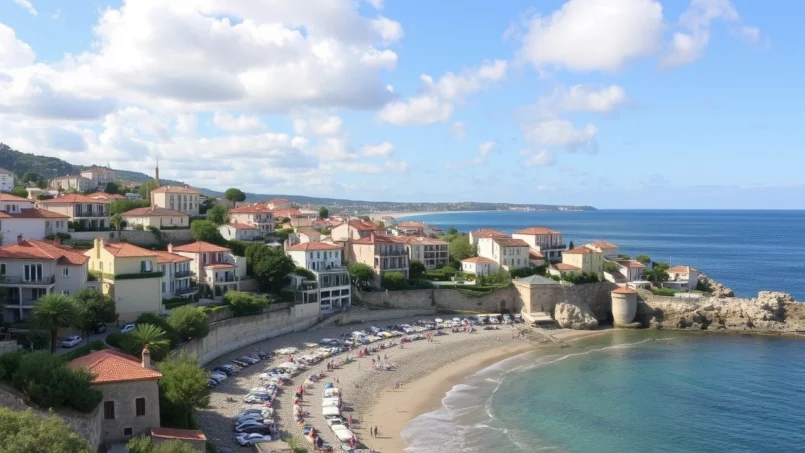
Situated facing the Toulon roadstead, in the heart of the French Riviera, La Seyne-sur-Mer long lived to the rhythm of its shipyards. Today, the city has largely reinvented itself around tourism, services, and maritime technologies. For a real estate investor, this economic shift, combined with prices still below the rest of the Var coast, creates a rare window of opportunity on the Mediterranean.
The La Seyne-sur-Mer real estate market shows potential with strong rental demand and major urban projects, in a context of a tight market. However, the city is a mix: some areas are very promising while others are to be avoided. A successful investment requires precise knowledge of neighborhood geography, price levels, realistic rental yields, and the specific risks of this coastal city.
A Riviera Market Still Affordable and in High Demand
La Seyne-sur-Mer is the second-largest city in the Var after Toulon, with just over 62,000 inhabitants and a density of over 2,800 inhabitants per km². Nearly half of households (about 45%) are renters, ensuring a solid base of structural rental demand. The income level remains decent, with an average income per capita around €21,400 and a median household income of over €25,000.
In terms of real estate, the city stands out for having a deep and dynamic market, where the number of buyers exceeds the number of available properties by 8%. Prices have risen sharply in recent years, while remaining lower than those in neighboring towns like Sanary-sur-Mer, Bandol, or Six-Fours-les-Plages.
Prices: An Attractive Quality/Price Ratio for the Côte d’Azur
Multiple sources converge on an average price that, depending on databases and periods, ranges between €3,400 and €3,900/m² for all properties. Apartments average around €3,100–€3,400/m² while houses typically trade between €4,200 and €4,700/m². The city is approximately 16% below the average for the Var department.
A summary of the approximate figures helps position La Seyne-sur-Mer within its environment:
| Indicator | La Seyne-sur-Mer | Var (average) | Six-Fours-les-Plages | Sanary-sur-Mer | Bandol |
|---|---|---|---|---|---|
| Overall avg. price per m² | ≈ €3,700–3,900 | ≈ €4,300 | ≈ €5,200–5,500 | ≈ €6,400–6,900 | ≈ €6,700–7,400 |
| Avg. apt. price per m² | ≈ €3,100–3,400 | — | ≈ €5,200 | ≈ €6,400 | ≈ €6,700 |
| Avg. house price per m² | ≈ €4,200–4,700 | — | ≈ €5,500 | ≈ €6,800 | ≈ €7,400 |
| Price trend over 5 years | +21% to +36% | — | strong increase | very strong | very strong |
| Price ranking per m² (Var) | ≈ 50th in the department | — | higher | very high | very high |
This relative discount, combined with a premium location (25 km of coastline, renowned beaches, proximity to Toulon and the future tramway), explains the growing interest from investors. At the same time, the city has seen a clear increase in values over 5 years, sometimes exceeding 30%, a sign of a market playing catch-up.
Rents and Yields: A Favorable Price/Rent Ratio
Rents are also on a rising trend. For apartments, the average rent is around €13.5/m², with a range from €9 to €22/m² depending on the neighborhood, condition, and size. Houses rent for an average of around €16.6/m².
Some practical benchmarks, very useful for building a quantified investment plan.
| Property Type | Indicative Avg. Rent* | Approx. Avg. Purchase Price | Observed Gross Yield |
|---|---|---|---|
| Studio | ≈ €590/month | ≈ €96,000 | ≈ 5.6–5.7% |
| 2-bedroom | €415–€830/month (median ≈ €580–735) | ≈ €123,000–140,000 | ≈ 5.6% |
| 3-bedroom | ≈ €900–1,050/month | ≈ €165,000–190,000 | ≈ 5.6% |
| 4-bedroom apt. | ≈ €900–1,150/month | ≈ €170,000–190,000 | ≈ 5.6% |
| 4/5-bed family house | €1,000–1,300/month | > €300,000 | 3–5% depending on area |
excluding charges, estimates from aggregated data.
On average, the gross profitability is around 4.9–5.8% according to sources. This is significantly higher than the Côte d’Azur average (around 3.3% gross yield) and competitive compared to other cities in the South of France. Smaller units (studios, 2-bedroom apartments) show the best rates, aligning with the strong demand from young professionals, students, and mobile workers attracted by the Toulon employment basin and the future marine technopole.
A City in Transformation: Urban Projects and Infrastructure
To judge the longevity of an investment, it is crucial to look beyond price and rental figures. In La Seyne-sur-Mer, several major projects are already reshaping the city’s face and will directly impact mid-term valuation.
The former industrial landscape of the shipyards is giving way to marinas, residences, soft mobility corridors, and cultural or scientific facilities. This shift is particularly visible along the waterfront, the corniche, and the Parc de la Navale.
Port Redevelopment and New Facilities
The seafront is the subject of a vast renovation program, with an investment of about €45 million to transform the port and its surroundings. The goal: to transition from a purely industrial facility to a mixed-use waterfront blending boating, housing, commerce, and quality public spaces.
Millions of euros committed to creating a new marina at Espace Grimaud.
These projects, along with the renovation of the Lazaret and Manteau ports and the redevelopment around Fort Balaguier, signal an upgrade of the coastal front. For an investor, buying today within the immediate perimeter of these transformations is betting on a potential revaluation of around 15 to 20% within a few years, according to estimates linked to the port overhaul.
Toulon–La Seyne Tramway and Soft Mobility
Another major catalyst: the future tramway connecting Toulon to La Seyne-sur-Mer, planned to serve areas like Berthe and Mar Vivo. Zones directly served are expected winners, with a projected price increase potentially reaching an average of +25% in the long term along the route.
The city already benefits from a bus network, boat-buses, an SNCF train station, and the A50 highway. The arrival of the tramway and work on the corniches further improve this accessibility, while enhancing coastal neighborhoods through the creation of secure pedestrian and cycle paths.
Marine Technopole and Economic Appeal
The local economy is reorganizing around centers of excellence related to the sea: oceanographic research, naval innovation, marine energy, port logistics. The Brégaillon port and the Pôle Mer Méditerranée cluster, associated with players like Ifremer, attract engineers, managers, and technicians.
Around this marine technopole, renovated 3/4-bedroom apartments located within 2 km already rent for about 15% above the town’s average. For an investor targeting a clientele of managers or engineers, this is a high-value-added segment, especially if the property offers good energy performance and contemporary standards.
High-Potential Neighborhoods: From the Seafront to Sought-After Residential Areas
La Seyne-sur-Mer is a mosaic of micro-markets. For an investor, the key is to identify the zones where the combination of yield/future appreciation is most interesting, balancing risk, budget, and strategy (long-term, furnished, seasonal, co-living…).
Les Sablettes: The Profitable “Seafront” Card
Les Sablettes is undoubtedly the emblem of La Seyne’s metamorphosis. This seaside area boasts 2 kilometers of sandy beach, a lively promenade (Charcot), a landscaped park (Fernand Braudel), a commercial front, and direct maritime service to Toulon (boat-bus in about fifteen minutes).
Prices here are among the highest in the city, generally ranging between €3,800 and €5,200/m², with higher peaks for frontline properties or those with sea views. A 65 m² 3-bedroom apartment needing renovation trades around €250,000. Including a renovation budget of about €60,000 for a quality renovation, resale could reach €380,000, representing a potential capital gain close to €70,000 after a few years if the market maintains its upward trend.
For rental, the combination of primary residence + seasonal rental is particularly profitable. In high season, a well-located 2-bedroom apartment easily rents for around €1,200 per week. For yearly rentals, average yields are around 5.8% gross, and can rise to 7.2% by mixing a classic lease for 8–9 months with short-term summer rentals.
The advantages are clear: immediate proximity to the beach, constantly developing commerce, planned green spaces and promenades, easy access to Toulon. However, there are drawbacks: summer overcrowding, seasonal noise nuisance, parking pressure.
For an investor, an effective strategy involves carrying out contemporary renovations with materials resistant to the marine environment, like aluminum, stainless steel, or suitable tiling. The renovation budget is generally around €1,000 per square meter. Carefully designing terraces and balconies can increase the property’s resale value by about 15%, fully justifying this investment.
Tamaris and Balaguier: High-End Residential and Potential Capital Gains
On the peninsula leading to Saint-Mandrier, Tamaris and Balaguier offer a privileged residential setting, with plunging views over the Toulon roadstead, discreet small coves, and beautiful vacation architecture. Historically, Tamaris was conceived in the 19th century by Michel Pacha as a chic seaside resort. Today, one can still find Belle Époque villas, the Michel Pacha Institute, the Tamaris villa transformed into a contemporary art center, and Fort Balaguier, now a museum.
Prices, although more moderate than in the “bling-bling” resorts of the Côte d’Azur, remain solid: generally between €3,500 and €4,500/m² for properties with partial sea views, more for dominant positions. A 1970s villa of 120 m² on a 500 m² plot can be found around €450,000. With a major modernization and energy renovation budgeted at €80,000, the value can climb to €650,000 according to local estimates.
The seasonal rental market is booming here. A renovated villa with a pool can generate around €35,000 in annual rents, equating to a net yield near 5.2% after expenses and management, with prospects of 5.2% to 6.5% depending on positioning and occupancy rate.
Capital gain projections over 3 years place these areas around +15%. This is compounded by the future renovation of the Tamaris corniche (a budget of over €39 million voted by the metropolitan authority), which plans for more soft mobility, heritage enhancement, and new leisure spaces. Everything indicates a gradual shift towards even higher standards.
Real Estate Market Analysis
Here, the optimal strategy often involves targeting a high-end product: designer fitted kitchen, reversible air conditioning, large open-plan living areas, Italian-style shower bathrooms. Renovation budgets then rise to around €1,500/m², but seasonal rents follow.
Developing Residential Neighborhoods: Berthe, Touffany, Mar Vivo, La Verne
For more contained budgets, while retaining capital gain potential, several peripheral neighborhoods merit close analysis.
Berthe and Touffany show very attractive acquisition prices, often between €2,000 and €2,800/m². For example, a 90 m² house with a garden can be purchased around €220,000. With €50,000 in work focused on energy renovation and interior modernization, the possible resale around €320,000 offers a good value margin. Projected rental yields are around 6.5–7% gross, and the potential for price appreciation is estimated at about +10% over 3 years.
These areas benefit from proximity to major roads (A50 within 5 minutes), improved transportation (new express bus line to Toulon, tram project), and a progressive upgrade of commerce and public facilities.
Caution, however: Berthe is classified as a “priority security zone,” with a high concentration of social housing, security issues, deterioration, and sometimes a negative perception. It is the subject of a massive urban renewal program for the 2024–2030 period. For an informed, yield-oriented investor, these zones can represent an opportunity, provided they factor in higher rental risk and carefully select micro-sectors and condominiums.
Located to the south, this booming neighborhood combines proximity to the sea, new real estate developments, and a future tramway connection, promising strong long-term appreciation.
Unique combination of immediate beach proximity with the upcoming arrival of a major tramway link.
Area energized by new construction projects, promising a renewal and modernization of the supply.
Once infrastructure work is complete, the beach + transport combination should drive real estate prices upward.
The current boom comes with construction sites causing disturbances, a situation expected to disappear after the work.
La Verne and Saint-Jean also benefit from redevelopment programs or new residential complexes. They can constitute good compromises for investors seeking a mix between price accessibility, sustainable rental demand, and revaluation potential.
Historic Downtown: Small Budget, Major Renovations, High Yields
The old town center of La Seyne-sur-Mer, with its picturesque alleys and pre-1950 buildings, represents a classic playground for investors seeking properties requiring heavy renovation. One can find apartments needing deep renovation for between €2,200 and €3,000/m², well below the city average (up to –21% according to some benchmarks).
Concrete examples show operations with high leverage. A 180 m² building can be acquired for around €400,000, then subdivided and renovated with a works budget close to €150,000. By reselling in lots or renting out the units, the gross yield can climb to around 8.5%.
Another typical case: a 25 m² studio, purchased for approximately €85,000 all-in after renovation, rents easily for €550/month, equating to nearly 7.8% gross yield. Demand is real, notably from young professionals working in Toulon and benefiting from maritime and road links.
This flattering picture, however, hides risks: deteriorated condominiums with high fees (sometimes €300/month for a 2-bedroom), old structures that can reveal surprises (roofs, floors, façades), lack of parking, and noise nuisance. In this sector, a structural study before purchase and an in-depth review of common areas are essential. Full renovations rarely start below €1,200/m² for a serious refurbishment.
Areas to Avoid or Approach with Great Caution
The other side of La Seyne-sur-Mer, less visible on postcards, includes several areas with insecurity, degraded buildings, struggling commerce, and natural risks.
Seyne Ouest, for example, combines high insecurity, aging housing, very few local shops, and risks of flooding and mudslides. The Toulon neighborhood (within the commune of La Seyne) suffers from a lack of green spaces, noise pollution, and a deficit of basic services. Sakakini is noted for its relative isolation, insufficient building maintenance, and a feeling of insecurity in the evening, associated with a significant concentration of social housing.
The former industrial zones in the east present risks of soil pollution, a lack of activity outside office hours, and an infrastructure deficit. The Parc de la Navale, although undergoing urban renewal, still suffers from nuisances (pollution, noise) linked to its industrial past and ongoing construction sites.
In these areas, the discount may seem attractive on paper, but rental risks (non-payment, vacancy, damage) and resale liquidity are significantly more problematic. For a first investment or a cautious profile, it is better to focus research on more balanced neighborhoods already engaged in a positive dynamic.
Traditional Rental Market: Strong Tension and Varied Profiles
With a tenant rate of about 45% and an average length of stay of nearly 4.7 years for renting households, La Seyne-sur-Mer offers an interesting base for long-term rental investment.
The stock of primary residences consists mainly of apartments (about two-thirds) with a predominance of 3 and 4-bedroom units. This structure reflects a significant family clientele, supplemented by students, young professionals, and seniors attracted by the climate and the sea.
Yields by Property Type: Where is the Best Compromise?
Data from 2018 transactions, cross-referenced with rents, provides a very useful grid for calibrating strategy:
| Type | Avg. Price (2018) | Avg. Monthly Rent | Estimated Gross Yield |
|---|---|---|---|
| Studio apt. | ≈ €96,000 | ≈ €455 | ≈ 5.67% |
| 2-bed apt. | ≈ €123,000 | ≈ €580 | ≈ 5.65% |
| 3-bed apt. | ≈ €165,000 | ≈ €770 | ≈ 5.60% |
| 4-bed apt. | ≈ €190,000 | ≈ €895 | ≈ 5.64% |
| 5-bed apt. | ≈ €203,000 | ≈ €950 | ≈ 5.61% |
| 3-bed house | ≈ €273,000 | ≈ €790 | ≈ 3.48% |
| 4-bed house | ≈ €339,000 | ≈ €900 | ≈ 3.18% |
| 5-bed house | ≈ €307,000 | ≈ €1,305 | ≈ 5.10% |
It is clear that apartments on average offer a gross yield close to 5.6%, almost homogeneous from small to large units. Houses, more expensive to purchase, show a more heterogeneous yield, sometimes modest for 3-4 bedroom units, more interesting for some larger units.
To generate cash flow or optimize yield, prioritize well-located studios and 2-bedroom apartments. For a patrimonial strategy focused on rental stability and future resale to residents, 3/4-bedroom units are more suitable.
Rental Strategies: Unfurnished, Furnished, Co-Living
In La Seyne-sur-Mer, two models dominate.
Unfurnished rental, very suitable for families, couples, and retirees, offers simplified management, more stable tenants, and the possibility to use either the micro-land regime (30% allowance) or the property deficit system in case of major works (interesting for reducing taxable income).
Furnished rental (LMNP) benefits from strong demand, notably from students and mobile workers around the technopole and Toulon. It allows for increasing rents by 10 to 20%, provides accounting depreciation for the property and furniture, and can neutralize tax on rental income for about 10 years. It requires an initial investment of €2,500 to €5,000 to furnish a small dwelling and annual accounting support of about €400 to €600.
Co-living can also make sense in certain well-served neighborhoods, close to transport and amenities, particularly for larger units (4-bed, 5-bed). It allows to increase income per m², provided management is mastered (turnover, inventories, shared charges).
The Seasonal Rental Ace: One of the Most Dynamic Airbnb Markets on the Coast
La Seyne-sur-Mer is not only a city of permanent residents. It is also a heavily frequented tourist resort, benefiting from the top spot in the Var in terms of tourist accommodation capacity, behind the Île-de-France in the national ranking. This tourist dimension has exploded the short-term rental market.
Between 2019 and 2022, prices for seasonal rentals jumped by 65%, according to a survey cited by Le Monde. Today, the commune is one of the most searched-for for Airbnb-type rentals on the Var coast.
Airbnb: Key Figures to Calibrate a Strategy
Recent data shows a particularly active market:
| Indicator (Airbnb and similar) | Approximate Value |
|---|---|
| Active Airbnb listings alone | ≈ 1,074 |
| Total rental listings (all platforms) | ≈ 1,900 |
| Average occupancy rate | ≈ 57% (≈ 209 nights/year) |
| Average daily rate | ≈ €99 |
| Average annual revenue per listing | ≈ €19,300 |
| Share of entire homes/apartments rented | ≈ 96% |
The best listings (top 10%) achieve occupancy rates above 80% and annual revenues sometimes exceeding €20,000, with daily rates around €130 or more. Demand is particularly strong in July and September, but the season stretches over several months thanks to the mild climate and cultural events.
This is the percentage of rental listings that are for one-bedroom apartments, the most profitable for a mixed rental investment.
Regulation: A Framework to Monitor, But Still Relatively Flexible
La Seyne-sur-Mer is located in a tight and very touristy zone, which opens the door to certain measures (rent caps, reduced notice periods, solidary long-term leases) but also requires compliance with rules governing furnished tourist rentals.
Owners must obtain a registration number and display it on their listings, comply with condominium rules and the local urban plan (PLU), collect the tourist tax, and adhere to specific safety standards (smoke detectors, appropriate insurance). However, the compliance rate is low, indicating a regulatory framework less strict than in major cities or very popular resorts.
For an investor, it is wise to build a prudent business plan, based on approximately 16 weeks of “full rate” seasonal rental to assess the operation’s viability, even if current data suggests higher occupancy levels.
Local Taxation and Additional Costs: A Parameter Not to Overlook
Local taxes in La Seyne-sur-Mer are in the upper average for a city of this size. The property tax, for example, is based on rates higher than those observed in comparable communes, even though these rates have generally increased less over the past 20 years than in the rest of the country.
The average annual amount of property tax for a standard-sized property, with possible exemptions for new builds and certain renovation works.
Non-resident landlord owners must also factor in French taxation applicable to rental income, capital gains on resale, and, where applicable, the IFI (Wealth Tax on Real Estate) for assets above thresholds, not forgetting the business contributions (CFE) for furnished rentals.
Regarding renovation work, renovation costs fall within a fairly standard range: starting from €240/m² for a simple refresh, €490/m² for a light renovation, €860/m² for a full refurbishment, and up to €1,200/m² for heavy rehabilitation. In a coastal context, it is prudent to add about 20% to cover contingencies related to humidity, corrosion, and pathologies of old buildings.
New Build Programs and Tax Schemes: The “Comfort” Route for Investment
La Seyne-sur-Mer currently concentrates several new build programs allowing investment in off-plan sales (VEFA), often eligible for the Pinel scheme (the commune is in Zone A), or for reduced VAT in certain perimeters.
Among emblematic operations, one can cite La Presqu’île on the Seynoise corniche, co-promoted by Constructa and VINCI Immobilier, or residences like Le Newport and L’Escapade Bleue which offer 2 to 5-room apartments starting from €149,000–€180,000. Other programs, like VILLA BAY or Sanha, clearly target an investor clientele, with 2/3/4-bedroom units at prices still contained compared to neighboring coastal communes.
Investment in new builds offers major advantages: limited need for renovation, better energy performance, strong rental appeal, and 10-year guarantees. Tax-wise, the Pinel scheme allows for a reduction in income tax in return for a commitment to rent (6, 9, or 12 years), with capped rents often still adapted to the local market. In certain neighborhoods, applying the reduced VAT at 5.5% can significantly improve the project’s profitability.
The gross yields of new build programs are generally slightly lower than for old properties requiring renovation, but the visibility on charges, legal security, and management comfort will appeal to more cautious investors, or those who do not wish to undertake complex construction projects.
Specific Risks and Best Practices to Secure Your Investment
Like any rapidly evolving market, La Seyne-sur-Mer is not without risks. In addition to localized social issues in certain neighborhoods, investors must deal with the specific constraints of the Mediterranean coast.
Exposure to natural hazards (flooding, mudslides, coastal risks) must be examined using the Géorisques website. The marine environment increases maintenance costs (corrosion, salt, humidity), justifying the need to allocate more generous renovation budgets and choose suitable materials.
Deteriorated condominiums, especially in old town centers or certain complexes from the 60s–70s, can generate very high fees to fund major works (façade cleaning, roof, elevator, bringing up to code). The risk of encountering a financially troubled condominium is real. It is therefore essential to carefully review the minutes of general meetings, voted work plans, and the level of unpaid fees before any commitment.
Finally, as the market is less liquid than in major cities (even though it remains active), a long holding horizon (10–15 years) is recommended to smooth out cyclical fluctuations and allow appreciation to play its full role, particularly in neighborhoods undergoing urban renewal or close to major projects (tramway, corniches, port).
Professionals recommend visiting at least 15 properties to properly understand the market, comparing with sales from the last 6 months, and attempting a negotiation of 10 to 15% on properties requiring major work. For extension or subdivision projects, it is crucial to check the PLU and condominium rules. For major operations, commissioning a soil study (cost: €2,000 to €3,000) is often very cost-effective to avoid future problems.
Conclusion: Why La Seyne-sur-Mer Deserves a Place in a Real Estate Portfolio
Investing in real estate in La Seyne-sur-Mer is betting on a coastal city in full transformation, still discounted compared to its prestigious neighbors, but catching up quickly thanks to large-scale urban projects, confirmed tourist dynamism, and solid rental demand, both long-term and seasonal.
The market suits several investor profiles. First-time investors with a budget of €100,000 to €200,000 will find opportunities in the historic center or certain up-and-coming neighborhoods for small units to renovate, with yields often exceeding 6%. More capitalized investors can position themselves on villas in Tamaris, Balaguier, or Les Sablettes, targeting an affluent clientele and long-term capital gains, while capitalizing on seasonal potential.
The La Seyne-sur-Mer real estate market is tight, ensuring steady demand, but it presents strong geographic heterogeneity. The value of an investment can vary considerably from one street to another. To succeed, it is essential to meticulously analyze each neighborhood, condominium, and urban project to identify the most promising opportunities.
In a Riviera landscape where yields are eroding and entry prices are skyrocketing, La Seyne-sur-Mer appears as one of the last links still offering an interesting balance between profitability and patrimonial value, provided one enters with method, discernment, and a good knowledge of its real estate playing field.
Disclaimer: The information provided on this website is for informational purposes only and does not constitute financial, legal, or professional advice. We encourage you to consult qualified experts before making any investment, real estate, or expatriation decisions. Although we strive to maintain up-to-date and accurate information, we do not guarantee the completeness, accuracy, or timeliness of the proposed content. As investment and expatriation involve risks, we disclaim any liability for potential losses or damages arising from the use of this site. Your use of this site confirms your acceptance of these terms and your understanding of the associated risks.

Cyril Jarnias is an independent expert in international wealth management with over 20 years of experience. As an expatriate himself, he is dedicated to helping individuals and business leaders build, protect, and pass on their wealth with complete peace of mind.
On his website, cyriljarnias.com, he shares his expertise on international real estate, offshore company formation, and expatriation.
Thanks to his expertise, he offers sound advice to optimize his clients' wealth management. Cyril Jarnias is also recognized for his appearances in many prestigious media outlets such as BFM Business, les Français de l’étranger, Le Figaro, Les Echos, and Mieux vivre votre argent, where he shares his knowledge and know-how in wealth management.





